Deep Dhyana, Self-Realization and Nondual Awakening: How Witnessing Dissolves Inner Imprints

Deep Dhyana as a Window into the Actual Self

It seems to me that during deep dhyana we are able to live, even if only temporarily, in the experience of our full structure of self, together with its actual state of development. This is not merely an idea about ourselves or a mental image of who we think we are. It is experienced in a subtler and more essential form. At other times, worldly distractions occupy our attention so completely that this deeper structure is forgotten. We continue to live, act and think, but we remain largely outside our actual form. In this sense, I have described the dhyana state as a kind of window into our real being, and ordinary life outside that window can feel almost like a state of existential death. This does not mean physical death or that the self ceases to exist. It means that the deeper dimension of oneself, which becomes directly accessible in deep dhyana, becomes functionally absent from ordinary awareness.

Why the Ancient Teaching About the World and the Soul Becomes Clear in Experience

This makes me think that what the ancient sages said about the world being different from the soul, and about worldly life making us blind to the soul, may be pointing to an experience rather than merely presenting a strange metaphysical theory. In theory, such statements can easily be misunderstood. They may sound as though the physical world is unreal or that the soul is some mysterious supernatural object hidden somewhere inside us. In practical experience, however, the distinction can become much clearer. The world does not necessarily destroy or remove the soul. Rather, our attention becomes absorbed in sensory experiences, thoughts, desires, reactions, identities, memories and external objects, and therefore we forget the deeper structure of our own being. Dhyana reverses the direction of attention. When the outward movement becomes sufficiently quiet, what was previously obscured can become directly apparent. Thus the contrast is not simply between a false world and a true soul, but between world-directed consciousness in which the self is forgotten and inwardly gathered consciousness in which the self becomes perceptible.

The Soul as the Complete Intrinsic State of Being

I do not see the soul as something special or as an additional supernatural substance added to a person. By soul I mean one’s own complete state of being as it exists in itself, without something foreign being newly added to it from outside. Yet this does not mean that the self is completely devoid of external influences. The self bears the imprints of everything it has experienced. These experiences, however, are not necessarily present within the self in the same gross and differentiated form in which they were originally encountered. Experientially, they may exist in a subtle, consolidated and relatively undifferentiated form. Therefore, the self is not an untouched thing standing apart from all experience. It is a being in which experience has been assimilated into a deeper structure. We can say self gets colored according to what it has experienced till date. In deep breathless dhyana, it is same eternal self but it is not pure rather it is individualised by experiential imprints.

From Gross Experience to Subtle Imprint

This gives a different meaning to the distinction between self and non-self. A gross experience that has not yet become assimilated into the subtle structure of the self can appear foreign or non-self. It is something occurring to us from outside in its gross, differentiated form. When experience becomes imprinted and assimilated, however, it becomes part of our own subtle experiential structure. It is not like something physical adheres to self as nothing can stick to void, the true nature of self. Yes, its experience gets somewhat distorted and this distorsion is according to the extent and nature of the external experiences. It is like a illusion. Just as, after revolving round and round for some time, the world around may seem to revolve for a while when we stop, though the world itself has remained stationary as before, similarly, after prolonged experience of the external world, our own self may appear different and foreign, though in reality it remains the same pure own form as before. The movement can therefore be understood as gross experience becoming an imprint, the imprint becoming subtly consolidated, and the consolidated impression becoming part of the self. In this sense, what is non-self is not necessarily everything that originates outside the body or mind. Rather, it is what has not yet been assimilated into one’s own deeper structure of being or pure self form. Everything we experience is, in some sense, our own self, because we can never experience anything other than what becomes present within the self. No physical thing can literally be attached to the self as something separate and then experienced as part of it. For the self to experience something fully, it has to take the form of that experience itself. Yet this self has become partitioned through experience. When an experience exists only as a mental pattern or as a gross external impression, it is experienced as non-self or as something foreign. But when that experience becomes deeply imprinted and assimilated as a change in the feeling and structure of the self, it is no longer experienced as something separate; it has become the self itself.

This may also explain why, after moderate drinking, a person can sometimes experience a temporary sense of joy or relief, as though the outer distractions have been reduced and one comes closer to a feeling of oneself. But what becomes accessible is not necessarily the pure self; it is still the self carrying all its accumulated imprints. Alcohol may temporarily weaken the ordinary mental activity through which worldly distinctions and distractions are maintained, making the underlying feeling of self seem clearer. Yet it does not remove the imprints. In fact, after heavy worldly involvement, experiences that might otherwise have gradually dissolved through witnessing can become more deeply impressed or carried forward as further conditioning. Thus the temporary relief may give the impression that the road has become clearer, while the underlying burden has not actually been removed. It may simply have been carried forward to be released later. Witnessing, in contrast, allows impressions to arise and dissolve without adding the same kind of further burden, so that the self can gradually become lighter, clearer and less partitioned. Actually, the mental noise that arises after worldliness is there to dissolve the imprint of that worldliness through witnessing. The imprint of worldliness has already been registered on the Self. This mental noise arises as a process through which that imprint can be dissolved, particularly when it is witnessed without interference. It is as though the fresh imprint is still loosely fixed and can therefore be released through awareness and witnessing.

If this mental noise is forcefully suppressed by will, continuously drowned out by further indulgence in the world as a means of forgetting it, or suppressed through the consumption of some substance, the opportunity for its dissolution is prevented. Instead of allowing the freshly formed, loosely fixed imprint to be erased through witnessing, such actions may reinforce or preserve it. With time, the imprint can become more deeply fixed and therefore much more difficult to remove. Daily yoga helps to shed fresh imprints from self as soon as they are formed easily. By this self gradually become lighter, clearer and less partitioned because, as the burden of accumulated imprints is shed, the darkness created by those imprints gradually diminishes. The self becomes clearer and begins to correspond more closely with the shimmering, undivided character of the external world as it is directly experienced. What had seemed divided between self and world becomes less sharply separated, not because the self becomes something new, but because the accumulated obscurations that made it appear separate are gradually released. Once this process reaches its full extent, the separation between self and the experienced world becomes completely nil. There is no longer a sense of the self standing apart from what is experienced. In that moment, there may be a glimpse of nondual awakening—a direct self-realisation in which the self is experienced without the partition that ordinarily separates it from the world. This is not the creation of a new self, but the recognition of the same self after the accumulated imprints and obscurations that made it appear separate have fallen away. However, the glimpse of awakening may fade after a few moments. The self then seems to regain its previous imprinted structure, although often in a somewhat lighter form. In my understanding, the sudden glimpse occurs through a strong upward movement of kundalini, which temporarily breaks through the accumulated structure and reveals the nondual state. But a glimpse is not the same as complete purification. If the self has been accumulating impressions through countless experiences over an enormously long period, their complete dissolution may require decades of meditation and witnessing. Awakening therefore need not be regarded as the end of the journey. It can instead be understood as a road marker: a brief direct glimpse of the destination that confirms what lies beyond the accumulated structure, while the remaining work is the gradual clearing of the imprints that still obscure it.

Witnessing Dhyana and the Release of Worldly Imprints

This also explains what seems to happen during witnessing dhyana. The self contains accumulated impressions, and these impressions can arise into consciousness as thoughts, memories, images, emotions, sensations or impulses. When they arise and are simply witnessed, without identification, fresh attachment or resistance, they can pass away. The self is then no longer continually burdened by them in the same way. Dhyana becomes not merely a method of observing thoughts but a process through which accumulated worldly imprints can gradually be released. With their release comes a sense of becoming clearer, lighter and purer. Purification, in this understanding, does not mean adding something new to the self. It means removing or releasing what has accumulated and obscured the self’s own intrinsic nature.

From Purification to the Pure Self of Liberation

The process can therefore be understood as a gradual movement from worldly experience to subtle imprint, from subtle imprint to witnessed thought or feeling, from witnessing without identification to release, and from release to increasing clarity and lightness. The deeper self does not have to be created through this process. Rather, what obscures it is gradually reduced. This gives liberation a particularly simple meaning: liberation may not be the creation of a new or extraordinary self, but the gradual removal of whatever prevents the already-existing self from being experienced in its own completeness. The final state could therefore be described as the true or pure self of liberation, in which accumulated worldly formations no longer obscure one’s intrinsic being.

The Dhyana Window and the Possibility of Continuous Awareness

Seen this way, the dhyana window may be only the beginning. At first, there may be a strong difference between deep dhyana and ordinary waking life. In dhyana, the deeper structure of being becomes clear, and for some time afterward, as an aftereffect of the practice, accumulated impressions may arise into awareness and be released to dissolve. Outside dhyana, however, worldly impressions and distractions again tend to dominate awareness, covering the deeper structure once more. Repeated witnessing may gradually disburden the self and reduce identification with these formations. The possibility then arises that the clarity experienced inside dhyana can increasingly remain present outside it. This is because shimmering world supports clearer self outside too. Spiritual development would therefore not simply mean repeatedly entering a special meditative state, but gradually carrying the recognition of one’s intrinsic being into ordinary life. The dhyana window could eventually become less of a temporary window and more of a continuous way of being.

This also gives a more precise meaning to the old idea that the world blinds a person to the Self. The problem is not necessarily the existence of the world but our absorption in its gross, differentiated experiences. The self carries the subtle impressions of experience, while ordinary consciousness is continually occupied with the experiences themselves. Deep dhyana allows attention to move beyond this gross level and encounter the subtler structure in which one’s accumulated experience has already been consolidated. Witnessing then allows those formations to arise and pass without renewed identification. Gradually, what remains becomes clearer, lighter and less burdened. Whether this final pure self should be understood metaphysically as an independent spiritual reality is a further philosophical question. The immediate experience, however, is simpler: through deep dhyana, one can experience a dimension of oneself that is normally forgotten, and through sustained witnessing, one may gradually become less obscured by what has accumulated upon it. In this sense, liberation can be understood as not becoming something else, but finally becoming fully present as what one intrinsically is.

What Happens to the Soul After Death? A Dream of Death, Kundalini Yoga, and the Continuity of Spiritual Development

A Dream After the Death of Someone I Knew

A few days ago, a known friend who was also a distant brother took some herbicide and had to be hospitalized for a few days.

I had not met him for years, as I had been living far away from home due to my job and business commitments. When I heard the sad news, I was shocked for a moment. He was such a happy, smiling, and active person. It makes one wonder whether some people manage to hide deep inner depression beneath an outward appearance of happiness and liveliness.

I have now also heard that he had been consuming both cannabis and alcohol, which were reportedly believed to have played a major role in the incident. However being living in spiritual environment and so called high order caste, he also used to go to perform spiritual worships and rituals in people’s homes with other more or less similar team members as part time hobby with little earnings. For one tour of this kind even he was ready but missed due to reluctance of her wife in returning her true home from her maternal home with him where both had gone to celebrate rakshabandhan festival. Was this spiritualism and addiction a lethal combination or was he caught inside dominance of woman related ego. Both appear as the valid psychological possibilities together. He had already warned of consuming something lethal but the family almost ignored it.

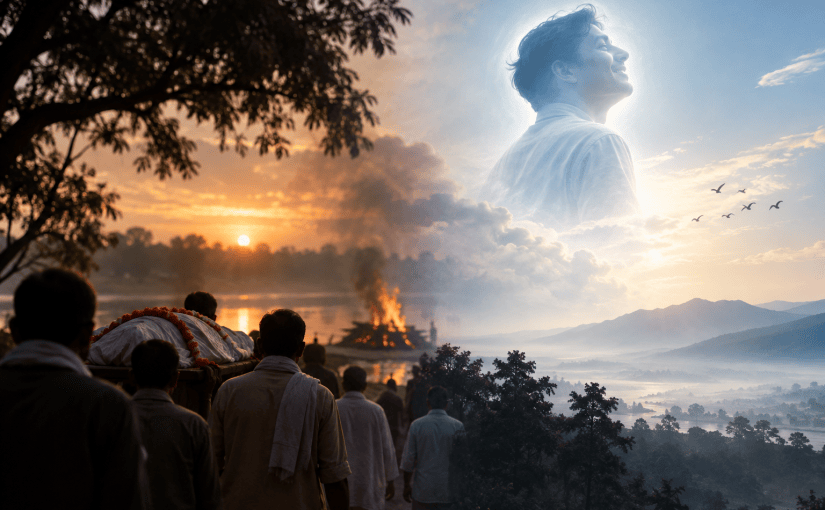
The event followed a quarrel between the couple throughout days of journey. After returning home the quarrel continued, and he reportedly beaten his wife and she also attacked back although male is male in strength. Even he hit his mother too in anger while she came to protect her and control him too. So she made them sleep in different rooms separate from each other. At night, God knows from where he got that 500 ml poison bottle and drank entire. In the morning naked due to heating up by poison and blood vomit everywhere. He opposed to be carried to hospital as he was already determined to die but was carried forcefully. Then his partner went back to report to police out of fear. He eventually passed away. When I saw the news on Facebook, I later had a strange dream. I saw a shavayatra moving toward the place of funeral, with people carrying a dead body, but I could not find out who had actually died. The person I had heard about appeared to me as if he were still alive, smiling and happy as he had been earlier. I asked people who had died, but nobody answered me. Instead, everyone seemed to be telling me to remain silent. I could not identify the dead person. At one point I thought that perhaps his younger brother had died because he was not clearly visible and, in the dream, he seemed to be the one showing the greatest grief. Yet this itself became strange, because the person whom I expected to be dead did not appear dead at all.

When the Dream Changed the Meaning of Death

The dream made me think that perhaps death is not as simple as the death of the body. The funeral procession clearly represented physical death, yet I could not locate the person who had supposedly died. The one whom I associated with death appeared alive, smiling, peaceful and recognizable. This contradiction became the central point of the dream for me. I began to feel that perhaps no one dies in the deepest sense merely because the physical body dies. What dies may instead be the bodily form and the world of physical relations connected with that form.

The younger brother’s grief seemed to deepen this interpretation. I had initially guessed that he was the one who had died because he was experiencing the greatest grief. This suggested another possibility: perhaps the person who undergoes a kind of death is not necessarily the one whose body has stopped functioning, but the person who thinks that everything he loved has become zero. When someone believes that the person he loved has completely disappeared, his own inner world can collapse. In that sense, the deepest psychological death may occur in the one who remains behind but becomes overwhelmed by the belief that everything meaningful has been lost.

This does not mean that physical death is unreal. The body certainly dies. The point is different: physical death need not necessarily mean annihilation of the person. The funeral belongs to the body, while the question of what happens to the person or soul belongs to a deeper level of existence.

The Soul May Remain Fully Alive After Bodily Death

I am not thinking only about the way the dead survive in the memories of other people. My meaning is more direct. I am referring to the possibility that the person himself, as a disembodied soul, remains fully alive after bodily death. I have also once experienced what I understood as a dream visitation of a soul, so my understanding of this possibility does not come only from abstract thinking. I experienced something personally that led me to consider the possibility that a person may remain present after the body has died.

My dream after this recent death therefore appeared meaningful to me because the physical body was being carried toward cremation, while the person I associated with that body was nevertheless appearing alive. This created a distinction between the body and the person inhabiting or experiencing through that body. The body may become lifeless, but the soul may not therefore become lifeless.

This gives another meaning to the statement that perhaps no one really dies even after death. It does not have to mean that biological death does not happen. Rather, it can mean that the death of the physical body is not necessarily the death of the person at the level of the soul.

Why the Disembodied Soul Might Feel More Alive

I then began to see another possibility. During embodied life, consciousness is continually surrounded by the distractions of the physical world. The body produces sensations, hunger, thirst, pleasure, pain, fatigue and other needs. The mind is occupied by relationships, social circumstances, memories, desires, fears, reactions and the ordinary stream of thoughts. Much of what we experience as ourselves may therefore be mixed with the activity and limitations of the physical body.

After disembodiment, this entire field of gross physical distraction may no longer dominate consciousness in the same way. If the soul continues after death, it may therefore become more directly aware of its own state of development. Without the same degree of sensory distraction and physical involvement, it could perhaps see and feel its own condition much more clearly.

In that sense, the disembodied soul might be more alive in one respect than the embodied person. This does not mean that it would continue thinking exactly as a living human thinks. Ordinary discursive thoughts, bodily sensations and many emotional reactions may themselves belong to embodied existence. They may be dharmas, or characteristics and activities, of the body-mind condition. The subtler experience of the soul would therefore not necessarily resemble ordinary human thinking.

Instead, the soul may experience reality as a subtle spiritual essence. What is experienced may be less gross, less sensory and less conceptual. It may be closer to direct seeing, feeling or knowing at a spiritual level. What is experienced during embodiment through the body and mind could, after disembodiment, be experienced in a much subtler form.

This is why the smiling and living appearance of the person in my dream seemed significant to me. The dream did not portray him as diminished or extinguished. It portrayed him as alive, even though the funeral procession was taking place. The body seemed to be going toward death, while the person himself did not appear to have become dead.

Physical Death, Psychological Death, and Spiritual Continuity

This way of looking at the dream also suggests three different meanings of death. Physical death is the end of the functioning body. Psychological death can occur in a living person when grief, attachment and the belief in complete loss make the person’s inner world collapse. Spiritual death, however, would be something different altogether. If a soul exists independently of the body and continues after bodily death, then physical death would not automatically mean spiritual death.

This distinction is important because the statement that “no one dies” can otherwise be misunderstood as denying the physical reality of death. I do not mean that. The body dies. What remains open is whether the deepest identity of the person also ends.

My dream cannot prove what happens to a soul after death. It is a personal experience and a source of philosophical reflection rather than scientific evidence. The same applies to my earlier dream visitation. I experienced it as a visitation, but that experience by itself cannot establish the metaphysical fact that souls survive bodily death. Still, an experience can be meaningful without being presented as scientific proof.

Kundalini Yoga and the Continuity of Spiritual Development

This understanding naturally connects with Kundalini Yoga. If consciousness is more than the physical body, then spiritual development may also be more than the temporary development of the body and personality. Ordinary life develops many things that belong to one particular embodiment: physical abilities, possessions, social identities, habits, memories and patterns of thought. These may end or change with the body.

Kundalini Yoga can be understood as working at a deeper level. Its purpose, in this interpretation, is not merely to produce unusual sensations, powers or altered states. It is a process of transforming consciousness and developing subtler levels of awareness. The deeper the transformation, the less it can be understood simply as something belonging to the physical body.

This leads to an important possibility. If the soul continues beyond bodily death, then spiritual development cultivated through Yoga may not necessarily disappear when the body dies. The physical instruments used for the practice belong to one lifetime, but the deeper transformation of consciousness may belong to the soul itself. In a spiritual understanding of rebirth, that development could therefore be carried subtly into the next birth.

The idea is not that every memory or ordinary thought survives in exactly the same form. Rather, what may continue is the deeper spiritual development. A person might lose the particular body, circumstances and personality through which development occurred, while still carrying forward the effect of that development at a subtler level.

In that sense, Yoga can always be seen as helping growth. Even if outward achievements end with the body, genuine inner development may not be lost. What is cultivated at the deepest level may become part of the continuing being.

Why Yoga May Not Require Escape from Society

This also gives another perspective on spiritual practice. One may imagine that leaving society is necessary in order to seek Kundalini or spiritual growth, but that need not follow. Society itself provides the circumstances through which consciousness can be tested and transformed. Relationships, attachment, desire, conflict, responsibility, distraction, loss and ordinary human interaction all reveal the condition of one’s consciousness.

The important question is therefore not simply whether one has escaped society, but what one is developing while living in it. A person may remain in ordinary life while gradually cultivating deeper awareness. The physical and social world can become the field through which spiritual development takes place rather than merely an obstacle to it.

This is also consistent with the central insight of the dream. The ordinary world may contain many distractions, but those same circumstances can become opportunities for growth. Kundalini Yoga does not necessarily require rejecting the world; it may instead involve learning to move through the world without allowing its gross distractions to completely determine consciousness.

What the Dream Means to Me

For me, the deepest meaning of the dream is not simply that a dead person can appear alive in a dream. It is that the dream reversed the ordinary assumption about death. We normally see the body as the person and therefore assume that when the body dies, the person is gone. In the dream, the body was moving toward the funeral, but I could not find the person who had supposedly died. The person was smiling and appeared alive. Nobody would tell me who had died. The one who seemed most visibly affected was the grieving person who believed that someone had been lost.

This makes me wonder whether the tragedy of death belongs primarily to the body and to the attachments surrounding the body, while the deeper person may continue in another condition. Perhaps what appears to us as the end is actually a transition from one mode of experience to another.

The disembodied soul, in this view, does not remain occupied in exactly the same way as the embodied person. Freed from much of the physical world’s distraction, it may experience its own spiritual condition more directly. It may see what it has become more clearly. It may feel reality not through the gross senses and ordinary thought but through a subtler spiritual essence.

And if spiritual development has been cultivated through Kundalini Yoga or another genuine path of inner transformation, perhaps that development does not simply become zero when the body dies. It may continue with the soul and, in a doctrine of rebirth, influence the next embodiment.

This is why I see Yoga as a form of growth that can never be completely wasted. The body is temporary, circumstances are temporary, thoughts are temporary, and personalities are temporary. But if there is something deeper that continues beyond them, then what is developed at that deeper level may have a continuity that ordinary physical achievements do not have.

The funeral procession in my dream therefore came to represent something different from simple annihilation. The body may be carried toward the funeral, but the person may continue. What we call death may be the ending of one form of embodiment rather than the ending of the being itself. And perhaps the greater spiritual task in life is to discover and develop that deeper dimension before the body is finally left behind.

I do not take this dream as proof of a metaphysical fact, nor do I think the death of my friend should be interpreted as something other than the tragedy that it was. His physical death was real, and his suffering before it was real. But the dream led me to ask whether the person who died physically may nevertheless continue in another form of existence, and whether spiritual development can therefore extend beyond a single lifetime.

For me, that possibility gives a deeper meaning to Yoga. It suggests that spiritual practice is not merely an attempt to become more peaceful or powerful within one temporary life. It may be a way of developing what can continue when the temporary body, its distractions and its ordinary mental processes finally fall away. In that sense, perhaps the deepest aim of Kundalini Yoga is not to escape life but to use life to cultivate the part of oneself that may not end with it.

This should not be taken as glorification of death in any way. The point is simply that when worldly activity and its associated mental noise temporarily subside, one may experience a sense of relief and a more direct feeling of the underlying Self. Such relief, however, can be temporary or illusory and should not be confused with genuine spiritual development or realization. The real emphasis is on understanding the nature of worldly impressions and mental noise, and how they can be dissolved through awareness and witnessing.

Entropy, Human Freedom, Social Order and Spiritual Liberation

Understanding Entropy as Nature’s Tendency

When I first heard the scientific statement that “in an isolated natural system entropy always increases,” I found the explanation unnecessarily complicated. The basic idea became clearer when I understood an isolated system as one that exchanges neither matter nor energy with its surroundings. In such a system, the total entropy cannot decrease. It may remain unchanged in an ideal reversible process, but natural processes generally produce an increase.

A simple example is heat. If a hot object and a cold object are placed together in an insulated system, heat naturally moves from the hot object toward the cold object until the temperature becomes more evenly distributed. Similarly, perfume spreads through a room, ink disperses in water, and a broken glass does not spontaneously return to its original form. Energy is not destroyed in these processes; rather, it becomes distributed among a greater range of possible arrangements. This is why “disorder” is often used as a simple explanation of entropy, although scientifically entropy is more closely related to the number of microscopic states available to a system.

This made me think of entropy as a general tendency toward greater freedom of possible arrangement. The word freedom here is only an intuitive analogy. Nature does not consciously seek freedom, but states with vastly more possible microscopic arrangements are overwhelmingly more probable. A concentrated or restricted state therefore tends naturally toward a more widely distributed state.

Entropy in Non-Isolated Systems

This does not mean that every part of nature must become less organized. A local system can become more organized when it is not isolated and can exchange energy and matter with its surroundings. A refrigerator can make its interior colder while releasing heat outside. A living organism can maintain an extraordinarily organized structure because it continuously takes in energy and matter and releases heat and waste. The important scientific rule concerns the total isolated system, including the relevant surroundings.

This distinction led me to consider whether the same general pattern can be seen in human life. Humans also have a tendency to seek greater freedom of movement, choice, thought, experience and possibility. But unlike physical matter, a human being is conscious and can deliberately accept discipline. A person may restrict immediate freedom in order to gain a larger capacity later, as in meditation, education, skill development or any demanding practice. Therefore human freedom should not be treated as identical to thermodynamic entropy.

Social Order Creates Greater Possibilities

The connection becomes especially interesting when looking at society. Human civilization contains countless organized departments and institutions. Their workers have duties, schedules, procedures and responsibilities. In an everyday sense, these individuals may have less immediate freedom because they are bound to particular functions. Yet their organization creates convenience and freedom for others.

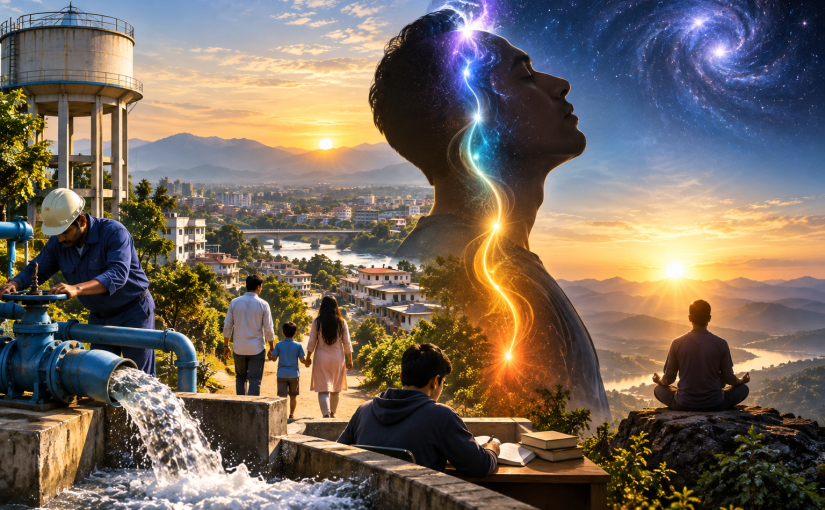
A water department is a simple example. Its employees must coordinate the supply system, maintain infrastructure, solve problems and perform their assigned duties. Their discipline allows water to reach the public without every individual having to obtain and transport water independently. The organization of a relatively small part of society therefore creates greater practical freedom for a much larger population.

The same principle operates through many other departments and services. People accept specialized duties so that society can function collectively. The result is that organization at one level can create possibilities at another level. This does not mean that these social arrangements literally possess low thermodynamic entropy; social order and physical entropy are different concepts. The connection is an analogy about restriction, organization and the expansion of possibilities.

From Social Freedom to Spiritual Practice

The most interesting extension comes when this socially created freedom is used for inner development. When basic facilities are available, a person does not need to spend all of their time meeting basic physical requirements. The time and energy made available by organized society can be directed toward work, creativity, education, enjoyment, contemplation or spiritual practice.

Some people may therefore use the conditions created by civilization to practice Kundalini Yoga or another spiritual discipline. From the perspective of that spiritual tradition and personal experience, such practice may lead toward awakening and liberation. In this sense, a chain can be imagined: individuals accept duties and create organized services; organized services make public life more convenient; convenience creates additional human possibilities; and some people use those possibilities for spiritual practice.

This is not a scientific claim that thermodynamic entropy causes Kundalini awakening. Thermodynamic entropy and spiritual liberation belong to different conceptual frameworks. Calling awakening “ultimate entropy” can therefore be meaningful as a philosophical metaphor, but it should not be presented as the scientific definition of entropy.

Local Order Within Overall Increase

The idea can now be stated more precisely. An individual or group within a larger non-isolated system can become highly organized while the larger process continues to involve entropy production. A water department may be highly coordinated, while its organized activity enables water, energy, time and convenience to flow outward through society. Likewise, social institutions can maintain internal order while making a wider range of activity possible for the people they serve.

Thus, what initially seemed like a contradiction becomes understandable: local order and overall entropy increase can exist together. The organized part does not have to become increasingly disordered merely because the larger system has increasing entropy. It can maintain its organization by participating in exchanges with its surroundings.

For human beings, this provides an interesting philosophical picture. Civilization uses organization and discipline to remove certain restrictions from ordinary life. The freedom produced by that organization can then be used in many directions. It may lead to more outward activity, more experiences and more choices, or it may be consciously turned inward.

That inward direction is where the spiritual interpretation begins. A person who has gained sufficient external freedom may choose to reduce distraction and voluntarily adopt discipline for Kundalini practice, meditation or contemplation. The apparent paradox is that one kind of restriction can create another kind of freedom. Social discipline can create practical freedom, and spiritual discipline can be understood as a path toward inner freedom.

The Larger Meaning

I therefore find entropy useful not because physics proves a spiritual doctrine, but because the concept provides a way of thinking about how restriction, organization and freedom can exist at different levels. The second law tells us that the total entropy of an isolated system cannot decrease. Means the general direction or tendency of creation is towards the freedom or liberation. Yoga does not produce this tendency, it is already there, it just speeds it up. Open systems can nevertheless develop and maintain local organization by exchanging energy and matter. Human society provides an analogous structure in which organized duties create services, services create convenience, convenience creates freedom, and that freedom can be used for purposes chosen by the individual.

At the farthest end of that possibility, a person may use the freedom created by the outer world not to seek more external possibilities but to turn inward toward awakening and liberation. This same happened to me in a way, I feel so. Whether that final state should be called “ultimate entropy” is a matter of philosophical language, not thermodynamics. The scientifically safe statement is that entropy concerns physical systems, while the spiritual journey concerns consciousness and experience.

The connection I see is therefore not an equation between entropy and liberation. It is a broader observation: nature can contain local organization within an overall process of increasing entropy, society can create freedom through organization, and human freedom can finally be used to pursue an inward form of liberation.

Shiva, Shakti and the Cyclic Universe: A Personal Intuition About Branes, Conception and Cosmic Rebirth

From Two Hands to Two Cosmic Branes

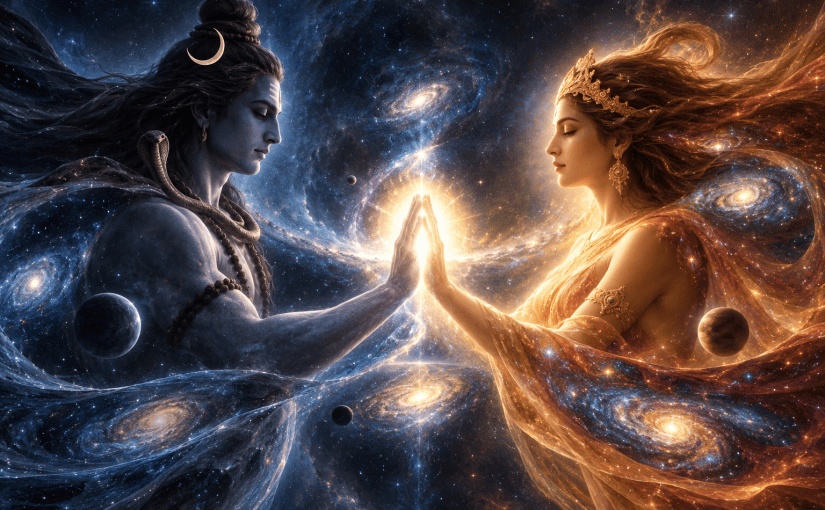
I began to understand the idea of a cyclic universe through a very simple image: two hands slowly moving toward each other in position of cosmic prayer, touching, separating, and then coming together again. In some versions of string-inspired cosmology, our universe can be pictured as a three-dimensional brane, or membrane, existing within a higher-dimensional space. Another brane may exist alongside it, and the two can move relative to one another. Instead of imagining the Big Bang simply as an explosion of matter from one point into already existing space, this picture allows us to imagine the changing relationship between the branes themselves as part of the cosmic story. When the two branes separate, the universe can pass through an immense phase of expansion. When they eventually come back together, their collision can produce a new hot, dense beginning, creating a Big Bang-like state. The whole process can then repeat again and again.

The Cosmic Clap: Collision and a New Big Bang

The most striking image is the final clap. After the branes have drifted apart to their maximum distance and the universe has expanded enormously, they begin moving toward each other. Their meeting represents a catastrophic collision, or bounce. In the simplified picture, the old universe is not preserved in its familiar form. Galaxies, stars, planets and other large-scale structures do not simply pass intact into the next cycle. Instead, the previous organized universe is replaced by an extremely hot and energetic state, a kind of plasma inferno in which the familiar structures of the old cosmos have disappeared. From that hot state, the universe can expand and begin forming structure again. Thus the Big Bang is no longer necessarily imagined as the unique beginning of everything. It can be one phase of an endless sequence: separation, expansion, convergence, collision, hot rebirth, and expansion once more. That is the basic appeal of the cyclic or ekpyrotic picture, although it remains a speculative cosmological model rather than an established description of our universe. The “cosmic applause” is simply the repeated meeting of the branes: clap, rebirth, separation, and another clap.

My Shiva-Shakti Intuition

What made this picture especially meaningful to me was that I could see it through an entirely different symbolic language: the ancient idea of Shiva and Shakti. In scriptural traditions, creation is associated with the union of Shiva and Shakti. Shiva can be understood as the still, enduring principle, while Shakti is the dynamic power through which manifestation takes place. I began to see the two branes not merely as two identical physical sheets, but as two complementary symbolic principles. The right and left hands became a simple image of this union. When the hands meet, conception occurs. When they separate, development begins.

This made me think of Shiva as the father principle and Shakti, the mother or goddess, as the creative womb. The union of the two is conception, and the newly conceived universe is then like something growing within a cosmic womb. The important point for me is that the universe does not have to appear fully formed at the moment of conception. After conception comes development. When the two branes separate, Shakti can symbolically be understood as carrying the developing universe, while Shiva remains associated with the essential principle, identity or recognition from which that manifestation arose. In this interpretation, separation is not the opposite of creation. Separation is what allows creation to unfold.

Shakti as the Developing Universe

This makes the female brane, in my symbolic reading, especially interesting. It is not simply another universe identical to the male brane. After the union, Shakti carries the manifested creation and allows it to develop. The universe grows within this cosmic womb, moving from an intensely energetic beginning toward increasing differentiation and complexity. What begins as a hot and chaotic state can eventually become particles, atoms, stars, galaxies, planets and perhaps life. Shiva, by contrast, represents the enduring essence or recognition behind the manifestation. In this picture, Shakti is the movement and development of creation, while Shiva is the principle that remains comparatively still.

This is only a symbolic interpretation; physics does not describe one brane as male and another as female, nor does it assign them the attributes of Shiva and Shakti. The physical model and the spiritual symbolism belong to different levels. What I find meaningful is the structural resemblance between the two pictures: union, creation, separation, development and return.

The Return of Shakti and the Death of the Universe

The idea becomes even more interesting when the universe reaches old age. After a vast period of development and expansion, the universe can be imagined as moving toward exhaustion. In my intuition, Shakti then begins to return toward Shiva. She does not return carrying the old universe as a fully functioning world. The recognizable universe is almost dead. Its galaxies, stars and other structures have lost their former organization, and what remains is increasingly reduced to underlying energetic potential. Yet this does not mean that everything has become meaningless residue. The remains of the old universe can be imagined as carrying the potential for another beginning.

This gives the reunion a different meaning. The approaching Shakti is like a cosmic mother returning to Shiva with the exhausted remains of their previous creation. The purpose is not to preserve the old universe in its previous form, but to allow its remaining essence, now concentrated in energetic form, to participate in another conception. The old universe therefore ends as a recognizable world but survives, in this symbolic picture, as potential. The new universe does not emerge as a completely unrelated event. Its birth is connected to the death and dissolution of the previous cycle.

Conception, Growth, Death and Rebirth

Seen this way, the entire cosmic process becomes almost like one continuous act of reproduction at the scale of the universe. Shiva and Shakti unite, conception occurs, and then they separate. Shakti carries and develops the universe. The universe expands, differentiates, lives through its vast history and eventually approaches death. Shakti then returns toward Shiva carrying the dying creation in a reduced energetic form. Their reunion becomes both dissolution and the preparation for another conception. The old manifestation disappears, but the creative process begins again.

The cycle can therefore be understood in a very simple sequence: union is conception, separation is gestation, expansion is life, aging is exhaustion, return is dissolution, and reunion is rebirth. Then the hands separate again, and the whole process begins once more.

Between Physics and Metaphor

I would not claim that this proves Shiva and Shakti are the physical explanation of brane cosmology, or that ancient scriptures scientifically predicted modern string theory. That would go beyond what either tradition can establish. The brane collision model is a speculative idea in theoretical physics, while the Shiva-Shakti framework is a spiritual and metaphysical language. My point is different. When I placed the two pictures beside each other, I found a striking pattern: two complementary principles come together, something is conceived, creation develops through separation, the manifested world eventually dissolves, and the remaining potential returns to the source for another beginning. My interpretation is closely aligned with the creation symbolism described in the scriptures, particularly the Shiva Purana, where Shiva and Shakti are understood as father and mother in relation to the origin and manifestation of the universe as a fetus growing in cosmic womb.

What began for me as a simple image of two hands coming together therefore became a much larger intuition about the universe. The cosmic clap is no longer merely a collision. Symbolically, it is conception through the death of the previous creation. The separation of the hands is not merely distance; it is the opening of the cosmic womb. And the return is not simply destruction. It is the movement of Shakti back toward Shiva with the almost dead universe, carrying whatever remains of its energetic potential toward a new union. In that sense, the universe becomes a repeating rhythm of union and separation, manifestation and dissolution, death and rebirth: an eternal cosmic cycle in which every ending is also the preparation for another beginning.

Kundalini, the Soul and the Big Bang: Is Consciousness Repeating the Birth and Death of the Universe?

The Big Bang, Inflation and the Question of Origin

When we ask how the universe began, the usual image is of a tiny point exploding outward. But modern cosmology gives us a subtler picture. Inflation describes an extremely early phase in which the cosmos underwent a dramatic stretching during a tiny fraction of a second. Space itself expanded rapidly; it was not matter simply exploding into an already existing empty space. A useful but limited analogy is compressed air expanding, because stored energy can drive expansion, but inflation is fundamentally different: there was no external container and no pre-existing space into which the universe was expanding. The geometry of space itself was changing.

What drove that expansion is generally described in terms of an inflaton field in a high-energy state. Its energy behaved approximately like vacuum energy and, because such a state has strongly negative pressure, it could produce accelerated expansion according to general relativity. When inflation ended, the inflaton transitioned toward a lower-energy state, and its energy was transferred into particles and radiation. This process is called reheating. The inflaton could oscillate, decay and interact with other fields, producing enormous numbers of particles that eventually interacted and approached thermal equilibrium, giving rise to the hot plasma from which the later universe evolved. The precise identity of the inflaton and the exact mechanism of reheating remain unknown.

This immediately raises the deeper question: where did the inflaton, its high-energy state, or even the initial conditions come from? Science does not presently have a complete answer. If we mathematically run the simplest classical Big Bang model backward, we reach what is called a singularity, where quantities such as density and spacetime curvature become infinite. But a singularity is probably better understood as a sign that our present theory, general relativity, has reached its limit rather than as proof that there was literally a tiny ball of infinitely compressed matter. We therefore have a major gap between the earliest describable universe and whatever deeper quantum-gravitational reality may have preceded it, if “preceded” is even meaningful there.

A Human Analogy of Cosmic Expansion

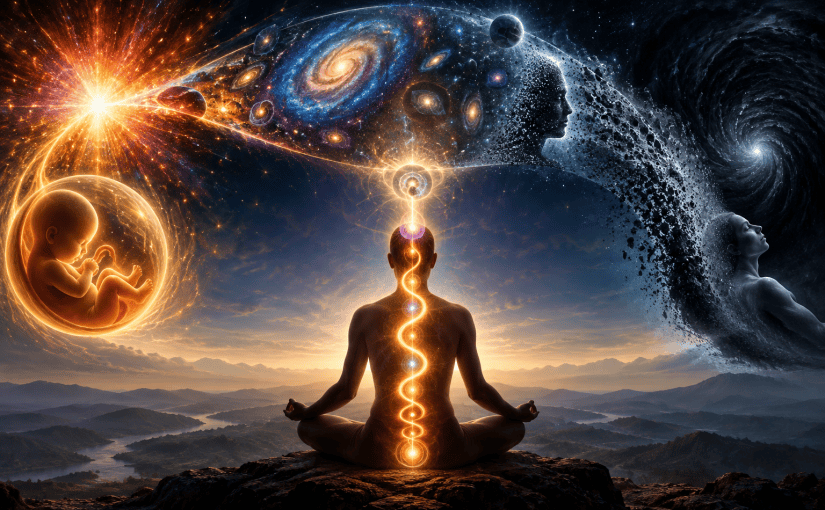
I began wondering whether a similar pattern could be imagined within a human being. God, or Brahman, is often called infinite. I imagine it not as ordinary physical space but as something indescribable and unlimited in every aspect, a ground more fundamental than any individual object, space or energy. Perhaps what we call an individual soul emerges within that infinite reality as a confined and highly energetic state. Birth could then be imagined as a kind of personal Big Bang. The initially concentrated inner space begins to expand, and as it expands its energy decreases while the released potential appears as the experienced world.

The first experiences of a person could metaphorically resemble fundamental particles: the simplest constituents from which later structures are formed. As life proceeds, the inner space continues expanding and new experiences fill it. Yet newer experiences are not necessarily entirely new creations. They can be growths, combinations and increasingly complex expressions of the earliest structures, just as complex physical structures develop from more elementary constituents. Memory, knowledge, relationships, skills, desires, understanding and identity gradually build an extensive inner universe.

The initial expansion also seems to slow. Yet there can come another stage in which one’s accumulated world begins to expand almost by itself. A person who has grown greatly in business may find that new opportunities generate further opportunities without conscious effort at every step. Knowledge produces more questions and connections. Art produces new possibilities from what has already been created. Intellectual growth creates the conditions for still more growth. This resembles, metaphorically, the role of dark energy in cosmology: an expansion that is no longer simply the continuation of the original impulse of birth but appears to possess its own further momentum. This is only an analogy, not a claim that human development is literally governed by dark energy.

Death as a Return of the Expanded Inner Universe

At death, the expanded inner world of a person would, in this speculative picture, no longer continue its ordinary outward development through the body. Instead, the enormous space of accumulated knowledge and experience could be imagined as contracting toward the concentrated high-energy state from which its journey began. The visible world of the individual would then be transformed back into a more concentrated potential. The amount of this remaining potential would correspond metaphorically to the richness and extent of the world accumulated during life. This would also explain why different souls could retain different identifying signatures: each would represent a unique configuration of experiences rather than an identical undifferentiated state.

Here the analogy with vacuum decay becomes interesting, though it must be used carefully. In physics, vacuum decay specifically refers to a hypothetical transition from a metastable false vacuum to a lower-energy vacuum. Some inflationary models involve such a transition, but the end of inflation in general is not simply synonymous with vacuum decay. Likewise, reheating is the transfer of inflationary energy into particles and radiation. My proposal is extending these physical ideas into a metaphysical analogy: a high-energy confined state gives rise to an expanded differentiated world, while movement toward a more stable state releases its stored potential into manifestation.

Creation, then, could be imagined as a cycle in which a concentrated high-energy state differentiates into an experiential universe, while dissolution returns that differentiated universe toward its original ground. The outer universe and the inner universe would be two scales of the same pattern.

A Personal Experience of a Departed Soul

This model became much more vivid for me because of an experience during a dream visitation in which I seemed to encounter directly the freshly departed soul of a close acquaintance. What I experienced did not resemble an unlimited, already dissolved consciousness. It felt more like a confined region of extremely high-energy space, limited in extent and apparently bounded. Most striking was the sense of enormous internal pressure, almost like a bubble trying to grow from within itself. It felt as though the space contained something intensely concentrated that naturally wanted to expand.

I do not take this experience as scientific proof of a physical mechanism. It was an experience, and its interpretation remains speculative. But phenomenologically it gave me a remarkably clear image for the model: perhaps a newly departed individual consciousness is still a highly concentrated configuration carrying the accumulated structure of a lifetime. In that sense it would resemble a universe immediately after its own beginning—bounded, intensely energetic and possessing an inherent tendency toward expansion.

Kundalini, Dissolution and the Final Direction of the Cycle

The deepest possibility in this model comes from Kundalini yoga and the practice of witnessing. If ordinary life continually expands the inner world, perhaps spiritual practice can reverse the process while one is still alive. Through deep witnessing, memories, identities, desires, attachments and distinctions are progressively seen without being reinforced. Instead of adding more structure to the inner universe, the practitioner allows that structure to dissolve into the indescribable ground.

This would make liberation fundamentally different from ordinary death. The ordinary person dies carrying an extensively differentiated inner world. The yogic practitioner may, through realization, dissolve that inner world before death. There is then no elaborate structure left to generate or sustain another cycle of inner expansion. In this metaphor, the ultimate state is not a larger universe but the absence of the separate world altogether.

This also gives a possible meaning to the idea that the void is the most stable and fundamental state. Rather than imagining the void as an empty container filled with nothing, it may be understood as that which remains when all distinctions have disappeared. It is not merely low-energy space in the scientific sense; it is the metaphysical ground beyond the distinctions of space, energy, object and individual identity.

From Individual Dissolution to Mahapralaya

The same pattern can finally be imagined on a cosmic scale. Perhaps one day the outer universe too could undergo its own form of dissolution. In the scriptural vision of Mahapralaya, everything returns into the Divine: not simply stars and matter disappearing, but all separate forms, distinctions and identities losing their independent existence. Space, energy and the differentiated universe itself would no longer stand apart as separate realities. In a way it is like the entire cosmos doing kundalini yoga to be liberated.

In that sense, creation and dissolution become two movements of one cycle: the One appearing as many, and the many returning to the One. The individual soul is then a miniature cosmos, birth is a kind of expansion, life is the filling of an inner universe with differentiated experience, death is a return toward concentration, and spiritual realization is the possibility of consciously reversing the process. The ultimate destination is not another object or another world but the indescribable ground from which all worlds appear.

Kundalini, Gravity and the Theory of Everything: Can the Four Fundamental Forces Reveal the Hidden Structure of Consciousness?

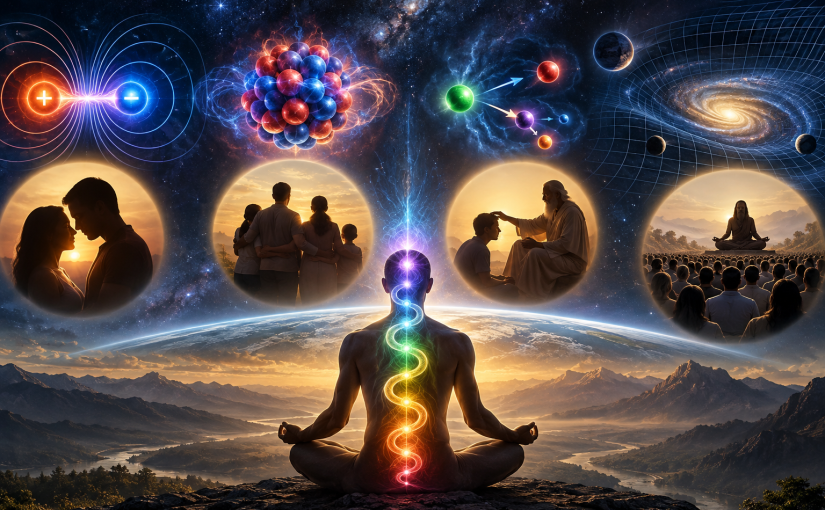
When I began thinking about the fundamental forces of nature, one difference kept standing out to me. In the familiar picture of the electromagnetic, strong, and weak interactions, there is some form of exchange. Particles interact through fields, and in quantum field theory this interaction is described in terms of exchange quanta. Electromagnetism is mediated by photons, the strong force by gluons, and the weak interaction by W and Z bosons. Gravity seems different. In general relativity, it is not ordinarily described as one object exchanging something with another in the same way. Instead, mass-energy changes the geometry of spacetime, and objects move through that curved geometry. This made me wonder whether the difference between gravity and the other forces could also be understood through the human world, through the old idea of understanding the macrocosm through the microcosm.

The attraction between two lovers gives me an image of electromagnetism. There is attraction and repulsion, but there is also exchange. Love, affection, attention, touch, companionship, gifts, care, and sometimes material support continually pass between the two. Their relationship is not simply an invisible attraction; something moves between them and sustains the relationship. In this sense, it resembles the electromagnetic picture, where interaction is associated with an exchange process.

The strong nuclear force suggests another kind of human relationship to me: the family. Family members may love each other, quarrel with each other, dislike each other, and sometimes even strongly repel each other emotionally, yet they remain bound together by an unusually powerful connection. There is also exchange here: food, money, shelter, protection, security, responsibility, inheritance, care, and other forms of support. The family bond can remain powerful even when personal feelings fluctuate. That makes it a useful human analogy for the strong force, not because the two are literally the same thing, but because both suggest an extraordinary form of binding.

The weak nuclear force seems to belong to a different category altogether. It is not primarily a force of binding. One of its defining features is transformation: particles can change from one type into another through weak interactions. That gives me an analogy with those human encounters that alter what a person is. A teacher, a crisis, a profound relationship, a spiritual experience, or some decisive insight can enter a person’s life and leave that person fundamentally changed. Before the encounter one is one kind of person; afterward one is no longer quite the same. In that sense, the weak force can serve as a metaphor for transformation rather than simple attraction or binding.

Gravity then appears to me as the most unusual of the four. My thought is about the attraction that people sometimes feel toward a mystic, sage, or kundalini yogi. A person may be drawn toward such an individual without romance, possession, material exchange, social ambition, or any obvious personal gain. People may become crowded in the discourse hall simply because they want to be in his presence. Yet the relationship can remain strangely non-personal. They may listen, sit quietly, and eventually leave without trying to possess him. There can be attraction without the kind of obvious give-and-take that characterizes ordinary relationships.

This is why gravity provides the most interesting analogy for me. In general relativity, gravity is not simply a force transmitted through space in the ordinary Newtonian sense. Mass-energy changes the geometry of spacetime itself, and bodies move according to that geometry. As a metaphor, I can imagine the mystic as someone who has profoundly transformed the geometry of his own inner space—almost as though he has curved and extended the space-time of consciousness within himself. A curved surface can contain more area than a corresponding flat projection, giving an intuitive image of how an apparently limited inner space might become vast through transformation. Mystics are traditionally described as experiencing Brahman, the pure and unlimited reality beyond the ordinary boundaries of individual consciousness, which can be contemplated as an experience of boundless inner space—not physical space in the scientific sense, but an immeasurable field of awareness. When other people enter such a mystic’s presence, their own inner movement may be altered; they are drawn toward him not necessarily because he is exchanging something with them or because they expect personal gain, but because his presence seems to change the space in which they experience themselves. In this sense, they are drawn not merely toward the person but toward the expanded field of consciousness associated with him, much as people have traditionally been drawn toward figures such as Krishna or Buddha. The analogy is not that consciousness literally curves physical spacetime, but that a transformed consciousness may create an expanded experiential space into which others feel naturally drawn, much as physical bodies move according to the geometry of curved spacetime.

Of course, this must remain an analogy. There is no established scientific evidence that a mystic literally curves physical spacetime through consciousness. Nor can we scientifically say that the attraction toward a spiritual teacher is gravity. The useful point is structural: the mystic gives a human image of attraction that does not obviously depend upon a transaction between two individuals. It resembles gravity as a metaphor because the presence of one changes the space through which another moves.

This also led me to another curious observation. Gravity is enormously weaker than the other fundamental interactions at the particle scale. Humanly, the attraction toward a mystic can likewise appear very gentle and distant. No one necessarily rushes forward to embrace or possess the mystic. People may simply remain at a respectful distance, listen, and still feel strongly drawn toward him. The attraction does not have to produce ordinary attachment.

From this perspective, the four interactions suggest four different patterns: electromagnetism attracts through interaction and exchange; the strong force binds despite opposition; the weak force transforms; and gravity changes the geometry in which movement takes place. These are not literal correspondences between physics and psychology, but they provide a way of contemplating different forms of relationship.

This is where the idea of the macrocosm and the microcosm becomes meaningful to me. The small can sometimes provide a language for thinking about the large. A pattern observed in the physical world can become a symbolic mirror for patterns in human life and consciousness. The microcosm does not prove anything about the macrocosm, but it can help us recognize structures that otherwise remain abstract.

It also makes the problem of a Theory of Everything appear even more profound. The difficulty may not simply be that gravity is another force whose particle has not yet been found. The deeper problem is that the other three interactions have quantum-field descriptions that operate within spacetime, whereas gravity, in general relativity, is itself associated with spacetime geometry. We are therefore not merely trying to put four similar forces into one theory. We may be trying to understand the relationship between the actors and the stage on which they act.

A graviton is expected in some approaches that quantize weak gravitational fields, but no graviton has been experimentally detected, and there is still no complete experimentally confirmed quantum theory of gravity. So perhaps gravity is not merely the fourth member of a group of otherwise similar forces. Perhaps it is pointing toward something deeper in the structure of reality.

That is why gravity feels special to me. Electromagnetism, the strong interaction, and the weak interaction can be imagined through exchange, binding, and transformation. Gravity seems to say something different: the presence itself can alter the space of relationship. Whether that remains only a metaphor or someday proves to reflect a deeper truth about nature is an open scientific question. But the analogy offers a simple way of looking from the human inward to the physical outward, and then back again—from the microcosm toward the macrocosm.

Vacuum Decay, the Human Mind, and the Kundalini Yogi: A Metaphorical Cosmology of Worldliness and Stillness

From the Physical Vacuum to the Inner World

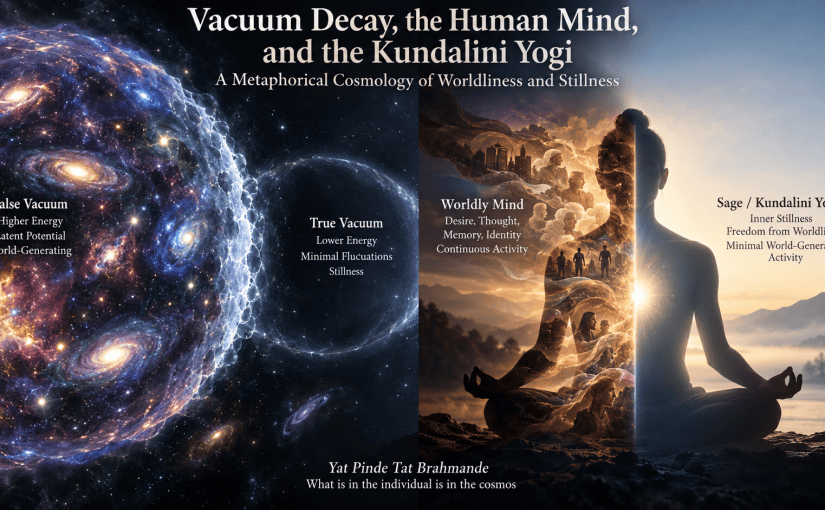
Vacuum decay sounds as if empty space suddenly disappears, but in modern physics a vacuum is not simply empty space. Quantum fields exist throughout space, and what we call particles are excitations of those fields. A vacuum is a particular state of those fields. That state can, in some theories, be a local minimum of potential energy rather than the absolute lowest one. Such a state is called a false vacuum, while the lower-energy state is called the true vacuum. Quantum mechanics allows a metastable false vacuum to tunnel into a lower-energy state. The transition is described through a tunnelling or bounce solution and can produce a bubble of the new vacuum. If the bubble is too small it can collapse, but beyond a critical condition it can expand, potentially approaching the speed of light and replacing the old vacuum. When gravity is included, the situation becomes even more profound because vacuum energy affects spacetime itself. This physical picture led me to see a possible metaphorical correspondence with the human mind.

False Vacuum as Worldly Mind

I began thinking of the false vacuum as similar to the darkness of an ordinary worldly mind. Here darkness does not simply mean evil or absence of knowledge. It means the unseen, unexamined and latent structure through which worldliness is continually generated. The more strongly a person is identified with the world, the greater this darkness appears to be. Beneath conscious thought there are memories, expectations, fears, desires, habits, identity, comparison, social conditioning and countless subtle associations. Much of what maintains our ordinary mental world is therefore not consciously visible. It is already present in a subtle or encoded form, ready to produce further thoughts, emotions, desires and actions. In this sense I see worldliness as a kind of latent world-generating potential.

This also gives a useful metaphorical meaning to the high energy of a false vacuum. In physics, one should not simply say that every high-energy vacuum necessarily has larger quantum fluctuations, because fluctuation behavior depends on the particular fields, masses and couplings. Yet higher-energy field configurations can possess substantial potential for excitation and manifestation. This is the part of the analogy that interests me. The false vacuum is not itself the particles, just as the subtle structure of the mind is not itself every individual thought. Rather, it is the underlying condition from which manifestations can arise. Quantum excitations arise from the field configuration, while thoughts, emotions and worldly responses arise from the latent organization of the mind. Therefore I began to think of the subtle information of worldliness as something like the potential structure hidden within the false vacuum. It is not a literal storage of every object or event, but a hidden capacity from which the manifest world can continually be regenerated.

Quantum Fluctuations and the Mental World

In this metaphor, mental activity can be compared with fluctuations. An ordinary mind continually moves through memory, desire, anticipation, fear, pleasure, pain, identification and planning. One thought produces another, one emotion activates another, and the resulting actions produce fresh impressions. The process therefore becomes self-maintaining: desire produces thought, thought produces action, action produces consequences, and those consequences produce new desire. The worldly mind can thus be imagined metaphorically as a high-activity state with substantial capacity for generating further manifestations. This does not mean that psychological activity is literally caused by quantum fluctuations, nor that the human mind can be physically equated with a cosmological vacuum. The correspondence is structural and phenomenological: hidden potential gives rise to visible manifestations.

The Sage as True Vacuum

A profound transformation appears when an ordinary person becomes a sage, or what I also call a kundalini yogi in this metaphor. The change is not simply that the person has fewer thoughts. It is more radical. The underlying compulsion to continuously construct and maintain a personal worldly cosmos becomes quiet. A deep contemplative state can therefore be imagined as a true vacuum: a state of minimal psychological agitation, minimal compulsive fluctuation and minimal dependence on the continual generation of worldly experience.

This does not necessarily mean that the sage has lost all information. A Buddha can remember people, language and teachings, and a kundalini yogi may still function normally in the world. The deeper change is that information no longer has the same power to generate attachment, identity, craving and psychological continuation. Thus the useful distinction is not information versus no information, but information that actively generates worldliness versus information that remains without compulsive identification. In this sense the true vacuum metaphor represents the lowest world-generating activity rather than literal mental emptiness.

When an Individual Changes State

The transformation of an ordinary householder into a sage can therefore be compared metaphorically with false vacuum becoming true vacuum. The old worldly state is a metastable condition, apparently secure but still carrying the possibility of transition. A brief mystical experience may be like a subcritical bubble: an extraordinary moment appears, but the ordinary mental structure reasserts itself and the experience collapses. A deeper realization may cross a critical threshold. At that point the new state becomes sufficiently stable that the previous organization cannot easily restore itself.

The critical bubble in this analogy is not a physical radius. It represents the depth, stability and integration of realization. Below the threshold, worldliness is stronger than realization; above it, realization becomes strong enough to sustain itself. The “bubble wall” can be understood metaphorically as the resistance between the old and new states: attachment, identity, fear, habit, conditioning and the fear of losing the familiar self. Spiritual practice then becomes a gradual weakening of the barrier between the ordinary worldly state and inner stillness.

From One Mind to Many Minds

The analogy becomes even more interesting when realization spreads. One person’s transformation can affect others through speech, example, teaching and direct influence. A sage may become a source from which other people begin to observe their own minds, question their attachments and discover a quieter state. One transformed mind can therefore influence another, and that mind can influence another, creating a chain of transmission. In this metaphor the sage becomes a nucleation center of a different mental state.

This is where the idea of a critical bubble becomes collective. A person’s realization may remain localized if it does not spread beyond the individual. But if it becomes sufficiently powerful and transmissible, the psychological bubble can expand into a community, a tradition, a civilization and perhaps, over very long periods, a wider transformation of collective consciousness. Figures such as Buddha can be viewed in this philosophical sense as extraordinary examples of a personal realization becoming a lasting field of influence. Krishna can similarly be treated as a theological or archetypal representation of a consciousness that transforms the relationship between action, attachment and liberation. I do not mean that these figures literally altered the quantum vacuum; rather, their significance lies in the ability of a transformed mode of consciousness to propagate through human minds.

Two Different Meanings of Cosmic Destruction

This metaphor also clarifies what it means to say that a sage “destroys the cosmos.” The physical universe is not necessarily destroyed by enlightenment. Stars, planets, bodies and ordinary physical processes can continue. What is diminished is the mentally constructed cosmos: the personal world of “I,” “mine,” desire, fear, comparison, memory, expectation and attachment. In that sense spiritual liberation is not necessarily annihilation of the external universe but cessation of the psychological machinery that continually recreates one’s experienced worldly universe.

The idea can therefore be expressed at three scales. At the level of physics, a metastable vacuum can theoretically transition into a lower-energy vacuum through quantum tunnelling and bubble nucleation. At the level of an individual, a worldly mind can metaphorically transition into profound stillness. At the collective level, a deeply realized person can transmit that transformation to others. The common pattern is a seemingly stable state containing hidden potential for transition, followed by a movement toward a state of lower activity and a possible expansion of the new state.

The Larger Cosmological Question

This metaphor naturally raises a much larger possibility. Perhaps the physical cosmos and the experienced cosmos should be distinguished: one is the universe described by quantum fields and spacetime, while the other is the universe constructed in consciousness through sensation, memory, interpretation, desire and identity. Vacuum decay belongs to the physical description, whereas enlightenment belongs to the phenomenological and spiritual description. There is currently no established scientific evidence that a sage’s mental realization causes physical vacuum decay. That would be a speculative hypothesis, not accepted physics. Yet the structural similarity is striking: a high-potential state, hidden possibilities, manifestation through excitation, a transition to a lower-energy condition and, under certain circumstances, expansion of the new state.

This gives a final way of expressing the whole idea. The false vacuum is not merely “empty space with energy”; metaphorically, it is a latent world-generating condition. The worldly mind is similarly not merely a collection of conscious thoughts; it contains subtle structures capable of continually regenerating its experienced world. The true vacuum, by contrast, represents the deepest stillness, where the compulsive generation of that personal cosmos has greatly diminished. A householder becoming a sage is therefore metaphorically a false vacuum becoming a true vacuum. A temporary realization is a subcritical bubble; a stable realization crosses the critical threshold; and a rare, extraordinarily powerful sage may become a center from which a different mode of consciousness spreads through many minds. In this sense the language of vacuum decay becomes a powerful metaphor for the movement from worldliness to stillness, from latent psychological complexity to liberation, and from the continuous creation of a mental cosmos toward its profound inner dissolution.

It should not be surprising, then, if cosmic vacuum decay has a corresponding reflection in the individual mind, just as other cosmic principles can be reflected in the individual. This is also expressed in the scriptural idea “yat pinde tat brahmande”—what is in the individual is in the cosmos, or what exists in the microcosm is reflected in the macrocosm. From this perspective, the individual is not separate from the larger cosmic process but can be regarded as its smaller reflection. Therefore, studying the individual mind may provide a way to study corresponding principles of cosmology, just as studying cosmological processes may provide metaphors or models for understanding the individual. In this sense, the possibility that a cosmic vacuum transition could have an inner psychological counterpart is not an arbitrary comparison but follows naturally from the microcosm–macrocosm principle. The physical correspondence itself remains a hypothesis rather than established science, but the philosophical method of looking for the same pattern in the individual and the cosmos is ancient.

The Cosmic Apocalypse Reflected Within the Individual

Thus the cosmic apocalypse may have its corresponding reflection within the individual as a mental apocalypse. According to the scriptural vision, God first brought forth the universe and then entered into it in order to experience and sustain it. The Upanishadic idea that the Divine, having created the world, then entered into it expresses this profound principle. If the human being is itself a miniature form of the universe, then the Divine did not merely enter the vast cosmos from outside; it first created a miniature cosmos in the form of the individual and entered that miniature through the individual soul, thereby entering the universe in concentrated form. The human body by itself is inert; it becomes a living centre of perception, thought, action and experience when animated by the soul. In this sense, the individual is a microcosm through which the macrocosm experiences and operates itself. Therefore, if the universe can undergo its own cosmic processes, including a possible transition from one vacuum state to another, a corresponding process may also be contemplated within the individual as a transformation of the mental cosmos. The worldly mind continuously maintains its experienced universe through memory, desire, identity, perception, thought and subtle tendencies; when these world-generating processes become profoundly quiet, that inner cosmos can undergo its own apocalypse—not necessarily the destruction of the physical world, but the dissolution of the mental world through which it is experienced. Thus the individual can be studied as a miniature expression of the cosmos, and the transformation occurring within the individual can offer a way of contemplating corresponding transformations in the larger universe. This remains a metaphysical interpretation rather than an established scientific description of cosmology, but within the scriptural understanding of the microcosm and macrocosm, the correspondence is natural: the Divine enters the cosmos through its living miniature, and the dissolution of the worldly cosmos can therefore be contemplated not only in the vastness of space but also in the deepest stillness of the individual mind.

Entropy, Kundalini and Higher Order: My Journey Beyond Social Order

From Social Order to Inner Order

There was a time when I began to feel that the order in which I was living was not the deepest order available to me. Ordinary life seemed largely organized around identity, status, ambition, possessions, reputation, social expectations and accepted ways of thinking. I gradually moved beyond some of this superficial order and entered a different field of inquiry through nonduality, karmayoga, Sharir Vigyan Darshan and what I call quantum darshan. Along this journey I experienced awakenings, nirvikalpa dhyana, peace and wisdom. From outside, this might have appeared as leaving one order behind, but inwardly it felt more like the loosening of one structure and the emergence of another.

Only later did entropy become useful to me as a metaphor for this transition. I do not mean that consciousness acquired measurable thermodynamic entropy. Entropy in physics has a precise scientific meaning. I use it only to describe the loosening of an existing organization: when its constraints weaken, attachment to its established arrangement decreases and a wider field of possibilities opens.

Entropy, therefore, should not simply be equated with disorder. A high-entropy state is not necessarily bad, chaotic or inferior, just as low entropy is not automatically better. The meaningful sequence is not entropy produces higher order, but an existing order loosens, possibilities widen, and another organization may or may not emerge.

Social Order and Kundalini

Social order is useful. It provides stability, responsibility, cooperation and continuity. But it can also become bound to ego. Status, ambition, possessions, reputation, comparison and social approval may create an outwardly organized life while leaving a person inwardly governed by fear, attachment or the need for recognition.

Likewise, someone who departs from conventional society may appear disordered while undergoing genuine inner transformation. Neither conformity nor rebellion proves spiritual realization.

This is especially important with Kundalini. Leaving society does not itself guarantee Kundalini awakening, meditation, realization or wisdom. One person may withdraw and discover deeper spiritual order; another may become isolated, unstable or attached to a new spiritual ego. The old structure may disappear without a better one replacing it.

My own experience therefore should not be treated as a universal formula. What mattered in my journey was not merely moving away from superficial social order, but what followed: spiritual inquiry, meditation, awakenings, nirvikalpa dhyana, peace, wisdom and my continuing exploration of nonduality, karmayoga, Sharir Vigyan Darshan and quantum darshan.

Detached Participation

Because of this, I increasingly see value in remaining connected with society while becoming inwardly detached from its superficial pressures. One can continue working, maintaining relationships and fulfilling responsibilities without being psychologically dependent on status, possessions, reputation or approval.

At the same time, one can associate with sincere Kundalini yogis, meditators and spiritually oriented people. I think of this as a secondary order within the primary social order: ordinary society continues to provide practical stability, while a second field develops around meditation, spiritual inquiry, discipline and practice.

This allows spiritual exploration without requiring complete social withdrawal. It also shows that greater freedom does not have to mean greater isolation.

The Water Cycle as a Metaphor

The water cycle gives me a natural image for this process. Water in the ocean has a recognizable large-scale organization. Through evaporation, it leaves that arrangement and becomes dispersed in the atmosphere. Later, cooling and condensation may bring it into droplets and clouds, contributing to rain, rivers, groundwater and the wider hydrological cycle.

The point is not that entropy creates clouds. It does not. The point is that water can leave one form of organization and later participate in another.

But there is an important limitation: vapour does not necessarily become a rain-bearing cloud. It may condense as dew or follow another pathway. Likewise, when a person loosens the structure imposed by conventional social conditioning, the resulting freedom may lead toward meditation, Kundalini practice and deeper realization—or toward confusion and fragmentation.

Dissolution is therefore an opening of possibilities, not a guarantee of evolution.

The water analogy is only structural, not literal. Water forms collective structures through physical processes, while human beings form spiritual communities through consciousness, relationships and shared purposes. Yet both illustrate that leaving an earlier arrangement does not mean remaining permanently dispersed.

The Scientific Boundary

The thermodynamic analogy must remain limited. Local organization can emerge within larger processes in which total entropy increases. Clouds and living organisms can display considerable structure while participating in processes involving entropy production. Thus entropy and ordinary “disorder” are not simple opposites.

This does not scientifically prove Kundalini, nonduality or spiritual evolution, nor do my experiences establish a physical law of consciousness. The scientific and spiritual levels must remain distinct.

The legitimate connection is only the structural one: an existing organization can loosen, a wider range of possibilities can open, and another organization can subsequently emerge.

The Pattern I See

The process can therefore be expressed as:

existing social order → loosening of identification → wider freedom → spiritual association and practice → possible deeper order → integration

But another outcome is possible:

existing social order → escape without deeper organization → fragmentation → loss of outer and inner order

The water cycle expresses the same structural possibility:

ocean → evaporation → atmospheric dispersion → condensation or another pathway → cloud, dew, rain or another state

Neither sequence guarantees its final stage.

My own journey taught me, therefore, not to romanticize either conformity or escape. One can leave society and find nothing higher; one can remain within society and become inwardly free. What matters is not the external form but the organization of life that emerges within it.

For the seeker of Kundalini, the wiser approach may be detached participation: remain connected enough to society to preserve useful outer order, detached enough to gain inner freedom, and connected enough with genuine practitioners to nurture deeper practice.

The central insight is not that entropy is good or that disorder produces Kundalini. It is that the dissolution of one order can open the possibility of another. The loosening is only the opening. If a higher order emerges, it is revealed by what becomes reorganized afterward.

The highest possibility is therefore not society versus Kundalini, or order versus entropy, but a deeper order capable of containing both.

Why Is Kundalini Called Mystical? When Awakening Happens Without Trying

The Continuous Meditation Image and the Movement of Prana

My meditation experience has led me to look at the relationship between prana, kundalini, breathing, nondual contemplation and the inner meditation image in a different way. The most striking feature is the continuous and uniformly shining quality of the meditation image. It does not remain like an ordinary thought or a weak mental picture. At times it becomes so stable, bright and lively that it seems almost like a physical object seen with open eyes. This raises a basic question: what keeps such an inner image continuously alive?

One possible explanation, within the traditional yogic understanding of prana, is that the major support is not ordinary breathing but an upward movement of prana from the muladhara toward the brain. Breathing may still play a role, but it appears to become secondary when sushumna is active. In ordinary functioning, breathing participates in the distribution and movement of prana throughout the body. Exhalation, in particular, seems to be associated in my experience with a downward movement. When this downward movement becomes stronger, the meditation image can become somewhat dimmer, as though some of the energy supporting the image has moved away from the brain.

But when sushumna becomes active and prana is experienced as continuously rising through the spine, the situation seems different. Kundalini energy appears to provide prana to the whole body according to need while its movement is upward through the central pathway, energizing the different chakras and their corresponding functions. It therefore does not seem necessary for this same energy to be repeatedly pushed downward in the way ordinary pranic distribution appears to occur with ordinary breathing. The kundalini energy rising up is giving proportionately equal nourishment to all chakras and their corresponding organs so energy do not need to be moved down frequently from the brain. This may explain why breathing naturally becomes slower or may even pause during deep activation of sushumna.

The experience becomes especially interesting when ordinary breathing cannot slow down. During physical work, stress or other conditions requiring increased respiration, breathing may remain active and its downward effect may still be present. Yet if sushumna is strongly activated and prana is continuously flowing upward, the meditation image may not become significantly dimmer. The downward movement associated with breathing is then apparently unable to overcome the continuous upward supply. The image can remain present, more or less continuously, because it is constantly being supported by the upward current.

From this perspective, a continuously present meditation image could become an experiential indication of an increasingly stable meditative state. If the upward movement through sushumna is sufficiently established, the image may remain continuously present in varying degrees of brightness, approaching what can traditionally be called savikalpa samadhi. This is not meant to establish scientifically that prana literally moves in this way, but to describe the relationship as it is experienced within the yogic framework.

Nondual Contemplation and the Felt Energy Vacuum in the Brain

Another part of the experience has become equally important. Nondual contemplation produces a particular peacefulness and calmness. It is not simply the intellectual acceptance of a philosophical idea. When contemplation becomes deep, ordinary mental activity seems to become quieter, and there is a distinct feeling of spaciousness or even an energy vacuum in the brain.

This felt vacuum may have an important role in the upward movement of kundalini. When ordinary mental activity becomes quiet, there seems to be less energy occupied by scattered thoughts, emotional reactions and ordinary subject-object thinking. The quietness may therefore allow, or in the traditional interpretation even draw, more kundalini energy upward from the base toward the brain.

This seems to explain why a meditation image can become particularly lively during nondual contemplation of sharirvigyan darshan, quantum darshan or another nondual vision. Nondual contemplation first produces the quiet and peaceful condition. That quietness seems to create a receptive space in the brain, after which the upward energetic movement becomes stronger and the established meditation image becomes more vivid.

The process can therefore be understood as a cycle: nondual contemplation produces stillness; stillness allows stronger upward movement; the upward movement makes the inner image brighter and more alive; the bright image stabilizes attention; and stabilized attention further deepens the stillness. The process reinforces itself rather than depending upon deliberate mental effort at every moment.

The term “energy vacuum” is useful for describing the experience, but it should not be mistaken for an established physiological mechanism. What can be directly reported is the felt peacefulness, quietness, spaciousness and associated energetic movement. Whether that experience is ultimately explained through prana, kundalini, neurological activity, attention, interoception, conditioning or a combination of these remains an open question.

Why Does Only One Meditation Image Become So Luminous?

This raises a more difficult question. If nondual contemplation and the upward movement of kundalini increase the energy available in the brain, why does only one preassigned meditation image become continuously bright and lively? Why do other thoughts not become equally vivid?

A possible answer is that the meditation image has become a specially established pathway through long and regular practice. Ordinary thoughts are temporary and associative. One thought produces another, and the mind constantly moves from one subject to another. A deliberately practiced meditation image is different. It is singular, predetermined, repeatedly brought back into awareness and strengthened through thousands of acts of concentration.

Thus, when the mind becomes quiet and more energetic, the established meditation image may be the easiest form through which that intensified activity can express itself. The energy may not literally be restricted to one image; rather, that image may have become the most strongly conditioned and stable representation available.

In this sense, prana may provide the power while meditation provides the channel. Repeated practice may have created a pathway of least resistance. This can explain why a random thought such as what to eat later does not suddenly acquire the same luminosity as the chosen meditation image. The random thought has no comparable stability, repetition or intentional reinforcement.

There is also an important difference in the quality of perception. Ordinary imagination is usually dim, unstable, fragmentary and dependent upon deliberate effort. The meditation image I experience can become continuous, uniformly bright and perceptually alive. It can approach the quality of seeing an object through open physical eyes. This is not simply a matter of imagining the object more clearly. It represents a change from deliberate visualization toward a more spontaneous and self-sustaining inner perception. However at times other images also can intensify like lively physical object but I do not give attention to those and in a way do not like them so energy from them again shifts to meditation image.

The strongest explanation may therefore involve both energy and conditioning. The upward energetic state supplies intensity, while long practice supplies the established form. The image becomes the point where the two meet.

Kundalini and the Long Association with the Meditation Image

There may be an even deeper reason for this special relationship. Kundalini may have become associated with the meditation image itself through the united contemplation of both over a long period of daily practice. The image was not practiced in isolation. It was repeatedly encountered in a meditative state involving concentration, inwardness, nondual contemplation and the experience of an upward kundalini movement through the spine.

If these elements have been repeatedly experienced together, they may eventually become strongly linked. Then, when the image first appears during nondual contemplation, even if only weakly, its appearance may itself become a trigger for the familiar upward movement of kundalini. The image becomes brighter; the upward movement becomes stronger; the stronger movement makes the image more stable; and the stable image draws attention still more completely.

The resulting process can be represented simply as image, upward current, brighter image, stronger concentration, stronger upward current, and still brighter image. The important point is that the image may no longer be merely an object of thought. It may have become a doorway into the entire meditative configuration developed through repeated practice.

This also explains why the experience can be directly felt as a continuity from the base to the image. The movement is not experienced merely as an abstract belief in kundalini. There can be a bodily sense beginning at the muladhara, moving upward through the spinal region and reaching toward the brain or the inner image. From the standpoint of phenomenology, this is a spatially organized experience: the energetic movement seems to have a beginning, a pathway and a point of expression.

It is still important to distinguish direct experience from interpretation. The direct experience is the sensation of an upward movement associated with the meditation image. Calling that movement kundalini, or saying that prana literally travels through a physical channel along the spine, is a traditional interpretation of the experience rather than something established by modern physiology. Keeping this distinction makes the account stronger rather than weaker.

When I enter a familiar place or meet people already associated with my meditation or meditation image, the experience may begin quite distinctly. More often it is better with loving environment that helps get peaceful rest with spine erect and relaxed breath. At first, kundalini seems to rise clearly, felt as a blissful sensation moving upward along the spine—sometimes as one continuous movement and sometimes in stages, almost as if it were passing from one chakra to another. After some time, however, the upward movement may become unnoticeable. An hour or so later, I may no longer consciously feel any movement along the spine, yet the meditation image remains vividly luminous in the brain, accompanied by a deep sense of bliss and peace. Means the kundalini energy prepared the stage for sometime for expression of meditation image there.

The bliss associated with the initial upward surge can resemble sexual pleasure, but it feels different in quality—more refined, diffuse, and inward, as though the familiar sexual sensation has been transformed into a subtler and more pervasive form of bliss. I can describe this as a subjective resemblance to sexual pleasure without claiming that the experience is literally sexual or that a specific physiological process of sexual energy moving upward has been established. But contraction and shrinkage of lower organs with feel of their relief from stress and burden by pushing something up proves this thing experientially.

The Role of the Third Eye and Ajna Chakra

The experience then suggests another component: the role traditionally attributed to the third eye or Ajna chakra. The meditation image does not merely become brighter somewhere vaguely inside the mind. It becomes exceptionally clear and immediate in the region associated in yogic traditions with Ajna.

From this perspective, savikalpa samadhi can be understood as the united contribution of several factors rather than as the result of one factor alone. The regularly practiced meditation image provides the established object. Nondual contemplation produces peacefulness, quietness and a reduction of ordinary mental activity. Kundalini or the upward movement of prana supplies the increasing energetic intensity. Ajna, or the third-eye center in the traditional model, provides the focal center through which the inner object becomes exceptionally clear.

This combination can explain why the image of Dadaguru can become so vivid. It is not merely a picture that has been remembered. It has been practiced repeatedly and associated with the deepest meditative conditions. When nondual contemplation quiets the mind and the upward movement becomes strong, the image can appear almost independently of deliberate effort. At its most developed, it can become continuous, uniformly luminous, stable and lively, with an immediacy approaching physical seeing with open eyes. Even can awaken providing self-realization glimpse in exceptionally favourable environment and heightened energy.

This is where the distinction between ordinary visualization and savikalpa samadhi becomes important. Ordinary visualization still requires the meditator to construct and maintain an image. In the experience being described here, however, the image increasingly seems to maintain itself. Attention no longer has to continuously manufacture it. It becomes a stable inner object around which the mind becomes unified.
This is, in a sense, the special quality of kundalini—the blissful and deeply absorbing state can be achieved deliberately through Tantra, but it can also happen spontaneously. The ordinary meditator may struggle for years, even for a lifetime, simply to maintain a meditation image steadily, let alone reach awakening. What kundalini seems to do spontaneously is therefore not something that can be reproduced so easily by other methods, even when those methods are practiced deliberately and for a very long time.
The difference is important. With ordinary meditation, there can be a continuous struggle to hold the image, bring the wandering mind back, and prevent the visualization from fading. In the experience associated with kundalini, the process can appear to reverse itself: instead of the practitioner constantly maintaining the image, the image seems to become self-sustaining. It shines by itself, attention gathers around it, and the mind enters a state of bliss, peace, and increasing unity without the same continuous effort.
This may be one reason the idea of kundalini appears so extensively in the spiritual literature of the world. Sometimes it is described directly, but much more often it may be expressed indirectly through symbolic stories, verses, sacred figures, ritual practices, images of ascent, inner transformation, divine union, death and rebirth, or the awakening of a hidden power. The language changes from tradition to tradition, and these accounts should not automatically be treated as literal descriptions of the same physiological process. Yet the remarkable persistence of such imagery suggests that human beings have repeatedly tried to describe experiences in which something deeper than deliberate mental effort seems to take over the process of transformation. That is why kundalini is so often termed mystical. But what exactly is mystical about it? If kundalini is understood as a process in which much of the work of awakening can happen spontaneously, without the meditator deliberately producing each stage, then the term seems especially appropriate.

Mystical does not necessarily mean something that has no scientific or physiological basis. It can simply point to something extraordinary that seems to unfold by itself, beyond the ordinary capacity of deliberate effort. A meditator may spend years struggling to maintain concentration, stabilize an inner image, deepen absorption, or transform consciousness. Yet in an experience attributed to kundalini, some of these processes can appear to happen spontaneously, sometimes with remarkable speed and intensity.

What could seem more extraordinary than awakening itself occurring in this way? The remarkable feature is not that kundalini must be a supernatural force, nor that its effects cannot ultimately have physiological or psychological explanations. The mystery lies in the phenomenology: something that normally appears to require enormous effort seems to organize and propel itself from within.

In that sense, kundalini can be called mystical without making an anti-scientific claim. Its mystery is not necessarily that it violates physiology, but that it can produce such profound changes in consciousness with such apparent spontaneity. The experience can feel as though the practitioner is no longer doing the awakening; rather, awakening itself has begun to do the work.

As told above, the term savikalpa remains appropriate within this framework precisely because there is still a particular object. The experience is not completely objectless. There is still the meditation image of Dadaguru, but ordinary mental fluctuation has become greatly reduced and the object has acquired extraordinary clarity and stability.

At the same time, the presence of a bright inner image alone should not automatically be equated with savikalpa samadhi in the classical sense. Traditionally, savikalpa samadhi refers to a deeper transformation in the relationship between awareness, mental activity, and the meditation object.

One can have a bright image of one’s puppy or buffalo or even a beautiful flower or a stone, but how can we call that meditation simply because the image is bright and vivid? There are other qualities of meditation as well, such as nonduality, detachment, bliss, humility, true and selfless love, and the rise of kundalini. These qualities make a meditation image much more spiritually significant. A person who develops such qualities can therefore be considered a better fit for a spiritually oriented meditation image, particularly one associated with a guru, God, or another sacred figure. A Guru, having achieved these qualities through deliberate effort, inspires his followers to cultivate the same qualities in their own lives. Thus, he makes the meditation image further intensify itself in the mind by encouraging the follower to sustain these qualities in daily life. As these qualities are sustained, they further intensify the image, which in turn inspires the follower to embody them even more deeply. This cycle continues, and the image gradually becomes established in the mind, remaining uninterrupted—somewhat like savikalpa samadhi.

Animals or inanimate objects may possess many of these qualities naturally, but they do not possess emotions and cognition in the same way as human beings. In animals, these qualities appear to be largely instinctive or naturally given, whereas in human beings they can be consciously chosen, cultivated, and developed. This gives them greater weight in the context of spiritual practice, because the human being can deliberately direct these qualities toward meditation and awakening. However, as per Patanjali medittion of whatever favourite object can produce samadhi but I think that may take more time than meditation of any spiritual subject. No doubt animals have many spiritual type qualities that is why each god is shown with an animal, so meditation of guru or god with animal seems having synergistic effect. This seems the meaning of god and animal shown together. I also felt this. I largely remain with animals and inside nature during my heightened initial spiritual growth and both awakenings. That’s why most of awakened beings are animal and nature lovers, atleast living in harmonious company with these. Also, animal and nature lovers tend to be more spiritual than others. This is because nonduality is inherent nature of animals and nature. What they do just instinctively to survive, not with any willful dual agenda.

Therefore, the strongest and most accurate statement is that a continuous, luminous image may be an experiential feature associated with a state that resembles or develops toward savikalpa samadhi, rather than by itself proving that the classical state has been attained. The image becomes much more significant when it appears together with the other qualities of meditation—bliss, detachment, nonduality, selfless love, inner stillness, and the spontaneous rise of kundalini.

A Possible Unified Model

Taken together, the experience suggests a unified process. Long practice establishes a particular meditation image as the strongest and easiest inner pathway. Nondual contemplation quiets ordinary thought and creates a profound peacefulness and felt spaciousness in the brain. This quietness appears to make the brain receptive to a stronger upward movement of kundalini from the muladhara through the spine. As that movement reaches the region of the brain and Ajna, the established meditation image becomes increasingly bright, stable and perceptually immediate.

Once the image appears, it may itself reinforce the upward movement because the image has been repeatedly associated with that energetic condition. The process therefore becomes self-reinforcing. A small appearance of the image can initiate a larger upward response; the upward response makes the image brighter; the brighter image holds attention more firmly; and the firmer attention deepens nondual stillness. Breathing may still influence the state, particularly through exhalation and its apparent downward effect, but when sushumna is strongly active, the continuous upward process may become dominant enough that ordinary breathing cannot extinguish the image.

The whole experience can therefore be understood as the convergence of nondual contemplation, kundalini, the practiced meditation image and the Ajna or third-eye focus. None of these elements needs to be considered independently. The meditation image supplies the established form, nonduality provides mental stillness, the upward kundalini experience provides energetic intensity and bliss, and Ajna provides the traditional focal center through which the inner perception becomes exceptionally clear.

The deepest feature of the experience is therefore not simply that an image can be seen in meditation. It is that a particular image, practiced over a long period, can become so deeply associated with stillness and upward energetic movement that it begins to appear with a continuity, uniform brightness and vividness normally associated with direct physical perception. From the yogic perspective, this can be understood as the meeting of prana, kundalini, sushumna and Ajna with a well-established meditation object. From a psychological and neuroscientific perspective, some of the same experience could be approached through learned attention, conditioning, imagery, interoception and changes in ordinary mental activity.

The experience itself, however, remains the starting point. The interpretation can continue to develop without diminishing what was directly observed: the quiet produced by nondual contemplation, the felt movement from the base through the spine, the reduced dependence on ordinary breathing, and above all the transformation of the practiced image of Dadaguru from an ordinary mental representation into a continuous, uniformly shining and unusually lively inner presence.

Third Eye Opening and Awakening: How Breath, Prana and Inner Seeing May Be Connected

The Experience That Led to the Question of the Third Eye

My understanding of the third eye did not begin with the idea of a mystical organ somewhere inside the head. It emerged from observing something much simpler: the difference between sensory experience and purely mental experience, and the remarkable change that can occur when the breath spontaneously pauses. This observation also connects with the larger exploration of sex, breath suspension, kundalini and samadhi, but the present question is much more specific. It concerns what happens to the brightness and continuity of experience when sensory input is present or absent, and why certain states are traditionally associated with the third eye or ajna chakra.

One of the first things I noticed was that there can be a remarkably uniform brightness in ordinary sensory experience even while the breath is running normally. If I look at beautiful scenery, for example, the visual experience remains continuously bright. The breath is moving in and out, yet the scenery does not seem to become darker with every outbreath. The sensory system is continuously receiving information from the external scene, and this continued sensory input appears to keep the corresponding mental formation uniformly alive and bright. The mental image is therefore constantly supplemented by perception itself.

But when the breath spontaneously pauses while looking at beautiful scenery, the experience can become much stronger. The scenery may suddenly feel extraordinarily vivid, stable and blissful. I have referred to this as “breathholding beauty.” The point is not that physically holding the breath creates beauty, but that when the breath naturally pauses, the already beautiful sensory experience can become unusually intense and experiential. The temporary absence of ordinary respiratory movement seems to allow the experience to become more continuous and concentrated.

This observation becomes even more interesting when there is no external sensory object.

Why Pure Thought Reveals the Effect More Clearly

During purely mental thought, when there is no sensory involvement, the darkening effect associated with outbreath becomes more obvious. A thought or mental image has no external sensory stream continuously supplying it with information. There is nothing like the visual scene before the eyes that keeps refreshing the mental formation. The thought therefore has to sustain itself internally, and fluctuations associated with respiration can become more noticeable.

In this sense, sensory experience may conceal something that becomes obvious in purely mental experience. When looking at a scene, the senses continually supplement the mental image. During a thought without sensory involvement, that supplementation is absent. The changing respiratory rhythm can therefore appear more directly related to the changing brightness or stability of the mental formation.

This should be understood as a phenomenological observation rather than an established physiological law. I am describing how the experience appears and the model that arises from it, not claiming that science has established that every exhalation literally darkens a thought. The distinction between experience and its proposed mechanism is important.

Spontaneous Breath Suspension and Uniformly Bright Thought

During energetic ascent, when the breath pauses spontaneously, something different can happen. A mental formation that would ordinarily fluctuate can remain uniformly bright. It can acquire a continuity similar to that of sensory experience, or even to directly seeing something with the eyes open.

This is significant because there may be no external sensory input providing the image. Yet the mental image can remain vivid, stable and continuously present. In the experience, it is as though prana is now doing what sensory input ordinarily does: sustaining the mental formation and keeping it continuously bright.

This gives a possible experiential explanation for why such states can feel like seeing rather than merely thinking. An ordinary thought is something I can know, imagine or construct mentally, but an intensely bright inner formation can have a different quality. It can feel directly experienced, almost as though something is actually being seen. The eyes can remain closed, and yet the experience can have a perceptual intensity comparable to seeing with open eyes.

This is the point at which the traditional idea of the third eye becomes especially interesting.

The Third Eye as Inner Seeing

The third eye does not necessarily have to mean another physical eye or an additional anatomical sensory organ. From this perspective, it can describe the emergence of a mode of inner perception in which prana sustains a mental formation with a continuity and brightness that ordinarily come through sensory input.

Normally, the physical eyes see an external object because sensory information is continuously reaching the brain and contributing to the perceptual experience. In the state I am describing, an internally generated mental image can acquire a similar continuity without depending upon an external sensory object. The experience can therefore resemble direct perception even though the physical eyes remain closed.

This also gives a deeper meaning to the word “awakening.” When a person wakes from ordinary sleep, the physical eyes open and the external world becomes visible. There is a transition from an inward, dreamlike or unconscious condition to a state in which the world is directly perceived. In a somewhat analogous sense, the third eye can be understood as an inner awakening: the physical eyes remain closed, but an internal world becomes directly and intensely perceptible.

The mechanism or process through which this inner “waking up” is experienced can therefore be called the opening or functioning of the third eye. The third eye is not necessarily a separate organ; it is the name given to the capacity for this intensified inner seeing.

Why Ajna Is Called the Third-Eye Chakra

At ajna, there can still be something that resembles an object of perception. There is inner brightness, inner seeing of medtation image, and an experience that can feel almost like direct perception through the senses. This is why ajna is specifically described as the location of the third eye.

The important feature is not merely brightness. Brightness alone would not explain the expression “eye.” The defining feature is the experiential quality of seeing. Something appears before awareness in a way that can resemble an object of perception. It may be an image, a form, a scene or another mental formation, but it is experienced with a directness that goes beyond ordinary intellectual thought.

This experience is also not necessarily mystical. In a broader sense, everyone may have the third eye open to some extent at different times. Human beings constantly experience mental images, thoughts and inner representations without having corresponding physical objects immediately before the senses. Every mental thought therefore has something of the nature of a third eye: it creates an internally experienced object or representation.

The difference is one of degree and intensity. The more a person is intellectually self-contained and inwardly engaged without unnecessary dependence on sensory and worldly stimulation, the more developed this capacity for inner seeing may be. A person who can remain inwardly occupied does not need constant external sensory stimulation to maintain mental activity. In this broad sense, the third eye is not an extraordinary possession belonging only to mystics. It is a capacity already present in ordinary consciousness.

From Ordinary Thought to a Fully Open Third Eye

Every mental thought can therefore be regarded as a very simple form of third-eye functioning. When I think about something that is not physically present, there can still be an internal representation of it. I may see a place in my mind, remember a person’s face, imagine an object or construct an entire scene without looking at anything externally.

Ordinary thought, however, usually does not have the same intensity as external sensory perception. I know that I am imagining it. Its brightness, stability and immediacy are generally weaker than the direct perception of an object before the physical senses.

The third eye can therefore be understood as a continuum rather than an all-or-nothing event. At one end there is ordinary mental imagery and thought. At a stronger level, inner imagery becomes increasingly vivid and independent of sensory support. At the highest level of this particular function, an inner thought or image can become as strong, stable and directly experiential as external sensory perception. In that sense, the third eye is fully open when inner seeing reaches the intensity of actual sensory seeing.

This also explains why third-eye experiences do not have to be dramatic visions. The essential characteristic is the quality of perception. A mental formation may become exceptionally clear without necessarily producing a supernatural event. What changes is the degree to which the inner formation is experienced as something directly seen.

My Experiences of Awakening and the Third Eye

My own experiences make the distinction between third-eye functioning and complete awakening particularly important. I experienced this inner seeing during both of my awakening experiences that were accompanied by self-realisation, and I experienced it for a third time during the temple imagery described earlier. But the third experience was different because the awakening was incomplete, or perhaps more accurately, it was a simple awakening without full self-realisation.

This suggests that the third eye may be closely synonymous with awakening, but the two cannot be treated as completely identical. The third-eye function can occur without complete awakening or self-realisation. There can be inner seeing, extraordinary brightness and a feeling of having awakened internally without the complete transformation associated with self-realisation. However it looks true that the way to full awakening is through third eye. It is like saying that door to awakening of meditation image is lively meditation image itself. When through prolonged and constant meditation it crosses certain threshhold of liveliness it becomes full awakening.

In my experience, the awakenings accompanied by self-realisation occurred at the level of sahasrara. The simple awakening associated mainly with the temple imagery was experienced around ajna, or did not fully express itself in sahasrara. This distinction helps explain why ajna and sahasrara can both be associated with extraordinary inner brightness while still representing different levels or qualities of experience. So third eye opening seems synonym to savikalpa samadhi.

Ajna, Sahasrara and the Difference Between Seeing and Realisation

At ajna, there can still be something resembling an object of perception. There is a seer and something that appears to be seen. The inner experience can be remarkably vivid, but it retains the character of seeing. This is precisely why ajna is associated with the third eye.

At sahasrara, however, the experience can move beyond inner perception. There can be full awakening together with self-realisation and complete nonduality. The issue is no longer simply whether a mental formation is bright enough to resemble sensory perception. The deeper transformation is that the distinction between the observer and the observed can itself disappear.

Therefore, sahasrara should not simply be understood as an even brighter version of ajna. Ajna represents the emergence or intensification of inner seeing; sahasrara, in the experience of full awakening, represents going beyond the separation between seer and seen. There can still be extraordinary brightness, but brightness is no longer the essential point. Self-realisation and nonduality become the defining features.

This also explains why I experienced third-eye-like inner perception during experiences that differed in their degree of awakening. The inner seeing could appear without complete self-realisation. The third eye, therefore, seems to be closely related to awakening because awakening makes inner perception exceptionally direct, but full awakening with self-realisation is something further.

Awakening as an Inner Opening of the Eyes

The word “awakening” itself now becomes particularly suggestive. When a person wakes from sleep, the physical eyes open and the external world becomes visible. The act of waking therefore naturally becomes associated with seeing. In the inner experience, something similar may happen while the physical eyes remain closed.

The difference is that instead of waking into the external sensory world, consciousness seems to wake into an internal world. The mental formations that previously existed only as thoughts or images can become directly perceptible, intensely bright and stable. It is as though the inner eye has opened while the physical eyes have remained closed.

This may be why the language of the third eye and awakening fits the experience so naturally. The physical eye sees objects after waking into the external world; the third eye sees the mental world after an inward awakening. The comparison is not intended to establish that a literal hidden eye exists. It describes the similarity in the experiential quality of becoming awake and seeing.

Thus, the internal mechanism or process that provides this experience of “waking up” can be called the third eye. It is the transition from ordinary mental representation toward direct inner perception.

The Continuum From Thought to Third Eye to Self-Realisation

The whole observation can therefore be seen as a continuum. Ordinary thought already contains a rudimentary form of inner seeing because a mental formation can be experienced without a corresponding external object. Sensory perception is normally stronger because continuous sensory input keeps the mental representation uniformly alive. Pure thought reveals respiratory fluctuations more clearly because there is no sensory supplementation. During spontaneous breath suspension while its work taken up by kundalini, an internally generated formation can become uniformly bright and stable. When this inner brightness becomes strong enough to resemble direct sensory perception, the experience can be described as a fully open third eye.

At ajna, this inner seeing can become particularly prominent, which explains its traditional association with the third eye. It can occur without full mystical awakening and may exist in lesser degrees in ordinary people. In my own experience, however, it became especially clear during awakening experiences. The temple imagery represented a simpler or incomplete awakening mainly associated with ajna, while the experiences accompanied by self-realisation reached sahasrara.

At sahasrara, the process goes beyond seeing. Full awakening with self-realisation and nonduality is not merely the perfecting of mental brightness. It is a change in the relationship between consciousness, the observer and the perceived world.

The third eye, then, may be understood not as a mysterious physical organ but as a name for the awakening of inner perception. Its ordinary form may already exist in every thought and mental image. Its stronger form appears when inner formations become independent of continuous sensory support and acquire exceptional brightness and stability. Its fullest perceptual expression resembles direct sensory seeing with the physical eyes closed. And when awakening proceeds beyond perception into self-realisation and complete nonduality, the experience reaches a different dimension associated, in this framework, with sahasrara.

This makes the traditional expression “opening of the third eye” less mysterious. It can be understood as an awakening of the capacity to see inwardly, first in ordinary mental forms, then with increasing brightness and directness, and finally with an intensity that can resemble external perception itself. The remarkable point is that the physical eyes need not open for this inner seeing to begin. In fact, the paradox is precisely that one can feel as though one has awakened and begun to see while the physical eyes remain closed. However both eyes are not fully equal. Outside is outside, and inside is inside. Therefore, difference is jenuine, still many things are in common.