
This chapter reveals the ultimate secret of the cosmos—a profound unification of the atom and the human being, both in the tangible world and in the realm of consciousness, ultimately demystifying Tantra. Here, the nucleus represents the core energy, like the Muladhara, while the electron shells correspond to the chakras, each level guiding the flow of energy and awareness. The dance of electrons mirrors the currents of prana, and the architecture of atoms reflects the structured ascent of consciousness. It is a journey where physics and spirituality converge, where the smallest particle and the vastness of human awareness are one, and where the mysteries of the universe unfold within and around us.
In the last chapter, we explored how mass gives weight and stability to the universe—how it anchors stars, planets, and even our own bodies, providing shape to creation. But mass alone is not enough. A stone may have weight, yet without energy it cannot move, shine, or evolve. The universe would be a silent sculpture, heavy but lifeless.
To bring that sculpture alive, nature needs another ingredient—energy.
If mass is the body of creation, then energy is its breath. Mass gives form, while energy gives play. Together, they weave the dynamic universe where stars burn, rivers flow, and life blossoms.
At the most fundamental level, everything is a play of energy. In the quantum world, particles are not fixed lumps of matter; they are waves of energy that rise, fall, and occupy specific levels inside an atom. In a similar way—though more metaphorical than scientific—human breath or prana is described in yogic traditions as rising, falling, and focusing on specific chakras. These levels decide the structure of reality itself—how atoms are built, how molecules form, how light interacts, and even how life becomes possible. In a similar metaphorical sense, the focus of a people’s breath or prana on different chakras is said to shape how they interact with the world—spiritually, intellectually, emotionally, playfully, lovingly, or even ignorantly. Imagine energy levels like the rungs of a ladder. A particle can occupy a lower rung or jump to a higher one, but it cannot linger in between. Each rung represents a discrete possibility offered by nature. The particle’s wavefunction assigns probabilities to each rung, often peaking near certain favored levels. When a quantum measurement occurs—or even when the particle interacts with its environment—it collapses to one of these rungs. If we clarify it further, An atom has fixed energy rungs where its electron can exist. Before any measurement or interaction, the electron is not tied to one rung but spreads out as a probability wave across several of the allowed rungs, depending on how it was excited. When collapse happens, this wave no longer stays spread out—the electron is found on one definite rung chosen from those present in the wavefunction. Electron transitions between energy rungs usually occur by absorbing or emitting photons, but can also happen through collisions, heat, or external fields. In every case, the interaction first collapses the wavefunction onto a definite rung and then shifts the electron to a new level uniquely determined by the energy gap. If the electron absorbs a single photon of known energy, the outcome is no longer a choice among many rungs—the fixed photon energy matches only one gap, so the electron must land on that specific rung. In very strong light, an electron can absorb multiple photons simultaneously, and because different combinations of the same fixed photon energy can match different energy gaps, several higher rungs may become possible, with wavefunction amplitudes weighting the probabilities and collapse determining which one is realized. This collapse is not a conscious choice, but an ego-less, natural selection dictated by probability and interaction. While a single event may seem insignificant, the collective activity of countless quantum particles accumulates and propagates, giving rise to the stability of matter, the formation of structures, and, ultimately, the grand architecture of the cosmos. Each tiny probabilistic selection—these primordial, nature-made choices—adds its thread to the vast cosmic tapestry. One should not call quantum particles or these events “experience-less” or “non-conscious,” for they occur within the all-pervading pure awareness, which is the form of endless experience and consciousness.
Similarly, chakras can be seen as the rungs of a ladder along the backbone. Energy is experienced most distinctly at the chakras, not in between them. The breath or prana may focus on a particular chakra depending on the body’s need to cope with the present environmental circumstances. This is a type of environmental interaction. This is somewhat like the quantum collapse of a particle, which interacts with its environment and chooses an outcome that best fits the situation—allowing not only itself to grow, but also to let all grow.
The Cosmic Blueprint in Energy Choices
Let us again take the atom as an example. Electrons around the nucleus do not roam aimlessly—they occupy specific energy shells. When an electron jumps from one shell to another within the same atom, it changes the atom’s behavior—how it reacts, absorbs light, or bonds—without changing the element itself. Hydrogen, with its single electron, is the simplest example: its electron in different shells clearly alters its properties. In multi-electron atoms, electrons in various shells can also shift, especially the outer (valence) electrons, affecting chemical behavior in more subtle ways. On the other hand, creating a completely new element requires adding more electrons along with additional protons, producing atoms like carbon, oxygen, gold, or uranium, each with distinct properties.
A similar principle is described in yogic science. Energy shifts between chakras may alter a person’s behavior for a time—spiritually, emotionally, or intellectually—yet the deeper personality remains unchanged. Only when greater energy is added through practices such as Kundalini Yoga, pranayama, asanas, or tantra can the subconscious impressions be dissolved or transformed, changing the personality. If the vacant space so generated is filled with a meditation image and awakened, it can lead quickly to self-realization, thus opening the hidden channel of energy fully and transforming one entirely. This is like adding protons and electrons to create a new element: the very structure changes.
Just as an atom finds stability when its positive protons and negative electrons are balanced, human consciousness finds harmony when the root (muladhara) and crown (sahasrara) energies are balanced. If energy gathers too much at the crown, one may feel ungrounded; if it sinks into the root, one may feel heavy and depressed. But when balanced, consciousness becomes steady, expansive, and capable of true transformation. Adding electrons and protons is like adding quantum energies of opposite natures: proton-energy is heavy and grounding, while electron-energy is light and liberating.
When an atom has more electrons than protons, it becomes a negatively charged ion, having captured extra electrons from its surroundings. When it has fewer electrons than protons, it becomes a positively charged ion, having released electrons to the environment. In nature, these exchanges balance themselves, forming bonds that stabilize matter. Similarly, in human beings, one who has more energy at the sahasrara than at the muladhara is naturally drawn to someone whose energy is stronger at the muladhara, and vice versa. This complementary balance or opposite pull is like a lame person riding on the shoulders of a blind man—together they benefit and move forward. Just as atoms bond by sharing electrons, human beings form relationships by sharing their energies, creating harmony and growth for both.
An electron rests in its ground state, stable and content at the lowest orbital, until a spark of energy lifts it to higher realms—yet it soon returns, releasing its borrowed light. So too, human energy dwells naturally at the muladhara, the root of stability, unless awakened by the fire of yoga, pranayama, or tantra or even healthy relationships. When charged with such force, it rises through the chakras, unveiling hidden awareness; but without sustained energy, it drifts back to its base. Thus, the dance of electrons mirrors the dance of prana—the journey between rest and awakening, between grounding and transcendence.
The attractive pull of the proton may be seen as Pingala, and the attractive pull of the electron as Ida channel. When both are in balance, the personality of the human-form atom remains steady and harmonious. If the electron pull dominates, the personality becomes floating and expansive, drawing others toward it to form bonds as most of the ordinary people are resting in muladhara, much like positively charged ions attracted towards the negatively charged ions to complete themselves. If the proton pull dominates, the personality turns ego-centered and heavy, weighed down by over-worldliness, and thus seeks a strong companion bond to supply the needed electron pull of expansivensess. In this way, the balance of Ida and Pingala mirrors the balance of charges in an atom, shaping both stability and relationships.
Neutrons, acting as the Sushumna of the atom, prevent protons from repelling each other that can lead to nuclear burst by producing the strong nuclear force that holds them together against their electrostatic repulsion. In the same way, Sushumna keeps a check on Pingala by attracting its energy and channeling it toward Ida for balance, while also taxing a little bit of its energy for the growth of awareness and stability. Metaphorically, neutrons thus indirectly help to push the electrostatic energy of protons toward electrons to maintain harmony, while consuming a part of it themselves—absorbing some binding energy—to keep the atom stable and even evolving through processes like nuclear fusion. This resembles the kundalini awakening in humans, where a fully new and improved personality appears—just as with nuclear fusion a new, larger, or more powerful atom can emerge with more number of protons, neutrones, electrons and orbitals. When Pingala is brought under control, Ida too becomes balanced, for both are relative and run on each other’s power. In this balanced state, protons do not fly away and electrons remain steady in their orbitals. It is like awakening would be impossible without Sushumna, just as stable fusion in stars would be impossible without neutrons holding nuclei together.
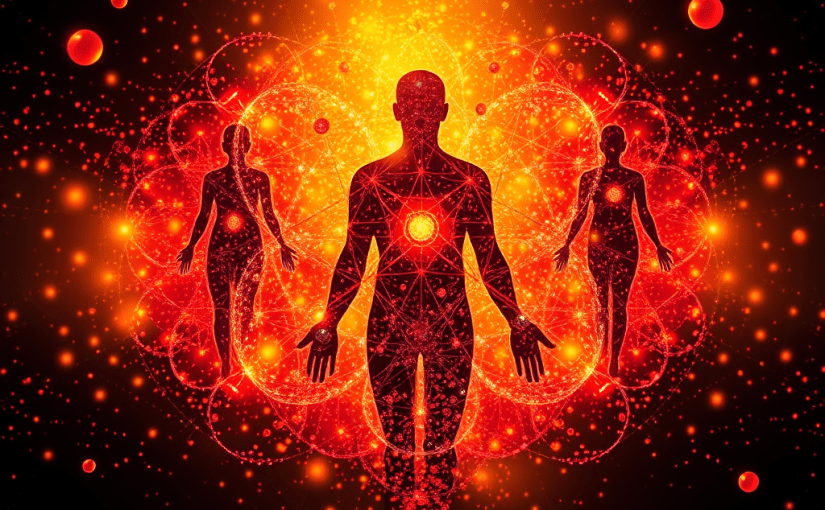
The nucleus of the human-form atom is the Muladhara, the powerhouse of energy that sustains all activity. Electrons circling around it represent thoughts and subtle energy, moving through various orbitals akin to the chakras. The higher orbitals correspond to higher chakras, culminating in the Sahasrara—the point of expansive consciousness. Nuclear fusion can be seen as the awakening of this system: an outburst of energy from the Muladhara surges upward through the chakras, activating them fully and giving birth to improved consciousness, where the new atom formed has larger flows of Ida, Pingala, and Sushumna, and a greater number of outer chakras, symbolizing expanded consciousness. Just as fusion releases immense energy by merging nuclei, kundalini awakening channels the latent potential of the Muladhara to the Sahasrara through the merging of Shiva and Shakti, producing a transformed, expansive, and enlightened state, with the chakras aligned and pointing toward the full expansion of consciousness. Even though both nuclei (or both Muladharas in a Tantric pair) are essentially of the same “type” or nature, for the purpose of attraction, union, and merging, they are treated as opposites as Shiva and Shakti—like complementary polarities that allow energy flow and unification. The legendary Brahmastra, fired by yogis such as Guru Putra Ashvatthama, can be seen as a similar awakening, but applied in the worldly domain—harnessing the same primal energy for external effect rather than inner transformation. Or it may be that the sages knew this psychological secret, reflected also in the physical material world, and expressed it both literally and philosophically through spiritual-metaphoric stories.
Electrons do not move gradually between orbits—they leap suddenly when enough energy is absorbed. In yoga, too, states such as dhyana and samadhi unfold in sudden leaps, not in slow crawling. This explains why enlightenment often feels like an instantaneous shift, even though the preparation may take years. You can determine the probability of an awakening occurring—how likely it is under certain conditions—but you can never predict the exact moment it will happen, just as in quantum mechanics where you know the probabilities of outcomes but not the precise result of a single event. The silent jump of an electron to a higher orbit can be likened to dhyana ripening gradually through repeated inner leaps between chakras—peaceful, steady, and gradually transformative. In contrast, the great surge of nuclear fusion resembles the moment when awareness itself flashes: the energy of the self previously bound and sleeping in muladhara suddenly leaps into pure, boundless consciousness, joining the endless expanse of full potential. In that momentary blaze, the atom also experiences boundless bliss and light, before stabilizing into a new, transformed, and evolved state—just as an awakened yogi shines with renewed being. It is exactly like Tantric Yoga, where the Muladharas of two loving partners merge, releasing an explosive surge of energy that rises from the base upward, piercing all the chakras, until it expands into the boundless infinity of the Sahasrara. Two nuclei merge to maximum extent but a small portion still remains unmerged that is converted to large amount of energy spreading upward. Similarly, both muladharas of a tantric couple share their energies with each other akin to merging as much as possible, but still some energy remains unmerged. Probably this extra energy left after merging manifests as awakening. In this sense, what tantra calls detachment can be seen as this unmerged residue of energy—preventing the partners’ energies from clinging completely, and instead redirecting the unified current upward for the awakening of the meditation image and self-realization. Just as in fusion, the unmerged part becomes the source of tremendous release, so too in tantra it is the subtle detachment that transforms love into awakening. Just as nuclear fusion requires intense heat to occur, tantric kundalini awakening too needs the inner heat generated by worldly activities, loving relationships, and the contemplation of non-dual philosophy such as Sharirvigyan Darshan.
People often perceive forbidden relationships as more thrilling because they are often formed in broad awareness of daytime, unlike genuine family bonds that society sometimes associates with duty or constraints, and often reserved for the ignorance-filled dark of the night when one is fully tired and exhausted due to roaming blindly and wildly amidst the so called job-jungle throughout the daytime for so called important livelihood activities, as if it is the least important work in the world so far. Even then it works fine more or less. What good not to expect if it is done in full awareness. Moreover, if family relationships were valued and nurtured openly in the light of day—with clarity, respect, and mutual understanding—there would be little attraction toward what is considered illegal. Just as nuclear fusion happens in broad daylight inside the sun—with full awareness, without secrecy, without being forbidden—resulting in the enhanced light of awareness, so too can lawful, harmonious bonds generate true fulfillment when embraced openly. Clinging to the external form of a partner without understanding the sameness of energetic essence in every human being is also a reason for attraction toward relationships outside the family. When Tantra shows its effect, this fact is properly understood and truly believed. Needless to say, I have seen near perfectly matching pairs go astray by not recognizing this deeper energetic essence and by being superficially swayed by egoistic patterns.
On the other hand, in the psychological fission, it is as if the neutron—the awakened sushumna of a potential partner—strikes the muladhara, the nucleus of the possible lover, and breaks it open into two. One half is the bunch of ego, while the other half is like the pure soul, suddenly lightened by shedding the burden of impressions. The energy that was once bound tightly within egoistic thoughts is now released and becomes available for awakening. Just as in nuclear fission the mass of the resulting nuclei is slightly less than that of the original, with the difference emerging as an immense burst of energy, so too the breaking of the ego releases a vast inner power. The mass of egoistic patterns shed is transformed into this energy. This surge of liberated energy flows upward, igniting awareness and transforming consciousness. Such a shift cannot occur through an ordinary bond; it can only be catalyzed by the presence of a partner whose sushumna is awakened, carrying the force to dissolve ego and redirect the released energy toward spiritual awakening. Just as nuclear fission does not require extremely high temperatures to occur, in the same way this indirect tantra does not demand the intense heat of passionate worldliness, unlike the fusion-form direct tantra described above. Can we, by extending this analogy, also discover a method of cold fusion—one that could solve the world’s energy needs forever? If nuclear fusion is the fiery union of energies and fission the breaking apart of burdens, perhaps the hidden key to cold fusion lies in the same mystery that tantra reveals—that energy, when rightly aligned, can be released without fire, silently transforming both the yogi and the world. But the problem with fission is the production of toxic radiation—just like the toxic thoughts that arise when love-filled relationships are made for breaking instead of union. If this is resolved, the energy problem is solved.
Moreover, this is not mere theory—by the grace of my guru and God, I have personally experienced both of these phenomena, receiving awakening glimpses through both fusion-like union and fission-like breaking apart.
Seeing the grand similarity between the atom and the body, it is not hard to believe that an atom can be understood as a complete human body in itself, just as these flowing chapters of Quantam Darshan have been asserting since the very beginning.
Repeating further, energy levels are like the blueprint of all diversity. Electrons can only exist in certain allowed energy levels around an atom’s nucleus, and these positions determine the atom’s behavior—how it bonds, reacts, or inter acts with other atoms. This arrangement shapes the molecules that form, deciding whether they become water, sugar, or DNA.
An atom’s energy levels can be imagined as the floors of a building, with electrons as tenants who can only occupy these designated floors. Lower floors fill up first, following specific rules, while the outermost floor—the valence level—holds the electrons that interact with the outside world and determine how the atom bonds or reacts. The energy gaps between floors act like elevator heights: small gaps allow electrons to move easily, while large gaps require precise energy input, such as from photons. Altogether, the number of floors, the arrangement of tenants, and the spacing between floors form a blueprint that dictates where electrons can be, how they can move, and ultimately how the atom behaves and interacts chemically.
On a much larger scale, the life of a star is determined by the nuclei of its atoms—the number of protons and neutrons—which dictate the nuclear fusion reactions in its core and whether the star burns steadily like our Sun or ends violently as a supernova.
In the heart of every star, life is sustained by hydrostatic balance—the delicate equality between the inward pull of gravity and the outward push of nuclear fusion. If fusion pressure runs ahead, the star swells outward until cooling slows the reactions and balance returns; if gravity takes the lead, contraction heats the core until fusion strengthens again. This harmony allows stars to shine for billions of years, but when their core fills with nuclei such as iron, which cannot yield net energy by fusion, no outward push remains to resist collapse. Gravity then crushes the core, sometimes into a neutron star, sometimes into a black hole, or in rare majesty, releasing all stored energy in a supernova explosion. So too in the inner cosmos: the body endures as long as prana, the fuel of life, sustains the balance between the contracting pull of ego and the radiant expansion of awareness. If awareness expands without grounding, the mind scatters; if ego contracts too tightly, consciousness suffocates into bondage. But in perfect equilibrium arises a steady luminosity—egoless quantum darshan, the inner sun burning without exhaustion. And when prana is finally exhausted at life’s end, the soul too meets its destiny: if awareness bursts free of ego’s last grip, liberation shines like a supernova, scattering individuality into the vastness; but if egoic gravity still outweighs, the soul collapses inward, bound like a neutron star or lost in the depths of a black hole—its journey continuing until balance is rediscovered.
Moreover, electrons and their energy levels play only an indirect role in this, influencing how radiation moves through the star. Without these energy levels setting the rules for electrons, nothing would take shape: no chemistry, no molecules, no planets, and no living beings to notice it.
The Drama of Quantum Jumps
Bringing the story to the fore again, you may have heard of the term “quantum jump.” It is not just a metaphor—it is a real event. When an electron absorbs or emits energy, it does not glide smoothly but suddenly leaps from one energy level to another. This jump is accompanied by light—what we call photons. And these photons are the messengers of creation, carrying information and energy across the universe.
Every ray of sunlight, every twinkle of a star, and every color in a rainbow arises from electrons making quantum transitions between energy levels. In stars and atoms, multiple energy levels exist, and the timing and path of each transition are probabilistic, giving photons a spectrum of colors and intensities—a whisper of the quantum world. In contrast, engineered systems like LED bulbs force electrons to drop across a single fixed energy gap, producing light of a steady wavelength and color. Whether probabilistic or fixed, each photon is still born from the same quantum rules, linking the microscopic choices of particles to the vast tapestry of creation.
Energy Levels and the Symphony of Life
If spin brought individuality and momentum brought direction, then energy levels bring structure. Consider the orchestra of life. Proteins fold into shapes, DNA forms a double helix, water forms crystals of ice—all because electrons collapse into specific energy levels, giving atoms predictable bonds and patterns.
Had these collapses gone differently, perhaps the chemistry of life would not exist. Imagine a universe where electrons never settled into stable shells—there would be no stable atoms, only chaos. Imagine a universe where energy gaps were wider or narrower—water might not exist, oxygen might not bind, and life as we know it could not breathe. Even sunlight would fail to power biology, because the energy of its photons would not match the molecular energy gaps needed for processes like photosynthesis or vision.
Thus, energy levels are not random—they are the stage upon which life performs.
Chakras as Quantum Energy Levels of Consciousness
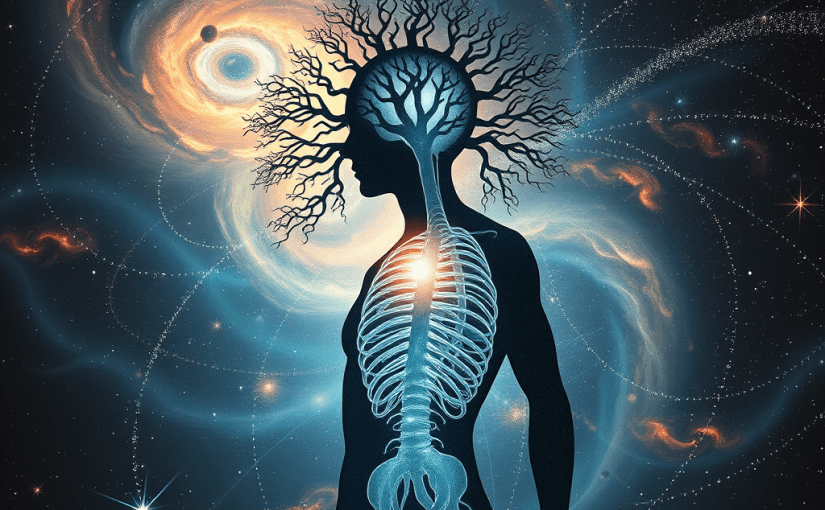
If we dwell on the chakra–energy level analogy again, we find that in both the quantum world and the human subtle body, energy shows a natural tendency to move in waves. Just as quantum energy in bound systems oscillates as standing waves with crests and troughs, fitting only discrete levels, while free waves spread continuously yet obey the same quantum laws, Kundalini energy too bound in muladhar-sahasrar axis undulates like standing wave from left to right and back, as if sahasrar and muladhar are its two nodes where wave returns back and forth in a closed loop, energizing the chakras as it rises from Mooladhara to Sahasrara and back again going repeating the pendulum like movements. Movement of both is snake-like. It appears snake like when different chakras act as different nodes. standing wave from one node to next node is one loop or half of the full curvature of snake, the second standing wave from next to further next chakra is second loop or second half of snake’s full one curvature and likewise. It is just intertwined play of ida nd pingla. Similarly, serpent nature of standing electron wave is more visible in p-wave, when two loops of stnding waves join together. Though Kundalini is one serpent power, it expresses itself through two oscillating currents—Ida and Pingala—which spiral around the central Sushumna like twin serpents around a staff, much like the caduceus symbol. Each chakra can be seen as a different energy level, much like the quantized states of an atom, where energy is not continuous but arranged in distinct steps that require a “jump” for transition. Just as electron-energy manifests as different characters of the atom at different levels, prana-energy manifests as different characters of the human being at different chakras. In physics, energy levels are measured in electron volts, and the electron’s presence within each level forms a standing wave enveloping nucleus—a probability pattern revealing where it is most likely to exist. In yoga, these same principles appear as vibrational centers of prana and consciousness. Means any centre from muladhar to sahasrar may be activated as per probability wave distribution and favoring the points where amplitude of oscillations is high. Both show the same profound truth: energy moves in oscillations, rising and falling, before settling into harmonious unity of sushumna as collapsed particle.
It is truly experiential. When the brain is tired from work, it actually receives energy from the base in a wave-like fashion. Sometimes this energy moves alternately along the left and right sides, directly merging at the Ajna Chakra and energizing it. At other times, it rises only up to the Heart Chakra and merges there. There is no fixed rule that it must always ascend step by step through each chakra from bottom to top, although mostly it tends to do so.
A Universe Sculpted by Choices
Think of the entire cosmos as a vast painting. Spin provides the brush strokes, momentum provides the direction, but energy levels provide the colors. Each collapse decides which hue appears, how bright it is, and how it blends with others. Together, they form the masterpiece of stars, galaxies, and living beings.
The amazing part is that all this structure comes from simple binary choices at the quantum level—this energy rung or that one, up or down, here or there. Multiply these micro-choices over cosmic time, and you get the grand, diversified creation we live in.
Quantum Collapse – The Engine of Creation
At this point, we can see a deeper pattern. Spin, momentum, position, and energy levels are all qualities waiting to be decided. But nothing is determined until a collapse occurs. Quantum collapse is like the beating heart of the cosmos. It pumps out choices, moment by moment, and each choice builds on the last, driving forward the story of creation.
If there were no collapse, the universe would remain a haze of probabilities, a dream never waking. But collapse turns possibility into reality. It is the engine of creation, transforming silence into song, emptiness into form, and potential into life.
So when you feel the warmth of sunlight, sip a glass of water, or look at the colors of a flower—remember that all of it is born from the humble but profound act of quantum collapse at the level of energy. Without those invisible decisions, the visible world would never exist.


 Demystifying Kundalini