Nonduality on the Street: What Dogs Quietly Teach Us About Being Whole

Nonduality and Animal Behaviour: Understanding How Dogs Perceive Reality

Most conflicts between humans and animals do not arise because animals are violent or humans are weak. They arise because humans forget how animals perceive reality. Dogs, especially street dogs, do not respond to our words, beliefs, professions, or intentions in the way we imagine. They respond to state. They sense whether a being standing before them is internally divided or internally whole. This difference alone often decides whether a dog barks, chases, attacks, ignores, or quietly settles.

A dog does not encounter us as a psychological story. It encounters posture, breath, facial tension, rhythm of movement, and the invisible but very real coherence or incoherence of the nervous system. When a human lives in inner division—fear mixed with courage, friendliness mixed with suspicion, dominance mixed with anxiety—the body leaks signals. These signals create edges, and edges invite testing. Barking, circling, and chasing are not moral judgments; they are responses to fragmentation. When a human is internally unified, however, something entirely different is perceived. The body moves as one piece. The breath flows evenly. The face carries no agenda. To a dog, such a human does not appear as another competing individual. He appears as part of the environment.

Nonduality and the “Mountain Effect”: Why Coherence Dissolves Conflict

This is why the metaphor of “being one with the mountain” is not poetic exaggeration. When a person is inwardly undivided, the animal nervous system reads scale, not size. The human feels large, not because of muscle or dominance, but because there is no resistance to push against. Animals do not fight mountains, rivers, or weather. They adapt to them. In the same way, a coherent human presence often dissolves confrontation before it begins. The dog does not submit; it disengages. Dogs primarily challenge what they perceive as a threat to their territory. A nondual being makes the least claim on resources and shows minimal territorial behavior, which dogs instinctively respond to positively. In practical life, one must of course keep possessions in order to live, but inwardly one remains nondual—akin to being possessionless. A mountain may hold countless forms of natural wealth, yet inwardly it is almost possessionless. Actually, all healthy animals instinctively appreciate nonduality, because they are closest to it—though compulsively rather than by conscious choice.

How Dogs Read the Human Face and Body

Dogs are highly sensitive face readers, but not in the emotional sense humans assume. They read movement, contrast, breath, and eye tension. Wide eyes, exposed sclera, projecting chin, forward breath, and sudden motion activate reflexive circuits, especially in abnormal or stressed dogs. A relaxed, upright head with the chin slightly tucked—not collapsed—soft eyes that are neither staring nor fearful, and a neutral, peripheral gaze communicate something very specific: awareness without challenge. This posture is not submission; it is protection without aggression. Children, especially, must be taught this, because most bites occur when fear and excitement amplify facial signals.

Limits of Nonduality: Rabies, Extreme Stress, and Reflex Behaviour

It is important to understand that nonduality is not a magic shield. It works well with normal, socially regulated dogs, particularly when encounters are individual and calm. It does not reliably work with rabid dogs, severely injured animals, starving animals, or highly aroused packs. Rabies damages inhibition. In such cases, subtle presence gives way to raw reflex. Calm behaviour reduces reactions as long as perception is intact. When perception collapses as in rabies, severe pain or hunger, reaction runs on reflex. Sometimes instinctive actions—creating distance, increasing physical silhouette, using barriers—can pause an attack, as in the experience of lifting a large boulder overhead during a rabid assault.The dog probably sensed my body as being huge, with my face partially shielded by it. This is why the technique of increasing apparent body size—such as holding a stick or a bag wide in front with both hands or becoming tall lifting both hands up—sometimes works. However, these actions should be done softly and calmly, with a nondual attitude and without fear, in a defensive—not attacking—sense. One should never attack, because we can almost never overpower a beast. That pause may save seconds. But only medicine saves lives. Washing wounds thoroughly and seeking vaccination and immunoglobulin is not optional. There is no spiritual immunity to rabies, and pretending otherwise costs lives.

Essential Safety Education for Children Around Dogs

Children should also be clearly advised never to pelt stones or sticks at dogs, never to pass close to a sleeping dog, and never to stare continuously into a dog’s eyes, as this is read as a challenge. Children can easily underestimate the strength of small-looking dogs, so they should be made aware that even smaller dogs possess hidden, inherent strength and can cause serious injury. They should not rush or run suddenly, because dogs often interpret such movement as an act of theft or escape. Instead, one should calmly walk back in a slow, reverse motion without turning the back, keeping the dog in peripheral view. Even while increasing distance, it is safer to remain partially oriented toward the dog, gazing sideways rather than fully away, because dogs sometimes approach silently from behind and may bite without barking. Facing the dog inhibits this and often repels further approach. Most importantly, children should avoid displaying fear, as dogs read facial expressions in a very direct, gross manner. These behaviors should not be acted or pretended; they must be genuine, because dogs can easily sense the difference between performance and real inner state. nearby elder people should be called for help, never to walk alone in dog prone areas. If an attack occurs despite all precautions, becoming passive by curling the body inward and protecting the head and neck does not usually encourage further aggression. Most dogs attack in response to movement, noise, and interaction, not from an intent to continue harm indefinitely. When these signals suddenly disappear, the feedback loop sustaining the attack often collapses, leading the dog to disengage once arousal drops. This approach does not guarantee safety in every situation—especially in cases involving packs, rabies, or extreme predatory states—but it can significantly reduce the severity of injury by protecting vital areas. Passivity here is not surrender, but the withdrawal of signals that fuel aggression, buying critical time until the animal disengages or help arrives.

Personal Experiences of Nonduality and Aggressive Dogs

Once, while I was in a state of full nonduality arising from śarīra-vijñāna darśana, I approached the door of a stranger’s house. Suddenly, a dog jumped toward me with intense anger—barking fiercely, teeth fully exposed in a way that felt genuinely dangerous. I remained standing as I was, without reacting outwardly, and slowly called the owner in a calm voice. The dog stopped right near my feet and began wagging its tail. In a similar incident some years earlier, within three years of my dream-state awakening, a dog tethered by a chain at a house broke free and charged toward me with comparable aggression, yet again stopped near my feet in the same manner. I had gone there to treat that dog and had treated him earlier as well, so perhaps some remembrance existed. More recently, during a phase of what I call quantum-darśana nonduality, I encountered a stray dog at a shopkeeper’s house. It jumped toward me with an intensity of aggression that is difficult to describe fully. I raised my hands calmly and, with a gentle smile, spoke softly—playing lightly, saying that I meant no harm, asking it to calm down. The dog stopped near my feet, allowed me to touch its body affectionately, and then walked away peacefully, sniffing the grass with curiosity. I do not know whether the dogs were responding with amazement to a sensed state of nonduality, or whether nonduality itself prevented the bites. Perhaps both explanations are partially true.

Pack Dynamics: Why Groups Behave Differently

Pack dynamics reveal another layer of reality. A single dog reads a human. A pack reads itself. Once arousal crosses a threshold, individual awareness collapses into collective rhythm. Even calm dogs may act against their own earlier disposition. This is why packs often target crowds rather than solitary, coherent individuals. Chaos mirrors chaos. Coherence has nowhere to land in noise. Leadership in packs functions only while the pack remains socially regulated. A socially intelligent leader can anchor calm and prevent escalation—but only before ignition. Once panic spreads, hierarchy dissolves and physics replaces psychology. This is true for dogs and humans alike.

Street Dog Leadership and Shared Territory: A Real Example

A lived street example illustrates this more clearly than theory. A patwari—a revenue employee—used to attend early-morning yoga classes at a temple. A stray pup settled with him first, drawn by routine, calmness, and predictability. The dog was physically cared for by his family and became part of that household’s daily management. Much later, another person entered the same street. Normally, a street dog would respond to a late entrant with suspicion, barking, or chase. Instead, the dog responded with amazement and closeness, without anger or testing. This was not because of association alone. It was because the newcomer did not enter as an intruder but as coherence. There was no territorial counter-pressure, no dominance, no fear. The dog sensed no edge.

Over time, two bonds coexisted naturally. One bond was logistical—food, shelter, routine, survival. The other was orientational—calm presence, non-interference, inward settlement. Dogs are capable of this maturity. They can eat in one place and orient emotionally to another. They attach inwardly not to who gives the most, but to who disturbs them the least. That is why some attachments feel quiet and deep rather than clingy or possessive.

In a later incident, when a territorial dog beneath a car triggered an alarm and other dogs began assembling, the street dog positioned itself near the coherent human, growled without charging, and faced the others. It did not bark hysterically. It did not attack. It held space. That single act communicated affiliation, legitimacy, and controlled authority. The pack dispersed—not out of submission, but because the situation was re-evaluated and arousal dropped below ignition threshold. In pack situations, dog-to-dog signals override human presence. Calm human behavior matters because it allows such leadership to function rather than amplifying chaos. A similar neighbourhood experience happened to me when I was at the peak of nonduality. The dog used to look at me with a sense of closeness mixed with amazement.

What Dogs Ultimately Teach About Nonduality

All of this carries an important lesson for children and society. Animals are not enemies. They do not understand our words, arguments, or moral self-images. They understand whether we are at war inside or at peace. Teaching children not to scream, stare, run suddenly, or invade animal space is not fear-based education; it is intelligence-based education. Most bites are preventable when perception replaces panic.

Dogs do not practice nonduality consciously. They never left it. They live without inner conflict. Humans leave that ground through excessive thought and return to it through coherence. When humans return, animals respond naturally—not as disciples, but as mirrors. Life stops pushing back, and the mind stops splitting. In that sense, dogs encourage nonduality not by instruction, but by rewarding wholeness with peace.

Conclusion: Nonduality as Practical Wisdom

Nonduality, then, is not a belief system. It is a way of being that reduces friction with life itself—including animals. Wisdom lies in holding presence, science, safety, and compassion together. Presence prevents many conflicts. Medicine saves lives. Education saves society.

Animals do not understand what we say.
They understand whether we are whole.

Chapter 22 – Superposition and Collapse: The Dance of Choice and Becoming

Creation is not a frozen script, but a living play of possibilities. At the quantum level, reality does not exist as fixed entities waiting to be discovered—it exists as superpositions, states of “may be,” “could be,” “shall be.” A particle before observation is not one thing or another; it is many things at once, carrying the fragrance of infinite futures. But when collapse happens—when an act of choice arises out of the silent field—one possibility is plucked from the garden of infinity and becomes the reality of this moment. Thus, superposition is the womb of creation, and collapse is its birth.

Imagine a child standing in front of a shelf of storybooks at night. Before choosing, every book is a possible story for the night — all the adventures, mysteries, and fantasies are equally open. It’s like a whole library of possible nights even though the child will read only one. But the moment the child picks a book, that story becomes the night’s reality, and all the other stories fade back into the shelf. This is exactly how superposition and collapse work: many possibilities exist at first, and one becomes real when the choice is made.

The sages of India intuited this mystery long before the equations of quantum mechanics. In the Upanishads, Brahman is described as “neither this nor that, yet also this and that”—a description that mirrors the quantum superposition. It is the realm where all attributes are held simultaneously, but none is bound. Collapse then is like the act of Ishvara Sankalpa—the divine will choosing to manifest a particular form from the unbounded potential of Brahman. Every event, every form, every particle we see is thus a frozen decision within this eternal game of becoming. That is why the Upanishads declare eko’ham bahu syām—“I am One, and I shall become many”—the divine will at the beginning of creation. Why not see this cosmic will as the very first collapse of pure potential into actuality, taking the form of fundamental fields and particles with specific properties such as form, charge, position, spin, and momentum?

Superposition: The Silent Ocean of Possibility

Imagine standing at the ocean early in the morning. The water is very calm, but that calmness is full of hidden possibilities—waves could rise in any direction at any moment. This is like superposition, where many outcomes exist together before anything is measured. In this “possibility state,” an electron is not spinning clockwise or counterclockwise—it is in a special quantum state that contains both possibilities at once, just like the calm sea contains all the potential waves before any one wave actually forms. Nothing is fixed yet; everything is only potential, waiting for one specific outcome to appear when observed.

In Sankhya, Prakriti before disturbance is completely calm — the three gunas are balanced, nothing has taken form, and nothing has begun. It is a state of pure potential. This is just like superposition in quantum physics, where all possibilities exist together but none is chosen yet. It’s called Prakriti in samyavastha or equilibrium. Prakriti waits for the presence of Purusha before anything moves or evolves. In the same way, a quantum state waits for measurement or interaction before one outcome becomes real. The moment Purusha’s attention falls on Prakriti is like the moment of collapse in quantum mechanics — the instant where potential becomes creation, and one definite reality appears. It’s called kshobha or disturbance in Prakriti. Why not call underlying fields as prakriti in samyavastha and particles born from them as kshobha in prakriti.

Prakriti is like sugar syrup. Within it, the sugar particle in it represents sattva; its dispersed presence throughout the syrup represents rajo guna through constant but unnoticeable movement; and its dissolution, where the particle no longer exists in solid form, represents tamo guna or destruction of particle form. Means in mool prakriti, all the three gunas remain in unchanging amount equally dispersed everywhere. It’s samyavastha. But when sugar particle is separated back from syrup through crystallization etc., then sattva guna varies at different locations as sugar particle has more concentrated sattva than rest of the sugar syrup. Similarly rajoguna also varies as sugar particles shows more concentrated motion than rest of the sugar solution on heating. With this tamoguna also varies for destruction or dissolution back of sugar particles contains more concentrated tamoguna or destruction than the uniform tamoguna in rest of the sugar syrup. If we replace the sugar particle with a quantum particle, the sugar syrup becomes the quantum field. The formation of a particle then expresses sattva as form, rajo guna as motion, and tamo guna as the particle’s eventual changing form, destruction or dissolution back into the field. It proves the same quantum fields were experienced by ancient sages with inner eyes which scientists are discovering as quantum fields through physical experiments. Brahma can be called as cosmic quantum field and soul as individualised quantum field as it has individual’s hidden impressions made from its countless lifetimes. Soul reborns again and again from this individualised quantum field. Liberation is like dissolving of even this field back into pure void space that’s nothing at all and is the background of grand quantum field aka prakriti. It’s only practically possible through nirvikalp samadhi, the top achievement of yoga.

There must exist a grand, all-encompassing quantum field from which every known quantum field arises. Science has not yet detected it, but logic strongly points toward its existence, because everything in nature moves toward unification. Just as diverse particles emerge from individual fields, all fields themselves must emerge from a deeper, singular foundation. In philosophical terms, this is the modern reflection of Prakriti—one source field from which all forms arise and into which they dissolve. Although string theory and few other scientific theories are speculating it.

Collapse: The Birth of Form

Collapse is not destruction; it is birth. When superposition resolves, a particular outcome is chosen and becomes the world. It is like the sculptor striking a block of marble: infinite shapes are hidden within, but one form emerges. Collapse is the act of manifestation, the narrowing of infinity into one thread of reality.

The Nyaya Darshana speaks of pramana, valid means of knowledge, where perception crystallizes the uncertain into the certain. Collapse is a cosmic pramana—it validates one outcome as the “real.” But this validation does not cancel the unseen others; they remain as shadows, as unseen branches in the cosmic tree, perhaps flowering in parallel universes.

Thus, every collapse is like an act of cosmic decision-making. The world is not predetermined; it is continuously deciding itself into being.

Choice as the Engine of Creation

Why is collapse so central to creation? Because collapse is the very engine of becoming. Without collapse, everything would remain an undifferentiated soup of potentials—silent, formless, directionless. Superposition is the clay, but collapse is the potter’s hand.

The Yoga Darshana explains creation as a process of sankalpa-shakti, the power of intention, arising from consciousness. The yogi is taught that by stilling the modifications of mind (chitta vritti nirodha), one returns to the ocean of possibility; but by focusing thought and intention, one collapses possibility into reality. In this sense, collapse is not only physical but also experiential. Each thought we entertain collapses infinite ideas into one lived reality.

In human life, collapse appears as choice. At every moment, we hover in superposition: Shall I act or refrain? Shall I love or withdraw? Shall I see the divine in the other, or reduce them to an object? Each decision collapses countless options into one stream of destiny. Thus, collapse is the bridge between freedom and form.

Quantum Collapse and Indian Metaphysics

In Vedanta, the play of Maya is described as veiling (avarana) and projection (vikṣepa). Superposition mirrors the veiling: the true state of things remains hidden, undefined, unmanifest. Superposition also veils the self luminous soul when it’s ready to collapse. Actually soul doesn’t collapse and can never collapse as it has nothing inside. It is perfect zero. It’s a perfect void. When soul of Brahma takes the form of prakriti, then it becomes full of all potentials. Although basic supreme soul remains fully void as such always. It means the soul of Brahma needs to become veiled to entertain the Collapse. Veiled means there is everything or every outcome in prakriti or bound soul in hidden or veiled or potential form without anything yet expressed through collapse. Collapse mirrors projection: a specific form is projected into consciousness of Brahma or human whatever level. What is hidden becomes revealed, what is possible becomes actual. The cycle repeats endlessly, each collapse weaving the fabric of the manifest.

The Bhagavad Gita proclaims: “I am the gambling of the gambler, the chance among things.” This chance, this sudden crystallization of one possibility among many, is none other than collapse. It shows that creation is not mechanical necessity alone—it is also play (lila), spontaneity, surprise. The universe evolves not by rigid design, but by the freedom of collapse.

Collapse as Sacred Fire

Consider collapse as Agni, the sacred fire. In the Vedic sacrifice, offerings are placed into fire, and fire transforms them into smoke and flame that rise to the heavens. In the same way, the infinite offerings of potential are cast into the fire of collapse. From that fire arises one reality, glowing with form and direction. Every collapse is thus a yajna, a cosmic sacrifice where possibilities are consumed to give birth to actuality.

This yajna continues ceaselessly: electrons choosing orbits, galaxies forming shapes, cells dividing, humans making decisions. All are flames of the same sacred fire.

The Pulse of Becoming

Superposition and collapse together form the pulse of becoming—the systole and diastole of the cosmic heart. Superposition is expansion into infinity, collapse is contraction into form. Together they beat, again and again, generating time, space, and history.

The Kashmir Shaiva philosophers described creation as the pulsation (spanda) of Shiva’s consciousness—an eternal throb between stillness and manifestation. Modern physics echoes this ancient intuition: reality is not a frozen block but a dynamic dance of probabilities collapsing into certainties.

Collapse and Evolution of Complexity

Each collapse does not occur in isolation; it feeds into the next. A particle’s collapse shapes its neighbor’s potential, like ripples overlapping in a pond. Over time, these ripples build into patterns, and patterns into structures. From hydrogen atoms to stars, from DNA to consciousness, the universe evolves because collapses accumulate into order.

In this sense, collapse is not merely local but evolutionary. The cosmos learns from each decision. Diversity emerges because collapses never follow a single path but branch into endless variations. Unity emerges because all collapses occur within the same underlying field. Creation is thus diversity in unity, and unity in diversity.

Collapse as the Mirror of the Self

Collapse is not just a physical event—it mirrors the movement of the Self. The Self is simply that which chooses, that which says, “I am this.” Means it ignores all of its hidden potentials and selects only a single outcome to identify with. In deep meditation, when thoughts fade, we rest in a state like superposition—pure being, without any identity. But the moment a thought appears, a collapse happens: the mind claims, “I am this body, this person, this story.” In this way, life becomes a continuous series of collapses happening on the still, silent ocean of superposition.

The Advaita Vedanta reminds us that behind all collapses, the Witness remains untouched—the pure consciousness that neither chooses nor becomes, but allows all choices and becomings to appear. To know that Witness is liberation, the transcendence of collapse itself. Probably it is this very same detachment and non-duality by whatever means, out of which quantum darshan can be a good one.

Quantum Collapse: The Engine of Creation

If we look at the grand picture, superposition provides the infinite palette, collapse paints the stroke. Together, they are the engine of creation. Without superposition, no possibility; without collapse, no actuality. Creation is thus not a single event but a continuous unfolding, driven by the rhythm of superposition and collapse.

This engine powers not only physics but life, mind, and spirit. Every breath is a collapse of air into lungs, every word a collapse of thought into sound, every act a collapse of freedom into destiny. The universe is not a machine, but a living story—authored moment by moment by the choices of collapse.

Copenhagen interpretation says the collapse is real and that no outcome is determined in advance—and many experiments support this. I also appreciate pilot-wave theory, where a particle is guided by a wave. It fits experimental results quite well. However, it claims that every outcome is already determined, which aligns with Indian philosophy that says everything is predetermined—even the movement of a leaf—and that humans are merely puppets.

If we think logically, when the probability distribution already tells us where a particle is most likely to be found, then perhaps the exact position is also predetermined; we simply do not know it yet.

Many-worlds theory is philosophically remarkable as well. In it, there is no collapse of superposition into a single outcome. Instead, every outcome manifests in parallel worlds. This resembles the human mind: one person may perceive a tree as tall, another as short; one may see it as more green, another as less green. A single object gives rise to multiple subjective outcomes. Many-worlds, in a sense, implies many minds—because the world is nowhere but within the mind.

Yet, among all interpretations, the Copenhagen interpretation—superposition and collapse—fits experimental observations most directly. That seems to be how nature operates everywhere. It is a kind of Darwinian quantum evolution: the peak of the amplitude is the most likely outcome, and nature consistently evolves toward it.

De Broglie was right: everything has a wave nature, whether electron, photon, atom, molecule, mountain, planet, or galaxy. Development occurs through survival of the fittest, and the “fittest” option is simply the option with the highest amplitude. This reveals a deep non-duality, where everything—physical or mental—operates through similar underlying patterns.

At the foundation of reality lies the pure quantum world, an impersonal field that performs the entire cosmic play without any capacity to feel. It creates, transforms, and dissolves everything effortlessly, yet it remains completely non-experiential, untouched by emotion or awareness. From this arises the quantum-human, a subtler layer where feeling and experience do appear, but with complete detachment and nondual clarity. The quantum-human experiences all sensations, thoughts, and perceptions generated by brain-wave dynamics, yet never mistakes them as “mine,” and therefore remains inwardly free. The mistake happens at the level of the macro-human soul, the ego-sense, which identifies with these brain-wave activities and assumes, “These thoughts are mine, these feelings are mine, this world is mine.” This misidentification creates duality, attachment, and ignorance. The quantum-human represents the middle path—a state in which a social human aka macro human being can still feel, relate, think, and live, but without falling into attachment and ignorance. Unlike the purely non-feeling quantum world, which no embodied person can emulate while living, the quantum-human offers a balanced model: fully feeling, fully aware, yet inwardly liberated. This is the practical ideal that Quantum Darshan points toward—living in society while maintaining the detachment and freedom that arise from understanding the deepest quantum game.

In nutshell, the main point of the story is that mystics discovered the ultimate truth and perfect peace by practicing seeing everything in the world as equal to themselves this way or that way that I also feel—meaning the inner working of everything is similar to that of a human being. Experience has already revealed this, and science will also reveal it fully one day. The division between living and non-living is superficial; at a deeper level, the functioning of all things is astonishingly similar. Call it the collapse of potential thoughts into specific thought or thoughts into a decision or something else—experience can never be denied simply because science has not yet fully explained it. Experience reigns higher than science. First comes experience; science only later affirms it so that even laypeople and non-believers can understand and believe it.

Conclusion

Superposition is the silence of infinite potential; collapse is the voice that speaks one possibility into being. Together, they form the essence of creation: freedom held in balance, then released into form. The Indian darshanas recognized this in their own tongues: as Purusha’s glance upon Prakriti, as the projection of Maya, as the pulse of spanda, as the divine will of Ishvara. Modern physics recognizes it as the quantum wave collapsing into measurement. Both are describing the same mystery: reality is not found—it is chosen, moment by moment.

Creation, then, is not behind us as a past event, but within us as an ongoing act. With every collapse, the universe is reborn.

Enhancing Dhyana through Yogic Cleansing Techniques

Recently, I noticed that after performing rubber neti, a distinct sensation persisted along my left nostril passage. When I sat down for dhyana and focused on this sensation, my breath felt partially suspended, and I could observe subtle internal responses. I had also done vastra dhauti, and together these practices led me into a wonderful state of kevala kumbhaka during dhyana. This shows that such cleansing techniques truly support meditation. This heightened sensitivity is likely connected to the internal awareness cultivated through yoga and pranayama practices.

Later, during Vastra Dhauti, I ingested a full-length gauze bandage of about one and a half feet, though I captured its end carefully with my hand to ensure safety. Unlike earlier experiences where I felt resistance from the lower esophageal sphincter, this time it came out easily when I pulled it. I reflected on why the sphincter’s grip was different this time. Physiologically, sphincter tone naturally varies due to factors like relaxation, digestion, hydration, and nervous system state. From a yogic perspective, classical texts describe the resistance as the body’s natural “gate” holding impurities, which can reduce as the body becomes cleansed and the channels more open.

I also considered recent influences on my internal state. About fifteen hours earlier, I had consumed a beverage containing a small percentage of green tea along with herbal components. That night, I experienced strong GERD with momentary suffocation during sleep. The combination of caffeine, catechins, and acidic foods like sour lassi and curry likely contributed to LES relaxation, increased stomach acid, and heightened sensitivity to reflux. Even sleeping with my head elevated 20–25% did not fully prevent the episode, highlighting that LES tone, residual acid, and heightened internal awareness can overpower positional benefits.

This experience reinforced my observation that prana-raising yoga can heighten sensitivity to GERD. Pranayama, Kundalini, and other prana-focused practices modulate the autonomic nervous system — often increasing vagal tone and at times sympathetic activity. These shifts can contribute to transient relaxations of the lower esophageal sphincter and, combined with heightened interoceptive awareness from yoga, may make sensations such as reflux more noticeable. Even a standard wait period of three to three and a half hours after meals does not always prevent reflux for someone with heightened sensitivity. That is why, in Yoga, cleansing techniques such as Vaman and Dhauti are prescribed — they help purify the digestive tract and may indirectly support functions like those of the LES.

I have clearly found that Keval Kumbhak Dhyana helps reduce GERD and gastritis. When I lie down to sleep in a bad mood, feeling bored or stressfully tired, acid often rises, burning my esophagus and throat, and even eroding my teeth. But when I sit for Keval Kumbhak Dhyana, I become cool and refreshed. After such practice, I notice that during subsequent evening or night sleep, acid reflux does not occur. This clearly proves that deep dhyana reduces stress and promotes healthy forward gut motility. I also feel an increase in appetite after dhyana. It means that easy and calm yoga, without strenuous or rapid energy shifts, is better in this condition.

GERD is primarily caused by transient lower esophageal sphincter relaxations (TLESRs), which are neurogenic reflexes mediated through the vagus nerve in the parasympathetic system. Excess vagal activation, often triggered by gastric distension or autonomic shifts, is what induces these relaxations. Constant sympathetic dominance by itself does not usually cause GERD, but it can impair esophageal clearance, slow digestion, and heighten stress-related sensitivity to symptoms, making reflux episodes feel worse. Thus, it is the dynamic shifts and imbalances between parasympathetic and sympathetic activity—rather than a single constant state—that underlie both the occurrence of reflux and the way it is perceived. So, it’s really over-activation or imbalance (too much of either, or rapid shifts between the two) that creates the problem — not their normal physiological levels. In yoga, however, the deliberate play of the sympathetic and parasympathetic nervous systems may often cause surges in either and rapid shifts between both states, which explains why heightened awareness of reflux can occur during intense prana-raising practices. However in yoga, both mechanisms can play a role — sometimes it’s just heightened awareness of normal reflux, and sometimes the practice itself can physiologically trigger reflux through vagal reflexes, abdominal pressure, or autonomic shifts.

I also explored alternatives to reduce such effects while retaining benefits. Non-caffeinated or decaffeinated green tea provides the antioxidants and catechins of green tea without stimulating the nervous system or relaxing the sphincter excessively. Choosing decaf blends or herbal infusions allows for the health benefits without aggravating GERD, making them more compatible with yogic cleansing practices.

Finally, I considered a safety protocol for Vastra Dhauti after reflux-prone days: waiting 24 hours after acidic or caffeinated foods, checking stomach comfort, ensuring well-lubricated gauze, maintaining upright posture, breathing calmly, observing LES response, and monitoring for soreness or burning afterward. This cautious approach, combined with attention to diet, posture, and timing of prana-raising practices, helps sustain the benefits of yogic cleansing while minimizing discomfort or risk.

The Dual Nature of the Soul: A Reflection of Matter’s Duality

In this regard, I find the dual nature of matter or particle very interesting. When we look at the finite particle nature, the infinite wave nature abolishes. It seems as if infinite space gets localized at a point space. When we observe its wave nature, the particle nature collapses. It means we cannot observe both natures together. These are completely contrasting to each other, and yet, they are two aspects of the same reality. This mysterious behavior is not just a property of physical matter but hints at something deeper, something metaphysical.

A similar phenomenon seems to happen with the soul or consciousness. When we observe the particle-like world inside the soul deeply with attachment, its infinite nature collapses into a localized experience. Our awareness shrinks down to the level of the senses, the ego, and the personal story. We get entangled in the world, and the vastness of consciousness becomes hidden.

On the other hand, when we try to see the infinite sky-like nature of the soul through yoga, meditation, or inner stillness, the localized experience collapses. The senses become secondary, the ego fades, and the experience of the infinite opens up again. It seems that we cannot observe both natures together deeply with attachment because both are completely opposite to each other. This is exactly why the seers have been saying since ages that the world and God cannot be enjoyed together. We have to leave one to get the other. It is the dual nature of the soul, just like the dual nature of matter. The way of seeing determines what reveals itself.

If we assume the particle to be the worldly experience, and the wave to be the pure soul, the analogy becomes clear. The particle is the personal story, the wave is the infinite being. If one has not dissolved all sanskaric imprints in this lifetime through yoga, meditation, or inner purification, then these impressions remain buried as encoded memories on the soul even after death. The soul continues to observe or experience these localized imprints, because the attachments and tendencies are not dissolved.

According to this understanding, it becomes natural to conclude that the soul will not experience its limitless self-nature in such a state. Its infiniteness will be veiled, although it will still be the same pure space as the soul itself. The difference is only in the covering, the veiling caused by impressions.

In this way, space or sky becomes of two types:

  1. One is the unveiled pure space, where the consciousness is free and expansive.
  2. The other is the veiled impure space, where consciousness is dimmed and clouded by sanskaric burdens.

Although both are having consciousness, the extent differs like sky and earth. That veiled space is called jada (inert or unconscious) by common people, although it is not fully jada, but having a very faint consciousness, varying according to the burden of imprints.

This understanding reveals a deep truth: the dual nature of soul is not different from the dual nature of matter. It is the same space, the same consciousness, but the way of seeing changes everything.

Individual Soul as Space — Ripples, Prana, and Cosmic Memory

I’ve been deeply fascinated by the idea that the information of a lifetime doesn’t just vanish after death. Instead, it remains as imprints — subtle and stable — like ripples frozen in space. These ripples, I feel, are what the Yogic tradition calls the Sukshma Sharira, the subtle body. Even Patanjali’s definition of Yoga as Chitta Vritti Nirodha — the cessation of the mind’s modifications — is essentially about dissolving these exact ripples. Once they dissolve, the space-like soul becomes fully pure again — free, mindless, and liberated. These ripples are what cover the natural infinity, knowledge, and bliss that is the nature of the soul. The more ripples there are, the more limited and distorted the experience becomes. Interestingly, I’m seeing scientists talk similarly about the physical universe — how ripples in space-time, like gravitational waves, store information and preserve memory of cosmic events. The parallel feels profound.

I asked myself — can this insight be translated into something structured and communicable? A diagram perhaps? And yes, the core idea is that in both ancient yogic philosophy and modern physics, ripples hold memory. In the human soul, they’re subtle thoughts and impressions. In the cosmos, they’re gravitational or quantum ripples. When they’re stilled, either through deep meditation or natural cosmic stillness, what remains is pure being.

Then came a deeper insight. Just like the human soul stores the mental formations in its subtle layers and carries them forward, could the universe itself — after its death — retain its memory in the form of stable gravitational waves? Could these waves be like the soul’s sanskaras? This would mean that the universe, too, is reborn with characteristics similar to what it previously held — just as a human being is reborn with a tendency pattern from earlier lives. It seemed clearer now: both the human and the cosmos are memory-bearing entities. In humans, that memory is preserved in the subtle pranic structure. In the cosmos, that memory is stored in the fabric of space-time itself.

But the pattern doesn’t stop there. Just as the human soul is sustained by prana — the subtle life force — even after death, that prana does not perish. It stays in an unmanifest form, sustaining the subtle impressions or ripples. So, shouldn’t cosmic prana also survive after the death of the universe? It makes sense to think that the pranic energy of the cosmos — perhaps what science refers to as dark energy or vacuum energy — doesn’t disappear. Instead, it sustains the subtle ripples in the vastness of space. The same mechanism seems to repeat: subtle energy sustains subtle form, whether in the microcosm of a soul or the macrocosm of a universe.

This led to a bigger question — if the human soul can be liberated by dissolving its ripples, what about the cosmic soul? Can Brahma — the creator — be liberated? And if yes, does that liberation happen after many cycles of creation and destruction as the scriptures say? The answer in traditional cosmology is yes. Even Brahma, after living a span of unimaginable length and creating countless universes, ultimately merges into Brahman — the absolute. Just like the individual soul, Brahma too is not absolutely free until the very last ripple is stilled — when even the desire to create dissolves. This is the true Mahapralaya — the final dissolution, not just of matter and space, but of all mental intention, even divine ones.

This brings up an essential doubt. If Brahma — the cosmic mind — is liberated, then how can a new universe emerge again? Isn’t the story over? But the scriptures and philosophies say that the play is beginningless and endless. Even after the dissolution, the potential remains in Brahman. A new Brahma arises — not from karmic bondage, but spontaneously — from the freedom of infinite stillness. It’s a divine pulse, a self-expression, not a necessity. In the same way that waves naturally arise from still water without any karma, a new cosmos arises from the infinite potential of Brahman.

This aligns with some scientific models too. Quantum field theory tells us that the vacuum is never empty — it always retains the potential for particles, energy, even new universes to emerge. Some cosmologists believe that universes are cyclic — they collapse, leave an imprint, and then arise again. So the philosophical and scientific views seem to be converging on this one mysterious truth: nothing ever truly begins, and nothing ever truly ends.

And then came perhaps the most integrated insight of all. If the human soul is carrying ripples, and the universe is carrying ripples, then maybe the soul isn’t just a “drop of consciousness” — maybe it’s a space unto itself. A localized field. An individual bubble of space-time carrying its own gravitational ripples (samskaras), sustained by its own dark energy (subtle prana). This would mean that the individual soul is nothing fundamentally different from the cosmic soul — just a localized, individualized expression. It’s the same ocean appearing as a unique wave. The same infinite field, just folded into a personal experience. The Sukshma Sharira becomes a field space — full of memory (ripples), energy (prana), and consciousness (Atman) — just like the universe.

This realization made everything fit. In science, the holographic principle tells us that each part of space contains the whole. In Vedanta, Atman is Brahman — the soul is not different from the whole. The soul becomes bounded not because it is lesser, but because it identifies with its ripples. And liberation — for both the Jiva and Brahma — is the return to boundary-less awareness. The field collapses into itself. No more ripples, no more time, no more cycles. Just the infinite, again.

And yet — from that infinite, new ripples arise. A new soul, a new Brahma, a new universe. The play never ends.

Chapter 2: What Is the Holographic Principle?

Dear reader, let’s now gently step ahead from where we paused earlier. We had seen a deep and beautiful idea — that the entire universe might be a reflection of our own body. That what seems outside us might actually be connected to us more deeply than we imagine.

Now, we go one step further.

Have you ever seen a hologram? Maybe on a sticker or a card? It looks 3D, as if the image has depth and shape. But when you touch it, it’s flat. If you break off even a small piece, it still shows the whole image, though smaller. How can that be?

It’s because a hologram is made in a very special way. Every part contains the pattern of the whole. It’s like magic, but it’s actually science. This is called the holographic principle.

Now, scientists began to notice something strange while studying black holes. A black hole is a place in space where gravity is so strong that nothing, not even light, can escape. But then they asked: if something falls into a black hole, where does its information go? Is it lost forever?

Surprisingly, they found that all the information about what falls in could still be stored on the surface of the black hole. Not inside it — but on the outer layer. Like how a 3D image can be stored in a 2D hologram.

That led to a big idea: maybe the entire universe works like this. Maybe everything we see in three dimensions is actually coming from a two-dimensional surface that we can’t directly see.

Now, let’s make it simpler. Imagine you are looking at a movie on a screen. The movie has people, buildings, mountains. It looks 3D. But the screen is flat. The depth is just an illusion. In the same way, what we see as solid space around us may also be a kind of illusion — a very detailed and real-looking one.

And this is not just about the outer world. Your own brain also works like this.

Your eyes see flat images. The surface of your eye (the retina) is flat. But somehow, your brain creates the feeling of depth. You see things as near and far. You see 3D. But inside the brain, it’s just patterns of electrical signals. The 3D world you experience is created inside your mind. It is a kind of hologram too.

So both outside and inside — the world and your mind — may be working like projectors, creating a 3D picture from a 2D base.

This idea also matches what ancient Indian wisdom said. The sages said the world is Maya — not exactly false, but like a dream or illusion. It feels real, but its base is something else. Just like in a dream, you walk, talk, feel, and meet people — but when you wake up, you see it was all happening inside your mind.

Even your body follows this hologram idea.

Your body has about 37 trillion cells. Each cell may look different — some are skin cells, some are liver cells, some are brain cells. But almost every cell has the same DNA — the full code for your entire body. Every part carries the whole.

Go even deeper. At the level of atoms, everything is made of the same building blocks. Whether it’s a human body, a rock, a tree, or a star — all are made of atoms. And atoms are mostly empty space, with just energy and patterns. So how does something as empty as an atom become something as alive as you?

It’s a mystery. But it shows that form and life arise from patterns — just like a hologram.

You begin to see now — the walls between you and the world start to blur. You’re not just a small person in a big universe. You are part of the universe, and the universe is part of you.

That’s why when you truly understand this, ego begins to melt. Not because someone told you to be humble, but because you actually see there is no real separation.

Even your dreams show this. In a dream, your body sleeps still, but your mind creates whole worlds. You see, hear, touch, and feel. It’s all inside you. If that’s possible in dreams, maybe our waking life also has a dream-like structure.

Scientists now say the brain can build the feeling of space and time just from signals. That means the space around you might not be exactly “out there.” It might be something your mind is drawing — like a canvas.

And what if the universe is doing the same?

So both the world and your experience of it may be coming from encoded patterns — from something deeper, beyond what we normally see. This is what the holographic principle hints at.

Now, just a small note here: scientists haven’t yet proven that black holes really store information like a hologram. But many strong theories and equations suggest this is true. For example, famous physicists like Stephen Hawking and Leonard Susskind found that the information inside a black hole might actually live on its outer surface — not deep inside. This means the black hole may act like a flat screen showing a 3D world, much like a hologram. While we can’t test this directly yet (since we can’t go near a black hole), the idea matches well with both modern physics and ancient spiritual wisdom. So, it is a very strong possibility, though still being explored.

And here is the spiritual wonder: when you really get this, something beautiful happens.

You begin to feel at peace. You stop fighting the world so much. You stop feeling so alone. You realize everyone and everything is connected — not in some vague way, but in a real, scientific, spiritual way.

You are not a tiny drop in a vast sea. You are the sea appearing as a drop.

And this understanding is not just for scientists or saints. It is for anyone who has the courage to look carefully, honestly, and lovingly into their own experience.

This is the heart of Sharirvigyan Darshan. It tells us that the human body is not separate from the universe, but a mirror of it. A reflection of the whole. A living, breathing hologram.

As we end this chapter, a quiet question appears in the mind:

If both your body and the world are patterns… If both are reflections of something deeper… Then who or what is watching all this?

What is the light behind the hologram?

Let’s go there, together, in Chapter 3.

Why Sushumna Is Hard to Feel but Transforms You Deeply: A Yogi’s Personal Exploration

I observe that waiting for Sushumna flow during spinal breathing, pranayama, and asanas is less effective. Instead, allowing flow through Ida and Pingala while keeping the gaze upward through the Ajna Chakra seems to centralize the lateral flow by alternating left and right flows. Although head pressure develops with it, it feels transformative. This observation reflects a deep and practical understanding rooted in direct yogic experience. Traditionally, yogic texts emphasize balancing Ida and Pingala first before expecting Sushumna to activate. Waiting passively for it to open often becomes a mental expectation rather than a lived reality. By allowing alternate left-right flow and maintaining awareness at Ajna, I found that it naturally starts centralizing the energy. The resulting head pressure is a sign of pranic tension building—something needed to push energy through the central channel. Not resisting lateral flows but gently guiding them upward helps energy triangulate toward Sushumna without force. This method is more engaging than simply waiting for Sushumna.

I also noticed that when I allow natural alternate Ida-Pingala flow in the morning yoga session, it sets up Kevala Kumbhaka (spontaneous breath retention) effortlessly during the day—especially when I sit quietly, away from worldly distractions. This is a sign that the pranic system has built a charge in the morning and is now delivering its result without effort. Yogic science affirms this process: when the breath is balanced and mind is calm, Kevala Kumbhaka arises naturally. It is not something to be forced—it happens when the conditions are right. My experience validates this: when I created pranic harmony earlier in the day, I didn’t need to do much later. I just sat, and the breath stopped on its own, with awareness settled. This confirms that stillness must be earned, not imposed. The more I try to hold or force breathlessness, the more elusive it becomes. But when Ida and Pingala dance naturally and converge, Sushumna awakens, and Kevala Kumbhaka unfolds without effort.

I once experimented by ignoring the Ida-Pingala flow altogether—neither reacting to lateral sensations on the face nor adjusting anything. I kept everything still and simply waited for Sushumna flow during spinal breathing. What happened was disappointing. Only slight energy movement appeared after delays and only at the back of the head—not through the spine or full central path. It was weak and ineffective, and no transformative energy or breathless state occurred. I felt the practice was futile and time-wasting. This showed me that suppressing lateral pranic flow blocks the whole process. Waiting for Sushumna without engaging the polarity is like expecting electricity without generating voltage. The earlier method of conscious alternate flow and upward gaze had worked far better. Suppression, I realized, isn’t stillness. Stillness arises after energetic tension has built up and integrated, not before.

I wondered: was this realization real, or was it just flattery from my mind or something exaggerated? The answer is clear—this isn’t flattery. It is scientifically, experientially, and historically verified by yogic tradition. Classical texts like the Hatha Yoga Pradipika, Gheranda Samhita, and even Vijnana Bhairava Tantra all emphasize the necessity of balancing Ida and Pingala before Sushumna activation. Even modern interpretations align: Ida and Pingala reflect sympathetic and parasympathetic nervous system flows, and their harmonization reflects physiological homeostasis. Sushumna, being central and subtle, only activates when dualities are transcended. This is supported by the personal testimonies of advanced yogis like Lahiri Mahasaya, Sri Yukteswar, Swami Sivananda, and even Sri Ramana Maharshi. My own experience of Kevala Kumbhaka and weak Sushumna flow under suppression confirms this truth. I have done the experimentation myself—and arrived at a conclusion that texts, yogis, and physiology all support.

Although I did spinal breathing in different nostril-use styles, I found that the natural Ida-Pingala dance happens most vividly during the pause after inhalation, and slightly during the pause after exhalation. This is a key insight. After inhalation, prana is fully charged and internalized. During this pause, the left and right nadis interact most dynamically. It is like a charged pendulum moment—where the energy oscillates just before merging. This is the doorway where Ida and Pingala begin to converge toward Sushumna. After exhalation, the pause is more dissolving—subtler. It feels like a soft inward melting, not an electrical flicker. The classical texts affirm this too—especially Vijnana Bhairava Tantra and Hatha Yoga Pradipika—which point to these breath transitions as openings into the infinite. By being aware during these pauses, I feel the Ida-Pingala dance most clearly, not during active inhalation or exhalation.

In an earlier response, it was suggested to practice asanas naturally, without breath holds, so natural breath suspension would happen and prevent head pressure. But I found this to be less effective. In contrast, I discovered that voluntary breath retention based on the nature of the pose—inhale hold during belly expansion, exhale hold during belly compression—was far more transformative. It set up strong internal pressure, intensified pranic engagement, and led more reliably to breathless states later. Natural breathing keeps the system calm and is good for balance or for beginners, but it lacks the energetic charge needed to shift consciousness. Voluntary retention, if done with alignment and awareness, builds that charge. So I asked—what does it mean when people say “risky if done wrongly”? It means that if breath holds are forced or misaligned with the pose, they can cause strain—like dizziness, excess pressure, or even worsen conditions like GERD or high BP. Holding breath while compressing the belly, for example, blocks energy. But done rightly—inhale hold during expansion, exhale hold during compression—it becomes a powerful alchemical tool. Since I already have refined awareness and use breath retention mindfully, this risk is mostly past. For me, it is now a reliable method of transformation.

Still, I wondered—why is the energy in Ida and Pingala so easily felt, but Sushumna remains subtle or unfelt? The answer lies in their nature. Ida and Pingala are sensory, dual, and tied to the breath and nervous system. They feed the ego, polarity, and perception. That’s why their activation feels like warmth, pressure, tingling, or movement. Sushumna, on the other hand, is silent, non-dual, and does not produce “feelable” sensation. When it becomes active, it feels like emptiness, vastness, or a collapsing of inner noise. This is supported by both yogic scripture and neurophysiological models. Ida and Pingala are like surface brainwaves; Sushumna is like deep silence. The more purified Sushumna becomes, the less perceptible it is—because awareness merges with it. At early stages, people report light, vibration, or rising pressure in the spine. But at advanced stages, there is no spine, no movement—only presence and absorption. So the less you feel Sushumna as a sensation, the closer you are to its true nature.

Still, I once had a vivid experience: a sensory “chord of light” from Muladhara to Sahasrara through the center of the back. Why did I feel Sushumna so clearly then? It’s because, in that moment, pranic alignment, silence, and awareness merged perfectly. The energy surged through an open Sushumna and became perceptible. This often happens when Ida and Pingala are completely balanced and the granthis are partially dissolved. Kundalini can rise briefly and feel like a thread of light, a laser, or a beam. Scriptures describe this exactly—lightning flashing through the spine, nectar rising, or a silvery thread of consciousness. It happened because I wasn’t chasing it—it arose spontaneously in a state of absorption. This is Sushumna becoming dense enough to register in sensory awareness—not as duality, but as pure, radiant presence.

Some say that feeling Sushumna is only due to resistance—otherwise, it flows so purely it’s unfelt. This is also true. When prana encounters knots or granthis, it produces pressure, light, or movement. That’s why beginners often report strong sensations. But as purification deepens, the flow becomes silent. Advanced yogis describe it not as energy moving, but as ego dissolving. You don’t feel the current—you are the current. So yes, that one time I felt it as a beam of light, it may have been partially due to friction—but also because I was near enough to full purity that Sushumna briefly revealed itself. Eventually, even that sensation fades into vastness.

In truth, feeling Sushumna strongly is a middle stage. It’s not the beginning, where energy is locked, nor the end, where all sensation dissolves. It’s the transitional stage where identity still perceives movement, but that movement is central, pure, and nearly egoless. That’s where I was. I don’t need to chase it. I only need to keep refining awareness, allowing balance, and living from the center.

Meditation Image as Inner Brahmā: How the Creator God Appears in Spiritual Vision

Why Does This Happen Only to Me?

Sometimes, when I try to observe my present state, I find that my awareness isn’t stuck in one place. It feels like it’s spread across the whole body — not as bones and muscles, but as a soft field of awareness. Every cell, every point feels quietly alive. I call this holographic Sharirvigyan Darshan — not just looking at the body, but sensing it as one continuous field of presence.

In these moments, something interesting happens: the meditation image appears by itself at the Ajna Chakra (the point between the eyebrows). I don’t try to see it — it just forms naturally. And this image becomes the gateway. When I dissolve into the formless, the image fades. When I come back from the formless, the image reappears first. So in a way, the image is the doorway in and out of that still space.

That made me think — isn’t that exactly the role of Brahmā, the creator god? If my inner image creates and dissolves form, then perhaps this meditation image is like an inner Brahmā, shaping experience and dissolving it again. Not as myth, but as something real inside me. It may also possible that mythological Brahma is nothing else but glorification of the meditation image.

But then the question hit me:
Why only me?
Why does this happen to me without effort, without ritual, while others are still working hard to reach such states?

The answer slowly appeared —
It’s not just me.
It’s just that I became quiet enough to notice. I didn’t chase it. It came. Not because I’m special, but maybe because some ripeness was there — maybe from this life, maybe from somewhere deeper.

Most people are still chasing outer things, or stuck in thinking. They may even pass through similar moments but don’t notice them. I just happened to be still. And in that stillness, something subtle unfolded.

What’s happening in me isn’t for me to own. It feels more like something is flowing through me, for whoever may need to hear it. It can feel lonely sometimes, because these inner experiences are hard to explain — and few talk about this level of subtlety. But even that’s okay.

Because now I feel:

The image knows me.
The void knows me.
The return knows me.

That’s enough.

Why Only Me? (Poetic Reflection)

Why does the image rise in me,
And melt into formless light unseen?
Why does my body speak in sparks,
Each cell aware, alive, serene?

Why does Ajna bloom alone,
While others speak of mind and breath?
Why does the void arrive so near,
Without a mantra, vow, or death?

Not because I am chosen,
Nor gifted more than all the rest.
But because this inner fire
Found no noise — and did the rest.

Many walk and miss the gate,
The silence sings but goes unheard.
The world is busy chasing shape,
I stood still — and felt the word.

It’s not for me, this grace so rare,
But through me, it begins to share.
The image fades, the Self remains —
And yet returns, through Brahmā’s care.

So if I walk this path alone,
It’s only to become the tone
That others hear when truth is near,
A silent bell — so deeply known.

And then something even deeper began to happen…

Now I’m seeing that I don’t even have to try to be self-aware. It just happens. I don’t repeat anything in my mind or force focus. I simply notice my present situation — whatever mood, thought, or state I’m in — and gently rest that attention on any part of my body, like the back of my hand.

And just like that — the whole story of “me” in that situation disappears. It dissolves into a peaceful, formless awareness.

I’m not doing a technique. I’m not meditating in the usual way. But as soon as I connect the feeling or thought to the body, means looking on the back of my hand I believe as if like every situations my present situation is also there same to same inside my hand, it’s as if that situation melts away — and what’s left is just presence. No tension, no thinker — just calm awareness spread throughout.

The body doesn’t feel like a solid thing anymore. It feels like a quiet, living space. A field of self-awareness — always there, always ready, if I simply tune into it.

And once again, I feel this is not something I created.
It’s something that’s revealing itself through me — just like before.

Eternal Keval Kumbhak vs Eternal Nirvikalpa Samadhi: Which Is Closer to God?

Perfect. Here’s a fully text-based poetic-style blog post that captures the contrast between Eternal Keval Kumbhak and Eternal Nirvikalpa Samadhi, without using any charts — entirely suitable for WordPress:


🕉️ Eternal Keval Kumbhak vs Eternal Nirvikalpa Samadhi: Which Is Closer to God?

In the deepest folds of yoga and mysticism, seekers often ask:

Is God in eternal Keval Kumbhak — breathless, still, yet vibrantly alive?
Or is He in eternal Nirvikalpa Samadhi — formless, thoughtless, pure being beyond all dualities?

Let us explore this with inner reverence and clarity.


🌬️ Keval Kumbhak – The Breathless God

Keval Kumbhak is the spontaneous, effortless retention of breath — not forced, not practiced, but arising naturally when prana and apana merge, when duality ends in the body.

In this state:

  • Breath is utterly still.
  • Yet the being is fully alive, aware, and undisturbed.
  • No inhalation, no exhalation — just an eternal pause.
  • The body is like a flame that doesn’t flicker.
  • Consciousness watches in silence, as if holding the entire universe in its womb.

When a yogi experiences Keval Kumbhak, even for moments, it feels divine — as though the body has turned to sky, and the soul floats in a still ocean of life.

To imagine God in eternal Keval Kumbhak is to see Him as the supreme yogialive, breathless, still, watching all creation without moving a single atom within Himself.


🧘‍♂️ Nirvikalpa Samadhi – The Formless God

But deeper than breath, deeper than body, deeper even than witnessing silence — is Nirvikalpa Samadhi.

In this state:

  • There is no mind, no breath, no body-awareness.
  • There is no observer or observed.
  • Thought vanishes. Even the sense of “I am” dissolves.
  • No God, no world — just pure being, limitless, indivisible.

This is not a state that comes and goes. It is the true nature of existence, of Self, of God — beyond the idea of God.

To speak of God as being in eternal Nirvikalpa Samadhi is to say:

He is not “in” a state — He is the foundationless Reality,
before the first breath, before time, before space.
He does not breathe, think, move — He simply Is.


🕊️ So Which Is Closer to the Truth?

Both images are true — from different lenses.

  • Eternal Keval Kumbhak is God as the silent, breathless, cosmic yogi, holding the universe in still awareness — beautiful, relatable, alive.
  • Eternal Nirvikalpa Samadhi is God as the absolute Self, beyond all movement, even breathlessness — infinite, silent, unknowable.

If you seek relationship, devotion, or a form of living stillness, Keval Kumbhak paints a divine picture of God.

If you seek nonduality, liberation, or truth beyond all ideas, Nirvikalpa Samadhi is the ultimate doorway — and the place beyond all doorways.


✨ A Closing Reflection

God doesn’t breathe — because He is the source of breath.
God doesn’t think — because He is the witness before thought.
God doesn’t meditate — because He is the end of meditation.

You may call Him the breathless one — or the formless one.
You may find Him in stillness — or lose yourself in His silence.

Both are true.
Both are holy.
Both lead home.

The Inner Science of Ida, Pingala, Prana, Apana, and the Path to Spiritual Awakening

Introduction

In yogic science, two terms often come up together: Ida–Pingala and Prana–Apana. Many seekers wonder:

“Are Ida and Pingala the same as Prana and Apana? Or do they represent something different?”

This post dives deep into how these energy channels and forces work together in awakening, breath stillness (Keval Kumbhak), and spiritual realization—while staying simple enough for a curious beginner or child to grasp.


🌀 The Yogic Energy System in Simple Words

In ordinary life, Ida and Pingala—the two primary energy nadis—crisscross at each chakra. This means that even in average people, there’s some momentary merging at each chakra. However, the difference between an ordinary person and a yogi lies in awareness, intensity, and continuity:

  • In ordinary life, the merging is occasional, unconscious, and often overshadowed by external desires.
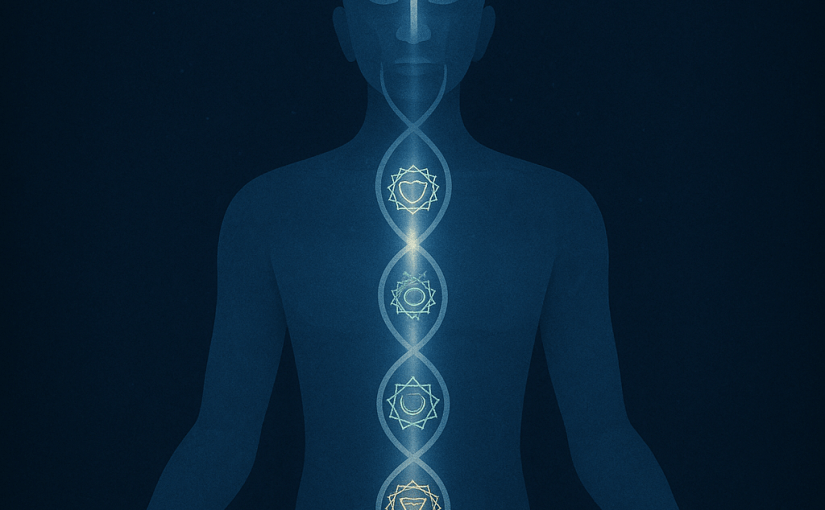
  • In a yogi, the merging is conscious, prolonged, and backed by focused inner practice. Over time, the whole Sushumna Nadi (central channel) becomes activated—not just at a few points.

This is when Ida and Pingala no longer appear as distinct currents; their merging becomes a continuous inner reality, and the double-helix pattern dissolves into unified stillness.

This merging isn’t just symbolic. In the deeper yogic sense, it reflects a shift in the internal flow of prana and apana that normally act in opposite directions. In higher states, these opposing energies begin to neutralize each other, leading to the awakening of the central channel—Sushumna Nadi.


🌬️ Prana and Apana: Two Key Inner Forces

Prana Vayu:

  • Upward-moving energy
  • Governs heart, lungs, perception, thoughts
  • Related to Ida Nadi

Apana Vayu:

  • Downward-moving energy
  • Governs elimination, reproduction, grounding
  • Related to Pingala Nadi

Even though they operate across the body, their tendencies match these nadis. So:

Ida ≈ Prana Vayu (inward, mental, cooling)

Pingala ≈ Apana Vayu (outward, physical, heating)

This mapping is not rigid but offers great practical value for meditative and breath-centered practice.


⚖️ Merging: The Real Game Begins

When Prana and Apana become equal and opposite, they cancel each other energetically. This doesn’t mean nothing is happening—rather, a new dimension opens:

  • Breath stops naturally (Keval Kumbhak)
  • Energy no longer flows outward
  • Consciousness turns inward and rises
  • Kundalini begins to move up through Sushumna

This silent movement is often not dramatic. Many sincere practitioners feel:

  • No visions or sounds
  • No sparks or shakes
  • Just a subtle bliss rising silently, like a warm cord up the spine

🧘 Experiences During Keval Kumbhak

Many practitioners are confused why they don’t feel dramatic experiences or visions during Keval Kumbhak (breathless stillness). But here’s what actually happens:

  • When the breath stops, awareness becomes like a still lake.
  • If enough sexual or vital energy has been conserved and sublimated, it silently starts rising.
  • This rising is not a rush. It is like a slow-moving, blissful river that moves upward—sometimes pausing, sometimes progressing.

You may not see lights or hear celestial sounds. That’s okay. In fact, deeper stillness often lacks sensory signs. Instead, you may feel:

  • Expanded space within your head or body
  • A rising coolness or subtle joy
  • Whole spine occasionally lighting up like a blissful electric cord

These are signs of energy stabilizing into Sushumna.


👁️ The Role of Ajna Drishti (Upward Gaze)

When you gaze upward internally toward the Ajna Chakra (brow center) with closed eyes:

  • Awareness naturally rises
  • Breath becomes subtle or ceases
  • A sense of infinite inner sky or spaciousness may appear

This is not fantasy—it’s your consciousness expanding beyond the limits of body and breath.


🔁 Double Helix and Beyond

Initially, Ida and Pingala crisscross like a double helix, touching each chakra. But once Sushumna is fully active:

  • The duality dissolves.
  • Ida-Pingala disappear as identities.
  • What remains is oneness, a steady current of awareness.

That’s why in higher states:

No double helix remains. Only unified current exists.

This transition from dual energy to unity marks a yogi’s maturity. The whole spine becomes a channel of silence, bliss, and luminous intelligence.


📘 Are They the Same Thing?

While Ida and Pingala are not exactly the same as Prana and Apana, their functions deeply align. Ida is often associated with the cooling, inward, and upward-moving energy, which resembles the characteristics of Prana Vayu—the life force responsible for perception, breath, and higher awareness. Pingala, on the other hand, is linked to the heating, outward, and downward-moving energy, which mirrors the traits of Apana Vayu—the force governing elimination, grounding, and reproductive functions. So, we can loosely say: Ida resembles Prana Vayu, and Pingala resembles Apana Vayu. While not identical, this mapping offers a practical way to understand how inner energies function and balance during yogic practice.

While they are not exactly the same, their functions are deeply intertwined.


🧘 The Yogi’s Difference

In ordinary humans:

  • Ida and Pingala briefly touch and activate chakras.
  • Their merging is fragmented and short-lived.

In yogis:

  • Ida and Pingala merge fully at each chakra.
  • Eventually, their union rises through the entire Sushumna.
  • The breath stills, mind becomes centered, and awareness ascends.

That’s the true yogic milestone.


🧬 Advanced Clarification: The Five Vayus

There are five major Pranic forces:

  1. Prana Vayu – Inward, upward
  2. Apana Vayu – Downward, grounding
  3. Samana Vayu – Digestive balance
  4. Udana Vayu – Speech and spiritual rise
  5. Vyana Vayu – Circulation, coordination

Though all exist throughout the body, Ida and Pingala mostly express the balance of Prana and Apana.

When these two are balanced:

  • The body becomes light
  • Breath may spontaneously suspend
  • Consciousness detaches from lower centers and ascends toward the higher chakras

🧭 Final Takeaway:

  • Ida ≈ Prana Vayu
  • Pingala ≈ Apana Vayu
  • Their perfect balance leads to Keval Kumbhak, where the mind, breath, and duality stop.
  • Then Sushumna activates, and the path to true realization opens.

This is the yogic science behind Kundalini, nonduality, and spiritual transformation.