Book Catalogue and the Quiet Role of Hobbies in Stabilizing the Mind

A person without any hobby or creative outlet often becomes mentally restless or disturbed over time. This is something many people observe in everyday life. When the mind has nothing meaningful to engage with, it begins to turn its energy inward in an unhealthy way. Thoughts multiply, worries grow, and small issues start appearing larger than they actually are. Because of this, almost every culture has encouraged some form of hobby, art, reflection, or creative engagement as a natural part of life.

The reason behind this is quite simple. The human mind continuously produces thoughts, ideas, emotions, and mental energy. That energy needs a channel through which it can move outward constructively. If no such channel exists, the energy keeps circulating inside the mind. Over time this internal circulation may appear as overthinking, worry, irritation, unnecessary arguments, or mental fatigue. A hobby functions almost like a release valve for this pressure. When the mind becomes engaged in a meaningful activity, its energy flows outward in a balanced way.

Another reason hobbies are helpful is that an idle mind tends to amplify problems. When someone has nothing engaging to do apart from routine duties, the mind often begins replaying past events repeatedly. It may imagine future difficulties that do not even exist yet. It may compare life constantly with others and create unnecessary dissatisfaction. This process happens quietly and slowly, but over time it can disturb mental balance. A hobby gives the mind something constructive to focus on, preventing this endless cycle of mental replay.

Hobbies also create what might be called micro-joys in everyday life. These are small moments of satisfaction that occur regularly through simple activities. Gardening, reading, writing, music, photography, yoga, meditation, sports, crafts, or learning new subjects can all produce these small but meaningful experiences. Each of these activities gives the mind a sense of participation and quiet accomplishment. Even when the activity itself is simple, the psychological effect can be surprisingly positive.

Another important aspect is identity. Many people build their entire identity only around work responsibilities and family duties. While these roles are important, they can make life feel narrow if nothing else exists alongside them. A hobby adds another dimension to life. It is something done not because of obligation but because of genuine interest. This additional dimension often brings balance and freshness into daily living.

Psychologists sometimes describe the mental state produced by hobbies as a flow state. In this state the mind becomes fully absorbed in the activity being performed. Time passes quickly, stress hormones decrease, creativity increases, and the mind becomes calm. Many people unknowingly experience this state while painting, writing, playing music, reading deeply, gardening, or engaging in sports. Even simple activities can generate this state when attention becomes fully present.

From a broader perspective, intellectual and spiritual exploration can also function as hobbies of this type. Reading philosophical works, studying mythology, exploring yoga psychology, or reflecting on consciousness allows the mind to engage deeply without agitation. In such cases the activity becomes both a hobby and a form of contemplation.

Writing and reading spiritual or philosophical reflections naturally fall into this category. They allow the mind to explore ideas about life, consciousness, and existence. At the same time they give mental energy a constructive direction. Over time, such reflections sometimes grow into longer writings or books.

Many of the writings listed below emerged from exactly such reflective exploration. Some of them discuss Kundalini and yogic psychology. Others examine mythology, philosophy, or the meeting point between spirituality and science. A few books address practical matters such as self-publishing and building websites. None of them were originally planned as part of a large catalogue. They appeared gradually over time as different ideas and reflections developed.

For readers who encounter one of these writings and wish to explore further, the following catalogue brings many of them together in one place.

Books That Emerged from These Reflections

  1. A New Age Kundalini Tantra: Autobiography of a Love-Yogi
  2. The Moon Vet: Consciousness, Cosmic Civilizations & Life Beyond Earth
  3. Kundalini Science: A Spiritual Psychology – Book 5
  4. Dancing Serpent: The Play of Inner Energies
  5. Love Story of a Yogi: What Patanjali Says
  6. Purana Riddles: Decoding the Hidden Meanings of the Puranas
  7. Tantra: The Ultimate Knowledge
  8. Kundalini Demystified: What Premyogi Vajra Says
  9. Organic Planet: Autobiography of an Eco-Loving Yogi
  10. Comic Mythology: Awakening the Spirit with Beards
  11. Kundalini Science: A Spiritual Psychology – Book 2
  12. Sex to Kundalini Awakening: Mystical Sexual Tantra Explained
  13. She Who Became My Guru
  14. Mythological Body: A New-Age Physiology Philosophy
  15. My Kundalini Website on E-Reader
  16. The Art of Self-Publishing and Website Creation
  17. Bhishma Pitamaha: The Unsung Mahāyogī
  18. Kundalini Science: A Spiritual Psychology – Book 4
  19. Vipassana & Kundalini: Harmonizing Inner Awakening
  20. Kundalini Science: A Spiritual Psychology – Book 3
  21. Beyond Kundalini: The Journey to Nirvikalpa – Book 6
  22. Sanātana Dharma: A Lived Experience
  23. Sankhya Sansar: Sankhya, Yoga & Vedanta United
  24. Quantum Science & Space Science in Yoga
  25. Quantum Darshan: Consciousness, Body & the Quantum Universe
  26. Blackhole Doing Yoga: A Cosmic Allegory
  27. The Dance of Unity: Kundalini Through Non-Dual Awareness
  28. Kundalini Science: A Spiritual Psychology
  29. Krishna Living: Play, Love, Yoga, and the Evolution of Consciousness — Sanātana Dharma – Lived Experience (Series) Volume II
  30. Walking along the Bank: Reflections After Kundalini — After the Six-Volume Kundalini Science Series

Series

  1. Kundalini Science – A Spiritual Psychology (Books 1–6)
  2. Sanatana Dharma – Lived Experience (Books 1–2)

Boxed Sets

  1. KUNDALINI ESSENTIALS – Experiences & Insights (Books 1–4)
  2. TANTRA & SACRED ENERGY – From Love and Sexuality to Awakening (Books 1–3)
  3. KUNDALINI SCIENCE: A Spiritual Psychology – Complete Six-Book Series

Readers can find these books on Amazon by searching the author’s name or through general search engines. All titles are also available in audiobook format.

In the end, whether through hobbies, creative activities, philosophical reflection, or spiritual inquiry, the mind naturally seeks a constructive anchor. When that anchor is present, mental energy finds direction and balance. The catalogue above is simply a collection of such reflections that grew over time from curiosity about consciousness, life, and the inner dimensions of human experience.

Perception of Time: An Illusion — How Yoga, Environment, and Awareness Dissolve Time Even While in Motion

Introduction: Question That Sparked the Inquiry

A reader once asked me a simple but profound question on the theme of demystifying kundalini: if time is an illusion, then what really happens when we travel? When we sit in an aircraft and fly from one city or country to another, are we actually going anywhere? Or is the mind creating the perception of movement and time, giving us the feeling that we have reached somewhere? And if movement itself is illusory, how does one experience timelessness even while the body is in motion? This question opened a deep inquiry, not theoretical, but rooted in lived experience, observation, yoga, and long years of inner life.

Time Is Not Experienced Directly, Only Change Is

Time is never experienced directly. What we experience is change. The mind observes change, compares it with a previous state, stores that comparison as memory, and from this process the feeling of time is generated. Without comparison and memory, time does not arise as a felt reality. When we sit inside an aircraft, from an external reference frame the body is moving across space. But from the standpoint of immediate awareness, one is simply sitting. He does not see any change in his position. Even when looking outside, no scene appears to be changing, unlike when sitting in a car or a train.

When I drive a car, I become timeless. I do not notice the hours or even days spent on the journey. But when I sit as a passenger, even two hours start feeling like a whole day. During driving, my mind does not register changes, nor are there continuously changing thoughts, so the sense of time disappears. Although roads change, scenes change, and even thoughts change, the mind does not register them deeply because it requires sufficient space for driving attention. When this is accompanied by a non-dual sense, timelessness increases further, along with a sense of bliss.

As a passenger, however, I experience whorls of fleeting and constantly changing thoughts. To reduce this, I started reading something while traveling. Reading calmed down vulgar and restless thoughts, and as a result, the sense of time was reduced to some extent. Sensations arise, thoughts arise, sounds are heard, the body breathes. The sense that “I am going somewhere” is not a direct experience but a mental construction created by clocks, schedules, destinations, expectations, and memory. If these mental reference points are temporarily removed, movement continues, but time collapses.

Motion Does Not Create Time, Mental Registration Does

Movement by itself does not create time. Time is created when change is registered deeply and held. Change is continuous everywhere, but felt time arises only when change is noticed, compared, and stored. This is the crucial mechanism. Yoga does not stop change, and meditation does not freeze the world. What yoga changes is how change is processed. In a yogic life, experiences are lived fully but are not clung to. Meditation dissolves impressions before they can consolidate into dense memory. Change may be noticed lightly or may be deregistered quickly before it turns into the psychological substance we later call time. This is why days can feel full while living them, yet years can feel astonishingly short when remembered.

Before formally sitting for yoga, this state of unchanging Tao occurred in me even during periods of intense worldliness, with the help of Sharirvigyan Darshan. Through this, I became non-dual in experience. Non-duality is essentially synonymous with non-changing.

During those fifteen years as well, I experienced timelessness. Time did not dominate my life even then, because awareness remained established in something that did not move, even though worldly activities continued on the surface.

Jet Lag and the Body’s Relationship With Time

This understanding becomes clearer when we look at jet lag. Jet lag is not caused by distance but by crossing time zones. When one travels fast across multiple time zones, clock time jumps abruptly, but the body does not jump. The body lives by rhythm, not by abstraction. Circadian cycles, digestion, hormone release, sleep and wakefulness all follow gradual solar cues. Jet lag is the desynchronization between symbolic clock time and biological rhythm. The body must realign itself, and that realignment is felt as fatigue, confusion, or discomfort. In this sense, jet lag can be understood as the body reconciling continuity after the mind has leapt ahead through space using technology.

Why Delhi to Goa Felt Effortless

This is why flying from Delhi to Goa did not produce any jet lag for me. Hunger came naturally, sleep came on time, and I felt rested on arrival. There was no disturbance because no time zones were crossed. Clock time, sunlight rhythm, and body rhythm remained aligned. This experience shows something important: the body does not care about distance, it cares about rhythm. Whether one moves ten kilometers or two thousand kilometers is irrelevant to the body if rhythm is preserved. From the awareness perspective, movement happened, but time did not fracture. Experience remained continuous.

Ten Years That Felt Like Ten Days

While living a full yogic life for nearly ten years, those years passed like ten days. This is not poetic exaggeration. It is a direct consequence of how time is stored. Time exists only as memory, not as lived presence. When life is restless, conflicted, or driven by unresolved desire, memory becomes dense, and time feels long. When life is lived in presence, with minimal psychological friction, memory accumulation is light. In yogic living, days are lived, not counted. Experiences complete themselves in the moment. When one looks back later, there are very few mental bookmarks. The mind therefore concludes that little time has passed. This does not mean life was empty. It means life was complete enough not to leave residue. Time feels long only when something is unfinished.

Registration of Change Is the Real Clock

This leads to the central insight: time is not produced by change itself, but by the depth of registration of change. Yoga weakens unnecessary registration. Meditation clears impressions before they harden. Experiences are either lightly registered or unregistered quickly. Before they can thicken into psychological time, they dissolve. This is why suffering stretches time. Suffering creates strong registration through resistance, repetition, and unresolved emotion. One painful year can feel longer than ten peaceful ones. Yoga does not erase memory. It prevents excess accumulation.

The Role of Unfamiliar Locations and Reduced Social Obligation

Another important observation from my experience was that I was living in an unfamiliar location, with far fewer social obligations. This played a major role. Social obligation is one of the strongest amplifiers of time. Social life requires constant identity maintenance, comparison, anticipation, and retrospection. Each interaction creates micro-registrations that multiply memory density. When social obligation is reduced, the mind has less to track, rehearse, and store. Events naturally cluster into broader chunks. Instead of daily registration, experiences register weekly or even more broadly. This is not because nothing happens, but because nothing demands psychological bookkeeping. Solitude or low-demand environments allow experience to complete itself immediately.

Spiritual Environment and Subconscious Orientation

Timelessness during those ten years was also supported by the spiritual environment itself. Temples, kathas, Sanatan rhythms, and sacred symbols were ever-present. This environment did not force belief or practice. It gently oriented the subconscious inward. Certain ideas were already settled deeply, such as the notion that the Ganga purifies or that the cow is sacred. Because these ideas were settled, they did not require daily mental debate. They rested quietly in the background, freeing attention. When inwardness is socially normal, the nervous system relaxes into yoga without effort.

Adolescence, Childhood, and the Earliest Experience of Time and Duality


This timelessness that I describe was also experienced by me for about three years during adolescence. However, before that, in early childhood, I felt time as extremely delayed, perhaps the slowest and heaviest in my entire lifetime. That phase occurred largely due to the company I kept, especially with Mohan, a stormy and restless child. That environment intensified duality and made even short periods feel unbearably long.
Yet, paradoxically, that phase also helped non-duality to be learned indirectly. Through contrast, awareness began to recognize what it was not. However, even a small bout of duality—such as anger, dispute, or loss of non-dual self-awareness—even if it lasts for only a few moments, makes one feel as if one is passing through ages. Time stretches instantly.
Such moments do not end with the moment itself. They strain relationships for a long time afterward, thereby increasing duality further, just as a small spark increases a fire ahead. One disturbance creates conditions for many more. Because of this, one needs to be always cautious, not merely in action, but in inner alignment.

During my university time, I felt that five years were spent like five lifetimes. This happened because the environment there was completely filled with duality, especially around me. I do not know whether those people were around me so that I could learn from them, or whether they were meant to make me learn their style of living, but later it felt like both happened.

I was affected by their dual lifestyle, and perhaps they were also affected by my non-dual style, especially later in their lives when their jumping energy calmed down. Although I was recently awakened at that time, what can a single awakening do if the environment does not support it and instead opposes it? I was happier remaining alone in non-duality, but one cannot remain alone in a crowd for long.

Even before awakening, because of my family background rooted in non-duality, I already felt timelessness. This shows that a non-dual environment is more important than awakening itself. Awakening only gives confirmation that nonduality is the final truth.

Symbols as Functional Yogic Tools, Not Superstition

In yogic understanding, symbols are not literal or superstitious. They are functional. The Ganga represents flow, purification, continuity, and subconsciously aligns attention toward the central channel, the sushumna. The cow represents sensory nourishment without aggression. Preserving the cow symbolically means protecting the senses from being scattered outward. Worship of natural objects is not about external objects themselves. It is about regulating inner systems. Each symbol corresponds to subtle functions within the body and nervous system. Every form of energy and matter is connected to one or another chakra. Therefore, worshipping the presiding deity of that form is essentially worshipping the corresponding chakra, or practicing chakra meditation in a symbolic way. symbols are not main aim but the subtle yogic principles represented by them.

It is not that worshipping nature or preserving any special animal is the main aim of the scriptures. The main aim is the subtle yogic truth. Symbols may change, but the truth does not.

Why Gross Worldliness Cannot Hold Subtle Insight

People deeply immersed in gross worldliness often cannot understand subtle yogic states. Even if they momentarily glimpse them, they cannot retain them. This is not because they are incapable, but because their memory systems are busy preserving visible, measurable, socially reinforced objects. Gross things advertise themselves repeatedly and therefore remain remembered. Subtle states are self-erasing. Without an environment, rhythm, and symbolic support, subtle awareness is quickly overwritten. This is why traditional yoga relies so heavily on environment, routine, and symbolism, not merely on technique.

Timelessness Is Not Escape, It Is Alignment

Timelessness did not arise because I escaped the world. It arose because the world I was in did not constantly pull attention outward. When the senses are protected, when symbols remind without demanding, when identity work is minimal, change still happens, but it is not registered as time. Yoga does not slow time or speed it up. It reduces the mind’s need to measure it. Awareness remains unchanged whether the body is sitting still or crossing continents. Movement continues. Time dissolves.

Conclusion: Living Yoga, Not Practicing It

This entire inquiry leads to one conclusion. Time is manufactured through memory. When memory lightens, time thins. When awareness is complete, time disappears. Yoga lived as a way of life, supported by environment, rhythm, and inward orientation, naturally dissolves time without effort. This is not an altered state. It is the ground of experience. Whether the body is in motion or rest becomes irrelevant. That is yoga lived, not practiced.

Ultimately, this converges to the ultimate base of non-duality. Change is what affects consciousness and the body. Change itself is duality. First, consciousness is affected, and with it the body, as both are deeply connected. A change in time zone is an extreme change in the environment, leading to extreme duality and, consequently, more pronounced effects on the body.

If non-duality is maintained, these changes may become less severe. In fact, change itself may even become beneficial by producing stronger non-duality, because the former becomes the basis for the emergence of the latter when approached with the correct mindset.

What a change in time zone produces body-change through a sudden alteration of position, an even greater degree of it is produced with dual mindset while living in the same location. We do not notice it because it is gradual and sustained, even though it is low-grade. Yet it affects the body and consciousness much more than occasional changes of location.

Thus, non-duality appears to be the most fundamental antidote to the poisoning of body and mind caused by continuous change, especially in modern life.

One more experiential insight emerges from this. Working too strenuously, to the point of exhausting the body and mind, strengthens duality indirectly and unknowingly. This happens because it gives the inner message that one’s work is more important or special. Importance should exist in the mind, but it should not be given excessive weight, as that produces duality.

Today, many people exhaust themselves in electronic screens, mobile phones, and constant stimulation. They may speak about non-duality, but their lifestyle itself is deeply dual. In the same way, doing too little is also duality, because it gives insufficient weight to responsibility and importance and makes one attached to easy goingness.

Excess and lack, both are harmful and dual. Only the middle path is non-dual. Working moderately, in balance, becomes a door to non-duality.

How Inner Throat Awareness Changed My Dhyana: A Lived Discovery of Dharana, Sushumna, and Ajna Balance

When Head Pressure Became the Teacher, Not the Problem

For a long time, my yoga and meditation practices were accompanied by a familiar companion—pressure in the head. It was not painful, but it was unmistakable, dense, and demanding. The more sincerely I practiced asanas and dhyana, the more this pressure intensified. Initially, I accepted it as a byproduct of progress, perhaps even a sign of spiritual ascent. But over time, it became clear that something in the internal mechanics of my practice was misaligned. The pressure was not expanding into clarity; it was accumulating. That accumulation itself became the inquiry.

During this phase, I performed sutra neti, initially with the understanding that it was only a cleansing practice. On my first attempts, I could not pass the sutra through the nostrils. After a few days and multiple attempts, I was able to penetrate the right nostril on the third try. Something unexpected happened. Internally, the right nasal passage felt as if it had widened, not just physically but spatially. Subsequent attempts became easier. The left nostril, however, remained untouched, almost untouched territory, what I instinctively called “virgin.” Along with this, I felt a mild scratchy irritation at the opening inside the throat, near the back of the mouth. This sensation was not alarming, but noticeable.

What followed surprised me more than the physical changes. My awareness, which previously stabilized in the brain region during yoga and meditation, spontaneously began settling at the throat. Bliss arose there, not in the head. The head pressure reduced immediately and dramatically, regardless of how intensely I practiced. Pressure was now felt subtly inside the mouth, at the back where the throat begins. With this shift, dhyana became easier, quicker, and more stable. It became clear to me that sutra neti had not only cleansed a passage; it had prepared a center of awareness. For the first time, I understood it as a preparatory practice not just for hygiene, but for regulation. It is just amazing.

Discovering the Hissing Breath and the Throat as a Regulator

As awareness stabilized in the throat, I noticed that breath naturally began moving through the mouth with a hissing quality. This hissing was not forced. It arose spontaneously. It was like a serpent hissing—yes, the Kundalini serpent. Now it became clear why Kundalini Shakti is called a serpent. One more thing became evident: as it progresses upward in the Sushumna, it alternates left and right through Ida and Pingala respectively. It is the movement of a snake—going left, then going right, and with each alternation progressing forward, not straight ahead. This can be seen clearly: first on the left side of the face, then on the right, and finally along the midline at the back of the head.

What was striking was its effect. The sound and subtle pressure maintained dominance of the throat point and prevented awareness from rushing back into the head. The hissing applied a gentle pressure to the scratchy point, keeping it awake. With this, prana no longer felt like it was trying to go upward to the head. Instead, it circulated through the body and returned from the throat. The topmost functioning point no longer felt like Sahasrara but distinctly Vishuddhi.

This realization corrected an earlier assumption. I had thought that higher experiences must always culminate at the crown. But here, stability, bliss, and ease were arising without any demand to move upward. The throat was not a stopping point; it was a turning point.

Humming, Ujjayi, and the Ocean Undercurrent of Breath

When I applied gentle pressure to this scratchy inner throat point using a humming breath, similar to ujjayi pranayama, or even during simple inhalation when breath felt like an undercurrent rather than airflow, the point activated further. The sensation was like the deep currents of the ocean—movement without turbulence. This further sharpened regulation. The more the throat point activated, the less head pressure was possible.

The insight became clear: vibration, pressure, and subtle breath were not techniques here but regulators. The throat was acting as a valve. Bliss was no longer explosive or sharp; it was circulatory and breathable. Over time, the scratchy sensation softened, becoming a stable sensory anchor rather than irritation. However, it dulls with time, so it needs to be reawakened with Sutra Neti at intervals.

From Sound to Silence Without Losing Stability

As humming and hissing softened naturally, the throat did not fall asleep. Instead, silence itself seemed to vibrate there. Breath became subtle, almost invisible, yet the throat remained alive. Awareness rested without fixation. The head remained light. Bliss remained present without pressure. This was not loss of practice; it was practice absorbing itself. The system had shifted from technique to function.

This configuration resolved a long-standing fear—the fear of going too far, of irreversibility, of renunciate drift. Earlier, intense upward movement had always carried a sense of danger. Now, ascent completed a loop. Nothing terminated at the head. Nothing demanded escape from life. The architecture had changed.

Rethinking the Location of the Throat Chakra

Earlier, I believed the throat chakra was located at the middle front of the neck. Now, lived experience showed me that the operative center was inside, at the back of the mouth where the throat begins. This raised a question: was my earlier understanding wrong, or was this another sub-chakra?

The clarity that emerged was subtle but firm. The earlier understanding was not wrong; it was incomplete. The front of the neck corresponds to expression, voice, emotion, and outward communication. The inner throat is the regulatory core where breath, sound, prana, and awareness converge. These are not two chakras but two functional layers of the same Vishuddhi field. One expresses. The other governs flow.

This understanding was further confirmed when I noticed that strong emotions still created sensations in the mid-neck region. These effects were moderate and transient, linked to emotional expression. In contrast, the inner throat effects were stabilizing, structural, and long-lasting. Emotion moved through the front; regulation lived inside.

Early Sushumna Flow Through Inner Vishuddhi

Another critical discovery followed. Activating the inner throat chakra stimulated Sushumna flow earlier and more smoothly during the very beginning of dhyana. Previously, meditation had an entry phase filled with effort. Now, the system seemed aligned before meditation even began. Ida and Pingala quieted naturally. The central channel did not need to be forced open. It simply conducted.

This was not premature Sushumna dominance. It was regulated access. The throat acted as a gatekeeper, ensuring balance before ascent. As a result, bliss circulated, thoughts loosened, and awareness stabilized without dissociation or fear.

Why Ajna Became Easy Only After Alignment

A crucial realization followed. Immediately placing focus on Ajna was demanding and challenging. It created effort, pressure, and disturbance in pranic flow. But when Sushumna was first stabilized through the throat or even lower chakras, Ajna became effortless later. Ajna no longer functioned independently. It became linked to the lower centers through common awareness.

Trying to isolate Ajna created head pressure and disturbed circulation. Allowing Ajna to arise within a unified axis created clarity without strain. Ajna revealed itself not as a ruler but as a relay.

Dharana Reunderstood Through Experience

This brought clarity to the meaning of dharana. Dharana was not holding attention at a point. Dharana was establishing an internal architecture where attention no longer needed to be held. When effort was present, dharana was incomplete. When pressure arose, dharana was incomplete.

For me, dharana occurred when awareness stabilized at the inner throat, Sushumna conducted naturally, lateral pulls quieted, and circulation established itself. At that point, dhyana emerged automatically. Meditation no longer began; it continued. Ajna participated without dominating. Thoughts lost traction without suppression.

Dharana, in lived reality, was not concentration. It was removal of everything that prevented the system from holding itself.

The Final Integration

What changed through this journey was not technique but orientation. The system moved from vertical ambition to circulatory intelligence. Bliss became nourishing instead of demanding. Head pressure became impossible, not managed. Fear dissolved not through reassurance but through structural balance. Practice became livable.

The throat did not replace the head. It taught the head how to belong to the whole. Ajna did not disappear. It learned to function within the axis rather than above it. Dharana ceased to be effort. Dhyana ceased to be a goal. Awareness ceased to chase peaks and began to circulate as life.

This discovery was not accidental. It was the body’s correction of an incomplete architecture. Once seen, it does not reverse. One does not go back to diagram-based spirituality after touching functional truth. The chakra was not relocated. It was entered.

And with that, meditation stopped demanding attention and began returning it.

Krishna Living: When Play, Love, and Life Become Yoga

Some lives do not follow a straight line.
They unfold like rivers—sometimes playful, sometimes forceful, sometimes quiet, but always guided by a deeper terrain beneath the surface.

This is the story of such a life.

Not a saint’s biography.
Not a philosophy.
Not a method.

But a lived exploration of what Sanātana Dharma looks like when it happens naturally—through childhood, love, confusion, failure, attraction, restraint, devotion, awakening, withdrawal, and maturity.

Early Life: When Survival Itself Is Yoga

Before conscious seeking begins, life itself often prepares the ground.

In Premyogi’s early years, survival was not guaranteed. Illness, loss, and narrow escapes marked childhood. Siblings did not survive. Circumstances were harsh. Yet something endured quietly, without panic, without grasping.

Even at birth, there was no cry.

It was as if prāṇa had already learned to settle.

From a yogic lens, this was not tragedy alone. It was tapas—not imposed, but lived. Yamas and niyamas enforced not by discipline, but by circumstance. Attachment loosened early. Fear visited, but did not dominate.

Sanskaras formed not through teaching, but through atmosphere—scriptures read aloud at home, rituals performed with humility, service offered without discrimination, dignity maintained without wealth.

Krishna-living does not begin with devotion.
It begins with resilience without bitterness.

Childhood and Play: Līlā Before Knowledge

As childhood unfolded, Premyogi did not become serious or withdrawn. Quite the opposite.

There was mischief, wandering, curiosity, frankness, and play. He observed people more than books. He roamed markets and parks. He learned human behavior instinctively. Authority was questioned—not rebelliously, but naturally.

This is an often-missed truth:
Krishna-consciousness is not solemn.
It is playful clarity.

Play is not distraction when awareness is present.
It is līlā.

Even conflicts, accidents, and encounters with danger carried lessons—not moral ones, but energetic ones. When to act. When not to interfere. When force worsens imbalance. When restraint is intelligence.

Without knowing the language of yoga, life itself taught it.

Adolescence: When Attraction Becomes a Teacher

Then came attraction.

Not romance as society understands it, but a powerful inner stirring triggered by a feminine presence. There was no contact. No confession. No possession. And yet the energy was intense—strong enough to awaken deeper layers of the psyche.

This was not repression.
It was fullness without discharge.

Held in nonduality, attraction refined itself. Energy rose instead of spilling outward. Desire did not fragment attention; it sharpened it. The mind became clearer, studies deeper, confidence steadier.

Here rasa was born—not as lust, but as sustained joy.

Rasa, in this sense, was not excitement. It was taste—the deep savoring of life without ownership. Beauty was neither rejected nor consumed. It was allowed to act as a yogic force.

This phase revealed a crucial insight:
love without contact can rotate energy rather than dissipate it.

Bhakti: When Love Loses Its Object

As time passed, physical separation happened naturally. The outer form disappeared.

Yet something unexpected occurred.

The inner presence did not fade—it spread.

Attraction completed its work and transformed into bhakti. Not devotion to a deity or belief, but devotion to presence itself. Remembrance flowed without effort. Meditation happened without posture.

Life itself became the practice.

This bhakti did not withdraw Premyogi from the world. It made him more attentive, more capable, more grounded. Stillness coexisted with movement. Silence lived inside activity.

This was bhakti born of lived rasa—not learned, not adopted, not chosen.

Gopī Samādhi: When Love Becomes Ground

As remembrance deepened, a threshold was crossed.

The beloved dissolved as an object. Love remained without direction. Attention forgot itself. Samādhi arose—not from silence, but from love.

Then came a brief, decisive moment.

In a dream-like waking state, Premyogi experienced a total collapse of observer and observed. River, bridge, mountain, sun, and self appeared as one unified reality. Everything was equally luminous. Nothing was higher or lower.

It lasted only seconds.
But it changed everything.

This was savikalpa-samādhi—a glimpse of self-realisation. Not sustained, not repeatable by will, but unmistakable.

And then it faded.

Not as loss.
As completion.

Withdrawal: When Sweetness Finishes Its Work

Krishna-living, by nature, does not last forever.

Its intensity softened. The inner image faded gently. There was no grief, no clinging. Readiness replaced longing.

This withdrawal was not renunciation. It was maturity.

What remained was fragrance—guidance without attraction. Protection without effort. The inner refinement guarded Premyogi through education, work, marriage, responsibility, temptation, and pressure.

Krishna-living no longer burned.
But it kept him safe.

Transition: From Sweetness to Power

Eventually, even sweetness felt insufficient.

Not wrong—just complete.

A new need arose: structure, direction, power. The feminine tone gave way to a masculine clarity. The image of Dada Guru replaced the consort. Ritambharā—truth-bearing intelligence—began to dominate.

There was no visible austerity. No public practice. Yet inwardly, discipline and tantra began quietly.

Krishna had refined the heart.
Now Shakti would build the spine.

The Deeper Pattern

Looking back, Premyogi saw that nothing was accidental.

Flooded rivers crossed safely. Lineages tested. Play, love, loss, awakening, withdrawal—all followed an intelligent sequence.

Water and energy behaved the same way. When consciousness accompanied intensity, even floods made way. When awareness guided energy, danger turned into passage.

In this light, the Bhāgavata Purāṇa no longer appeared as mythology—but as ancient spiritual case studies. Patterns repeating across time, expressed differently in different lives. All the scriptures evolved from the Vedas, the Vedas are called Shrutis. Shruti means knowledge gained through listening over ages. These Shrutis are different cases of awakenings. By studying them, an average pattern of events experienced by awakened beings was identified and written in a style simple enough for the general public. This became the timeless Bhagavata Purana. In it, the main event was love, so it is love-dominated.

Similarly, Tantra-type listenings formed the Shiva Purana, with Shiva as the main character. Since the primary events in such awakenings were Tantric in nature, the Shiva Purana is Tantra-oriented. Likewise, Shakti-oriented and Rama-oriented scriptures were created, all evolved from the Vedas as listenings.

It was a scientific age—not material science, but spiritual science. Data collection, segregation, averaging, and analysis were the same as today, but they were applied to spirituality in the form of boundless human growth, not the limited physical growth of today.

The Essence

This journey does not argue for belief.
It does not offer technique.
It does not promise permanence.

It reveals something simpler and deeper:

  • Awakening often comes through intensity, not avoidance
  • Love can be yogic when held without collapse
  • Sweetness is a phase, not a destination
  • Withdrawal can be intelligence, not loss
  • Power becomes safe only after the heart is refined

Krishna-living is not the end.

It is the preparation.

When play teaches awareness,
when love teaches restraint,
when devotion teaches stillness,
and when sweetness teaches when to leave—

life itself becomes the guru.

And the river, however flooded, always finds a way forward.

Krishna Living is not about imitating the divine, but dissolving the ego that stands between life and love. When play, love, and life become yoga, they do so in the spirit Krishna revealed—effortless, spontaneous, and free of self-importance. The river of life flows playfully yet powerfully, just as His leelas flowed from pure awareness, not from desire to prove or possess. Childhood joy, mischief, and curiosity here are reminders of innocence, not identity—signposts pointing toward surrender rather than superiority. To live this way as a premyogi is to walk lightly, love deeply, and act joyfully, knowing that all beauty belongs to Krishna alone, and we are merely participants in His rhythm, not claimants of His grace.

Vrindavan Within: How Cows, Prana, and Self-Awareness Open the Door to Nirvikalpa Dhyana

Vrindavan Not as a Place but as an Inner Field of Self-Awareness

The understanding began very simply and very directly, not as philosophy but as lived seeing. Vrindavan appeared to me not merely as a sacred town associated with stories and devotion, but as a field of self-awareness inside. This inner Vrindavan is not created by imagination; it is discovered when awareness becomes calm, spacious, and naturally present. In this field, nothing is forced and nothing is rejected. It is a place of inner softness, where awareness rests in itself without struggle. The idea that Vrindavan exists within is not symbolic poetry alone; it reflects an actual experiential landscape that becomes available when attention settles into its own source.

Cows as the Senses and Grass as Subtle Bliss

Within this inner Vrindavan, cows reveal themselves as the senses. Senses are often treated as enemies or distractions, but here they appear gentle, habitual, and innocent, just like cows. They move toward nourishment naturally. The nourishment they seek, in a meditative inner state, is not gross pleasure but subtle, blissful, calm, and peaceful thoughts. These thoughts feel like grass—soft, tender, refined, and non-violent. Grass is nourishment that does not agitate; it sustains without intoxicating. When blissful and sattvic thoughts arise in meditation, they are like this grass, feeding the senses without disturbing awareness.

From Inner Grass to Outer Grain and Worldly Activity

Grass, however, does not remain grass forever. When it grows outward, when it matures and hardens, it becomes grain. Grain is useful, productive, and necessary, but it is denser and harder. In the same way, subtle inner bliss, when expressed outwardly, becomes worldly activity. The outer world is not wrong or inferior; it is simply condensed sensory awareness. What is soft and fluid inside becomes structured and solid outside. The gross world is like hard grain, while the inner field remains like living grass. This distinction is crucial: it shows that worldly life is not separate from inner awareness, only a different density of the same reality.

Cow Grazing as Calm Sensing Without Disturbance

When cows graze peacefully, they do not fight the grass nor cling to it anxiously. They simply eat. Similarly, when the senses function calmly, without craving or resistance, sensing continues but does not bind. This is the meaning of cows grazing in the inner Vrindavan. Sensing happens, but awareness remains untroubled. There is no suppression of the senses and no indulgence. There is only relaxed participation. In this state, life flows smoothly, and awareness remains intact.

When grain is shown and fed to cows, they struggle to get it, fight with each other, and eat it with craving and attachment. They appear disturbed and restless. This disturbance also affects the cowherd, because he now has to actively control them.

Similarly, in the outer world, the senses behave like furious animals rather than grazing cows. They no longer move calmly but rush toward objects with craving and competition. This agitates self-awareness as well, because it must struggle to restrain and manage the senses instead of resting naturally in witnessing

The Cowherd as Witnessing Self-Awareness

The most important presence in this inner scene is the cowherd. The cowherd does not graze, does not become the cows, and does not consume the grass. He watches, guides lightly, and remains free. This cowherd is witnessing self-awareness itself. It is not effortful observation and not mental vigilance. It is simple presence. When witnessing becomes strained or intentional, the inner Vrindavan turns into a field of discipline. When witnessing is natural, it becomes play, or līlā. Awareness simply remains aware.

Krishna as Self-Awareness Itself

At this point, Krishna appears not as a mythological figure. He may have been incarnated in the Dvāpara Yuga, as scriptural stories always carry double meanings—both internal and external. Yet here, Krishna is revealed as the very essence of self-awareness. He is not the mind, not a personality, and not an individual doer. He is the effortless center of attraction that awareness naturally has when it rests in itself. That is why Krishna never forces anything. He does not command the cows; they come on their own. Self-awareness does not push the senses inward; alignment happens naturally when conditions are right.

The Flute as the Subtle Body and the Seven Chakras

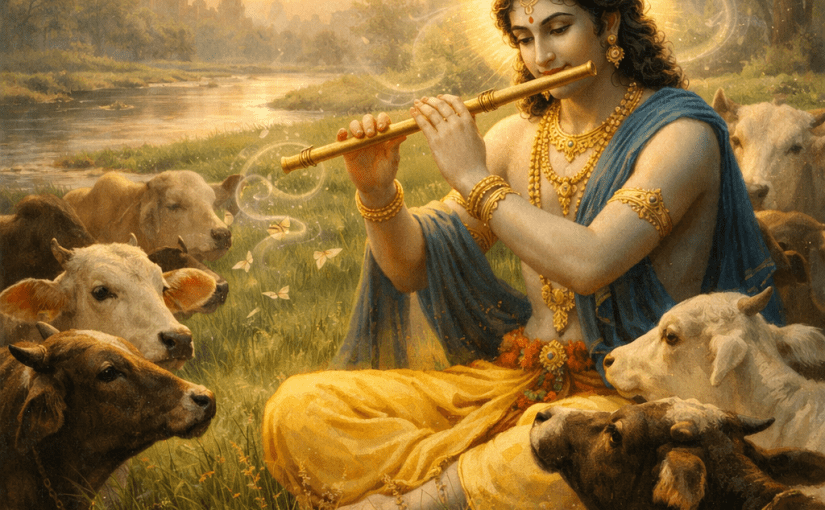
Krishna’s flute reveals another layer of lived understanding. The flute is empty inside, just like the subtle body must be empty of egoic tension to function as an instrument. It is helped by nonduality. Its seven holes correspond to the seven chakras of the body. Without holes, there is no sound; without chakras, there is no expression. The body itself does nothing. It becomes music only when prana flows through it under the presence of awareness. This emptiness is not absence but readiness. Prana flows through different chakras, invoking different expressions and emotions. It is as if different sounds are emerging from the flute.

Playing the Flute as Natural Prana Flow

Krishna playing the flute is awareness breathing prana through the subtle body. This is not forceful pranayama and not controlled breathing. It is natural breath, unstrained and effortless. Awareness does not blow hard; it simply allows prana to pass. Because of this alignment, the sound produced is irresistibly harmonious. In yogic terms, when awareness and prana align, the entire system becomes coherent. When awareness and prana align means prana becomes so subtle that it is equal to void-like awareness. Its subtle music is so refined and harmonious that the senses, which are feeding on grain in the gross outer world, leave it and move toward inner Krishna playing the flute in inner Vrindavan, to graze again on grass. As the breath passes through the flute and becomes almost zero-like, even the grazing senses calm down so deeply that they themselves dissolve into void.

Cows Leaving Grass as Entry into Nirvikalpa

When the flute sounds with feeling of breathlessness, the cows leave even the grass and move toward Krishna. This moment carries the deepest yogic meaning. Grass itself represents subtle bliss and sattvic pleasure. When cows leave the grass, it means the senses abandon even refined enjoyment. They are not suppressed; they forget themselves. This forgetting is nirvikalpa. There is no object, no experiencer, no claim of bliss. Even the thought “I am experiencing bliss” disappears. There is only absorption.

Why Nirvikalpa Cannot Be Held

This state cannot be maintained by will. The moment a thought arises—“I am in nirvikalpa”—the absorption breaks, and the senses return to grazing. Awareness does not mind. Krishna keeps playing. Self-awareness does not cling to states. It allows coming and going. That is why nirvikalpa often lasts only moments, yet leaves deep understanding behind.

Direct Experience in Riverbeds and Flood Plains

These insights are not theoretical. Repeatedly, I sit near a riverbed spread across vast flood plains. The ground is covered with stones of varied sizes and shapes, naturally polished and layered like a welcoming carpet. The openness of the land, the silence of the space, and the slow rhythm of nature create a natural inner stillness. In these places, stray cattle often roam and graze freely.

The Presence of Cows and Effortless Nirvikalpa Dhyana

In these environments, nirvikalpa dhyana arises easily, without effort. This repeated experience reveals something important: cows grazing are not only symbolic representations of yogic processes; cows themselves have a direct effect on the mind. Their presence calms the nervous system. Their grounded, non-aggressive energy supports inner silence. The mind mirrors what it perceives. When awareness rests among beings who live without inner conflict, awareness recognizes itself more easily.

Sages composed scriptural stories in such a way that they carry both physical and symbolic meanings, though the symbolic meaning is primary. The physical layer is not accidental; it supports and strengthens the inner teaching. For example, if grazing alone were the message, other grazing animals could have been chosen. The cow was chosen specifically because of her physical qualities as well—her calmness, non-violence, nourishing nature, and her ability to transform rough grass into sustaining milk. These physical characteristics make the symbolic teaching visible and experiential, ensuring that the metaphor is not abstract but lived and understood through everyday life.

Nature, Animals, and the Support of Awareness

The river, the stones, the open plains, and the grazing cattle together create an environment where prana flows smoothly and awareness remains uncontracted. This shows that yogic realization is not only an inward practice but also a resonance with living nature. The outer landscape reflects and supports the inner landscape.

Vrindavan as Awareness at Play

Ultimately, Vrindavan reveals itself as awareness at play. Senses graze on subtle bliss without agitation. Worldly action emerges naturally from inner calm, just as grain emerges from grass. Prana flows like flute music through an empty body. The senses abandon even bliss when alignment deepens. Awareness remains the silent cowherd, untouched and free. When awareness breathes through emptiness, the senses dissolve into silence, and nirvikalpa appears effortlessly. This is not mythology, not imagination, and not borrowed doctrine. It is direct yogic physiology lived, seen, and expressed through the timeless language of Vrindavan.

Chapter 25: A Simple Understanding of How We Create Our Inner World

Modern physics and Vedanta both tell us that the world we experience is not exactly the world that exists outside. Quantum physics says things exist in many possible states until interaction selects one. Vedanta says the universe created by Ishvara is one, but the world each person lives in is different. This difference comes from how our own mind and energy process the same situation.

Every moment, our mind goes through three steps. First, the subconscious picks one emotional possibility out of many. A single scene can hold fear, love, disgust, calmness, or joy. Which one we feel depends on our past experiences, tendencies, guna balance, energy flow, and the dominant chakra. This selection happens instantly and quietly. Next, the mind turns that selected possibility into an actual emotion—fear becomes anxiety, anger becomes heat, love becomes warmth, and peace becomes stillness. Finally, our intellect interprets that emotion and forms meaning, stories, and opinions. This is how our personal world is created.

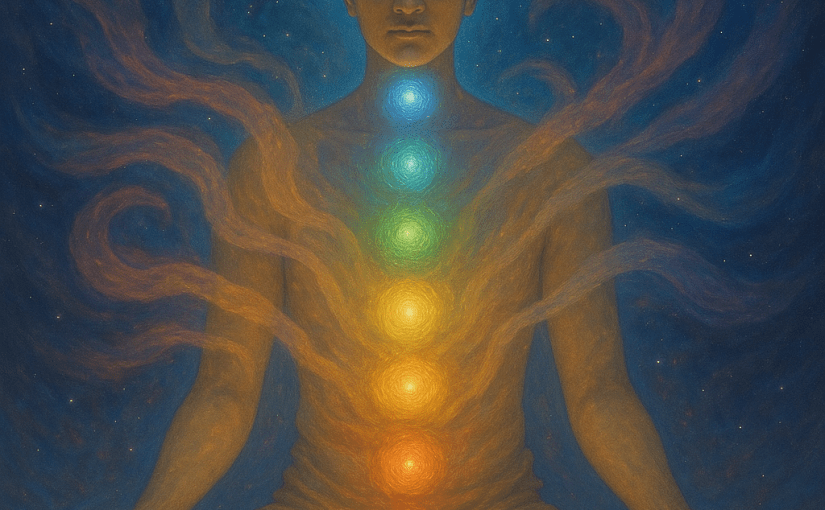
Chakras play a big role in this process. Lower chakras make us collapse experiences into fear, desire, or anger. Middle chakras make us collapse experiences into love, empathy, and understanding. Higher chakras make the collapse lighter, calmer, and more detached. When the energy reaches Ajna or Sahasrara, emotional reactions become very subtle, and the person begins to witness thoughts and feelings without getting pulled into them.

Kundalini movement changes the collapse even more. When energy is low, the collapse is emotional and reactive. When energy rises to the heart and throat, collapse becomes meaningful and refined. When energy reaches the higher centers, collapse becomes quiet and almost neutral. In deep meditation or samadhi, collapse becomes extremely weak or stops completely. There is no emotional or mental coloring—only pure awareness remains.

Quantum physics supports this kind of idea at a physical level. A particle stays in many possible forms until interaction fixes it. But this does not mean we create the entire universe by observing it. Ishvara creates the physical universe. We only create our personal experience of it. Things happen outside, but our inner world forms through emotional and mental collapse inside us.

As we grow spiritually or through meditation, this collapse becomes less noisy and more peaceful. The mind reacts less. Interpretation becomes minimal. Awareness becomes clearer. In the highest state, there is no collapse at all—no emotion, no story, no reaction—only pure consciousness aware of itself.

In simple words:
We do not create the outer universe, but we continuously create the inner universe we live in.
The more balanced our energy and mind become, the more peaceful and clear this inner universe becomes, until finally it dissolves into pure awareness in samadhi.

How Balanced Chakra Energy Stops Emotional Overreaction and Leads Toward Samadhi

In everyday life, we react emotionally because one part of our inner system becomes stronger than the others. If lower chakras become active, we react with fear, anger, or hurt. If middle chakras dominate, we respond with empathy or emotional softness. If upper chakras dominate, we remain calm, clear, and unaffected. But through practices like chakra meditation, pranayama, and other yogic methods, our energy gradually spreads evenly across all chakras. When this balance happens, something very interesting occurs: no single emotional pattern becomes dominant. All emotional possibilities arise together, and because they appear at the same time, they naturally cancel each other out.

When chakra energy becomes balanced, cancellation does not mean we stop feeling emotions. In fact, we feel all emotional responses more clearly, but none of them overpower us. The emotions rise naturally, but because opposite tendencies appear together, they quickly neutralize each other. This creates a healthy inner balance where we remain aware of every emotion without getting trapped in any one of them. Yoga does not make us dull or detached from life; instead, it expands our capacity to experience. We sense fear, love, anger, compassion, clarity, and calmness all at once, but they do not disturb our inner state. This expanded emotional umbrella allows us to enjoy the world more deeply while staying free from entanglement. In this sense, yoga helps us live fully, feel everything, respond intelligently, and yet remain centered and unaffected. This natural neutrality is what gradually leads toward inner peace and eventually toward samadhi.

This means the mind does not fall into one fixed reaction. It doesn’t collapse into only fear, only anger, only love, or only logic. Instead, all these tendencies stay balanced. This creates an inner state where emotional reactions lose their force, and the mind remains steady and neutral. In this balanced condition, awareness becomes spacious and calm because nothing inside pulls the mind strongly in any direction. This is why the experience begins to feel like samadhi—quiet, open, and free from emotional disturbance.

For example, if someone insults us, an unbalanced system reacts from whichever chakra is strongest at that moment. Lower chakras produce hurt or anger. Middle chakras produce understanding or softness. Upper chakras produce calm detachment. But if all chakras are balanced, the lower and middle reactions rise together and neutralize each other. What remains is the clarity and calmness of the higher centers. The result is that the person does not feel shaken, and the mind stays peaceful.

In simple terms, balanced chakra energy prevents the mind from collapsing into one emotional pattern, and when no single collapse is favored, the mind naturally becomes still. This stillness is the doorway to samadhi. When the mind does not cling to any specific reaction or outcome, inner freedom appears on its own. This is the essence of why balanced energy leads to calmness, clarity, and eventually glimpses of real samadhi.

Awareness at the Anahata Chakra – Healing Through the Goddess Within

I began my yoga practice at 5 a.m. today. The air was still, mind silent, and body ready. After spinal breathing, I moved through guru-given yoga and my own selected set, including chakra meditation from top to bottom — without holding breath. These days I avoid breath-holding to prevent excess head pressure. Yet I’ve realized there’s no real need to fear it; the head has an incredible capacity to bear and balance the force of prana.

Once, during a dream-state gastric uprising, I experienced immense head pressure, momentary choking, and a transient rise in blood pressure — but the body adjusted beautifully. It reminded me that a well-practiced body knows how to balance itself. So, my preparatory yogic routine continued for about an hour and a half — enough to create the internal yogic pressure required for launching into dhyana.

I know this yogic pressure is temporary. It gradually dissolves into the luminosity of dhyana, just like gas slowly burning out from an LPG cylinder. And when that inner fuel finishes, the practitioner naturally returns from dhyana — first through strong internal contractions from lower to upper area of body backside as to facilitate the movement of energy in the three main spinal channels, followed by the gradual deepening of breath. When the breath returns to normal, the eyes open by themselves. The same happened today.

During dhyana, Vajrasana again gave an excellent starting response. Subtle breathing began automatically at the Ajna Chakra and continued for quite long. Yet all along, I felt a kind of sexually blissful senation at the Anahata Chakra. I was including this bliss within my Ajna-to-Muladhara meditation line, so both centers — Ajna and Anahata — were simultaneously satisfied. No other centres seemed power hungry. Later, I shifted my dhyana solely to Anahata. The awareness deepened there, but the main purpose of dhyana — the realization of Shunya (void) — was not completely fulfilled there. So, I again combined both Ajna and Anahata awareness together.

I recall a Kriya Yoga expert once said that “spinal meditation alone can’t grant liberation.” He emphasized that Ajna Chakra meditation includes the whole spinal system. Today, I understood his point deeply — indeed, every chakra of the backbone is reflected within Ajna. Yet, even knowing this, my sensational awareness remained localized at the rear Anahata Chakra, unwilling to move elsewhere, although breathing awareness was on agya chakra.

Yesterday my focus was at Vishuddhi Chakra, where I had a throat infection. That infection cleared today, but the infection and along with it the energy had descended to the chest. This shows how sensitively these inner sensations mirror physical conditions — a subtle diagnostic test and often a healing mechanism. Still, medicines nowadays help more directly, supporting this inner process. In ancient times, diagnosis and healing through awareness given the form of the Goddess held prime importance, as there were not so many worldly facilities available.

As I visualized the Goddess at the Anahata, the rising sexual bliss from the Muladhara seemed to empower Her presence. I could faintly see Her fighting demons — symbolic of microorganisms — within my chest. It felt as if the Anahata Chakra itself had become a Lingam, the real blissful lingam now manifesting only there.

After about thirty minutes, when my legs cramped, I slowly shifted to Sukhasana, minimizing body movement while keeping awareness rooted at Ajna to avoid breaking dhyana. I then sat for another hour, not breaking earlier feeling that Shakti was healing my heart center and its connected tissues.

Towards the end, a magnificent experience unfolded — a clear perception of Shunya, more radiant than yesterday. It felt as though I was seeing the infinite sky directly above, though my head was hardly tilted upward.

Reflections:
The heart center feels open today — calm, luminous, and healing. The Shakti there is gentle yet profound. Awareness no longer seems confined to a point but spread like the sky itself. Every breath now feels like a hymn in the temple of the heart. Moreover, I was quite busy intellectually yesterday, so it seems that heavy intellectual work facilitates dhyana; however, it can also take a toll on the body’s health.

Diwali Week: A Yogi’s Practical Insights Through Temple Experiences

This Diwali week, after a long journey, I visited my ancestral home and stayed there for several days. It was a joyful time — being again with family, relatives, and friends, celebrating the festival of lights in full enthusiasm. Yet along with the outer joy, many new practical yogic experiences unfolded naturally.

I was so involved in the living flow of the festival — meeting people, travelling, helping family, and feeling the spirit of Diwali — that I could not write them down then. But within those days, in between the busy movements, I received sharp insights that no book or teaching could give. These experiences came in the most natural settings — especially when I got moments of solitude inside the city temples while my family was shopping nearby.

Day 1 – Durga–Bhairav Temple: The Dual Anchor of Meditation

On the first day, after dropping my family at a city shopping complex, I went straight to a Durga temple.
There, in front of the large and powerful idol of Maa Durga, I sat in padmāsana. The moment I closed my eyes, deep stillness descended. Soon, the breath became effortless — almost absent — and I entered Kevala Kumbhak, the natural breathless dhyāna.

At intervals, I opened my eyes and looked at the idol. Every single glance into the serene face of Durga instantly deepened the state again, as if the outer image was helping the inner form stabilize. The image remained alive even after closing the eyes, glowing vividly in the mental screen — not as imagination, but as a living vibration.

In front of Durga’s idol was a smaller statue of Bhairav. When the attention slightly tired or mind became neutral, I gazed at Bhairav’s image instead. Strangely, his gaze and energy acted as another anchor, rekindling the stillness from a different polarity — sharp, grounding, and stabilizing.

Thus, I discovered a beautiful rhythm: when Durga’s compassionate presence began to feel saturated, I turned to Bhairav’s fierce calmness; when that too reached a plateau, I returned to Durga.
It was like alternating currents of Shakti and Shiva, feminine and masculine energy, balancing and sustaining each other — a living demonstration of Ardhanārīśvara tattva.

Perhaps this is the deeper reason why Durga and Bhairav idols are placed together in many temples. For ordinary devotees, it represents protection and blessing. But for a yogi, it becomes a direct energetic mechanism — allowing both polarities of consciousness to support dhyāna.
The ordinary mind may see the idol as an object, but the yogic mind perceives it as a mirror of consciousness.

I realized that idols (pratimā) are not merely symbolic or devotional aids — they are scientific instruments of meditation. For a sincere meditator, the benefit is immediate and measurable: the mind falls into stillness the very moment one connects with the living image. That is direct proof, not belief.

Others, who approach idols only through tradition or emotion, also receive benefits, though subtler and delayed. But to a real yogi, the result is instant — the statue becomes alive, the mind becomes no-mind.

Evening – Shulini Sister Temple: The Silent Pindi and the Deep Breathless Stillness

In the evening of the same day, when my family again went for shopping, I visited Shulini Mata’s sister temple.
The environment was deeply sattvic like earlier temple: gentle movement of people, occasional ringing of the temple bell, mantra chants from distant devotees, the fragrance of burning incense, oil lamps glowing in rows, and from time to time, the conch sound from the priest echoing through the hall.
Each element seemed perfectly tuned to draw the consciousness inward.

The main deity was not a fully personified idol but a stone pindi — a simple mound of stone representing the goddess. Silver eyes were fixed on it, with tiny black dots marking the pupils, and a nose faintly carved in the middle. Despite this simplicity, or perhaps because of it, the image radiated immense power.

As I sat before it, the same Kevala Kumbhak arose again naturally — effortless, spontaneous, and prolonged. The experience was even deeper than in the morning. I remained in vajrāsana for forty-five minutes to an hour. My legs went numb, yet the body felt weightless, pain absent. Awareness remained centered, breath minimal, mind absorbed in the living vibration of the pindi.

That evening, I learned that personification is not necessary for divine connection. Even a symbolic form — if approached in stillness — can become a complete doorway to samādhi.
What matters is the state of mind, not the complexity of the idol.

Day 2 – Shani Temple and Saraswati Painting: The Spontaneous Prāṇāyāma Emerges

The next day, while on the way to relatives’ home, my family again stopped for shopping. I dropped them out of the car, parked it safely, and started searching for a new temple — a change that could help me enter deeper dhyāna again without feeling bored. It made me realize that the more temples there are, the better it is for a seeker; one can keep visiting different temples daily and repeat the cycle once all have been covered. This means it is good, both socially and economically, to build as many temples as possible. That is exactly why we see countless temples in pilgrimage towns. Some people may ask, “Why so many? Why not just one?” But human likings differ — just as there are many kinds of sweets, not only one. The same principle applies here. I found a Shani temple nearby and decided to sit there for a while. The main sanctum was closed, but on the outer wall was a small painting of Goddess Saraswati. I sat on the cool marble floor and used that painting as my dhyāna anchor. As concentration deepened, something remarkable happened: effortless rhythmic breaths began — not forced, not practiced, but arising on their own. Each inbreath was imperceptible; each outbreath carried a subtle sound — like a soft, continuous “gharr” vibration, resembling bhrāmarī prāṇāyāma but much subtler and self-born.

The awareness stayed steady, and the breath pattern continued automatically — a clear reminder that real prāṇāyāma is spontaneous, not mechanical.

Scriptures mention countless types of prāṇāyāma and their benefits, but the essence is often misunderstood. The yogi who practices Kundalinī Yoga eventually discovers that these classical prāṇāyāmas are natural by-products of inner awakening — not techniques to be imitated but symptoms of true meditative absorption.

When energy begins to move naturally through the channels (nāḍīs), prāṇa itself reshapes the breathing pattern according to the need of inner transformation. Trying to imitate these states from scriptures — without the foundation of dhyāna — may give some outer sensations, but they are superficial.
Such imitation can even give illusion of attainment — a feeling that one has mastered all prāṇāyāma — while in truth, the deeper awakening remains untouched.

Therefore, one must understand that the real prāṇāyāma of the scriptures refers to the spontaneous phenomenon arising during deep kundalinī sādhanā, not the deliberate breathing exercises often mistaken for it. I don’t know, but perhaps these superficial forms of prāṇāyāma gradually lead to deeper dhyāna, either in a worldly or spiritual way. One may also become accustomed to them, so that when spontaneous prāṇāyāma arises naturally, it doesn’t come as a shock. Therefore, even these external practices should be taken positively.

Summary Insight

Across all these temple experiences, one truth became clearer:

  • Idols, images, and symbols are not only external aids but also living focal points for consciousness.
  • The feminine and masculine energies (Durga–Bhairav) act alternately to balance the mind.
  • The form of deity — whether human-like or abstract — is secondary; the stillness it invokes is the real prāṇa.
  • True prāṇāyāma, like true samādhi, happens naturally in the state of inner silence.

These few days of Diwali brought me both family joy and spiritual refinement. I returned back with a deep gratitude — for the divine presence that works through simple images, through silence, through breathless stillness, and even through the seemingly ordinary circumstances of daily life.

In this way, the festival of light truly became a festival of inner illumination.

Riding Over Sleep

The very next day, my sleep broke at 2:30 a.m. I left the bed and sat on the ground in asana. The breath was agitated but not as rocket-like as the previous day. After trying for an hour, I did yogasana for the next half hour, followed by spinal breathing. Then I again tried dhyana for an hour — no success, though the witnessing of buried thoughts continued with a sense of bliss. But how can the mind be satisfied with that once it has tasted the deep breathless dhyana?

Afterwards, I ate a bowl of khichari, a ripe apple, and some herbal tea. However, the herbal tea, being strong, caused a little acidity, so I decided not to use it in a strong ratio in the future. Then I sat again for half an hour, but there was not much improvement. The morning light has grown outside. After that, I did chakra meditation on each chakra. A blissful yogic pressure arose, and I felt dhyana ripening. There was some throat obstruction, so I did jala neti. At various moments during the entire sitting since beginning, pranic energy was rushing upward.

Then deep dhyana launched — the breath became very shallow, and there was a partial entry into pure awareness. For a moment or two, the breath stopped completely, with total merging into pure awareness, but it was too transient. Suddenly, the face of a man seemingly practicing distorted tantra appeared with a strange, cursing expression—though silent, it felt as if he were speaking ill behind my back. This vision dislodged me from that dhyana despite my attempt to remain unaffected.

A new understanding emerged — Dictatorial control, even if positive in intent, should not be held in mind toward such selfstyle people. The amazing thing is that it becomes little bit difficult to reopen the pranic channels and flow energy inside them even after just a few days of yogic inactivity or worldly involvement, or both. Moreover, sexual energy had also been drained away to clean and freshly refill the reservoir. This, too, had slightly slowed the upward movement of energy. Truly, successful yoga depends on many positive contributing factors, not just one. Each factor adds gradually, culminating in a unified whole. Like bricks coming together to build a sturdy home, all these elements combine to create the full structure of yoga practice. Let us now pick up the formal yoga blog next.

Riding Over Sleep

There’s something I keep noticing — sleep and yoga feel almost the same sometimes. When I sit quietly, some people around me say I’m not meditating, just sitting and pretending while actually dozing off. They don’t know how thin that line really is.

In a jagrata, during an all-night bhajan or kirtan for Mata or Shiva, something similar happens. You ride on the wave of sleep instead of letting it swallow you. The body is tired, but you don’t collapse. You stay alert through music, rhythm, and devotion. Slowly the boundary between waking and sleep melts. If you manage to stay aware at that edge, you touch a state that feels like Nirvikalpa — awareness without thought, just stillness watching itself. However if one is highly tired, he may sleep too while sitting in meditation pose. Moreover, it is better to meditate at a sufficient distance from such kirtans; otherwise, the loudspeaker’s sound can be disturbing. However, it should still be faintly audible so that its sattvic vibrations can have an uplifting and purifying influence.

Spiritually it makes sense. The repetition of divine names and surrender quiets the usual noise of the mind. Consciousness stays bright though the body is dull. You hover right between wake and sleep — the thin doorway the scriptures call Turiya, the state behind waking, dream, and deep sleep.

Even physiologically it fits. Chanting soothes the nerves, slows the breath, and keeps you relaxed but awake. Sleep pressure builds, yet rhythm and emotion don’t let you slip into full sleep. The brain rests while awareness stands guard — a soft, glowing balance that scientists call a hypnagogic state, and yogis call bliss.

So yes, jagrata can really open that doorway if the inner condition is right. Not everyone reaches Nirvikalpa through it, but the path runs that way.

The Mandukya Upanishad describes this beautifully. It speaks of four states — waking (jagrat), dream (svapna), deep sleep (sushupti), and the fourth one, Turiya. The first three come and go, but Turiya stays untouched. When you are at that sleepy edge during bhajan yet remain aware, you are already brushing Turiya.

Yoga Vasistha echoes the same truth. Sage Vasistha tells Rama that a wise person “sleeps even while awake and is awake even while asleep.” It means a yogi’s awareness doesn’t blink, no matter what the body does. What ordinary people call rest becomes conscious rest for the yogi. The body may be half asleep, yet awareness shines quietly. This is Yoga Nidra or Jagrat Sushupti — wakeful deep sleep, the art of riding over sleep instead of sinking into it.

Now, look at it through the Kundalini–Tantra eye. The state between waking and sleep — jagrat sushupti sandhi — is where prana turns inward. Usually energy flows outward through senses. In sleep it withdraws, but awareness also fades. If, by mantra or kirtan or still meditation, awareness stays awake while energy turns inward, you catch the serpent of sleep consciously — that’s Kundalini entering Sushumna, the central channel. This edge is the real turiya-dwara, the doorway to the fourth state.

During long chanting or meditation, breath evens out, emotions settle, Ida and Pingala — the left and right flows — come into balance, and Sushumna opens. Energy that once fed thoughts now rises upward. When awareness is pure and surrendered, it merges into silent consciousness — Nirvikalpa-like stillness. When awareness wavers, it still brings a wave of bliss or devotion, though not full samadhi.

Tantra says nothing is to be rejected, not even sleep. “Whatever binds you can liberate you, when seen rightly.” Even sleepiness can help if you meet it consciously. At that edge, Muladhara energy melts upward, the Ajna and Sahasrara light up. A tired body with wakeful awareness is fertile ground for spontaneous samadhi. That’s why many saints reached awakening through music, love, and surrender rather than severe austerity — their prana rose gently, effortlessly.

If you learn to watch yourself at the point where waking becomes sleep and stay aware with devotion or mantra, that small passage turns royal — it takes you straight toward Turiya. Nothing to force, nothing to do, just don’t fall unconscious.

The same energy that pulls you into sleep can, when met with awareness, lift you into samadhi.

It all began from a simple feeling that yoga and sleep seem alike. Yet behind that simple resemblance hides a deep secret — both touch the same doorway. In jagrata or devotional wakefulness, sleep stops being an enemy. It becomes a wave to ride — one that can carry you beyond waking and dream into that luminous stillness where only awareness itself remains.

When Sleepiness Became Dhyana

After a few days of worldly indulgence—caught up in the sense of heightened ambition for a minor physical property, working tirelessly for it—I noticed my yoga routine faltered. The rhythm that once carried me into calm depth grew shaky. My sittings reduced, and the familiar breathless stillness in dhyana did not appear.

When the worldly deal finally finished, I spent two or three days trying to regain the lost acceleration. As soon as I opened my eyes in the morning—whatever the time—I would rise from bed and first sit for dhyana, then yoga, alternating both. Today I rose around three-thirty in the morning. I went through everything including both types of neti and also dhouti, yet the breathless dhyana eluded me.

Later, after lunch, while sitting in vajrasana, I caught a small glimpse of that breathless state. In the evening I sat long—from four-thirty to five-thirty. The breathing was like a rocket, fast and fierce, and it wouldn’t calm down despite simple watching and the mental recitation of Soham. Then a kind of drowsiness appeared, an urge to lie down. I resisted it, and soon the body grew tired enough that it couldn’t keep pace with the breath. The breathing itself began to subside and finally became breathless, although not fully as earlier. I couldn’t hold it beyond an hour, but something new dawned on me: perhaps deep dhyana is like sleep—but with awareness.

It felt like a discovery. If I keep trying while sitting, and tiredness and sleepiness develop, deep dhyana comes of its own accord. There seems to be a lot of similarity between sleep and yoga, so much so that many people say I’m just sitting and pretending to do yoga while actually sleeping.

That realization opened an inner understanding. What I had stumbled upon matched what the old yogic insights describe. After intense worldly activity, the rajas in the system—the restless energy of ambition—agitated the prana and made the mind outward-bent. That’s why my yoga was disturbed. Yoga thrives on sattva, on balance. The disturbance wasn’t a fall; it was simply the pendulum of prana swinging outward before returning inward.

When I sat again, the period of “rocket-speed” breathing was the body’s way of clearing that outward energy. The prana was neutralizing the residue of worldly intensity. Such rapid breathing often comes when sadhana resumes after heavy worldly engagement.

Then the fatigue came. The body wanted rest. I understood that this sleepiness wasn’t an obstacle—it was a doorway. When the body tires, egoic control relaxes. Effort softens. The automatic patterns of breath and thought lose momentum. If awareness remains present, if I do not slip into ordinary sleep, what unfolds is wakeful stillness—a state like sleep, yet suffused with consciousness.

In yogic terms, this is the threshold where the transition from waking (jagrat) toward turiya begins, passing through a “sleep-like” quiet where only awareness remains and the body and breath rest deeply. Breathless samadhi doesn’t come through effort but through the total exhaustion of effort.

It became clear that when striving ends and awareness simply watches, the body may fall into sleep-like repose, breath may stop, and consciousness alone remains. That is the path leading into Yoga Nidra, Dhyana, and Turiya alike.

Yoga Nidra, Breathless Dhyana, and Turiya—One Thread

I saw that all three—Yoga Nidra, Turiya, and breathless Dhyana—are reached through the very process I experienced. The difference lies only in depth and continuity.

Yoga Nidra happens when body and senses withdraw, mind slows, thoughts fade, and a gentle sleepiness comes while awareness stays faintly awake. Breath grows light or pauses briefly. I realized that the tiredness and sleepiness bringing deep dhyana are the same threshold where Yoga Nidra begins.

Deep Dhyana or Kevala Kumbhaka unfolds when mind and effort both stop. Awareness is steady and bright. Because the mind’s vibration ceases, breath naturally ceases too. The breathless state comes not from control but from silence itself. Here time and body vanish; only luminous stillness remains.

And Turiya—the “fourth state”—is that awareness of awareness itself. It’s the substratum beneath waking, dream, and sleep. When I stay aware through the Yoga-Nidra-like stillness, without slipping into sleep, consciousness recognizes itself. Breathlessness is incidental; the real mark is unbroken awareness through all states.

Yoga Nidra quiets the mind; Dhyana stills both mind and breath; Turiya shines as the background of all. They don’t come strictly one after another in time but unfold in depth. Breathless dhyana uncovers Turiya; Turiya is what remains when even the sense of meditating dissolves.

So, the relationship is simple:
Yoga Nidra is mental slowing with calm breath,
Breathless Dhyana is total stillness of mind and breath,
Turiya is the foundation discovered when stillness itself is seen to be one’s own nature. Means it is like samadhi. Actually turiya is background state and samadhi is process of achieving it. When with repeated practice of samadhi the background awareness starts remaining always then this is turiya.

When Turiya Is Seen

Once Turiya is truly seen, something irreversible happens. It is not a passing state but the ever-present background consciousness of every state—waking, dream, or deep sleep. The first recognition feels like an experience, yet soon it’s clear it was never gained or lost—only revealed.

Even when worldly activity resumes, a quiet background of awareness remains beneath all movement. At first it flickers—noticed at times, forgotten at others—but it never disappears completely, because the illusion of separateness has been pierced.

Then the role of meditation changes. Before this recognition, meditation is a practice, an effort to reach stillness. Afterward, meditation becomes resting in what already is. Earlier, one did dhyana; now dhyana happens. Effort stops; awareness pervades everything—thoughts, actions, and breath.

This is why saints describe Sahaja Samadhi—the spontaneous abiding in Turiya during all activities. Meditation doesn’t end; it becomes continuous. Some still sit each day, not to attain, but because the body finds harmony in that posture and prana refines itself further. It’s simply joy—like a musician who still plays, not to learn but because sound itself is blissful.

The essence is this:
Meditation ends as effort, not as awareness.
Turiya is not practiced; it is noticed.
The only “practice” afterward is non-forgetfulness—remembering that all movements of life rise and fall within the same unmoving awareness.

When Turiya is clearly recognized, peace no longer depends on meditation. One may sit in silence simply because it is natural. Awareness rests in its own delight, unaffected by whether the breath is still or moving.

The Understanding Now

Looking back, I can see the full sequence in my own journey:

  • The worldly ambition disturbed the balance of prana.
  • Sitting again, the high-speed breathing purified that outward rush.
  • Fatigue drew the ego into surrender.
  • Sleepiness appeared, but staying aware within it opened the gate to stillness.
  • The breath stopped, revealing a silence beyond effort.
  • From that silence, the recognition dawned—this unmoving awareness was there before, during, and after every experience. Although it remains a fleeting and unstable experience, that is why the effort to achieve it continues.

And that awareness, once seen, never completely leaves.