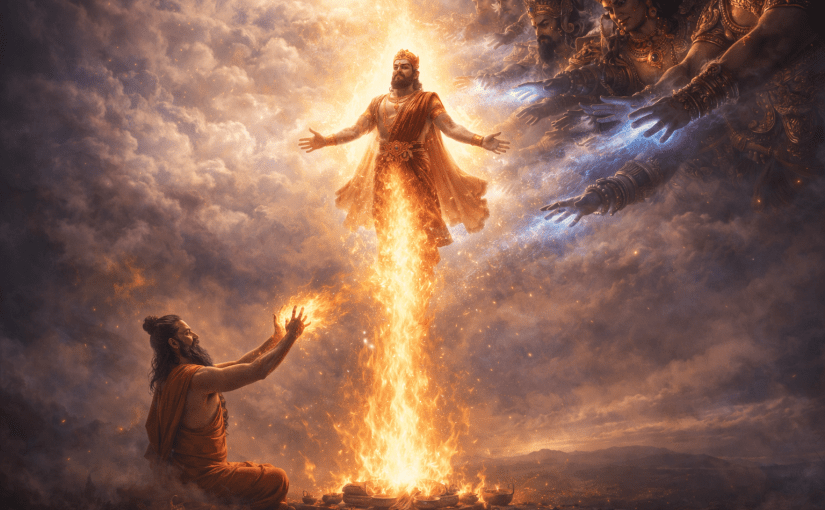
Beyond Death and Liberation: Holding Consciousness Between Worlds

A Personal Reflection on Trishanku, Vishvamitra, Kundalini, and the Inner Guru

How Compassion, Ritual, and Inner Prayer Hold Consciousness Until Liberation Ripens

The Classical Story of Trishanku: The King Suspended Between Heaven and Earth

In the ancient tradition, King Trishanku of the Ikshvāku lineage desired to ascend to heaven in his physical body. When the royal priests refused to perform the rite, he approached the sage Viśvāmitra, whose tapas was unmatched. Through his austere power, Viśvāmitra attempted to send Trishanku to the celestial realms, provoking resistance from the gods. When the ascent was obstructed, Trishanku was left suspended between heaven and earth, neither accepted by the devas nor returned to the mortal world. Refusing to let him fall, Viśvāmitra established him in a unique state—neither fully liberated nor condemned—where he remained held by the force of the sage’s tapas.

Rethinking the Trishanku Story: Blessing, Not Punishment

I have often felt that the story of Vishvamitra and King Trishanku is misunderstood. Most readings stop at ego, rivalry, or defiance of the gods. But to me, it feels very different. It feels like a blessing, not a punishment. Vishvamitra did not abandon Trishanku halfway. He held him.

I feel Vishvamitra created an abode for Trishanku not out of anger, but out of compassion. However, it may be understood as a spiritual anger directed toward the devas for denying liberation to Trishanku. It was pure and positive—aimed at growth, and getting inspiration to do a great job, not rivalry. Trishanku was not ready for full liberation, yet he should not have fallen back. So Vishvamitra, through tapas, prayer, and sheer inner power, held him in between—high enough to be safe, steady enough to ripen. This suspension itself feels like grace. Liberation is not always immediate. Sometimes it is protection from regression.

Rituals for the Departed: Collective Tapas in Everyday Life

When I look at society today, I see the same intention expressed differently. People perform Bhagavatam kathas, shraddhas, yagyas, pindas, and tarpanas, prayers, rest in peace or RIP for their departed loved ones. These are not empty rituals. They are collective efforts to hold consciousness high enough so that it does not collapse back into unconscious karmic drift. Vishvamitra did this alone. Ordinary people do it together, repeatedly, across time.

Seen this way, Trishanku becomes an archetype. Not damned. Not liberated. But protected. Suspended with care.

When the Myth Became Personal: My Own Experience

This is not just philosophy for me. It touched my life directly.

Dream Visitations and the Call for Assistance

After the death of a close acquaintance, I experienced her presence repeatedly in dream visitations. These were not frightening. They were not dramatic. They felt like a seeking—an unspoken request for assistance in liberation. I did not try to command anything. I did not panic. I prayed.

Prayer, Kundalini, and the Meaning of Urging God

I prayed strongly. I urged kundalini for her peace, for her liberation, for forgiveness of acts that might be preventing liberation, for release from unresolved weight. For me, kundalini is representative of God—not as a personality, but as the deepest intelligence of integration. Urging kundalini is urging God. It is aligning intention with the highest coherence of consciousness. We may even call it a personified dhyāna-supporting chitra that often lingers during savikalpa dhyāna and, as it converges toward nirvikalpa dhyāna, enables a smooth and rapid transition.

I also urge liberation for all beings, twice daily, in my dhyana. I do this because liberation is not a limited resource. It is not like physical matter that gets exhausted by giving. It is like light. It can be wished for all, together, without loss. This understanding feels very clear to me.

Signs of Resolution: Clarity, Softening, and Residual Sadness

Over time, I noticed something important. The appearances in dreams became clearer. Calmer. More refined. Each interaction carried less confusion. There was a subtle sadness present—not fear, not agitation—but a gentle sorrow. It felt connected to not being perfectly cared for during illness and the dying phase. I did not try to fix this sadness. I simply allowed it. I know it will resolve one day on its own.

This clarity felt like confirmation—not in a grand mystical sense, but in a quiet, settling way. Something was integrating. Something was being completed.

Kundalini as Dhyana Chitra: The Inner Guru Clarified

I want to be clear about one thing. When I speak of kundalini here, I mean dhyana chitra. The inner meditative image. The inner guru. Not a voice. Not an external command. Not an authority that tells me what to do. It is orientation, not instruction. It does not demand action. It dissolves naturally in meditation.

Where Resolution Truly Happens

On careful observation, I see that nothing was resolved outside me. The resolution happened within. A tense relational field completed itself, which is why clarity increased and interactions became softer instead of more intense.

This reflects the true purpose of ancient rituals. They were meant as acts of love, not fear—support rather than rescue, holding rather than pulling. Their role was to stabilize awareness, reduce downward pull, and allow natural ripening to occur. It means these practices certainly work in this world, and they may also have effects beyond it, in the afterworld as well.

Yogic Understanding: Death as Pratyahara and Suspension

From a yogic perspective, death itself is forced pratyahara. The danger is regression into old samskaras. Holding practices—whether tapas, prayer, ritual, or remembrance—keep awareness above that collapse point or above throat chakra. Trishanku’s suspension mirrors this exactly.

Psychological Grounding: Grief, Holding, and Completion

From a psychological perspective, this is also healthy grief. Remembering without clinging. Caring without binding. Letting go without denial. Societies that abandon ritual often carry unresolved trauma because transitions are left unheld.

Responsibility Without Burden

One crucial truth remains central to me. I am not responsible for liberating anyone. I am responsible for not obstructing liberation with fear, guilt, or attachment. My prayers are permission, not intervention. Opening, not pushing.

Why Experiences Fade When Resolution Occurs

That is why these experiences naturally fade. Fewer visitations. Less emotional charge. More neutrality. Eventual quiet disappearance. Resolution softens. It does not escalate.

This is the role of the inner guru. Not to act. Not to control. But to allow completion to happen without force.

Returning to Trishanku: The Archetype of Compassionate Suspension

When I look back at Vishvamitra and Trishanku now, the story feels intimate, not mythic. One consciousness holding another until gravity loosens. One being refusing to let another fall, without pretending readiness that is not yet there.

Different methods. Same compassion.

Not a Conclusion, But a Resting Place

This blog is not a conclusion. It is a resting place. A suspension that does not need to hurry. Just as liberation itself does not hurry.

From Inert Matter to Supreme Consciousness: A Journey Through Self

When we look up at the sky, it appears still, silent, and vast. It’s natural to see it as lifeless or jada—an inert physical space. In the same way, we label objects and even dead bodies as jada because they seem unconscious. There’s no movement, no response, no sign of inner awareness. But what if this stillness is not truly lifeless? What if what appears jada is actually holding a deep, silent potential within?

Traditionally, we consider something jada when it doesn’t show any signs of life. Even a human body, once the soul leaves, is referred to as jada because the expressions of consciousness are gone. But this jada state doesn’t mean emptiness. It’s more like a tightly packed capsule—where all the impressions, experiences, and memories are compressed and hidden, like data in a zip file. That’s why it feels dense, bound, and even suffocating.

On the other hand, when something is alive and expressive, we call it chetan—conscious. A living being breathes, feels, acts, and reflects. Its inner information is not hidden—it’s in motion, interacting with the world. This openness makes chetan appear far superior to jada. The life within it flows. It explores, it expresses, it evolves. That’s why we admire living beings—they are like windows through which consciousness shines.

But even chetan has its limitations. While the conscious being can act and interact, it still carries inner burdens—deep impressions called samskaras—that shape its personality, habits, and sufferings. The beauty, though, lies in the fact that a chetan being can work on itself. It can shed these burdens through inner work—whether through spiritual practice, self-inquiry, yoga, or meditation. This path leads to something even greater.

That greater state is param chetan—the supreme consciousness. It is not just living. It is fully awakened, totally free. It doesn’t carry any burden of impressions. It doesn’t suffer from ignorance or duality. It exists in its purest form: full of satta (existence), chitta (consciousness), and ananda (bliss). This is the real sky of the self—boundless and untouched.

Ironically, param chetan may still look like jada to the ordinary eye. A realized sage may appear calm and still like a rock or empty sky. But within that stillness lies a fullness beyond comprehension. What appears lifeless is, in fact, the most alive. It’s just not agitated or noisy. It’s like a silent ocean—motionless on the surface, yet infinitely deep.

So what we call jada may just be param chetan in disguise—consciousness in rest, not in absence. The journey of the soul is to move from being unconsciously bound, to consciously expressive, and finally to being consciously free. This is the hidden evolution—from inert matter, through active life, to divine being.

And in that ultimate state, the infinite sky within us is no longer veiled. It shines in its original light—pure, luminous, and complete.

Kevala Kumbhaka: Stilling Prana, Stilling Mind, and Burning Karmas to reach moksha

I’ve been contemplating Kevala Kumbhaka and its deep effects on the mind and karma. I see that stilling prana through breath cessation (Kevala Kumbhaka) stills the mind, but I wonder—how does it still the subconscious mind or the deep hidden imprints (samskaras)?

I’ve realized that normal meditation quiets only the surface mind. Even in deep Dhyana, thoughts may become weak, but the subconscious continues vibrating in the background, storing desires, fears, and past impressions. The deeper layers of the mind, where samskaras lie hidden, remain untouched. But Kevala Kumbhaka seems different—it doesn’t just calm the mind, it halts it at its very root.

How Kevala Kumbhaka Reaches the Subconscious Mind

The mind and prana are two sides of the same coin. The subconscious (chitta) holds karmic imprints, and these samskaras stay alive only because prana keeps moving. These sanskaras keep rapidly and continuously forming thoughts related to them. Only few gross thoughts come to our awareness, majority of thoughts are subtle which we even don’t feel. These all thoughts Keep these sanskaras in subconscious alive. Everything fades up with time if energy is not used to sustain it. The same happens with sanskaras. Karma and related thoughts make sanskaras and sanskaras Keep forming same karma and related thought patterns in return. Thus both keep energizing or strengthening each other. Even during few hours of keval kumbhak, when thoughts and subtle thoughts become zero, these sanskaras loose enough strength. That’s why we feel a permanent transformation. Although full erasing may need keval Kumbhak applied for days or routinely. Intentional removal of gross thoughts don’t erase sanskaras because subtle thoughts keep these alive. That’s why we don’t feel transformation with gross mind control even for a long time. May be it works but extremely long time taken by it seems too much impractical. I think permanent transformation after few seconds of awakening or glimpse is also due to this phenomenon. Means even few seconds of full mindlessness is enough to weaken all buried sanskaras.

When prana moves, thoughts and impressions keep arising—like waves in an ocean.

When prana stops completely, there is no movement left to activate samskaras.

Since samskaras get their energy from prana, they lose their charge and start dissolving.

This is why deep states of Kevala Kumbhaka feel like emptiness (shunya), stillness, or even formless awareness. It’s not just a mental silence—it is an absence of karmic momentum itself. Momentum in science means increasing speed. Prana is like a push or speed enhancer to wheeled baggage of sanskaras that otherwise has tendency to slow down and stop as seen in physical world. Push force stops, baggage stops.

This also answers why normal meditation (without breath cessation) cannot fully erase samskaras. In usual meditation, even if thoughts become still, subtle subconscious vibrations still persist. But in Kevala Kumbhaka, even these hidden layers stop vibrating, leading to deep dissolution of past conditioning.

Does Kevala Kumbhaka Deactivate Past Karmas?

Yes, Kevala Kumbhaka can deactivate past karmas, because karma is not just an idea—it is an energy pattern in the subconscious. Since prana fuels karma, when prana stops completely, karmas lose their foundation.

This is how it works:

Sanchita Karma (Accumulated Past Karmas) → Dissolves, because there is no pranic movement to sustain them.

Prarabdha Karma (Karma Already Playing Out in This Life) → Continues temporarily, like a fan that keeps spinning even after the power is cut. But without ego involvement, it is just a play—suffering disappears.

Kriyamana Karma (New Karma Being Created Now) → Completely stops, because the egoic doer (kartabhava) dissolves.

This is why Kevala Kumbhaka is one of the fastest paths to Moksha (liberation). It stops prana, which stops the mind, which stops karma. When karma is erased, the cycle of rebirth (punarjanma) is broken.

Where I Stand in This Journey

I have not yet achieved Nirvikalpa Samadhi, but I have touched Savikalpa Samadhi—where the sense of ‘I’ dissolved, leaving only unified consciousness. However, I intentionally lowered my experience back to the Ajna Chakra, fearing that I might become a renunciate (baba). This choice might have prevented me from entering the realm of Nirvikalpa Samadhi.

I now realize that awakening glimpses alone are not enough. The true challenge is sustaining liberation forever. While enlightenment experiences may happen, if karmic seeds remain, one may still fall back into egoic identification. Karma or sanskara baggage makes ego of a person because he’s deeply attached to it. The real work is in burning samskaras completely, ensuring no return to ignorance.

Right now, I believe that Kevala Kumbhaka is the missing key—it seems to be the fastest way to erase deep karmic imprints, still the subconscious, and lead to Nirvikalpa Samadhi and final Moksha.

I see that chasing Nirvikalpa Samadhi without Kevala Kumbhaka seems nearly impossible—because as long as prana moves, some mind activity remains, and as long as mind moves, some karma remains.

Final Thoughts

This journey is not about mystical experiences or temporary bliss—it’s about final, irreversible freedom. Awakening, enlightenment, glimpses of truth—they all lose meaning if the mind returns. True liberation is when nothing returns—not the ego, not karma, not even the subtlest movement of thought.

Kevala Kumbhaka appears to be the direct method to reach that state. Whether I will achieve it or not, only time and my practice will tell—but the direction is clear.

For now, I continue my sadhana, refining my understanding and methods, aiming to go beyond mere glimpses into permanent dissolution.

From Savikalpa to Nirvikalpa: The Path Beyond Bliss to Ultimate Liberation

Nirvikalpa Samadhi can arise directly, bypassing Savikalpa in rare cases like Keval Kumbhak, deep sleep-like states, or sudden grace. While traditional paths emphasize gradual absorption, some awakenings skip this stage entirely, plunging straight into the formless. My experience with Keval Kumbhak confirms this possibility, where no structured transition was needed. However, stabilization remains key, whether one follows a gradual or direct path.

But why is there no such infinite bliss and light as that was in my Savikalpa Samadhi and included awakening glimpse?

In my awakening glimpse, there was overwhelming bliss mainly a sexual type of bliss comparable to the infinite or ultimate or super sex, light that’s experiential and different from physical one, and unity—a divine experience beyond words. It felt like the peak of existence, a complete merging with the infinite. Yet something was there to achieve as I felt. Probably it was a subtle yerning to achieve nirvikalp samadhi. In contrast, in Keval Kumbhak csused transient Nirvikalpa Samadhi, there was neither light nor darkness, neither ecstasy nor emptiness. It was something beyond words itself. It was as if I was in deep sleep with intermittent fleeting thoughts like dream. But one thing special was I was aware of this state. It was just pure awareness of myself. If there was awareness then it’s itself obvious that there was bliss in it. Because with awareness or existence, there is always happiness or bliss. And where there is existence and happiness, there is also knowledge. Even in today’s information age, it is seen that by acquiring knowledge, a person gets existential power i.e. achievement as well as happiness. That is why God is also called Sachchidananda. But I didn’t find any experience full of light and bliss or appearing as peak of worldly physical or mental experiences as felt in savikalp samadhi. However there was satisfaction in it. Satisfaction itself means there’s everything contained in it. It means that was nirvikalp samadhi slowly developing. In deep sleep, there doesn’t even remain self awareness. 

I now see the reason. In Savikalpa, there is still a subtle observer, a refined perception that allows bliss and radiance to manifest. Also there’s a refined neurochemistry that may release bliss forming chemicals. Means it may not be entirely the bliss of pure self but a play of neurochemicals. In Nirvikalpa, even that dissolves. In pranaless state of keval Kumbhak even ecstatic thoughts with accompanying bliss chemicals can’t form in the brain. Then there’s left only the soul and its natural self awareness and bliss. There is no one left to witness, no duality, only pure existence. Only mental formation or ego acts as witness. Pure self is void that can’t witness anything other than itself means directly knowing itself. And also it can’t be witnessed by anyone. It can only be directly felt as one’s own self. It is not an absence, nor is it something that can be described—it simply is.

Yet, strangely, its after-effect is deeper. The bliss of Savikalpa fades, but Nirvikalpa leaves a silent presence that does not come or go, just remains. A strange feeling always remains for many births or until one attain perfection in it. There is some kind of a peaceful void which is helping me in every way and pulling me towards it. I had this feeling since birth. It can also mean that I may have got a glimpse of Nirvikalp Samadhi in some previous birth but I have not attained it completely. The beauty of the soul is not something to be seen; it is to be lived.

What is said by many that after attaining Savikalpa, there is no need to make efforts to attain Nirvikalpa, is not to say that effort is secondary. Rather, it means that after Savikalpa Samadhi, a person progresses towards Nirvikalpa Samadhi on his own, because after attaining everything or touching the pinnacle of the world, the desire or attachment towards the world starts to end on its own. But this can take a lot of time, it can even take many births. Therefore, to speed up this natural process, efforts have to be made for Nirvikalpa as well. The more efforts you make in the form of sadhana, the sooner you will attain it. Even after nirvikalp efforts need to be put to achieve sahaj samadhi that’s last doorway to liberation. The importance of effort does not decrease in any field and in any situation.

Kundalini Awakening is the ultimate goal of the living being

It seems to me that awakening is the ultimate goal of any living being. Liberation is not in the hands of the living being, nor was it in his control to get bound. By putting the living being in bondage, God gave him the opportunity to experience awakening. The logic of God becoming a soul and getting bound to the world only makes sense if it is believed that he did not have the experience of awakening that is love-filled. He came to the mortal world to attain that. If that was already available to him, then why would he abandon his complete form and become a living soul and wander in the forms of creatures full of sorrows. Of course, not he himself but his photocopy comes in the form of a living being, but the logic still seems the same. Why would a photocopy come without any purpose or benefit? And when the soul attains awakening, what is the purpose of remaining in bondage? It frees itself from the world. Logic says this, what the scriptures say is a different matter. Even God himself does not have this experience of awakening at peak of love, because he never took a body. The storm of rising energy is possible only in the body, and this is also the original source of love. Awakening is achieved only through love. Perhaps God is satisfied by experiencing the awakening of the living being. What is not possible for him? He is infinite.

The living being has suffered in the world for countless years. This is the reward of his penance, a gift that is only for the devotee living beings, not even for God himself. That is why he considers the devotee to be greater than himself and continues to search for him. This idea is completely in line with the Bhakti philosophy and also agrees with the teachings of the scriptures and saints.

My experience tells me that the worldliness of life is not an obstacle, but an opportunity. If this is lived with awareness, then natural progress towards awakening is possible. This can be made even easier by integrating physiology of philosophy aka sharirvigyan darshan or mythological body. In my own journey, I have not yet experienced nirvikalp samadhi, but I have understood the touch of awakening. This experience arises from the balance of love and energy.

I also feel that the process of raising and lowering of energy is just a natural game. There is no need to forcibly control it, but it needs to be accepted naturally. It is akin to accepting the world as it is. Awakening is not an external achievement, but the culmination of internal experience and love.

If instead of awakening i.e. enlightenment, liberation or samadhi was the main goal, then various spiritual sects like different types of yoga, tantra etc. would not have been created to achieve it. Everyone would just sit quietly and observe their thoughts as a witness. Everyone would always live a life away from worldly affairs by remaining calm. No one can see liberation, but awakening feels like a direct experience. By striving for awakening, there is at least a hope of getting awakening, and one can also get liberation. But if we leave awakening and try only for liberation, then it is possible that neither awakening nor liberation is attained. And what is the proof of liberation? If someone is calm today, then he is free, but if he is attacked tomorrow and he takes defensive action, then peace is gone and liberation is also gone. It is like neither Maya nor Ram is attained. Most people live their lives like liberated people. Looking at them, it is not known whether there is life in them or not. They do not even try for awakening because they live in the illusion that they are liberated. They will immediately justify it by giving examples from the scriptures. I think this is a big scriptural deception. Either this is an incomplete understanding of the scriptures. Or the scriptures were written by people of later times. There were others who had the real experience.

I consider awakening, Kundalini awakening, samadhi and enlightenment to be the same thing. At many places, different meanings are derived from them or subtle differences are found between them. I do not get into these impractical hassles nor do I care about them. Instead of wasting time in these, if time is spent for experience, then something can be gained.

I have also experienced that by focusing too much on energy in meditation, the image of meditation becomes blurred. Therefore, it is best to preserve the original image of meditation. Actually by focusing on the meditation picture the energy itself becomes balanced and upward moving meaning it automatically gives necessary strength to all the chakras, whereas by focusing only on the energy it can go anywhere, it is not necessary that it strengthens the meditation picture only. My journey is still on, and I am moving towards understanding this truth more deeply.

If this experience is adopted, it will not only give spiritual progress, but can also make the worldly life balanced and prosperous. Awakening is not a distant ideal, but a truth available in every moment. It is possible only with love and dedication.

The Path of Awakening: Balancing Enlightenment and Worldly Life

For those who have glimpsed enlightenment, the journey does not always lead to immediate liberation. Instead, it often raises an even deeper question: how does one integrate this profound realization into daily life? My own experiences have taken me through different dimensions of awakening, from adolescence to my later years, shaping a unique perspective on spirituality, renunciation, and engagement with the world.

A Glimpse Beyond the Mind

The first significant brush with enlightenment came in my adolescent years through a dream-state experience. It was a powerful realization—one that connected me to the limitless cosmos. Yet, it left me with a lingering craving for fulfillment, suggesting that the experience, though transformative, was not complete liberation. Years later, a more conscious awakening occurred through a combination of Kundalini Yoga and Tantric sexual yoga, leading to an even more intense moment of self-dissolution. This time, the craving was minimal, but I found myself bringing the energy back down intentionally, fearing the irreversible shift towards renunciation.

This conscious grounding of energy led me to explore the delicate balance between spiritual transcendence and worldly engagement. Unlike some who fully embrace monastic life after such experiences, I felt compelled to remain in the world while sustaining my awakening.

Does Enlightenment Guarantee Liberation After Death?

A common question that arises after a glimpse of enlightenment is whether it guarantees liberation post-death. Various traditions offer different answers. Some suggest that even a single deep realization creates an irreversible imprint, ensuring that the soul moves toward liberation, even if rebirth occurs. Others argue that full stabilization of enlightenment—either in this life or at the moment of death—is necessary to break free from samsara entirely. My perspective aligns with the idea that even a temporary experience of the ultimate truth provides a direction after death, ensuring a well-guided transition, if not immediate liberation.

Renunciation or Integration?

Experiencing profound states like Savikalpa Samadhi naturally leads to the question of renunciation. Does one leave the world to deepen into Nirvikalpa Samadhi, or is there a way to maintain realization while living a worldly life? Initially, I leaned toward integration, choosing to stabilize awareness while engaging in responsibilities. Over time, I noticed that my energy remained centered in the Ajna Chakra, creating a state of Pratyahara—a withdrawal from external distractions while still being functional in the world.

However, this also led to reduced engagement with lower chakras, affecting worldly interests. To counterbalance this, I consciously applied Panchamakara practices in minimal amounts, using them as a tool for grounding rather than indulgence. This strategic approach allowed me to retain awareness without losing myself in worldly entanglements.

A Structured Approach with Kriya Yoga

While my earlier awakening experiences were rapid and unstructured, I later explored Kriya Yoga, appreciating its systematic approach. Unlike my initial methods, which focused on direct energy ascension, Kriya Yoga emphasized gradual refinement through Dharana, Dhyana, and Samadhi. I found that my earlier practice had already developed these states, but in a spontaneous way rather than in a staged progression. Now, Kriya Yoga serves as a structured refinement tool rather than a new revelation.

However, I also discovered a practical challenge—deep breathing exercises after a full stomach were showing possibility of increasing my GERD-related issues, including sleep apnea. Adjusting my practice to 4-5 hours after meals removed this possibility, reinforcing the importance of aligning spiritual techniques with bodily conditions.

Key Takeaways

A glimpse of enlightenment shapes the post-death journey, but full liberation may require further stabilization.

Balancing nonduality with worldly life is possible but requires conscious grounding techniques. The philosophy of Sharir Vigyan darshan (mythological bidy) is amazingly helpful in this, which I created for myself but is now available to everyone everywhere.

Kriya Yoga provides a systematic approach but does not necessarily reveal anything new for those who have already experienced direct awakening.

Pratyahara naturally occurs as awareness stabilizes in higher chakras, but intentional grounding helps maintain functionality in the world.

Physical factors like GERD can affect spiritual practices, requiring mindful adjustments.

The Road Ahead

Rather than seeking another grand experience, my focus now is on sustaining the clarity of awakening without getting lost in either spiritual absorption or worldly distractions. I remain open to refining grounding techniques while ensuring that my sadhana continues to evolve. In the end, enlightenment is not about a single peak moment—it is about maintaining unwavering awareness, whether in meditation or in daily life.

For those walking a similar path, the key lies in understanding one’s unique energetic tendencies and shaping a practice that balances both inner realization and outer existence. True liberation is not about escape—it is about realizing that whether in the world or beyond, the awakened state remains unchanged.

Is a Glimpse of Enlightenment the Highest Experience?

Is there anything higher than a glimpse of enlightenment for a living being? If someone has tasted it, has he reached the ultimate peak? The answer is—no. A glimpse is like touching the summit for a moment, but true fulfillment comes only when one can stay there. After such a glimpse, one must return to their natural state, which is liberation or Samadhi.

Does Liberation Bring Greater Bliss Than Enlightenment’s Glimpse?

In a moment of enlightenment, prana fuels the experience, making it intense and extraordinary. But this surge is bound by the body’s limitations. In Samadhi, this energy is balanced, effortless, and eternal. The bliss may not feel as explosive, but it never fades. A lightning bolt may be brighter than the sun for a moment, but the sun never stops shining.

Will Someone Regret Missing the Glimpse If They Attain Liberation Directly?

If someone reaches Samadhi without ever having a glimpse of enlightenment, will they feel like they missed something? Perhaps, yes. That’s why it is said—before liberation, experience the peak of love, surrender, and devotion. Bhakti, romance, and deep connection give birth to that glimpse. It may last only a moment, but it ensures that Samadhi is not just a silent void—it becomes a state filled with love, bliss, and completeness.

Why a Glimpse Is Worth Experiencing

I truly believe that at least once in a lifetime, a glimpse of enlightenment is worth having. It may be brief, but it changes everything. Without it, Samadhi may feel like an absence rather than a presence. Love, devotion, and a deep sense of connection prepare the ground for it. After all, what is the point of reaching the peak if you have never felt the thrill of climbing?

The Illusion of Completion

For a long time, I lived under the subtle illusion that after experiencing a fleeting glimpse of enlightenment, I had attained everything. That single moment felt so complete, so overwhelming, that I mistook it for the final destination. But life, with its trials and lessons—especially through the lens of sharirvigyan darshan—revealed a deeper truth. That glimpse was not the end, but merely the beginning. The journey is far from over, and the path ahead is longer than I once believed.

Kundalini Awakening Bliss vs. Samadhi Bliss: Seeking Stability Beyond Intensity

Many seekers, after a glimpse of awakening, wonder: If awakening bliss is so intense, how can Samadhi, which feels less energetic, be superior? Shouldn’t the highest bliss be the ultimate state? Though I haven’t reached Samadhi yet, I believe the answer lies not in intensity, but in stability, depth, and permanence.

My Experience: The Awakening Surge and Its Limitations

During my awakening, I experienced an overwhelming surge of bliss, as if consciousness exploded into infinite expansion. My breath naturally suspended, and I felt a complete dissolution of self. But it was too intense to sustain. The body’s resources felt drained, and soon, the state faded. It lasted for about 10 seconds, yet its impact was profound. No matter how profound the moment was, it wasn’t lasting liberation. This made me wonder: What if Samadhi is not about such energy surges at all?

The Awakening Surge: Powerful but Fleeting

In a moment of awakening, energy rushes to the brain, causing extreme bliss, vast expansion, and a deep sense of connection. But this surge is prana-dependent, demanding high body resources. It is a peak experience, not a lasting state. Like a lightning bolt, it illuminates everything for a moment but then fades, leaving one seeking it again.

Samadhi: The Deep, Silent Ocean of Bliss

Unlike awakening, Samadhi is not an energy surge but a state of stillness. From what I understand, it feels subtle yet profoundly satisfying. No energy is spent, no force is needed, no excitement is required. The mind dissolves, revealing a bliss that is infinite and self-sustained. It may seem less intense than an awakening jolt, but it never fades.

Why Stability is More Powerful than Intensity

Imagine two kinds of light:

Awakening Bliss = A Flash of Lightning – Blindingly bright but gone in an instant.

Samadhi Bliss = The Sun – Constant, effortless, and unshakable.

A high-energy surge can break illusions, but only a stable Samadhi dissolves them permanently. Awakening shows the truth; Samadhi makes it your reality.

The Journey from Awakening to Samadhi

Many struggle to sustain Kevali Kumbhak (spontaneous breath suspension), thinking more intense effort will bring Samadhi. But effort creates resistance. Instead, one must surrender into stillness, letting the mind and prana naturally settle. When breath stops by itself, without force, true Kevali Kumbhak may lead effortlessly to Samadhi.

What if One Tries to Reach Samadhi Without Awakening First?

Some may attempt to enter Samadhi without experiencing an awakening surge first. While deep meditation can bring profound silence, true Samadhi requires the dissolution of identity. Without awakening, the mind may still cling to subtle ego structures, preventing complete absorption. Awakening loosens these bonds, making true Samadhi possible. Without it, one might enter deep trance states, but not the irreversible shift of true liberation.

The Real Superiority of Samadhi

Awakening is an experience. Samadhi is a state of being. Awakening comes and goes. Samadhi is unbreakable. Awakening opens the door. Samadhi is walking through it forever.

Though I haven’t reached Samadhi yet, I believe true liberation is not in chasing bliss but in resting in that which never fades. Maybe Samadhi is not about more energy, but about less resistance.

Can One Reach Samadhi Without Awakening If They Have Low Prana?

If someone lacks the pranic intensity to trigger an awakening surge, does that mean they can never reach Samadhi? Not necessarily. While an energetic awakening can act as a catalyst, Samadhi is ultimately about stillness, not energy surges. A seeker with low prana can still reach Samadhi by deepening silence and dissolving egoic identification. Even without an awakening flash, consistent meditation, surrender, and absorption into stillness can open the door to liberation.

Kundalini yoga teaches the art of dying

Friends, there is a famous saying that by practicing continuously, even a fool becomes wise and skilled. All people are fools when it comes to attaining salvation. So, can salvation be attained effortlessly by practicing Kundalini yoga continuously? Let us analyze it in this post.

I was reading the introduction to Purana Purush. It was written in it that how did a householder yogi, known to the author, die? At the last moment, he had focused his life exactly in the middle of the eyebrows. Due to this, there was a strong vibration there. Then he breathed his last there. It was believed that he was liberated. That same Agya Chakra has been called Ram Dwara. In common parlance, the death that people used to mention at Ramdwara was the Agya Chakra itself.

Now the question is that at the last moment, when all the senses become devoid of knowledge, how can one focus the life of the body on the Agya Chakra? I think this happened on its own, through lifelong practice. Science also shows that the blood circulation of the body keeps on shifting from non-essential organs to essential organs. Then this should happen even without yoga. It does happen. Whether one does yoga or not, blood circulation gives importance to the brain. Agya Chakra is one of the main parts of the brain, and is the most effective point in the path of the main nerve of the body. But such vibration is not seen in everyone. It is seen only in Yogis. It seems that blood circulation is automatically controlled by itself. There is no need to be aware or experienced about it. But to make Nadi Sanchar more effective, one has to be aware of it. Meaning, one has to experience it. Although Nadi Sanchar keeps happening at the basic level even without experience. It is due to it that the body remains active. But to raise it to the level of providing liberation, its experience has to be increased. Blood circulation cannot do all the work. It certainly supplies all the necessary substances to the cells for their work, but it is the nerve circulation that motivates the cells to work by using them. Perhaps this nadi circulation is called Prana. If we place material for building a house in front of a person, he will not immediately start building the house. He will have to be motivated to work using that material. This motivating work is done through nadi circulation. You all know that for liberation, it is necessary for all the thoughts suppressed in the mind to manifest in the soul. This is what happens in the witness state. That is why there is a feeling of liberation from it. We certainly experience all the previous suppressed thoughts in the soul in the witness state, but the new thoughts that are suppressed after that are enough to put us in bondage. At the time of death, because all the senses become inactive, the new world cannot be experienced, meaning new thoughts cannot be formed and suppressed in the mind. In such a situation, if all the old suppressed thoughts are experienced in the soul even once due to the great circulation of Prana in the brain, then there should be no doubt about liberation. It is written in the scriptures that if the name of God is taken or he is remembered at the time of death, then one attains salvation. It is also written in many places that this can be done only if there is a lifelong practice. This practice points towards Kundalini Yoga practice. Because the common practice will not be useful at that time. That is because all the senses will be almost dead. How can anything be thought through them. Those almost dead inner senses can come to life only if a strong wave of life force shakes them. Right now because the blood circulation would have shifted from the external senses like eyes, ears etc. to the internal senses like mind and intellect. That blood circulation will also not be so much that it can provide sufficient nutrition to the nervous system there. In such a situation, only the strong wave of life force rising from the Mooladhara can make it active.

Then it is said that whatever a man thinks about in his last moments, he becomes that in his next life. Jad Bharat thought about a deer, so he became a deer. Perhaps this thinking is solitary thinking which happens due to lack of prana. Attachment or credit intelligence remains towards only one mental picture. That is why one gets the same kind of birth. But due to the powerful vibration of prana coming from the Mooladhar, all the mental pictures are felt together and become calm in the soul. Then there is no attachment to any particular picture. This gives liberation. Either do not get attached to anyone or do it with everyone. The result of both is the same, detachment. Either do not remember anyone at the time of death, or remember everyone. The thing is the same. But this does not happen because the ordinary prana will make you remember someone or the other. The kundalini power flowing in the Sushumna is so powerful that it makes you experience everything together. Perhaps this is its basic principle.

But death does not always come so comfortably that it gives the thoughts a chance to merge with the soul. Premature death occurs suddenly. In today’s modern, mechanical, polluted, war-ridden and disease-ridden era, it occurs more often. Earlier it was considered very inauspicious and an obstacle to salvation. It was even believed that the soul would wander without a body for a long time. That is why it was said that one should always be spiritually prepared for death so that even if untimely death comes, one can still get salvation. Such preparation can be done only by daily Kundalini Yoga practice.

When I had corona, I used to feel the transmission of prana through my back, which was probably to fight the disease. In those days I was not even able to do Kundali Yoga. Thoughts were emerging very peacefully and merging into the soul. Perhaps it happens that when the practice of yoga is missed, the accustomed body tries to do that yoga on its own. Perhaps this is why pranayama and yoga are considered liberating. Countless yogis have tested it for centuries.

Kundalini Yoga transforms advanced cognition into basic cognition

Friends, man is an advanced creature. Advanced cognition is present in it. But one side effect of improved cognition is that it creates attachment, due to which the person becomes bound to it. It is like a life-saving medicine is the most helpful, but it also has the most side effects.

Basic cognition is present in all the cells of our body. Similarly, all the lowest and most microscopic organisms also have basic cognition. All of them adapt themselves according to their surrounding environment. To survive they follow a lifestyle similar to ours. Learn new things, and remember old things. But for this, no brain like structure has been seen in them yet. Meaning that they are controlled by a series of different and countless chemical reactions. So why not consider those chemical reactions as their brain. Our brain also runs on chemical reactions only. It is possible that even inanimate objects like stones and air may have a lower level of basic cognition than this, which science has not yet been able to understand. The flow of air is controlled by atmospheric pressure. So why not consider air pressure as the basic cognition of air. Similarly, every time air has a specific reaction at a particular air pressure. So why not consider it as the memory power of air pressure. With basic cognition there is no sense of good and bad. For example, due to low air pressure at a place, air entering there does not give a good experience to the air. Nor does the movement of air from there when there is high air pressure give a bad experience to the air. Similarly, a bacteria does not feel happy when it receives a particle of food and does not feel sad when faced with an enemy. Meaning that with basic cognition there is no attachment or hatred. At the same time, in higher cognition, that intermediate state of equality turns into attachment and hatred. Just like a neutron gets converted into a positive proton and a negative electron. When both are mixed, a neutral neutron is formed again. The plus and minus charges cannot be destroyed separately. These two will be destroyed only when they meet each other. Similarly, we cannot eliminate attachment and hatred by keeping them separate. If we keep attachment to passion and aversion, they will remain separate and grow stronger. When passion arises, hatred will also arise somewhere, because like electric charges, these also arise in pairs, not alone. Detachment is the process which connects positive passion and negative hatred and destroys both. Call positive Yang and negative Yin. Their union is the much talked about confluence, or Advaita.

The development of cognition is like a necessary evil. When man was only in the form of air, water or micro-organism, he had basic cognition. There was neither passion nor hatred in him. He was neutral. He was neither happy nor sad. But as cognition developed, he started experiencing good and bad. Due to this, happiness and sorrow arose in him. Life and death came into existence. Earlier he neither lived nor died. Perhaps this is the indescribable liberation which has been talked about in the Vedas. There was neither light nor darkness in it. Meaning there was no conflict in it. That situation can also be understood in such a way that in that situation all the conflicts were there together. A neutron contains both a proton and an electron, yet not both. Similarly it is said that everything is there in God and also not there.

Now the description of the universe in the Vedas which is similar to that of human society, and the description of various animate gods and demons etc. in it is exactly like that of the people of human society, actually seems to be an attempt to return towards basic cognition. Similarly, in Tantra based physiology philosophy aka Sharirvigyan darshan, the description of the body like the universe and human society is also an attempt to achieve the same primitive basic cognition. Both have the same theme, but the philosophy of physiology seems more contemporary and scientific. However, both methods work better when combined with each other. According to a previous post, Kundalini Yoga strengthens the philosophy of physiology. This means that Kundalini Yoga strengthens the basic i.e. pure cognition.

So will we accept the existence of only electrons and protons and not neutrons? Meaning, will we accept the existence of consciousness only in advanced organisms and not in lower organisms and inanimate substances? The meaning is clear that there is no such time, place and substance in the universe which does not have consciousness.