Chapter 24: When the Atom Dissolves the Ego

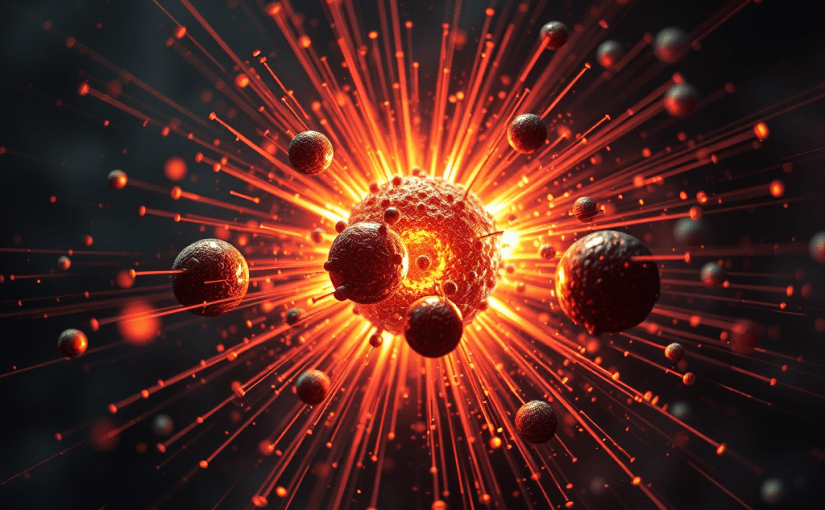
The exploration that began with matter and moved towards the self now reaches another doorway. Matter has been seen not as something separate but as a reflection of the self. The body has been observed not as a lifeless machine but as a field of consciousness woven through atoms, molecules, tissues, and energies. Now comes the most delicate and mysterious turn in this journey, where the very atom itself reveals the illusion of doership and quietly melts the ego away.

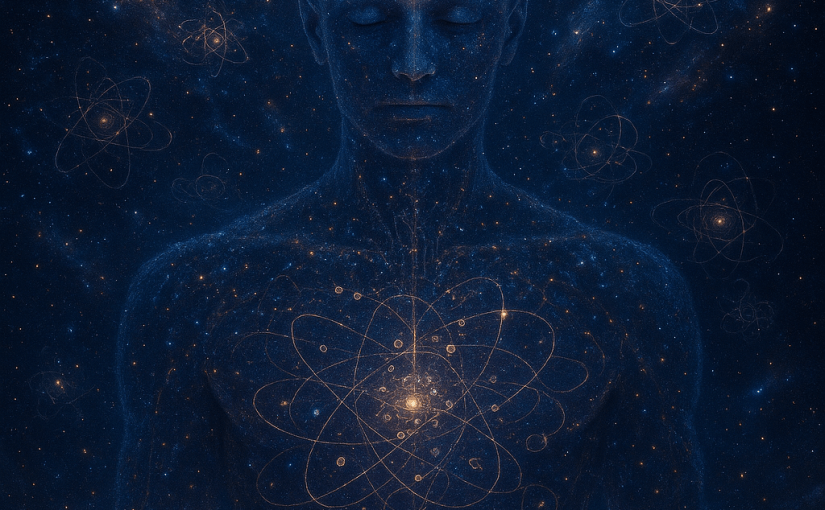
Every atom is endlessly active. Within it, protons and neutrons are bound in ceaseless dance, while electrons whirl around with unimaginable speed. Yet in all this activity, never does an atom declare, “I am the doer.” There is no self-assertion in its functioning. It simply acts because action is woven into its nature. The atom never claims ownership of creation, and yet without it, nothing can move. In this silent humility of the atom lies a mirror for the human being. The body, built of countless atoms, also functions in the same way. Breath rises and falls, blood circulates, thoughts appear and fade, but nowhere within does the body say, “I am the thinker.” Thoughts are not manufactured by the body; they are ripples in the vast lake of mind.

Ancient wisdom had already noticed this truth. In the Gita it is said that the gunas act upon the gunas. Forces of nature act upon forces of nature. Fire burns because it is the nature of fire to burn, wind blows because it is the nature of wind to move. Likewise, actions emerge from the body and mind because it is their nature to act. The witnessing consciousness remains untouched. The illusion of ego is nothing but the mind’s mistaken identification with this flow of actions. Ego believes, “I am doing,” whereas in truth action is happening through the gunas, just as rain falls or a flower blossoms.

Science, too, has begun to echo the same insight in its own language. Physics shows that before any particle is observed, it exists in superposition, holding many possibilities together. Only in the moment of observation does one outcome collapse into being. In the same way, before a thought arises, the mind is filled with infinite possibilities. Each thought is like a quantum collapse, a crystallization from the field of potential into the world of form. Prior to thought, there is only a vast dark stillness, a zero point where every possibility cancels itself by its opposite, leaving nothing but unexpressed energy. This state of unmanifest mind is experienced in meditation as a deep darkness, an ocean without ripples.

When one emerges from samadhi, there is often no immediate storm of thoughts. First, the still energy is felt, like a dark silence holding everything within it. Only afterwards does the chain of thoughts begin to rise, one by one, each collapse giving birth to the next. Ancient yogic language called this process vyutthana, the return of the mind from samadhi. The modern physicist calls it the movement from superposition to collapse. The meaning is the same: from pure potential arises form, from silence arises sound, from stillness arises motion.

During meditation, scattered traces of thoughts may appear like clouds on a clear sky. The seeker need not fight them. Simply allowing them to pass keeps the mind open to the vast akarnava, the boundless ocean beyond. Sometimes a gentle mental chanting of akarnava itself helps link the mind with this endlessness. And when thoughts grow heavy, the ancient method of neti neti offers a simple key. Neti means “not this.” At intervals, when a thought appears, it is quietly dissolved by remembering, “not this, not this.” The thought fades back into the void. Yet even this practice must remain subtle, for if repeated without pause, it turns mechanical and loses its power. Used occasionally, it creates sudden dips into stillness, where breath slows and relaxation deepens.

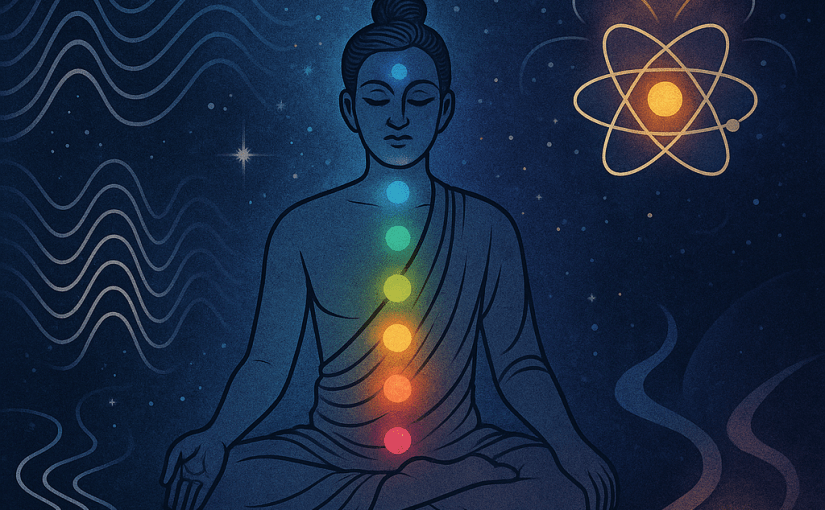
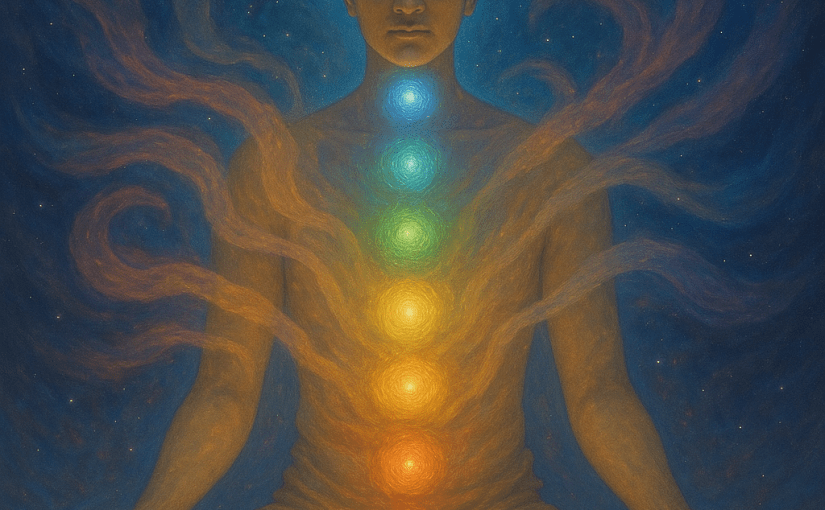
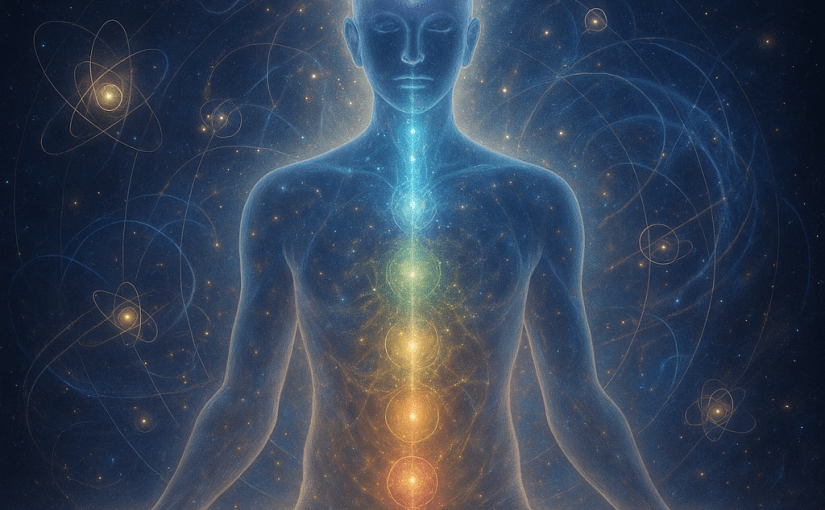
In deeper meditation, when the awareness is extended to the entire sitting body, something extraordinary is noticed. The body itself becomes a gateway to the cosmos. Every chakra within the body is a hidden archive of universal patterns. Within the heart lie echoes of cosmic emotions, within the throat the seeds of all expression, within the brow the visions of countless worlds. When the whole body is kept in gentle notice, the entire cosmos hidden within begins to open. Thoughts connected with the universe itself may arise, only to dissolve in the same silence.

Yet sometimes meditation feels blocked. Energy stuck at certain chakras creates a sensation of suffocation or heaviness. Breath automatically begins to focus on that region as if the body is trying to heal itself. This is not for oxygen but for prana, the subtle energy required by that chakra. Until these blockages are released, meditation remains shallow. Breathlessness is the sign of release. When, after working through the chakras, breath is naturally held at the end of inhalation or exhalation, a depth opens where suffocation disappears. The once-blocked chakra now feels free, or at least so subtle in its lack that it cannot stop the energy from rising. From this breathless stillness, meditation enters its deepest flow.

Actually, after mastering prāṇa through repeated yoga practice, one can hold the breath at will and focus on an energy-deficient chakra. That chakra then feels “hungry” for breath, producing a sharp, suffocating sensation. In reality, it is not hunger for air; it is hunger for prāṇa. When attention is placed on that sensation, the energy in the suṣumṇā naturally floods that chakra and satisfies it, even while the breath remains stopped or nearly absent. When all the chakras become fully nourished with prāṇa, a breathless and deeply satisfied state appears, which is wonderful and naturally leads to a mindless dhyāna-like stillness.

Seen in this light, the discoveries of Sanatan Dharma appear less as religious imagination and more as profound quantum insights in disguise. The sages saw that everything in existence is conscious in its own way, and thus they worshipped every element as divine. Stones, rivers, trees, animals, all were held as manifestations of the same conscious field. Idols and mandalas were not superstitions but symbolic mirrors to the cosmic order hidden within the atom and within the self. Today, quantum scientists too are beginning to wonder if consciousness itself plays a role in the collapse of possibilities into one outcome. The ancient and the modern are slowly meeting on the same ground.

Science shows the structure. Biology reveals the process. Matter, in its endless forms, presents the illusion of separation. But Sharirvigyan Darshan, the direct seeing of the body as a field of consciousness, dissolves ego through pure vision. In this vision, it becomes clear that the self is not an atom, not a cell, not a body. The self is the field in which all these arise and into which they dissolve. Ego may pretend to be the doer, but the atom has no such illusion. Ego may take ownership of thought, but thought itself is only a quantum ripple arising from silence.

The final freedom is nothing dramatic. It is the melting of ego, the end of false ownership. When this happens, silence itself shines forth, not as something achieved but as something that was always there. The self remains, untouched, unbroken, ever luminous. The journey through atoms, body, mind, and cosmos ends where it began, in the pure witnessing that needs no name.

Thus the story comes full circle. The human being entered the investigation thinking of himself as a separate doer and knower. He examined matter, cells, energies, and mind. He discovered that the atom does not claim doership, the body does not think, the mind does not own thoughts. The gunas act upon the gunas, and he is only the witness. In that recognition, the atom dissolved the ego. The silence behind all action became visible. That silence is the self, radiant and free.

And here ends the adventure of Sharirvigyan Darshan as Quantum Darshan, not in noise but in a quiet flowering. When the atom is seen as innocent of doership, the ego cannot survive. When the body is seen as a field of energies, the mind cannot cling. When thought is seen as a ripple in the quantum ocean, the self shines as the boundless sky. This is the final realization, simple and astonishing: the self was never hidden, only the illusion of doership covered it. With its melting, the journey finds its destination, and the seeker finds himself where he always was—free, silent, eternal.

Chapter 23: The Atom Is You – A New Way to See Yourself

From the great canvas of cosmos where stars swirl like sparks scattered in infinite space, the journey once again narrows its focus, drawing the gaze back toward the human form. The previous exploration had revealed how the same rhythm that patterns galaxies also structures the body, how the vast universal flow reflects itself in the miniature figure of flesh and bone. It was a movement outward, tracing the human outline until it dissolved into the map of stars. Now the path turns inward with equal wonder, asking with trembling curiosity: if the cosmos is within the body, what lies within the very atom that builds this body?

The human body is not merely made of atoms; it is the dance of atoms. There is no gap where something called “body” exists apart from them. The eyes that watch, the hands that move, the thoughts that arise, all are formations of vibrating atomic fields. To say “my body” is already a step too far, for what ownership can be claimed over trillions of particles borrowed from earth, water, air, and fire? Atoms flow through food, through breath, through the touch of the environment. They do not belong to an individual; they simply assemble for a while in the pattern that is recognized as a person.

Ego, however, is clever. It rushes forward like a signature stamped on a moving river, claiming that this function of walking, this act of speaking, this thought of dreaming, is mine. Yet in truth it never possessed the materials of its claim. The muscles are shaped by proteins from food that grew in distant fields, the thoughts are stirred by impressions absorbed from a world stretching beyond sight, the very breath is gifted freely by trees and winds that circle the planet. Ego is like a shadow insisting it owns the sun.

Think of your true self like the sun—always shining, always there. Your ego is like a shadow—always around you, moving with you. The shadow never really controls the sun, but it can’t help acting like it does. In the same way, your thoughts, your roles, and your “I am this” ideas feel important, but they aren’t who you truly are. They only reflect the real you. No matter how much the ego claims or worries, the true self stays free, untouched, and shining on its own.

Consider the simple atom. It seems so small that the mind struggles to picture it, yet it is a kingdom of vastness in itself. Within it, electrons spin in mysterious clouds, protons and neutrons huddle in a vibrant heart, and within that heart quarks shimmer like restless sparks. Each layer recedes into deeper mysteries, like a hall of mirrors extending without end. The more science peers into the atom, the less substance it finds, until matter itself dissolves into probabilities, vibrations, and wave-like dances of energy. Thus the atom is not a hard grain but an event, not a brick of reality but a doorway into uncertainty. It’s more like a little event or a happening—always moving, always changing. You can’t pin it down completely, and it behaves in ways that are a bit unpredictable. So instead of thinking of atoms as fixed building blocks, think of them as tiny sparks of activity that make up the world around us.

Now pause for a moment and realize: the body is nothing but the collective appearance of these doorways. What is called “flesh” is a swarm of events, what is called “thought” is a ripple of atomic processes, what is called “emotion” is an orchestration of subtle biochemical storms. To identify with them as a permanent self (mind-body sense of self) is like mistaking a rainbow for a solid bridge. The rainbow glows, astonishes, and vanishes—yet no one can catch it. The self too appears as a dazzling formation, radiant yet elusive, made of atoms that do not stay in one place, do not belong to one being, and do not even truly exist as solid matter.

If the body is made of atoms, and those atoms also make up the world, then the ego is only a claim over what was never truly ours. It is like writing your name in sand while the waves keep washing the shore. With every breath, atoms flow out into the air; with every meal, atoms flow in from the earth. Each day, billions of particles leave the body and billions more enter, so the boundary called “me” is never fixed. A person is more like a whirlpool in a river—shaped for a time, distinct to the eye, yet made only of water that flows in and out. What we call “me” is never separate from the stream it belongs to, but part of the river’s continuous, unbroken flow.

Yet there is an even deeper turning in this inquiry. For just as the body is not separate from atoms, and atoms are not separate from the universe, so too the person is not truly separate from awareness itself. While accepting the physical unity between body and world, how can we deny their mental or spiritual unity as well?This is the final and most delicate insight of Sharirvigyan Darshan, leading us to the ultimate non-physical through the doorway of the physical. Atoms appear, bodies appear, worlds appear, but they all rise within a field of witnessing or silent and pure awareness that itself cannot be touched, weighed, or measured. Awareness does not belong to atoms any more than the sky belongs to clouds. Clouds drift and scatter, yet the sky is not reduced or enhanced by their passing. In the same way, awareness remains open, untouched, while atoms whirl and assemble into the temporary form of a body.

This recognition overturns every ordinary assumption. When the body is mistaken as self, life becomes heavy with fear and desire. Fear arises because what is owned can be lost, and desire arises because what is lacking seems to complete the self. But when it is seen that the body is only an arrangement of atoms, the grip loosens. There is no need to clutch at what was never owned. The hands may still work, the heart may still love, but the compulsion to control lessens, replaced by a spacious ease. Even death itself begins to appear in new light—not as the end of a self but as the recycling of atoms into new patterns, like clay reshaped into new vessels. This means we need not meditate separately on the pure self; simply seeing the body as a temporary arrangement of atoms is enough to bring the pure self into view. This contemplation looks similar to that experiential facet of Sharirvigyan Darshan, where body cells are seen as complete human beings in every aspect—a contemplation that led the author to a Kundalini awakening and a glimpse of self-realization.

Science too whispers of this mystery, though in different words. It tells that energy cannot be destroyed, only transformed. The carbon of the body once burned in stars, the oxygen once flowed through ancient forests, the water once traveled in rivers older than mountains. At death, these elements scatter once more into the world, ready for new cycles. Awareness, however, is not part of this cycle of matter. It does not scatter or rearrange, because it is not made of atoms. It is the stage upon which the atomic drama unfolds.

This is the new way to see oneself: not as a solid individual enclosed within skin, not as a fixed identity defined by thought, but as the open awareness within which atoms gather and dissolve. The “I” that ordinarily feels so heavy is only an appearance, like an add on to pure awareness or like moving and chaotic reflections upon clean and still water. To recognize this is not to deny the body but to appreciate it more deeply, as one appreciates a song without claiming ownership of each note.

Mystics of many traditions hinted at this long before modern physics unfolded its revelations. They spoke of the world as maya, as dreamlike appearance, as shimmering play. Now science confirms that matter is not solid but probability, not substance but energy. Means, matter is not truly solid but energy shaped as a cloud of probabilities, where particles can be in many possible states at once. Only when observed or interacted with do these probabilities collapse into a single definite event we call “reality.” The mystic gaze and the scientific gaze meet at the threshold of the atom, both astonished at the emptiness and wonder that lie within.

This insight does not remove life’s responsibilities or dissolve the needs of the world. Rather, it lends them a gentler context. Work is still done, relationships are still cherished, struggles still appear. But underneath, there grows a subtle knowing that no function is truly “mine.” All our actions come from the whole, shaped by atoms and situations. They appear in pure awareness for a moment and then fade back into it. Ego may still claim them out of habit, but the claim no longer deceives as it once did.

To live with this understanding is to live like a wave that knows it is ocean. The wave rises, dances, and falls, yet never ceases to be ocean in essence. In the same way, the human being may rise in laughter, fall in grief, shine in love, tremble in fear, yet beneath every form lies the same undivided pure awareness. Atoms may assemble into different names and faces, but awareness remains one, endless, without division.

Thus the atom becomes not merely a scientific curiosity but a spiritual mirror. It teaches that the smallest unit of matter is already a gateway into infinity. It makes us see that nothing is really ours to hold on to, because everything is always changing and flowing. Behind all this change there is a quiet awareness that never changes. When we realize this, we find a freedom that nothing in life can shake, because it rests on what is permanent, not on what is temporary.

Our journey can move outward, studying the body and the cosmos, and inward, exploring atoms and finally the awareness that observes them. At first we see only the physical world—our body and the stars—but the real adventure leads us back to the center of our own consciousness. When this is seen, life appears as a play of light and energy, like atoms glowing as tiny fireflies or conscious beings within pure awareness. In that vision, we no longer feel the need to possess or control anything, but instead feel deeply connected, belonging to the whole.

chapter 21- Entanglement: The Hidden Thread of Unity

Imagine a universe where nothing is separate—not even for a moment. A universe where every particle, every star, and every human heart is silently connected through an invisible thread. This hidden thread is quantum entanglement, and it may be the most profound clue we have to understanding the unity of existence. What begins in physics soon expands into life, society, consciousness—and even spirituality.

If spin is the rhythm of creation, position is its stage, energy is its fuel, charge is its attraction and repulsion, and mass is its weight, then entanglement is the invisible thread that binds everything together.

Entanglement is one of the most mysterious qualities of quantum particles. It means that two or more particles, once connected, remain linked even if they fly apart across the universe. What happens to one immediately affects the other, as though an unseen string ties their destinies together.

To understand it in simple terms, imagine two lamps that were once lit from the same spark. No matter how far you take them—one on a mountain, another deep in a valley—their glow flickers in harmony. When one shifts, the other responds. This is how entanglement works. It defies distance and time, whispering that unity never truly breaks, even when diversity blooms everywhere.

Unity Beneath Diversity

Creation looks like diversity to our eyes: stars, rivers, animals, trees, and people. Everything seems separate. Yet entanglement suggests there is a deep oneness running beneath this seeming separation. Like a spider’s web, invisible yet holding all its strands, entanglement ensures that the cosmos is not a scattered puzzle but a woven tapestry.

Why not call entanglement an analogy to human society, where each member interacts with all the members to live and earn livelihood together? With this cooperation both manufacture various structures and machineries in a similar way. One insight emerges from here. Take an example: quantum particles make human eyes; humans make cameras. Both are similar, so the maker of both also proves similar. It also means both work in a cooperative society through similar 5 work senses, feel through 5 feeling senses, think with mind, decide with intellect, and have all bhavas, emotions, rasas, and arishadvargas. Simply, the qualities we see in humans are reflections of deeper cosmic principles already present at the fundamental level.

When the first quantum particles emerged, they did not float around in isolation. They carried within themselves silent connections with others. Because all are the children of single mother space. Each collapse of entangled particles did not just decide the fate of one—it shaped the destiny of both and probably even all to more or less extent, simultaneously, no matter how far apart they were. This synchronicity became the secret glue of creation.

Human’s married and family life can be understood through an analogy with quantum entanglement: just as one particle can be maximally entangled with only one partner and only partially with others, a husband is maximally entangled with his wife and indirectly with their children through her, while maintaining partial entanglements with society. Multipartite quantum entanglement fully resembles the family unit, where husband, wife, and children form a shared web of connections. If a person had a deep love affair before marriage, he became maximally entangled with that lover, and therefore cannot form maximal entanglement with his wife but only a partial one, exactly reflecting the monogamy and distribution rules of quantum entanglement. That is why purity is preferred for marriage, and society considers this a valid reason. If someone is accused of loving another partner, he or she is maligned and dishonoured. Similarly, In school and college life, students who get into romantic or sexual relationships with someone of the opposite sex tend to show less bonding with other classmates. This simply means that quantum particles behave very similarly to human beings in terms of family and social relationships, symbolically proving non-duality at all levels.

In Indian Darshana, this resonates with the idea of Advaita—the non-duality of existence. Just as the children of a mother are indirectly entangled with each other through their one shared mother, in the same way all quantum particles — or everything in existence — is entangled to some degree through the one shared mother: space itself. It is a reverse analogy, but it explains the idea clearly.

The Choosy Collapses of Entanglement

So how does entanglement guide creation? It does so through its choosy collapses.

When two entangled particles exist in superposition, each remains a cloud of possibilities until one collapses into a definite state, instantly shaping the state of the other. This is not merely a passive reaction but a creative choice of nature. In a deeper sense, all particles arise from the same shared space — the single ‘mother’ of creation — and therefore carry faint traces of connection with all others, just as children remain indirectly linked through their mother. Although modern physics shows that strong entanglement fades through decoherence, the underlying unity of space and quantum fields suggests a subtle background interconnectedness. Every collapse, every quantum decision, participates in shaping the unfolding cosmos, reflecting the profound non-duality behind the dance of forms.

This is also evident from the fact that every event in the body and even cosmos is connected to the past, future, and even processes occurring elsewhere in nature. For example, when strong stomach acid enters the mouth during vomiting, there is an immediate profuse flow of saliva to neutralize it; otherwise, the acid would dissolve the teeth. This hints at entanglement occurring even at the macroscopic level.

If two entangled particles must always be opposite in spin, when one chooses “up,” the other instantly becomes “down.” If one locks into a position, the other aligns correspondingly. It is similar to the case of two people arguing: when one becomes angry, the other calms down to maintain harmony. In the same way, married life works better when one partner embodies a more masculine energy and the other a more feminine energy. This coordination echoes everywhere in creation. It is as though nature whispers, “Even in difference, remain one.”

Through countless such coordinated and harmonical collapses, the universe maintains order — galaxies stay together instead of flying into chaos, atoms form stable molecules, and even human hearts feel subtle connections across distances. Entanglement is not just a physical phenomenon; it is the universe’s way of reminding us that, beneath everything, we are all connected.

Entanglement and Living Beings

Look at how life mirrors this principle. A mother feels the cry of her child even from miles away. Twins often sense each other’s moods without speaking. Friends think of calling each other at the same moment. Science may call this coincidence, but at its root lies the same mysterious entanglement that connects all existence.

Just as quantum particles collapse together, our lives, too, are woven in collapses of destiny. The choices of one being ripple through the web, shaping the path of another. Entanglement makes the cosmos less like a machine of cold parts and more like a living organism, breathing in unity.

In simple forest tribes or small rural communities, people often feel more emotionally connected, because their lives are quieter, slower, and less filled with distractions. In crowded metro societies, this emotional ‘coherence’ breaks down due to noise, stress, and constant mental clutter — very similar to how quantum entanglement disappears in particles when they interact too much with their environment. This is the social equivalent of decoherence. Yet even in big cities, a faint sense of connection still persists — between family members, close friends, or even strangers who suddenly understand each other without words. This lingering human coherence suggests that, just as some emotional entanglement survives in complex societies, a very tiny trace of quantum entanglement might also persist in complex and noisy natural objects. It would not be strong or useful like laboratory entanglement, but the fact that coherence never becomes zero hints at an underlying unity that never fully breaks.

Entanglement as the Harmony of Creation

Imagine a grand orchestra. Each instrument is unique, playing its own notes, yet all are tuned to a single rhythm, otherwise the music would be noise. Entanglement is that hidden rhythm. It ensures that even when the violin sings differently from the drum, both remain part of the same symphony.

Without entanglement, the world would splinter into lifeless fragments, like scattered beads without a thread. But because of it, the beads form a necklace—diverse in form, united in purpose.

Quantum Collapse: The Engine of Creation

At the heart of it all is quantum collapse. Creation is not a pre-written script. It is a live performance, each moment born afresh when a particle chooses one possibility out of many. Collapse is the great chooser, the silent decision-maker.

Entanglement adds depth to this act. One collapse does not happen alone—it carries others along, weaving a larger order. It is like dominoes falling in patterns, not randomly, but in carefully chosen designs that give rise to galaxies, stars, life, and consciousness.

Collapse is the engine that keeps creation moving, while entanglement ensures that the engine’s many parts remain in harmony. Together, they make sure the universe is not just a collection of accidents, but a living, breathing dance of unity and diversity.

Closing Thought

Entanglement teaches us that separation is only skin-deep. Beneath the surface, all existence remains connected. Every particle, every being, every star is part of a silent unity. When quantum particles collapse, they do not just create diversity—they reveal that this diversity never left its unity.

In this light, entanglement is not only a scientific puzzle but also a spiritual reminder: we are many, yet one; different, yet inseparably bound. Creation thrives on this truth, and collapse is the way it continuously paints the picture of unity within diversity.

Chapter 20: The Place of Creation

At the dawn of the universe, there was no here or there. The first particles were not settled in any fixed place. They existed as clouds of possibility, spread like mist across the vastness. To ask “where” they were was meaningless, because they were everywhere and nowhere at once.

This is the strange nature of quantum position. A particle before collapse is not a dot on a map but a haze of probabilities. Only when it interacts, only when it “decides,” does it appear at a particular spot. In that instant, a position is chosen, and the many vanish into the one.

The First Footsteps

Imagine a great empty field covered in soft dew. Countless birds hover above, each uncertain where to land. Suddenly, one descends on a blade of grass. Another chooses a twig. Another settles by the riverbank. Slowly, the field fills with definite presences.

In the same way, the first particles collapsed into positions. One appeared here, another there. What was once a uniform mist became a patterned arrangement. The seeds of galaxies were scattered across space like stars across the night sky.

It seems similar to bird instinct—when one bird settles somewhere, others also follow and occupy the surrounding spots, rather than choosing isolated places. In the same way, quantum particles may also seek different forms of “social security” such as protection, interaction, cooperation, division of labour, and many other collective behaviors. In this sense, they appear almost living, depending on how they express their liveliness through different modes. One thing is certain: they are not bound by the strict patterns that define life in the conventional biological sense. Perhaps the yogic principles of detachment and non-duality partially emerged by observing such natural phenomena, which were worshipped in Vedic culture.

Those choices — small, random, delicate — shaped everything that followed. A particle a little closer here made matter gather. A particle a little farther there left emptiness behind. Out of those uneven gatherings grew stars, planets, and the stage on which life would walk.

The Cosmic Mosaic

Think of making a mosaic. You have colored stones spread loosely in a basket. Where you place each stone decides the picture that emerges. A stone here may form the curve of a flower. A stone there may form the outline of a face. The picture is nothing but the sum of all placements.

Creation too is such a mosaic. Quantum particles, by collapsing into specific positions, drew the outlines of the universe. One placement led to density, another to emptiness, another to symmetry, another to asymmetry. Together, they painted the grand design of existence.

The Indian Darshana Parallel

In Indian thought, space is not a void but a living principle — Akasha. It is the first element, the womb in which all other elements arise. Yet Akasha is not filled until particles take their positions. Only then does space find its rhythm, its structure, its meaning.

Just as the choice of deśa (place) in yoga influences how smoothly the mind becomes quiet, the location of a quantum event determines where a particle finally appears, yet both operate on entirely different planes. In dhyāna, the mind returns to the original Ākāśa, the silent field of pure awareness, where no physical settling occurs; there is only dissolution into stillness. In contrast, the settling of a particle during quantum collapse is a material process within space-time, governed by physical conditions rather than consciousness. The analogy works only in a metaphorical sense: a supportive sacred space like temple helps the mind stabilise, just as certain dense regions of the cosmos allow matter to gather, while vast empty stretches remain like neutral spaces where nothing settles. This comparison highlights a resemblance in behaviour without confusing their foundations — one belongs to inner consciousness, the other to outer matter.

A temple is a concentrated field of pure consciousness, and therefore it naturally attracts the minds of meditators to merge with it. Similarly, a dense region of space is a concentrated field of particles, and it attracts the surrounding quantum waves to collapse into particles and join that cluster.

Chance or Play?

Science tells us that the particle “chooses” its place according to probability. Where the wave is stronger, the chance of collapse is greater. To the human mind, this looks like chance.

But Indian darshana reminds us: what seems random is also play — Lila. Each collapse is like a dancer choosing a step, not planned, not rigid, but part of a spontaneous unfolding. Out of those steps, the dance of the cosmos arises.

In cosmic psychology, quantum collapse can be seen as the mind of the universe choosing a definite experience from infinite possibilities. Each quantum quality—such as spin, charge, or position—unfolds on the same single probability wave, unaffected by the outcomes of the each others. The higher the amplitude of the probability wave, the stronger its pull on creation’s attention—like a thought or desire that repeats until it manifests. Collapse then is not random chaos, but a weighted selection, where the cosmos tends toward the possibilities most charged with energy, while still allowing even faint possibilities to occasionally become reality.

Layman’s Metaphor: Children in a Park

Picture a park where children are playing hide and seek. Before they run, you do not know where each will hide. Every bush, every tree, every bench is a possibility. But as the game begins, each child chooses a spot. One hides behind the slide, another under the tree, another by the fountain. Suddenly, the empty park is filled with presence, pattern, and life. The fun of the game comes from their choices. The universe too was like that park. Particles chose their hiding spots, and from those choices, the drama of galaxies and stars began.

If we look a little deeper, a child chooses the hiding spot that appears most strongly in his mind. This means his inner energy-wave rises higher toward the brain when he imagines that particular place. If he suddenly notices another, safer spot, the energy-wave remains the same, but the thought related to the previous choice sinks towards the muladhara chakra—a site of lower amplitude—while the new thought for the newer hiding place rises to the sahasrara chakra, a site of peak amplitude of the energy-wave. Because he has no time to analyse further, he quickly collapses into that choice.

The same play of rising and falling of every choice or expression on the amplitudes of the kundalini energy-wave operates in every living organism, much like in a quantum particle. Time also becomes a factor in determining the collapse, for if the time available is short, the best possible outcome that may be available later might not be selected.

A man who craves one motorcycle today may crave a different model tomorrow. When this happens, the thought of buying the earlier model sinks into the darkness of the Mūlādhāra, while the thought of buying the new model rises and shines in the brain. Yet exceptional circumstances—such as a low budget, an unwillingness to borrow money, or emotional or cultural factors—may still force him to buy the earlier, less-preferred model, because that thought is not fully in the zero-amplitude region of the Mūlādhāra. However, he will never buy a scooty if he naturally dislikes it, because the thought of buying it sits in the true zero-amplitude region of the Mūlādhāra, which corresponds to zero probability.

A similar situation can occur in quantum events, where the wave may collapse in a lower-amplitude region due to environmental interactions. Although the probability of this remains low, it never collapses into a zero-amplitude region, because the probability of finding a particle there is exactly zero.

It is like the spin character of a quantum particle with two outcomes: spin-up and spin-down. Suppose spin-up corresponds to the peak amplitude-height and spin-down to a mid-height of amplitude, while the “no-spin” or “both-spin” state corresponds to zero amplitude-height—something known to be impossible. Here, spin-up is like the new motorcycle model, spin-down is like the older model, and the scooty corresponds to the impossible “both-spin or no-spin” situation.

Similarly, a quantum state such as momentum can have many possible outcomes spread across the wave at various amplitude-heights: the highest amplitude level giving the highest probability, the lowest amplitude level giving the lowest probability, and intermediate level heights giving intermediate probabilities. The same dynamic operates in the human mind when many options are present.

A highly attractive motorcycle model may occupy one’s heart; another, slightly lower in preference, may focus energy on the navel chakra; a still lower option may settle around the Svādhiṣṭhāna chakra; and a problematic choice may rest in the Mūlādhāra. This means thoughts corresponding to each motorcycle model settle in a particular chakra after being analysed by the mind. The top model may focus energy on the Ājñā or Sahasrāra chakras. That is why there is a common Hindi saying for something deeply liked: “sīr chaṛhkar bolī hai”—it has risen to the head. It has the highest probability of being expressed or chosen. But it is also a famous saying that Hearth speaks more truth.

Dull localisations in the lower chakras are easy to ignore, but the shining leaps of energy in the higher chakras are hard to overlook. This is māyā—the illusion or attraction created by this shining and joyous thrill. If studied deeply, it may reveal profound psychological secrets about how humans behave and how they are propelled by the subconscious and by external environments.

Seeing this, the similarity between the living world and the quantum world appears astonishing and almost complete. The only major difference is that the quantum world is fully detached, non-dual, and completely unaffected and unbound — unlike the living world. If that is so, is it possible for human beings to share even a small portion of that freedom while still living? Perhaps nature worship and its personification in the Vedas were developed for this very purpose.

A yogi’s mind being like an innocent child is attuned to the cosmic mind because of his detached and nondual attitude. It functions like a quantum probability wave, naturally tending to choose the most uplifting and harmonious outcome for expression — just as a quantum wave has the highest probability of collapsing into a particle at the peak of its amplitude. This is because they have no bias toward any particular outcome. However, even if they must maintain a bias in order to run the world, it is not a real bias, because their attitude remains detached and nondual. That is why most of a yogi’s decisions appear wise and beneficial to all. However, there remains a negligible chance of a lower or less ideal decision, much like the faint probability of a quantum wave collapsing at a lower amplitude — but such instances are rare and cause little harm.

Position as the Seed of Diversity

Why is position so important? Because where something is decides what it can become. A seed in dry soil may wither. The same seed in fertile earth may grow into a tree.

So too with particles. A proton alone in emptiness is only a proton. A proton near an electron can become hydrogen. Many hydrogen atoms close together can become a star. Thus, the placement of each particle set the chain of possibilities that would follow. Similarly, a man digging alone, away from a group of people who are also digging, cannot complete a well on his own within a practical period of time.

One choice of position led to emptiness. Another led to clustering. From clustering came stars, from stars came elements, and from elements came us.

Humans also share the same tendency. They prefer to build homes and settle in already existing colonies or villages rather than in empty forests. As a result, these colonies grow increasingly populated, interactive and vibrant — just as stars cluster together, leaving the vast empty spaces of the cosmos untouched.

Quantum Collapse as the Engine of Creation

Here lies the heart of the mystery: creation is nothing but collapse. Before collapse, everything is a possibility. After collapse, something is real. Without collapse, the universe would remain a silent fog of probabilities, never stepping into form.

Collapse is the invisible engine that drives becoming. Each time a particle “decides” — to be here, to be there, to be this, not that — the world gains a new detail. Collapse is the moment when the unmanifest takes birth.

The rishis said, “From the unmanifest, the manifest arises.” Physics calls it collapse. Unmanifest means everything is there in superposition, not manifested in any outcome. Darshana calls it creation. Both point to the same truth: the world exists because probabilities bow down into realities.

In the same way, the soul decides where and in what form to express itself in a new birth, according to its hidden mental waves — the subconscious imprints. This corresponds to the peak of amplitude, meaning the peak of experience. The form with which this peak of experience aligns determines the soul’s next birth — some become human, others take form as animals, birds, and so on — together filling the Earth to enable the interactive and harmonious living of all creatures with one another and with nature.

Closing Reflection

So when you walk across the earth, remember: every grain of soil beneath your feet is there because a particle long ago chose that place. Every star shining in the sky is there because ancient collapses scattered matter into its seat.

Position is not a trivial thing. It is the silent artist, arranging particles like beads on a cosmic thread. Without those choices of “where,” there would be no “what,” no galaxies, no rivers, no bodies, no breath.

Closing Verse (Mantra-style)

From the cloud of maybes, a single point arises.
From the unseen spread, a place is chosen.
Position is the brushstroke of the cosmos,
Painting stars, weaving bodies, grounding life.
O choosy collapse, O silent hand —
You are the engine that made creation real.

Quantum darshan; Chapter 19 – Parity: The Tilt of Creation

At the very start, the universe was almost perfectly balanced — like a mirror showing the same picture on both sides. It simply means, In the beginning, the universe was perfectly symmetric—there was no left-right distinction between object and image, no real-virtual difference between the two, and although charges, forces etc. were opposite, they were exactly equal, creating a state of complete balance. Every particle, every force, every tiny action had an equal and opposite twin. If the universe had stayed this way, nothing would have moved. Nothing would have changed. Nothing would have existed as we know it.

But the universe didn’t stay perfectly balanced. It tilted. Even a tiny tilt was enough to start everything moving and changing. This small imbalance is seen in two important ways in science:

  1. Parity asymmetry – Some forces in nature, like the weak nuclear force, do not treat left and right the same. Tiny differences here meant that the universe could have direction, that one side could behave differently from the other. The weak nuclear force is the only one that prefers one “handed” direction over the other, breaking the mirror symmetry of nature. This tiny one-sidedness preferred reactions that allowed matter to win slightly over antimatter after the Big Bang, making the very existence of stars, worlds, and life possible. Likewise inside the body, If prana flowed perfectly symmetrically in the Sushumna, meaning equal left and right, equal up and down, there would be no directional impulse—no manifestation of individual experience, no creation of worlds—just pure nonduality, just as perfect parity symmetry would prevent matter from winning over antimatter, leaving the universe empty. This imbalance in the magnitude of prana drives specific emotions and actions. When the upward-moving prana is dominant, a person becomes more spiritually oriented; when the downward prana is stronger, one is more physically inclined. Similarly, greater prana flow in the left channel (Ida Nadi) makes a person more feminine, while dominance in the right channel (Pingala Nadi) makes one more masculine. When prana becomes equal in all directions, the opposing currents neutralize each other, leading to breathlessness in Kevala Kumbhaka or Nirvikalpa Samadhi—a thoughtless pre-creative state, just like the stage preceding the beginning of creation.
  2. Matter-antimatter imbalance – At the beginning, matter and antimatter were almost equal. But there was a tiny excess of matter. This small difference is why stars, planets, and life exist at all. Without it, everything would have destroyed itself in a flash of energy. Likewise inside the body, at the very beginning, the potentials for stillness and manifestation were almost equal: the upward and downward currents in the Sushumna flowed symmetrically, just as matter and antimatter existed in nearly equal amounts. Then a tiny excess of upward flow appeared, creating just enough imbalance to spark individual experience—thoughts, sensations, and life—allowing consciousness to unfold into worlds, while a small excess of matter over antimatter allowed stars, planets, and life to exist. Without this slight tilt, everything would remain in perfect nonduality, like a universe where matter and antimatter annihilate each other completely, or a Sushumna where energy flows perfectly symmetrically, producing no manifestation at all.

Let us rewrite this in further detail. At the very beginning, the universe was almost perfectly balanced, like a mirror reflecting an object — left and right were opposite in appearance but equal and followed the same rules. Although they appear slightly unequal—differing only in direction—they remain identical in their underlying laws and reactions. In other words, both have been said equal with respect to rules obeyed, not appearance. This is called symmetry: even if something looks reversed, its behavior is still predictable and is equal to parent form. But if the universe had stayed perfectly symmetric meaning if particles and their mirror images were equal in number, nothing would have moved or changed. Everything would have cancelled out with its mirror image. Matter and antimatter would have destroyed each other, forces would have canceled out, and creation could not have begun. Treat antimatter as mirror image of matter. A tiny tilt — a small breaking of symmetry of number or force — changed everything. Weak forces began to treat left and right differently, a scientifically proven effect called parity violation, and some reactions slightly favored matter over antimatter — a phenomenon known as CP violation or charge-pairity violation. Matter and antimatter always have opposite charges. Matter is what makes up the universe — electrons, protons, and neutrons — while antimatter is their “mirror opposite,” like positrons and antiprotons. Normally, when matter and antimatter meet, they annihilate each other, producing energy. But in experimental particle decays, there is a slightly higher probability for matter to form than antimatter. Though these differences are extremely tiny, they pile up repeatedly in the early universe, eventually creating a small excess of matter that formed all the stars, planets, and life we see today. Even at the quantum level, particles exist in multiple possibilities, and one outcome becomes real when measured — this is called quantum collapse. Together, these scientifically proven effects explain how the universe tilted, giving direction to galaxies, allowing stars to burn, molecules to have “handedness,” and life to grow. Symmetry alone is stillness, like calm water; breaking symmetry is motion, like a river flowing. Creation began with this first tilt, the subtle imbalance that turned potential into reality, stillness into movement, and possibility into the living, evolving universe we see today. Yet at the deepest level, why nature has these rules — why left differs from right, or matter slightly outweighs antimatter — remains one of the greatest mysteries of existence. The same mystery extends to the body as well: why Ida differs from Pingala, or why the upward surge of energy outweighs the downward flow, remains one of the greatest mysteries of existence. Philosophically, it may be regarded as the growth-oriented wish of the Almighty Supreme.

If we dissect it further, in the universe, symmetry is subtle and sometimes broken. Parity (P) violation shows that nature is not perfectly left-right symmetric — the weak force “prefers” one handedness. Charge (C) violation reveals that swapping particles with their antiparticles (means replacing particles with their antiparticles or in other words charged particle made oppositely charged antiparticle) does not always produce identical behavior and weak nuclear force does not affect them equally. CP violation goes deeper: even after combining a mirror flip with a particle-antiparticle swap means after directional swap and trying to correct it with charge swap, a tiny asymmetry still remains. While P and C can be violated independently, Parity violation (P) was already known in the weak force — it treats left and right differently. When scientists combined parity violation with charge conjugation (C), which swaps particles with antiparticles, they expected the two violations to cancel out. But experiments showed that even this combined symmetry (CP) is slightly violated — meaning a small imbalance still remains. In other words, CP violation means that an imbalance — arising from the combined effects of charge violation and parity violation — still remains, although it is reduced after attempting to correct the parity violation through particle swapping. This tiny leftover asymmetry is crucial, as it helps explain why matter dominates over antimatter in the universe, showing that the cosmos itself carries an inherent, subtle bias at the most fundamental level. In yogic terms, If the asymmetry between the upward and downward prana is balanced by shifting the flow between Ida and Pingala, a subtle imbalance still remains — and this residual asymmetry gives rise to thoughts.

In yoga and the human body, symmetry too is subtle and often incomplete. The two sides of the body — ida and pingala, lunar and solar currents — represent the left-right (P) aspect of our internal energy field. Perfect balance between them creates stillness; imbalance generates movement and evolution. The charge (C) aspect parallels the polarity of emotion and intention — attraction and aversion, desire and renunciation — our human version of positive and negative charge. Yoga gradually harmonizes these forces, yet even after deep purification, a faint residue of imbalance often remains — the yogic equivalent of CP violation. This subtle leftover tendency — neither purely active nor passive, neither fully detached nor fully engaged — becomes the creative bias that sustains individual existence, just as cosmic CP violation sustains matter itself. Without that faint asymmetry, neither the universe nor the yogi would manifest as a living, evolving expression. Hence, the aim is not to erase all imbalance, but to realize its sacred role — the gentle imperfection that allows consciousness to experience itself as creation.

In another analogy, In the beginning, both the universe and a perfectly still mind were in flawless balance—no left or right, no real or virtual, just pure symmetry. Yet, tiny biases—like subtle impulses in meditation or CP violation in particles—created small differences. Normally, perfect balance would erase them, but a slight openness lets them persist, seeding growth: in the cosmos, it became stars and galaxies; in the mind, it becomes evolving awareness. From the subtlest imperfection, the greatest creations arise.

Think of a pot of water. If the pot is perfectly still, the water stays still. Tilt it just a little, and the water flows. That’s what happened with the universe — it leaned slightly, and the flow of galaxies, stars, and life began.

In Indian philosophy, this is like Shiva and Shakti. Shiva is stillness, perfect balance. Shakti is movement, the first tilt, the first action that starts creation. Without Shakti, the universe would remain frozen and silent.

Even at the tiniest level, in the world of quantum particles, things can exist in many possibilities at once. When a particle is measured or interacts with something, one possibility becomes real — this is called quantum collapse. By itself, quantum collapse doesn’t create the universe’s tilt, but it shows how possibilities become reality. The real tilt comes from nature’s small preferences — like the slight favoring of matter over antimatter.

In the human field of consciousness, countless thoughts, emotions, and intentions also exist in superposition — potential realities waiting to be chosen. The moment awareness focuses on one thought or emotion, that possibility collapses into experience — just like a quantum event manifesting from probability. Meditation trains this awareness to become a silent observer, reducing unnecessary collapses caused by mental restlessness. Yet, even in deep stillness, the mind retains its subtle bias — its own version of nature’s tilt — a gentle preference shaped by tendencies (vasanas) and latent impressions (samskaras). The subtle bias within consciousness sustains individuality, propelling life’s continuity from moment to moment. Yoga doesn’t erase this bias but purifies it until the remaining preference aligns with truth itself. Then, consciousness begins to choose effortlessly — not from ego, but as pure intelligence expressing harmony. What once was mental decision becomes spontaneous movement, free of tension or motive. Every action, word, or thought arises as if the universe itself is flowing through the individual. This is quantum darshan — the direct seeing where observer and observed merge, and infinite potentials collapse into form by the silent will of Truth. Life then unfolds naturally, every moment luminous, precise, and whole — not chosen by someone, but happening through the still radiance of awareness itself.

Because of these tiny tilts, the universe works the way it does:

  • Galaxies spin in certain directions. This is reflection of directional preference of quantum world.
  • Stars burn matter, not antimatter. This is like life shines with ascending energy in spine.
  • Life uses molecules with a preferred “hand” (left-handed or right-handed). Amino acids of proteins, the main building blocks of body have left handed twists.
  • Time moves forward, never backward. On paper or equation, it can move backward but in reality, time always moves forward.

Without these tiny imbalances, nothing would grow, nothing would change, nothing would exist. Symmetry is like calm, still water. Asymmetry is like a river flowing toward the sea. Symmetry is silence; asymmetry is life itself.

Everything we see — from the tiniest particle to the largest galaxy — began with a tiny tilt, the first small imbalance that made the universe start moving, growing, and creating.

Similarly, within the human being, perfect balance is pure stillness — samadhi, where all dualities dissolve into calm symmetry. Yet life as we know it arises from tiny tilts within that stillness — the pull of desire, the urge to breathe, the impulse to move, to love, to seek. Just as the cosmos began from a minute asymmetry, the human journey unfolds from the faint imbalance between rest and expression, awareness and activity, Shiva and Shakti. Too much symmetry and one dissolves into stillness; too much asymmetry and one is lost in turbulence. Yoga is the art of keeping this sacred tilt alive — not erasing it, but refining it until it flows in harmony with the universal rhythm. In that subtle dance between silence and movement, the yogi mirrors the cosmos: still at the center, yet ever-creating at the edge.

Chapter 18: The Polarity of Creation – How Quantum Charge Weaves the Web of Attraction and Repulsion

If spin is like the dance step of particles and momentum is their direction of travel, then charge is their invisible magnet, deciding who hugs, who runs away, and who stands apart.

It is one of the most magical qualities of quantum particles because it sets the stage for the push and pull of the universe. Without charge, everything would simply sit in one bland soup. With charge, sparks fly, patterns form, and structures are born.

Charge: The Invisible Tug-of-War

Every fundamental particle comes with its charge already written into its identity.

  • Electrons always carry a negative charge.
  • Protons always carry a positive charge.
  • Neutrons carry no charge and act as mediators.

This is not something they decide later, nor is it chosen during wave collapse. It is an inborn property, as fixed as your fingerprint. The moment a particle comes into existence, its charge is already determined.

And this little detail is what decides the destiny of matter.

  • Negative electrons are forever pulled toward positive protons.
  • Protons seek electrons to balance themselves.
  • Neutrons stand in between, stabilizing the fragile harmony of the atomic world.

These rules are simple, yet when repeated trillions upon trillions of times, they give rise to chemistry, biology, and even thought. Your heartbeat, for example, is nothing but a grand orchestra of ions—charged particles—rushing in and out of cells in rhythmic waves.

Attraction Builds, Repulsion Shapes

Creation is not only about joining things together—it is also about keeping them apart in balance.

Think about the architecture of a house: bricks hold together by mortar, but spaces are left open for doors and windows. Without gaps, there would be no air, no light, no movement. Similarly, in the cosmic design, attraction builds molecules and stars, while repulsion prevents them from collapsing into a meaningless lump.

When electrons (negative) dance around nuclei (positive), they do not crash into each other. Instead, their mutual repulsion and attraction create a delicate balance of orbits. This balance later gave birth to the periodic table of elements, the grammar of all matter.

With just this push and pull, the universe writes its story.

The Cosmic Magnetism of Design

Picture the first moments after the Big Bang. Particles were buzzing like tiny fireflies in a stormy night sky. They did not need to “decide” their charge—it was already built-in.

Electrons carried negativity, protons carried positivity, neutrons stayed neutral. And out of this fixed polarity, a grand web of relationships emerged:

  • Electrons found protons → atoms were born.
  • Atoms joined → molecules appeared.
  • Molecules combined → chemistry awakened.
  • Chemistry blossomed → biology emerged.
  • Out of biology came thought, culture, poetry, and the very question: “How did all this begin?”

All this because polarity was written into the very fabric of particles.

Creation as a Game of Loves and Distances

If spin is the rhythm and momentum is the direction, then charge is the love and dislike of the universe.

It decides not only who pairs with whom but also who must keep their distance. Without it, everything would collapse into a single, undifferentiated lump of energy. With it, the universe blossoms into complexity.

Think of magnets scattered on a table. Some snap together with a click, some stubbornly refuse to touch, and some lie unaffected. Watch long enough, and they arrange into little clusters and chains.

Now stretch this imagination to the cosmic stage—the same principle plays out at unimaginable scales.

The Subtle Spiritual Mirror

In Indian Darshana, charge and polarity echo in the eternal dance of Shiva and Shakti, Purusha and Prakriti, masculine and feminine.

It is the cosmic principle that says: without the pull of opposites, nothing stirs. And without the balance of repulsion, nothing lasts.

The universe itself is woven from this dance of duality—union and separation, attraction and balance.

Quantum Collapse – The Director, Not the Creator of Charge

If charge is inborn, what then is the role of quantum collapse?

Collapse does not assign charge—it simply decides where and how a charged particle shows up in space-time. The electron is always negative, but collapse decides whether it appears here or there, inside this atom or that one.

In this way, collapse is like the director of the play, while charge is the personality of the actors. The script is written, but collapse chooses which stage to light up at each moment.

Without collapse, all charges would remain as shadows of probability. With collapse, they take concrete form, shaping stars, rivers, flowers, and even the thoughts dancing in your mind as you read this line.

To clarify further, every object in nature carries a silent signature called charge. Unlike spin or position, which may remain hidden in superposition until observed, charge is not undecided—a particle is born positive, negative, or neutral. Yet the way these charges interact—the attraction, repulsion, or balance—first exists as a cloud of superposed possibilities, collapsing into one outcome only when interaction takes place. This superposed possibility does not concern the form of the charge, but rather its location — whether it will be near an opposite charge for attraction or near a like charge for repulsion. Human thought offers a parallel: our likes and dislikes are embedded in our nature, but how we finally respond—whether with connection, avoidance, or neutrality—remains suspended in the field of thought until a decision collapses it into action. The form of liking, like quantum charge, will not change — only the way it is placed or handled, whether positively or negatively. Moreover, Man can keep away from an attractive thing, and similarly a quantum particle can collapse to a position away from an opposite charge. Therefore, even in the presence of opposite charges, attraction may not occur—showing that collapse provides the final decision. In this way, Sharirvigyan Darshan mirrors quantum reality: polarity is the inner law, collapse the outer choice of interaction. At the quantum level, a positive charge naturally seeks a negative, while negatives repel each other, not as personal decisions but as eternal laws of nature. Yet the exact form of their meeting—the orbit, the bond, the release of energy—remains in superposition until collapse selects one reality. This dual dance of polarity and collapse builds the architecture of existence, just as the human mind holds both affection and aversion but must choose one at each moment, giving rise to the ongoing play of life and cosmos.

Thus, polarity is not just a scientific detail—it is the very heartbeat of diversity. Every attraction and every repulsion, from the bonding of hydrogen and oxygen into water to the neurons firing in love or anger, owes its existence to this fixed, inborn quality of charge.

From Quantum Charges to Conscious Waves

Just as quantum charges weave a web of attraction and repulsion at the microscopic level, human consciousness and social interactions operate according to remarkably similar principles. The subtle energies within us — our pranic waves, the oscillations of thought, and the flow of awareness — mirror the quantum fields. In this section, we extend the analogy from physical charges to the waves of consciousness that guide greetings, choices, and interactions, showing how coherence, decoherence, and probability manifest in everyday life.

Coherence and Decoherence in Social Interaction

Consider Smith entering a group where he is welcomed with warmth and sympathy. Surrounded by acceptance, he feels no need to select a specific form of greeting. Instead, he smiles or nods, embracing everyone in his heart through that simple gesture. In this state, Smith exists in a superposition of greetings: his smile carries within it the essence of all possible salutations without collapsing into any one of them. However good greeting words are socially more accepted than countless mental options. The best way is to use an appropriate greeting outwardly, while inwardly holding countless positive greetings in superposition within the mind — along with a gentle smile.

When Smith enters a group that feels attuned to him, it is like a particle in the double-slit experiment left unobserved: his inner wave holds many greeting possibilities in superposition, resonating with itself, and the outcome can spread into a rich interference of options. A high amplitude of Namaste can be overlapped by a low amplitude of Good afternoon, creating a combined amplitude higher than either of them individually. If the group carries only a mild expectation, it resembles a particle observed at one slit: the superposition collapses into a single path, yet the wave nature remains, producing a broad diffraction pattern—Smith still has time and space to choose among several fitting greetings. But if the group immediately sees him as a stranger or outsider, the collapse happens at once, like a quantum particle generated and spotted instantly and strongly without traveling as a wave of possibility; no spread or exploration is allowed, and he is forced into a hurried, often unfit greeting. In the same way, society shapes human potential: where love, harmony, and sympathy prevail, people remain coherent, with freedom to explore widely like a full wave of possibilities; where only mild expectations exist, their freedom is narrowed but not lost; and where rejection or alienation dominates, their options collapse before they even begin, leaving them confined to hurried and limited choices. Where Smith’s inner wavefront aligns with the collective energy of the group, that is a state of coherenc. His expression is unbounded, free, and fully resonant with the surrounding field. However, as soon as the group begins to expect a definite word, gesture, or confirmation, this anticipation acts like a measurement in quantum physics. Just as a particle’s superposition collapses upon observation, Smith’s openness is now constrained into a particular outcome. He must choose one greeting — “Namaste,” “Good Afternoon,” or another.

While being in coherence with the group members, the amplitude of the energy wave is reinforced constructively, and the prana rises in the spine as high as possible, resulting in a greater probability of selecting an advanced form of greeting. Even a single greeting-character contains different sub-characters, each with its own independent probability distribution along the spinal wave. For example, expressions like “Namo Namah” or “Shat Shat Naman” have higher probability in the upper-chakra zone, while “Good Afternoon” is more likely in the mid-chakra zone, and simple expressions like “Hello” or “Hi” are more probable in the lower-chakra zone. Thus, when the energy wave peaks in the upper chakras, refined and reverential greetings such as “Namo Namah” naturally arise. When the amplitude centers around the mid-chakras, formal greetings like “Good Afternoon” are more probable. And when the amplitude peaks only in the lower chakras, casual greetings such as “Hello” or “Hi” appear, often without much enthusiasm. Actually, these expressions are simply placement-based names given to the single greeting-character. When the greeting arises in the Sahasrāra zone, it is expressed as “Namo Namah.” When it arises in the mid-chakra zone, it takes the form of “Good Afternoon,” while in the lower-chakra zone it appears as “Hello” or “Hi.” The greeting is only an example to illustrate the parallel between quantum probability and mental probability.

In quantum mechanics, energy and probability are distinct: a particle’s energy is tied to the wavelength or frequency of its wave, while probability is tied to the amplitude of its wavefunction. Yet in the pranic analogy, these two aspects converge into one. As the pranic wave swings with greater amplitude through the chakras, it not only carries more energy but also increases the probability of higher expressions manifesting. In lived experience, this is why when prāṇa surges upward, one feels both heightened vitality and a stronger tendency to express elevated greetings or actions — such as Namo Namah instead of a casual Hi. Thus, while physics separates energy and probability, in the pranic field amplitude embodies both at once, blending intensity and likelihood into a single force of expression.

When meeting a best friend in a truly heartfelt way, no words are needed — only joy, a smile, and simple, casual talk flow naturally. There’s no need for formal or honouring words like aap; instead, spontaneous words like tu arise effortlessly. It feels as if all positive emotions rush together toward the friend, and trying to confine them into a specific, polished gesture or phrase feels limiting — it breaks the charm. In the same way, showing particular formal greetings or forced emotions toward close family members feels unnecessary and even a bit artificial. Some children are especially sensitive to this — they sense the disturbance when love is expressed in rigid, social ways. They respond best to an atmosphere of natural love, care, and harmony, without expectations of formal gestures. Yet, when among outsiders, they naturally follow social norms as needed.

This pattern mirrors quantum mechanics, where a particle’s wavefunction spreads its probability across multiple energy states. Just as higher-energy states carry greater amplitude and thus greater likelihood of expression when the system is energized, the upper chakras resonate with more refined greetings when pranic energy rises to their level. Mid-level amplitudes correspond to more ordinary states of expression, while lower amplitudes give rise to simple, minimal outcomes. In both cases—whether quantum states or human greetings—the probability of expression depends on where the wave peaks, with energy amplitude guiding the most likely manifestation. However, frequency or energy of pranic wave can be higher or lower at any amplitude or chakra height. On its peak being at Swadhishthan Chakra, it can be rapidly or slowly oscillating between Muladhar and Swadhishthan. If rapidly oscillating, energy will be higher, and the expression on Swadhishthan will be highly probable with stronger intensity; but if slowly oscillating, probability will be still higher, though intensity of expression will be low.

Through its cascade of interactions, the quantum essence unfolds into multiplicity, shaping particles, matter, life, and ultimately the networks of human society. In every system, from the tiniest particle to the human body and beyond, the same principle applies: potential exists in coherence, yet interaction brings specificity. In this light, consider Smith in a group—when the environment is open and accepting, his gestures reflect the full spectrum of possibility. Suppose in that moment, Smith enters decoherence. The infinite field of possibilities reduces to a single, observable expression shaped by the environment. Human interactions mirror the dance of quantum particles: when harmony and resonance prevail, we live in the openness of superposition, embodying many possibilities at once; when external expectations arise, our potential collapses into defined roles and responses. Just as the quantum essence organizes particles into order, so too do our lives unfold between coherence and collapse, freedom and necessity—a ceaseless play of unity expressing itself in multiplicity.

Quantum Darshan in Everyday Greetings

As we were exploring the psychology of greetings through the lens of quantum principles, we see that even simple salutations unfold from a field of infinite possibilities. When we say “Good Afternoon,” “Namaste,” “Ram Ram Ji,” or “Radhe Radhe, hello, hi or simply welcoming smile with gesture” it may appear as if we consciously choose the words. In reality, beneath the surface exists a spectrum of potential greetings, each carrying its own likelihood, of course zero or minimal likelihood for unwelcoming or unsocial words, much like a quantum particle in superposition. These possibilities resonate along the inner spectrum of energy, from heart to head, awaiting expression.

Some expressions naturally rise to the forefront. A heartfelt “Shat Shat Naman” flows effortlessly, while “Koti Koti Naman” may appear slightly less frequently. Other greetings emerge occasionally, and offensive expressions remain absent, their probability effectively zero. this is because they often lies on darkness of muladhara that has zero wave amplitude thus having zero probability.

This unfolding is not guided by deliberate choice. Just as a quantum particle collapses into a definite state upon interacting with its environment, the social and energetic field around us channels the greeting into a single expression. What we call “I” choosing is, in truth, the dance of possibilities responding to context. Even in these small gestures, we participate in the universal play — a microcosm of the same coherence and decoherence that flows from the primordial quantum essence to the vast networks of life, matter, and consciousness.

The ego, or the sense of “I,” is ultimately an illusion; humans do not truly act as independent agents. Just as a quantum particle has no self and collapses into a specific outcome according to the influence of external interactions, human actions and responses arise according to external stimuli, internal conditioning, and momentary context. The feeling of “I am doing this” is therefore false and constructed, not the ultimate truth. Yet the experience of ego naturally arises, and sensing it is not wrong. It can be used temporarily as a practical tool to navigate worldly life — for decision-making, responsibility, and action — but it should never be mistaken for the final reality. Awareness of this allows one to live effectively in the world while recognizing that the ego is provisional and not the true self. It also doesn’t mean abstaining from work. Ego cannot be neutralised in the absence of action. There is no benefit in suppressing the ego through inaction; the real benefit lies in neutralising the ego that arises during action. Moreover, One might misunderstand it as acting foolishly — no, no, a big no. It simply means acting with perfect norms, yet without ego.

In reality, all other living characters, expressions, and human interactions follow the same thumb rule — their form of expression depends on the energetic placement within the human system, just as quantum outcomes depend on the probability distribution of the wavefunction.

Character Waves and Chakra Energy

As we touched this earlier, human behavior can be understood as character wave, the oscillations of pranic energy across the body’s chakras. We cannot even call it a character wave, but simply a wave, because all characters lie upon this single pranic wave, just as all the qualities of a quantum particle remain on a single quantum wave without disturbing one another. When prana swings from Mulādhāra (root) to Sahasrāra (crown), the amplitude is maximal. Such full-body waves generate peak joy and awareness, making corresponding actions highly probable.

Consider a greeting again. If Smith’s inner prana tends to rise fully to Sahasrāra while contemplating or simply thinking of expressing “Namaste or even better form like namaskar,” causing awareness and joy to touch peak, then this greeting is most likely to be expressed. If he is in a low-energy or depressed state, the pranic oscillation may reach only the navel chakra, then he will be bypassing higher-amplitude options and favoring a lower-energy greeting, like “Good Afternoon.” This means that in this case while thinking about ‘Namaste’ and other greeting options, he may inwardly dismiss them and instead choose the lower-energy option of saying ‘Good Afternoon.’

In this framework, the wavefront of character is the pranic oscillation, and options that generate maximal swings, joy, or resonance and even more stability and balance are naturally favored. This phenomenon can be explained in terms of resonance or constructive interference. Every greeting word carries its own vibrational signature or frequency. When a person chooses a greeting word that aligns with the current vibrational frequency of their chakra, the two waves — the individual’s chakra frequency and the word’s vibrational frequency — resonate. This resonance creates constructive interference, which amplifies the combined vibration and elevates the awareness at that chakra to a higher state. If the oscillation reaches up to Sahasrāra as top possible amplitude of the character-wave, then outward expression from Sahasrāra is the most probable. This effect is best achieved when the chosen greeting word’s vibrational frequency aligns with the frequency of the Sahasrara Chakra. In such a case, the resonance between the two produces a highly coherent and powerful wavefront. The resulting constructive interference amplifies the energy to a level comparable to, or harmonized with, the Sahasrara’s own subtle vibration — leading to an experience of heightened awareness and unity. Expressions from lower chakras can also arise; this is the play of probability, much like quantum probability. A person most often selects expressions that resonate with his highest active energy level, as these reflect his inner worth to the world. Words carrying such high-frequency vibrations include “Namaste,” “Namaskar,” “Namo Namah,” and “Shat Shat Naman.” At times, however, one may overlook the higher energy and express from a lower chakra, feeling slightly out of tune—as if something within is being concealed from society. Lower-amplitude expressions occur less frequently and depend on mood, context, and coherence with surrounding energy fields. In a low mood or while interacting with people of lesser or decohered energy, one may naturally adopt a low-energy expression; yet the probability of this remains low, since such choices demand conscious effort. By contrast, expressions that harmonize with one’s prevailing energy level arise spontaneously and effortlessly. Thus, the amplitude of pranic energy mirrors quantum probability—the greater the amplitude, the higher the likelihood of an action or expression manifesting.

In quantum mechanics too, when a particle ends up in a low-probability state, the reason is usually linked to its interaction with other particles or the environment. Strong, resonant interactions tend to channel the particle into its most probable states, much like a person naturally expressing from his highest energy level. However, external disturbances, weak couplings, or unfamiliar contexts can nudge the particle into less likely outcomes. This is similar to how a person, when in a bad mood or among unsympathetic people, may deliberately adopt a lower-amplitude expression. In both cases, the system does not act in isolation—the surrounding conditions shape whether the natural, high-amplitude expression unfolds or whether a rarer, lower-probability path is taken.

If someone’s energy is rising from Mūlādhāra to Sahasrāra and he accompanies a person whose energy is falling from Sahasrāra to Mūlādhāra, it is like the crest of a wave meeting the trough, where energies neutralize or cancel each other and grounding occurs, making the probability of life expressions almost zero so that he becomes neither this way nor that but neutral. When two rising energies meet, resonance happens and both rise further, which is the effect of good company, while two falling energies meeting create an even deeper trough than normal. Actually, it is like a basic line further sinking deep, not amplitude growing in the trough, as happens in tantric union. Unlike quantum mechanics, where crest and trough amplitudes are symmetrical and there is no positive or negative amplitude, in the human body the base chakra can be seen as the zero line, for there the probability of lively expressions is zero, a state of ignorance-filled darkness with no minus amplitude below it. In Tantric union, however, the partner completes the wave below the baseline, making the wave full, so that both amplitude peaks enhance each other and the energetic expression of characters is doubled.

If we take the Mulādhāra as the baseline of the wave, then the male spine rising toward Sahasrāra can be seen as the crest of positive amplitude. His tantric consort, by contrast, embodies the complementary trough of negative amplitude, extending her energy below the baseline and reaching her own Sahasrāra as the opposite crest. When united, the two together complete the full span of the wave, doubling the amplitude of living expression. This mirrors the tantric truth that Śiva and Śakti are not separate but two poles of the same oscillation, their union giving rise to the fullness of life and consciousness. A clear quantum counterpart exists here: just as a wave requires both crest and trough to exist, and just as two wavefunctions can merge in superposition or entanglement to form a richer and more powerful reality, so too does the union of the tantric pair generate constructive resonance. In this way, pranic union mirrors quantum interference, where two halves converge into a single, luminous wholeness.

Dhyana, Shabd Brahm, and Quantum Consciousness

Meditation on Shabd Brahm, the primordial sound, manifests the same quantum-like principles. Sound, as an atomic or quantum essence, awakens awareness and reveals the nondual Brahman. When the mind engages with Shabd Brahm, the sound reveals our complete identity, expressing the nonduality between the self and quantum particles — for sound itself is the movement of those particles, reflecting the unity of consciousness and matter.

Just as a quantum particle exists in pure potential until observed, the essence of a human being is also a wave of possibility. The pranic energy oscillating from Mūlādhāra to Sahasrāra mirrors the amplitude of a quantum particle’s wave. When the full wave spans all chakras and oscillating at maximum speed, it represents maximal probability distribution of living potential, energy and awareness, while different points along the oscillation correspond to specific chakras. Outer forms, identities, and ego are only transient coverings — beneath them lies a common wave-like essence, reminding us that separation is superficial. In this sense, a quantum particle is, in essence, the entire human body expressed in its most fundamental form.

Law, Karma, and Human Responsibility

Some argue that inhumanity is excusable because circumstances compel action. But it is not true. While natural phenomena — floods, storms, quantum particles — are fully egoless and unbound by karma-phala, so their apparent inhuman karmas are excusable, humans remain subject to moral consequences. Actions within humanity can be understood in context, as both humans and quantum particles are egoless by nature and compelled by circumstances to perform karmas and thoughts — yet inhumanity breaks this natural harmony and slows spiritual progress. This is because a human can never become fully egoless while working; it is a fixed rule. Nature operates with impersonal law, but humans carry karma and responsibility, ensuring that choices aligned with dharma are bound by ethical consequence.

Pranic Wave Collapse and Experiential Settlement

As we were discussing, the settlement of experience depends not only on the amplitude of the pranic wave but also on the type and strength of interaction. Just as a quantum wavefunction appears to collapse through interaction with a measuring device or its environment, pranic waves converge into an experiential center according to the context of life. Other interactions also influence this convergence, and the manner of collapse or decoherence varies depending on the nature and strength of these interactions. While the peak amplitude of energy may reach Sahasrāra, an emotional impact—such as fear, attachment, or joy—can cause the wave to collapse most often at Anāhata (heart), because the nature of the interaction biases the collapse toward that chakra. However, if Sahasrāra is active, the experience is not confined to Anāhata alone; it can be simultaneously felt at both Sahasrāra and Anāhata, reflecting the full span of the wave. In other words, the peak of pranic energy at Sahasrāra amplifies awareness of the emotion, while the heart provides its experiential “seat.” Similarly, in quantum mechanics, a particle may have maximal amplitude in one state, yet upon measurement it can collapse into another state if the measurement operator couples preferentially to it, while residual amplitudes in other states can continue to influence the system what comes next. The peak amplitude indicates maximal potential, but the locus of settlement is determined by the type and strength of coupling with the environment. In both realms, randomness arises naturally from the complexity and coupling of the system: minor deviations and less probable outcomes remain possible, while the peak of probability guides the most likely expression. Thus, human experience, like quantum behavior, unfolds in a structured yet non-deterministic manner, where potential, interaction, and overlapping amplitudes together shape the final expression.

  • Divine or transcendental interactions: Collapse at Sahasrāra, manifesting as peak illumination.
  • Fear or survival situations: Collapse at Anāhata, generating heart-centered fight-or-flight responses.
  • Oral or expressive interactions: Collapse at Viśuddhi, producing speech.
  • Intellectual interactions: Collapse at Ājñā, revealing thought and insight.
  • Digestive or sustenance-related interactions: Collapse at Maṇipūra.
  • Sexual interactions: Collapse at Svādhiṣṭhāna.
  • Inertia or ignorance: Collapse at Mulādhāra, the unconscious base.

Even as collapse occurs at lower centers, Sahasrāra remains the site of highest probability if energy-wave amplitude is peaking at it, just as quantum mechanics allows multiple outcomes but favors certain states under strong coupling. The chakra system is a living probability distribution, with the crown chakra as its luminous attractor.

The wave analogy is complete:

  • In quantum mechanics, the particle’s wavefunction oscillates, forming crests and troughs, with every point contributing to probability.
  • In yoga, the pranic wave spans the chakras; the highest expressions are visible, yet the lower chakras silently support every experience.
  • The crown chakra reveals consciousness’s brilliance, while Mulādhāra provides foundational support — unseen, but indispensable.

Unified Field of Potential

Human consciousness, social interactions, and the quantum realm share a common principle: a unified field of potential that unfolds through probability. Coherence allows freedom and superposition; decoherence collapses possibilities into expression. Pranic waves, chakra energy, and quantum wavefunctions are parallel manifestations of this field.

In every greeting, thought, or action, the universe orchestrates its spontaneous play. Understanding this principle allows us to navigate life with clarity, awareness, and resonance, harmonizing our inner waves with the cosmic field. This same underlying intelligence is reflected in the natural world, where every form and pattern reveals a subtle orchestration beyond mere chance.

Nature looks beautiful because there seems to be hidden intelligence in it. If we observe every aspect deeply, a grand intelligent design emerges: why is the mountain on this side, why this height, why this type of soil, why does the water channel flow this way? Does this not prove that nature, guided by quantum particles, works tirelessly in the growth of humanity, remaining engaged in the interactive world and learning from challenges just like a moral human being?

The Quantum Essence and the Probabilistic Dance of Life

The dual forces of attraction and repulsion govern the very fabric of the universe, orchestrating the dance of matter and energy. From the alignment of atoms in a crystal to the balance of social interactions, polarity creates order while allowing diversity to emerge. Within this field of polarity, a single primordial quantum essence holds the potential for everything that unfolds in creation. In the earliest moments of the universe, this unified field—the undivided source—underwent a cascade of transformations, giving rise to the multitude of quantum fields we now recognize: electrons, photons, quarks, and more. Each field is an expression of that original essence, just as every particle is a ripple or excitation within it. Through countless interactions and recombinations, these fields produced the fundamental particles that eventually built the complex structures of matter, life, and consciousness.

In the physical, inanimate world, quantum interactions exist everywhere, but they are relatively sparse and simple. Particles follow probabilistic laws, yet the complexity of their interactions remains limited by physical constraints. It is in the biological world that quantum principles expand to remarkable complexity. Life harnesses these interactions, amplifying them through networks of molecules, cells, and organs, producing behaviors and structures that mirror the subtle dynamics of human social interactions. The probabilistic flexibility of quantum processes, when embedded in living systems, reaches its peak—coordinating cooperation, communication, learning, and adaptation in ways that reflect the rich interplay of society itself.

In this sense, the organization of the human body mirrors human social structures as described in the modern Sharirvigyan darshan. Cells specialize like individuals, organs cooperate like communities, and the entire organism functions as a harmonious society. Just as the quantum essence gives rise to particles that interact and form networks under the polarity of forces, so does nature orchestrate the emergence of life and social systems. The human body, like the universe, is a living network of interactions, bound by underlying rules yet expressing flexible outcomes.

Even when a quantum particle appears still—bound in a rock or floating in vacuum—it is not inert. Its stability is rooted in the fixed laws of physics, yet its behavior remains probabilistic, shifting with interactions, environment, and circumstances. Rigidity at the law level coexists with adaptive, responsive behavior at the level of manifestation. In this way, the particle is dynamically poised, ready to respond to the world, much like a yogi in nirvikalpa samādhi: outwardly still and absorbed, yet fully capable of action when the conditions arise.

Scriptural stories, such as Brahmā producing the Prajāpatis who then filled the world with progeny, can be seen as allegories of this very process. The single quantum essence, like Brahmā, unfolds into multiplicity, cascading into ever-diverse forms, yet remaining rooted in the undivided source. In every interaction, from the smallest particle to the largest organism, the intelligence of this quantum essence guides organization, growth, and learning—revealing the hidden design and harmony of nature.

Humans, too, operate under fixed laws or disciplines: to act within the boundaries of humanity, to work as if worshipping, to learn from mistakes, and to cooperate with society. Yet within these boundaries, human actions are probabilistic and flexible, shaped by circumstances, environment, and internal disposition. While the framework is fixed, the specific choices cannot be predetermined, much like a quantum particle governed by immutable laws but expressing outcomes probabilistically.

As we discussed earlier, nature appears beautiful because there seems to be a hidden intelligence within it. When we observe every aspect deeply—the position of a mountain, its height, the type of soil, or the course of a river—a grand intelligent design emerges. Does this not suggest that nature, guided by quantum particles, works tirelessly for the growth of humanity, remaining engaged in the interactive world and learning from its challenges? Even in stillness, it is poised, dynamic, and full of potential, reminding us that creation itself is a living, learning, and evolving quantum play.

Thus, the polarity of attraction and repulsion, combined with the probabilistic flexibility of the quantum essence, underlies not only the physical universe but the moral, social, and conscious worlds as well. Every action, every interaction, every oscillation of energy is guided by these intertwined principles—fixed in law, yet fluid in expression—a cosmic dance of order and freedom.

Chapter 17: The Spin of Creation

In the beginning, there was nothing that our senses could recognize — no sound, no form, no time. It was a vast stillness, like a deep breath before the first word is spoken. Out of that stillness, the first particles of creation arose. They were not yet bound by fixed qualities. They existed in a subtle condition the sages of modern science call superposition — a state where a particle holds the potential for different outcomes, as if it could be this or that, but not yet forced to reveal which one. Only through interaction or observation does one definite reality emerge.

Many people misunderstand superposition as if a particle is literally doing opposite things at once, like spinning both up and down or moving in two directions simultaneously. In reality, superposition means the particle exists in a state that carries the potential for different outcomes — mathematically expressed as a combination of options. For example, in terms of momentum, a particle may be in a superposition of “moving left” and “moving right.” It is not actually traveling in both directions in the classical sense; rather, it holds amplitudes for either possibility. When a measurement is made, or when the particle interacts with its environment, the superposition collapses, and one definite outcome is realized.

A close human analogy is the state of mind before making an important decision. Suppose you are choosing between two job offers. Until you decide, both options are active in your thoughts — you are simultaneously considering the advantages of this or that. But the moment you commit (or circumstances force you), only one choice becomes real, while the other vanishes. Similarly, in quantum mechanics, the system “chooses” one definite outcome out of its superposed possibilities when interaction occurs.

Among the many secret features these first particles carried, there was something very subtle called spin. Now, when we say “spin,” you may imagine a ball spinning like a top, but that is not what it means here. Spin in the quantum world is not a physical spinning, but rather a kind of inner orientation — an invisible arrow that can point “up” or “down,” “this way” or “that way.” It is a hidden direction, a secret signature of the particle.

Think of it like a coin spinning in the air. Before it lands, it is constantly changing orientation, carrying the potential for heads or tails, but not fixed as either. In the same way, a quantum particle in the beginning carried all possible spins within itself, holding the potential for different outcomes. Only when it interacted with other particles or its environment did it “choose” one orientation. A human analogy would be a mind weighing an important decision: before committing, all options coexist in potential, constantly shifting in consideration. That choice — so small, so silent — became a turning point in the unfolding of creation.

The First Tilt

Imagine the whole universe as a great blank canvas. Now, each particle that comes into being must place a tiny brushstroke on this canvas. The direction of its spin is like the angle of that stroke. A single stroke may not matter, but when countless strokes are placed side by side, the picture begins to emerge.

Some particles tilted their spin upward, others downward. Some aligned together, creating harmony and resonance. Others opposed each other, creating contrast and tension. These small differences became the foundation of diversity. Out of these delicate patterns, the great structures of the universe slowly took shape.

A human analogy would be the choices we make in our daily lives. Each decision — however small — is like a brushstroke on the canvas of our existence. Some choices align with each other, bringing coherence and flow; others clash, creating challenge and growth. Over time, the accumulation of these tiny decisions shapes the unique landscape of our character and destiny.

It is astonishing that the universe, with its galaxies, stars, planets, and living beings, began not from thunder or explosion alone, but also from such subtle tilts — from hidden arrows within invisible particles, much like the quiet decisions that quietly shape a life.

A Cosmic Coin Toss

Let us bring it closer to daily life. Suppose you flip a coin. If it lands heads, you walk to the river. If it lands tails, you walk to the forest. A small outcome decides a big difference in your day. Now imagine this happening not just once, but trillions upon trillions of times, with every particle in the early universe making its own “coin toss” of spin. The sum of those endless little decisions decided the destiny of stars, the clustering of galaxies, and even the chemistry that makes up our bodies.

The creation we see around us — the blue sky, the flowing rivers, the green forests — is nothing but the grand result of countless tiny choices at the level of quantum spin.

The Indian Darshana Parallel

The ancient rishis had their own way of describing this subtle truth. They spoke not of spin, but of gunas — the three basic tendencies of nature:

  • Sattva: the quality of clarity, balance, light.
  • Rajas: the quality of movement, energy, passion.
  • Tamas: the quality of rest, inertia, darkness.

Just as the balance of sattva, rajas, and tamas in prakriti shapes the flavor of experience, the universe too began with subtle biases at the quantum level. Each particle’s spin could exist in superposition, a combination of up and down, representing the potential for different outcomes. A “tilt” in this context does not mean the spin is physically angled; rather, it reflects a slight preference in the probabilities — a small bias toward one outcome over another. Over countless interactions, even these tiny tilts influenced how particles aligned, combined, and formed larger structures.

Similarly, in the human mind, a small tilt in the balance of the gunas can shift thoughts, decisions, and actions. A slight increase in sattva might bring calm reflection, a subtle rise in rajas might spark restlessness or drive, while a small surge of tamas could induce inertia or heaviness. Just as a tiny quantum bias can cascade into the architecture of matter, a small change in guna balance can cascade into patterns of behavior and experience. In both nature and mind, the smallest asymmetries — these invisible tilts — can quietly guide the unfolding of complex patterns, shaping the cosmos outside and the inner world within.

Thus, both modern science and ancient darshana point to the same mystery: that subtle, invisible orientations are not small — they are the hidden steering wheels of creation.

From Spin to Structure

But how does a simple quantum “choice” of spin create the vastness we see today? Here’s one way to imagine it. Each particle carried a spin, existing in superposition — a subtle combination of up and down — with tiny biases in that potential. As particles interacted, these spins influenced how atoms formed and how magnetic properties emerged in certain materials. Clouds of gas and dust, shaped partly by these local magnetic effects, coalesced under gravity to become stars. Within stars, nuclear fusion produced heavier elements, scattered into space by supernovae. From these elements, planets formed, and eventually, life arose. In this way, even the smallest quantum tilts in spin contributed to the grand architecture of the cosmos.

At every stage, the hidden fingerprints of spin are carried forward. Without spin, atoms would not bond properly. Without bonding, there would be no chemistry. Without chemistry, there would be no life. That means the difference between you and a stone, between a tree and a star, begins with the simplest decision of spin.

A Layman’s Metaphor: The Dance

Picture the universe as a grand dance hall, where countless dancers — electrons, stars, and beings — spin in their own rhythms. Some spin clockwise, some anticlockwise; when they align, harmony flows, and when they oppose, sparks arise, giving birth to new patterns. Science sees this as particles in superposition, collapsing into outcomes governed by probability and natural laws. Indian philosophy sees the same dance not as cold chance or rigid mechanics, but as Līlā, the divine play: the cosmos unfolds through Ṛta, the order sustaining it, Karma, the unfolding of cause and effect, and Līlā, the joyful creativity within that order. A star forms when gas clouds obey gravity and thermodynamics (Ṛta), compress and ignite fusion (Karma), yet shine uniquely with color, size, and lifespan (Līlā). Similarly, human life mirrors this cosmic dance: the body and mind maintain rhythms (Ṛta), choices create consequences (Karma), and within this structure, consciousness expresses freedom, joy, and creativity (Līlā). From quantum particles to galaxies to hearts and minds, the universe is a continuous dance — an endless, playful, yet orderly creation, where each move, each collapse, each heartbeat, is a note in the music of existence.

Spin as the Hidden Poet

If we look deeply, spin is like the secret poet of the cosmos. It does not shout or roar like gravity or thunder. It whispers quietly within each particle. Yet its whisper is strong enough to script galaxies and breathe life into matter.

It reminds us of the Upanishadic saying: “Anor aniyan, mahato mahiyan” — “That which is smaller than the smallest, is also greater than the greatest.” Spin is smaller than the smallest, yet it directs the unfolding of the greatest.

The Mystery of Choice

Now comes the most mysterious question: do particles really choose their spin, or is it destiny written in probability? Science tells us that until we measure, the spin is undecided. It is both up and down, existing in potential. But the moment of interaction forces it into one.

Indian philosophy might see this not as mechanical randomness, but as Lila — the divine play as told above. The cosmos is not bound to rigid law alone, nor to absolute chance, but to a creative play where possibilities bloom into realities. Each spin collapse is a note struck in the great music of existence.

In quantum mechanics, the probability pattern arises from the wavefunction, where a higher amplitude corresponds to a greater likelihood of observing a particular spin. This strict probabilistic law may be seen as Rhit, the cosmic order. When measurement collapses the wavefunction and a definite spin is acquired, that realization can be regarded as Karma, the action that manifests. Yet, even when a spin state has lower amplitude and thus lower probability, it can still be realized—this freedom within law reflects Leela, the divine play through which the universe unfolds.

The human mind also behave like a quantum particle in a superposition of spin, holding two opposite possibilities at once. For example, a boy may think of a girl he never interacts with and simultaneously “spin” between believing he loves her and he does not. When he is with one group of friends, his mental state collapses like a particle’s spin measurement, resulting in “I don’t love her.” With another group, the collapse leads to “I do love her.” Interaction acts like observation in quantum physics, forcing a definite outcome. Even if his friends only watch silently, he still has to choose, because remaining in both states makes him look odd, as if he doesn’t belong to the same world as others. The world expects clear and definite outcomes, not a blur of possibilities.

Importantly, the belief itself is selected naturally by the environment—he does not need to apply mental force. For instance, in the group of introverted friends, the belief “I do not love her” arises automatically, aligning with the group’s dynamics, because it allows the group to function smoothly. Similarly, the belief “I do love her” fits better with extroverted friends, so in that context, it naturally emerges. This is like a hidden societal pressure: just as a particle’s spin depends on its environment, the mind’s belief collapses into the option that best complements its social surroundings, supporting the orderly growth of creation.

Even the “opposite spin” can be chosen if it serves the group. If an introverted group needs a push of extroversion to grow, the double-minded boy may naturally select “I do love her,” even though the group values the opposite belief. We can call this now as the selection of a low-probability outcome a movement away from rigid law into the divine play of Leela. Just as a quantum choice happens automatically without conscious effort, human choices can also emerge spontaneously. Consciousness, experienced as ego, is merely an extra layer added by the mind and is unnecessary for the process itself instead it is harmful and shrinks down the vast self.

In human analogy, this can be further understood as follows: suppose an office opens at 10 a.m. sharp, and an employee usually arrives at this time. This regularity represents Rhit or rigid law—the employee has the highest probability of reaching at 10 a.m. However, the employee may also arrive earlier, later, or even take a day or more off, though the probability of these outcomes is lower. The further the departure from the usual time, the lower the probability, yet such variations can occur at any moment. This unpredictability is Leela or divine play, where nothing is absolutely rigid but is shaped by circumstances. Reaching the office at a time determined by circumstances is Karma, which naturally results in Phala. Spending more time in the office means more Karma leading to greater Phala, while spending less time means less Karma and thus less Phala.

The above example solves the puzzle of conscious observation very well and also suggests that every particle in the cosmos possesses consciousness—pure consciousness. When a particle is in a superposition of qualities and interacts with other particles, those other particles, in a sense, “observe” it, causing it to collapse into an outcome that favors them as well as the entire creation. Just as the conscious observation of the boy by the people around him fixes his mindset to one option, the conscious observation of a particle by other particles fixes its character in a way best suited to the conditions. But what is the level of consciousness of those observing particles? It cannot vary like that of living beings, because the inert world does not possess ego—let alone the changing levels of ego seen in living beings. Since only ego diminishes consciousness, this itself proves that the inert world abides in supreme consciousness, or pure awareness. In this manner, there remains no doubt that human behavior reflects the behavior of the external, so-called inert world. This demonstrates that everything is conscious, although the level of consciousness may differ. Even each level of consciousness exists elusively, not truly on its own, but appearing like a bubble in water within a single grand super-consciousness—omnipresent and called God.

Many people argue that quantum decisions are non-conscious, while human decisions are conscious, and therefore refuse to see a similarity. But why not consider that the ultimate void present everywhere is the soul of everything, in a way experiencing all events and outcomes? Suppose this consciousness is completely free of ego and exists as pure awareness. It is like the extreme state of a karma-yogi living in the world, whose ego is dissolved to a minimum. Such a being experiences all choices and selections but perceives no difference between experiences—he is fully nondual. Now, consider God as the ultimate form of this being, who even does not experience anything at all but remains in waveless, pure consciousness forever. His existence in pure consciousness is sufficient to account for experiencing everything, yet he does not experience it in the ordinary, ocean-wave like way. Instead, he remains as the ever-waveless, undisturbed ocean of consciousness itself. Viewed through this lens, there is no difference between human, world, and God. This is ultimate nonduality, described as the highest truth in Vedanta.

Since the substance of an idol—stone, metal, or clay—represents the world of inert matter, and the super-consciousness of God is invoked into it by priests through the spiritual ritual of prana pratishtha, it is natural to believe that this God is the experiencer and controller of every material change, from the minutest quantum fluctuation to the vastest cosmic event throughout his cosmic body. That is why it is said that God sees everything, and not even a leaf moves without His will. In fact, this God is the same observer for quantum collapses throughout the entire cosmos, just as a human being acts as the observer of a quantum particle in the double-slit experiment causing it to collapse from superposition of outcomes to definite outcome. Just as the human soul experiences and governs its limited body—even not physical body directly but only negligible portion of the brain called mind—the supreme soul pervades and governs every particle, in a measure equivalent to the entirety of creation. By recognizing human-like consciousness in every inert particle—either through observing orderly and beautiful nature or doing idol worship—we are naturally led to the experience of quantum darshan. Moreover, observing physical similarities between the human body and inert particles through modern quantum science further reinforces this belief, making the understanding of quantum darshan full in entirity.

Why not then consider everything in the cosmos as part of God’s cosmic body? Just as the human body eats, drinks, and excretes, similar basic patterns of “life” can be observed in every inert particle—from electrons to atoms, stars, galaxies, and even beyond, if we consider the multiverse. For example, in the quantum world, an electron absorbing a photon is like eating or drinking. It is even comparable to inhaling air, through which prana-energy rises and the seminal essence is lifted. These intakes allow the particle to grow. Similarly, when an electron emits energy or releases electrons, it can be compared to exhaling air, through which prana-energy descends, and the seminal essence is carried down and even lost to the environment. Bodily excretions such as defecating, urinating, and sweating, which reduce size or energy, are all like outflows and opposites to intakes.

Electron taking energy from outside with food air water etc and conserving it without releasing out jumps to higher orbital of higher awareness and loosing energy through seminal discharge to outside force it to lower chakras of low energy status. It cannot even be called low-energy chakras or high-energy chakras, because the sum total of energy is always equal. It is only the orientation of energy that differs. In the lower chakras, energy is oriented towards blind worldly activities marked by ignorance, duality, and attachment. In the upper chakras, energy is oriented towards awakened worldly activities marked by self-awareness, non-duality, and detachment. The tilt of energy is like the tilt of spin—either upward or downward. If the probability of energy tilting upward is increased through good company, yoga, and meditation, then the likelihood of energy rising to the upper chakras becomes greater. However, environmental impacts—such as a sudden fight-or-flight situation in self-defense or an overload of work—can also push the energy into the low-probability domain of the lower chakras. This is the same divine play that can never be fixed or rigid. On the other hand, if the probability of energy settling in the lower chakras is higher due to overburden, stress, bad company, addiction, tamasic food, or excessive sexual conduct, then through Tantric support the energy may suddenly shift into the low-probability domain of the upper chakras. Truly, life is another name for probability.

Quantum Spin and the Livingness of Existence

In a way, sound is nothing mystical—it is the forward push of atoms and molecules of air. It is actually quantum particle in this sense. What we perceive as sound is actually the blow of those atoms and molecules upon the eardrum. In truth, it is their touch that we feel. When we place ourselves within sound, we recognize that it is not something immaterial, but a direct contact with atoms and molecules fully like us as revealed by quantum darshan.

In the same way, smell is the touch of quantum particles of a substance inside the nose. Sight is the touch of photons on the retina of the eye. Taste is the intimate embrace of food molecules with the tongue. And touch itself is the meeting of surfaces at the atomic level. Thus, all our senses—hearing, smelling, seeing, tasting, touching—are nothing but the embrace of atoms. On this foundation, we can apply Quantum Darshan, which reveals that we are not separate from what we sense; the experiencer and the experienced are one. Just as Patanjali Yoga teaches that in Samadhi the experiencer and the experienced become one, the same truth also holds at the physical level—where every sensory experience is nothing but the meeting and unity of atoms, particles, body and consciousness.

Actually, the fundamental essence of life is choice and decision, which are exhibited everywhere—from the behavior of a quantum particle to the dynamics of the endless cosmos. Therefore, everything is alive, and we are not different things but the same reality expressed everywhere.

Here the role of spin becomes crucial. In the quantum world, particles always carry spin—an intrinsic quality that represents direction, orientation, and the potential for alignment or disorder. When spins are scattered, disorder reigns. But when they align, order emerges, creating magnetism, coherence, and harmony. Human life reflects the same law: when our thoughts, desires, and choices are scattered, ego and duality arise. When they align through nonduality and detachment, great harmony and strength appear, producing bliss and higher states of consciousness.

In meditation on the breath, we feel the constant touch of air molecules in the nostrils and the subtle movements of the body, which are nothing but the embrace of atoms. With steady attention, the Quantum Darshan–mediated benefit arises—the emergence of nonduality, calmness, and bliss. Similarly, constant gazing (trataka) at a flame, a brick, or any steady object directs energy to higher centers, awakening nonduality and detachment—the very qualities of higher chakras. This occurs due to the Quantum Darshan effect produced by the atoms of the observed material. The higher chakras resonate with this aligned order, just as coherent spin systems in physics generate powers such as magnetism, laser emission, and more. Magnetism or personal attractiveness naturally arises when one abides in higher chakras, suggesting the presence of aligned spin–type coherence in higher states of consciousness.

Natural forces—air, water, fire, sun, mountains—were personified into idols not merely for devotion, but to make inert matter attractive to the mind, to fix attention easily and for prolonged periods. The hidden science behind spiritual progress with this is none other than Quantum Darshan, working through the alignment of inner and outer spins.

Even the act of looking at beautiful or beautified nature for long with interest and getting a type of spiritual upliftment with this works on the same principle: when the mind’s spins align with the ordered beauty of nature, nonduality and calmness arise, uplifting the spirit.

This also explains why living, human-like machines fascinate us so much. It is not merely because they share our workload, but because they manifest Quantum Darshan in visible form—clusters of quantum particles performing work in an intelligent, lifelike manner. If it were only about reducing effort, ordinary labor would have been equally fascinating. But it is not. Human labor often appears binding and mechanical, whereas machines embody the detached, efficient, and nondual qualities of aligned spin systems in nature.

Only rare human workers bring the same nonduality and detachment into their work. When they do, they naturally radiate all other divine and humane qualities, and achieve far greater progress than ordinary workers. That is why they are so highly valued and sought after.

I even remember one such worker in my own family, kept by my ancestors long ago. He had no ego, no duality, no attachment. He worked with machine-like discipline—untiring, precise, and dedicated—yet carried the added human gifts of politeness, sincerity, loyalty, and a smiling, happy presence. He was like a perfectly aligned spin system in human form—disciplined, calm, and full of energy, but also radiating warmth and harmony. His very life became a living demonstration of Quantum Darshan in action, where detachment and nonduality did not diminish human warmth, but actually enhanced it.

Thus, Quantum Darshan of spin teaches us that spiritual progress, humane work culture, and even joy in daily life all emerge from the same principle: alignment, nonduality, and detachment. The alignment of quantum spins in nature and the alignment of human qualities in life are one and the same reality, manifesting everywhere from the smallest particle to the boundless cosmos.

Disburdening the Mind: Lessons from Quantum Spin Alignment

Quantum processing in the inert world is not less or slower than that of the human mind, but often greater in many places and at many times. Despite this, only humans require repeated rest. This is because humans consciously experience all these processes. They become burdened by the binding and blinding effects of ego and may even go mad.

Here, the situation is very similar to quantum spin systems. When spins are disordered or decoherent, energy scatters and the system becomes unstable. The human mind, when caught in ego and scattered thoughts, experiences the same disorder. That is why humans need to be disburdened of this scattered spin-like state.

For this, they require philosophical thinking and practices such as Sharirvigyan Darshan, Quantum Darshan, idol worship, visiting temples, yoga, and meditation. This is only possible when they temporarily disengage themselves from work, which gives them enough time and energy for such practices. This refreshes them and makes them ready for the next bout of work.

In this way, just as aligned spins radiate new powers in physics Like ferromagnetism, superconductivity, nuclear magnetic resonance (NMR) or MRI, lasers (photon spin coherence), Bose–Einstein condensates, etc., aligned human consciousness—freed from ego—radiates new energy, clarity, and strength for life.

The One Becoming the Many

From this understanding arises a beautiful vision: the universe did not need a loud command to begin. It began quietly, through the simplest of gestures — a tilt, a turn, a hidden arrow of spin. From that silent whisper, the cosmos unfolded into diversity.

It is as if the One wished to become the Many. To do this, it did not split violently but simply inclined itself in tiny ways, here up, there down. Those inclinations multiplied, interacted, and blossomed into the vastness we now see.

Closing Reflection

So when you look at the sky at night, filled with stars, remember: their brilliance was born of the tiniest tilts of unseen particles. When you look at your own hand, made of living cells, know that the bonds of those cells depend on the same quantum spins.

Spin is the secret reminder that the smallest things hold the greatest powers. In the delicate play of orientations, creation found its diversity. And in every up and down of spin, the cosmic story continues to be written.

Closing Verse (Mantra-style)

From the subtle, the gross is born.
From the unseen, the seen arises.
From a hidden tilt, a universe blossoms.
O silent spin, O cosmic poet —
You are the whisper that became creation.

Chapter 16: The Flow of Momentum

This chapter opens a rare window where the mysteries of the quantum world mirror the journey of human existence. Just as an electron can be spread out like a single thread flowing smoothly in one direction, or gathered like a ball of thread pointing in many directions at once, so too does human life shift between being widely open and singularly focused. The dance between position and momentum, localization and freedom, becomes not only a law of physics but also a profound analogy for consciousness itself. Here, the quantum principle transforms into a stable pillar of Quantum Darshan—showing how the unseen play of momentum shapes both particles and people in their search for truth.

In the everyday world, a water wave carries momentum because countless molecules move together, each adding its tiny push. But in the quantum world, the wonder is that even a single particle behaves like a wave. Its ripples are not built from many particles, but from many possibilities of one particle, spread out until observation pins it down. The form of this wave itself encodes momentum: when the ripples are spread far apart, with more space between them, the wavelength is long and the momentum is gentle; when the ripples are tightly packed, the wavelength is short and the momentum is strong. And when many ripples of different spacing mingle together, the momentum becomes uncertain and spread into countless options. Just as the ocean’s ripples can rock a ship, the unseen quantum wave carries the full push and direction of a single particle—an awe-striking truth where matter and motion flow as one. Think of it like a **festival crowd**. When everyone is packed tightly in one corner, you know where they are, but you cannot guess which way each will rush — momentum is uncertain. When the same crowd moves as a **procession down one road**, their positions are spread out, but their direction is obvious — momentum is clear. Or like a **thread**: stretched straight, it points firmly in one direction, but coiled into a ball, it points everywhere at once. And most strikingly, like water: when left to flow, a river runs smooth and straight — momentum clear, position vague. But press your finger sharply into it, and instantly whirlpools arise — the flow coils round and round, revealing many hidden directions. In the same way, when a particle is forced into one place, its wave curls into a whirl of momenta. Even the **human mind** follows this rhythm. When it flows freely on one thought like on meditation image, its direction is steady and momentum clear. But when forced into a single point of obsession, thoughts scatter in all directions at once. Thus, the particle does not switch between “wave” and “particle.” It is always one reality, but its manifestation shifts with the balance between position and momentum. This is the mysterious dance — the very flow of momentum.

In the quantum world, momentum is never just one thing. Just as a particle’s spin can be many states at once until observed, momentum too exists as a wave of possibilities. Just clarifying, spin before measurement is a mix of up and down (shown as a tilt), but when measured it always collapses to fully up or fully down. Regarding momentum, a particle carries not a single direction but a cloud of potential directions. Only when it interacts — when it collides or is measured — does that cloud collapse into a definite movement.

We usually don’t say that momentum itself gives rise to matter or particle from energy, because momentum is only one aspect of the wave. When a quantum particle is localized in space, the wavefunction is concentrated at certain spots. This localization can only happen when many different momentum components superpose together—so a sharp position always comes at the cost of mixed directions. Conversely, when a particle is completely delocalized, like a plane wave stretched across space, it is not manifested at any one place, and its momentum becomes sharp and single. This trade-off between position and momentum is the essence of the uncertainty principle.

A simple analogy is a thread: a single long stretched thread runs neatly in one direction, like a delocalized wave with one fixed momentum. But if you roll the same thread into a ball, it points in many directions at once, just as a localized particle requires many momenta. Similarly, a human being, localized in his body and ego, has countless directions of thoughts and choices—no one can predict when he will turn over. But a sage, whose consciousness is unlocalized and expanded, flows in one single direction of fixed morals and ethics.

In the language of physics, the electron never collapses into the nucleus, though drawn by its powerful attraction. The uncertainty principle guards it—when confined too closely, its momentum becomes wildly uncertain, granting it the energy to escape that fatal embrace. In the language of spirit, the same truth shines: the soul, pressed into the narrow prison of ego, cannot vanish into nothingness. As it approaches that dark zero, the mind grows chaotic, restless, and unpredictable, until the deeper essence breaks free. Just as quantum law protects the electron, the divine play of consciousness protects the soul from eternal bondage.

A good example of quantum localisation is the electron as a standing wave inside the atom. Between the imaginary walls of the atomic potential, nodes and antinodes arise, showing that waves in opposite directions coexist. Because the electron is bound by the nucleus through Coulomb attraction, its wave does not point in just two directions but spreads into a cloud of countless directions. This makes the electron a superposition of many momenta, with probability thick in some regions and thin in others, like a cloud dense here and faint there.

In the same way, the human mind does not only swing in the straight line of yes or no. It also feels pulls from many centers. At the very base lies muladhara, the root, where instincts of survival and grounding take hold. From here rises svadhisthana, the center of passions and desires, carrying the waters of creativity, pleasure, and romance. Above it shines manipura, the fiery seat of willpower, ambition, and the drive to shape one’s path. Higher still, at the heart, rests anahata, where love and compassion blossom, where emotions soften into care and empathy. From the throat flows vishuddha, the power of speech and expression, where words carry both truth and deception, shaping destinies like ripples on water. At the brow glows ajna, the eye of vision and clarity, where intellect refines into insight and direction. Finally, at the crown unfolds sahasrara, the thousand-petaled lotus, where ignorance melts into pure awareness, and consciousness stretches beyond body and mind toward the infinite. Just as the atomic electron is a cloud of probabilities, the human mind is a cloud of tendencies.

An atom and a human are similar—both are made of waves and held in shape by forces, both are clouds of many possibilities, and both reveal the same principle of quantum darshan—that reality manifests as a dance of localization and delocalization, of multiplicity and oneness.

A particle is the actual excitation of a quantum field, the fundamental spark that exists independently of how it appears. This excitation is real and does not depend on whether its wave is spread out or concentrated. What superposition of momenta does is shape the particle’s appearance: when many momentum components combine, the particle seems bundled and localized, like a small dot in space; when momentum is sharp and singular, the particle appears as a smooth, delocalized wave, stretching across regions. In the same way, a human being is the true essence of consciousness, ever-present and whole, regardless of how thoughts or desires seem to fluctuate. When consciousness localizes in the body and ego, it flows in many directions—toward intellect, speech, emotion, instincts, passions, and even ignorance—much like the superposition of many momenta creating a particle-like cloud. But when consciousness delocalizes, like a sage absorbed in truth, it flows steadily in one direction, unaffected by distractions, just as a wave with a single momentum spreads evenly without forming a concentrated dot. Thus, physics distinguishes between the particle itself and the way it manifests, and quantum darshan mirrors this distinction by showing the difference between pure being and the multiple forms in which that being expresses itself.

Momentum: The Hidden Sculptor of Electron Orbitals

Electrons in atoms are not tiny balls orbiting the nucleus but standing waves governed by quantum mechanics. Their behavior is determined by both position and momentum, which are intimately connected: a sharply localized electron requires a wide range of momentum components, while a well-defined momentum corresponds to a delocalized spatial distribution. The familiar orbitals—s, p, d, and f—emerge as the visible patterns resulting from the superposition of momentum states in three-dimensional space. Where momentum components cancel, nodes appear; where they reinforce, the probability of finding an electron is high.

Momentum plays a central role in shaping orbital forms. In s-orbitals, momentum is distributed evenly in all directions, producing a spherical cloud that may slightly overlap the nucleus. In p-orbitals, momentum flows along opposite directions, creating dumbbell-shaped regions and vanishing at the center due to angular nodes. In d- and f-orbitals, momentum organizes into increasingly complex patterns, forming clover-like or intricate shapes. In each case, the spatial arrangement of electrons reflects the underlying balance of momentum, constrained by the nucleus’ potential energy.

A human analogy makes this clearer. Imagine a bonfire at the center of a field, representing the nucleus, with people arranging themselves around it. Their seating is not random but reflects tendencies—some drawn closer, others pushed farther away—until a stable pattern emerges. In s-like behavior, people spread evenly in all directions, reflecting balanced momentum. In p-like behavior, they sit opposite each other, leaving gaps in between. In d-like patterns, groups form lobes, much like intersecting momentum flows. What governs these patterns is not mere position but the “push and pull” of movement—just as momentum sculpts electron orbitals.

This physical principle mirrors human life. Just as a quantum state is infinite and wave-like in its true nature but becomes localized into particle-like form through interactions, so too is the human soul infinite by essence yet localized into worldly roles through social interactions and duties. The key insight is that localization does not erase the underlying reality. An electron may appear particle-like, yet its momentum-based wave nature continues to govern its behavior. Similarly, a human being may act within roles and responsibilities, yet can remain inwardly free and egoless through awareness—what may be called “quantum darshan.

Thus, momentum is more than a physical quantity; it is the hidden architect that bridges infinite possibility with localized reality. In atoms, it gives rise to orbitals, nodes, and the structure of matter. In life, it offers a metaphor for how the infinite can remain untouched even while appearing in finite forms. Matter and consciousness alike are shaped by this subtle law: structure emerges not from rigidity but from the balanced interplay of hidden momentum.

From Infinite Wave to Localized Self: A Quantum Analogy

For matter seen as particles, momentum is mass multiplied by velocity, giving speed and direction. For waves, momentum is expressed differently: it is linked to wavelength by the relation p=ℏkp = \hbar kp=ℏk. A shorter wavelength corresponds to higher momentum, a longer wavelength to lower momentum. In this sense, momentum does not push a single point forward but shapes how the entire wave extends and propagates. A single traveling wave is like a calm, steady thought flowing endlessly in one direction—peaceful, unbroken, extending into infinite consciousness. A standing wave is like a thought that keeps reflecting back on itself, creating rhythmic patterns of clarity and pause, much like a mantra echoing in the mind. But when many thought-waves of different kinds arise together, rushing in various directions, they interfere with one another: sometimes aligning to produce bright flashes of awareness and insight, and sometimes canceling to leave dark patches of confusion or ignorance. Just as an electron wave interferes only with another electron wave and not with a proton wave, in the mind too, one type of thought mostly interferes with its own kind—peace reinforcing peace, desire clashing with desire, fear amplifying fear—while different categories of thoughts usually pass by without strongly disturbing one another. In the same way that a localized electron wave emerges from the interference of many momentum components, the mind’s sharp moments of awareness appear as temporary luminous blobs born from the interplay of many thought-waves converging at once.

The arrangement of electron orbitals may be compared to a bonfire gathering. No single person’s movement defines the whole crowd, yet patterns of sitting, shifting, and adjusting ripple through the circle. The arrangement around the fire is not set by one individual’s speed or direction, but by the combined tendencies of all—much as a wave’s momentum is not a single push but the harmony of many components.

A whirlpool offers another image of the same principle. Its spirals are not caused by one drop of water but by countless flows of momentum combining, cancelling, and reinforcing each other until a stable pattern forms. In orbitals, the interference of momentum components works in the same way: some directions cancel to form nodes, others add up to create lobes of high probability. What emerges is not random motion but a structured, wave-shaped pattern, sculpted by momentum.

The same can be seen in the human mind. Thoughts arise from many subtle impulses—memories, desires, and impressions—that move in different directions like wave components. When these mental momenta conflict, they cancel out into silence; when they align, they create strong patterns of thought or emotion. Just as atomic orbitals emerge from the balance of momenta, the structure of the mind emerges from the balance of inner currents. A calm and egoless awareness, like quantum darshan, allows one to remain infinite and unbound even while these patterns form, much as the electron remains a wave even when appearing particle-like.

Thus, whether seen in the crowd around a fire, the swirl of a whirlpool, or the patterns of the mind, the lesson is the same: momentum is the hidden architect, silently shaping both matter and consciousness.

Momentum of Union: From Manifestation to Dissolution

In the quantum wave, the peaks are not points of highest energy but of highest probability, special zones where existence is most likely to show itself. Energy belongs to the whole standing wave, shared between stillness and motion, but probability gathers in the crests as if the cosmos were leaning toward manifestation there. Yet one wave alone does not guarantee appearance; true manifestation arises when waves of the same kind meet in harmony, their crests merging, amplitudes rising, and probability surging until the particle is found. This is constructive interference—the cosmic embrace of Shiva and Shakti, not two separate substances but two polarities of one wave, consciousness and power, motion and stillness, whose union gives birth to the manifest world. It is as if one human alone can experience the world, but the experience becomes extraordinary, vivid, and far more joyful when two or more human beings share it together in sympathetic coherence, each energising the other’s awareness. In the same way, a single wave can manifest the world at its peaks, but this is nothing compared to the towering peaks that arise when many waves merge in harmony. Just as a thought is potentiated by the same kind of thought from others, and not by unrelated thoughts, so too an electron wave is potentiated only by another electron wave, not by a photon wave. When crest meets trough, however, the wave cancels, probability vanishes, and manifestation dissolves. This destructive interference is not mere negation but a deeper kind of union. In tantra, it unfolds in two phases: first, the mental energy released by dissolution is gathered and delivered wholly to a single meditation image. Like a secret momentum shift, the scattered forces of desire collapse into one direction, awakening the image into living presence aka kundalini awakening and producing self-realisation that burns away the final traces of craving for the world. Only then, in the second phase, is the yogi free to dissolve completely. With no momentum pulling outward, the cancellation of crest and trough becomes total absorption, the wave rests in silence, and the yogi merges into the void of Samadhi. This rhythm of creation and dissolution can also be glimpsed in human life. I heard of two students, one boy and one girl, bound in intense friendship. They studied, grew, and rose together, step by step, reinforcing each other without leaps and bounds—like two waves in perfect constructive interference. Yet when their bond deepened into total merging, they no longer remained as individuals in the world. Their togetherness became so absolute that they dissolved into silence, cut off from outward play, like crest and trough folding into stillness. First, their friendship amplified life; then, their union carried them beyond it. However, it was a premature union and not of much use. Thus, the wave reveals both arcs of cosmic psychology. Constructive interference is the rising momentum of manifestation, the creative embrace where resonance swells into being. Destructive interference is the withdrawing momentum of dissolution: first conserving energy into awakening, then releasing it into pure stillness. In this rhythm we see the eternal play of Shiva and Shakti, of probability rising into form and dissolving back into the void, the very dance of momentum through which the cosmos breathes. It simply means that married life is not only for dissolution, as many think, but also for rising to the peak through constructive interference.

Quantum Interference and Electron Localization

An electron in an atom behaves as a wave, continuously reflected by the nucleus, forming a standing wave at discrete wavelengths—these are the atomic orbitals where it can exist stably. When the electron absorbs a photon, it gains energy, which increases its momentum and shortens its wavelength. This new wavelength can no longer fit the lower orbital’s standing-wave pattern, creating destructive interference there. The electron can only stabilize in a higher orbital whose standing-wave pattern matches its new wavelength, allowing constructive interference. Analogously, it is like a person trying to focus: when their energy or attention increases, they cannot remain in a previous state of focus; they must adjust to a new pattern that accommodates the added intensity, or else their focus scatters. In this way, discrete atomic energy levels naturally emerge from the wave-like momentum of the electron, and photon absorption “lifts” the electron precisely to the next allowed standing wave.

Harmony in Motion: How Electrons and Minds Find Their Balance

Just as momentum gives matter its speed and direction, the Pauli exclusion principle shapes the organization of electrons in an atom. No two electrons with the same spin can occupy the same orbital—much like in a harmonious family life, where two members of the same kind cannot occupy the same niche; balance requires diversity. One electron must be “male” and the other “female,” complementing each other, creating stability and order. Similarly, a doctor’s mind thrives on a delicate balance of opposing thoughts: one aims to benefit the patient through proper treatment, while the other ensures the doctor receives fair compensation. If only one thought dominates—pure altruism without reward, or pure self-interest without care—the system fails. When both coexist in harmony, like opposite spins in an orbital, the doctor can act effectively, grow in skill, and sustain the practice. In both the quantum world and human endeavors, stability and progress emerge from the interplay of opposites, each finding its rightful place in the dance of balance and cooperation.

Human as Mirror of All Worlds: From Atoms to Cosmos and Brahma

Actually, human beings give experience to the world. Whatever is happening in the quantum world, the micro world, and the macro world is experienced by the human being. But how? Humans never directly see the quantum world, nor the macro world extended into infinite space. They only observe the limited world of friends, family, social connections, and job. Yet, in truth, every world is covered within this. All other worlds are only photocopies of this limited world—some reduced in size down to the quantum level, and some enlarged to the scale of endless space and cosmos. All these worlds are reflected in human thoughts, emotions, and behaviour. So it is not hard to conclude that the human being is everywhere: in every quantum particle, in every piece of matter, and in every space. Keeping this in mind, a person naturally becomes detached and non-dual like those. This is like the repeated scriptural sayings that Brahma learned the art of living from Narayana, many great rishis and kings learned the art of living from Brahma, and from King Janak his people learned the art of living from him. It is a tradition. Brahma means the world we live in. So, when we count ourselves equal to all matter, we are in fact counting ourselves equal to Brahma. This is direct learning, but we can also learn from a Vedic priest, who through Sanatan rituals shows that he is equating himself with Brahma. That is the indirect method, and it is also very effective. Probably I received this learning from my Dada Guru, in whose company I grew, who was a great Sanatan Purohit and expert in gods and nature-worship rituals.

The tendency of humans and atoms is the same. The atom has made eyes; humans have made cameras and televisions. The atom has made feet and plain areas to walk; humans have covered feet with shoes and created roads and automobiles for travel. The atom made protective skin over the body; humans have added extra protection by building houses. Whatever work we compare, the patterns are similar. Then where lies the difference? The difference is only in the style of doing and living. The atom is egoless, peaceful, orderly nondual, and detached—whereas humans are quite the opposite. Yet, when one keeps in mind the similarity between the two, it becomes easier to imbibe the very character of the atom itself.

Actually, nature looks beautiful because it is created by the orderly activities of atoms. Among them we feel our own orderly social life. And through this recognition we attain detachment and non-duality like them. That is why we feel peace in naturally flowing, orderly, and beautiful picturesque sceneries, which appear to be made by the intelligent design of the cosmos.

Quantum Darshan: The Unity of All Life and Matter

No one is truly illiterate or ignorant in this world. Everyone, in their own way, understands their body and mind at least in a gross sense. This is the most visible reflection of the cosmos, whether we look through the lens of the quantum world or space science. Quantum Darshan reveals this truth and, by doing so, sows the seeds of love, sympathy, and cooperation among human beings. Once we see this, no one — not even the smallest creature — can be considered ignorant, for all are moving along the same life pattern and deserve to be treated as equal to ourselves. What may seem like utopia — equality between every living and non-living being — is in fact real and possible. A stone is carrying out the same quantum processing that a quantum computer performs. A mosquito lives the same fundamental lifestyle as Brahma himself. Indeed, what Brahma does, the quantum world is also doing silently within even a stationary stone, as revealed by Quantum Darshan. It reveals that all matter, living or non-living, follows the same fundamental laws — superposition, uncertainty, interactions and collapse including every quantum and cosmic phenomena as revealed above — even if we cannot perceive them directly.

Then a logical question arise, why study quantum science and space science if everything already reflects in human behavior? Primarily, it is to provide scientific authenticity for the principles of non-duality and detachment to non-believers, superficial believers, or insincere believers, since genuine believers are already guided in a practical way by the true teachings of the scriptures on these fundamental spiritual truths. Even after so much effort to uncover the deep, hidden secrets of the quantum world and the vast cosmos, if no insightful philosophies like Sharirvigyan Darshan or Quantum Darshan emerge, then we are only grasping the tip of the iceberg in terms of real understanding and benefits.

The First Currents

Imagine a blank canvas covered with countless tiny droplets of paint, each one holding the potential to flow in any direction. Left untouched, the canvas seems empty, as if nothing is happening. But the slightest nudge—a tilt, a breeze, a brushstroke—sets the droplets in motion. They merge, spread, and create patterns, slowly forming a vibrant painting full of movement and life.

In the same way, the first tiny differences in momentum among quantum particles created the first cosmic currents. Some moved faster, some slower. Some turned left, others right. These slight variations created uneven patches in the early universe — places where particles crowded together, and places where they spread apart.

Those uneven patches were the womb of galaxies. Without them, matter would have been evenly smeared across the universe, like a thin mist with no stars, no planets, no life.

A Small Push, a Big Destiny

To understand momentum’s power, think of a football match. A player gives the ball just a little extra push, and that small change decides whether the ball hits the goalpost or scores the winning shot. Momentum changes work like that. A tiny nudge in one direction at the beginning can lead to entirely different outcomes later.

In the quantum world, such nudges multiplied billions of times, across billions of particles. The universe was like a grand game, with each tiny push shaping the larger play. Out of these minute movements came the vast rivers of matter that flowed into galaxies, the clusters of stars, and finally, the planets that hold life.

Indian Darshana View: The Flow of Gati

In Indian thought, momentum finds its echo in the idea of gati — movement, flow, the ceaseless dance of prakriti. The Bhagavad Gita reminds us that all beings are helplessly driven by their nature, their guna. In the same way, all particles are carried forward by their inherent momentum.

A small shift in guna can change a person’s destiny; a small shift in momentum can change the destiny of a universe. Rajas pushes, Tamas resists, Sattva balances—and between them the world flows. Momentum is the hidden driver that turns possibility into pattern. Movement in the direction of Sattva leads toward the divine, in the direction of Rajas creates restlessness, and in the direction of Tamas leads to inertia or darkness. Yet, the superposition of movement in all three directions and choosing a single direction at a time according to the need and situation at that time produces a balanced, complete human being. Similarly, the superposition of particles in all directions but choosing one as per requirement allows the world to remain balanced, harmonious, and ever-growing.

From Fluctuations to Galaxies

Modern cosmology tells us something remarkable: the universe today, with its starry skies and living worlds, is a magnified version of the tiniest quantum fluctuations of momentum in the very beginning.

Those tiny differences, amplified over time by gravity, created the “cosmic web.” Imagine stretching a net across the universe, with knots where galaxies form and empty spaces between them. That cosmic net was woven by momentum changes in the earliest moments.

Without these variations, we would see no clusters of stars, no Milky Way, no Earth, no us. Momentum changes are the fingerprints of creation on the fabric of space.

Layman’s Metaphor: The River

Picture a mountain stream. At first, water drips quietly from melting snow. One drop goes left, another right. These tiny shifts decide where the stream will carve its path. Soon rivulets join, currents grow, and a mighty river flows down to the valley, nourishing fields and villages.

In the same way, momentum changes in the earliest particles were like those first drops. A particle leaned slightly this way, another that way. These small differences grew into vast flows of matter, carving out the rivers of stars and planets that fill the universe.

A simple change of flow in one particle became a cascade, and from that cascade, entire galaxies were born.

The Dance of Interactions

Momentum also governs how particles meet each other. Two particles rushing straight at each other may collide and create new forms. If their momentum differs only slightly, they may miss, glide, or scatter. Thus, the angle and force of momentum are like the steps of a dance, deciding whether the meeting gives rise to creation or separation.

Think of a crowded marketplace. People walk in all directions. A small change in someone’s step can lead to bumping into another, a conversation, maybe even a lifelong bond. In the same way, momentum directs the encounters of particles, and from those encounters new structures are born.

Momentum as Karma

If spin is the hidden poet of the cosmos, momentum is its karmic force. Once set in motion, it carries forward until acted upon. Just as karma propels a being through cycles of birth and rebirth, momentum propels particles through endless interactions.

The rishis said: “As you sow, so shall you reap.” In physics we say: “Momentum is conserved.” Both mean the same at heart: what is set in motion continues, weaving consequences through time.

Chance and Necessity

But why do particles change their momentum? Sometimes it is through collisions, sometimes through interactions with fields, sometimes through quantum uncertainty itself.

Science calls it probability. Darshana calls it play, or lila. In both cases, what begins as a slight uncertainty blossoms into rich variety. Without these uncertainties, the universe would be a dead, uniform block. With them, creation dances with diversity.

The One Flowing into Many

Seen deeply, momentum is nothing but the One flowing into the Many. At the root, there is stillness, the Brahman beyond movement. But when Brahman expresses as prakriti, motion begins. That first motion is momentum — the drive to expand, to scatter, to gather, to become.

Thus, momentum is not only a physical property; it is also a symbol. It is the cosmic urge to create, the primal breath of the universe.

Closing Reflection

So the next time you watch a river bend, or a gust of wind shift a leaf, remember: these are echoes of the earliest quantum pushes. The diversity of creation — galaxies, stars, life — was not written in stone from the beginning. It was written in the small, delicate changes of momentum, multiplied across the endless ocean of particles.

Momentum is the gentle nudge that became the grand design. It is the current that carried the universe from silence into song.

Closing Verse (Mantra-style)

From the smallest push, the vastest flow.
From the tiniest drift, the grandest design.
Momentum is the river of becoming,
Carving galaxies, cradling life.
O flowing current, O cosmic breath —
You are the motion that became creation.