Chapter 15 – The Energy of Creation

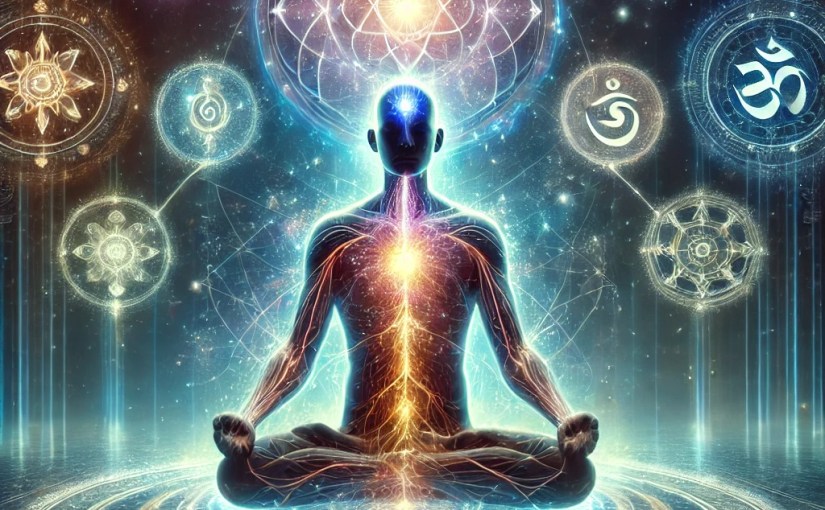
This chapter reveals the ultimate secret of the cosmos—a profound unification of the atom and the human being, both in the tangible world and in the realm of consciousness, ultimately demystifying Tantra. Here, the nucleus represents the core energy, like the Muladhara, while the electron shells correspond to the chakras, each level guiding the flow of energy and awareness. The dance of electrons mirrors the currents of prana, and the architecture of atoms reflects the structured ascent of consciousness. It is a journey where physics and spirituality converge, where the smallest particle and the vastness of human awareness are one, and where the mysteries of the universe unfold within and around us.

In the last chapter, we explored how mass gives weight and stability to the universe—how it anchors stars, planets, and even our own bodies, providing shape to creation. But mass alone is not enough. A stone may have weight, yet without energy it cannot move, shine, or evolve. The universe would be a silent sculpture, heavy but lifeless.

To bring that sculpture alive, nature needs another ingredient—energy.
If mass is the body of creation, then energy is its breath. Mass gives form, while energy gives play. Together, they weave the dynamic universe where stars burn, rivers flow, and life blossoms.

At the most fundamental level, everything is a play of energy. In the quantum world, particles are not fixed lumps of matter; they are waves of energy that rise, fall, and occupy specific levels inside an atom. In a similar way—though more metaphorical than scientific—human breath or prana is described in yogic traditions as rising, falling, and focusing on specific chakras. These levels decide the structure of reality itself—how atoms are built, how molecules form, how light interacts, and even how life becomes possible. In a similar metaphorical sense, the focus of a people’s breath or prana on different chakras is said to shape how they interact with the world—spiritually, intellectually, emotionally, playfully, lovingly, or even ignorantly. Imagine energy levels like the rungs of a ladder. A particle can occupy a lower rung or jump to a higher one, but it cannot linger in between. Each rung represents a discrete possibility offered by nature. The particle’s wavefunction assigns probabilities to each rung, often peaking near certain favored levels. When a quantum measurement occurs—or even when the particle interacts with its environment—it collapses to one of these rungs. If we clarify it further, An atom has fixed energy rungs where its electron can exist. Before any measurement or interaction, the electron is not tied to one rung but spreads out as a probability wave across several of the allowed rungs, depending on how it was excited. When collapse happens, this wave no longer stays spread out—the electron is found on one definite rung chosen from those present in the wavefunction. Electron transitions between energy rungs usually occur by absorbing or emitting photons, but can also happen through collisions, heat, or external fields. In every case, the interaction first collapses the wavefunction onto a definite rung and then shifts the electron to a new level uniquely determined by the energy gap. If the electron absorbs a single photon of known energy, the outcome is no longer a choice among many rungs—the fixed photon energy matches only one gap, so the electron must land on that specific rung. In very strong light, an electron can absorb multiple photons simultaneously, and because different combinations of the same fixed photon energy can match different energy gaps, several higher rungs may become possible, with wavefunction amplitudes weighting the probabilities and collapse determining which one is realized. This collapse is not a conscious choice, but an ego-less, natural selection dictated by probability and interaction. While a single event may seem insignificant, the collective activity of countless quantum particles accumulates and propagates, giving rise to the stability of matter, the formation of structures, and, ultimately, the grand architecture of the cosmos. Each tiny probabilistic selection—these primordial, nature-made choices—adds its thread to the vast cosmic tapestry. One should not call quantum particles or these events “experience-less” or “non-conscious,” for they occur within the all-pervading pure awareness, which is the form of endless experience and consciousness.

Similarly, chakras can be seen as the rungs of a ladder along the backbone. Energy is experienced most distinctly at the chakras, not in between them. The breath or prana may focus on a particular chakra depending on the body’s need to cope with the present environmental circumstances. This is a type of environmental interaction. This is somewhat like the quantum collapse of a particle, which interacts with its environment and chooses an outcome that best fits the situation—allowing not only itself to grow, but also to let all grow.

The Cosmic Blueprint in Energy Choices

Let us again take the atom as an example. Electrons around the nucleus do not roam aimlessly—they occupy specific energy shells. When an electron jumps from one shell to another within the same atom, it changes the atom’s behavior—how it reacts, absorbs light, or bonds—without changing the element itself. Hydrogen, with its single electron, is the simplest example: its electron in different shells clearly alters its properties. In multi-electron atoms, electrons in various shells can also shift, especially the outer (valence) electrons, affecting chemical behavior in more subtle ways. On the other hand, creating a completely new element requires adding more electrons along with additional protons, producing atoms like carbon, oxygen, gold, or uranium, each with distinct properties.

A similar principle is described in yogic science. Energy shifts between chakras may alter a person’s behavior for a time—spiritually, emotionally, or intellectually—yet the deeper personality remains unchanged. Only when greater energy is added through practices such as Kundalini Yoga, pranayama, asanas, or tantra can the subconscious impressions be dissolved or transformed, changing the personality. If the vacant space so generated is filled with a meditation image and awakened, it can lead quickly to self-realization, thus opening the hidden channel of energy fully and transforming one entirely. This is like adding protons and electrons to create a new element: the very structure changes.

Just as an atom finds stability when its positive protons and negative electrons are balanced, human consciousness finds harmony when the root (muladhara) and crown (sahasrara) energies are balanced. If energy gathers too much at the crown, one may feel ungrounded; if it sinks into the root, one may feel heavy and depressed. But when balanced, consciousness becomes steady, expansive, and capable of true transformation. Adding electrons and protons is like adding quantum energies of opposite natures: proton-energy is heavy and grounding, while electron-energy is light and liberating.

When an atom has more electrons than protons, it becomes a negatively charged ion, having captured extra electrons from its surroundings. When it has fewer electrons than protons, it becomes a positively charged ion, having released electrons to the environment. In nature, these exchanges balance themselves, forming bonds that stabilize matter. Similarly, in human beings, one who has more energy at the sahasrara than at the muladhara is naturally drawn to someone whose energy is stronger at the muladhara, and vice versa. This complementary balance or opposite pull is like a lame person riding on the shoulders of a blind man—together they benefit and move forward. Just as atoms bond by sharing electrons, human beings form relationships by sharing their energies, creating harmony and growth for both.

An electron rests in its ground state, stable and content at the lowest orbital, until a spark of energy lifts it to higher realms—yet it soon returns, releasing its borrowed light. So too, human energy dwells naturally at the muladhara, the root of stability, unless awakened by the fire of yoga, pranayama, or tantra or even healthy relationships. When charged with such force, it rises through the chakras, unveiling hidden awareness; but without sustained energy, it drifts back to its base. Thus, the dance of electrons mirrors the dance of prana—the journey between rest and awakening, between grounding and transcendence.

The attractive pull of the proton may be seen as Pingala, and the attractive pull of the electron as Ida channel. When both are in balance, the personality of the human-form atom remains steady and harmonious. If the electron pull dominates, the personality becomes floating and expansive, drawing others toward it to form bonds as most of the ordinary people are resting in muladhara, much like positively charged ions attracted towards the negatively charged ions to complete themselves. If the proton pull dominates, the personality turns ego-centered and heavy, weighed down by over-worldliness, and thus seeks a strong companion bond to supply the needed electron pull of expansivensess. In this way, the balance of Ida and Pingala mirrors the balance of charges in an atom, shaping both stability and relationships.

Neutrons, acting as the Sushumna of the atom, prevent protons from repelling each other that can lead to nuclear burst by producing the strong nuclear force that holds them together against their electrostatic repulsion. In the same way, Sushumna keeps a check on Pingala by attracting its energy and channeling it toward Ida for balance, while also taxing a little bit of its energy for the growth of awareness and stability. Metaphorically, neutrons thus indirectly help to push the electrostatic energy of protons toward electrons to maintain harmony, while consuming a part of it themselves—absorbing some binding energy—to keep the atom stable and even evolving through processes like nuclear fusion. This resembles the kundalini awakening in humans, where a fully new and improved personality appears—just as with nuclear fusion a new, larger, or more powerful atom can emerge with more number of protons, neutrones, electrons and orbitals. When Pingala is brought under control, Ida too becomes balanced, for both are relative and run on each other’s power. In this balanced state, protons do not fly away and electrons remain steady in their orbitals. It is like awakening would be impossible without Sushumna, just as stable fusion in stars would be impossible without neutrons holding nuclei together.

The nucleus of the human-form atom is the Muladhara, the powerhouse of energy that sustains all activity. Electrons circling around it represent thoughts and subtle energy, moving through various orbitals akin to the chakras. The higher orbitals correspond to higher chakras, culminating in the Sahasrara—the point of expansive consciousness. Nuclear fusion can be seen as the awakening of this system: an outburst of energy from the Muladhara surges upward through the chakras, activating them fully and giving birth to improved consciousness, where the new atom formed has larger flows of Ida, Pingala, and Sushumna, and a greater number of outer chakras, symbolizing expanded consciousness. Just as fusion releases immense energy by merging nuclei, kundalini awakening channels the latent potential of the Muladhara to the Sahasrara through the merging of Shiva and Shakti, producing a transformed, expansive, and enlightened state, with the chakras aligned and pointing toward the full expansion of consciousness. Even though both nuclei (or both Muladharas in a Tantric pair) are essentially of the same “type” or nature, for the purpose of attraction, union, and merging, they are treated as opposites as Shiva and Shakti—like complementary polarities that allow energy flow and unification. The legendary Brahmastra, fired by yogis such as Guru Putra Ashvatthama, can be seen as a similar awakening, but applied in the worldly domain—harnessing the same primal energy for external effect rather than inner transformation. Or it may be that the sages knew this psychological secret, reflected also in the physical material world, and expressed it both literally and philosophically through spiritual-metaphoric stories.

Electrons do not move gradually between orbits—they leap suddenly when enough energy is absorbed. In yoga, too, states such as dhyana and samadhi unfold in sudden leaps, not in slow crawling. This explains why enlightenment often feels like an instantaneous shift, even though the preparation may take years. You can determine the probability of an awakening occurring—how likely it is under certain conditions—but you can never predict the exact moment it will happen, just as in quantum mechanics where you know the probabilities of outcomes but not the precise result of a single event. The silent jump of an electron to a higher orbit can be likened to dhyana ripening gradually through repeated inner leaps between chakras—peaceful, steady, and gradually transformative. In contrast, the great surge of nuclear fusion resembles the moment when awareness itself flashes: the energy of the self previously bound and sleeping in muladhara suddenly leaps into pure, boundless consciousness, joining the endless expanse of full potential. In that momentary blaze, the atom also experiences boundless bliss and light, before stabilizing into a new, transformed, and evolved state—just as an awakened yogi shines with renewed being. It is exactly like Tantric Yoga, where the Muladharas of two loving partners merge, releasing an explosive surge of energy that rises from the base upward, piercing all the chakras, until it expands into the boundless infinity of the Sahasrara. Two nuclei merge to maximum extent but a small portion still remains unmerged that is converted to large amount of energy spreading upward. Similarly, both muladharas of a tantric couple share their energies with each other akin to merging as much as possible, but still some energy remains unmerged. Probably this extra energy left after merging manifests as awakening. In this sense, what tantra calls detachment can be seen as this unmerged residue of energy—preventing the partners’ energies from clinging completely, and instead redirecting the unified current upward for the awakening of the meditation image and self-realization. Just as in fusion, the unmerged part becomes the source of tremendous release, so too in tantra it is the subtle detachment that transforms love into awakening. Just as nuclear fusion requires intense heat to occur, tantric kundalini awakening too needs the inner heat generated by worldly activities, loving relationships, and the contemplation of non-dual philosophy such as Sharirvigyan Darshan.

People often perceive forbidden relationships as more thrilling because they are often formed in broad awareness of daytime, unlike genuine family bonds that society sometimes associates with duty or constraints, and often reserved for the ignorance-filled dark of the night when one is fully tired and exhausted due to roaming blindly and wildly amidst the so called job-jungle throughout the daytime for so called important livelihood activities, as if it is the least important work in the world so far. Even then it works fine more or less. What good not to expect if it is done in full awareness. Moreover, if family relationships were valued and nurtured openly in the light of day—with clarity, respect, and mutual understanding—there would be little attraction toward what is considered illegal. Just as nuclear fusion happens in broad daylight inside the sun—with full awareness, without secrecy, without being forbidden—resulting in the enhanced light of awareness, so too can lawful, harmonious bonds generate true fulfillment when embraced openly. Clinging to the external form of a partner without understanding the sameness of energetic essence in every human being is also a reason for attraction toward relationships outside the family. When Tantra shows its effect, this fact is properly understood and truly believed. Needless to say, I have seen near perfectly matching pairs go astray by not recognizing this deeper energetic essence and by being superficially swayed by egoistic patterns.

On the other hand, in the psychological fission, it is as if the neutron—the awakened sushumna of a potential partner—strikes the muladhara, the nucleus of the possible lover, and breaks it open into two. One half is the bunch of ego, while the other half is like the pure soul, suddenly lightened by shedding the burden of impressions. The energy that was once bound tightly within egoistic thoughts is now released and becomes available for awakening. Just as in nuclear fission the mass of the resulting nuclei is slightly less than that of the original, with the difference emerging as an immense burst of energy, so too the breaking of the ego releases a vast inner power. The mass of egoistic patterns shed is transformed into this energy. This surge of liberated energy flows upward, igniting awareness and transforming consciousness. Such a shift cannot occur through an ordinary bond; it can only be catalyzed by the presence of a partner whose sushumna is awakened, carrying the force to dissolve ego and redirect the released energy toward spiritual awakening. Just as nuclear fission does not require extremely high temperatures to occur, in the same way this indirect tantra does not demand the intense heat of passionate worldliness, unlike the fusion-form direct tantra described above. Can we, by extending this analogy, also discover a method of cold fusion—one that could solve the world’s energy needs forever? If nuclear fusion is the fiery union of energies and fission the breaking apart of burdens, perhaps the hidden key to cold fusion lies in the same mystery that tantra reveals—that energy, when rightly aligned, can be released without fire, silently transforming both the yogi and the world. But the problem with fission is the production of toxic radiation—just like the toxic thoughts that arise when love-filled relationships are made for breaking instead of union. If this is resolved, the energy problem is solved.

Moreover, this is not mere theory—by the grace of my guru and God, I have personally experienced both of these phenomena, receiving awakening glimpses through both fusion-like union and fission-like breaking apart.

Seeing the grand similarity between the atom and the body, it is not hard to believe that an atom can be understood as a complete human body in itself, just as these flowing chapters of Quantam Darshan have been asserting since the very beginning.

Repeating further, energy levels are like the blueprint of all diversity. Electrons can only exist in certain allowed energy levels around an atom’s nucleus, and these positions determine the atom’s behavior—how it bonds, reacts, or inter acts with other atoms. This arrangement shapes the molecules that form, deciding whether they become water, sugar, or DNA.

An atom’s energy levels can be imagined as the floors of a building, with electrons as tenants who can only occupy these designated floors. Lower floors fill up first, following specific rules, while the outermost floor—the valence level—holds the electrons that interact with the outside world and determine how the atom bonds or reacts. The energy gaps between floors act like elevator heights: small gaps allow electrons to move easily, while large gaps require precise energy input, such as from photons. Altogether, the number of floors, the arrangement of tenants, and the spacing between floors form a blueprint that dictates where electrons can be, how they can move, and ultimately how the atom behaves and interacts chemically.

On a much larger scale, the life of a star is determined by the nuclei of its atoms—the number of protons and neutrons—which dictate the nuclear fusion reactions in its core and whether the star burns steadily like our Sun or ends violently as a supernova.

In the heart of every star, life is sustained by hydrostatic balance—the delicate equality between the inward pull of gravity and the outward push of nuclear fusion. If fusion pressure runs ahead, the star swells outward until cooling slows the reactions and balance returns; if gravity takes the lead, contraction heats the core until fusion strengthens again. This harmony allows stars to shine for billions of years, but when their core fills with nuclei such as iron, which cannot yield net energy by fusion, no outward push remains to resist collapse. Gravity then crushes the core, sometimes into a neutron star, sometimes into a black hole, or in rare majesty, releasing all stored energy in a supernova explosion. So too in the inner cosmos: the body endures as long as prana, the fuel of life, sustains the balance between the contracting pull of ego and the radiant expansion of awareness. If awareness expands without grounding, the mind scatters; if ego contracts too tightly, consciousness suffocates into bondage. But in perfect equilibrium arises a steady luminosity—egoless quantum darshan, the inner sun burning without exhaustion. And when prana is finally exhausted at life’s end, the soul too meets its destiny: if awareness bursts free of ego’s last grip, liberation shines like a supernova, scattering individuality into the vastness; but if egoic gravity still outweighs, the soul collapses inward, bound like a neutron star or lost in the depths of a black hole—its journey continuing until balance is rediscovered.

Moreover, electrons and their energy levels play only an indirect role in this, influencing how radiation moves through the star. Without these energy levels setting the rules for electrons, nothing would take shape: no chemistry, no molecules, no planets, and no living beings to notice it.

The Drama of Quantum Jumps

Bringing the story to the fore again, you may have heard of the term “quantum jump.” It is not just a metaphor—it is a real event. When an electron absorbs or emits energy, it does not glide smoothly but suddenly leaps from one energy level to another. This jump is accompanied by light—what we call photons. And these photons are the messengers of creation, carrying information and energy across the universe.

Every ray of sunlight, every twinkle of a star, and every color in a rainbow arises from electrons making quantum transitions between energy levels. In stars and atoms, multiple energy levels exist, and the timing and path of each transition are probabilistic, giving photons a spectrum of colors and intensities—a whisper of the quantum world. In contrast, engineered systems like LED bulbs force electrons to drop across a single fixed energy gap, producing light of a steady wavelength and color. Whether probabilistic or fixed, each photon is still born from the same quantum rules, linking the microscopic choices of particles to the vast tapestry of creation.

Energy Levels and the Symphony of Life

If spin brought individuality and momentum brought direction, then energy levels bring structure. Consider the orchestra of life. Proteins fold into shapes, DNA forms a double helix, water forms crystals of ice—all because electrons collapse into specific energy levels, giving atoms predictable bonds and patterns.

Had these collapses gone differently, perhaps the chemistry of life would not exist. Imagine a universe where electrons never settled into stable shells—there would be no stable atoms, only chaos. Imagine a universe where energy gaps were wider or narrower—water might not exist, oxygen might not bind, and life as we know it could not breathe. Even sunlight would fail to power biology, because the energy of its photons would not match the molecular energy gaps needed for processes like photosynthesis or vision.

Thus, energy levels are not random—they are the stage upon which life performs.

Chakras as Quantum Energy Levels of Consciousness

If we dwell on the chakra–energy level analogy again, we find that in both the quantum world and the human subtle body, energy shows a natural tendency to move in waves. Just as quantum energy in bound systems oscillates as standing waves with crests and troughs, fitting only discrete levels, while free waves spread continuously yet obey the same quantum laws, Kundalini energy too bound in muladhar-sahasrar axis undulates like standing wave from left to right and back, as if sahasrar and muladhar are its two nodes where wave returns back and forth in a closed loop, energizing the chakras as it rises from Mooladhara to Sahasrara and back again going repeating the pendulum like movements. Movement of both is snake-like. It appears snake like when different chakras act as different nodes. standing wave from one node to next node is one loop or half of the full curvature of snake, the second standing wave from next to further next chakra is second loop or second half of snake’s full one curvature and likewise. It is just intertwined play of ida nd pingla. Similarly, serpent nature of standing electron wave is more visible in p-wave, when two loops of stnding waves join together. Though Kundalini is one serpent power, it expresses itself through two oscillating currents—Ida and Pingala—which spiral around the central Sushumna like twin serpents around a staff, much like the caduceus symbol. Each chakra can be seen as a different energy level, much like the quantized states of an atom, where energy is not continuous but arranged in distinct steps that require a “jump” for transition. Just as electron-energy manifests as different characters of the atom at different levels, prana-energy manifests as different characters of the human being at different chakras. In physics, energy levels are measured in electron volts, and the electron’s presence within each level forms a standing wave enveloping nucleus—a probability pattern revealing where it is most likely to exist. In yoga, these same principles appear as vibrational centers of prana and consciousness. Means any centre from muladhar to sahasrar may be activated as per probability wave distribution and favoring the points where amplitude of oscillations is high. Both show the same profound truth: energy moves in oscillations, rising and falling, before settling into harmonious unity of sushumna as collapsed particle.

It is truly experiential. When the brain is tired from work, it actually receives energy from the base in a wave-like fashion. Sometimes this energy moves alternately along the left and right sides, directly merging at the Ajna Chakra and energizing it. At other times, it rises only up to the Heart Chakra and merges there. There is no fixed rule that it must always ascend step by step through each chakra from bottom to top, although mostly it tends to do so.

A Universe Sculpted by Choices

Think of the entire cosmos as a vast painting. Spin provides the brush strokes, momentum provides the direction, but energy levels provide the colors. Each collapse decides which hue appears, how bright it is, and how it blends with others. Together, they form the masterpiece of stars, galaxies, and living beings.

The amazing part is that all this structure comes from simple binary choices at the quantum level—this energy rung or that one, up or down, here or there. Multiply these micro-choices over cosmic time, and you get the grand, diversified creation we live in.

Quantum Collapse – The Engine of Creation

At this point, we can see a deeper pattern. Spin, momentum, position, and energy levels are all qualities waiting to be decided. But nothing is determined until a collapse occurs. Quantum collapse is like the beating heart of the cosmos. It pumps out choices, moment by moment, and each choice builds on the last, driving forward the story of creation.

If there were no collapse, the universe would remain a haze of probabilities, a dream never waking. But collapse turns possibility into reality. It is the engine of creation, transforming silence into song, emptiness into form, and potential into life.

So when you feel the warmth of sunlight, sip a glass of water, or look at the colors of a flower—remember that all of it is born from the humble but profound act of quantum collapse at the level of energy. Without those invisible decisions, the visible world would never exist.

My Journey Through Sharirvigyan Darshan, Tantric Kundalini, and Self-Realization

Friends, this is one of my favorite posts, deeply experiential in nature and reflective of my lifetime spiritual journey. Ever since I began exploring meditation, I noticed a subtle yet profound distinction between thought-based contemplation and the deeper, formless stillness of awareness. Raman Maharshi often said it is better to engage in neti-neti or non-dual contemplation, yet I realized that these experiences — as blissful as they were — were still transient. Nirvikalpa samadhi, on the other hand, creates chidakash or ekarnava, a stillness that abides for longer periods, whereas contemplation alone only gives fleeting glimpses.

Eventually, I understood that to sustain even the transient experiences of ekarnava, one has to embrace breathlessness. Before I experienced keval kumbhak, even after Kundalini awakening, self-realization, and non-dual awareness through sharirvigyan darshan, I could not fully comprehend thoughtless awareness. Yet I had immense bliss, rest, satisfaction, and a feeling of completeness — all connected to subtle thought. I realized that bliss and non-duality connected with thought could not reach the final state of fully thoughtlessness.

This led me to a subtle but important insight: after self-realization and Kundalini awakening, and even sharirvigyan darshan, one can attempt to reach breath stillness more quickly, because the ego is already weakened and the body-prana system more prepared. In the same way, Ramana Maharshi had cautioned against forceful breath control without inner maturity. He emphasized that natural keval kumbhak arises only when the mind and ego are ready. Forceful suppression might temporarily quiet thoughts, but it does not destroy the ego and can create strain or attachment.

In my observation, thought stillness slows the breath but does not stop it sufficiently or for long periods, whereas breath stillness immediately calms the mind and lasts longer. This is because thought is like waves on the lake’s surface — you can quiet them, but the lake still moves underneath. Breath, however, is like the spring feeding the lake: if the source of movement stops, the surface cannot ripple. This shows why prana stillness (keval kumbhak) is far more decisive for sustained thoughtless awareness.

Ramana Maharshi often said, “Mind and breath arise from the same source. To still one is to still the other.” Ego is the hidden source of both. When the ego weakens, prana settles naturally; when prana is still, the mind has no fuel for thought. In deep states, breath is the shadow of the ego. This simply means that in ordinary, laborious worldly activities, breath reflects not only the ego but also the need for oxygen. During deep meditation without ego, the breath itself fades, and awareness abides in pure stillness — the chidakash or ekarnava.

I noticed subtle variations in breath depending on ego orientation. Unequal inspiration and expiration reveal ego tendencies:

  • Longer inspiration reflects inward, self-centered attention.
  • Longer expiration reflects outward, world-centered attention.

This aligns with the ida–pingala–sushumna play in yogic physiology:

  • Ida (left, inward) → longer inhalation → self-absorption.
  • Pingala (right, outward) → longer exhalation → outer engagement.
  • Balance in breath → equilibrium between ida and pingala → sushumna activation → mind quiets → doorway to sustained stillness. That is why it is said that when breath flows equally through the left and right nostrils, dhyana becomes fixed quickly. This is because equal inhalation and exhalation balance each other, leading to a natural stillness of breath.
  • The up-and-down movements of the breath reflect both the vertical and left-right movements of Ida and Pingala: up for the left, down for the right. Actually, Ida Nadi feels more inclined toward inhalation or upward breath movement, while Pingala feels more inclined toward exhalation or downward breath movement.It is amazing. The left nostril activating Ida does create a subtle left-side dominance in energy, and right nostril activating Pingala creates right-side dominance.

Even a single complete breath moves awareness up and down: inhalation lifts consciousness inward or upward, exhalation spreads it outward or downward. Prolonged breathing keeps awareness oscillating. Only when prana rests in sushumna, in natural breathlessness, does awareness remain steady. Sushumna means that the breath is neither moving up nor down, but stays in the center; it is neither in the left nor the right, but centrally aligned—this corresponds to the breathless state, or Kevala Kumbhaka. Breathing through the left nostril brings the sensation of the breath moving through the left side of the body and more upward, and breathing through the right nostril brings the sensation of the breath passing through the right side and more downward. When there is no breathing, it is self understood that the breath is flowing neither through the left nor the right nostril, neither upward nor downward. When there is no left-right sensation, it is self-evident that the breath is central, along the midline of the body or through the backbone. The sensation also confirms this. Along with it, when there is no up-down movement in the breathless state, the breath is understood to be in the central line, precisely at the midpoint of that line. “No up-down movement” does not imply prana is physically fixed at the midpoint; it means prana is static along the central channel. Feeling it at the midpoint is a perceptual focus, not a literal physical location. It is amazing psychology and terminology, sometimes confusing too. At first, I used to think of Sushumna as a special type of heavenly breath, never imagining a breathless state for a living being, but my experience now shows otherwise. This is why destroying ego, reducing breath oscillations, and balancing breath are crucial. Ego is notorious in producing duality. Yet, with sharirvigyan darshan, the ego feels hurt — the body is revealed as a non-dual, ego-less and detached living system, not as “me,” and that hurt is purification, loosening the ego’s grip.

In a nutshell, Keval Kumbhak (breath stillness) and Sushumna breathing are synonymous. Both are highly praised in the scriptures and regarded as the direct doorway to liberation as well as the source of supernatural powers. Yet, liberation itself is the supreme power — beyond all others. Strictly speaking, Sushumna breathing (when ida and pingla flows are equal) prepares the ground and naturally matures into Keval Kumbhak, so the two are inseparably linked stages rather than exactly the same.

When breath flows equally through both nostrils, it shows that Idā and Piṅgalā are balanced and prāṇa is entering the Sushumnā, creating the right state for meditation; when this deepens, the breath may stop on its own without effort—this is Keval Kumbhak, the natural peak of Sushumnā flow where prāṇa is fully absorbed and the yogi rests in stillness.

The insight of sharirvigyan darshan was a turning point for me. I realized why I was drawn toward Tantric Kundalini Yoga after practising it consistently: in Tantra, contemplation or thinking, beautification, care, respect, and love toward the body are of prime importance—just as in Sharirvigyan Darshan—thus both complementing each other at both the physical and spiritual levels, leading to progressive development. It is another amazement. The cells of the body live without claiming doership of work or enjoyment, so why should I? This shook the ego profoundly, and freed prana or energy for meditation. Sharirvigyan darshan gave me a contemplative base — a rational, embodied insight — while Tantric Kundalini Yoga liberated my world-entangled energy, allowing me to offer it to the meditation image. This image, nourished by freed prana, awakened and became alive before me, not just a mental visualization. That living image led to glimpse of self-realization.

The sequence of my journey — Darshan → Energy Release → Image Awakening → Realization — mirrors the Tantric map of jñāna-śakti (knowledge), icchā-śakti (will), kriyā-śakti (action), and śakti (energy/awakening):

  1. Sharirvigyan darshan gave me knowledge.
  2. My choice to pursue Tantric Kundalini Yoga provided will. Although it originated itself through practice of sharirvigyan darshan. It is the most amazing part. In majority of scriptures, will is forced that seldom succeeds.
  3. The practice itself — offering energy to the meditation image — was action.
  4. The awakened image and glimpse of Self-realization was the manifested energy, śakti.

This phenomenon is interpreted differently in various traditions:

  • Tantra sees the image awakening as divine Shakti appearing in form, a sacred manifestation.
  • Advaita Vedānta regards it as a transitional phenomenon; the image is only a springboard — awareness turning inward leads to direct realization.
  • Yoga Sutras classify this as savitarka samadhi, where meditation on form (image) is energized and luminous, leading toward nirvitarka (formless stillness).

Had I pursued Tantric Kundalini Yoga alone, without sharirvigyan darshan, I could still have achieved realization with great difficulty and after prolonged practice, even getting none because favourable conditions do not sustain for long. Even after getting plainly, I would have missed the extraordinary bliss, creativity, and worldly play that arose naturally when freed energy flowed into the meditation image during normal worldly activities. This illustrates the difference between the nivṛtti-mārga (ascetic vertical path) and pravṛtti-mārga (world-affirming spiral path) of Tantra:

  • Nivṛtti: rapid, inward ascent, ego dissolves quickly, but world’s richness may feel muted. But failing it, one may feel astrayed forever.
  • Pravṛtti: spiral, celebratory ascent, energy sanctifies worldly life while also piercing into realization — what I experienced.

In my path, Sharirvigyan Darshan provided a non-dual type of insight, while Tantric Kundalini Yoga freed the energy bound to latent thoughts and impressions. This happened through two processes: carrying the non-duality of Sharirvigyan Darshan to its peak, and knocking out hidden mental activities. In this way, the last drop of available energy was extracted, with which the meditation image became alive by itself—just like drinking that very energy, similar to Goddess Kali drinking the bowl of blood—leading to glimpse of Self-realization. The world itself became part of the practice, joyous and meaningful, not something to escape. My experience beautifully combined both liberation and enjoyment, embodying the Tantric principle of bhoga-apavarga-samyoga — the union of divine enjoyment and liberation.

This journey shows that self-realization, energy mastery, and meditation image awakening can converge naturally when knowledge, will, and action align, and when the ego loosens its grip. Breath stillness (keval kumbhak) and mind stillness become inevitable outcomes, leading to sustained awareness, ekarnava, and chidakash, where thought, duality, and oscillation finally dissolve.

In essence:

  • Sharirvigyan darshan shook the ego and freed energy.
  • Tantric Kundalini Yoga harnessed that energy for inward ascent.
  • Meditation image became alive, serving as the doorway to realization.
  • Breath and ego gradually stabilized, leading toward sustained stillness.
  • The world became a stage for bliss, not a distraction.

My journey exemplifies a harmonious path where insight, energy, and practice converge, showing that the Self can be realized not only in withdrawal but also in full-bodied, joyful engagement with life.

Why Tantric Maithuna Sends Energy Directly to Sahasrara: The Fastest Path to Awakening

One of the most striking differences between Tantric Maithuna and solo energy practices is how energy moves through the body. In traditional yoga, energy ascends gradually, chakra by chakra, often pausing at Ajna (third eye) before reaching Sahasrara. But in Tantric Maithuna, something extraordinary happens:

Energy doesn’t stop. It shoots straight up to Sahasrara, skipping Ajna and other chakras.

Why does this happen? What makes Tantric union such a powerful shortcut? Let’s dive into the inner science of why sexual energy, when harnessed correctly, takes a direct route to the highest center of consciousness.

1. Direct Fusion of Shiva and Shakti: No Blockages, No Pauses

In solo spiritual practices, the goal is to gradually unite Shiva (pure consciousness) and Shakti (energy) inside oneself. The double role is being played by a single individual. So it’s obvious that it’s much less inefficient and too slow a process. This process takes time because energy must clear blockages at each chakra before rising further. Actually blockages are that of worldly duality. A strong nondual sentiment is to be poured there to clean or open those. These blockages are like different worldly thoughts full of duality. When duality of these is counteracted with nondual awareness then these thoughts rise up with rising energy to sahasraar because it’s the main chakra of nondual awareness. In sahasrar These thoughts become clean and get merged into infinite soul. Yin-yang union is top nonduality producer that’s why all chakras are pierced instantaneously with tantric maithuna.

Means, in Maithuna, this fusion happens instantly.

The two polar forces, yang and yin (masculine and feminine, consciousness and energy) are already in direct union.

There is no need for energy to pause at lower chakras because the balance is already achieved. Balance here means balance of yin and yang. We don’t need to seek  balance of both of these at each chakra. In solo practice, either we need to indulge in worldly activities corresponding to each chakra with nondual awareness to remove duality from that chakra or we have to witness the thoughts arising on that particular chakra. Witnessing itself produce nonduality that neutralize the buried thoughts. But Tantric coupling produce extreme nonduality. This gets superimposed on all  thoughts buried in all the chakras as soon as sexual energy rising up knocks them out to expressed form on the mental screen. It seems they are merging with the self. This removes their resisting effect. Actually, something considered dual or no self can’t be carried to the bedroom. But it’s not so with the life partner. The same happens with thoughts. That’s why dual or foreign thoughts remain buried in there corresponding chakras. The body’s inherent intelligence hesitate to carry them to the original seat or bedroom of soul that’s sahasraar. Therefore they block rising energy means they keep consuming energy to sustain themselves there separately. Instead when they are made self like clean with nonduality practice, they are easily carried up to sahasraar for merging them with the self. This is shiv shakti Milan or marriage. In Rajyoga based kundalini yoga, only single meditation image is carried up to sahasraar to merge it with self to be experienced as glimpse of awakening. It’s a very beautiful concept friends. Although all buried thoughts are carried up but they remain in background. We meditate only on single meditation image. This increases its intensity manyfolds then other thoughts. This help in its quickest merging with the self means quickest Shiv Shakti union. In Tantric coupling, this shiva shakti union is happening there since the beginning at physical level. This produces spiritual qualities mainly nonduality since the beginning. These qualities reach peak level during subtle yin yang union that’s awakening. In fact, it is the unconscious Shakti who unites with the conscious Shiva. That is why this is the biggest yin-yang union. Shakti is unconscious and nonlocalised. We have made it conscious by giving it the form of a meditation image. This has been done because how will we experience an unconscious thing and how will we pinpoint it and how will we handle it since it is not localized.

The moment arousal reaches its peak, energy has only one path left: directly up from muladhar to Sahasrara.

It’s like connecting the two ends of a broken wire—the current flows immediately, without interruption.

2. Extreme Energy Surge: No Time to Stop

Ordinary meditation raises energy in small, controlled steps, allowing the body to adjust. But in Tantric Maithuna, the energy surge is so powerful that there’s no time for step-by-step ascent.

The intensity of the moment generates a massive wave of life force that rushes upward.

This is far stronger than what solo breathwork or Kriya can generate in one session.

Instead of flowing gradually through chakras, the energy overflows like a dam breaking open—straight into Sahasrara.

This is why Tantric energy can bring instant awakening, while solo practices often require years of effort.

3. Yab-Yum Position Naturally Aligns Sushumna

In Tantric Maithuna, the lovers’ bodies are aligned in the Yab-Yum posture, which means:

Their Sushumna Nadis (central energy channels) are directly connected.

This alignment creates a perfect energy circuit, removing resistance.

Instead of needing to push energy upward, it rises effortlessly.

Think of it like two rivers merging into one powerful stream. Instead of energy moving step by step through chakras, it now flows as a single force straight to the highest point.

4. Orgasmic Energy is Already Non-Dual

The peak point of sensation before ejaculation is a state beyond thought, beyond separation. It’s full nonduality for yang and yin are fully mixing.

At that moment, the mind stops functioning in duality.

This state is identical to the nature of Sahasrara—pure, undivided bliss-consciousness.

Instead of staying in Ajna (where thought and perception still exist), the energy moves beyond it—to the ultimate.

But there’s a catch.

✔ If the practitioner withdraws at the right moment and merges this energy with a meditation image or mantra, it reaches Sahasrara and stabilizes. ✖ If the limit is crossed (ejaculation), the energy drops back down, losing its momentum.

This is why mastering control at the peak point is critical for success in Tantric Maithuna.

5. No Mental Interference at Ajna Chakra

In solo practice, energy often stalls at Ajna Chakra because:

The mind starts observing, analyzing, and questioning.

Thought creates a pause, and energy slows down.

But in Maithuna, the practitioner is in total surrender—there’s no mental resistance.

There is no separation between observer and experience. There is a feeling of complete non-duality. This is because when the Tantrik has ended the most powerful separation like Yin-Yang, then the rest of the worldly separations cannot remain without ending. Meaning, when the Tantrik in the form of Yang feels even his most opposite lover in the form of Yin to be unseparate from him, then nothing else in the universe can remain unseparate from him. Meaning he experiences the best non-duality in the world. It is a different matter that the non-duality in the form of God-experience is one step above that. But both are the closest.

The mind is too overwhelmed with bliss to interrupt the flow.

As a result, energy bypasses Ajna and moves straight to Sahasrara.

This is the biggest secret of why Maithuna works as a direct path: no thought = no stopping point.

Why Doesn’t This Happen in Solo Practice?

✔ In solo practice, energy moves slowly through each chakra, stopping where blockages exist. ✔ In Maithuna, all chakras are stimulated at once, so there’s no need to activate them one by one. ✔ The sheer intensity of the moment forces energy upward in a way solo breathwork cannot replicate.

In short: Solo practice follows steps. Tantric Maithuna skips straight to the destination.

The Ultimate Formula: Tantra + Kriya = Sustainability

While Tantric Maithuna is the fastest way to ignite energy and send it to Sahasrara, it has limits:

✔ If physical exhaustion sets in, the energy falls. ✔ If ejaculation happens, the process resets. ✔ If one’s mental focus is lost, the energy dissipates.

That’s why the most sustainable approach is to combine Tantra with Kriya Yoga:

Step 1: Use Tantra to generate intense energy at the base. Step 2: Superimpose a meditation image to refine and stabilize the energy. Step 3: Use Kriya breath to sustain and lift it permanently into Sahasrara. Step 4: Instead of letting energy drop, circulate it through subtle breath awareness in daily life.

This prevents energy loss and allows the awakened state to remain stable for weeks, even without constant practice.

Final Thought: A Shortcut, But With a Cost

✔ Tantric Maithuna is the fastest way to Sahasrara, but it requires precision. ✔ If done correctly, energy ascends instantly, without stopping at lower chakras. ✔ But if the physical limit is crossed, energy drops back down, requiring another cycle.

That’s why the real mastery lies in knowing when to stop, when to lift, and how to sustain the awakened state beyond the practice itself.

Ultimately, energy ascent is not just about technique—it’s about balance, awareness, and integration.

Tantric-Kriya Awakening: The Most Powerful Yet Practical Path

Disclaimer:

This post discusses Tantric sexual practices and may contain sexually explicit content. Proper guidance is essential, as incorrect practice may cause physical, emotional, or psychological imbalances. This content is for informational purposes only and not a substitute for expert instruction. Practice responsibly and at your own risk.

In my spiritual journey, I have experimented with different approaches to energy awakening. While many people talk about Kriya Yoga and breathwork, my own experience has shown me that nothing compares to the power of Tantra—especially Tantric Maithuna—as a kickstarter.

My Awakening Through Tantra

Whenever I started from Tantric Maithuna, I experienced profound and blissful awareness similar to my glimpse of full awakening though at lower grade to it almost instantly. Then I turned to solo practice when prostate issues made it problematic. But honestly, after experiencing the real impact of Tantra, I found that solo practice is nothing but scrap in front of this.

I have also heard about meditation at the tip of the Linga while energizing in the Yoni. The process works like this:

Meditation image is contemplated continuously on Linga tip sensation while during spiritual union. Reaching the peak point of sensation—just before ejaculation—where the limit of tolerance is almost crossed.

Instead of letting the Yoni contractions trigger ejaculation, the Linga is withdrawn just before crossing the threshold.

Then, using yogic breathing, the meditation image rises along with the sensational energy through Sushumna.

Finally, when the energy reaches Sahasrara, the meditation image becomes lively, instantly producing all spiritual qualities.

For weeks, this low grade awakening remains. But worldly pull tends to draw the energy downward again, no doubt.

Why Tantra is More Powerful Than Solo Kriya Practice

Many believe Kriya alone is enough for spiritual transformation. But my experience tells a different story.

✔ Prana flows upward with inhalation, but the real question is—how does it come down from the chest? This is where Apana (the downward force) plays a role. If I explain it further, I mean that the accumulation of energy in the brain causes headache, heaviness in the head, a feeling of unconsciousness or darkness or joylessness or uneasiness. There is no dedicated channel to bring the energy down from the brain like the Sushumna. Of course some yogis take the energy down through the imaginary front channel, but this seems to be a makeshift arrangement and is not very efficient. In Kriya, the energy is also taken down through the Sushumna. But this is also a similar arrangement because the Sushumna is made to take the energy upwards. If a one way road is made two way, you can understand what will happen. On the contrary, the consort tied to the Yabyum is the best and most effective channel to bring the energy down. This makes the energy move like a truck in a loop road and continuously pours the loaded cargo in the form of meditation picture into the Sahasrara. That’s why Tantra works on Prana-Apana union, ensuring a strong energy circuit instead of just mechanical breathing. Let me just elaborate it little more. In solo practice, prana and apana sparingly move together. If it’s made possible with techniques even then movement isn’t that appreciable. But during yab-yum union, when in breathing causes prana move up, apana simultaneously flows through the consort’s body down. This is probably to balance prana and apana. This rotates energy constantly in dynamic loop. Energy is also of high intensity due to less restriction in movement. Prana and apana also meet together in this way constantly. In solo practice, while breathing in causing prana to move up, apana is visualised as coming down through front of body. This is done to unite prana and apana and to keep them in dynamic rotation. But front part of body is not as dedicated channel for apana movement as separate body of consort. Also solo method requires much practice. Probably backbone of consort acts as down channel for apana movement. Consort is actually embodied shakti. It’s real. It’s not just like visualising yoni or shakti in muladhara during solo practice as in yoni mudra, vajroli etc. Majority of advanced and secret hathyoga techniques are actually based on real sexual tantra.

✔ Kriya breath—whether it be spinal breathing, internal breathing, or reverse breathing—it somewhat mimics the energy movement as it happens in tantric union. But if there’s no sexual energy generated at the base, why pump a dry well? Although naturally too, sexual energy itself goes up compiling in lower chakras by default but it’s too slow as compared to tantric build up.

✔ That’s why a mix of both Tantra and Kriya is the most efficient approach. First, generate energy at the base (Tantra), then refine and lift it (Kriya). Refining means superimposing meditation image on energy. I’ll describe it in detail in next post.

Since I have already held the awakened state for weeks, I can confidently say that Tantra produces the most direct and undeniable spiritual shift. But let’s be real—this practice can’t be sustained for long periods because the physical body has its limits.

The Reality of Sustaining the Awakened State

Since the body has limitations, the next question is: How to sustain this awakening without frequent practice?

Here’s what I have learned:

Shifting From Physical to Mental Practice

Once the meditation image is fully alive in Sahasrara, one doesn’t always need the physical act.

Instead of restarting from Linga-Yoni, one can begin directly in Sahasrara and tap into the same energy state.

Energy Memory Activation

Every practice leaves a deeper imprint in the system. Meditation image linked to awakening adds up to this memory. But I just can’t do it that’s why I take help of kriya breathing. It’s a well balanced approach.

Over time, just recalling the experience can trigger the same state without any physical stimulation. However it seems remote or difficult without taking help of kriyas.

Letting the Energy Circulate in Daily Life

Instead of letting the world unconsciously bring energy down, I consciously direct it. I have made myself the controller of mine, not the world.

A soft Ujjayi breath during normal activities can keep the higher state subtly active in the background. Instead of it, holographic sharirvigyan darshan is enough for me.

Despite this, in today’s chaotic world, purely mental activation without a physical trigger is difficult. That’s why a flexible approach is the most realistic—adapting between Tantra and Kriya based on the situation.

What I Haven’t Achieved Yet & What I Believe Is Possible

I won’t make exaggerated claims. I have held the awakened like state for long time, but the world eventually pulls it down.

I have also realized that Kriya alone can achieve the same awakening—if done for countless hours and repetitions. But in today’s chaotic era, that’s unrealistic. That’s why my practical approach is:

✔ Generate and refine energy with Tantra when possible. ✔ Use Kriya to refine and lift it. ✔ Adapt based on life’s situations.

Through all of this, I’ve realized something important:

✔ Rigid methods don’t work. ✔ Tantra alone is not healthy and social. Kriya alone is not enough. ✔ A mix of both—based on the situation—is the fastest, strongest, and most practical path.

This is not just theory. This is my own lived experience. And I can say without a doubt—this path works.

Kundalini: The Natural Unfolding of Awareness through Karma

Spiritual awakening is not a rigid path but an organic unfolding—one that refines itself through direct experience rather than structured effort. My journey has taken me through deep states of awareness, yet I remain grounded, flowing with nature rather than chasing an ultimate destination. Nirvikalpa Samadhi remains beyond my understanding, something I have not yet experienced, but I sense a subtle pull toward it. There is no restless seeking, only an openness to its possibility.

Kundalini: From Constriction to Expansion

I have observed that prana in the Muladhara Chakra remains constricted in darkness due to duality, which is why Kundalini is said to be “coiled.” As it moves up through the Sushumna, it expands toward non-duality and light, reaching infinite consciousness. This is often described as the uncoiling of the snake, rising with its hood open.

During this uncoiling, I touched full awakening. But rather than letting it consume me, I chose to maintain awareness—not allowing myself to lose control in the overwhelming expansion. I realized that this experience is part of the cosmic dance, but I must stay rooted in awareness through Sharirvigyan Darshan (awareness through the body). This understanding acts as a “consciousness shock absorber,” ensuring that my awareness remains balanced, does not slip into unconscious tendencies and even don’t crave for unbound or limitless consciousness of awakening. For me, awareness or knowledge means spontaneous expression of meditation image.

Grounding: Balancing Expansion and Stability

Grounding is essential in this process, but I have observed that no grounding method works effectively in isolation. Whether it’s deep meditation, worldly activities, or even the Panchamakara practices, grounding must be integrated with awareness. For example if panchmakara practice is not smoothed out means if its energy isn’t transferred to meditation image through sharirvigyan darshan, then it pushes one into unconscious or non awareness tendency that goes on amplifying like a cascade of events with never ending chain of action and its fruit. An action produces its fruit, that fruit further produces action, that action further produces fruit and so on like an endless chain. If awareness is tied with panchmakara practice then it goes on amplifying instead of amplification of ignorance as in former case. I will further simplify it further later elsewhere.

I further noticed something interesting—Panchamakara causes an immediate, deep grounding effect. However, it also carries a hidden feeling of committing sin even when accompanied with sharirvigyan darshan, which creates a karmic impression. While its effects are powerful at that time, the conditioning of the mind ensures that even when the fruit of it is experienced later, the same heightened awareness remains. I performed an intellectual experiment. I once undertook a sinful panchmakara. Along with it I contemplated on sharirvigyan darshan so powerfully that my meditation image was dancing like live outside. Very quickly, in days I got its resultant fruit. How I recognised that? My meditation image became so strong as if dancing live outside and I remembered that sinful panchmakara very lively. Unbounded Awareness went multiplying further with that single event like the chain reaction of a nuclear weapon as told above. Karma and its fruit along with circumstances and mentally accompanying them tend to live together. As much strong is the awareness with this type of karma-grounding that much quickly it yields the resultant fruit because God or nature wants to clear away karmic debris that much fast to liberate one fascinated by his urge for quick knowledge or salvation.

On the other hand, grounding through ordinary worldly activities is gentler and carries no sense of sin, making it feel more effortless. However panchmakara gives amazing results. That’s why it’s said don’t practice panchmakara without proper knowledge or guru’s company otherwise instead of raising up it can also pull down rapidly. Both types of grounding methods work, but the key is maintaining awareness so that grounding does not lead to unconscious tendencies.

Karma: A Refining Process, Not a Bondage

I have observed that karmic fruition does not bind me further—it refines my awareness instead. As karma unfolds, my inner stability increases rather than decreases. This is because I want to be aware during every karma with help of sharirvigyan darshan. Even when difficult situations out of some previous karma arise, I experience an interesting paradox: the awareness I had during past elevated states while doing those karma remains intact even in those moments. This is due to karma-fruit coliving.

Another key observation is that during exhaustion or illness or old age, karmic formations naturally reduce due to inability to work. In such times, I naturally prefer passive meditation rather than active practices of karma yoga. It feels as if taking advantage of rest the body system is updating itself, making the whole process smoother.

Beyond Seeking: Flowing With Nature

At this present stage, my sadhana is mostly effortless—there is no rigid discipline, just a natural flow. Although twice a day yoga is like eternal routine. If an further opportunity arises for structured practices like Kriya Yoga, I take it, but I do not force it. There is no compulsion to practice or avoid anything—it all happens as time and priorities allow.

I also see no separation between spiritual and worldly life. Just like the dual nature of matter (wave and particle), both aspects exist simultaneously. One does not contradict the other—they simply shift fluidly based on the moment or requirement.

Inner Intuition as the Guide

Now, external guidance is no longer a necessity—inner intuition has taken its place. However, when it comes to Nirvikalpa Samadhi, I still seek intellectual clarity, as it remains beyond my experience. I do not claim to have achieved it, nor do I chase it. There is only a subtle seeking—an openness to its possibility rather than a restless pursuit.

Conclusion: The Journey Never Ends

The unfolding of awareness has no final destination. Every phase brings new refinements, deeper insights, and greater stability. Even the idea of “progress” dissolves, because the unfolding itself is the destination.

Rather than resisting or forcing, I now allow life to unfold naturally. Awareness deepens effortlessly when one flows with it rather than against it.

Kundalini, Prostate, and the Natural Shift in Energy

For years, I have explored meditation, Kundalini Yoga, and Tantric Yoga (Sexual Yoga) as a means of spiritual awakening. My journey led to powerful states like Savikalpa Samadhi, yet I haven’t reached Nirvikalpa Samadhi. Through direct experience, I have come to realize that energy work is not just about pushing limits—it’s also about recognizing when the body signals a natural shift.

One of the most surprising discoveries I made was the connection between prostate inflammation and Kundalini energy movement. This wasn’t something I read in scriptures or books—it emerged from my own practice. However, later I found that scriptures do hint at this connection.

Ancient Wisdom and Modern Experience

Though rarely discussed directly, traditional spiritual texts mention the “seat of vitality” in the lower body, which can be linked to the prostate. Some interpretations suggest that excessive sexual energy without proper transformation can lead to tension, congestion, or even inflammation in this region. In the story of Agnidev who became a pigeon in Shiv Puran, perhaps the prostate is called a pigeon. Parvati cursed it in anger that due to the disgusting act of drinking semen, there will always be a burning sensation in its throat. Then Shiva, being kind to him, told him to give that burning through and through to Ganga in which Kartikeya in the form of awakening is born. This story is described in a post of this blog. Taking a bath in cold water also provides relief. It seems that an energy line starts from the gaduda (prostate) and moves up the spinal cord carrying its burning sensation and pours that energy into the Ajna Chakra or Sahasrar. This is also a part of the same story.

In my case, I observed something striking—when the prostate reached a certain level of irritation or inflammation, it seemed compelling to do yoga breathing or energy meditation so that Kundalini energy star up rising naturally, sometimes rising itself even without active practice. It was as if the body, unable to handle the excess buildup, had no choice but to direct the energy upwards.

However, I noticed a crucial difference:

When real energy rising happened, it was blissful and expansive.

When it was just inflammation, there was no bliss—only discomfort.

The same applies to spinal inflammation too. I have physical inflammation in spine occasionally due to ankylosing spondyloarthritis too. I differentiate between inflammatory sensation and energy sensation by this bliss mark.

May be prostate inflammation a sequel to ASA, an inflammatory disease or it along with Tantric yoga both in combination may be culprit or each of both affecting it little bit separate from each other and thus raising it up in  cumulative way.

Interestingly, when the energy moved upward, the prostate inflammation temporarily reduced. The more effort I put into meditation, the more relief I felt, but the effect wasn’t permanent—it reset after some time.

The Hidden Relationship Between Stress, Tantra, and Inflammation

I later realized that stress and excessive Tantric Yoga both contributed to prostate inflammation. It wasn’t just physical activity—it was also mental stress and the forceful nature of energy work.

There was a phase where I had already achieved awakening, yet I kept pushing Tantric Yoga unnecessarily. The body and circumstances gave subtle hints to stop, but I ignored them. For one swimming in the pool of nectar it’s difficult to come out. Eventually, prostate inflammation became the final warning. It was a clear sign that I needed to transition to a more sustainable practice.

This aligns with traditional wisdom:

Tantric Yoga acts as a rocket booster—it provides rapid breakthroughs but is not meant for continuous use forever.

Once awakening is triggered, a more balanced approach like Kundalini Yoga or ordinary meditation sustains the experience.

From Rocket to Airplane Mode: A Natural Shift

Looking back, I can describe my journey as moving from a rocket launch to an airplane mode.

During intense Tantric Yoga, the energy shot up like a rocket—fast, powerful, but unsustainable.

Now, with meditation, the energy movement is like an airplane—slower but steady and long-lasting.

This transition was natural—I didn’t force it. But I realize now that if I had continued forcing Tantric Yoga beyond its natural limit, it would have only caused more discomfort, not progress.

No Regrets—Only Understanding

Now, I don’t miss the rocket phase. A glimpse of awakening was enough. Actually real awakening is not about constantly chasing intensity—it’s about clarity and balance in daily life.

Even though prostate inflammation became a challenge, it also became a teacher. It forced me to slow down, listen to my body, and transition into a more refined, sustainable spiritual path.

For anyone experiencing something similar, my advice is simple: listen to your body’s signals. Awakening is not about pushing harder—it’s about knowing when to shift methods. If energy has already risen, the next step is integration and steady progress.

The path is not about extremes—it’s about harmony.

Kundalini Energy Funnel: Awakening, Balance, and Grounding Techniques

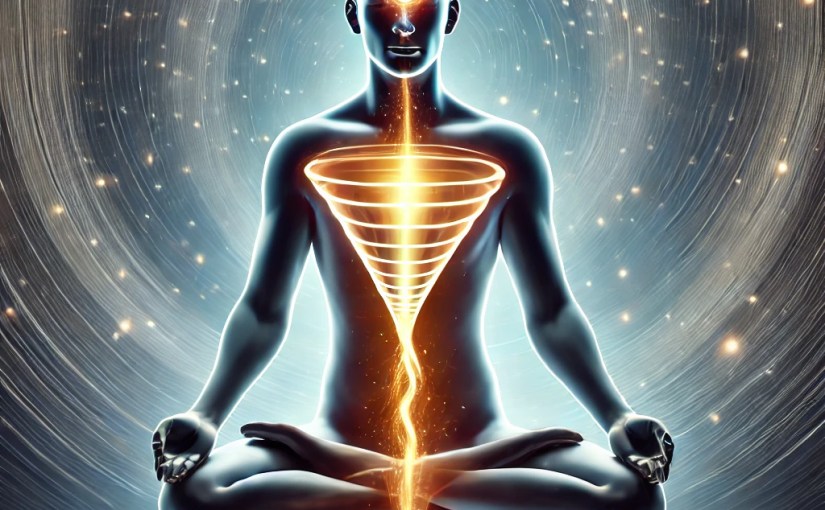
Through my experience, I have realized that Kundalini energy moves like water through a funnel, gathering life force from the entire body, accumulating it near base chakra, and directing it toward Ajna and Sahasrara through drain of sushumna channel. If energy could simply rise directly, this process wouldn’t exist. Also, without a natural collection point and a proper exit channel, the intensity wouldn’t be the same as required for awakening. Suppose there may be another energy collection point in body, but without dedicated direct drain channel going straightway to brain just like sushumna couldn’t exist. Moreover, this funnel also has a filter paper snugly fitted inside its cone. It filters out the impurities like lust, attachment, misbehavior, hatred, duality etc. and sends the flow of Kundalini energy forward only after purifying it.

Just as yang energy naturally flows towards yin, so the streams of energy from the mountain of the body are drawn towards an invisible spring at the foot of the mountain. Just as water seeps from the heights of the mountain and collects in the lowest sources, similarly the life-energy also first gets collected in its deepest center called the Muladhara. This attraction is the play of gravity—the eternal attraction between yang and yin for the union.

But, if the water has to be taken back to the top of the mountain, we have to resort to a pump. Similarly, when the energy has to be taken to the highest chakras, the pump of sadhana diverts its direction. It is difficult to collect water directly from every particle of the mountain, so first it is allowed to collect on its own below, then it is raised up. This journey is not just of flow, but of balance and resurrection—an eternal cycle, where depth becomes the mother of height.

Prana can be guided to the brain directly, but when concentrated and channeled through this funnel, it becomes far more powerful. However, this requires complete isolation. If the senses remain engaged, energy dissipates, reducing the necessary pressure to open the path. Without enough force, the upward flow is weak. If pressure builds beyond tolerance, energy may backflow, causing imbalances. Sudden accumulation without proper release can also create strain, while the brain, if activated but left unfed, may face disturbances.

I have experienced this firsthand. Excess energy accumulation, combined with external chaos, may have triggered physical discomfort, including inflammation mainly prostatic. Although other factors also trigger it. The idea of backflow came naturally to me—like water forced in the wrong direction when a system designed for one-way flow is blocked.

Balancing this process is key. Stress reduction, yoga, pranayama, and kriya breathing have brought relief. Grounding has been especially helpful—it eases the brain’s demand for energy, reducing the funnel’s workload and allowing it to stabilize. To me, prana and energy are one and the same, just understood through different lenses.

I have not yet mastered this process, nor have I reached an irreversible state of enlightenment. My journey continues, and my understanding deepens. But now, I no longer seek to force energy. Instead, I focus on refining, balancing, and allowing its natural flow.

Prana: The Hidden Connection Between Body, Mind, and Experience

Millions of salutations to Adi Tantra Yogi Shiva on the occasion of his sacred Shivratri festival, may he continue to bless us all.

One simple yet profound realization changed how I see prana. When we feel pain in the foot, why do we experience it in the foot itself and not in the brain, where it is actually processed?

Nerves only send signals to the brain. If the brain were the sole center of experience, pain should be felt in the brain, not at the point of injury. Yet, it doesn’t work that way. This means something beyond just nerve signals is connecting consciousness to the body—something that allows experience to be localized at the exact place of sensation. This invisible connection is prana.

Prana: More Than Just Energy—It Localizes Consciousness

If prana were just physical energy, it wouldn’t explain why different parts of the body hold different experiences. Love is felt in the chest, fear in the stomach, sexual pleasure in the lower body. Prana acts like a network flowing through non physical experiential channels or nadis that binds consciousness to different locations in the body, making sensations real and localized.

This made me rethink prana—not just as life force but as the very mechanism that determines where we experience life. Prana is not just movement of energy; it is the movement of experience itself.

Tantra Yoga: Shifting Experience from Body to Mind

This understanding connects directly to my Tantra Yoga practice. In Tantra, sexual energy is not suppressed—it is shifted. Normally, pleasure is felt in the lower body because prana is concentrated there. But through specific techniques, this energy can be moved upwards to the brain.

When prana moves, the location of conscious experience moves with it.

  • The same energy that once felt like raw pleasure transforms into mental clarity, bliss, and stability.
  • Instead of being outwardly stimulating, it becomes inwardly illuminating.

I’ve experienced this shift, but not yet to a state where it remains stable. The connection is clear, but true mastery—where prana stays effortlessly in higher awareness—is something I still seek.

Health Aspects: Can This Practice Cause Issues?

While moving energy upward can bring profound mental clarity and deep meditation, forcing the process unnaturally can create imbalances. Some possible issues include:

  • Head Pressure or Mental Fatigue: If too much prana is held in the brain without grounding, it can create discomfort or detachment from daily life.
  • Lack of Interest in Worldly Activities: A rapid shift of prana to the higher centers can reduce attachment to physical experiences, making normal activities feel empty.
  • Physical Imbalance: Moving prana upward without proper grounding can sometimes lead to nervous system issues, digestive problems, or sexual dysfunction.

Balancing Energy for a Healthy Experience

I’ve realized that prana must be guided, not forced. When the shift happens naturally, it leads to clarity without imbalance. I consciously use grounding techniques when needed, ensuring that I stay connected to both higher awareness and practical life.

What This Means for Spiritual Growth

This insight opened a new perspective for me:

  • Prana is not just sustaining the body—it is directing consciousness itself.
  • Where prana flows, experience follows.
  • If we can control prana, we can control not just energy, but where and how we experience reality.

I’ve seen glimpses of this transformation, but I am still refining the practice. My goal is to make this shift natural and effortless—not just something I touch occasionally, but a state I can rest in permanently. At the same time, I’m careful to balance this journey with health and well-being, so the experience remains both profound and sustainable.

Kundalini and Sharirvigyan Darshan – The Holographic Reality of Awakening

Lately, I’ve been reflecting deeply on something that has completely changed my understanding of meditation and consciousness. I used to think that meditation dissolves thoughts, but then I realized—it doesn’t dissolve them at all. Instead, it opens them up, like a blossoming flower. The proof? When we exit meditation, all the previously shrunken thoughts are still there, unchanged. This means that the transcendental state isn’t about wiping thoughts away—it’s about keeping everything open, expanded, and connected to the all-pervading consciousness.

Then another realization hit me: Universal consciousness itself is shrunken into thoughts. When we meditate deeply, it expands. But then it tends to recoil back with great force. Even if one touches the Nirvikalpa experience, this recoil effect gradually brings them back, step by step. For the first few months after deep meditation, consciousness remains expanded, and creativity peaks. Thoughts feel weak, almost blending into the universal consciousness. But as time passes, mental processes start becoming more distinct again. The more awareness contracts, the darker the mind appears.

If meditation is completely stopped, in three years, the original state returns. However, if daily meditation is maintained, even for a little time, this expanded awareness remains forever, though in a subtle way. And then I realized something even bigger—continuous meditation without any worldly disturbance can lead to complete stabilization.

Kundalini is the power that makes us feel this universe in our mind. Because the nature of this power is to curl up like a snake and go towards the dark hole of the Muladhara, therefore it is also called the divine serpent. The literal meaning of Kundalini Shakti is the power that coils. It remains standing straight with its hood raised for only a few moments of awakening. After that it starts returning back.

Sharirvigyan Darshan – The Holographic Science of the Body

Then I discovered Sharirvigyan Darshan, a powerful Tantric philosophy that explains something mind-blowing—everything outside exists inside the body, in every detail. It’s not just an idea, but a scientific truth.

This is where the holographic principle comes in.

Just like in a hologram, where every part contains the whole, the human body is a miniature universe. The galaxies, the sun, human societies, emotions—everything is within. At first, it sounded unbelievable. But then I started experimenting. I found that just looking at my own bare hand brought an immediate sense of calmness and transcendental awareness.

And then I thought: Isn’t everything that’s happening outside actually happening inside this very body?

It’s not imagination—it’s real. This realization is so powerful that it instantly shifts consciousness into a higher state. It’s not just theory—it’s something you can verify right now, just by looking at your own hand.

No Effort Needed – Just Knowing and accepting is Enough

The most shocking part? No effort is needed to shift consciousness. It’s not like other spiritual paths that demand years of effort. Just reading the book once and acknowledging its truth is enough.

Of course, like everything, it deepens over time. But the beauty is that worldly life remains fully engaged. Work, relationships, enjoyment—everything becomes richer, not weaker. Unlike traditional meditation, which often leads to detachment and renunciation, this path makes life more fulfilling, more intense, more alive.

Kundalini and Higher Tantra Seek the Seeker

As this realization deepened, something even more incredible happened. Higher Tantric sadhanas started finding me. I wasn’t looking for them, but it felt like they were searching for me. Kundalini itself seeks out those who are ready.

But this also brought a warning—immature or forced practice can be harmful. I realized that Left-hand Tantra, if practiced without readiness, can be dangerous. This book warns about it in detail, explaining how the body itself is the greatest temple, and that enlightenment unfolds naturally, without force. Right-hand Tantra is safe, but Left-hand Tantra requires a deep inner readiness.

And it’s true—deliberate or immature practice can cause harm. This is not something to be forced. It has to happen at the right time.

The Holographic Universe Inside Us

The most fascinating part of this approach is that it integrates everything. Unlike traditional spiritual systems that separate worldly life from enlightenment, Sharirvigyan Darshan shows that everything—work, relationships, pleasure, responsibilities—are all part of the path. There is no need to escape. Awakening happens within life, not outside it.

And the secret behind this? The body is a hologram of the entire cosmos.

If the whole universe is inside, then there is nothing to renounce. Enlightenment isn’t about escaping—it’s about realizing that everything even enlightenment is already inside.

This is why even a simple glance at the hand can instantly shift awareness into transcendence. Why? Because the hand itself contains the entire cosmos. This is not a metaphor—it is an actual, scientific truth.

Beyond Theory – The Direct Path

What makes this different from all other spiritual teachings is that it is immediate. No waiting for years, no complicated practices. Just a direct acknowledgment of reality—that the body contains everything.

The universe is not outside—it is inside. The galaxies, the sun, the people, the emotions—all are happening within this very body. And once this truth is seen, life becomes effortless.

Meditation is no longer about “doing” something. It becomes natural and spontaneous. Even a single look at the hand reminds us that everything is within. And that simple realization brings instant calm, a direct connection to the universal consciousness.

Where This Path Leads

This knowledge doesn’t just stay at an intellectual level. It transforms everything. The mind expands, creativity peaks, emotions stabilize, and worldly life becomes richer.

And when the time is right, higher Tantric sadhanas start revealing themselves. But instead of being forced, they come naturally, as if consciousness itself is guiding the way.

However, it is important to be ready. Some practices, especially in Left-hand Tantra, can be dangerous if done without maturity. This book explains it clearly—there is a right time for everything. Rushing can cause harm, but when the seeker is truly ready, the path opens effortlessly.

Final Realization – A New Way to Awaken

This experience has convinced me that the old way of spirituality needs to change.

There is no need for unnecessary struggle. Awakening does not mean renouncing life—it means living it fully, with deep understanding.

And the greatest secret?

The body is the key.

The body is the hologram of the universe.

Everything outside is already inside.

Once this is realized, there is nothing more to seek.

And once this truth is seen, there is no unseeing it.

Everything changes, forever.

Kundalini Yoga vs. Kriya Yoga: Key Differences, Benefits & Which One is Right for You?

Friends, Kriya Yoga is often in the news. But is it different from Patanjali Yoga? Not at all. Kriya Yoga is hidden in Patanjali Yoga Sutras. In the beginning, one has to follow Yama, Niyama, only then the mind will become calm and stable. Then the Asana will be done automatically. Because only a person with a restless mind runs. A person with a calm mind sits quietly and relaxes. When a person sits, he will definitely breathe. He will take a good breath too. He will not take it with fear like a restless person. When the energy of life will be saved from being wasted in useless running, it will be used only for breathing. Taking a good, long and deep breath will also give him pleasure. With deep breath, the energy of the Mooladhara will rise. Suppressed thoughts will emerge from it and will connect with the soul. We cannot even call it suppressed thoughts. We can call it a blooming flower. It means everything is the same old but now it is not compressed and dark like a closed flower but is free and bright like an open flower. That is why the chakras have been given the shape of lotus flowers. Happiness comes only when the flower blooms. The common man will stop here. But a particularly curious person will adopt yoga and will pull and push his breath a lot. This will make his power cross the Mooladhar, Swadhisthana and Manipur Chakras. The power will rise above from there on its own. Many yogis say that it will not come down again, but I feel that breath pulling and pushing will have to be done in between. Because no one has a permanent state, not even power. This pull-push is done by withholding deep inhalation and exhalation. Of course, the daily practice may be of ordinary deep pranayam, and not of holding the breath, but one or two days in a week one has to give jolts. Who knows when the enemy in the form of ignorance will attack. The enemy should not be considered weak. What happens is that if we keep pushing the energy upwards by pulling and pushing the breath, then we will not be able to meditate enough in the Ajna Chakra. Because during deep Pranayam, we will be busy in pushing the energy upwards by focusing on the sensation on the spine and the chakras. Therefore, that energy will be spent in material worldly affairs. That is why it is said that when the energy reaches the Ajna Chakra, then start meditating. Once the meditation is done, then it will keep increasing on its own because it is bliss and bliss itself pulls everyone towards itself. When the life force reaches the Ajna Chakra, then it is known by itself. The great Sattva Guna is felt. The man seems to be transformed. All the divine qualities come automatically. There is no need to do or read anything. Even animals and birds start looking at him with attention and curiosity. This is the magic of breath and life force. This will automatically lead to Pratyahara. Because when a person gets bliss within, then why will he adopt the costly path of senses for it? Dharana, Dhyana, and Samadhi happen automatically in Ajna Chakra. Meaning the picture of meditation becomes very clear. Many Tantrik type people use Panchamakaras to reach Ajna Chakra immediately. After that they leave them. Because the Sattva Guna of Ajna Chakra prevents them from using them. Meaning climb up the ladder and then throw it away. If you keep the ladder then you will accidentally come down again. If a Sadhak continues to use them then he will get Kundalini awakening quickly but he will not be able to bear that experience for long. And will bring Kundalini down immediately. Because the Panchamakaras contain Tamoguna and Rajoguna, which cannot bear Sattva Guna for long. Still, even this momentary experience is better than nothing. The meditation of Ajna Chakra enters inside and forms a triangle in the middle of the brain. There are three points on its three ends. Meaning this triangle is felt in the form of sensation lines and sensation points of thin nerves or channels. In its middle, attention and sensation also get concentrated on the Shri Bindu. A little behind the Shri Bindu, another sensation line goes. It ends at the Sahasrar Bindu. This is the most divine place. This is the final goal. Moksha is attained here. The original sensation or Sushumna coming up from the spine from the back also joins there. All these are experiences of practice. These are not any physical line, point, triangle, chakra etc. Many yogis say that while going from the Ajna Chakra to the Sahasrar Chakra point, one feels a dark sky, then a lighted cave etc. All these experiences seem strange when heard and read. But when one continues to practice, one feels them on one’s own. There is no need to tell anyone. Many yogis say that during yoga one should not concentrate on the chakras or the back etc. Rather one should only concentrate on the Ajna Chakra point, between the eyebrows. They are also right. The main target is the Ajna Chakra. Why not aim directly at the target? The rest of the chakras are connected to the Agya Chakra. Therefore, meditation on the Agya Chakra leads to meditation on the other chakras. If you run after the sun, the moon will automatically come in your way. You will not find the sun just by chasing the moon. Yes, the path will become a little lighter or easier but it will take a lot of time. Who knows, till then man will even be alive in this world. Many people waste a lot of their precious time on the chakras. When Patanjali says that only through meditation, you will get the ultimate success, then meditation will not happen below the Agya Chakra, will it? Many tantriks make the meditation picture on the Agya Chakra very strong by sexual intercourse and very quickly or say miraculously attain samadhi and enlightenment. But the thing is the same as said earlier. To gain something, something has to be lost. One does not know when the meditation picture shining there becomes samadhi after reaching the Sahasrar, and when it turns into enlightenment. This happens so quickly that one does not get a chance to experience this or that diagram, this or that point, and this or that triangle. That is why if they are asked about the method and experience of yoga, they do not know much. They just talk about self-realization and the sex yoga that helps them achieve it. They just want the fruit, their enemies climbing the tree. But this is not everyone’s cup of tea. Anyway, after self-realization, for the benefit of the world, they deliberately do yoga in the right way and tell everyone about all their experiences. They do not need it for themselves, but for the benefit of the public, they do it. This is the sign of Bodhisatva. Many orthodox Yogis hide their experience like the Kohinoor diamond. Just as the shining line of experience is felt in the form of Sushumna, similarly, there must be a circular network of lines of experience in place of Chakra. This must be called Chakra Darshan. But what is the benefit of these? Go straight to the Agya Chakra and become free.

After Dharana, Dhyana/meditation, all Yogas are the same. There are various methods and techniques to reach here. However, the basic purpose is that power is needed. For this, someone takes extra power from the Mooladhar. Someone saves power by leaving worldly affairs. Then someone saves power by keeping non-duality in worldly affairs. So there are three types of Yoga. Kundalini Yoga or Hatha Yoga, Sanyas Yoga and Karma Yoga, these three Yogas are the basic ones. You can make as many Yogas as you want. Bhakti Yoga is also the part of Karma Yoga.

The original Kriya Yoga says that one should do nothing except Pranayam with Om Japa while meditating on the centre of eyebrows. But many later Yogis have made it so complicated that the original Kriya Yoga seems to have disappeared. The specialty of mental Om Japa is that it strengthens the picture of meditation on the eyebrows. Recite this mantra in your mind 4 to 6 times while inhaling and the same amount while exhaling. While doing Anulom Vilom Pranayama, keeping the tip of one finger resting on the centre of the eyebrows also helps in concentrating the attention there. Many poor people, falling into their mess, remain entangled in the Chakras and Sushumna throughout their lives. They are unable to reach real meditation. Some Yogis, by doing amazing Sadhana, experience these so-called strange experience like lines, points, triangles, lights, darknesses, tunnels and Chakras and also achieve various kinds of Siddhis. But they are miles away from self-realization and even real Samadhi. That is why they are unable to tell the experience of self-realization and when asked, they say that the Guru forbids them from telling it to others. Many say that the one who says that he has attained self-realization, has not, and the one who says that he has not, has got. They say that self-knowledge disappears when ego comes in. But how can this happen? If someone shows the neck hanging prize he has won to others, how will it disappear? It is true that someone can steal it, but no one can steal the inner experience. There may be some other meaning. Anyway, we do not want to get into this discussion.

One solution is to do whatever you feel is right but always keep an eye on the main goal of yoga, Dharana, Dhyana and Samadhi on Agya chakra and enlightenment on Sahasrara chakra. Change the techniques, improve them, do anything, but keep moving. Don’t stand at one place. Understand by experimentation and move forward. It is possible that someone gives the world a new yoga technique. Meditation on the eyebrows does not mean that you look upwards obliquely like squint, but that you close your eyes in the dark and meditate in the middle of them. Although by opening the eyes and looking obliquely, the power rises upwards, but this is not meditation. By this, the power itself rises above the Muladhara. Of course, meditation happens only with power. This is done in Shambhavi Mudra. While meditating on the centre of the eyebrows in the dark, keep moving your closed eyes in between so that the Agya Chakra is not lost.
This Chakra is more inside than outside. It is a simple matter that one should keep increasing knowledge and keep moving according to the need. If you feel uneasy with Siddhasana, then simply sit cross-legged in Sukhasana. Keep a thick pillow under your hip so that there is no pain in the knees.

The initiation is talked about so that the meditation picture of the one who gives the initiation is formed. If the meditation picture is already formed then what is the need for initiation? Once a priest of a temple asked me if I had taken mantra initiation from anyone? Sensing his intention, I immediately said that my revered grandfather is my Guru. He became very happy and was forever impressed by me.