My post

Chapter 15 – The Energy of Creation

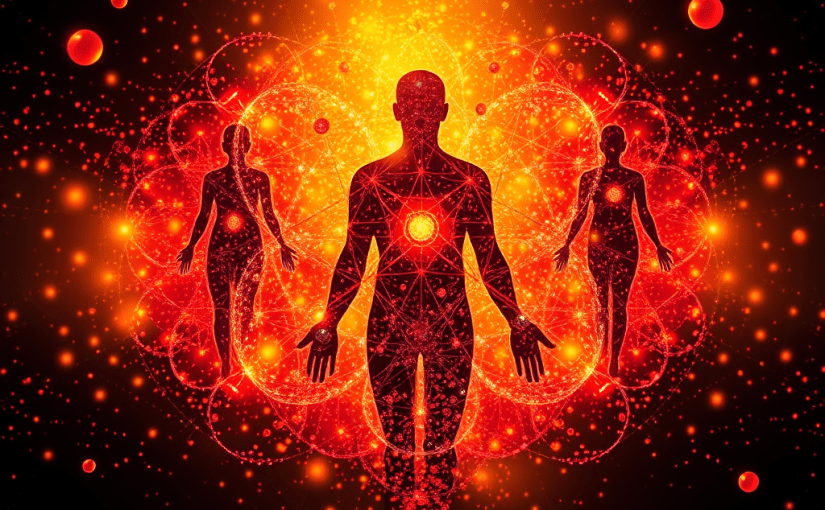
This chapter reveals the ultimate secret of the cosmos—a profound unification of the atom and the human being, both in the tangible world and in the realm of consciousness, ultimately demystifying Tantra. Here, the nucleus represents the core energy, like the Muladhara, while the electron shells correspond to the chakras, each level guiding the flow of energy and awareness. The dance of electrons mirrors the currents of prana, and the architecture of atoms reflects the structured ascent of consciousness. It is a journey where physics and spirituality converge, where the smallest particle and the vastness of human awareness are one, and where the mysteries of the universe unfold within and around us.

In the last chapter, we explored how mass gives weight and stability to the universe—how it anchors stars, planets, and even our own bodies, providing shape to creation. But mass alone is not enough. A stone may have weight, yet without energy it cannot move, shine, or evolve. The universe would be a silent sculpture, heavy but lifeless.

To bring that sculpture alive, nature needs another ingredient—energy.
If mass is the body of creation, then energy is its breath. Mass gives form, while energy gives play. Together, they weave the dynamic universe where stars burn, rivers flow, and life blossoms.

At the most fundamental level, everything is a play of energy. In the quantum world, particles are not fixed lumps of matter; they are waves of energy that rise, fall, and occupy specific levels inside an atom. In a similar way—though more metaphorical than scientific—human breath or prana is described in yogic traditions as rising, falling, and focusing on specific chakras. These levels decide the structure of reality itself—how atoms are built, how molecules form, how light interacts, and even how life becomes possible. In a similar metaphorical sense, the focus of a people’s breath or prana on different chakras is said to shape how they interact with the world—spiritually, intellectually, emotionally, playfully, lovingly, or even ignorantly. Imagine energy levels like the rungs of a ladder. A particle can occupy a lower rung or jump to a higher one, but it cannot linger in between. Each rung represents a discrete possibility offered by nature. The particle’s wavefunction assigns probabilities to each rung, often peaking near certain favored levels. When a quantum measurement occurs—or even when the particle interacts with its environment—it collapses to one of these rungs. If we clarify it further, An atom has fixed energy rungs where its electron can exist. Before any measurement or interaction, the electron is not tied to one rung but spreads out as a probability wave across several of the allowed rungs, depending on how it was excited. When collapse happens, this wave no longer stays spread out—the electron is found on one definite rung chosen from those present in the wavefunction. Electron transitions between energy rungs usually occur by absorbing or emitting photons, but can also happen through collisions, heat, or external fields. In every case, the interaction first collapses the wavefunction onto a definite rung and then shifts the electron to a new level uniquely determined by the energy gap. If the electron absorbs a single photon of known energy, the outcome is no longer a choice among many rungs—the fixed photon energy matches only one gap, so the electron must land on that specific rung. In very strong light, an electron can absorb multiple photons simultaneously, and because different combinations of the same fixed photon energy can match different energy gaps, several higher rungs may become possible, with wavefunction amplitudes weighting the probabilities and collapse determining which one is realized. This collapse is not a conscious choice, but an ego-less, natural selection dictated by probability and interaction. While a single event may seem insignificant, the collective activity of countless quantum particles accumulates and propagates, giving rise to the stability of matter, the formation of structures, and, ultimately, the grand architecture of the cosmos. Each tiny probabilistic selection—these primordial, nature-made choices—adds its thread to the vast cosmic tapestry. One should not call quantum particles or these events “experience-less” or “non-conscious,” for they occur within the all-pervading pure awareness, which is the form of endless experience and consciousness.

Similarly, chakras can be seen as the rungs of a ladder along the backbone. Energy is experienced most distinctly at the chakras, not in between them. The breath or prana may focus on a particular chakra depending on the body’s need to cope with the present environmental circumstances. This is a type of environmental interaction. This is somewhat like the quantum collapse of a particle, which interacts with its environment and chooses an outcome that best fits the situation—allowing not only itself to grow, but also to let all grow.

The Cosmic Blueprint in Energy Choices

Let us again take the atom as an example. Electrons around the nucleus do not roam aimlessly—they occupy specific energy shells. When an electron jumps from one shell to another within the same atom, it changes the atom’s behavior—how it reacts, absorbs light, or bonds—without changing the element itself. Hydrogen, with its single electron, is the simplest example: its electron in different shells clearly alters its properties. In multi-electron atoms, electrons in various shells can also shift, especially the outer (valence) electrons, affecting chemical behavior in more subtle ways. On the other hand, creating a completely new element requires adding more electrons along with additional protons, producing atoms like carbon, oxygen, gold, or uranium, each with distinct properties.

A similar principle is described in yogic science. Energy shifts between chakras may alter a person’s behavior for a time—spiritually, emotionally, or intellectually—yet the deeper personality remains unchanged. Only when greater energy is added through practices such as Kundalini Yoga, pranayama, asanas, or tantra can the subconscious impressions be dissolved or transformed, changing the personality. If the vacant space so generated is filled with a meditation image and awakened, it can lead quickly to self-realization, thus opening the hidden channel of energy fully and transforming one entirely. This is like adding protons and electrons to create a new element: the very structure changes.

Just as an atom finds stability when its positive protons and negative electrons are balanced, human consciousness finds harmony when the root (muladhara) and crown (sahasrara) energies are balanced. If energy gathers too much at the crown, one may feel ungrounded; if it sinks into the root, one may feel heavy and depressed. But when balanced, consciousness becomes steady, expansive, and capable of true transformation. Adding electrons and protons is like adding quantum energies of opposite natures: proton-energy is heavy and grounding, while electron-energy is light and liberating.

When an atom has more electrons than protons, it becomes a negatively charged ion, having captured extra electrons from its surroundings. When it has fewer electrons than protons, it becomes a positively charged ion, having released electrons to the environment. In nature, these exchanges balance themselves, forming bonds that stabilize matter. Similarly, in human beings, one who has more energy at the sahasrara than at the muladhara is naturally drawn to someone whose energy is stronger at the muladhara, and vice versa. This complementary balance or opposite pull is like a lame person riding on the shoulders of a blind man—together they benefit and move forward. Just as atoms bond by sharing electrons, human beings form relationships by sharing their energies, creating harmony and growth for both.

An electron rests in its ground state, stable and content at the lowest orbital, until a spark of energy lifts it to higher realms—yet it soon returns, releasing its borrowed light. So too, human energy dwells naturally at the muladhara, the root of stability, unless awakened by the fire of yoga, pranayama, or tantra or even healthy relationships. When charged with such force, it rises through the chakras, unveiling hidden awareness; but without sustained energy, it drifts back to its base. Thus, the dance of electrons mirrors the dance of prana—the journey between rest and awakening, between grounding and transcendence.

The attractive pull of the proton may be seen as Pingala, and the attractive pull of the electron as Ida channel. When both are in balance, the personality of the human-form atom remains steady and harmonious. If the electron pull dominates, the personality becomes floating and expansive, drawing others toward it to form bonds as most of the ordinary people are resting in muladhara, much like positively charged ions attracted towards the negatively charged ions to complete themselves. If the proton pull dominates, the personality turns ego-centered and heavy, weighed down by over-worldliness, and thus seeks a strong companion bond to supply the needed electron pull of expansivensess. In this way, the balance of Ida and Pingala mirrors the balance of charges in an atom, shaping both stability and relationships.

Neutrons, acting as the Sushumna of the atom, prevent protons from repelling each other that can lead to nuclear burst by producing the strong nuclear force that holds them together against their electrostatic repulsion. In the same way, Sushumna keeps a check on Pingala by attracting its energy and channeling it toward Ida for balance, while also taxing a little bit of its energy for the growth of awareness and stability. Metaphorically, neutrons thus indirectly help to push the electrostatic energy of protons toward electrons to maintain harmony, while consuming a part of it themselves—absorbing some binding energy—to keep the atom stable and even evolving through processes like nuclear fusion. This resembles the kundalini awakening in humans, where a fully new and improved personality appears—just as with nuclear fusion a new, larger, or more powerful atom can emerge with more number of protons, neutrones, electrons and orbitals. When Pingala is brought under control, Ida too becomes balanced, for both are relative and run on each other’s power. In this balanced state, protons do not fly away and electrons remain steady in their orbitals. It is like awakening would be impossible without Sushumna, just as stable fusion in stars would be impossible without neutrons holding nuclei together.

The nucleus of the human-form atom is the Muladhara, the powerhouse of energy that sustains all activity. Electrons circling around it represent thoughts and subtle energy, moving through various orbitals akin to the chakras. The higher orbitals correspond to higher chakras, culminating in the Sahasrara—the point of expansive consciousness. Nuclear fusion can be seen as the awakening of this system: an outburst of energy from the Muladhara surges upward through the chakras, activating them fully and giving birth to improved consciousness, where the new atom formed has larger flows of Ida, Pingala, and Sushumna, and a greater number of outer chakras, symbolizing expanded consciousness. Just as fusion releases immense energy by merging nuclei, kundalini awakening channels the latent potential of the Muladhara to the Sahasrara through the merging of Shiva and Shakti, producing a transformed, expansive, and enlightened state, with the chakras aligned and pointing toward the full expansion of consciousness. Even though both nuclei (or both Muladharas in a Tantric pair) are essentially of the same “type” or nature, for the purpose of attraction, union, and merging, they are treated as opposites as Shiva and Shakti—like complementary polarities that allow energy flow and unification. The legendary Brahmastra, fired by yogis such as Guru Putra Ashvatthama, can be seen as a similar awakening, but applied in the worldly domain—harnessing the same primal energy for external effect rather than inner transformation. Or it may be that the sages knew this psychological secret, reflected also in the physical material world, and expressed it both literally and philosophically through spiritual-metaphoric stories.

Electrons do not move gradually between orbits—they leap suddenly when enough energy is absorbed. In yoga, too, states such as dhyana and samadhi unfold in sudden leaps, not in slow crawling. This explains why enlightenment often feels like an instantaneous shift, even though the preparation may take years. You can determine the probability of an awakening occurring—how likely it is under certain conditions—but you can never predict the exact moment it will happen, just as in quantum mechanics where you know the probabilities of outcomes but not the precise result of a single event. The silent jump of an electron to a higher orbit can be likened to dhyana ripening gradually through repeated inner leaps between chakras—peaceful, steady, and gradually transformative. In contrast, the great surge of nuclear fusion resembles the moment when awareness itself flashes: the energy of the self previously bound and sleeping in muladhara suddenly leaps into pure, boundless consciousness, joining the endless expanse of full potential. In that momentary blaze, the atom also experiences boundless bliss and light, before stabilizing into a new, transformed, and evolved state—just as an awakened yogi shines with renewed being. It is exactly like Tantric Yoga, where the Muladharas of two loving partners merge, releasing an explosive surge of energy that rises from the base upward, piercing all the chakras, until it expands into the boundless infinity of the Sahasrara. Two nuclei merge to maximum extent but a small portion still remains unmerged that is converted to large amount of energy spreading upward. Similarly, both muladharas of a tantric couple share their energies with each other akin to merging as much as possible, but still some energy remains unmerged. Probably this extra energy left after merging manifests as awakening. In this sense, what tantra calls detachment can be seen as this unmerged residue of energy—preventing the partners’ energies from clinging completely, and instead redirecting the unified current upward for the awakening of the meditation image and self-realization. Just as in fusion, the unmerged part becomes the source of tremendous release, so too in tantra it is the subtle detachment that transforms love into awakening. Just as nuclear fusion requires intense heat to occur, tantric kundalini awakening too needs the inner heat generated by worldly activities, loving relationships, and the contemplation of non-dual philosophy such as Sharirvigyan Darshan.

People often perceive forbidden relationships as more thrilling because they are often formed in broad awareness of daytime, unlike genuine family bonds that society sometimes associates with duty or constraints, and often reserved for the ignorance-filled dark of the night when one is fully tired and exhausted due to roaming blindly and wildly amidst the so called job-jungle throughout the daytime for so called important livelihood activities, as if it is the least important work in the world so far. Even then it works fine more or less. What good not to expect if it is done in full awareness. Moreover, if family relationships were valued and nurtured openly in the light of day—with clarity, respect, and mutual understanding—there would be little attraction toward what is considered illegal. Just as nuclear fusion happens in broad daylight inside the sun—with full awareness, without secrecy, without being forbidden—resulting in the enhanced light of awareness, so too can lawful, harmonious bonds generate true fulfillment when embraced openly. Clinging to the external form of a partner without understanding the sameness of energetic essence in every human being is also a reason for attraction toward relationships outside the family. When Tantra shows its effect, this fact is properly understood and truly believed. Needless to say, I have seen near perfectly matching pairs go astray by not recognizing this deeper energetic essence and by being superficially swayed by egoistic patterns.

On the other hand, in the psychological fission, it is as if the neutron—the awakened sushumna of a potential partner—strikes the muladhara, the nucleus of the possible lover, and breaks it open into two. One half is the bunch of ego, while the other half is like the pure soul, suddenly lightened by shedding the burden of impressions. The energy that was once bound tightly within egoistic thoughts is now released and becomes available for awakening. Just as in nuclear fission the mass of the resulting nuclei is slightly less than that of the original, with the difference emerging as an immense burst of energy, so too the breaking of the ego releases a vast inner power. The mass of egoistic patterns shed is transformed into this energy. This surge of liberated energy flows upward, igniting awareness and transforming consciousness. Such a shift cannot occur through an ordinary bond; it can only be catalyzed by the presence of a partner whose sushumna is awakened, carrying the force to dissolve ego and redirect the released energy toward spiritual awakening. Just as nuclear fission does not require extremely high temperatures to occur, in the same way this indirect tantra does not demand the intense heat of passionate worldliness, unlike the fusion-form direct tantra described above. Can we, by extending this analogy, also discover a method of cold fusion—one that could solve the world’s energy needs forever? If nuclear fusion is the fiery union of energies and fission the breaking apart of burdens, perhaps the hidden key to cold fusion lies in the same mystery that tantra reveals—that energy, when rightly aligned, can be released without fire, silently transforming both the yogi and the world. But the problem with fission is the production of toxic radiation—just like the toxic thoughts that arise when love-filled relationships are made for breaking instead of union. If this is resolved, the energy problem is solved.

Moreover, this is not mere theory—by the grace of my guru and God, I have personally experienced both of these phenomena, receiving awakening glimpses through both fusion-like union and fission-like breaking apart.

Seeing the grand similarity between the atom and the body, it is not hard to believe that an atom can be understood as a complete human body in itself, just as these flowing chapters of Quantam Darshan have been asserting since the very beginning.

Repeating further, energy levels are like the blueprint of all diversity. Electrons can only exist in certain allowed energy levels around an atom’s nucleus, and these positions determine the atom’s behavior—how it bonds, reacts, or inter acts with other atoms. This arrangement shapes the molecules that form, deciding whether they become water, sugar, or DNA.

An atom’s energy levels can be imagined as the floors of a building, with electrons as tenants who can only occupy these designated floors. Lower floors fill up first, following specific rules, while the outermost floor—the valence level—holds the electrons that interact with the outside world and determine how the atom bonds or reacts. The energy gaps between floors act like elevator heights: small gaps allow electrons to move easily, while large gaps require precise energy input, such as from photons. Altogether, the number of floors, the arrangement of tenants, and the spacing between floors form a blueprint that dictates where electrons can be, how they can move, and ultimately how the atom behaves and interacts chemically.

On a much larger scale, the life of a star is determined by the nuclei of its atoms—the number of protons and neutrons—which dictate the nuclear fusion reactions in its core and whether the star burns steadily like our Sun or ends violently as a supernova.

In the heart of every star, life is sustained by hydrostatic balance—the delicate equality between the inward pull of gravity and the outward push of nuclear fusion. If fusion pressure runs ahead, the star swells outward until cooling slows the reactions and balance returns; if gravity takes the lead, contraction heats the core until fusion strengthens again. This harmony allows stars to shine for billions of years, but when their core fills with nuclei such as iron, which cannot yield net energy by fusion, no outward push remains to resist collapse. Gravity then crushes the core, sometimes into a neutron star, sometimes into a black hole, or in rare majesty, releasing all stored energy in a supernova explosion. So too in the inner cosmos: the body endures as long as prana, the fuel of life, sustains the balance between the contracting pull of ego and the radiant expansion of awareness. If awareness expands without grounding, the mind scatters; if ego contracts too tightly, consciousness suffocates into bondage. But in perfect equilibrium arises a steady luminosity—egoless quantum darshan, the inner sun burning without exhaustion. And when prana is finally exhausted at life’s end, the soul too meets its destiny: if awareness bursts free of ego’s last grip, liberation shines like a supernova, scattering individuality into the vastness; but if egoic gravity still outweighs, the soul collapses inward, bound like a neutron star or lost in the depths of a black hole—its journey continuing until balance is rediscovered.

Moreover, electrons and their energy levels play only an indirect role in this, influencing how radiation moves through the star. Without these energy levels setting the rules for electrons, nothing would take shape: no chemistry, no molecules, no planets, and no living beings to notice it.

The Drama of Quantum Jumps

Bringing the story to the fore again, you may have heard of the term “quantum jump.” It is not just a metaphor—it is a real event. When an electron absorbs or emits energy, it does not glide smoothly but suddenly leaps from one energy level to another. This jump is accompanied by light—what we call photons. And these photons are the messengers of creation, carrying information and energy across the universe.

Every ray of sunlight, every twinkle of a star, and every color in a rainbow arises from electrons making quantum transitions between energy levels. In stars and atoms, multiple energy levels exist, and the timing and path of each transition are probabilistic, giving photons a spectrum of colors and intensities—a whisper of the quantum world. In contrast, engineered systems like LED bulbs force electrons to drop across a single fixed energy gap, producing light of a steady wavelength and color. Whether probabilistic or fixed, each photon is still born from the same quantum rules, linking the microscopic choices of particles to the vast tapestry of creation.

Energy Levels and the Symphony of Life

If spin brought individuality and momentum brought direction, then energy levels bring structure. Consider the orchestra of life. Proteins fold into shapes, DNA forms a double helix, water forms crystals of ice—all because electrons collapse into specific energy levels, giving atoms predictable bonds and patterns.

Had these collapses gone differently, perhaps the chemistry of life would not exist. Imagine a universe where electrons never settled into stable shells—there would be no stable atoms, only chaos. Imagine a universe where energy gaps were wider or narrower—water might not exist, oxygen might not bind, and life as we know it could not breathe. Even sunlight would fail to power biology, because the energy of its photons would not match the molecular energy gaps needed for processes like photosynthesis or vision.

Thus, energy levels are not random—they are the stage upon which life performs.

Chakras as Quantum Energy Levels of Consciousness

If we dwell on the chakra–energy level analogy again, we find that in both the quantum world and the human subtle body, energy shows a natural tendency to move in waves. Just as quantum energy in bound systems oscillates as standing waves with crests and troughs, fitting only discrete levels, while free waves spread continuously yet obey the same quantum laws, Kundalini energy too bound in muladhar-sahasrar axis undulates like standing wave from left to right and back, as if sahasrar and muladhar are its two nodes where wave returns back and forth in a closed loop, energizing the chakras as it rises from Mooladhara to Sahasrara and back again going repeating the pendulum like movements. Movement of both is snake-like. It appears snake like when different chakras act as different nodes. standing wave from one node to next node is one loop or half of the full curvature of snake, the second standing wave from next to further next chakra is second loop or second half of snake’s full one curvature and likewise. It is just intertwined play of ida nd pingla. Similarly, serpent nature of standing electron wave is more visible in p-wave, when two loops of stnding waves join together. Though Kundalini is one serpent power, it expresses itself through two oscillating currents—Ida and Pingala—which spiral around the central Sushumna like twin serpents around a staff, much like the caduceus symbol. Each chakra can be seen as a different energy level, much like the quantized states of an atom, where energy is not continuous but arranged in distinct steps that require a “jump” for transition. Just as electron-energy manifests as different characters of the atom at different levels, prana-energy manifests as different characters of the human being at different chakras. In physics, energy levels are measured in electron volts, and the electron’s presence within each level forms a standing wave enveloping nucleus—a probability pattern revealing where it is most likely to exist. In yoga, these same principles appear as vibrational centers of prana and consciousness. Means any centre from muladhar to sahasrar may be activated as per probability wave distribution and favoring the points where amplitude of oscillations is high. Both show the same profound truth: energy moves in oscillations, rising and falling, before settling into harmonious unity of sushumna as collapsed particle.

It is truly experiential. When the brain is tired from work, it actually receives energy from the base in a wave-like fashion. Sometimes this energy moves alternately along the left and right sides, directly merging at the Ajna Chakra and energizing it. At other times, it rises only up to the Heart Chakra and merges there. There is no fixed rule that it must always ascend step by step through each chakra from bottom to top, although mostly it tends to do so.

A Universe Sculpted by Choices

Think of the entire cosmos as a vast painting. Spin provides the brush strokes, momentum provides the direction, but energy levels provide the colors. Each collapse decides which hue appears, how bright it is, and how it blends with others. Together, they form the masterpiece of stars, galaxies, and living beings.

The amazing part is that all this structure comes from simple binary choices at the quantum level—this energy rung or that one, up or down, here or there. Multiply these micro-choices over cosmic time, and you get the grand, diversified creation we live in.

Quantum Collapse – The Engine of Creation

At this point, we can see a deeper pattern. Spin, momentum, position, and energy levels are all qualities waiting to be decided. But nothing is determined until a collapse occurs. Quantum collapse is like the beating heart of the cosmos. It pumps out choices, moment by moment, and each choice builds on the last, driving forward the story of creation.

If there were no collapse, the universe would remain a haze of probabilities, a dream never waking. But collapse turns possibility into reality. It is the engine of creation, transforming silence into song, emptiness into form, and potential into life.

So when you feel the warmth of sunlight, sip a glass of water, or look at the colors of a flower—remember that all of it is born from the humble but profound act of quantum collapse at the level of energy. Without those invisible decisions, the visible world would never exist.

My Journey Through Sharirvigyan Darshan, Tantric Kundalini, and Self-Realization

Friends, this is one of my favorite posts, deeply experiential in nature and reflective of my lifetime spiritual journey. Ever since I began exploring meditation, I noticed a subtle yet profound distinction between thought-based contemplation and the deeper, formless stillness of awareness. Raman Maharshi often said it is better to engage in neti-neti or non-dual contemplation, yet I realized that these experiences — as blissful as they were — were still transient. Nirvikalpa samadhi, on the other hand, creates chidakash or ekarnava, a stillness that abides for longer periods, whereas contemplation alone only gives fleeting glimpses.

Eventually, I understood that to sustain even the transient experiences of ekarnava, one has to embrace breathlessness. Before I experienced keval kumbhak, even after Kundalini awakening, self-realization, and non-dual awareness through sharirvigyan darshan, I could not fully comprehend thoughtless awareness. Yet I had immense bliss, rest, satisfaction, and a feeling of completeness — all connected to subtle thought. I realized that bliss and non-duality connected with thought could not reach the final state of fully thoughtlessness.

This led me to a subtle but important insight: after self-realization and Kundalini awakening, and even sharirvigyan darshan, one can attempt to reach breath stillness more quickly, because the ego is already weakened and the body-prana system more prepared. In the same way, Ramana Maharshi had cautioned against forceful breath control without inner maturity. He emphasized that natural keval kumbhak arises only when the mind and ego are ready. Forceful suppression might temporarily quiet thoughts, but it does not destroy the ego and can create strain or attachment.

In my observation, thought stillness slows the breath but does not stop it sufficiently or for long periods, whereas breath stillness immediately calms the mind and lasts longer. This is because thought is like waves on the lake’s surface — you can quiet them, but the lake still moves underneath. Breath, however, is like the spring feeding the lake: if the source of movement stops, the surface cannot ripple. This shows why prana stillness (keval kumbhak) is far more decisive for sustained thoughtless awareness.

Ramana Maharshi often said, “Mind and breath arise from the same source. To still one is to still the other.” Ego is the hidden source of both. When the ego weakens, prana settles naturally; when prana is still, the mind has no fuel for thought. In deep states, breath is the shadow of the ego. This simply means that in ordinary, laborious worldly activities, breath reflects not only the ego but also the need for oxygen. During deep meditation without ego, the breath itself fades, and awareness abides in pure stillness — the chidakash or ekarnava.

I noticed subtle variations in breath depending on ego orientation. Unequal inspiration and expiration reveal ego tendencies:

  • Longer inspiration reflects inward, self-centered attention.
  • Longer expiration reflects outward, world-centered attention.

This aligns with the ida–pingala–sushumna play in yogic physiology:

  • Ida (left, inward) → longer inhalation → self-absorption.
  • Pingala (right, outward) → longer exhalation → outer engagement.
  • Balance in breath → equilibrium between ida and pingala → sushumna activation → mind quiets → doorway to sustained stillness. That is why it is said that when breath flows equally through the left and right nostrils, dhyana becomes fixed quickly. This is because equal inhalation and exhalation balance each other, leading to a natural stillness of breath.
  • The up-and-down movements of the breath reflect both the vertical and left-right movements of Ida and Pingala: up for the left, down for the right. Actually, Ida Nadi feels more inclined toward inhalation or upward breath movement, while Pingala feels more inclined toward exhalation or downward breath movement.It is amazing. The left nostril activating Ida does create a subtle left-side dominance in energy, and right nostril activating Pingala creates right-side dominance.

Even a single complete breath moves awareness up and down: inhalation lifts consciousness inward or upward, exhalation spreads it outward or downward. Prolonged breathing keeps awareness oscillating. Only when prana rests in sushumna, in natural breathlessness, does awareness remain steady. Sushumna means that the breath is neither moving up nor down, but stays in the center; it is neither in the left nor the right, but centrally aligned—this corresponds to the breathless state, or Kevala Kumbhaka. Breathing through the left nostril brings the sensation of the breath moving through the left side of the body and more upward, and breathing through the right nostril brings the sensation of the breath passing through the right side and more downward. When there is no breathing, it is self understood that the breath is flowing neither through the left nor the right nostril, neither upward nor downward. When there is no left-right sensation, it is self-evident that the breath is central, along the midline of the body or through the backbone. The sensation also confirms this. Along with it, when there is no up-down movement in the breathless state, the breath is understood to be in the central line, precisely at the midpoint of that line. “No up-down movement” does not imply prana is physically fixed at the midpoint; it means prana is static along the central channel. Feeling it at the midpoint is a perceptual focus, not a literal physical location. It is amazing psychology and terminology, sometimes confusing too. At first, I used to think of Sushumna as a special type of heavenly breath, never imagining a breathless state for a living being, but my experience now shows otherwise. This is why destroying ego, reducing breath oscillations, and balancing breath are crucial. Ego is notorious in producing duality. Yet, with sharirvigyan darshan, the ego feels hurt — the body is revealed as a non-dual, ego-less and detached living system, not as “me,” and that hurt is purification, loosening the ego’s grip.

In a nutshell, Keval Kumbhak (breath stillness) and Sushumna breathing are synonymous. Both are highly praised in the scriptures and regarded as the direct doorway to liberation as well as the source of supernatural powers. Yet, liberation itself is the supreme power — beyond all others. Strictly speaking, Sushumna breathing (when ida and pingla flows are equal) prepares the ground and naturally matures into Keval Kumbhak, so the two are inseparably linked stages rather than exactly the same.

When breath flows equally through both nostrils, it shows that Idā and Piṅgalā are balanced and prāṇa is entering the Sushumnā, creating the right state for meditation; when this deepens, the breath may stop on its own without effort—this is Keval Kumbhak, the natural peak of Sushumnā flow where prāṇa is fully absorbed and the yogi rests in stillness.

The insight of sharirvigyan darshan was a turning point for me. I realized why I was drawn toward Tantric Kundalini Yoga after practising it consistently: in Tantra, contemplation or thinking, beautification, care, respect, and love toward the body are of prime importance—just as in Sharirvigyan Darshan—thus both complementing each other at both the physical and spiritual levels, leading to progressive development. It is another amazement. The cells of the body live without claiming doership of work or enjoyment, so why should I? This shook the ego profoundly, and freed prana or energy for meditation. Sharirvigyan darshan gave me a contemplative base — a rational, embodied insight — while Tantric Kundalini Yoga liberated my world-entangled energy, allowing me to offer it to the meditation image. This image, nourished by freed prana, awakened and became alive before me, not just a mental visualization. That living image led to glimpse of self-realization.

The sequence of my journey — Darshan → Energy Release → Image Awakening → Realization — mirrors the Tantric map of jñāna-śakti (knowledge), icchā-śakti (will), kriyā-śakti (action), and śakti (energy/awakening):

  1. Sharirvigyan darshan gave me knowledge.
  2. My choice to pursue Tantric Kundalini Yoga provided will. Although it originated itself through practice of sharirvigyan darshan. It is the most amazing part. In majority of scriptures, will is forced that seldom succeeds.
  3. The practice itself — offering energy to the meditation image — was action.
  4. The awakened image and glimpse of Self-realization was the manifested energy, śakti.

This phenomenon is interpreted differently in various traditions:

  • Tantra sees the image awakening as divine Shakti appearing in form, a sacred manifestation.
  • Advaita Vedānta regards it as a transitional phenomenon; the image is only a springboard — awareness turning inward leads to direct realization.
  • Yoga Sutras classify this as savitarka samadhi, where meditation on form (image) is energized and luminous, leading toward nirvitarka (formless stillness).

Had I pursued Tantric Kundalini Yoga alone, without sharirvigyan darshan, I could still have achieved realization with great difficulty and after prolonged practice, even getting none because favourable conditions do not sustain for long. Even after getting plainly, I would have missed the extraordinary bliss, creativity, and worldly play that arose naturally when freed energy flowed into the meditation image during normal worldly activities. This illustrates the difference between the nivṛtti-mārga (ascetic vertical path) and pravṛtti-mārga (world-affirming spiral path) of Tantra:

  • Nivṛtti: rapid, inward ascent, ego dissolves quickly, but world’s richness may feel muted. But failing it, one may feel astrayed forever.
  • Pravṛtti: spiral, celebratory ascent, energy sanctifies worldly life while also piercing into realization — what I experienced.

In my path, Sharirvigyan Darshan provided a non-dual type of insight, while Tantric Kundalini Yoga freed the energy bound to latent thoughts and impressions. This happened through two processes: carrying the non-duality of Sharirvigyan Darshan to its peak, and knocking out hidden mental activities. In this way, the last drop of available energy was extracted, with which the meditation image became alive by itself—just like drinking that very energy, similar to Goddess Kali drinking the bowl of blood—leading to glimpse of Self-realization. The world itself became part of the practice, joyous and meaningful, not something to escape. My experience beautifully combined both liberation and enjoyment, embodying the Tantric principle of bhoga-apavarga-samyoga — the union of divine enjoyment and liberation.

This journey shows that self-realization, energy mastery, and meditation image awakening can converge naturally when knowledge, will, and action align, and when the ego loosens its grip. Breath stillness (keval kumbhak) and mind stillness become inevitable outcomes, leading to sustained awareness, ekarnava, and chidakash, where thought, duality, and oscillation finally dissolve.

In essence:

  • Sharirvigyan darshan shook the ego and freed energy.
  • Tantric Kundalini Yoga harnessed that energy for inward ascent.
  • Meditation image became alive, serving as the doorway to realization.
  • Breath and ego gradually stabilized, leading toward sustained stillness.
  • The world became a stage for bliss, not a distraction.

My journey exemplifies a harmonious path where insight, energy, and practice converge, showing that the Self can be realized not only in withdrawal but also in full-bodied, joyful engagement with life.

Chapter 14: The Mass of Creation – How Weight Gives Shape to the Universe

In the previous chapter, we saw how matter is not something separate from us but is already woven into our very sense of self. The particles that form our body and the stars above share the same fabric of existence, whispering that the universe is one continuous being.

But to move from this insight of oneness to the world of form, another question arises:
If everything is already me, then what decides the different shapes and roles matter takes?
Why does one part of the cosmos become a star, another part a tree, and another, me?

The answer lies in mass — the quiet sculptor that gives the self a body, the cosmos a shape, and energy a destiny.

The Weight That Anchors Creation

Mass is not a random gift given at collapse. It is the inborn property of a particle, written into the universe through the Higgs field. This invisible field fills all of space, and each particle interacts with it in a unique way. Some interact weakly, staying light, like the electron. Others interact strongly, becoming heavy, like the top quark. And some, like the photon, do not interact at all, remaining massless.

In this way, the Higgs field quietly determines the “responsibility” each particle must carry. Mass is fixed, permanent, and essential. Without it, all particles would rush through space at the speed of light, unable to clump, unable to form structure, unable to make worlds.

The Higgs field is like a cosmic university, and the Higgs bosons are its professors. Each professor evaluates the particles—the students—assigning them different weightages based on their character and abilities, shaping their place in the grand curriculum of cosmic engineering.

Collapse: From Possibility to Reality

If mass is fixed by the Higgs field, then where does superposition enter the story?

Here lies the subtle beauty. A particle’s mass is set, but its state — position, spin, momentum — can exist in a superposition of possibilities. Collapse is the act by which one possibility becomes actual. In this sense, collapse does not create mass, but it decides how mass-bearing particles arrange themselves to form the structures of reality.

If we clarify it further, Mass is a fixed intrinsic property of elementary particles and does not exist in quantum superposition. However, its influence appears through energy and momentum, which do remain in superposition and collapse upon measurement. In composite systems, or in special cases like neutrinos, superpositions of states with different effective masses can occur. Thus, mass also expresses itself only when collapse decides the final outcome—though not directly, but indirectly through energy and momentum.

This is like the mind. Our body is given to us — flesh, bone, and weight, already fixed by genetics, diet, and time. But our thoughts are in superposition, countless and fleeting. Collapse occurs when the mind chooses one thought and makes it into a decision. Just as collapse crystallizes one quantum possibility into reality, our decisions crystallize the flow of thought into action. The mass or weight of the body cannot show its effect if the mental choices collapsing into favorable decisions do not carry the body to jump over the grass-filled bag and compress it to make silage.

In other words, it is like a degree-qualified student who can only demonstrate the effect of his knowledge when he meets and interacts with people who need him—an outcome determined by the probabilistic superposition of his placement, energy, and momentum, collapsing into a favorable result. If the placement is favorable in a favorable college but his energy drains away due to illness or bad habits, his knowledge-weight will not show its effect to students. Even if both placement and energy are favorable, but he lacks momentum in the right direction, the result still won’t manifest. So you can imagine how many favorable conditions creation must have required—from the quantum level to today’s human society—for us to be mutually interacting through our laptops across the entire world. Truly amazing.

Thus, in Sharirvigyan Darshan, mass is like the body’s given clay, and collapse is like the potter’s hand shaping it into vessels of destiny.

Balloons in the Fairground

Imagine a grand fairground where countless balloons float in the air. Some are light and barely tethered, drifting wherever the wind pushes them. Others are heavy, filled with sand, falling quickly to the ground and forming clusters. This playful scene mirrors one of the most profound truths of our universe: mass decides clumping, and clumping decides form.

Without the Higgs field assigning weight, all balloons would drift endlessly. But with it, some anchor, some rise, and together they paint the diversity of the fairground.

The First Drops of Weight

In the earliest moments of creation, the universe was like a weightless ocean — full of energy but without anchors. Particles were massless sparks, rushing about freely. But when the Higgs field “switched on,” particles gained mass, as though dew had settled on an invisible web. Suddenly, energy was not only light but also heavy. It could now clump, gather, and begin to form structures.

Mass became the sculptor’s tool. Where there was none, everything stayed diffuse, a mist without boundaries. Where mass appeared, centers of gravity emerged, galaxies condensed, and stars found their birthplaces.

The Cosmic Balancing Act

Mass is not merely about heaviness — it is about responsibility. A particle with more mass pulls on its neighbors, like a magnet drawing iron filings. A lighter particle, on the other hand, slips past interactions, unnoticed, like a feather in the wind. A politically minded person, massive in every field of life, always attracts a crowd of people around him who are less massive. But those who are too thin or like feather-light—like beggars, who are truly deficient, or saints, always fulfilled but resting in pure awareness, the lightest of all—pass by unaffected by his massive pull.

Imagine a cosmic marketplace. Particles with greater mass settle down like merchants in the square, attracting customers (other particles) toward them. Those with less mass are like travelers, always moving, rarely stopping. Together, they create balance: the merchants giving centers of stability, the travelers ensuring motion and exchange. Without both, creation would tilt either into lifeless stillness or restless scattering.

The Sculptor of Diversity

Consider Earth. Its mountains, rivers, oceans, and living beings — all owe their existence to how mass was apportioned. If electrons had been a little heavier, chemistry would have danced differently, atoms might never have formed stably, and life as we know it might have been impossible.

If protons had been slightly lighter, stars might never have ignited fusion, and the Sun’s gentle warmth would not have shone on Earth. A small difference in mass is the line between a cold void and a living cosmos.

Mass and the Poetry of Form

Think of clay in the hands of a potter. Without clay, the potter’s wheel spins endlessly, but no vessel takes shape. Mass is like the clay of creation. It gathers, it holds, it allows form to be molded. The Higgs field provides the clay, collapse provides the shaping hand, and together they sculpt the universe. The spinning wheel is like pure awareness, yet it neither spins nor requires spinning, because here the particles, becoming metaphorical clay, move themselves to be shaped—unlike ordinary clay.

A stone mountain is nothing but clustered particles that carry mass. A drifting cloud is made of lighter forms, airy and mobile. The rhythm of form and formlessness, of solid and fluid, is written by the pen of mass.

Even non-physical has mass

Dark matter is invisible and non-physical, yet it has a non physical type of mass that never can be measured, may be it is encoded mass in the form of special streching of empty space. its gravity affects the visible cosmos. Similarly, invisible ghosts means bhūta, preta, ḍākinī, piśācinī, yātudhāna, kiśkindhika, and others described in ancient Hindu spiritual texts can be understood as subtle forces, like different types of dark matter, that influence the physical lives of people. Various remedial spiritual rites, yoga, mantras, and forms of meditation are practiced to alleviate their effects. These practices carry the soul of the practitioner closer to pure awareness, which is completely beyond all influences—even the gravity of this non-physical “dark matter.” Just as cosmic dark matter pervades everything but cannot touch the pure cosmic sky, so too do these forces fall short of reaching pure awareness.

Closing Image

Picture again the fairground of balloons. Some rise, some fall, some cluster, some drift away. Each balloon’s motion is shaped both by its given weight (from the Higgs field) and by the path it takes (decided by collapse).

So too in life: our body is our given weight, our thoughts are countless balloons, and our decisions are collapses that tether some while letting others drift. Had thoughts been as heavy as the body, they could not drift at will; we would not be able to let go of some while tethering the important ones, and making decisions would not be possible. Thus Creation itself is this delicate play of weight and lightness, attraction and release, collapse and freedom.

Thus, mass is not just about heaviness. It is the quiet architect of creation — the one who gives shape to the shapeless and anchors the dance of the cosmos.

This is how the Higgs field, superposition, and collapse together make the universe diverse, structured, and alive.

Chapter 13: From Matter to Self – How Everything You See Is Already You

The journey that began with seeing the atom not as something hidden or separate but as the very stuff of the body and world now opens into a wider understanding. Once it is understood that atoms are not something out there, but the very essence of blood, bone, and breath, then the next step naturally arises: if atoms make up all things, then all things are already part of the same self. It means, if the thinking body is conscious or self, then thinking or superposition and deciding or collapse of quantum particles — and everything made of them — are also conscious or self. Atom makes the cosmos, atom makes the body. So atom is the father of all, and every piece of matter is a brother to human. Matter itself begins to reveal its secret—that it is not lifeless dust scattered in space, but a mirror in which the conscious self finds countless disguises. It means, it is the same self taking on many different forms. Things once worshipped as possessions—car, house, food, money—are now seen in a new way, as if they are all showing the same one reality.

The common mind is accustomed to worshipping matter in fragmented ways. A vehicle is adored as a symbol of status, money as a guarantee of security, food as a source of satisfaction, and a house as a shelter of pride. Yet strip them of their labels, look deep enough, and they are only clusters of atoms dancing in familiar forms. The very same atoms pulse through veins as blood, hold bones together as calcium, breathe life as oxygen. What appears as external wealth and what circulates inside as flesh and thought are not two substances but one continuum. In this realization, a door opens that does not belong to any religion or creed, for the logic is plain: if all is built from one pattern or blueprint like vibrations, energy, superposition, collapse etc., then all is essentially one.

When the claim of ego is gently dropped, the discovery becomes more intimate. The person once seen as enemy also breathes the same air, shares the same atomic foundation, and moves under the same laws of cosmos. Hostility then melts, not because of preaching or command, but because opposition itself loses its reality. It is like watching two waves fight on the surface of an ocean, forgetting they are water through and through. The ocean never quarrels; it only plays or does Leela.

Maanavata se bada dharm nahin, kaam se badi pooja nahin; samasya se bada guru nahin, aur grihasth se bada matha nahin”—this secret verse, discovered and propagated by the author, directly reflects the principles of quantum science. Although not really discovered, but researched and understood, as it has persisted since ancient times in one form or another. The first line, no religion is greater than humanity, reflects how countless probabilities in quantum physics collapse into a single event near the peak of the probability wave. This peak represents the peak development of the creation. Humans have the peak level of grey matter to carry forward the creation to that height. This makes humanity the true religion of the quantum world. To reach this peak, quantum particles select the best or highest-valued option among many, just as the human mind collapses multiple thoughts into a single decision of utmost humane significance. Most probably this peak of humanity aligns with the peak of quantum probability wave in this or that way. Although this happens naturally by quantum law, the human ego grows and claims that it was ‘I’ who did it. Suppose Ramu is living in Shimla with his family. Now consider the whole cosmos as a probability wave of his position. In theory, he could choose to live anywhere in the cosmos, but why only at his present place? Even this is fully true in practical terms too, a human can be reborn in that specific part of the infinite cosmos where its existence best serves the purpose of humanity. This is because the highest human potential for work and business is usually at familiar places, with accustomed and supportive people such as family members, friends, and relatives. When this potential for humane work declines at his native place, he has to migrate—just as countless people migrate elsewhere for the same reason. However, shifting always happens toward a favorable place, much like quantum particles relocating to a new position near the peak of the probability wave as the peak of humanity wave, and not arbitrarily. This is clearly seen in quantum tunneling, when a quantum particle shifts from one side of a barrier to the other, landing most likely at the peak of its probability wave. The particle does not actually travel physically; it is as if it ‘dies’ in one universe and is ‘reborn’ in another, more suitable universe, where it can contribute more effectively to the service of creation and humanity. That decision or wish to relocate becomes mental work, and its result expressed in action becomes physical work—together forming the only genuine worship of the quantum world, free from hypocrisy or flattery. Hence, no worship is greater than work, second verse of the joint verse is proved. The third verse, no guru is greater than the problem, shows that guidance does not come from outside only. A quantum particle adjusts and learns by interactions with other particles and overcoming obstacles; in the same way, humans grow by social interactions and solving problems in the service of humanity. The final line, no hermitage is greater than family life, explains that if quantum particles remained forever dissolved in stillness of pure awareness without interacting with other particles, or if one stayed only in Nirvikalpa Samadhi away from social interactions, no world could exist. Life continues because creation expresses itself through family and duties. Also, as told above, humanity grows best in a family type cooperative environment. In this way, the verse applies equally to the quantum realm, the macrocosm, and human society. Yes, interactions between cosmic bodies like stars and galaxies are similarly based on this quantum verse. The author lived this truth in letter and spirit, learning indirectly from the quantum world with the help of this so called quantum verse, attaining the essence of Karma Yoga along with glimpses of Kundalini awakening and self-realization. Beyond this stage, one may pursue Nirvikalpa Samadhi, but it remains optional—for one can also remain in Karma Yoga and Sahaj Samadhi always. Though few may reach such a nirvikalpa state, their indifference to worldly show does not harm the world’s activity; instead, their journey benefits society when others follow their footsteps from the very beginning, and not by trying to enter directly into samadhi. Since it is directly linked to the quantum world, this verse qualifies to be called a quantum verse.

If we dissect quantum behaviour further, every quality of a quantum particle exists as a separate probability wave, and these waves are independent, not interfering with one another. Similarly, each aspect of human life—where one is born, whom one marries, what profession one follows—arises in uncertainty independently. No one knows beforehand where a person will be born, but wherever it is, it carries the potential to contribute best to humanity. Marriage too is uncertain, yet it naturally aligns in a way that serves the larger good. A person may be born in a royal family and marry into poverty, yet both possibilities are part of the same unfolding toward humanity’s peak. One may appear inborn poor yet hold the role of a company’s CEO. In truth, it is the wave of humanity itself that determines these outcomes. If mutual relationships seem to appear among the different “waves” of life, it is only because they all are guided by that larger wave of humanity. Relationships among them are secondary; the primary movement is always toward the flowering of humanity.

This truth as told above deserves repeating: no guru is greater than a problem. In the quantum world, a particle is not instructed from outside—it learns by meeting resistance, by facing tension, by adjusting itself again and again. So too in human life, real challenges often teach more than any teacher. A problem can sharpen the mind, melt away pride, and give lessons that even the best guru cannot always sustain. Of course, the role of a human guide is valuable, but it is never enough on its own. Progress needs willingness, and though willingness can be encouraged by a teacher, it must finally rise from within. True growth comes from balancing the guidance of an external guru with the inner guru of lived experience. Returning once more to the verse, it concludes: no hermitage is greater than family life. If particles were to dissolve forever in stillness, nothing could appear—no world, no movement, no life. Creation is alive because stillness agrees to move, because silence becomes sound, because the inner withdrawal returns outward as relationship and duty. In the same way, family is not a barrier to realization but the very field where realization ripens. The home itself becomes the monastery, and daily life becomes the true ground of awakening.

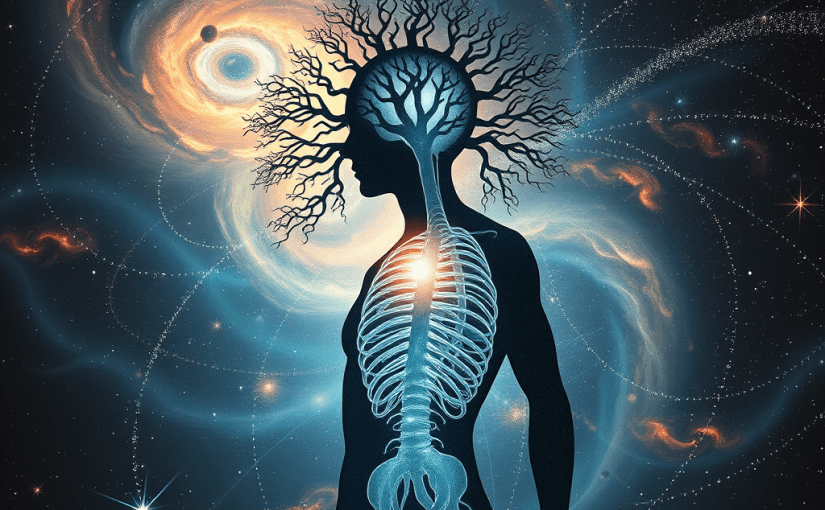
As said above, the author of this vision did not leave these quantum truths as dry philosophy. They were lived, tested, breathed. Karma Yoga was not a slogan but a way of cleansing. Problems were accepted as teachers. Work itself became worship. This approach opened a doorway where the currents of Tantric Kundalini stirred, bringing glimpses of awakening and self-realization—achieved not in isolation, but alongside the fulfillment of worldly duties, obligations, and tangible physical progress. The body, when seen with clarity, is no longer only biology; it becomes Sharirvigyan Darshan—the science of body as mirror of cosmos and human behaviour. What nature has inscribed in the workings of cells is echoed in human society and even in cosmic evolution. Digging deeper, the pulse of metabolism reflects the pulse of stars, and the pattern of neurons echoes the pattern of galaxies. It means, steady pulse of metabolism in every cell reflects the pulse of stars, which are born, shine, and fade in cosmic cycles. Likewise, the intricate branching of neurons in the brain strikingly resembles the web of galaxies stretched across the universe. The tiny rhythms within us are not separate from the vast rhythms of the universe. Seen this way, the body is not an isolated fragment but a miniature cosmos, repeating on a small scale the same patterns that shape the stars and galaxies on the grandest scale.

Basic Sharirvigyan Darshan has already shown how viewing simple similarities between body cells and human behavior reveal unexpected wisdom. For instance, cells communicate, compete, cooperate, and balance survival with sacrifice—just as communities do. And when this insight is not merely thought but lived, its power is astonishing. The author, guided by such a karmic-yogic mindset, found the doors of Kundalini Yoga opening naturally, as if the body itself rewarded sincerity with vision. A glimpse of the serpent power uncoiling and rising gave a direct taste of unity, an experiential confirmation that the science was not mere speculation. Advanced Sharirvigyan Darshan dares to go further, suggesting parallels not only between cells and society but between atoms themselves and human workings. If atoms and human actions are reflections of each other, then studying one becomes a way to understand the other. When the physical parallels are seen, and the mind rests in egoless wisdom, truth is both confirmed and experienced. This idea is not yet fully tested, but its promise is immense. It suggests that life is like a play in which every moment and every particle reflects the whole. Time and space themselves are holographic, where each fragment carries the imprint of the entire universe. Just as in a hologram each fragment carries the complete image. It means, even a single fragment of endless time and endless cosmos reflects the whole of time and cosmos itself, showing that each passing instant and each quantum of space occupied by the quantum particle holds within it the signature of eternity. Therefore, it is possible to experience eternity at every moment and at every place by experiencing similarity between cosmos, human body and quantum particle.

Basic Sharirvigyan Darshan as indicated above, authored by the same author, has been well described in the published work The Mythological Body – A New Age Physiology Philosophy [Sharirvigyan Darshan]. Originally written in Hindi, it is thoughtfully translated here into English to make its insights accessible to a wider audience while preserving the depth and essence of the original. The work explains the striking similarities between the internal physical structures of the human body—cells, organs, and systems—and human behavior as well as societal dynamics. It demonstrates how patterns governing the body, such as communication, cooperation, competition, and balance, are mirrored in human actions and social organization, offering a unique lens to understand life as a reflection of universal principles. Extending this insight, the human body itself can be seen as the supreme living mandala, a microcosm containing countless dehapurushas—miniaturized, non-dual beings that work in perfect harmony, mindful yet unattached. Observing and contemplating these inner beings teaches lessons in non-duality, cooperative society, and even the nurturing of nature, while also serving as a practical and powerful gateway to Kundalini awakening and liberation. Through this understanding, the body becomes both a mirror and a guide, showing how true spiritual growth occurs naturally within the world, without the need for forced renunciation, and how life itself can gently lead one to detachment once a threshold of inner realization is reached.

In this way the story of matter becomes the story of self. The universe that appears vast, cold, and external softens into intimacy. A stone is not alien; it is kin. A stranger is not separate; he is the same play of atoms as the hand that writes. Even loss begins to transform, for nothing can truly vanish; it only reshapes its disguise. This realization does not demand retreat into caves or cloisters, though that too may be chosen. It equally allows one to remain in Karma Yoga, to live in Sahaj Samadhi—an effortless harmony where the ordinary world is no longer a trap but an open field for action without entanglement.

The thrill of this adventure is that it unites opposites. It makes science and spirituality kiss where they once seemed strangers. Quantum collapse becomes a metaphor for human decision. The activity of cells becomes a mirror of society. Family life becomes the monastery of the modern seeker. Every corner of matter becomes a temple because it is none other than the self in costume. Awe arises not from imagining miracles beyond reach but from seeing the miracle that is already present in every sip of air and every grain of dust.

See the brick fixed in the wall: its quantum particles have chosen to stay grouped, solid, and unmoving for years. For what? Only for humanity—enduring the suffering of weather as silent penance. What greater austerity than this? Its work of supporting the house is constant and unwavering. Living in a large family of bricks, it eases its burden through close interaction with its companions. In the heat of summer, it expands, releasing excess energy; in winter, it shrinks, huddling with others like family members conserving their shared vitality. In this way, it learns from environmental challenges how to adapt and interact to minimize suffering. This is not mere material behavior—it is cosmic psychology, inseparable from human psychology.

The mystery is not diminished by this understanding. Rather, it deepens. To see that everything is self is not to reduce it to a mechanical formula, but to watch the play of disguises with wonder. Why should the self choose to appear as tree, as river, as mountain, as laughter, as sorrow? The answer may never be pinned down, and perhaps that is the beauty. Mystery is not something to be destroyed by knowledge but to be embraced by deeper seeing. Just as a child never tires of looking at the ocean though it is only water, so the awakened mind never tires of looking at the world though it is only self.

I am pointing to the presence of Self in every particle, because only Self—consciousness—can think and decide as we do. What is non-Self is non-conscious. Thus, Self is synonymous with consciousness, while non-Self is synonymous with non-consciousness. In this way, there is nothing truly non-Self or non-conscious in the cosmos, for even quantum particles display a kind of choice or decision, reflecting the presence of consciousness. Everything is conscious. It has been strongly advocated by sanatan dharma where everything is worshipped.

The path from matter to self is not an abstract riddle but a lived possibility. The car parked on the street, the money folded in the pocket, the house filled with voices, the bread broken at the table—all are matter. But in a deeper gaze, they turn, shimmer, and reveal the self. It is the same journey atoms take when they become flesh, the same journey flesh takes when it becomes awareness. And from awareness arises again the sense of world. Round and round the circle turns, not to trap but to liberate, once the play is recognized.

Thus, the thirteenth chapter stands not as a conclusion but as an opening into a greater adventure. From atom to body, from body to world, from world to self, and from self again to cosmos, the circle is complete yet always expanding. The invitation is not to escape this dance, nor to be drowned in it, but to stand in its heart, free, luminous, at play—where everything seen is already the self in countless forms.

And yet, if everything you see is already you, what gives this shared self its many shapes — stars, rivers, mountains, and bodies? The answer lies in mass, the quiet architect that turns the oneness of matter into the diversity of form.

Harnessing Inner Silence: A Yogic Approach to Stress

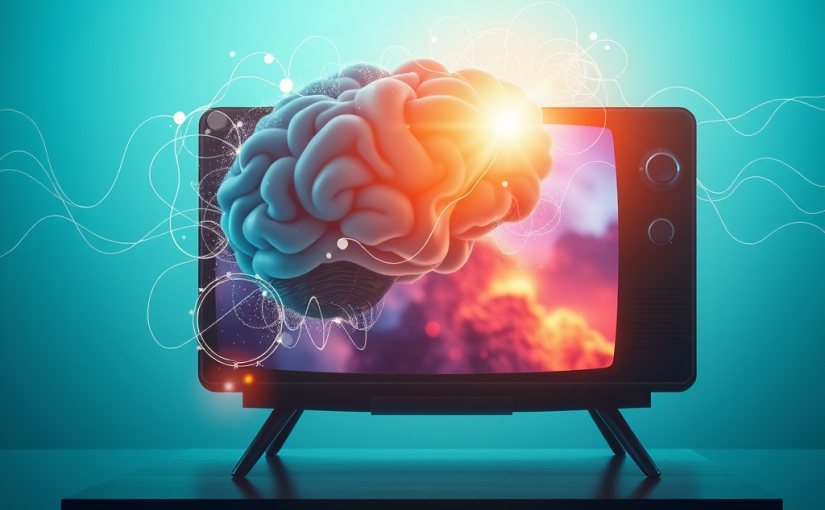
I often feel that the best way to understand the working of the mind is to compare it with something everyone has seen in daily life—a television set. A TV screen looks simple: you switch it on, and pictures appear, but behind those pictures is a dance of invisible electromagnetic signals. Science tells us that these signals are nothing but waves of energy, and the TV has the ability to catch them and convert them into clear images. In the same way, our mind also catches signals. These signals are not coming from a satellite or broadcasting tower but from inside us—from our own emotions, thoughts, desires, and karmic tendencies. When these mental electromagnetic waves strike the inner screen of our awareness, pictures of experience appear. It could be joy, anger, worry, love, or fear, but the process is similar. Consciousness plays the role of the TV screen, and the mind keeps throwing waves of energy onto it.

The more emotionally charged we are, the stronger these waves become. A small irritation in the mind produces a faint image, but a burning anger or deep desire produces a very sharp and lasting picture. Just as a powerful broadcast fills the whole TV screen with brightness and color, a strong mental wave engraves itself on our inner screen with force. These impressions do not go away easily; they leave behind stains that we call samskaras or karmic seeds. Over time, the mind keeps collecting these charges, like a capacitor storing electricity. If the charge remains unprocessed, the same patterns keep repeating—old memories replay, reactions arise automatically, and inner conflicts become stronger. The result is a restless, noisy screen where one hardly sees clearly.

Yet, there is a miracle hidden in this very mechanism. Through yogic insight and practice, these waves can be stilled and transformed. Instead of becoming deeply emotional, amplifying the waves, and then either burying them in the subconscious or scattering them outward through speech and restless action, the energy of thought can be quietly conserved through sharirvigyan darshan contemplation. It no longer surges as an uncontrolled wave on the surface, nor does it sink irretrievably into the subconscious; rather, it settles as a silent charge a little deeper within. Energy at this depth remains accessible—ready to be uncovered and transformed through yoga—whereas energy buried too deeply by strong, uncontrolled, and painful emotions becomes difficult to reach or work with in ordinary life. This is like electricity stored in a battery—not being wasted in a running fan or bulb, nor going too too deep to be retrieved, but waiting silently, full of potential. In my own practice of Sharirvigyan Darshan-based Karma Yoga, I witnessed this transformation. Normally, thoughts rise and immediately push us into speaking, moving, or reacting. But when I practiced awareness-in-action, I did not allow them to flare out. I did not suppress them either; I simply let them reduce into a silent potential. This potential felt like an electric field—not noisy or oscillating, but alive and calm. When it accumulated sufficiently, it produced a strange kind of pressure in the mind—calm, blissful, yet sometimes accompanied by occasional headaches that could even last for a long time. At times, this excess silent energy would suddenly release itself, giving me a glimpse of samadhi or awakening, whatever one may call it. What made it remarkable was that it did not happen through withdrawal from the world but right in the midst of karma, simply by shifting my attitude toward action through Sharirvigyan Darshan. That made it even more precious for me, because it happened without leaving ordinary life behind.

The challenge is that this potential charge cannot remain suspended forever; life keeps pulling us back. If it is not consciously dissolved through sitting meditation, dhyana, tantra, or self-inquiry, it reactivates into waves as soon as ignorance-filled worldly activity begins without the guidance of Sharirvigyan Darshan. Yet one cannot keep contemplating Sharirvigyan Darshan endlessly, because with prolonged practice the mental pressure can grow uncontrollable, forcing one to abandon it. To be safeguarded from this, the excess pressure needs to be discharged through sitting yoga—primarily through tantra yoga—by channeling all the stored charge into a single meditation image. This awakens the image swiftly and can grant a glimpse of self-realization.

In savikalpa dhyana, the energy smoothens into deep absorption through a meditation image, while in nirvikalpa dhyana, it merges even more directly—through keval kumbhak—into pure awareness. Without such conscious dissolution, the stored charge eventually finds unconscious routes of discharge, appearing as impatience, ego, or restlessness. If this is true over the long term—after decades of Sharirvigyan Darshan-based Karma Yoga—it is equally true in the short term, during a single sitting of energy work. That is why I found it important to sit silently after daily practice, without rushing back into activity. An hour or two of stillness after yoga allowed the inner field to settle and release naturally in silence, rather than spilling into unconscious reactions. Otherwise, failing to channel the stored energy is like collecting rainwater carefully only to let it leak away through a broken vessel, or seep so deep underground that it becomes irretrievable.

The difference between yogic charge and ordinary worldly charge is subtle but crucial. Worldly charge is like stuffing garbage into a cupboard—on the surface, things may look organized, but inside, toxins are building up. These repressed charges eventually cause psychological confusion or even physical illness. Yogic charge, on the other hand, is like distilling water until it becomes pure and transparent. In fact, it is not fresh charge but the resurfacing and purification of buried charge. It doesn’t add a new burden; it slowly releases what is already there, refining it into silence.

Charge generated through Sharirvigyan Darshan-based Karma Yoga works in a similar way. Although it does create fresh charge, it first purifies it through non-dual awareness and detachment. Unlike impure worldly charge, which seeps deep into the subconscious, karmayogic pure charge remains on the surface and can be easily channeled. It also never feels heavy like ordinary worldly charge.

When I practiced with bodily awareness in a calm environment, I saw this clearly. My emotions would rise, but instead of identifying with them, I stayed aware. Outwardly, I was as active and expressive as before, yet inwardly there was silence—as if the waves had transformed into pure charge. No one could have guessed that I was containing so much energy within. It was entirely mental; physically, I was fully engaged in worldly life. That inner quietude was powerful, luminous, and gave me an intuitive understanding that no book could ever teach.

Even brief moments of such inner silence left a permanent mark, like a cascading effect that continued to unfold long after the sitting meditation or a Karma Yoga–based dynamic meditation, both in their own way equally. Silence grows upon silence, each pause deepening into the next, because it is both blissful and strangely addictive in its purity. Once, for about ten seconds, all the inner waves dissolved into the field of pure awareness. In that moment, there was no difference between the waves and the ocean, no division of experiencer and experienced — everything was non-dual. That short glimpse proved more valuable to me than years of ordinary experience, for it carried a weight and certainty that no external proof could provide. It revealed that even a fleeting contact with silence plants a seed that begins to grow of its own accord, quietly shaping the inner landscape. It also clarified that the real purpose of sadhana is not to chase after visions, energies, or sensations, but to refine one’s accumulated charge into a state of quiet potential that naturally opens into samadhi. Over time, as the brain becomes accustomed to holding this subtle current, the potential no longer feels heavy or overwhelming but grows fluid and light. This refinement allows life to be lived with a freedom and clarity untouched by restlessness, as if silence itself has become the ground upon which every experience moves.

This helped me understand viveka and vairagya in a practical way. Viveka is simply the ability to discern which impressions are beneficial and which are harmful, because in silence the mind becomes transparent and a better judge. The Sāṅkhya-based puruṣa–prakṛti viveka is this same practical viveka: the world with attachment (prakṛti) is denied, while the world without attachment (puruṣa) is accepted. Vairagya is not about running away from life, but about engaging without clinging — since the inner charge is no longer restless, it does not grasp at anything for relief.

Slowly, I began to see that the yogic path is not mechanical at all. It is not about forcing bliss or controlling every thought, but about a deep sensitivity to how one’s inner charge is forming and expressing. When the mind is charged in the yogic way, even a small stimulus is enough to enter dhyāna. This happened to me: I was deeply charged with my meditation image, and when my kin spoke about it, that small stimulus instantly awakened me into self-realization. Just as a charged particle produces a wave instantly with a slight movement, a charged mind can sink into meditation with minimal effort. In contrast, an uncharged mind must struggle first to build that energy before it can focus. Conversely, if the mind is charged in a worldly way, even a small stimulus can push it into blind worldliness.

I also noticed that the same applies in worldly life. An officer who has been given charge of an office can act immediately, while a stranger in the same chair will spend weeks just figuring things out. In the same way, a stretched canvas can take paint beautifully, while a loose canvas must first be stretched. A charged brain is quick to respond with thoughts, while an uncharged brain — like that of a nirvikalpa yogi absorbed in silence — takes much longer to respond. To the outside world, that silence may appear dull or even boring, but within it is blissful. The paradox is striking: first one builds the charge to attain self-realization and nirvikalpa samadhi, and then one lets go of all charge in renunciation. Yet even after self-realization and nirvikalpa samadhi, karmayogis continue to cultivate yogic charge in moderation, using it as needed to remain engaged in worldly life without drifting away from it entirely.

For me, the most important realization was that stress itself is a form of charge. The difference is only in its quality. Worldly stress is heavy and destructive, while yogic stress—or yogic charge—is light and releasing. Both are stretches in the fabric of inner space, but one binds and the other frees. My personal journey showed me that the same mind that suffers under chaotic charge can also shine when that charge is refined into stillness. What matters is not to let the waves scatter outward or bury them in deeper layers but to reduce them gently into potential. That potential becomes the gateway to silence, to freedom, and ultimately to samadhi.

Journey of Nada, Keval Kumbhak, and Deep Dhyana

I noticed that during deep meditation, when I enter keval kumbhak — spontaneous breath suspension — even ordinary external sounds like people talking, mantras, or conch blowing affect my meditation profoundly. The stillness of the mind in keval kumbhak makes these external sounds feel amplified, not terribly but blissfully and calming down breath to enter deeper dhyana, almost like they are resonating inside me. Within these sounds, mind dissolves and these sounds even dissolve into nirvikalpa quickly. At first, I wondered if this was the same as Nada, the inner sound described in Nada Yoga.

After reflecting, I realized there’s a subtle difference. Nada is internal, independent of the outside world, and arises naturally from the flow of prana and consciousness. What I was experiencing with external sounds was similar in effect, but not true nada. The external sounds were acting as triggers or anchors, deepening dhyana, but they are not generated from within.

Interestingly, I once had a glimpse of true internal sound — an extraordinary OM-like vibration that was blissful, deep, and sober, like so called voice of God. That experience felt completely different: it was independent of external stimuli, and I could feel consciousness itself vibrating in resonance. That is what Nada truly is, and it shows the mind is capable of perceiving the subtle inner universe.

Many practitioners wonder if keval kumbhak alone, with its associated void, is enough for final liberation. I found that the void from keval kumbhak is indeed sufficient. The stillness, non-dual awareness, and temporary dissolution of the sense of “I” create a direct doorway to nirvikalp samadhi. Nada is helpful, as it deepens and stabilizes meditation, but it is not essential for liberation.

I also noticed that in my practice, my strong meditation image of Dada Guru already acts as a powerful anchor. The image generates concentration, subtle energy, and devotion, which naturally lead to deep absorption. In this case, keval kumbhak arises spontaneously, the mind enters void, and bliss is already accessible. Nada may appear, but the image alone is sufficient to stabilize meditation.

Here’s how I conceptualize the stages of my meditation experience:

  1. Meditation Image as Anchor:
    My Dada Guru image keeps the mind absorbed and generates subtle energy. External sounds or nada are optional at this stage.
  2. Keval Kumbhak:
    Spontaneous breath suspension creates extreme mental stillness. The void arises naturally, and subtle mental vibrations may appear.
  3. Void:
    The mind experiences non-dual awareness. Mental fluctuations stop, bliss arises, and the mind is ready for advanced stages.
  4. Nada:
    Internal sound may arise spontaneously, guiding deeper absorption. It enhances meditation but is not mandatory for liberation.
  5. Integration:
    Meditation image, void, keval kumbhak, and nada work in harmony. The mind achieves stable absorption, preparing for continuous nirvikalp samadhi.

Practical Insights from My Experience:

  • External sounds can deepen meditation, but true Nada is internal and independent.
  • Keval kumbhak is a powerful catalyst, but Nada does not require it to arise.
  • A strong meditation image can serve as a complete anchor, making external Nada, even internal nada optional.
  • Liberation ultimately depends on stable void and absorption, not phenomena like sound.

Daily Practice Direction:

  • Let your meditation image anchor your mind effortlessly.
  • Allow keval kumbhak to arise spontaneously; do not force it. However, in yoga, both views about keval kumbhak are valid. Patanjali-type Raja-yoga teachings emphasize that kumbhak should arise naturally as the mind becomes still, while Haṭha Yoga texts say that by learning uniting prāṇa and apāna through practice, one can also enter it willfully. In practice, a middle way works best: slight, gentle regulation of breath helps balance prāṇa and apāna, after which kumbhak may either happen spontaneously or be entered at will. Forcing is harmful, but skillful tweaks to breath, as hinted in the old texts, can make keval kumbhak accessible immediately.
  • Observe any inner sound that appears, without grasping or expectation.
  • Bliss and absorption will deepen naturally; Nada will appear when awareness is refined.

Through this journey, I learned that meditation is a play of subtle energies, awareness, and devotion. External triggers help, inner phenomena inspire, but ultimately, it is the mind’s stillness and refined awareness that open the doors to the ultimate experience — nirvikalp samadhi.

Morning Dhyana: My Journey Through Nirvikalpa and Heart-Space Purification

Recently, I noticed a new development in my morning sadhana. Immediately after rising from bed, I concentrated on the Ajna and Sahasrara chakras, with subtle awareness of breathing seemingly rising from there. My mind waves began dissolving into a vast background space, leaving a sense of stillness. It felt effortless, as if the nirvikalpa-type dhyana was happening naturally without any prior yoga or preparatory practices.

After about an hour, my awareness shifted downward to the heart area. There, I felt a heavy darkness, which I realized was the emotional weight stored over time. Slowly, emotions and thoughts associated with those impressions emerged into my awareness, making the space lighter. It felt like an inner cleansing, a natural process of emotional and karmic purification.

From a Kundalini perspective, this process shows a beautiful rhythm: first, energy rises to higher centers, giving freedom from thought and and bringing waveless awareness. Then, it naturally descends to integrate higher consciousness into the emotional body. The darkness I felt in the heart was dense energy, now being slowly dissolved. This combination of upward transcendence and downward integration is rare, as many practitioners rise without cleansing the lower centers.

From a psychological perspective, the heaviness in the heart reflected unconscious or repressed emotions. By observing them in awareness, they surfaced without resistance and gradually lightened. This is a natural catharsis — the mind sees what was hidden, allowing tension and stored impressions to dissolve.

This experience made me question whether my usual physical asanas, cleansing techniques, and pranayamas were necessary before morning dhyana. I realized that if nirvikalpa absorption arises naturally, intense or long practices could drain the subtle energy needed for it. Gentle, minimal preparation, however, can support the body and subtle channels without interfering with the natural flow.

My guru had suggested a few practices: Jal Neti, Vastra Dhouti, Vaman, sneezing, Kapalbhati, Anulom Vilom, Sarvottan Asan without stretching, Greeva Chalan, Skandh Chalan, Nabhi Chalan (10 forward + 10 backward), and Sarp Asana. Upon reviewing them, I found them light enough if performed gently, slowly, and briefly. Vaman should only be done when advised or needed for it may be heavy in gerd; Kapalbhati should be mild; movements should be smooth and relaxed.

I created a light, energy-preserving morning prep routine to complement my dhyana: start with 3–5 minutes of gentle cleansing (Jal Neti, Sneezing, Vastra Dhouti), then 4–6 minutes of light movements (neck, shoulder, and core), followed by 3–5 minutes of gentle pranayama (Anulom Vilom and mild Kapalbhati), a short Sarvottan Asan without stretching, and finally 2 minutes of settling into stillness. After this, I enter nirvikalpa-type dhyana, focusing first on Ajna and Sahasrara for 15–20 minutes, followed by heart-space descent for 5–10 minutes to observe and release emotional heaviness. I end with integration and gentle awareness for 2–3 minutes.

The guiding principle is simple: let the dhyana arise naturally and effortlessly. Pre-dhyana practices exist only to prepare the body and subtle channels, not to produce forceful energy. Overdoing movements, pranayama, or cleansing can drain the subtle prana that fuels morning absorption. Consistency and gentleness are more valuable than intensity.

However, this is not always true. Most often, my rigorous energy work with strong āsanas, spinal breathing, and chakra meditation creates such potential in the brain that, after deep nirvikalpa dhyāna within five to ten minutes, I feel the āsanas themselves become perfected. When the same āsanas are practiced for many years, they seem to make the nāḍīs flow better, whereas new or even complicated āsanas do not have the same effect. Of course, these are simple ones like leg lifts, shoulder turns, and similar stretches. Probably, the nāḍīs develop in better alignment with the direction of those habitual āsanas with time. Interestingly, the guru-given effective āsanas did not work as well for me as my own simple stretching poses, which I had been doing for decades. No doubt, the guru’s prescribed āsanas will also become perfected with time, perhaps in an even better way. Thus, time and habit seem to be the main factors. When I am sufficiently tired, simple dhyāna starts by itself; when I am fresh and energetic, energy work leads to better dhyāna with greater awareness.

Through this approach, I am learning to harmonize high consciousness in the brain and subtle emotional purification in the heart. Simple Thokar practice also helps heart a lot. The upward flow gives bliss and waveless awareness, while the downward flow clears the unconscious, leaving a light, integrated, and balanced inner state. Observing my own responses allows me to adjust pre-dhyana practices, ensuring that maximum absorption and minimal energy drain occur every morning.

This journey teaches me that advanced sadhana is not about more effort but about precise awareness, gentle preparation, and letting the natural currents of energy and mind guide the practice. By honoring this rhythm, the heart opens, the mind rests, and the subtle energy supports a consistent and deepening nirvikalpa experience. However, all of this is relative. The definition of effort, energy, and practice may vary from person to person. So the approach is simple: try, observe, and practice — the “TOP” formula.

My Experience with Dhauti, GERD, and Food Sensitivity

The other day when I practiced vastra dhauti, I noticed something very interesting. As I started to draw out the cloth, it felt like it was being gripped from inside. When I kept a constant, light pull, it didn’t slide out smoothly. Instead, it came out in small pulses, as if something inside was releasing it little by little.

The Haṭha Yoga Pradīpikā (2.24) and Gheraṇḍa Saṁhitā (1.16–18) describe Vastra Dhauti as a practice where a moist, clean strip of cloth is swallowed and later withdrawn, purifying the stomach. The texts say the stomach “grasps and pulls it in”, which should not be taken literally; rather, once throat resistance is overcome, the natural peristaltic movement of the esophagus and stomach muscles carries the cloth inward, giving the yogi the feeling that the stomach itself is drawing it inside. It purifies the stomach, removes excess bile and phlegm, and prepares the yogi for subtler practices.

That made me wonder: was the cloth stuck in my stomach? Or was some sphincter muscle holding it?

After thinking over it, I realized the esophagus has two main sphincters. One is the cardiac (lower esophageal) sphincter, which sits just above the stomach, and the other is the pyloric sphincter, which sits at the stomach’s exit into the intestine. The pulsative grip I felt was most likely from the cardiac sphincter. This sphincter naturally prevents food or foreign objects from falling freely into the stomach, so the entire cloth cannot simply slip down and get trapped.

That discovery was a relief. It meant that if one end of the vastra is held in the hand, even a beginner should be able to withdraw it safely, though slowly and with patience. The pulsating contractions and the irritation from the cloth itself help in gradually pushing it upward.

Then another thought struck me: if my cardiac sphincter can grip the vastra this strongly, does it mean my sphincter is not weak? I’ve been dealing with GERD (acid reflux), and one common explanation is that the lower esophageal sphincter gets weak. But maybe in my case, that isn’t the whole story. Perhaps there are other reasons for my reflux.

This is where the question of food sensitivity came up. I wondered if gluten sensitivity might be a hidden factor, mainly in ankylosing spondyloarthritis like me. Gluten can irritate the gut lining in some people and worsen reflux or bloating, even when the sphincter itself is working fine.

But then I noticed something else: even when I ate jwar (sorghum) roti, which is gluten-free, it felt hard to digest. Although I found relief with it when well cooked, thin and in small to moderate quantity. This made me realize that digestion is not just about gluten. Foods like jwar, bajra, and chana are heavy, high in fiber, and too much can sit in the stomach longer, which can sometimes worsens reflux.

I considered mixing grains: jwar + bajra + chana multigrain roti. This could balance heaviness with variety, but it may still feel dense if digestion is already weak. On the other hand, lighter options like oats + kutki (little millet) seem easier on the system.

Yet, I have a deep habit of eating roti every day. It’s cultural, emotional, and satisfying. So the challenge is not to quit roti, but to find the grain combination that gives me both digestibility and comfort.

From this whole journey, my learnings are:

  • The body has natural safety mechanisms (like the sphincter grip in dhauti).
  • GERD is not always about a weak sphincter; food type and sensitivity matter a lot.
  • Heavy gluten-free grains can also be tough, so light mixes may be better.
  • Habits like roti can be kept, but with smart substitutions.

In the end, the practice of dhauti not only helped me cleanse but also gave me a direct insight into how my sphincter works. That, combined with my experiments with roti and grains, is slowly teaching me the personal balance I need for both yoga practice and digestive health.

I got help in meditative Dhyana, relief from GERD, and an improvement in personality through it. I felt I had come to know enough of the interior of my body. Dhouti Vastra was like a narrow clinical gauze bandage, about 1.5 feet in length. The throat resists it and propels it out with coughing; it only enters the stomach if enough normal saline water is drunk along with it. The outer end should never be swallowed, otherwise it may be lost inside and surgery could be required to remove it. Therefore, this is a serious practice and should be done cautiously, under the guidance of an expert.

Chapter 11: From Body to Cosmos – The Universal Pattern

The story of existence never stops at the boundary of skin or skeleton. What appears as the human body is not an isolated lump of matter that stands apart from the universe, but a continuing expression of the same laws, the same intelligence, the same hidden pattern that stretches from the deepest atom to the widest galaxy. When the thread of reflection that began in the mystery of memory and death is carried further, it naturally points to a vision even larger: that the body is not separate from the cosmos at all. It is cosmos in miniature, cosmos folded into form, cosmos breathing through flesh, blood, and bone.

Anyone who looks carefully will see the signature of this grand design hidden everywhere. The lungs of a human, for instance, branch out into finer and finer networks of bronchi and alveoli in a structure that is practically indistinguishable from the branching of trees in a forest or the winding course of rivers across a continent. Each time the breath expands into the lungs, it is not different in essence from the way rivers pour into tributaries, or roots split beneath the soil. It is the same branching fractal, endlessly repeating at different scales. And when one gazes at images of galaxies, with their spiraling arms of stars, or the faint lines of electrical discharges flashing in the sky, the resemblance becomes undeniable. A single pattern seems to be playing endlessly on the canvas of life and matter, shaping lungs, shaping trees, shaping rivers, shaping galaxies.

Such patterns are not accidents. They point to a universal mathematics that flows like hidden music through creation. The golden ratio, for example, appears with uncanny consistency in the proportions of the human body (for example, the ratio of the total height to the height of the navel is often close to 1.618), in the spiral shells of mollusks, in the arrangement of seeds in a sunflower, in the double helix of DNA. The golden ratio is about 1.618. If a line is divided into a long part and a short part, then (whole ÷ long part) = (long part ÷ short part) ≈ 1.618. It appears in nature and art—like sunflower seeds, snail shells, human body proportions, and famous paintings—because it looks naturally balanced and beautiful. When sculptors of ancient Greece carved their statues, they sought this ratio instinctively, believing it to be the mark of divine harmony. Today, biologists and physicists confirm the same truth: life builds itself following this mysterious proportion. It is as if creation itself chooses to appear beautiful, to mirror a hidden order, and to reveal that behind apparent randomness lies a secret rhythm of pure awareness.

One does not need complicated theories to sense this. The curve of a leaf, the symmetry of a snowflake, the spread of a peacock’s feather, all whisper the same message. The body is not only a product of nature, it is nature compressed into a form. As in the cell, so in the star. As in the atom, so in the galaxy. The microcosm and the macrocosm mirror each other endlessly, each carrying the holographic imprint of the whole.

This insight has been sung in different ways by sages and scientists alike. The rishis of the Upanishads proclaimed long ago that the self inside is not different from the vast Brahman outside. Modern physics, when it speaks of quantum entanglement, hints at the same truth—that even when particles are separated by unimaginable distances, they remain linked by a hidden unity. The same intelligence that decides the fate of a subatomic particle collapsing into one event out of countless possibilities is present in every pulse of thought and every beat of the heart. Quantum collapses are determining every activity at every moment, whether inside or outside the body. That intelligence is what ancient seekers personified as Brahma, the creative deity sitting on a lotus, from whom all forms arise and into whom they dissolve.

Yet in the ordinary flow of life this reality becomes veiled. It is said that mental waves, like restless ripples on the surface of a pond, cover the calm depth of awareness that lies behind. But this is not to be mistaken for any physical light or material radiance. It is the nature of awareness itself, self-experiencing, silent, without second. The trouble begins when indulgence in the world makes one forget this background awareness. Then what remains is a fall into a kind of slumber, an absence. That absence is like a blank comma in the book of life, or the gap of deep sleep. It is not the same as the zero of pure awareness.

The difference between these two zeros is profound. The zero of ignorance, as in deep unconscious sleep, is the absence of everything—even the sense of one’s own being. Nothing is present, not even background self-awareness; it is a void of non-experience. Yet, I perceived the departed soul of a close acquaintance as a wave-less sky, a zero-like vastness, yet still feeling localized and compressed or subtly suffocated due to the subtle impressions of encodings in it, but fully self-aware. Through that subtly encoded vastness, she expressed that she was not different from her living state—her consciousness remained continuous and alive, with all her past lives encoded in her wave-less space form. I also perceived her as part of the same continuity of livingness, without any interruptions—full of even more freshness and vastness. It seemed as if she had never died at all.

This suggests that the apparent loss of awareness immediately during and after death can be temporary, a rebound effect after intense worldly experience, like deep sleep following a long journey. In bound souls, awareness returns soon in an encoded form within the sky of their being, while in liberated souls, pure awareness shines unbound, free of all encoding and form. The zero of pure awareness is exactly the opposite of encoded awareness: it is fullness hidden as emptiness, presence without form, a self-experiencing reality that needs no object to prove itself. One is absence, the other is essence. One is loss, the other is liberation. Encoded awareness, however, is neither truly empty nor truly fulfilled—it is like a half-filled pot, partially filled with water and air, whereas pure awareness is like an empty pot naturally full of air, completely full in its own way. Encodings can never fully occupy the endless pure awareness, because the physical world that generates subtle encodings is limited. That is why fulfilledness is never achieved by the bound soul. In contrast, the absence of all encodings in a liberated soul allows pure awareness to be immediately full of zero-space making it fully fulfilled and empty together. It is just a blank philosophical idea, not meant to be explored deeply, but to encourage yoga practice to directly experience the fact.

The patterns of body and cosmos invite the seeker to recognize the distinction between appearance and reality: what seems separate is in truth inseparable. A river’s flow is not separate from the cloud that gave it birth or the ocean that waits at its end. Similarly, thought, memory, breath, and bone are not separate from the universal energy that sustains them. To mistake the body for an isolated lump is to forget the river’s connection to the ocean. To realize the body as cosmos in miniature is to rediscover the background ocean of awareness that never vanishes, even when forms dissolve. When the physical connection of body with cosmos is contemplated, the non-physical connection of bound awareness with pure awareness also reveals itself—for wherever the container goes, the content goes with it. This is the secret mantra of moving to the non-physical with the help of the physical.

There are always two ways of life that appear in society. Some individuals walk fully into the world, immersed in duty, family, business, responsibility, karma. Others retreat, renounce, and dedicate themselves wholly to inner search. Both paths look opposite in the eyes of people, but both can arrive at the same awakening. If such a karmayogi or such a renunciate touches the state of nirvikalpa, they know from within its worth, a worth that cannot be explained to those outside. To the ordinary crowd such a person may even appear foolish type, a laggard type who has lost interest in the games of the world. Yet, society often sees a difference: the karmayogi who turns into a dhyana yogi is respected as genuine, for he has tasted the world fully and then transcended it on finding a higher treasure. But the one who remains a dhyana yogi from the beginning may appear strange or lifeless to the public, even though he may be equally genuine, for people think he has never known the taste of the world and therefore avoids it like a timid creature. Such is the misunderstanding of those who cannot see the inner flame that burns quietly beyond the world’s games.

At the heart of all this lies the same universal intelligence, deciding moment by moment which possibility will collapse into actuality. In quantum language, it is the wave function collapsing into one outcome while others remain unrealized. In ancient language, it is Brahma choosing to manifest a world out of countless latent potentials. The wonder is that this intelligence does not operate only in the farthest galaxies or deepest atoms. It is pulsing right now in the thoughts passing through the mind, in the choice to breathe deeply or shallowly, in the gentle branching of a nerve fiber inside the brain. To awaken to this is to see that one’s own life is not apart from the cosmos but is cosmos in motion. That is why the Vedic people saw conscious gods in every part of nature—air, water, sun, planets, fire, and all that exists. They were not worshiping lifeless objects nor they were experts in quantum science but recognizing the play of intelligence shimmering through every element. They were recognizing the deep essence of the quantum wave of superposition collapsing into a single outcome experientially, not merely through the physical experimentation that science is reaching today after so much hue and cry. To them, every force of nature was a living expression of the same cosmic awareness, worthy of reverence, for nothing in creation was outside that one intelligence.

When the patterns are followed deeper, the thrill grows. A child looking at a snail’s shell sees only a pretty curve. But if eyes are sharpened, that curve is the golden spiral, the same that governs hurricanes, galaxies, and the unfolding of a pinecone. The pattern repeats endlessly, whispering that nothing is random, everything is woven in rhythm. And when these patterns are mirrored inside, when the mind sees itself as fractal extension of universal mind, then wonder turns into reverence. Means, When the mind realizes that the same intelligence—collapsing quantum possibilities into form and shaping galaxies—also shapes its own thoughts, amazement naturally deepens into reverence.

The journey from body to cosmos is not merely a scientific curiosity. It is an emotional discovery. To realize that the veins inside the hand flow like rivers across the earth, that the alveoli in the lungs mirror the blossoms of trees, that the pulse of DNA carries the same spiral as galaxies, awakens a sense of belonging that no philosophy class can teach. The body ceases to be just “mine” and becomes a sacred bridge to the universal. Each breath, each heartbeat, each step, becomes part of a cosmic dance that began before time and will outlast death.

This adventure does not demand withdrawal from life. It demands only a shift of vision. A trader at his stall, a mother at her kitchen, a student bent over a notebook, a monk in meditation—all are participants in the same universal pattern. To see the body as cosmos in form is to remove the artificial boundary between sacred and ordinary. Everything becomes sacred when seen as expression of the same intelligence.

Yet the suspense of this vision lies in its simplicity. The closer one looks, the more it becomes clear that there is no separate ‘inside’ and ‘outside.’ The cell is already a star, the star already a cell—intelligent quantum collapses happening everywhere, every moment. The body is cosmos condensed, the cosmos body expanded. What remains is only to awaken to this recognition, to let the restless waves of mind grow quiet so that the background ocean of awareness shines forth again. As the body mirrors the cosmos, so the mind mirrors the cosmic mind—pure awareness itself. There is no real separation. Then absence turns into essence of pure awareness, and foolishness turns into wisdom.

In this recognition the journey that began with death and memory flowers into cosmic belonging. The body is not a prison but a portal. The patterns in the lungs, the golden spirals in DNA, the fractals in rivers and galaxies are not coincidences but signatures left by the same intelligence, reminding every seeker that the self within and the universe without are not two. They are one song, sung endlessly through countless forms, waiting to be heard in the silence of pure awareness. Simply put, The self and the universe are not two but one reality, expressing itself through endless forms. When the mind is restless, its noise fragments reality into separate pieces, like ripples breaking the reflection of a clear lake. But when it grows silent, those distortions fall away, and awareness shines by itself. In that stillness, it becomes evident that the self within and the universe without are not two, but one seamless whole. Only then does Sharirvigyan Darshan find true contemplation, for contemplating it reveals pure awareness—and pure awareness, in turn, deepens that contemplation.

Chapter 10: Death, Memory, and the Holographic Field

Life has a mysterious way of continuing itself. What looks like an end is often only a rearrangement. The tree that falls becomes soil, the flame that dies leaves behind smoke and warmth, and the body that breathes its last turns into earth again. Nothing in existence truly disappears. Matter never dies, atoms never lose their being; they simply change places, alter their bonds, and take on new forms. Death, therefore, is not the destruction of reality but the reshuffling of patterns. The body that is cremated is only a temporary arrangement of atoms and molecules. Fire loosens those arrangements and hands them back to air, earth, and water. The wave collapses from one expression only to rise again in another.

From this understanding, memory itself begins to look different. It no longer seems locked inside the gray folds of the brain alone. There are countless mysterious events where heart transplant recipients reported memories, tastes, or fears belonging to the donors. Science finds it hard to explain how such impressions travel with organs, but the idea of memory being held in fields makes it less strange. It is the electromagnetic field of the heart. The heart creates the strongest field in the body, even more powerful than the brain’s, and it carries patterns that can hold impressions of memory and emotion. When a heart is transplanted, this field may transfer subtle imprints from the donor to the recipient, which explains why some people suddenly feel the donor’s tastes, fears, or memories as their own. Water itself is known to hold patterns, rearranging its structure according to subtle vibrations. If even water, a simple arrangement of hydrogen and oxygen, can keep impressions, then what of the human heart that pulses with electrical rhythm every moment of life? Scientific studies suggest water’s structural “memory” lasts only for seconds to minutes under normal conditions, though some experiments in homeopathy and quantum coherence claim it can persist hours to days if stabilized by external fields or freezing. In simple terms: without preservation, water’s impressions are short-lived, not permanent as those patterns are dynamic and can dissolve or change with new influences. The possibility that memory is a field, not just a circuit in neurons, opens a vast new horizon.

One morning, during a nirvikalp-like dhyana immediately after rising from bed, my attention first concentrated on the Ajna and Sahasrar chakras. Subtle breathing seemed to arise from these centers as the mind waves dissolved into the background of space, leaving a still, expansive awareness. After about an hour, the meditation naturally shifted downward to the heart area. There, a dense darkness was felt, as if heavy emotions had been deeply encoded in that space. Gradually, as these emotions and the associated thoughts emerged into awareness, the dark weight began to ease, and the space in the heart felt lighter. This revealed how even subtle residues of memory and feeling can exist as energetic imprints in the body, quietly influencing awareness until brought gently into consciousness.

Death, in this light, is not erasure but continuity. The ancient thought of rebirth carries the same intuition. The traces of one life do not vanish but remain as subtle vibrational residues. Just as a fragrance lingers in an empty room long after the flower is removed, karmic impressions linger in the field even after the body dissolves. When circumstances ripen, when conditions align, those vibrations may find new soil to sprout again as another life. What is called “self” may not be a solid entity at all but a recurring pattern, rising whenever the field resonates with the right conditions. Means the self is not a fixed solid thing but a shifting pattern that reappears according to thoughts, karmas, and conditions—like a wave that takes different shapes yet belongs to the same field—and that field itself is the Supreme Soul, the unchanging reality from which all selves arise and into which they return. A candle flame passed from one wick to another does not carry the same molecules, but the pattern of fire continues. The one who says “I” may be only a wave-form that can appear again and again.

In a dream visitation, I once met a freshly departed close acquaintance. What appeared was not a body but a presence—waveless darkness, infinite like space yet strangely compressed and localized. It carried a sense that all its lives were recorded there, not as visible waves but as the finest ripples in conscious space, too subtle to be recognized as movement. This gave me the unmistakable feeling that what I encountered was more real and complete than even its time in the living body. Such an encounter reflects how memory and experience may exist as subtle encodings in the very fabric of consciousness itself.

To the ordinary eye, this cycle of arising and vanishing feels dark, frightening, ghostly. Yet in the mystic vision, it is none other than Shiva, the great witness of the cremation ground. The Shmshana Shiva is not merely a deity surrounded by deathly silence; it is the Shiva of Nirvikalpa Samadhi, appearing terrifying only because the ego cannot imagine its own absence. What the layman sees as a fearful god of the funeral pyre is, for the awakened, the supreme stillness beyond form. The cremation ground is nothing but the mind’s final surrender, where the false self is burnt away and only pure awareness remains.

This play of rising and falling is mirrored even in the breath. In the morning, with an empty stomach, prana naturally moves upward, light and clear, ready for meditation. In the evening, after meals, apana dominates, pulling downward in its grounding movement. Breath is not a simple inhaling and exhaling of oxygen but a wave that reflects the entire rhythm of existence. Particles themselves run in a wave-like fashion of probability because they emerged from energy that is wave in nature. God is wave, Om is wave, breath is wave. Rising to a peak, falling to the base, sinking into a negative trough of destruction, then again creation beginning, the cycle of nature follows the same undulation. To contemplate the breath is to contemplate Om, the eternal vibration of God.

Even the human attempt to understand the body at the deepest level follows this wave-like adventure. In early stages, my awakening came through body-based Sharirvigyan Darshan, through direct physical and spiritual experimentation. Yet the same awakening can also be glimpsed through the lens of quantum science. For if whatever is in awareness at any moment is reflected in every cell of the body as per Sharirvigyan Darshan, then naturally the same principle extends to every atom in the cosmos as per Quantum science philosophy, since each atom too carries the imprint of the whole. Every atom of the body is not just matter but a miniature cosmos, thinking as probability distributions and deciding reality as collapses. If every atom carries this mystery, then the human itself is a walking quantum experiment, unfolding wave into particle at each decision, each thought, each action.

Atoms, though appearing silent, perform their roles with precision. In the air, atoms remain mobile, constantly moving, their wave-nature decohering into the simple expression of free motion. Yet hidden within that motion is the entire spectrum of possibilities their quantum nature holds. A stone, on the other hand, seems fixed and unmoving, its atoms bound tightly in a lattice. But even here, at the heart of stillness, the atoms vibrate, whispering with suppressed possibilities. Physics confirms that every atom, whether roaming in air or locked in stone, carries a wave-function of countless options—though only one expression is allowed to shine forth in the visible world, while the rest remain folded in silence. Inside an atom, the probabilities of many quantum particles overlap and interfere, weaving into a far more intricate pattern than any single particle alone. This combined wavefunction is what gives atoms their unique shapes, shells, and behaviors. Humans are no different. Within lies the field of all possibilities, but only one expression appears as practical reality at a given moment, shaped by circumstances and conditions.

Just as a quantum particle has fixed traits like mass or charge that do not change, so a human being carries fixed aspects like the body and general personality. Yet there are also shifting properties—energy, mood, thought, momentum—that remain in a kind of superposition, open to change until collapsed into one choice by the movement of life. The mind itself resembles this quantum dance, hovering in possibilities until crystallized into a single perception or decision.

The breath again reveals the secret of this dance. When the amplitude of its up-down wave merges into a central point at a chakra, the feeling arises of breath cessation—Keval Kumbhak. In that state, there is no mental formation. For a quantum particle too, the probability at zero amplitude is zero. At this still point, mind and world dissolve into nothingness. As amplitude grows again, the world reappears, just as thought and perception bloom back into being after the pause of Samadhi. This very rhythm echoes the Orch-OR theory, which holds that mind itself is the collapse of quantum particles in microtubules of the brain. Yet the collapse never lands on the zero amplitude itself; it always arises at some non-zero state. That is why in Samadhi, there is still existence but no sense of mind—because the probability rests at the silent node of the wave.

The human body is not only made of matter but also of energy, memory, and possibility. Death is not the final end but a doorway. Memories are never fully lost; they remain imprinted in the deeper field of life. The deeper field of life points to something larger: the universal field of consciousness or energy where both personal and cosmic memories are imprinted. The subconscious is like one person’s private notebook, while the deeper field of life is like the universal library where every life, memory, and pattern is recorded. Each life is like a wave that rises again from the hidden movements of earlier waves on the deeper field of life. Just as every piece of a hologram contains the whole picture, every cell in the body reflects the whole person, and every atom carries the song of the universe.

One who understands this does not see death as an ending but as a doorway. Cremation ground or graveyard, morning prana or evening apana, rising wave or falling trough—all are expressions of the same eternal pulse. Existence breathes itself in and out, collapses itself into forms, releases itself into silence, only to start again. The mystery of memory, rebirth, karma, and the holographic field is not a puzzle to be solved but a song to be heard.

Standing at the boundary of life and death, science and spirituality, matter and consciousness, the vision opens. The self is no longer a fixed identity but a pattern woven from waves, rising, collapsing, arising again. Death then becomes less frightening, for it is not erasure but return to the great wave, waiting to be expressed once more. Memory is not just ours but part of a shared field, carried forward and echoed across lives and forms.

The adventure of understanding life does not stop here. If the body holds the whole cosmos inside, then looking within is also seeing beyond. Death, memory, wave, collapse—these are not endings but doorways. And through them, the human spirit continues its journey, shimmering like a wave, never ceasing, always becoming.