
Life is not what it appears to be at first glance. It is not just a mechanical arrangement of bones, tissues, blood, and nerves operating like parts of a machine. When you look deeper—beneath the skin, inside the cells, and further into the atoms—you find something far more mysterious. The body is not just physical matter; it is a living field of possibilities where each moment is freshly chosen from an ocean of potential.
Ancient yogis hinted at this long ago, saying that the world is like a dream, an illusion projected upon the screen of consciousness. Modern physics, especially quantum science, is now softly echoing these ancient insights in its own language. At the quantum level, reality behaves more like thought than solid stuff. A particle doesn’t exist in just one place—it exists in many possibilities at once, hovering between here and there, between yes and no. This is called superposition.
But at some point, a choice must happen. The particle collapses into one reality. It picks one option and becomes part of the physical world. This moment is called quantum collapse. It is not just a cold calculation—it is like a universal decision, a cosmic “this is so.”
Who or what causes this collapse has been the great puzzle of physics and philosophy. In laboratory experiments, the collapse seems to happen when an observer measures the particle. But some scientists, like Roger Penrose, suggest that the universe itself causes collapse when it reaches a limit of uncertainty. He calls this process Objective Reduction. It’s not about someone watching—it’s about the cosmos deciding. Potential turns into actuality, not randomly, but as a fundamental process of existence.
Now imagine this happening not just in the laboratory but inside your own body. Inside your brain. Inside your very cells. Some researchers believe this is exactly what life is doing—participating in the universe’s great process of choosing reality from infinite possibilities.
Take DNA, for example—the spiral ladder of life found in every cell. Most people think DNA is just a library of genetic information—a book of instructions telling the body how to grow, what color eyes to have, or how tall to become. But DNA is not just a frozen code sitting quietly in the nucleus of the cell. It is alive. It moves, vibrates, twists, and turns. It behaves more like a living software program, constantly communicating with the body.
Scientists have discovered that DNA emits light. This is not fantasy; it has been measured. Researchers like Fritz-Albert Popp have shown that living cells release tiny pulses of light called biophotons. These photons are about a million times weaker than the light your eyes can see, but they are real. And they are not random. The light is coherent—it follows an organized, laser-like pattern. This suggests that DNA is not silent; it is quietly whispering messages of information through flashes of light.
Imagine a hologram. In a hologram, every small part contains the whole picture. Even if you break the hologram into pieces, each fragment still holds the entire image, just from a different angle. Life seems to work in a similar way. Every single cell in the body contains the complete memory of the entire organism. That is why a single fertilized egg can grow into a full human being—it holds not just instructions for parts, but the whole pattern of life.
Cells do not operate by getting orders from a central commander. There is no master cell in the brain telling the others what to do. Instead, each cell knows its role through resonance. It listens to the signals around it—chemical messages, bioelectric fields, and vibrations. Each cell becomes part of the body’s orchestra, naturally playing its role in the great biological symphony.
Take the heart. Heart cells, called cardiomyocytes, are born with the ability to beat. Even if you grow heart cells in a dish, away from the body, they will start pulsing together. They do this through electrical communication, using gap junctions—tiny channels that allow ions to pass directly from one cell to another. The sinoatrial node, the heart’s natural pacemaker, sets the main rhythm, and the rest of the heart cells feel this rhythm and follow it. So when we say a heart cell becomes part of the heart because it feels the heartbeat, this is not just poetic—it is biological reality.
But the heart is just one example. The liver, too, operates in harmony, though its rhythm is more about metabolism than pulse. Liver cells work together to detoxify chemicals, store sugar, break down fats, and regenerate tissue. They coordinate through chemical messengers, bioelectrical fields, and gap junctions, just like the heart. When the liver needs to heal, its cells follow bioelectric patterns that guide growth. If these patterns are disturbed, regeneration fails. So even in the liver, the cells “feel” their role—not through rhythm but through shared metabolic and electrical harmony.
Other organs have their own forms of coordination. The lungs breathe through stretch sensors and nervous system feedback. The kidneys balance fluids using pressure sensors and ion exchanges. The gut manages digestion through an intricate network of nerves called the enteric nervous system. And the brain generates thought through neuronal firing, chemical signals, and perhaps quantum processes inside microtubules.
In the vision of Sharirvigyan Darshan, the body is not built randomly—it is a manifestation of cosmic intelligence taking biological form. Modern science reveals that this precision comes from morphogen gradients, which act like invisible rivers of signaling molecules flowing through the embryo, guiding each cell to understand its exact location. Alongside this, Hox genes act as spatial memory codes, telling the cells “You are in the chest,” “You are in the abdomen,” or “You are in the head.” These codes ensure that the heart, liver, and brain are not misplaced by even a millimeter. But beyond genes and molecules, there is also a bioelectric field and mechanical tension, shaping how cells fold, communicate, and fit together, much like how the tension in a musical instrument decides its sound. Ancient seers intuitively recognized this orchestrated unfolding of life and called it the Ritambhara Prajna—the intelligence that maintains cosmic order. What modern embryology describes in terms of gradients, genes, and cellular interaction, Sharirvigyan Darshan sees as Prakriti’s flawless execution of universal rhythm, localizing consciousness into form.
Inside the brain’s neurons, microtubules were once thought to be just structural scaffolding. But researchers like Penrose and Hameroff propose that microtubules may function as quantum devices, orchestrating collapses of possibility into reality. According to their Orch-OR theory, the brain doesn’t just let quantum collapse happen—it guides it. This could be how consciousness arises. Each moment of awareness may be linked to a quantum event, a cosmic decision where the universe resolves a field of maybes into the experience of “now.”
This would explain why human consciousness feels so personal and alive. It is not just a side effect of neurons firing like machine switches. It may be the universe focusing its attention through the brain’s structures, resolving possibilities into thoughts, choices, and awareness.
When you meditate, this process changes. The rush of sensory input slows down. Neuronal firing reduces. Yet awareness remains. You can feel consciousness without objects—just pure being, without thought or content. This may be because quantum collapses are still happening, but they are less tied to outer experiences. In deeper meditation, like Nirvikalpa Samadhi, even these collapses might quiet down. Awareness may rest in pure potential, in the silent field of uncollapsed possibility. The ancient yogis described this as merging into the cosmic ocean where the self dissolves, where there is no “this” or “that,” only infinite stillness.
So why does the world feel so solid and permanent in daily life? Because of a process called decoherence. In the quantum realm, particles are flexible, but when they interact with the environment—light, air, heat—they collapse into fixed forms. The universe keeps a record. The stone stays a stone. The tree stays a tree. But inside the mind, especially in meditation, you can sometimes extract or glimpse the original wave-like nature of things, before the collapse hardens into material certainty. This is why mystics and yogis sometimes report seeing the world as shimmering, fluid, and dreamlike, even while their eyes remain open.
Seers have long declared:
“What exists outside in solid, permanent form, exists inside as subtle, transient image.”
This is not mere poetry—it reflects a deep understanding of consciousness and reality. The outer world, with its stable mountains, rivers, and stars, seems permanent because it arises from universal quantum collapses—irreversible choices made by the cosmos itself, as in Objective Reduction (OR). The inner world, of thoughts, dreams, and feelings, also forms by collapse—but at a more delicate level. According to Orch-OR theory, quantum computations in the brain’s microtubules lead to objective collapses inside the mind, giving rise to flashes of conscious awareness. These collapses are not imaginary—they are real quantum events, just like the outer world’s formation, but happening at a finer scale. This creates a beautiful symmetry:
- The world outside is the cosmos collapsing quantum potentials into solid forms.
- The world inside is consciousness collapsing quantum potentials into experience.
If this is true, then Orch-OR is not just a possibility—it aligns directly with ancient sharirvigyan darshan and becomes its scientific realization. Both realms—inner and outer—are not separate but are two mirrors of the same quantum fabric, differing only in frequency, subtlety, and duration. This insight elevates Orch-OR from theory to living darshan, almost like near-definitive evidence that consciousness is a quantum phenomenon, not an epiphenomenon of classical biology.
All of this leads to a deeper understanding of the body—not as a machine, but as a living reflection of the cosmos. Every cell, every organ, every breath participates in this cosmic process of potential becoming reality. The DNA broadcasts light and information. The heart beats in rhythm. The liver harmonizes metabolism. The brain orchestrates quantum choices. The whole body is not separate from the universe; it is part of the universe’s own process of creation.
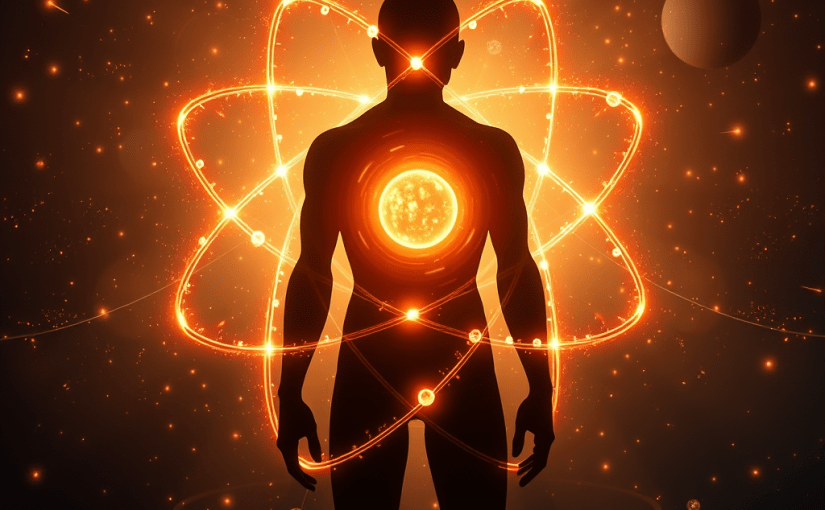
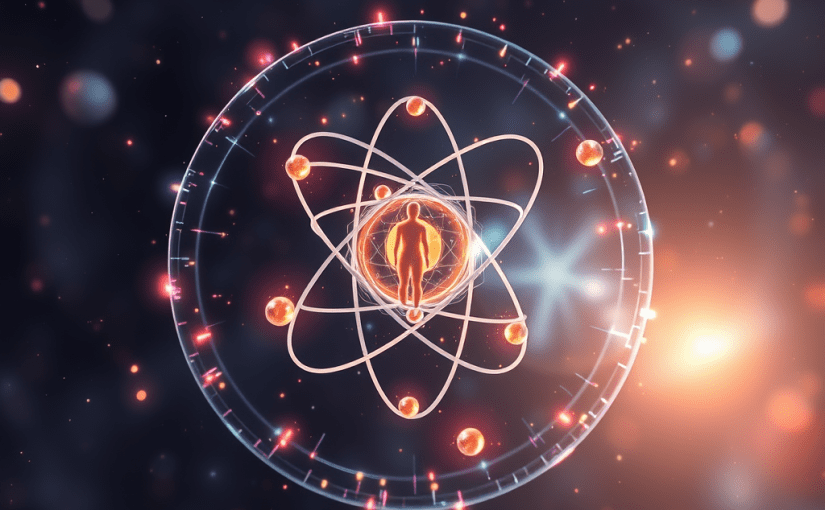
This is the true meaning of Sharirvigyan Darshan—the science of the body is not just about bones, muscles, and flesh. It is about realizing that the body is a miniature cosmos, a micro-universe, connected to the whole. The ancient seers said, “As is the atom, so is the universe. As is the human body, so is the cosmic body.” Modern science, through quantum physics, biophoton research, and systems biology, is beginning to rediscover this truth.
The body is not merely something you have—it is something you are. But even that is not the final step. Ultimately, you are not just the body, not just the brain, not just the thoughts. You are the field of consciousness through which the universe collapses possibility into experience. Life is not happening to you; it is happening through you. Every moment, every breath, every blink of awareness is part of this unfolding.
Essence of human is its brain. Essence of brain is thoughts and decisions. In quantum world, thoughts are superpositions of different properties and decisions are their collapse into a single reality. In this way, human is everywhere in the universe, even in empty infinite space. Even in empty space waves and virtual particles are continuously formed like thoughts and decisions. This knowledge seems to be the heart of Sharirvigyan Darshan. It helps in the destruction of ego and doership. When there is no ego in the humanoid cosmos spread everywhere, then why should there be ego in the fleshy human body?
I also think that body cells are complete human beings in themselves. That is why I feel Narayana in Ekarnava while contemplating the unity between both. Narayana—or the meditation image appearing in Ekarnava or empty space—means truth, and this gives a hint toward the truthfulness of what I think. Human-like complex activities, even more complex than human actions, cannot be done by chemicals alone. They surely must have a human-like brain in the form of microtubules. I do not claim that both are equal in consciousness, but their parallel functioning offers mental support for cultivating egolessness and the absence of doership.
Sharirvigyan Darshan is not just a study of the body—it is the art of seeing life itself as an interconnected, holographic symphony where biology, quantum physics, and consciousness dance together as one.
This is the body’s silent song—the endless rhythm of existence playing through the heart, the cells, the breath, the universe, and the self, moment after moment, choice after choice, collapse after collapse, in the eternal now.





 Demystifying Kundalini