From Savikalpa to Nirvikalpa: The Path Beyond Bliss to Ultimate Liberation

Nirvikalpa Samadhi can arise directly, bypassing Savikalpa in rare cases like Keval Kumbhak, deep sleep-like states, or sudden grace. While traditional paths emphasize gradual absorption, some awakenings skip this stage entirely, plunging straight into the formless. My experience with Keval Kumbhak confirms this possibility, where no structured transition was needed. However, stabilization remains key, whether one follows a gradual or direct path.

But why is there no such infinite bliss and light as that was in my Savikalpa Samadhi and included awakening glimpse?

In my awakening glimpse, there was overwhelming bliss mainly a sexual type of bliss comparable to the infinite or ultimate or super sex, light that’s experiential and different from physical one, and unity—a divine experience beyond words. It felt like the peak of existence, a complete merging with the infinite. Yet something was there to achieve as I felt. Probably it was a subtle yerning to achieve nirvikalp samadhi. In contrast, in Keval Kumbhak csused transient Nirvikalpa Samadhi, there was neither light nor darkness, neither ecstasy nor emptiness. It was something beyond words itself. It was as if I was in deep sleep with intermittent fleeting thoughts like dream. But one thing special was I was aware of this state. It was just pure awareness of myself. If there was awareness then it’s itself obvious that there was bliss in it. Because with awareness or existence, there is always happiness or bliss. And where there is existence and happiness, there is also knowledge. Even in today’s information age, it is seen that by acquiring knowledge, a person gets existential power i.e. achievement as well as happiness. That is why God is also called Sachchidananda. But I didn’t find any experience full of light and bliss or appearing as peak of worldly physical or mental experiences as felt in savikalp samadhi. However there was satisfaction in it. Satisfaction itself means there’s everything contained in it. It means that was nirvikalp samadhi slowly developing. In deep sleep, there doesn’t even remain self awareness. 

I now see the reason. In Savikalpa, there is still a subtle observer, a refined perception that allows bliss and radiance to manifest. Also there’s a refined neurochemistry that may release bliss forming chemicals. Means it may not be entirely the bliss of pure self but a play of neurochemicals. In Nirvikalpa, even that dissolves. In pranaless state of keval Kumbhak even ecstatic thoughts with accompanying bliss chemicals can’t form in the brain. Then there’s left only the soul and its natural self awareness and bliss. There is no one left to witness, no duality, only pure existence. Only mental formation or ego acts as witness. Pure self is void that can’t witness anything other than itself means directly knowing itself. And also it can’t be witnessed by anyone. It can only be directly felt as one’s own self. It is not an absence, nor is it something that can be described—it simply is.

Yet, strangely, its after-effect is deeper. The bliss of Savikalpa fades, but Nirvikalpa leaves a silent presence that does not come or go, just remains. A strange feeling always remains for many births or until one attain perfection in it. There is some kind of a peaceful void which is helping me in every way and pulling me towards it. I had this feeling since birth. It can also mean that I may have got a glimpse of Nirvikalp Samadhi in some previous birth but I have not attained it completely. The beauty of the soul is not something to be seen; it is to be lived.

What is said by many that after attaining Savikalpa, there is no need to make efforts to attain Nirvikalpa, is not to say that effort is secondary. Rather, it means that after Savikalpa Samadhi, a person progresses towards Nirvikalpa Samadhi on his own, because after attaining everything or touching the pinnacle of the world, the desire or attachment towards the world starts to end on its own. But this can take a lot of time, it can even take many births. Therefore, to speed up this natural process, efforts have to be made for Nirvikalpa as well. The more efforts you make in the form of sadhana, the sooner you will attain it. Even after nirvikalp efforts need to be put to achieve sahaj samadhi that’s last doorway to liberation. The importance of effort does not decrease in any field and in any situation.

Kundalini, Prostate, and the Natural Shift in Energy

For years, I have explored meditation, Kundalini Yoga, and Tantric Yoga (Sexual Yoga) as a means of spiritual awakening. My journey led to powerful states like Savikalpa Samadhi, yet I haven’t reached Nirvikalpa Samadhi. Through direct experience, I have come to realize that energy work is not just about pushing limits—it’s also about recognizing when the body signals a natural shift.

One of the most surprising discoveries I made was the connection between prostate inflammation and Kundalini energy movement. This wasn’t something I read in scriptures or books—it emerged from my own practice. However, later I found that scriptures do hint at this connection.

Ancient Wisdom and Modern Experience

Though rarely discussed directly, traditional spiritual texts mention the “seat of vitality” in the lower body, which can be linked to the prostate. Some interpretations suggest that excessive sexual energy without proper transformation can lead to tension, congestion, or even inflammation in this region. In the story of Agnidev who became a pigeon in Shiv Puran, perhaps the prostate is called a pigeon. Parvati cursed it in anger that due to the disgusting act of drinking semen, there will always be a burning sensation in its throat. Then Shiva, being kind to him, told him to give that burning through and through to Ganga in which Kartikeya in the form of awakening is born. This story is described in a post of this blog. Taking a bath in cold water also provides relief. It seems that an energy line starts from the gaduda (prostate) and moves up the spinal cord carrying its burning sensation and pours that energy into the Ajna Chakra or Sahasrar. This is also a part of the same story.

In my case, I observed something striking—when the prostate reached a certain level of irritation or inflammation, it seemed compelling to do yoga breathing or energy meditation so that Kundalini energy star up rising naturally, sometimes rising itself even without active practice. It was as if the body, unable to handle the excess buildup, had no choice but to direct the energy upwards.

However, I noticed a crucial difference:

When real energy rising happened, it was blissful and expansive.

When it was just inflammation, there was no bliss—only discomfort.

The same applies to spinal inflammation too. I have physical inflammation in spine occasionally due to ankylosing spondyloarthritis too. I differentiate between inflammatory sensation and energy sensation by this bliss mark.

May be prostate inflammation a sequel to ASA, an inflammatory disease or it along with Tantric yoga both in combination may be culprit or each of both affecting it little bit separate from each other and thus raising it up in  cumulative way.

Interestingly, when the energy moved upward, the prostate inflammation temporarily reduced. The more effort I put into meditation, the more relief I felt, but the effect wasn’t permanent—it reset after some time.

The Hidden Relationship Between Stress, Tantra, and Inflammation

I later realized that stress and excessive Tantric Yoga both contributed to prostate inflammation. It wasn’t just physical activity—it was also mental stress and the forceful nature of energy work.

There was a phase where I had already achieved awakening, yet I kept pushing Tantric Yoga unnecessarily. The body and circumstances gave subtle hints to stop, but I ignored them. For one swimming in the pool of nectar it’s difficult to come out. Eventually, prostate inflammation became the final warning. It was a clear sign that I needed to transition to a more sustainable practice.

This aligns with traditional wisdom:

Tantric Yoga acts as a rocket booster—it provides rapid breakthroughs but is not meant for continuous use forever.

Once awakening is triggered, a more balanced approach like Kundalini Yoga or ordinary meditation sustains the experience.

From Rocket to Airplane Mode: A Natural Shift

Looking back, I can describe my journey as moving from a rocket launch to an airplane mode.

During intense Tantric Yoga, the energy shot up like a rocket—fast, powerful, but unsustainable.

Now, with meditation, the energy movement is like an airplane—slower but steady and long-lasting.

This transition was natural—I didn’t force it. But I realize now that if I had continued forcing Tantric Yoga beyond its natural limit, it would have only caused more discomfort, not progress.

No Regrets—Only Understanding

Now, I don’t miss the rocket phase. A glimpse of awakening was enough. Actually real awakening is not about constantly chasing intensity—it’s about clarity and balance in daily life.

Even though prostate inflammation became a challenge, it also became a teacher. It forced me to slow down, listen to my body, and transition into a more refined, sustainable spiritual path.

For anyone experiencing something similar, my advice is simple: listen to your body’s signals. Awakening is not about pushing harder—it’s about knowing when to shift methods. If energy has already risen, the next step is integration and steady progress.

The path is not about extremes—it’s about harmony.

Kundalini Energy Funnel: Awakening, Balance, and Grounding Techniques

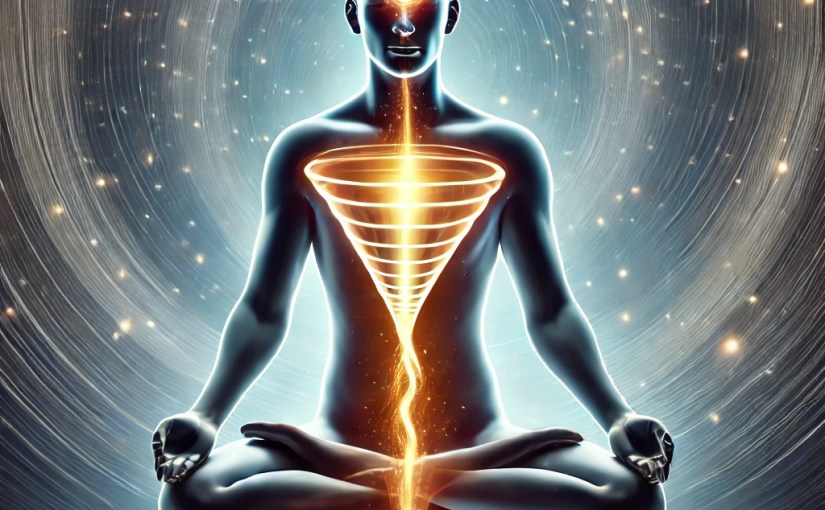
Through my experience, I have realized that Kundalini energy moves like water through a funnel, gathering life force from the entire body, accumulating it near base chakra, and directing it toward Ajna and Sahasrara through drain of sushumna channel. If energy could simply rise directly, this process wouldn’t exist. Also, without a natural collection point and a proper exit channel, the intensity wouldn’t be the same as required for awakening. Suppose there may be another energy collection point in body, but without dedicated direct drain channel going straightway to brain just like sushumna couldn’t exist. Moreover, this funnel also has a filter paper snugly fitted inside its cone. It filters out the impurities like lust, attachment, misbehavior, hatred, duality etc. and sends the flow of Kundalini energy forward only after purifying it.

Just as yang energy naturally flows towards yin, so the streams of energy from the mountain of the body are drawn towards an invisible spring at the foot of the mountain. Just as water seeps from the heights of the mountain and collects in the lowest sources, similarly the life-energy also first gets collected in its deepest center called the Muladhara. This attraction is the play of gravity—the eternal attraction between yang and yin for the union.

But, if the water has to be taken back to the top of the mountain, we have to resort to a pump. Similarly, when the energy has to be taken to the highest chakras, the pump of sadhana diverts its direction. It is difficult to collect water directly from every particle of the mountain, so first it is allowed to collect on its own below, then it is raised up. This journey is not just of flow, but of balance and resurrection—an eternal cycle, where depth becomes the mother of height.

Prana can be guided to the brain directly, but when concentrated and channeled through this funnel, it becomes far more powerful. However, this requires complete isolation. If the senses remain engaged, energy dissipates, reducing the necessary pressure to open the path. Without enough force, the upward flow is weak. If pressure builds beyond tolerance, energy may backflow, causing imbalances. Sudden accumulation without proper release can also create strain, while the brain, if activated but left unfed, may face disturbances.

I have experienced this firsthand. Excess energy accumulation, combined with external chaos, may have triggered physical discomfort, including inflammation mainly prostatic. Although other factors also trigger it. The idea of backflow came naturally to me—like water forced in the wrong direction when a system designed for one-way flow is blocked.

Balancing this process is key. Stress reduction, yoga, pranayama, and kriya breathing have brought relief. Grounding has been especially helpful—it eases the brain’s demand for energy, reducing the funnel’s workload and allowing it to stabilize. To me, prana and energy are one and the same, just understood through different lenses.

I have not yet mastered this process, nor have I reached an irreversible state of enlightenment. My journey continues, and my understanding deepens. But now, I no longer seek to force energy. Instead, I focus on refining, balancing, and allowing its natural flow.

Kundalini: A Threshold of Prana Awakening

“O Mahadeva, the One beyond form and time,
I dissolve like the Ganga in Your wild locks,
I burn like the Dhuni in Your ascetic fire,
I rise like Kundalini in Your cosmic dance.
Neither life nor death holds me now—
Only You, the infinite void, the roaring silence,
The eternal ecstasy where I become Shiva!”

May this Shivaratri awaken the divine within!

I once thought Kundalini was a mystical force, but now I see it as a name for the moment when prana crosses the awakening threshold. My experience wasn’t a slow, years-long process—it happened rapidly, in just a month.

I was practicing rigorous Tantric Kundalini Yoga, transmuting prana that would normally build up in the sexual organs and dissipate into worldliness. Instead of losing it in daily life, I redirected it upward, nourishing my meditation image in the brain. One day, the threshold was crossed—a sudden rush of prana to the brain, and an awakening glimpse unfolded.

Why Long-Term Buildup Often Fails

Many accumulate prana for years but never awaken. Why? Because the intensity never sustains—it leaks away through worldly engagements, emotions, and desires. Even if prana builds up, it breaks at intervals, depleting rapidly before reaching the required threshold. My process was different—I sealed off distractions, transmuted prana efficiently, and locked in energy.

The Symbolism of the Coiled Snake & Chakras

I now see why Kundalini is symbolized as a two-and-a-half-turn coiled snake:

  • Coiled = Latent prana, stored but inactive. The two and a half Kundali or coil is probably the circle of chakras. The first Kundali is of the Muladhara and Swadhisthana Chakras. It is the biggest, meaning that initially, more effort is required to release the life force from these Chakras. The second Kundali is of the Manipur and Anahat Chakras. It is somewhat easier to open it. The three Chakras above it are shown in the half Kundali. Meaning that the Kundalini Shakti easily rises above it.
  • Uncoiling = Rising energy, moving through the chakras.
  • Hood Spreading = Awakening, as energy floods the brain.

Some describe Kundalini as ascending through chakras step by step, but in my case, there was no gradual unlocking—I felt a direct rush to the brain. My Dharana, Dhyana, and Samadhi weren’t stage-wise as in traditional texts but present from the beginning of my sadhana.

Favorable Natural Conditions Helped

It wasn’t just my effort—natural conditions favored it. Even without strong willpower, things aligned:
✔ My prana system was already near the threshold.
✔ No major distractions or worldly entanglements drained energy.
✔ My practice acted as the final catalyst.

Main reason ~ Shiva’s devine Grace

What I Haven’t Achieved Yet

I didn’t hold the awakened state for long—just ten seconds. I haven’t reached Nirvikalpa Samadhi, nor do I seek another forced awakening. But I see that meditation still slowly fills the “dam”, visible as bliss and an intensifying meditation image.

Now, I integrate my practice wisely:

  • During work burden: Sharirvigyan Darshan (body-science awareness).
  • In free time: Kriya Yoga.
  • When fully out of worldly concerns & health is perfect: Tantra.

Final Understanding: A Threshold, Not a Mystery

Kundalini is not an external force—it is simply prana crossing a threshold. My experience showed that slow accumulation often leaks energy, but rapid, focused transmutation locks it in place until the floodgates open.

Would I attempt to reach the threshold again? Not necessarily. My curiosity remains, but I am already at peace with understanding its nature.

Glimpse Awakenings: Proof That the Path Is Real

Happy Shivaratri festival to all friends, may Lord Shiva bless all

In today’s world, where science and logic shape our understanding, only what is directly experienced holds real value. Spirituality, too, must be grounded in tangible, firsthand experience rather than just belief. That is why glimpse awakenings matter. Unlike the distant and often vague idea of “final liberation,” glimpses offer real proof—moments where the ordinary self dissolves, leaving behind pure awareness.

I have had such glimpses—profound yet fleeting. In those moments, my sense of “I” vanished, and only consciousness remained. These experiences were real, but they did not last. They did not transform into a permanent state, nor did they lead to what is often described as ultimate liberation. I do not claim to have achieved the final state, nor am I lost in the illusion of having arrived. Instead, these glimpses revealed a deeper truth: chasing an imagined end goal is itself an illusion. It has also has saved me from falling into the traps of various illusory spiritual organisations for it helping to force me believe on myself only.

These awakenings have acted as both pathfinders and trackers—guiding my way and showing me where I stand. They have exposed my shortcomings, preventing me from getting caught in spiritual fantasies. Many seekers live in ideas rather than experiences, but glimpses remove the need for blind belief. They prove that the path is real, not just a concept.

Rather than feeling like I have reached something final, these experiences fuel my curiosity. I no longer seek an abstract idea of “liberation.” Instead, I focus on deepening and stabilizing what I have already touched. It is no longer about chasing something unknown but about refining what is already here.

To do this, I rely on both structured practice and intuition, whichever suits the moment. Structure provides discipline and stability, while intuition allows refinement and fluidity. I take material from different thoughts of schools yet unbound to them and freely adopt all mixing my own insights whatever suits me. Both blend naturally, and I see their effects directly in my meditation image. If the image fades, I adjust—sometimes with discipline, sometimes by letting go. This balance keeps the experience alive.

I have also realized that the movement of energy is natural. It rises and falls on its own, without needing to be forced. Earlier, I tried to control it, but now I allow it to unfold freely. Although forced concentration may be required at meditation time. My focus has shifted from seeking an imagined future state to fully experiencing what is present.

These glimpses have shown me that the path is not an illusion. They are not the final destination, but they are proof that awakening is real. Instead of waiting for some grand liberation, I continue refining, exploring, and deepening—because what is already here holds far more truth than any distant idea.

Kundalini Awakening is the ultimate goal of the living being

It seems to me that awakening is the ultimate goal of any living being. Liberation is not in the hands of the living being, nor was it in his control to get bound. By putting the living being in bondage, God gave him the opportunity to experience awakening. The logic of God becoming a soul and getting bound to the world only makes sense if it is believed that he did not have the experience of awakening that is love-filled. He came to the mortal world to attain that. If that was already available to him, then why would he abandon his complete form and become a living soul and wander in the forms of creatures full of sorrows. Of course, not he himself but his photocopy comes in the form of a living being, but the logic still seems the same. Why would a photocopy come without any purpose or benefit? And when the soul attains awakening, what is the purpose of remaining in bondage? It frees itself from the world. Logic says this, what the scriptures say is a different matter. Even God himself does not have this experience of awakening at peak of love, because he never took a body. The storm of rising energy is possible only in the body, and this is also the original source of love. Awakening is achieved only through love. Perhaps God is satisfied by experiencing the awakening of the living being. What is not possible for him? He is infinite.

The living being has suffered in the world for countless years. This is the reward of his penance, a gift that is only for the devotee living beings, not even for God himself. That is why he considers the devotee to be greater than himself and continues to search for him. This idea is completely in line with the Bhakti philosophy and also agrees with the teachings of the scriptures and saints.

My experience tells me that the worldliness of life is not an obstacle, but an opportunity. If this is lived with awareness, then natural progress towards awakening is possible. This can be made even easier by integrating physiology of philosophy aka sharirvigyan darshan or mythological body. In my own journey, I have not yet experienced nirvikalp samadhi, but I have understood the touch of awakening. This experience arises from the balance of love and energy.

I also feel that the process of raising and lowering of energy is just a natural game. There is no need to forcibly control it, but it needs to be accepted naturally. It is akin to accepting the world as it is. Awakening is not an external achievement, but the culmination of internal experience and love.

If instead of awakening i.e. enlightenment, liberation or samadhi was the main goal, then various spiritual sects like different types of yoga, tantra etc. would not have been created to achieve it. Everyone would just sit quietly and observe their thoughts as a witness. Everyone would always live a life away from worldly affairs by remaining calm. No one can see liberation, but awakening feels like a direct experience. By striving for awakening, there is at least a hope of getting awakening, and one can also get liberation. But if we leave awakening and try only for liberation, then it is possible that neither awakening nor liberation is attained. And what is the proof of liberation? If someone is calm today, then he is free, but if he is attacked tomorrow and he takes defensive action, then peace is gone and liberation is also gone. It is like neither Maya nor Ram is attained. Most people live their lives like liberated people. Looking at them, it is not known whether there is life in them or not. They do not even try for awakening because they live in the illusion that they are liberated. They will immediately justify it by giving examples from the scriptures. I think this is a big scriptural deception. Either this is an incomplete understanding of the scriptures. Or the scriptures were written by people of later times. There were others who had the real experience.

I consider awakening, Kundalini awakening, samadhi and enlightenment to be the same thing. At many places, different meanings are derived from them or subtle differences are found between them. I do not get into these impractical hassles nor do I care about them. Instead of wasting time in these, if time is spent for experience, then something can be gained.

I have also experienced that by focusing too much on energy in meditation, the image of meditation becomes blurred. Therefore, it is best to preserve the original image of meditation. Actually by focusing on the meditation picture the energy itself becomes balanced and upward moving meaning it automatically gives necessary strength to all the chakras, whereas by focusing only on the energy it can go anywhere, it is not necessary that it strengthens the meditation picture only. My journey is still on, and I am moving towards understanding this truth more deeply.

If this experience is adopted, it will not only give spiritual progress, but can also make the worldly life balanced and prosperous. Awakening is not a distant ideal, but a truth available in every moment. It is possible only with love and dedication.

The Path of Awakening: Balancing Enlightenment and Worldly Life

For those who have glimpsed enlightenment, the journey does not always lead to immediate liberation. Instead, it often raises an even deeper question: how does one integrate this profound realization into daily life? My own experiences have taken me through different dimensions of awakening, from adolescence to my later years, shaping a unique perspective on spirituality, renunciation, and engagement with the world.

A Glimpse Beyond the Mind

The first significant brush with enlightenment came in my adolescent years through a dream-state experience. It was a powerful realization—one that connected me to the limitless cosmos. Yet, it left me with a lingering craving for fulfillment, suggesting that the experience, though transformative, was not complete liberation. Years later, a more conscious awakening occurred through a combination of Kundalini Yoga and Tantric sexual yoga, leading to an even more intense moment of self-dissolution. This time, the craving was minimal, but I found myself bringing the energy back down intentionally, fearing the irreversible shift towards renunciation.

This conscious grounding of energy led me to explore the delicate balance between spiritual transcendence and worldly engagement. Unlike some who fully embrace monastic life after such experiences, I felt compelled to remain in the world while sustaining my awakening.

Does Enlightenment Guarantee Liberation After Death?

A common question that arises after a glimpse of enlightenment is whether it guarantees liberation post-death. Various traditions offer different answers. Some suggest that even a single deep realization creates an irreversible imprint, ensuring that the soul moves toward liberation, even if rebirth occurs. Others argue that full stabilization of enlightenment—either in this life or at the moment of death—is necessary to break free from samsara entirely. My perspective aligns with the idea that even a temporary experience of the ultimate truth provides a direction after death, ensuring a well-guided transition, if not immediate liberation.

Renunciation or Integration?

Experiencing profound states like Savikalpa Samadhi naturally leads to the question of renunciation. Does one leave the world to deepen into Nirvikalpa Samadhi, or is there a way to maintain realization while living a worldly life? Initially, I leaned toward integration, choosing to stabilize awareness while engaging in responsibilities. Over time, I noticed that my energy remained centered in the Ajna Chakra, creating a state of Pratyahara—a withdrawal from external distractions while still being functional in the world.

However, this also led to reduced engagement with lower chakras, affecting worldly interests. To counterbalance this, I consciously applied Panchamakara practices in minimal amounts, using them as a tool for grounding rather than indulgence. This strategic approach allowed me to retain awareness without losing myself in worldly entanglements.

A Structured Approach with Kriya Yoga

While my earlier awakening experiences were rapid and unstructured, I later explored Kriya Yoga, appreciating its systematic approach. Unlike my initial methods, which focused on direct energy ascension, Kriya Yoga emphasized gradual refinement through Dharana, Dhyana, and Samadhi. I found that my earlier practice had already developed these states, but in a spontaneous way rather than in a staged progression. Now, Kriya Yoga serves as a structured refinement tool rather than a new revelation.

However, I also discovered a practical challenge—deep breathing exercises after a full stomach were showing possibility of increasing my GERD-related issues, including sleep apnea. Adjusting my practice to 4-5 hours after meals removed this possibility, reinforcing the importance of aligning spiritual techniques with bodily conditions.

Key Takeaways

A glimpse of enlightenment shapes the post-death journey, but full liberation may require further stabilization.

Balancing nonduality with worldly life is possible but requires conscious grounding techniques. The philosophy of Sharir Vigyan darshan (mythological bidy) is amazingly helpful in this, which I created for myself but is now available to everyone everywhere.

Kriya Yoga provides a systematic approach but does not necessarily reveal anything new for those who have already experienced direct awakening.

Pratyahara naturally occurs as awareness stabilizes in higher chakras, but intentional grounding helps maintain functionality in the world.

Physical factors like GERD can affect spiritual practices, requiring mindful adjustments.

The Road Ahead

Rather than seeking another grand experience, my focus now is on sustaining the clarity of awakening without getting lost in either spiritual absorption or worldly distractions. I remain open to refining grounding techniques while ensuring that my sadhana continues to evolve. In the end, enlightenment is not about a single peak moment—it is about maintaining unwavering awareness, whether in meditation or in daily life.

For those walking a similar path, the key lies in understanding one’s unique energetic tendencies and shaping a practice that balances both inner realization and outer existence. True liberation is not about escape—it is about realizing that whether in the world or beyond, the awakened state remains unchanged.

Kundalini, Tantra, and Kriya: The Fastest Path to Transcendence

Friends, Kundalini energy is mysterious. It can take you to the highest bliss, or it can scatter in all directions. When I first started practicing, I didn’t care about complicated techniques or traditions—I just wanted results. And through trial and error, I found that pure Kriya energy alone leads to nowhere unless it is anchored in something deeper.

Why Kriya Alone is Not Enough

Kriya Yoga is often said to be a direct path, but I’ve realized that without a meditation object, energy remains worldly. It feels powerful, but it doesn’t hold in a transcendental way. The moment I combined Kriya with a single-pointed meditation object, everything changed. The bliss lasted longer, the mind became still, and energy naturally moved upwards instead of just spreading.

What About Patanjali’s Ashtanga Yoga?

I’ve thought a lot about why Kriya Yoga is different from Patanjali’s traditional path of Dharana (concentration), Dhyana (meditation), and Samadhi (absorption). In Patanjali’s system, these happen one after another—step by step. But in Kriya, they happen together, effortlessly. The moment breath is controlled, Dharana arises. The moment energy moves, Dhyana starts. And as it deepens, Samadhi follows on its own. There’s no waiting, no struggle.

Patanjali probably designed his system for people who needed structure. But I’ve seen that when energy moves properly, the mind doesn’t need to be forced into concentration—it just happens.

Why Tantra is Even Faster

If Kriya is fast, Tantra is like a lightning bolt. The first time I experimented with Tantra, I was shocked. It doesn’t take days or months—it snatches you out of the world immediately. The energy becomes completely obedient, like a pet that listens to every command. Even instant enlightenment or liberation is possible with Tantra.

But there’s a catch—Tantric practice can’t be done daily. It’s intense, overwhelming, and too powerful to sustain continuously. That’s where Kriya comes in. Kriya helps to hold and extend the experience for days, keeping the energy steady and preventing the mind from crashing back into ordinary life too quickly.

Tantra is like a rocket, and Kriya is what keeps it in orbit.

My Own Kriya Kundalini Yoga Practice

Over time, I’ve built my own system. I practice:

✔ Anulom Vilom, Kapalbhati, and both-nostril Pranayama
✔ Asanas and meditation on each chakra
✔ Chanting their Bija mantras and visualizing their colors
✔ A single meditation object to hold energy in the highest state
✔ Maha Bandh for energy stabilization
✔ Chakra meditation with breath retention in Bahya and Antar Kumbhaka

I don’t bother with Thokar, Yoni Mudra, Tribhangmurari, or Mahamudra. Although, now I start doing Thokar Kriya. It is not necessary to chant a complex mantra like Om Namo Bhagwate Vasudevay while doing it. You can also chant Om in your mind. Tribhangamurari means three natural bends of the spine through which the energy passes. That is why the back is not kept straight like a plank but is kept in its natural shape.

By the way, Thokar and Mahamudra itself happen in a mild form at the time of Mahabandh. If you do Sadhana at four o’clock in the morning, then Yoni Mudra also happens in a mild form automatically. In Yoni Mudra, the eyes, ears, nose and mouth are closed with the fingers. At four in the morning, there is neither any sound nor any sight. During Kumbhak Pranayam, the nose remains closed automatically. The time between three and four o’clock is the best for Sadhana. There is no shortage of time during that time. Due to this, the attention is not drawn towards time. Therefore, a person does Sadhana without any worry. During this time, the possibility of getting into Samadhi with Keval Kumbhak is also quite high. It is a unique experience. Breathing becomes so slow that many times it is not known whether breathing is going on or not. The Asana itself seems stable. Of course, set it again after a while. Breathing will go on for a while and then it will stop. The meditation picture on the Ajna Chakra feels uniform and clear. It seems that from where is the oxygen coming to maintain this picture continuously. It is said that at that time the internal breath is going on in the spinal cord. But where does the oxygen come from in the spinal cord? Even gross science has not been able to understand this yet. Perhaps this is the life force, which does not require oxygen in its original form. It may be that the purpose of breathing is not to give oxygen but to give momentum to the life force directly. Oxygen may have additional role in this. It may be that although the breath is not felt, subtle breath is going on. It may be that due to lack of physical work, the demand for oxygen becomes almost zero. But while sleeping, there is good breathing. All these are speculations and need deep research on them. That state is a wonderful mixture of life and death. There is breath and there is no breath. It is felt only after 20 or 30 long, deep, slow and pull-push type breaths of Kumbhak of Kriya Yoga. After these deep breaths, again concentrate on your breathing with the So~Ham mantra. Chant So while inhaling and Hum while exhaling in your mind. Let the breath continue as it is; do not interfere with it. In some time the breath will slow down and become almost zero. Keep chanting So~Ham even if there is only a hint or sign of breathing. Keep your attention on the meditation picture on the Ajna Chakra. This is only Kumbhak. Only about two or three of above said deep breaths are taken in a minute. Due to this, the energy of the Mooladhara is felt to rise upwards with bliss. Perhaps this is what starts the breath or life force in the Sushumna. Only by the intense practice of Keval Kumbhak, Yogis remain alive for many days in places with lack of air, such as in a closed basement, etc. However, this is also not the final siddhi. The final siddhi is self-knowledge. Of course, Keval Kumbhak helps in keeping the mind stable, focused and knowledgeable even in the midst of worldly affairs. It is called Keval Kumbhak because in this the breath is not stopped forcefully. The breath stops automatically without any pain and that too for a long time.

What I’ve found is that pure Kriya arouses energy, but without a meditation image, it leads nowhere. With a meditation object, energy becomes transcendental and stays for many days. The state attracts me back again and again, effortlessly. Of course, meditation support /object/image is necessary even in Tantra, only then its energy will be able to connect with the spiritual dimension, otherwise it will get scattered in worldly matters, which can also cause harm.

Conclusion

Kundalini is not just about energy rising—it’s about where the energy is directed. Tantra pushes you out of the world instantly, Kriya sustains it, and a meditation object makes it deeply spiritual.

Patanjali’s system is slow and structured. Kriya is fast and natural. Tantra is instant and overpowering. But when you mix Tantra and Kriya wisely, you get both speed and stability—awakening and absorption, freedom and grounding.

Would you say that Tantra gives the breakthrough and Kriya helps hold it forever?

Kundalini Yoga keeps a person swinging between wakefulness and dreams

Friends, an idle mind is really the devil’s workshop. That is why I keep doing something or the other all the time. If I don’t see anything to do, I start writing. My son works awake so that he can have good dreams. Wow, he considers the world of wakefulness to be fake and the world of dreams to be real. I was shocked to hear this. A new thought arose. All the sages and Vedas and Puranas also say the same thing. They say that a life full of detachment and non-duality is the real one. Such is the life in dreams as well. In that, happiness and sorrow, all feel almost the same. Everything is in the form of experience. Pure experience. All experiences are in the form of happiness. If a lion runs from behind, even though you are afraid, you don’t feel afraid. If someone starts fighting, even though you are angry, you don’t get angry. If you fall from a mountain, even though you are in pain, you don’t feel sad. Even if you get a kingdom, even though you are happy, you don’t feel happy. Meaning, uniform happiness is everywhere, but not the polluted happiness of materialism. It is a happiness in the form of a subtle experience. The physical gross world pollutes the subtle experience of happiness and sorrow. Happiness increases due to the gross world, but it also increases sorrow. The higher the ball goes, the lower it falls. Happiness is the soul’s own form. But the world subjugates it and creates waves in that uniform spiritual happiness. Then, with time, in the absence of the gross world, that wave is destroyed. Due to this, of course, a person reaches the uniform or waveless spiritual happiness again, but in that state, darkness in the form of sorrow is felt. This appears to be due to illusion. Actually, it is not so. It is like after moving around in a circular motion around your body, everything around you feels as if it is rotating for a while. This is also called dizziness. This is why the word illusion has been used for ignorance.

While living in the world, no one can escape from illusion. Yes, it can definitely be reduced. Perhaps that is why people leave the world and become sadhus and sanyasis, so that the world cannot create illusion. But the disadvantage of this is that it does not lead to self-development. Because the world is necessary for this. The world can also be called a necessary evil in this case. That is why it is considered appropriate for those who have attained self-awakening to take sanyaas. It means that they have reached the peak of self-development, and there is no need for them to get entangled in the world. Actually, there is a need. But only to keep the body alive, because until the age determined by the previous deeds is not completed, the sanskars related to the prarabdha karma will keep troubling. Yes, this will not create sanskars for the next birth.

Dreams also produce a wave in self-happiness, but not as much as the awakened state. That is why when that wave disappears in the dream, the illusion is also not as much as in the awakened state. Some illusion is there. That is why it is said in the scriptures that the world is like a dream, and it should be considered as a dream only. In reality, it is so because the physical world does not enter the mind. We are only feeling its subtle picture, as we do in dreams. But considering it gross and physical creates all the mess. Man considers it gross and physical only in the greed of a wave of happiness, so that he can get more pleasure from the wave. At that time he does not realize the sorrow that comes with it in the long run. Actually, the big wave is called the gross world and the small wave is called the subtle world. While watching a movie, nothing gross happens but many people become too attached to it. Meaning, they get too immersed in it. And create a wave of happiness to the fullest from it. Due to this, the scenes shown on the screen, despite being subtle, become gross for them. That is why, many times, when such and such scenes come, they create a ruckus and vandalism in the theater. Many people, despite being in the gross world, do not get attached to it. They remain absolutely calm no matter what happens. Meaning, it does not create huge or rapid waves in their mind. For them, even the gross world is as subtle as a dream. Due to this they remain the same in happiness and sorrow. But the same thing is that for self awakening, strong mental waves like that of physically awakened state are also necessary.

This world is like a river flowing in both directions. That is why it is not understood properly. It lifts some people up and takes some people down. It can be said that the worldliness full of attachment should be pacified with non-dualistic philosophies like Sharirvigyan Darshan. This will give self awakening and also will not create illusion. Kundalini Yoga can give this benefit that the power to hold the picture of Samadhi felt during the non-dualistic feeling will increase and along with this, due to the energy in the brain, one will be able to do the feeling of Sharirvigyan Darshan well along with worldliness. Because every chakra is connected to some kind of worldliness, so at the time of every kind of work, some chakra or the other will become active. Meaning, the effect of power will increase to that chakra. Due to this, the feeling of Sharirvigyan Darshan along with that work will become easy, because all work is done with power. That extra power may seem trivial to us, but it is very useful. With the daily practice of Kundalini Yoga, the channels to all the chakras will remain open. When energy reaches the chakras, some energy will also reach the chakras of the brain, because all the chakras are interconnected. And it is from the brain that feelings arise, whether dualistic or non-dual.

In between, with the feeling of physiology, a person should continuously oscillate between the waking state and the dream state.
This will give you the benefits of both. Both the awakened and the dream state. The benefits of the awakened state include the benefits of material worldliness along with Kundalini awakening and the benefits of the dream state include the benefits of sannyasa. Meaning that the awakened state changes into the dream state with Kundalini yoga. However, the dream state also changes into the awakened state because of it. When there is fatigue in the body, that is, incapacity, that is, lack of strength, then the person is in a state similar to that of intoxication or dream. When he gets strength from Kundalini yoga, he again becomes like an awakened person in the worldly life. Of course, later, being troubled by it, he again changes his physically awakened state into a dream state with the feeling of physiology philosophy, and minimizes his illusion. At that time, he has the power. That state is not like that of intoxication or sleep, in which there is no strength. Therefore, his extra power is transformed into a mental picture of samadhi. Meaning that he enters samadhi with that extra power.

When one feels his present state in the body, the breath comes out of the stomach rapidly, especially if there is a lot of pressure in the brain. Due to this, the energy descending from the front channel makes the brain feel lighter. I feel that this energy going down turns back from the Muladhara and ascends to the brain again through the spinal cord. This means that a closed circuit loop of energy is formed. Surprisingly, this energy going up does not increase the pressure in the brain but makes it lighter. Anyway, the pressure should increase due to lack of energy. Perhaps the back part of the brain helps more in creating emotions, or it is the main controller of the entire brain. That is why the energy received by its back part from the spinal cord is more effective. It may also be that the energy pushed down is not full of oxygen. While passing down through the heart chakra, it becomes full of oxygen, gets purified and ascends up from the back. Perhaps that is why it is said that the energy should keep moving in the microcosmic orbit loop. If there is lethargy or low pressure in the brain, then deep breath is taken in. Due to this, the energy ascends up and makes the brain powerful. This means that if there is no energy in the brain, then how will it descend down. That is why at that time the emphasis is on lifting it from the bottom to the top. It happens on its own. Meaning, just as the gross physical body remains in balance, similarly it also makes the mind in the same way, if it is meditated upon properly.

Kundalini awakening is also like physical awakening. It can also be called the peak point of the physical awakened state. Because in this, the subconscious mind also awakens along with the conscious mind. Meaning that for Kundalini awakening, one has to be more awakened than the awakened state. This can happen only from the awakened state, not from the dream state. However, it can be achieved by saving the energy by converting the awakened state into a dream state. Meaning that dream state also have a contribution in this. But that dream state is not a dream state of powerlessness or laziness or compulsion, but a dream state that has been achieved deliberately. With that extra energy, the mental picture of the form of a Guru, God etc. is meditated upon. With practice, that meditation increases so much that that mental picture awakens. Although usually the mental picture is in the dream state, but at the time of Kundalini awakening it comes into the awakened state. It means that the mental wave that creates that picture becomes so strong that it crosses the limits of the dream state and enters the realm of the awakened state. The power that awakens it is so great that it also awakens the subconscious mind i.e. the soul with it. That is why everything seems non-dual i.e. one i.e. one’s own form because then the earlier sleeping dark soul becomes as bright as the awakened Kundalini picture by waking it up.

Actually, it is the soul that is awakened. The mental meditation picture is only a medium to awaken it. Because the Kundalini picture is a mental wave, which is already a form of an awakened state. Of course that wave is so light that it comes in the realm of the dream state. Still a wave is a wave. The mental waves of the dream state and the awakened state are the same thing, there is only a difference of intensity in them, nothing else. The light is the same, it does not change if it is reduced. What I mean to say is that the meditation picture was not asleep that it would wake up. The sleeping soul is connected to the subconscious mind which wakes up with the help of meditation picture. The meditation picture works to send power to the brain. When that power reaches above a certain limit, it wakes up the subconscious mind. We call this Kundalini awakening.

It is the soul that is asleep, and which wakes up at the time of Kundalini awakening. In reality, his illusion of being in deep sleep is dispelled, because it is only due to the illusion that he appears to be asleep. Of course, after experiencing a few moments of Kundalini awakening, the person goes back to sleep, but that deep sleep is not as effective as it was before because now he has known the truth. The subconscious mind of a man becomes like a burnt seed which does not have the power to give birth to a new life or birth. It is burnt by the light of the soul. Like a burnt seed, it exists but cannot give a new birth. Then it is said that the deeds that will be done after Kundalini awakening will create the subconscious mind to give results. But when the subconscious mind itself is burnt, then how can new deeds be added to it. When the basis of the existence of the subconscious mind is destroyed, then how will a new one be created. But then how will the fruits of the new deeds be obtained. Then a self-awakened man can do any sinful act without any fear. So in answer to this it is said that due to the absence of the subconscious mind, there is no attachment towards the deeds and their results. What attachment can light have towards light? Darkness has attachment towards light only. He keeps flowing with time. If he commits sinful deeds due to ignorance or compulsion, he gets its fruits quickly and in a mild form because his attachment was also mild. Even if he does not get the fruits in that life, he gets free by handing them over to nature. Now it is nature’s will to decide to whom it gives its fruits. Perhaps that is why it is said that the whole universe or the whole society has to suffer the consequences of the deeds done by great men. There are many such examples of the founders and preachers of religions, and great or world leaders. Why many religions are thirsty for each other’s blood till date, this can also be linked to this. All these experiences and thoughts are from the scriptures, which we are analyzing here as scientifically as possible. When the soul becomes illuminated or luminous, then every object or thought wave or the whole world will look like oneself because all things are luminous. What is the difference between light and light? This light is much above ordinary light, meaning it is the light of consciousness.
Kundalini Yoga vs Sanyas ~ An in-depth exploration

Best wishes to all friends for the Maha Kumbh fair at Prayagraj

Friends, this time I thought that whatever is in my mind, I should keep writing, of course it may not become a systematic post. It often happens with me that I sit down and start writing and that article itself becomes a systematic post.

This time many great personalities were seen as sanyasis in the great Kumbh Mela. For example, IIT Baba Ji or Gorakh Masani Ji and Mamta Kulkarni Ji. It is believed that most of the sanyasis got peace by leaving the world, got knowledge as well. But no one has shared the experience of getting self-realization or Kundalini awakening. So, has sanyas remained limited to peace and knowledge only? It can be thought that many people do not make it public. But this thing does not make sense. If they can share the miracle-filled siddhis and powers with everyone, then why not the experience of awakening. There is definitely a discrepancy somewhere. I am not expressing distrust in the tradition of sanyas. But it also has its own limitations.

Sanyasis inspire common householders to live a life of simplicity, meditation, charity and detachment. But this sect should also be reserved for deserving people only. It can also be contaminated by the entry of undeserving people into it. In olden times, the Guru used to give permission to his disciple to become a Sanyasi only after being assured of his disciple after taking a tough test, not just like that. However, today also twelve years are needed to spend serving Guru, yet screening doesn’t seem as rigorous as earlier. Although there being a tough exam to enter the Akhara, its quality cannot be doubted. Babas roaming around outside the Akharas and doing as they please create confusion about everyone. Our respected grandfather also once asked his Guru for permission to take initiation in Sanyas. But the Guru flatly refused saying that his household responsibilities were incomplete at that time. He accepted that advice. That is why he remained detached in household life. It is because of him that we are here today. If he had become a Sanyasi prematurely, then we would not have been what we are today, neither this blog would have been there, nor so many books and nor so much knowledge and science.

By taking Sanyas, the burden of the mind is reduced. This gives strength to do Sadhana. But due to lack of sufficient availability of power, that Sadhana often does not succeed on time. You know that power is associated with a woman, and her company is forbidden in sanyaas. Or else it takes countless years to get success due to lack of power. Many people cannot wait for this long period, and many pack up and leave. And many get deviated from sadhana and get into the habit of intoxicants like bhang etc. Time moves cyclically everywhere. Leaving the world for a short time may give peace, but soon that peace also starts feeling like a burden. That peace is relative, not absolute. Absolute is the ultimate peace which is found only when one attains complete samadhi. Even after removing the burden from the head, the head feels a little light for some time. But after some time, even an empty head starts feeling like a burden. And then one feels like lifting the burden. If awakening is found in that time of a little relative peace, then it is fine, otherwise it is a lost cause. This is because when that time of peace is over, he again takes up the burden of worldliness, forced by nature. Of course that worldliness is then limited to the monastery and the temple. But it is worldly. If I did not take the burden from there, I took it from here. If I took the golden pitcher off my head, I picked up a clay one. It is the same thing.

In this context, I am reminded of the story of King Shikhidhwaj from the Yoga Vasishtha Granth. He was a great scholar and the husband of Yogini Chudala. The king leaves the kingdom and goes to the forest, and starts living there like a householder. The queen tries to convince him a lot, but he was obsessed with renunciation. Morning and evening ritualistic practices, evening prayers, tarpan, sacrifices to Gods, yagnas, idol worship and being busy all day long for them. He spent many years living in the forest but he did not get the direct knowledge of awakening. His Yogini wife was watching his entire drama with her Yoga Vidya. Out of pity, she came to the forest and after listening to his tale of sorrow, started consoling him. She started telling her husband that when he had left the household, why did he start a new household in the forest. How will he get peace by taking off one burden and picking up another. In the relative peace that he got for a short time, he did not do real meditation but spent his accumulated energy in expanding the new household. Now when his mind is inclined towards Sadhana, he has no strength left due to the entanglements of the jungle household. If you miss the time, then it is lost. Then the king made his wife his Guru and did Yoga Sadhana under her guidance. Finally, he attained knowledge. Then when she started taking her back to the kingdom, the king started hesitating, fearing that he might fall into ignorance again. Then the queen explained to him that after attaining knowledge, there is no ignorance, no matter what kind of pleasures a person chooses. Yes, there is one condition that one has to remain detached. The queen’s desire of Romance pleasures and love-making also remained unfulfilled due to the king’s untimely departure to the forest. Then both of them returned to their kingdom with immense happiness, traveling in various planes in beautiful gardens, forests, groves etc. and doing various lovemaking. After enjoying the kingdom happily for countless years, both of them got liberated. This is the main and very beautiful story of this book, and shows that women were also not less than men in Yoga, but were better than them. It also highlights the importance of household dharma.

In the limited period of peace, only Tantra Yoga can bring awakening, but it is socially forbidden. Of course, the left-way people use sex, meat and alcohol for Kundalini Yoga Sadhana. But they stay hidden from society. These means are outside the Vedas. That is why they come under Left Tantra. It means that household life is better than Sannyas. Because there, even the left-way sadhana can be done secretly. For a householder, it is more important than a Sanyasi. Because by chance of time, he gets peace only for a very limited time.

In ancient times, a gentleman used to work in a government job. He lived a very struggle-filled life. Because there was a lot of pressure of work. But he did not let the flame of spirituality die in his mind and in his daily life. Due to time, he was transferred to a deserted and lonely Himalayan region for a limited time. This was bound to give him great relative peace. There, he came in contact with a yogi and did intense sadhana and attained awakening. From a common man, he became a great yogi. Then soon he was again transferred to a stressful area. However, he continued his sadhana somehow and little by little. Due to this, he got many disciples in due course of time. All of them started spreading the word of Grihastha Yoga. What I mean to say is that this happens with many people. Opportunities are rarely found again and again. But at least one opportunity is received by everyone in their life.

Some scientists also say that the more the difference between worldliness and renunciation, the more is the possibility of getting sudden awakening. In my opinion, even if a simple effort is made for awakening, then also that possibility increases manifold. If tantric power is also involved in it, then what can one say? If knowledge could be obtained only by leaving the world, then memoryless or drug addicts would be the most knowledgeable. They do not remember anything about the world, meaning they have completely left the world. But many other factors are also responsible for knowledge.

This means that nothing is left by leaving. The real leaving is to become detached. It means to remain detached or unattached from the world while living in it is to leave it. By this, both kinds of happiness are obtained together. The happiness of household life like love etc. and the happiness of renunciation etc. We can use the comforts and luxuries of life while living in the world. You can do it for attaining knowledge also. This is not possible in sanyaas. Of course, comforts and luxuries are bad because they make you fall in the trap of illusion. But they can also be useful in getting you out of illusion. The knife with which a dacoit can create terror, can also be used to cut vegetables. Here we are not comparing any system with another. Neither are we calling anyone good or bad. We are only telling that as far as our eyes can see. Of course, there is no doubt that there is much more beyond this.