My post

Chapter 20: The Place of Creation

At the dawn of the universe, there was no here or there. The first particles were not settled in any fixed place. They existed as clouds of possibility, spread like mist across the vastness. To ask “where” they were was meaningless, because they were everywhere and nowhere at once.

This is the strange nature of quantum position. A particle before collapse is not a dot on a map but a haze of probabilities. Only when it interacts, only when it “decides,” does it appear at a particular spot. In that instant, a position is chosen, and the many vanish into the one.

The First Footsteps

Imagine a great empty field covered in soft dew. Countless birds hover above, each uncertain where to land. Suddenly, one descends on a blade of grass. Another chooses a twig. Another settles by the riverbank. Slowly, the field fills with definite presences.

In the same way, the first particles collapsed into positions. One appeared here, another there. What was once a uniform mist became a patterned arrangement. The seeds of galaxies were scattered across space like stars across the night sky.

It seems similar to bird instinct—when one bird settles somewhere, others also follow and occupy the surrounding spots, rather than choosing isolated places. In the same way, quantum particles may also seek different forms of “social security” such as protection, interaction, cooperation, division of labour, and many other collective behaviors. In this sense, they appear almost living, depending on how they express their liveliness through different modes. One thing is certain: they are not bound by the strict patterns that define life in the conventional biological sense. Perhaps the yogic principles of detachment and non-duality partially emerged by observing such natural phenomena, which were worshipped in Vedic culture.

Those choices — small, random, delicate — shaped everything that followed. A particle a little closer here made matter gather. A particle a little farther there left emptiness behind. Out of those uneven gatherings grew stars, planets, and the stage on which life would walk.

The Cosmic Mosaic

Think of making a mosaic. You have colored stones spread loosely in a basket. Where you place each stone decides the picture that emerges. A stone here may form the curve of a flower. A stone there may form the outline of a face. The picture is nothing but the sum of all placements.

Creation too is such a mosaic. Quantum particles, by collapsing into specific positions, drew the outlines of the universe. One placement led to density, another to emptiness, another to symmetry, another to asymmetry. Together, they painted the grand design of existence.

The Indian Darshana Parallel

In Indian thought, space is not a void but a living principle — Akasha. It is the first element, the womb in which all other elements arise. Yet Akasha is not filled until particles take their positions. Only then does space find its rhythm, its structure, its meaning.

Just as the choice of deśa (place) in yoga influences how smoothly the mind becomes quiet, the location of a quantum event determines where a particle finally appears, yet both operate on entirely different planes. In dhyāna, the mind returns to the original Ākāśa, the silent field of pure awareness, where no physical settling occurs; there is only dissolution into stillness. In contrast, the settling of a particle during quantum collapse is a material process within space-time, governed by physical conditions rather than consciousness. The analogy works only in a metaphorical sense: a supportive sacred space like temple helps the mind stabilise, just as certain dense regions of the cosmos allow matter to gather, while vast empty stretches remain like neutral spaces where nothing settles. This comparison highlights a resemblance in behaviour without confusing their foundations — one belongs to inner consciousness, the other to outer matter.

A temple is a concentrated field of pure consciousness, and therefore it naturally attracts the minds of meditators to merge with it. Similarly, a dense region of space is a concentrated field of particles, and it attracts the surrounding quantum waves to collapse into particles and join that cluster.

Chance or Play?

Science tells us that the particle “chooses” its place according to probability. Where the wave is stronger, the chance of collapse is greater. To the human mind, this looks like chance.

But Indian darshana reminds us: what seems random is also play — Lila. Each collapse is like a dancer choosing a step, not planned, not rigid, but part of a spontaneous unfolding. Out of those steps, the dance of the cosmos arises.

In cosmic psychology, quantum collapse can be seen as the mind of the universe choosing a definite experience from infinite possibilities. Each quantum quality—such as spin, charge, or position—unfolds on the same single probability wave, unaffected by the outcomes of the each others. The higher the amplitude of the probability wave, the stronger its pull on creation’s attention—like a thought or desire that repeats until it manifests. Collapse then is not random chaos, but a weighted selection, where the cosmos tends toward the possibilities most charged with energy, while still allowing even faint possibilities to occasionally become reality.

Layman’s Metaphor: Children in a Park

Picture a park where children are playing hide and seek. Before they run, you do not know where each will hide. Every bush, every tree, every bench is a possibility. But as the game begins, each child chooses a spot. One hides behind the slide, another under the tree, another by the fountain. Suddenly, the empty park is filled with presence, pattern, and life. The fun of the game comes from their choices. The universe too was like that park. Particles chose their hiding spots, and from those choices, the drama of galaxies and stars began.

If we look a little deeper, a child chooses the hiding spot that appears most strongly in his mind. This means his inner energy-wave rises higher toward the brain when he imagines that particular place. If he suddenly notices another, safer spot, the energy-wave remains the same, but the thought related to the previous choice sinks towards the muladhara chakra—a site of lower amplitude—while the new thought for the newer hiding place rises to the sahasrara chakra, a site of peak amplitude of the energy-wave. Because he has no time to analyse further, he quickly collapses into that choice.

The same play of rising and falling of every choice or expression on the amplitudes of the kundalini energy-wave operates in every living organism, much like in a quantum particle. Time also becomes a factor in determining the collapse, for if the time available is short, the best possible outcome that may be available later might not be selected.

A man who craves one motorcycle today may crave a different model tomorrow. When this happens, the thought of buying the earlier model sinks into the darkness of the Mūlādhāra, while the thought of buying the new model rises and shines in the brain. Yet exceptional circumstances—such as a low budget, an unwillingness to borrow money, or emotional or cultural factors—may still force him to buy the earlier, less-preferred model, because that thought is not fully in the zero-amplitude region of the Mūlādhāra. However, he will never buy a scooty if he naturally dislikes it, because the thought of buying it sits in the true zero-amplitude region of the Mūlādhāra, which corresponds to zero probability.

A similar situation can occur in quantum events, where the wave may collapse in a lower-amplitude region due to environmental interactions. Although the probability of this remains low, it never collapses into a zero-amplitude region, because the probability of finding a particle there is exactly zero.

It is like the spin character of a quantum particle with two outcomes: spin-up and spin-down. Suppose spin-up corresponds to the peak amplitude-height and spin-down to a mid-height of amplitude, while the “no-spin” or “both-spin” state corresponds to zero amplitude-height—something known to be impossible. Here, spin-up is like the new motorcycle model, spin-down is like the older model, and the scooty corresponds to the impossible “both-spin or no-spin” situation.

Similarly, a quantum state such as momentum can have many possible outcomes spread across the wave at various amplitude-heights: the highest amplitude level giving the highest probability, the lowest amplitude level giving the lowest probability, and intermediate level heights giving intermediate probabilities. The same dynamic operates in the human mind when many options are present.

A highly attractive motorcycle model may occupy one’s heart; another, slightly lower in preference, may focus energy on the navel chakra; a still lower option may settle around the Svādhiṣṭhāna chakra; and a problematic choice may rest in the Mūlādhāra. This means thoughts corresponding to each motorcycle model settle in a particular chakra after being analysed by the mind. The top model may focus energy on the Ājñā or Sahasrāra chakras. That is why there is a common Hindi saying for something deeply liked: “sīr chaṛhkar bolī hai”—it has risen to the head. It has the highest probability of being expressed or chosen. But it is also a famous saying that Hearth speaks more truth.

Dull localisations in the lower chakras are easy to ignore, but the shining leaps of energy in the higher chakras are hard to overlook. This is māyā—the illusion or attraction created by this shining and joyous thrill. If studied deeply, it may reveal profound psychological secrets about how humans behave and how they are propelled by the subconscious and by external environments.

Seeing this, the similarity between the living world and the quantum world appears astonishing and almost complete. The only major difference is that the quantum world is fully detached, non-dual, and completely unaffected and unbound — unlike the living world. If that is so, is it possible for human beings to share even a small portion of that freedom while still living? Perhaps nature worship and its personification in the Vedas were developed for this very purpose.

A yogi’s mind being like an innocent child is attuned to the cosmic mind because of his detached and nondual attitude. It functions like a quantum probability wave, naturally tending to choose the most uplifting and harmonious outcome for expression — just as a quantum wave has the highest probability of collapsing into a particle at the peak of its amplitude. This is because they have no bias toward any particular outcome. However, even if they must maintain a bias in order to run the world, it is not a real bias, because their attitude remains detached and nondual. That is why most of a yogi’s decisions appear wise and beneficial to all. However, there remains a negligible chance of a lower or less ideal decision, much like the faint probability of a quantum wave collapsing at a lower amplitude — but such instances are rare and cause little harm.

Position as the Seed of Diversity

Why is position so important? Because where something is decides what it can become. A seed in dry soil may wither. The same seed in fertile earth may grow into a tree.

So too with particles. A proton alone in emptiness is only a proton. A proton near an electron can become hydrogen. Many hydrogen atoms close together can become a star. Thus, the placement of each particle set the chain of possibilities that would follow. Similarly, a man digging alone, away from a group of people who are also digging, cannot complete a well on his own within a practical period of time.

One choice of position led to emptiness. Another led to clustering. From clustering came stars, from stars came elements, and from elements came us.

Humans also share the same tendency. They prefer to build homes and settle in already existing colonies or villages rather than in empty forests. As a result, these colonies grow increasingly populated, interactive and vibrant — just as stars cluster together, leaving the vast empty spaces of the cosmos untouched.

Quantum Collapse as the Engine of Creation

Here lies the heart of the mystery: creation is nothing but collapse. Before collapse, everything is a possibility. After collapse, something is real. Without collapse, the universe would remain a silent fog of probabilities, never stepping into form.

Collapse is the invisible engine that drives becoming. Each time a particle “decides” — to be here, to be there, to be this, not that — the world gains a new detail. Collapse is the moment when the unmanifest takes birth.

The rishis said, “From the unmanifest, the manifest arises.” Physics calls it collapse. Unmanifest means everything is there in superposition, not manifested in any outcome. Darshana calls it creation. Both point to the same truth: the world exists because probabilities bow down into realities.

In the same way, the soul decides where and in what form to express itself in a new birth, according to its hidden mental waves — the subconscious imprints. This corresponds to the peak of amplitude, meaning the peak of experience. The form with which this peak of experience aligns determines the soul’s next birth — some become human, others take form as animals, birds, and so on — together filling the Earth to enable the interactive and harmonious living of all creatures with one another and with nature.

Closing Reflection

So when you walk across the earth, remember: every grain of soil beneath your feet is there because a particle long ago chose that place. Every star shining in the sky is there because ancient collapses scattered matter into its seat.

Position is not a trivial thing. It is the silent artist, arranging particles like beads on a cosmic thread. Without those choices of “where,” there would be no “what,” no galaxies, no rivers, no bodies, no breath.

Closing Verse (Mantra-style)

From the cloud of maybes, a single point arises.
From the unseen spread, a place is chosen.
Position is the brushstroke of the cosmos,
Painting stars, weaving bodies, grounding life.
O choosy collapse, O silent hand —
You are the engine that made creation real.

When Darkness Turns Peaceful: The Quiet Maturity of Dhyāna

Today, I felt the Kundalini stationed at the navel chakra. I rose a little late, around 6 a.m., and practiced spinal breathing, my Guru-given poses and pranayama, along with some self-devised postures and a top-to-bottom chakra meditation—without holding the breath as daily routine. Soon, enough yogic pressure built up to launch dhyāna.

I sat in vajrāsana, keeping my eyes turned upward toward the eyebrow center, and even beyond—straight up toward the unlimited height of Ekārṇava. The breath gradually became regular and calm, though not completely suspended as on previous days.

The śūnya dhyāna was deep, with occasional flashes of my Guru Nārāyaṇa’s image—alive and radiant. Guru Tattva is not actually outside but within. When one turns inward, it naturally emerges from inside. It is the intermittently appearing image in the mind during dhyāna that keeps the mind from wandering—by focusing it upon itself until it finally dissolves into Brahman. In a way, it acts like a cargo vehicle of the mental world, carrying awareness directly toward Brahman.

That is why many religions give prime importance to the Guru. They design their lifestyles to encourage introversion and dhyāna, allowing a stable Guru-image to form within the mind itself. However, for this process to become truly effective, there must be a suitable person embodying divine qualities—only then can he or she become a true Guru. In the absence of such a living master, divine idols may serve as substitutes, though they cannot compare to a living Guru, who is like an animated idol of God, and therefore far more transformative.

The Guru principle is revered in every sect and religion, but it seems that Sikhism understands the essence of Guru Tattva most profoundly.

I felt that just as Kundalini energy nourishes the chakras within the body, it also nourishes the chakras beyond the body, extending infinitely into śūnya. The same Kundalini that maintains physical vitality also helps transcend the body, merging into the endless expanse of Ekārṇava śūnya.

Today, I gave priority to the nourishment of śūnya rather than to any specific chakra. Still, the intermediate chakras seemed to receive their share of energy naturally whenever it was directed upward toward Brahman. I could sense the energy supporting the area behind the navel chakra along the spine, while the other chakras felt calm and balanced—not blissfully inflamed like the navel center.

Yesterday, my energy had settled at the Anāhata chakra. It had descended gradually—from Sahasrāra downward—each day resting at the next lower chakra. A day earlier, I had also conserved Mūlādhāra energy, which perhaps rose swiftly to the navel. This rapid movement might be due to the role of descending energy; although all energies rise from Mūlādhāra, the descending current seems to return from Sahasrāra like the monsoon rains returning from the mountains. When the forward and returning monsoons (the western disturbance rains) meet over an area, they bring catastrophic rainfall. Similarly, when descending and ascending energies meet at a chakra, they cause its profound activation, often producing a mental upheaval that can be difficult to control at times although quantum darshan helps in it.

In any case, śūnya dhyāna was peaceful. Later, I tried focusing directly on the navel chakra to give it an extra boost. The breath then turned irregular, as if adjusting itself to channel energy into the navel center. When I shifted my focus back to the Ājñā chakra, the breath again became calm. After a few such cycles, I gently ended my dhyāna and stood up to begin my morning routine.

There comes a time in meditation when bliss fades, and only silent awareness remains. I am experiencing this now—no bliss, but a completely still and neutral space. I can’t even call it darkness, because darkness usually frightens or repels one; yet I feel the exact opposite. I find perfect peace there, a deep relief from the agitation of breathing. At first, this may seem like something is lost—but in truth, it marks the maturity of dhyāna.

Earlier, the mind sought experiences—light, warmth, or waves of joy. Darkness felt empty and unsettling. But when the storms of breath and thought finally rest, perception changes. The same darkness no longer threatens; it simply is. Nothing outside has changed—only the seer has.

This is the quiet flowering of awareness: peace without excitement, clarity without effort. Even without inner light or sensation, a subtle luminosity begins to shine—the light of knowing itself.

When this awareness deepens, life feels transparent and gentle. Speech, work, and movement unfold within the same still space that once appeared only in meditation. There is no need to hold awareness—it holds itself. I am still waiting for that stage to blossom within me.

In this simplicity lies the true radiance of dhyāna: not a blaze of visions, but a calm seeing that never leaves, even in the heart of darkness.

Quantum darshan; Chapter 19 – Parity: The Tilt of Creation

At the very start, the universe was almost perfectly balanced — like a mirror showing the same picture on both sides. It simply means, In the beginning, the universe was perfectly symmetric—there was no left-right distinction between object and image, no real-virtual difference between the two, and although charges, forces etc. were opposite, they were exactly equal, creating a state of complete balance. Every particle, every force, every tiny action had an equal and opposite twin. If the universe had stayed this way, nothing would have moved. Nothing would have changed. Nothing would have existed as we know it.

But the universe didn’t stay perfectly balanced. It tilted. Even a tiny tilt was enough to start everything moving and changing. This small imbalance is seen in two important ways in science:

  1. Parity asymmetry – Some forces in nature, like the weak nuclear force, do not treat left and right the same. Tiny differences here meant that the universe could have direction, that one side could behave differently from the other. The weak nuclear force is the only one that prefers one “handed” direction over the other, breaking the mirror symmetry of nature. This tiny one-sidedness preferred reactions that allowed matter to win slightly over antimatter after the Big Bang, making the very existence of stars, worlds, and life possible. Likewise inside the body, If prana flowed perfectly symmetrically in the Sushumna, meaning equal left and right, equal up and down, there would be no directional impulse—no manifestation of individual experience, no creation of worlds—just pure nonduality, just as perfect parity symmetry would prevent matter from winning over antimatter, leaving the universe empty. This imbalance in the magnitude of prana drives specific emotions and actions. When the upward-moving prana is dominant, a person becomes more spiritually oriented; when the downward prana is stronger, one is more physically inclined. Similarly, greater prana flow in the left channel (Ida Nadi) makes a person more feminine, while dominance in the right channel (Pingala Nadi) makes one more masculine. When prana becomes equal in all directions, the opposing currents neutralize each other, leading to breathlessness in Kevala Kumbhaka or Nirvikalpa Samadhi—a thoughtless pre-creative state, just like the stage preceding the beginning of creation.
  2. Matter-antimatter imbalance – At the beginning, matter and antimatter were almost equal. But there was a tiny excess of matter. This small difference is why stars, planets, and life exist at all. Without it, everything would have destroyed itself in a flash of energy. Likewise inside the body, at the very beginning, the potentials for stillness and manifestation were almost equal: the upward and downward currents in the Sushumna flowed symmetrically, just as matter and antimatter existed in nearly equal amounts. Then a tiny excess of upward flow appeared, creating just enough imbalance to spark individual experience—thoughts, sensations, and life—allowing consciousness to unfold into worlds, while a small excess of matter over antimatter allowed stars, planets, and life to exist. Without this slight tilt, everything would remain in perfect nonduality, like a universe where matter and antimatter annihilate each other completely, or a Sushumna where energy flows perfectly symmetrically, producing no manifestation at all.

Let us rewrite this in further detail. At the very beginning, the universe was almost perfectly balanced, like a mirror reflecting an object — left and right were opposite in appearance but equal and followed the same rules. Although they appear slightly unequal—differing only in direction—they remain identical in their underlying laws and reactions. In other words, both have been said equal with respect to rules obeyed, not appearance. This is called symmetry: even if something looks reversed, its behavior is still predictable and is equal to parent form. But if the universe had stayed perfectly symmetric meaning if particles and their mirror images were equal in number, nothing would have moved or changed. Everything would have cancelled out with its mirror image. Matter and antimatter would have destroyed each other, forces would have canceled out, and creation could not have begun. Treat antimatter as mirror image of matter. A tiny tilt — a small breaking of symmetry of number or force — changed everything. Weak forces began to treat left and right differently, a scientifically proven effect called parity violation, and some reactions slightly favored matter over antimatter — a phenomenon known as CP violation or charge-pairity violation. Matter and antimatter always have opposite charges. Matter is what makes up the universe — electrons, protons, and neutrons — while antimatter is their “mirror opposite,” like positrons and antiprotons. Normally, when matter and antimatter meet, they annihilate each other, producing energy. But in experimental particle decays, there is a slightly higher probability for matter to form than antimatter. Though these differences are extremely tiny, they pile up repeatedly in the early universe, eventually creating a small excess of matter that formed all the stars, planets, and life we see today. Even at the quantum level, particles exist in multiple possibilities, and one outcome becomes real when measured — this is called quantum collapse. Together, these scientifically proven effects explain how the universe tilted, giving direction to galaxies, allowing stars to burn, molecules to have “handedness,” and life to grow. Symmetry alone is stillness, like calm water; breaking symmetry is motion, like a river flowing. Creation began with this first tilt, the subtle imbalance that turned potential into reality, stillness into movement, and possibility into the living, evolving universe we see today. Yet at the deepest level, why nature has these rules — why left differs from right, or matter slightly outweighs antimatter — remains one of the greatest mysteries of existence. The same mystery extends to the body as well: why Ida differs from Pingala, or why the upward surge of energy outweighs the downward flow, remains one of the greatest mysteries of existence. Philosophically, it may be regarded as the growth-oriented wish of the Almighty Supreme.

If we dissect it further, in the universe, symmetry is subtle and sometimes broken. Parity (P) violation shows that nature is not perfectly left-right symmetric — the weak force “prefers” one handedness. Charge (C) violation reveals that swapping particles with their antiparticles (means replacing particles with their antiparticles or in other words charged particle made oppositely charged antiparticle) does not always produce identical behavior and weak nuclear force does not affect them equally. CP violation goes deeper: even after combining a mirror flip with a particle-antiparticle swap means after directional swap and trying to correct it with charge swap, a tiny asymmetry still remains. While P and C can be violated independently, Parity violation (P) was already known in the weak force — it treats left and right differently. When scientists combined parity violation with charge conjugation (C), which swaps particles with antiparticles, they expected the two violations to cancel out. But experiments showed that even this combined symmetry (CP) is slightly violated — meaning a small imbalance still remains. In other words, CP violation means that an imbalance — arising from the combined effects of charge violation and parity violation — still remains, although it is reduced after attempting to correct the parity violation through particle swapping. This tiny leftover asymmetry is crucial, as it helps explain why matter dominates over antimatter in the universe, showing that the cosmos itself carries an inherent, subtle bias at the most fundamental level. In yogic terms, If the asymmetry between the upward and downward prana is balanced by shifting the flow between Ida and Pingala, a subtle imbalance still remains — and this residual asymmetry gives rise to thoughts.

In yoga and the human body, symmetry too is subtle and often incomplete. The two sides of the body — ida and pingala, lunar and solar currents — represent the left-right (P) aspect of our internal energy field. Perfect balance between them creates stillness; imbalance generates movement and evolution. The charge (C) aspect parallels the polarity of emotion and intention — attraction and aversion, desire and renunciation — our human version of positive and negative charge. Yoga gradually harmonizes these forces, yet even after deep purification, a faint residue of imbalance often remains — the yogic equivalent of CP violation. This subtle leftover tendency — neither purely active nor passive, neither fully detached nor fully engaged — becomes the creative bias that sustains individual existence, just as cosmic CP violation sustains matter itself. Without that faint asymmetry, neither the universe nor the yogi would manifest as a living, evolving expression. Hence, the aim is not to erase all imbalance, but to realize its sacred role — the gentle imperfection that allows consciousness to experience itself as creation.

In another analogy, In the beginning, both the universe and a perfectly still mind were in flawless balance—no left or right, no real or virtual, just pure symmetry. Yet, tiny biases—like subtle impulses in meditation or CP violation in particles—created small differences. Normally, perfect balance would erase them, but a slight openness lets them persist, seeding growth: in the cosmos, it became stars and galaxies; in the mind, it becomes evolving awareness. From the subtlest imperfection, the greatest creations arise.

Think of a pot of water. If the pot is perfectly still, the water stays still. Tilt it just a little, and the water flows. That’s what happened with the universe — it leaned slightly, and the flow of galaxies, stars, and life began.

In Indian philosophy, this is like Shiva and Shakti. Shiva is stillness, perfect balance. Shakti is movement, the first tilt, the first action that starts creation. Without Shakti, the universe would remain frozen and silent.

Even at the tiniest level, in the world of quantum particles, things can exist in many possibilities at once. When a particle is measured or interacts with something, one possibility becomes real — this is called quantum collapse. By itself, quantum collapse doesn’t create the universe’s tilt, but it shows how possibilities become reality. The real tilt comes from nature’s small preferences — like the slight favoring of matter over antimatter.

In the human field of consciousness, countless thoughts, emotions, and intentions also exist in superposition — potential realities waiting to be chosen. The moment awareness focuses on one thought or emotion, that possibility collapses into experience — just like a quantum event manifesting from probability. Meditation trains this awareness to become a silent observer, reducing unnecessary collapses caused by mental restlessness. Yet, even in deep stillness, the mind retains its subtle bias — its own version of nature’s tilt — a gentle preference shaped by tendencies (vasanas) and latent impressions (samskaras). The subtle bias within consciousness sustains individuality, propelling life’s continuity from moment to moment. Yoga doesn’t erase this bias but purifies it until the remaining preference aligns with truth itself. Then, consciousness begins to choose effortlessly — not from ego, but as pure intelligence expressing harmony. What once was mental decision becomes spontaneous movement, free of tension or motive. Every action, word, or thought arises as if the universe itself is flowing through the individual. This is quantum darshan — the direct seeing where observer and observed merge, and infinite potentials collapse into form by the silent will of Truth. Life then unfolds naturally, every moment luminous, precise, and whole — not chosen by someone, but happening through the still radiance of awareness itself.

Because of these tiny tilts, the universe works the way it does:

  • Galaxies spin in certain directions. This is reflection of directional preference of quantum world.
  • Stars burn matter, not antimatter. This is like life shines with ascending energy in spine.
  • Life uses molecules with a preferred “hand” (left-handed or right-handed). Amino acids of proteins, the main building blocks of body have left handed twists.
  • Time moves forward, never backward. On paper or equation, it can move backward but in reality, time always moves forward.

Without these tiny imbalances, nothing would grow, nothing would change, nothing would exist. Symmetry is like calm, still water. Asymmetry is like a river flowing toward the sea. Symmetry is silence; asymmetry is life itself.

Everything we see — from the tiniest particle to the largest galaxy — began with a tiny tilt, the first small imbalance that made the universe start moving, growing, and creating.

Similarly, within the human being, perfect balance is pure stillness — samadhi, where all dualities dissolve into calm symmetry. Yet life as we know it arises from tiny tilts within that stillness — the pull of desire, the urge to breathe, the impulse to move, to love, to seek. Just as the cosmos began from a minute asymmetry, the human journey unfolds from the faint imbalance between rest and expression, awareness and activity, Shiva and Shakti. Too much symmetry and one dissolves into stillness; too much asymmetry and one is lost in turbulence. Yoga is the art of keeping this sacred tilt alive — not erasing it, but refining it until it flows in harmony with the universal rhythm. In that subtle dance between silence and movement, the yogi mirrors the cosmos: still at the center, yet ever-creating at the edge.

Awareness at the Anahata Chakra – Healing Through the Goddess Within

I began my yoga practice at 5 a.m. today. The air was still, mind silent, and body ready. After spinal breathing, I moved through guru-given yoga and my own selected set, including chakra meditation from top to bottom — without holding breath. These days I avoid breath-holding to prevent excess head pressure. Yet I’ve realized there’s no real need to fear it; the head has an incredible capacity to bear and balance the force of prana.

Once, during a dream-state gastric uprising, I experienced immense head pressure, momentary choking, and a transient rise in blood pressure — but the body adjusted beautifully. It reminded me that a well-practiced body knows how to balance itself. So, my preparatory yogic routine continued for about an hour and a half — enough to create the internal yogic pressure required for launching into dhyana.

I know this yogic pressure is temporary. It gradually dissolves into the luminosity of dhyana, just like gas slowly burning out from an LPG cylinder. And when that inner fuel finishes, the practitioner naturally returns from dhyana — first through strong internal contractions from lower to upper area of body backside as to facilitate the movement of energy in the three main spinal channels, followed by the gradual deepening of breath. When the breath returns to normal, the eyes open by themselves. The same happened today.

During dhyana, Vajrasana again gave an excellent starting response. Subtle breathing began automatically at the Ajna Chakra and continued for quite long. Yet all along, I felt a kind of sexually blissful senation at the Anahata Chakra. I was including this bliss within my Ajna-to-Muladhara meditation line, so both centers — Ajna and Anahata — were simultaneously satisfied. No other centres seemed power hungry. Later, I shifted my dhyana solely to Anahata. The awareness deepened there, but the main purpose of dhyana — the realization of Shunya (void) — was not completely fulfilled there. So, I again combined both Ajna and Anahata awareness together.

I recall a Kriya Yoga expert once said that “spinal meditation alone can’t grant liberation.” He emphasized that Ajna Chakra meditation includes the whole spinal system. Today, I understood his point deeply — indeed, every chakra of the backbone is reflected within Ajna. Yet, even knowing this, my sensational awareness remained localized at the rear Anahata Chakra, unwilling to move elsewhere, although breathing awareness was on agya chakra.

Yesterday my focus was at Vishuddhi Chakra, where I had a throat infection. That infection cleared today, but the infection and along with it the energy had descended to the chest. This shows how sensitively these inner sensations mirror physical conditions — a subtle diagnostic test and often a healing mechanism. Still, medicines nowadays help more directly, supporting this inner process. In ancient times, diagnosis and healing through awareness given the form of the Goddess held prime importance, as there were not so many worldly facilities available.

As I visualized the Goddess at the Anahata, the rising sexual bliss from the Muladhara seemed to empower Her presence. I could faintly see Her fighting demons — symbolic of microorganisms — within my chest. It felt as if the Anahata Chakra itself had become a Lingam, the real blissful lingam now manifesting only there.

After about thirty minutes, when my legs cramped, I slowly shifted to Sukhasana, minimizing body movement while keeping awareness rooted at Ajna to avoid breaking dhyana. I then sat for another hour, not breaking earlier feeling that Shakti was healing my heart center and its connected tissues.

Towards the end, a magnificent experience unfolded — a clear perception of Shunya, more radiant than yesterday. It felt as though I was seeing the infinite sky directly above, though my head was hardly tilted upward.

Reflections:
The heart center feels open today — calm, luminous, and healing. The Shakti there is gentle yet profound. Awareness no longer seems confined to a point but spread like the sky itself. Every breath now feels like a hymn in the temple of the heart. Moreover, I was quite busy intellectually yesterday, so it seems that heavy intellectual work facilitates dhyana; however, it can also take a toll on the body’s health.

परमात्मा तो पता नहीं पर,कण-कण रहता तू है जरूर

काफी दिनों से मौन था कविता-मन, आज फिर मन बोला — और कविता बन गई।
परमात्मा तो पता नहीं पर,
कण-कण रहता तू है जरूर।

मूलकणों ने सबकुछ देखा जो,
कुछ देख रहा है तू।
काम भी सारे करते हैं वो,
जो कुछ भी करता है तू।।
काम, क्रोध और लोभ, मोह,
मत्सर के जैसे सारे भाव।
सारे मूल कणों में रहते,
जैसे दिखलाता है तू।।
वो तो भवबंधन से दूर,
तुझको इसका क्यों सरूर।
परमात्मा तो पता नहीं पर,
कण-कण रहता तू है जरूर।।

मूल कणों का वंशज है तू,
वे ही ब्रह्मा-प्रजापति।
उनके बिना न जन्म हो तेरा,
न ही कोई कर्म-गति।।
वे ही तेरे कर्ता-धर्ता,
वे ही हैं पालनहारी।
वे ही हैं शरणागत-वत्सल,
रक्षक, स्वामी, और पति।।
अहंकार बिल्कुल न उनमें,
पर तुझको किसका गरूर।
परमात्मा तो पता नहीं पर,
कण-कण रहता तू है जरूर।।

सृष्टि के आदि में बनते,
परम पिता परमात्मा से।
परमात्मा तो दिख नहीं सकते।
वे ही निकटतम आत्मा से।।
बना के मूर्ति पूजो या फिर,
ऐसे ही चिंतन करो।
सबकुछ कर भी अछूते रहते,
तुम भी ऐसा जतन करो।।
झांका करो उन्हें भी नित पल,
रहो न दुनिया में मगरूर।।
परमात्मा तो पता नहीं पर,
कण-कण रहता तू है जरूर।।

योग से ऐसा चिंतन होता,
सुलभ किसी से छिपा नहीं।
कर्म ही है आधार योग का,
वाक्य कहां ये लिपा नहीं।।
क्वांटम दर्शन निर्मित कर लो,
अपने या जग हित खातिर।
चमत्कार देखो फिर कैसे,
हार के मन झुकता शातिर।।
मेरा दर्शन न सही पर,
अपना तो गढ़ लो हजूर।
परमात्मा तो पता नहीं पर,
कण-कण रहता तू है जरूर।।

डाक्टर हो या हो इंजिनीयर,
नियम समान ही रहते हैं।
अच्छे चिंतन बिना अधूरे,
काम हमेशा रहते हैं।।
कर्म से स्वर्ग तो मिल सकता है,
मुक्ति बिना न चिंतन के।।
यूनिवर्सटी शिक्षा दे सकती।
ज्ञान बिना न संतन के।।
उसके आगे सब समान हैं,
गडकरी हो या हो थरूर।
परमात्मा तो पता नहीं पर,
कण-कण रहता तू है जरूर।

🌸 मेरी नई कविता प्रकाशित 🌸

मुझे खुशी है कि मेरी कविता

“परमात्मा तो पता नहीं, पर कण-कण रहता तू है जरूर”

एक अंतर्राष्ट्रीय हिंदी साहित्यिक पत्रिका साहित्य कुञ्ज में प्रकाशित हुई है, जो मूलतः कनाडा से प्रकाशित होती है।

📖 इसे पढ़ें और अनुभव करें:

🔗 https://tinyurl.com/43vucmpp कविता पढ़ें

यदि आपको कविता पसंद आए, तो इसे शेयर करें और साहित्य प्रेमियों तक पहुँचाएँ।

🙏 आपका समर्थन मेरे लिए बहुत मायने रखता है। #कविता #साहित्यकुंन्ज #HindiPoetry #PublishedPoem #InternationalPublication

The Fiery Grace of the Goddess Within

A Morning of Dhyana and the Awakening of the Red Shakti

In spiritual practice, every dawn brings a new mystery. Sometimes the journey unfolds gently — like a soft sunrise — and sometimes it roars like a divine storm within. This morning’s sadhana revealed one such fierce and purifying play of Shakti — a meeting with the Red Goddess who dwells in the Vishuddhi Chakra, cleansing and transforming with fiery grace.

The Dawn of Practice

Today, I rose early at 4:30 a.m., drawn by the quiet pull of dawn. My sadhana began with spinal kriya breathing, followed by Guru-given light postures and pranayama. Then came chakra meditation — top to down — and finally, a few self-learned postures that felt natural in the moment.
By around 6 a.m., the body was prepared, the breath steady, and the awareness ready for dhyana.

Breath at the Ajna — The Seat of Silent Fire

I sat first in Vajrasana. The breath gradually calmed and anchored itself at the Ajna Chakra, mostly at its back side though still connected to the front. The sensation there was unique — a broad, dull, yet blissful inflammation, carrying a subtle sexual tone.

It felt as though that area alone was breathing, consuming the prana, while the rest of the body remained still and breathless. With each inward pulse, it seemed to feed on the breath, performing some mysterious, vital work known only to itself.

My face had turned slightly upward, and the neck tilted back just enough to make my inner gaze face infinite space above. Though the tilt wasn’t physically great, the awareness itself had turned upward in surrender to infinity.
The mind was silent. The dhyana deepened.

The Shift and the Hunger of Vishuddhi

After some time, I brought my head slightly down, eyes closed, gaze fixed in a gentle squint at the eyebrow centre. The meditative current continued unbroken. I occasionally scanned all chakras — each felt fresh and content — all except the Ajna, which alone still hungered for breath.

I let it feed as it wished until, after a while, awareness shifted to the throat region, where the oral and nasal passages meet the back wall. That area, too, began consuming breath, drawing pranic nourishment like a thirsty desert drinking rain.

Then the current descended into the Vishuddhi Chakra. There, the energy found the greatest hunger — something was out of order. The Shakti refused to move further; she had work to do there. She lingered — healing, transforming, purifying.

The Vision of the Red Goddess

As the process intensified, the sexual-type bliss grew stronger. Suddenly, a vivid image of the Goddess appeared within the throat region — fierce and radiant.
She wore red garments, her many hands adorned with red bangles, worn along most of the length of her forearms, clashing and ringing as she struck at tiny rascals — perhaps microorganisms — symbols of impurities. Her lion roared beside her, aiding her divine battle.

Her face was fearsome, glowing with red anger, lips painted crimson, thirsting to devour the darkness. Her long, dishevelled hair flew in all directions as she fought relentlessly. Her terrifying feminine roar in high pitch was heart shaking.

Then the sexual energy from the Muladhara rose to support her — surging upward, fueling her divine rage and purpose. The scene grew ever more intense — the Shakti rising, transforming, conquering.

When I visualized the same Goddess at the Muladhara, she rose in even greater ferocity, bursting upward through the spine. The body, caught in this inner battle, grew exhausted. Dhyana slowly came to its natural end.

A Symbolic Offering

As the awareness returned outward, I found myself instinctively walking to the chemist’s shop and buying Betadine gargle — as if to offer a worldly weapon to the Goddess, aiding her fight within me.
Perhaps she was cleansing not only the spiritual but also the physical battlefield.

Thus ended today’s dhyana — a fierce yet purifying encounter with the Red Goddess of the Throat, the living embodiment of transformation and sacred fire.
Each such meditation reveals that the Divine Feminine is not distant or abstract — she is alive within, tirelessly healing, balancing, and guiding the evolution of consciousness.

Kundalini Through the Mahabharata – Demystifying the Yoga of the Fifth Veda (Chapter 2)

The Mahabharata is often called the Fifth Veda — written for those unable to study the original Vedas. Veda means “supreme knowledge,” and the supreme knowledge can only be the knowledge of God. In this sense, Yoga too is the same supreme knowledge — the direct realization of the Divine.

So, in a deeper way, the Mahabharata is Yoga expressed in the form of stories. Through social, moral, and mythological narratives, it offers the essence of Yoga to the general public. It is like a sugar-coated tablet — one may taste only the sweetness of the story, yet unknowingly receive the medicine of spiritual wisdom. The reader enjoys the unfolding of events, but deep within, subtle seeds of Yoga are sown, silently preparing the mind for higher realization.

Those who read it with an open heart begin to feel its inner power. Even without knowing, they receive glimpses of Yoga. And gradually, they are propelled toward direct spiritual practice, drawn by the unseen force hidden within its verses.

Through this series, I am trying to demystify the Mahabharata step by step — revealing how behind every event, character, and dialogue lies the play of Yogic principles. I hope readers find this exploration not only interesting but also deeply beneficial for their inner journey.

Kundalini Through the Mahabharata – Demystifying the Yoga of the Fifth Veda (Chapter 2)

Continuing from Chapter 1 in the previous blog, we now progress to Chapter 2.

When Ganga Left and Desire Returned: The Silent Law of Separation

Shantanu had questioned Ganga to save Bhishma from flowing into the conscious ocean. In that moment, ego disturbed the divine energy flow. Ganga had already fulfilled her promise—to leave Shantanu if she were ever stopped from her sacred work. Seven luminous streams, symbolizing the seven chakras, had merged back into her waters; the eighth, Bhishma, she raised herself before returning him to his father. When she withdrew, the flow of Kundalini that once danced freely became a memory of bliss in Shantanu’s being—awareness without movement. Instead, it settled into stillness, carrying within it the silent ache of separation from the divine current.

The Loss of the Divine Flow

Shantanu’s grief was not ordinary. It was the ache of a yogi who once felt the current of Shakti and now feels her absence. The river of consciousness had retreated; prana stood still.
That stillness — though peaceful — carries a hidden danger: in stagnation, desire re-awakens.

Satyavati: The Call of Earthly Nature

From that emptiness rose Satyavati, the daughter of the fisherman, born of river fragrance and clay. She was not Ganga’s pure flow but its earthy echoMaya in tangible form. Fish or fishy means strong ill desire or craving.
Where Ganga rose upward, Satyavati pulled downward, reminding consciousness of its unfinished bond with matter.

When Shantanu longed for her, it was the spirit re-entering the field of duality. Her father’s condition — that only her son may inherit the throne — was not greed but the law of karma: every descent must create lineage, continuity, consequence.

Bhishma’s Terrible Vow

To preserve his father’s longing, Bhishma renounced his own.
That single act became the hinge of Yoga itself — energy choosing duty over desire.
Celibacy here is not denial but containment: the upward redirection of force that once sought union in body now seeks union in consciousness. Bhishma stands as the embodiment of Shantanu’s sexual energy, sublimated after Ganga withdrew. This energy rises upward, becoming holy and pure, giving rise to spiritual qualities such as penance, renunciation, and tolerance and many more.

Bhishma thus stands as retained Kundalini, energy stabilized in awareness. He governs the realm of dharma but never sits on the throne — just as awakened energy rules life silently but never claims ownership.

The Hidden Movement of Consciousness

Ganga’s withdrawal, Shantanu’s longing, Satyavati’s demand, and Bhishma’s vow — together form a single inner event:

  1. Union with the Divine (Ganga)
  2. Loss of Grace and the Return of Desire (Shantanu’s sorrow)
  3. Re-entry into Matter (Satyavati)
  4. Sublimation and Mastery (Bhishma)

Simply put, Bhishma represented the top chakra, while his seven brothers symbolized the lower chakras that were released from emotional bondage as the energy rose through the Sushumna in the form of Ganga. Bhishma himself was not released, because Mother Nature desired that he fulfill many moral and worldly duties in the public interest. Satyavati gave him a further push upward, helping to test and prove his worth. In truth, spirituality flourishes best when balanced with material life, for the latter continually guides the former along the right path. Moreover, the sublimation of energy from the physical to the spiritual plane is aided by materialism itself, since energy or Shakti is fundamentally material in nature.

Each seeker walks through these stages: awakening, loss, temptation, and vow. The river flows on, but its memory becomes the discipline that guides the rest of the journey.

Essence

When Kundalini withdraws, the seeker feels bereft. Yet that loss births Bhishma within — the steadfast awareness that guards the soul’s dharma even amid worldly storms.
Ganga’s absence is not abandonment; it is initiation into responsibility.

In practical life, Nature often grants brief moments of opportunity for spiritual upliftment amidst worldly chaos and duties. These moments invite one to take refuge in Ganga—symbolizing the upwardly sublimated energy of sexual union—which cleanses all the chakras. As the highest chakra begins its perfect purification, worldly temptations appear in the form of Satyavati. At this stage, man forgets to sublimate and raise the sexual energy; instead, he lets it flow downward, like a fishing stream.

The pure awareness established in the highest chakra, though unable to attain liberation, becomes a great worldly saint—like Bhishma. This is Nature’s way of maintaining the balance between worldly existence and supreme knowledge. Ultimately, Nature liberates Bhishma as well, once she is satisfied with his worldly service. After a period of worldly immersion, he again receives Ganga’s companionship and grows spiritually.

Again for some time, he indulges in outward sensual pleasures to test the strength and maturity of his Bhishma-awareness. This cycle continues until man, as Shantanu, becomes old and mature enough to receive Bhishma’s awareness permanently from Ganga, raising it further toward liberation through his yogic wisdom.

An interesting point here is that these mythological figures and stories are eternal, unlike a single human being bound by flesh and a limited lifespan. Bhishma still exists today as the awakened mind, continually nurtured by Ganga as Sushumna— now and forever.

Kundalini and the Eight Vasus: The Secret Descent of Divine Energies

When one reads the Mahabharata through the eyes of Yoga, every myth becomes a mirror of inner evolution.
The story of Ganga and her eight sons—the Vasus—appears as an ancient drama of curse and compassion. Yet within it flows the hidden current of Kundalini Shakti, moving between heaven and earth, spirit and matter.

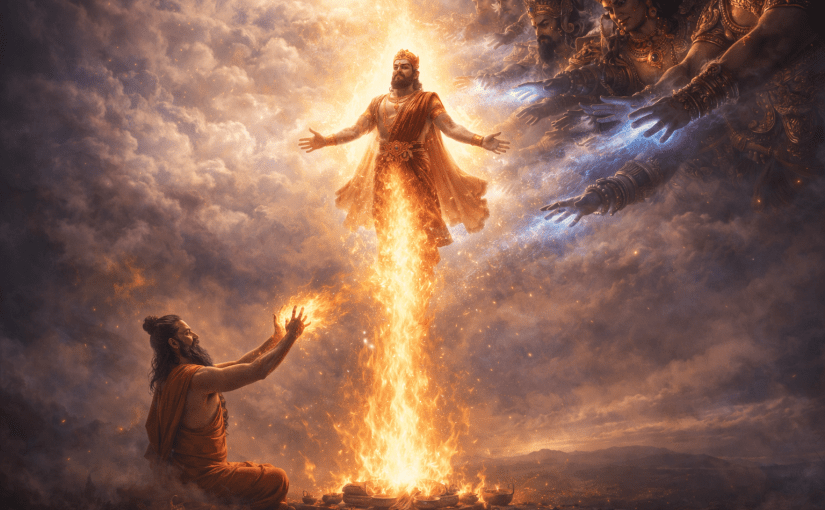
The eight Vasus were radiant beings of light, guardians of nature’s elemental powers. But once, out of a moment’s desire, they stole the celestial cow Nandini from Rishi Vashishtha’s ashram. The cow was not a mere creature—it was Maya, the wish-fulfilling field of creation itself. By desiring her, the divine energies turned toward possession, and thus, the fall began.

Vashishtha’s curse was not punishment—it was the law of descent. When pure pranic forces seek pleasure rather than purpose, they must enter the limitation of birth. The eight Vasus, once infinite, were destined to experience the density of form.

Ganga, the river of consciousness, took mercy. She agreed to bring them into the world and return them swiftly to her waters.
As she gave birth, each of the first seven sons was immersed back into her flow—symbolizing the seven levels of energy that dissolve into the Source when purified by surrender. These seven represent the seven chakras, released one by one as consciousness ascends beyond them.

But the eighth—Prabhasa, the chief offender—had to remain. He was born as Bhishma, the son who could not be freed. He became the embodied energy, the Kundalini retained—not dissolved, but disciplined. Bhishma’s legendary vow of celibacy mirrors the highest yogic restraint, where desire is transformed into awareness, and energy no longer flows outward but stands still in eternal witnessing.

Thus, in the language of Yoga:

  • The eight Vasus are the eight pranic currents that animate creation.
  • The theft of Nandini is consciousness seeking fulfillment in the external.
  • The curse is embodiment—karma’s necessity.
  • Ganga’s flow is the river of purification, where energies return to their origin.
  • Bhishma is the enlightened awareness that remains in the world but not of it—the realized yogi who lives amidst dharma yet stays untouched.

Kundalini, too, descends and ascends through these very layers. Seven streams rise and merge back into the ocean of spirit; the eighth, the witnessing consciousness, abides on earth as the dharmic flame.

When one reads this story not as history but as inner scripture, Bhishma’s silence on the bed of arrows becomes the silence of the awakened mind—pierced by the arrows of karma yet unmoved by pain, waiting only for the auspicious hour to return to the Eternal Ganga.

Guru Parva Grace and the Deep Descent into Dhyana

Today is Guru Parva — a day soaked in subtle grace. Perhaps that’s why dhyana came with such ease and depth. Truly, Guru Tattva is omnipresent and omnipotent, guiding from within when outer guidance rests.

I woke around 4:30 a.m., calm and receptive. Instinctively began deep spinal kriya breathing for about twenty minutes. Then I read a few blog posts — words that perhaps tuned my consciousness higher. After that, I shifted into chakra meditation, moving awareness from crown to base, up and down for about twenty minutes. The movement of prana created the right yogic pressure — a preparatory current that automatically launched me into dhyana.

At first, I sat in Padmasana, but it remained a preparatory phase. Then I shifted to Vajrasana, and the change was instant — deep dhyana dawned naturally. Maybe Vajrasana truly suits me best. I laughed inwardly: “So, my name must be Premyogi Vajra.”

What followed was one and a half hours of continuous, breathless dhyana.
In the beginning, energy was high in the upper chakras. The in-breath was imperceptible, and the out-breath only faintly perceptible — as if nature herself was drawing energy downward in a balancing act. Gradually, prana descended through Vishuddhi and Anahata, though not distinctly separated. The awareness of subtle pulsations grew clearer in the lower regions — a breath of energy, not air.

A key realization emerged — never force stillness. Allow the body micro-movements to release strain. When I released effort, breathing softened further, and bliss deepened.

My neck bore much strain, holding the head’s weight. Tilting it slightly left eased the flow; then returning to center or right as needed — a gentle, intelligent cooperation between body and consciousness.

Later, when Vajrasana made the limbs numb, I slowly shifted to Sukhasana. Instead of distraction, dhyana deepened further. Sometimes I lowered the head, sometimes kept it upright or tilted slightly upward. Sometimes back full straight with natural curve, sometimes loosening it little. These spontaneous maneuvers tuned the current like a musician refining his note.

For Ekarnava Dhyana, keeping the head gently dropped with closed eyes gazing upward toward the Ajna Chakra worked best.

When Sukhasana tired, I moved into Siddhasana. Here bliss magnified again — energy dipped lower, steady and full. The ankle pressing Swadhisthana, and the other pressing Muladhara, created a perfect circuit and sensational points to concentrate energy more there. The microcosmic orbit activated naturally, the energy revolving in serenity.

Later, I attempted to lift energy back to Ajna Chakra as an experiment, but it felt stressful. The energy preferred to stay grounded, working in silence. So I let it remain, continuing Ekarnava Dhyana as it was. However, prolonged ekarnava dhyana shifts energy up slowly again. It’s good switch to direct energy rather than directly manipulating.

However, in the lower chakras, dhyana became more witnessing than transcendence — not Nirvikalpa, but a subtle purification. Hidden emotional imprints arose as faint, heartfelt memories — gently surfacing and dissolving. It felt like inner cleansing, a self-healing of the soul.

When calls began coming and bathing time approached, I slowly rose. This time, not with repentance — but with deep satisfaction and fullness.

Perhaps this was the fruit of integrating sitting meditation with working meditation in recent days. I noticed a clear truth:

When dhyana is practiced after days of worldly indulgence, the preparatory phase is longer.
When practiced regularly, with no lingering desires, dhyana launches instantly — like a rocket already fueled by purity.

Today’s experience was not just about time or posture. It was about effortless descent into grace — a reminder that Guru Tattva lives within, guiding from breath to stillness, from effort to surrender.

Moreover, after bathing, I had practiced all the remaining major asanas to rebuild the inner energy for the next meditation session during the day. To avoid too much pressure building up in the head, I slightly turned my hands and feet — especially the front parts of the feet — outward and downward, as if pressing the ground with paws during each pose. This simple adjustment had a wonderful effect. It helped the energy move down and kept me well-grounded, preventing any heaviness or excess pressure in the head.

When Breath Dissolves: A Real Experience of Deep Dhyana, Prana Movement, and Silent Awakening

Sometimes I feel a quiet repentance for breaking my breathless Dhyana for small worldly reasons—like taking a meal. Yesterday evening, after many days, I found myself alone in perfect silence, almost like being in a forest retreat.

For the first hour, my breath was irregular, sometimes resembling Kapalbhati. It felt as though the Pranas were adjusting themselves, preparing for breathlessness. I broke this preparatory phase two or three times by standing up, changing asana, or making small neck movements. Once, I even went to the kitchen to check if my dinner had arrived. When the tiffin man called to say his scooty had broken down, I told him not to worry—I suddenly felt grateful, as this delay gifted me more time for Dhyana.

The Deepening Stillness

I sensed that my difficulty in entering Dhyana might be due to sitting in Padmasana, so I shifted to Vajrasana. To my amazement, within fifteen minutes, my breath began to calm and regulate on its own, and Dhyana deepened.

Because the state was still fragile, I remained extra alert—aware that even a slight movement or swallowing of kuf (phlegm) voluntarily could disturb it. As I allowed it to deepen, my legs slowly became numb. I tolerated it patiently and then changed posture to Sukhasana with utmost care, keeping awareness steady on breath and movements minimal. Interestingly, as blood returned to the legs, the Dhyana deepened further.

Soon, my neck began to stiffen. I gently alternated between left, right, and central positions, staying for a while at each position as per guidance of dhyana without losing awareness. This small movement stabilized the Dhyana even more.

The Movement of Prana

It felt as if imperceptible breathing currents were flowing through different chakras—sometimes at the rear Ajna, sometimes Vishuddhi, sometimes Anahata. Later, while in Siddhasana, subtle activity appeared even at Swadhisthana and Muladhara, though faintly. I couldn’t easily focus at the Navel Chakra, though a very slight alignment was felt there too. However, while trying dhyana later on after dinner, energy had seemed focusing more on naval chakra.

It felt as if a blissful yet mildly tired sensation was developing at certain chakras that needed attention. When I focused on that sensation during inhalation and exhalation, both breath and awareness seemed to converge there naturally.

During inhalation, as energy rose from that chakra, my attention simultaneously descended onto it—like the merging of Prana (upward force) and Apana (downward force). I realized this might be what ancient texts refer to as the union of Prana and Apana during deep Dhyana.

When I heard the tiffin man’s voice in the kitchen, I replied without seeing him—calmly, directly, without disturbance. There was still some very light mental activity, but it was stable and non-chaotic, like thoughts moving in slow motion and dissolving soon—either directly or after transforming into two or three subtle thoughts, often of the meditation image or Guru form.

The Silent Ocean Within

I started mental chanting of “Ekarnava,” connecting with the sense of the endless, wave-less cosmic ocean. The vibration of the mantra felt alive and meaningful.

Later, as I tired in sukhasana and again shifted to Siddhasana for grounding energy in the lower chakras, mild fatigue appeared in this asana too after sometime. The call of dinner tempted me to end the session. I finally rose, already grounded and centered, without losing worldly balance.

A subtle repentance followed: why didn’t I just change posture and raise the energy again, instead of ending the Dhyana altogether? Hunger had already faded due to the deep state, and I could have continued longer. But I accepted that perhaps the energy had already been sufficiently expended.

Dinner was light, taken without much appetite—very different from the earlier days when I felt strong hunger after immature Dhyana. It seemed as if the body’s energy for digestion had been diverted toward Dhyana.

Interestingly, I usually enter Dhyana more easily after meals, but this time, in an empty stomach, the state felt more genuine and spontaneous. Taking a meal may make energy forcefully downward and so calming breath and awareness just like artificially. After dinner, I couldn’t re-enter the state, perhaps because the accumulated Yoga Shakti had already expressed itself.

Short vs. Long Immersions

Many yogis say short, regular sittings are better than long, infrequent ones. Yet, occasional long immersions, supported by daily shorter Dhyana, have their unique benefits. This session reaffirmed that balance is key—neither suppression of the body’s needs nor indulgence in them.

That night, I also had faint dreams of talking with subtle beings or spirits—not vivid, and not much memorable but peaceful and meaningful in their own way.

Reflections

Looking back, I realized a few gentle truths:

  • Dhyana never truly breaks; it only shifts form.
  • Body needs are not obstacles, but part of the spiritual rhythm.
  • Repentance arises from attachment and ego; gratitude dissolves it.
  • The movement of Prana among chakras is self-guided, not to be forced.
  • After-effects like calm hunger or subtle dreams are natural signs of internal rebalancing.

A simple reminder arose within:

“Let what was revealed in stillness spread through movement also.”

Every act, even eating or walking, can then continue the same Dhyana in motion.