When Buddhi Chooses Sleep: The Yogic Psychology of Gandhārī and Dhṛtarāṣṭra

A Moment in the Mahābhārata That Demands Deeper Seeing

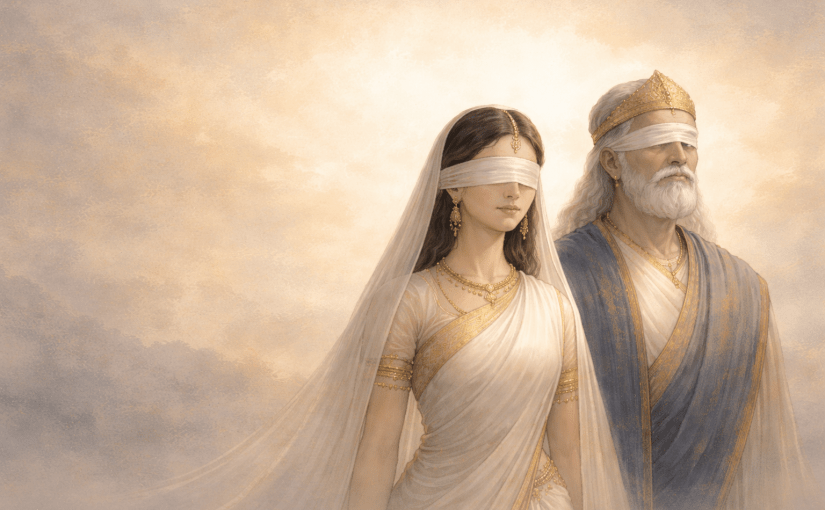
In the Mahabharata, Gandhārī’s decision to cover her eyes for life so as to share the blindness of her husband Dhritarāṣṭra is often praised as the highest form of devotion. Yet when looked at quietly, without sentiment, this act does not remain simple. Something in it presses for a deeper reading. It feels less like sacrifice and more like a decisive inner posture—one that silently shapes destiny.

This is not a story about physical blindness alone. It is a story about consciousness, intelligence, and the subtle ways bondage continues even in the presence of love.

Jīva as Dhṛtarāṣṭra: Blindness Carried Forward

Dhṛtarāṣṭra represents the Jīva—the individual being shaped by past karma. His blindness is not accidental and not limited to the eyes. It symbolizes a long-standing incapacity to see clearly, to discriminate, to restrain desire and attachment. This blindness is carried forward from previous births as samskāra. In this birth, it simply expresses itself openly.

Nothing in the story suggests that this Jīva could not have been aided. Blindness here is not fate sealed forever; it is a condition awaiting either reinforcement or correction.

Gandhārī as New Buddhi in a Fresh Birth

Gandhārī represents Buddhi, the faculty of intelligence and discernment. She is not blind by nature. She enters this life with clear seeing, moral strength, and the capacity to guide. Before marriage, she stands close to what can be called samaṣṭi buddhi—intelligence that is still aligned with universal order rather than personal entanglement.

This is crucial: Buddhi arrives fresh in this birth. It is capable of seeing what the Jīva cannot.

The Warnings of Elders and Gurus

The elders and gurus advise Gandhārī clearly to keep her eyes open. This is not a social detail; it is symbolic. It represents śāstra, dharma, and higher wisdom reminding Buddhi of its responsibility. The message is simple: do not abandon discernment. Love does not require blindness. Partnership does not demand the sacrifice of intelligence.

At this moment, a real choice exists.

The Decisive Act: Buddhi Choosing Slumber

Gandhārī sees the blindness of the Jīva she is about to join. Instead of remaining awake and serving as a mirror, she chooses symmetry. She decides that if the Jīva cannot see, she too will not see. This is not ignorance and not compulsion. It is a conscious, emotionally motivated decision.

Here, Buddhi abandons its dharma of viveka. It chooses companionship over correction, harmony over awakening, loyalty over truth. Intelligence does not illuminate; it lies down beside blindness. It is like the Kundalinī snake coiled and Śakti sleeping in the Mūlādhāra chakra.

This is the silent turning point of the epic.

Why This Is Not Compassion in Yogic Psychology

In yoga, compassion never requires the dimming of intelligence. Buddhi exists to bring clarity to the Jīva, not to anesthetize it. When Buddhi voluntarily suspends its seeing, it does not become noble; it becomes dormant. By blindfolding herself, Gandhārī validates the Jīva’s blindness and removes the very friction that could have led to awakening.

This is love that prefers peace over truth—and therefore sustains bondage.

Why the Jīva Remains Unawakened

A Jīva does not awaken simply because Buddhi is present. Awakening happens only when Buddhi stays awake. In this pairing, Buddhi becomes a sedative rather than medicine. The Jīva remains blind not because help was absent, but because help chose not to function.

This is the deepest tragedy: intelligence was available, but it refused its role.

Later Power, Earlier Failure

Gandhārī later demonstrates immense tapas and spiritual power. Her curse after the war is devastating. Yet this power appears only after irreparable damage has occurred. If she had seen and acted early, things could have changed. Acting only at the end changed nothing. A blind Buddhi practicing yoga may acquire various powers and siddhis, but it does not attain awakening.

Blindness postpones responsibility. What is not corrected early returns later as destruction. Similarly, a blind Buddhi practicing yoga may acquire various powers and siddhis later in life, but it does not attain awakening.

A Pattern That Repeats Everywhere

This story is not confined to an ancient epic. It repeats wherever intelligence dims itself to preserve relationship, wherever clarity is sacrificed to avoid disturbance, wherever love fears awakening more than ignorance. In such moments, Buddhi chooses sleep, and Jīva continues as it is.

Awareness cannot be awakened by someone who refuses to see.

Final Understanding: How Bondage Continues Quietly

The Jīva was blind due to past karma.
The Buddhi was seeing in this birth.
But Buddhi chose sleep over sight, companionship over awakening.

Thus blindness continued—not by fate, not by ignorance, but by a conscious choice made in the name of love.

Liberation does not fail because light is absent.
It fails when intelligence willingly turns away from seeing.

Beyond Death and Liberation: Holding Consciousness Between Worlds

A Personal Reflection on Trishanku, Vishvamitra, Kundalini, and the Inner Guru

How Compassion, Ritual, and Inner Prayer Hold Consciousness Until Liberation Ripens

The Classical Story of Trishanku: The King Suspended Between Heaven and Earth

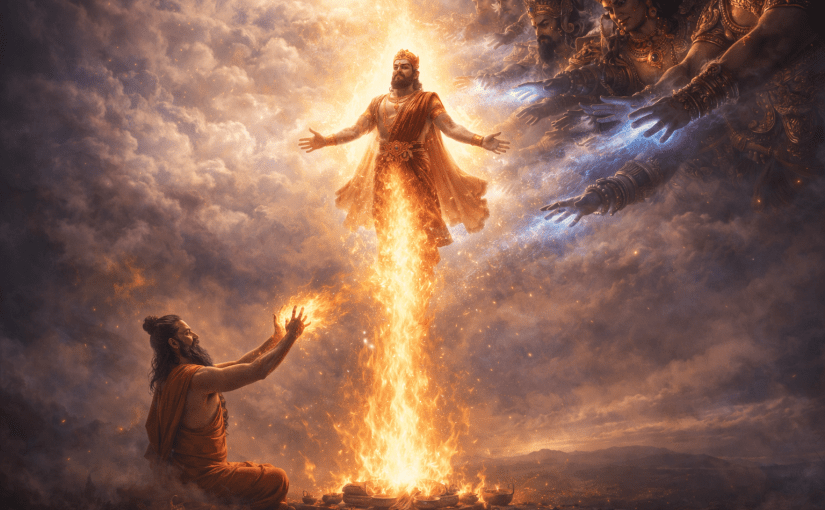
In the ancient tradition, King Trishanku of the Ikshvāku lineage desired to ascend to heaven in his physical body. When the royal priests refused to perform the rite, he approached the sage Viśvāmitra, whose tapas was unmatched. Through his austere power, Viśvāmitra attempted to send Trishanku to the celestial realms, provoking resistance from the gods. When the ascent was obstructed, Trishanku was left suspended between heaven and earth, neither accepted by the devas nor returned to the mortal world. Refusing to let him fall, Viśvāmitra established him in a unique state—neither fully liberated nor condemned—where he remained held by the force of the sage’s tapas.

Rethinking the Trishanku Story: Blessing, Not Punishment

I have often felt that the story of Vishvamitra and King Trishanku is misunderstood. Most readings stop at ego, rivalry, or defiance of the gods. But to me, it feels very different. It feels like a blessing, not a punishment. Vishvamitra did not abandon Trishanku halfway. He held him.

I feel Vishvamitra created an abode for Trishanku not out of anger, but out of compassion. However, it may be understood as a spiritual anger directed toward the devas for denying liberation to Trishanku. It was pure and positive—aimed at growth, and getting inspiration to do a great job, not rivalry. Trishanku was not ready for full liberation, yet he should not have fallen back. So Vishvamitra, through tapas, prayer, and sheer inner power, held him in between—high enough to be safe, steady enough to ripen. This suspension itself feels like grace. Liberation is not always immediate. Sometimes it is protection from regression.

Rituals for the Departed: Collective Tapas in Everyday Life

When I look at society today, I see the same intention expressed differently. People perform Bhagavatam kathas, shraddhas, yagyas, pindas, and tarpanas, prayers, rest in peace or RIP for their departed loved ones. These are not empty rituals. They are collective efforts to hold consciousness high enough so that it does not collapse back into unconscious karmic drift. Vishvamitra did this alone. Ordinary people do it together, repeatedly, across time.

Seen this way, Trishanku becomes an archetype. Not damned. Not liberated. But protected. Suspended with care.

When the Myth Became Personal: My Own Experience

This is not just philosophy for me. It touched my life directly.

Dream Visitations and the Call for Assistance

After the death of a close acquaintance, I experienced her presence repeatedly in dream visitations. These were not frightening. They were not dramatic. They felt like a seeking—an unspoken request for assistance in liberation. I did not try to command anything. I did not panic. I prayed.

Prayer, Kundalini, and the Meaning of Urging God

I prayed strongly. I urged kundalini for her peace, for her liberation, for forgiveness of acts that might be preventing liberation, for release from unresolved weight. For me, kundalini is representative of God—not as a personality, but as the deepest intelligence of integration. Urging kundalini is urging God. It is aligning intention with the highest coherence of consciousness. We may even call it a personified dhyāna-supporting chitra that often lingers during savikalpa dhyāna and, as it converges toward nirvikalpa dhyāna, enables a smooth and rapid transition.

I also urge liberation for all beings, twice daily, in my dhyana. I do this because liberation is not a limited resource. It is not like physical matter that gets exhausted by giving. It is like light. It can be wished for all, together, without loss. This understanding feels very clear to me.

Signs of Resolution: Clarity, Softening, and Residual Sadness

Over time, I noticed something important. The appearances in dreams became clearer. Calmer. More refined. Each interaction carried less confusion. There was a subtle sadness present—not fear, not agitation—but a gentle sorrow. It felt connected to not being perfectly cared for during illness and the dying phase. I did not try to fix this sadness. I simply allowed it. I know it will resolve one day on its own.

This clarity felt like confirmation—not in a grand mystical sense, but in a quiet, settling way. Something was integrating. Something was being completed.

Kundalini as Dhyana Chitra: The Inner Guru Clarified

I want to be clear about one thing. When I speak of kundalini here, I mean dhyana chitra. The inner meditative image. The inner guru. Not a voice. Not an external command. Not an authority that tells me what to do. It is orientation, not instruction. It does not demand action. It dissolves naturally in meditation.

Where Resolution Truly Happens

On careful observation, I see that nothing was resolved outside me. The resolution happened within. A tense relational field completed itself, which is why clarity increased and interactions became softer instead of more intense.

This reflects the true purpose of ancient rituals. They were meant as acts of love, not fear—support rather than rescue, holding rather than pulling. Their role was to stabilize awareness, reduce downward pull, and allow natural ripening to occur. It means these practices certainly work in this world, and they may also have effects beyond it, in the afterworld as well.

Yogic Understanding: Death as Pratyahara and Suspension

From a yogic perspective, death itself is forced pratyahara. The danger is regression into old samskaras. Holding practices—whether tapas, prayer, ritual, or remembrance—keep awareness above that collapse point or above throat chakra. Trishanku’s suspension mirrors this exactly.

Psychological Grounding: Grief, Holding, and Completion

From a psychological perspective, this is also healthy grief. Remembering without clinging. Caring without binding. Letting go without denial. Societies that abandon ritual often carry unresolved trauma because transitions are left unheld.

Responsibility Without Burden

One crucial truth remains central to me. I am not responsible for liberating anyone. I am responsible for not obstructing liberation with fear, guilt, or attachment. My prayers are permission, not intervention. Opening, not pushing.

Why Experiences Fade When Resolution Occurs

That is why these experiences naturally fade. Fewer visitations. Less emotional charge. More neutrality. Eventual quiet disappearance. Resolution softens. It does not escalate.

This is the role of the inner guru. Not to act. Not to control. But to allow completion to happen without force.

Returning to Trishanku: The Archetype of Compassionate Suspension

When I look back at Vishvamitra and Trishanku now, the story feels intimate, not mythic. One consciousness holding another until gravity loosens. One being refusing to let another fall, without pretending readiness that is not yet there.

Different methods. Same compassion.

Not a Conclusion, But a Resting Place

This blog is not a conclusion. It is a resting place. A suspension that does not need to hurry. Just as liberation itself does not hurry.

An Evening Conversation on Faith, Spirits and Yoga

A few days ago, while on my evening walk after an early dinner, I stopped at a fellow’s shop to sit for a while. His neighbour, who runs a gosadan (cow shelter), and known to me since few months had recently broken his arm when a herd of cattle rushed toward the gate, breaking it while he was leaning on it. I had come there to offer sympathy and a helping hand, but he was not there at that moment. A few months earlier, his 14‑year‑old son had passed away from a rare disease.

I had often noticed a mysterious dark mixed glow in this man’s eyes. Despite his suffering, he is a devout follower of Lord Shiva and every year he, along with his entire team, arranges food (langar) for pilgrims during the month‑long Manimahesh Yatra in the hills.

While sitting there, I said to the shopkeeper that perhaps the neighbour was under bad stars or some evil influence and that he might visit a nearby city yoga guru to remove this effect. The shopkeeper immediately denied the efficacy of yoga for removing evil spirits.

I told him, “I have myself evaded such a spirit.”
He asked, “How?”

I explained: “Whenever that spirit tries to come in my dream, my guru appears there and tells it to leave me and come to him. I simply put my dhyana on my guru and pray for the peace and liberation of that spirit. It is not evil, but who would want to frequently encounter something paranormal?”

Hearing this, he softened a little.
Then he asked, “Who is your guru?”

I replied, “It should not be told to anyone.”
He asked again, “But it must have some form?”

I said, “Yes. Sometimes my guru appears as my Dadaji, sometimes as Shiva, and sometimes as Narayana, depending on the situation.”

Hearing this, and being himself a member of the Manimahesh team, he began speaking as if he knew more. He said, “Shiva cannot be worshipped. Shiva is Mahakaal. He doesn’t save, he destroys as per one’s Karma. One can become Shiva but can’t worship him. One has to become Shiva to gain benefit.”

I wondered silently: How can one become one’s favourite deity without first admiring, honouring, and worshipping it?

Then he added, “Only a Satguru can save from evil spirits, not others.”

Again, I reflected: He first opposed yoga but now he praises the Satguru — and a Satguru becomes functional only through yoga and dhyana.

That small conversation once again highlighted for me the importance of open discussion to grow and to deepen understanding.

Narayana, Ekarnava, and the Inner Cosmic Symbolism of Meditation

Every day, in the depth of meditation, we witness Narayana emerging from Ekarnava—the cosmic sea of consciousness. Ekarnava is not an ordinary ocean; it is the primordial, wave-less expanse, the silent substratum from which all existence arises. It is the state of Nirvikalpa Dhyana, where the mind dissolves and only pure awareness remains. In this inner vision, Narayana appears not as a distant deity but as a sattvik, luminous, and loving presence—beautiful, peaceful, and radiating all divine qualities. His emergence is not from turbulence but from absolute stillness. He symbolizes the liberating force within meditation, an image of cosmic order and divine peace that gently calms the mind.

In this vast ocean of consciousness, Narayana performs a sacred task—he destroys the demons that produce evil ripples in the cosmic sea. These demons are not literal beings but represent chaotic thoughts, restless emotions, and egoic patterns that disturb the stillness of the inner ocean. When the mind is scattered, the cosmic Ekarnava becomes agitated, like a lake troubled by wind. Narayana, in the form of a meditation image, absorbs and dissolves these disturbances, restoring silence and harmony. The practice of meditation thus becomes a cosmic act, where the inner Narayana neutralizes the mental asuras—the vrittis that bind consciousness in cycles of suffering.

The journey into the Ekarnava, or cosmic ocean of formless consciousness, happens through Narayana. The meditator first focuses on the divine form—the saguna aspect—and gradually dissolves even that, entering the wave-less ocean beyond all images. Yet, Narayana himself is like a liberating wave—unlike the binding waves of mental turbulence, he is a gateway wave that carries the meditator into formlessness. On returning from this Nirvikalpa Samadhi, when the mind resumes its worldly functions, Narayana is the first to greet the seeker, symbolizing the return to dharma, compassion, and peace in daily life.

This same cosmic pattern explains why Rama and Krishna are considered avatars of Narayana. They were not avatars only in the theological sense but because their presence naturally became meditation images for millions. Their beauty, serenity, compassionate nature, practicality, spirituality and complete alignment with divine law made them easy objects of dhyana for the masses. People spontaneously visualized them, meditated upon them, and aligned their minds to divine consciousness through their forms. This is why they are called avataras of Narayana—they descended not just to perform earthly tasks but to anchor human minds in sattva and meditative absorption.

In deeper yogic symbolism, Narayana reclining on Sheshanaga in Ekarnava represents the human subtle body. The Sheshanaga (cosmic serpent) symbolizes the spine and the nervous system, with the raised hood representing the Sahasrara (crown chakra). When prana flows through the Sushumna Nadi, the central spinal channel, the breath becomes calm, and the mind enters deep meditation. Only then does Narayana appear in inner vision—resting peacefully on the serpent of the awakened kundalini. The serpent’s hood rising above Narayana is not just mythological ornamentation; it represents the pranic energy feeding the Sahasrara, allowing the mind to expand into cosmic awareness.

This ancient imagery is not mere mythology; it is psychological and yogic science hidden in symbols. When the breath becomes subtle and still, when prana ascends the spine, the mind becomes an ocean without waves—the Ekarnava of consciousness. Narayana is both the gateway and the guardian of this ocean. He destroys the demons of distraction, dissolves into the formless state, and welcomes the seeker back with peace and love when the meditative journey is complete. In this way, the images of Rama, Krishna, and Narayana reclining on Sheshanaga are not distant cosmic tales but direct representations of human spiritual anatomy and meditative experience.

Eternal Keval Kumbhak vs Eternal Nirvikalpa Samadhi: Which Is Closer to God?

Perfect. Here’s a fully text-based poetic-style blog post that captures the contrast between Eternal Keval Kumbhak and Eternal Nirvikalpa Samadhi, without using any charts — entirely suitable for WordPress:


🕉️ Eternal Keval Kumbhak vs Eternal Nirvikalpa Samadhi: Which Is Closer to God?

In the deepest folds of yoga and mysticism, seekers often ask:

Is God in eternal Keval Kumbhak — breathless, still, yet vibrantly alive?
Or is He in eternal Nirvikalpa Samadhi — formless, thoughtless, pure being beyond all dualities?

Let us explore this with inner reverence and clarity.


🌬️ Keval Kumbhak – The Breathless God

Keval Kumbhak is the spontaneous, effortless retention of breath — not forced, not practiced, but arising naturally when prana and apana merge, when duality ends in the body.

In this state:

  • Breath is utterly still.
  • Yet the being is fully alive, aware, and undisturbed.
  • No inhalation, no exhalation — just an eternal pause.
  • The body is like a flame that doesn’t flicker.
  • Consciousness watches in silence, as if holding the entire universe in its womb.

When a yogi experiences Keval Kumbhak, even for moments, it feels divine — as though the body has turned to sky, and the soul floats in a still ocean of life.

To imagine God in eternal Keval Kumbhak is to see Him as the supreme yogialive, breathless, still, watching all creation without moving a single atom within Himself.


🧘‍♂️ Nirvikalpa Samadhi – The Formless God

But deeper than breath, deeper than body, deeper even than witnessing silence — is Nirvikalpa Samadhi.

In this state:

  • There is no mind, no breath, no body-awareness.
  • There is no observer or observed.
  • Thought vanishes. Even the sense of “I am” dissolves.
  • No God, no world — just pure being, limitless, indivisible.

This is not a state that comes and goes. It is the true nature of existence, of Self, of God — beyond the idea of God.

To speak of God as being in eternal Nirvikalpa Samadhi is to say:

He is not “in” a state — He is the foundationless Reality,
before the first breath, before time, before space.
He does not breathe, think, move — He simply Is.


🕊️ So Which Is Closer to the Truth?

Both images are true — from different lenses.

  • Eternal Keval Kumbhak is God as the silent, breathless, cosmic yogi, holding the universe in still awareness — beautiful, relatable, alive.
  • Eternal Nirvikalpa Samadhi is God as the absolute Self, beyond all movement, even breathlessness — infinite, silent, unknowable.

If you seek relationship, devotion, or a form of living stillness, Keval Kumbhak paints a divine picture of God.

If you seek nonduality, liberation, or truth beyond all ideas, Nirvikalpa Samadhi is the ultimate doorway — and the place beyond all doorways.


✨ A Closing Reflection

God doesn’t breathe — because He is the source of breath.
God doesn’t think — because He is the witness before thought.
God doesn’t meditate — because He is the end of meditation.

You may call Him the breathless one — or the formless one.
You may find Him in stillness — or lose yourself in His silence.

Both are true.
Both are holy.
Both lead home.

अभिनन्दन को अभिनन्दन- Abhinandan (Congratulations) to Abhinandan

अभिनन्दन को अभिनन्दन (please browse down or click here to view this post in English)

भारत-पाकिस्तान की निगरानी के लिए अंतर्राष्ट्रीय (संयुक्त राष्ट्रसंघ) पर्यवेक्षकों की नियुक्ति नहीं हुई है। यदि हुई है, तो वह नाकाफी है, या पक्षपातपूर्ण है। मैं यह बात बता देना चाहता हूँ कि यह बहुत ही ऊंचे स्तर की बात है, जिसकी सम्पूर्ण कूटनीति को समझना मेरे बस की बात नहीं है। फिर भी मैं अपने विचार प्रकट कर रहा हूँ, यह जानने के लिए कि सब कुछ जानते हुए भी संयुक्त राष्ट्रसंघ मूकदर्शक क्यों बना रहता है। तभी तो पाकिस्तान नित-नए झूठ के रंग-बिरंगे बादल उड़ाता रहता है, दुनिया भर में। वह ऐसा हमेशा से ही करता आया है। वह रोज सीजफायर का उल्लंघन करता है, और हमारे रिहायशी इलाकों को अपना निशाना बनाता रहता है, जिसे दुनिया या संयुक्त राष्ट्रसंघ देख ही नहीं पाता। भारत केवल आतंकी शिविरों को ही अपना निशाना बनाता है, सैनिक व नागरिक क्षेत्रों को नहीं। पाकिस्तान केवल सैनिक व नागरिक क्षेत्रों पर ही हमले करता है। और करेगा भी कहाँ, क्योंकि हमारे देश में आतंकवादी हैं ही नहीं।

एक बात जरूर है कि शिमला समझौते के बाद अंतर्राष्ट्रीय पर्यवेक्षक का प्रश्न ही पैदा नहीं होता। पर यह सवाल भी सच है कि पाकिस्तान ने समझौतों का पालन किया ही कब? जो समझौतों को माने, वह पाकिस्तान ही कैसा? भारत-पाक सीमा पर अंतर्राष्ट्रीय पर्यवेक्षक रखने का पाक का सुझाव भी साजिश से भरा हुआ लगता है। आजकल के अटैक हाईटेक होते हैं। उन पर सड़क पर दौड़ने वाली यूएनओ की गाड़ी कैसे नजर रख पाएगी। एलओसी बहुत बड़ी है। उस पर एकसाथ नजर रखना आसान काम नहीं है। पाकिस्तान को तो वैसे भी झूठ, दुष्प्रचार व साजिश को रचने में महारत हासिल है। ऐसा वह अनगिनत बार कर चुका है। अतः यह कैसे माना जा सकता है कि वह यूएनओ की टीम का ब्रेनवाश नहीं कर देगा? वह तो उन्हें आतंकवादियों का डर दिखा कर उनसे झूठी रिपोर्टें भी बनवा सकता है। जान बचाने के लिए आदमी क्या काम नहीं कर सकता? आजकल तो आकाशीय उपग्रहों का युग है। एलओसी पर उपग्रहों से क्यों नजर नहीं रखी जाती। उसके लिए तो किसी की अनुमति की आवश्यकता भी नहीं है। उस पर खर्चा भी कम आएगा, और त्रुटि की संभावना भी नहीं होगी। आजकल के उपग्रह तो छत के ऊपर लगी पानी की टंकी को भी स्पष्ट दिखा सकते हैं। क्या वे एलओसी का निरीक्षण नहीं कर पाएंगे?

विकिलीक ने खुलासा किया है कि अमरीका को बालाकोट के आतंकवादी-शिविरों के बारे में बहुत पहले से पता था। जब उसे पता था, तब उसने उनको अपना लक्ष्य क्यों नहीं बनाया? उसने भारत को भी उस बारे में सतर्क करते हुए, उसकी सहायता भी क्यों नहीं की। यह एक विचारणीय विषय है। डेविड हेडली जो मुंबई हमले की योजना का हिस्सा था, उसका पता अमरीका को पहले से ही था, पर उसने बताया नहीं। यह सबको पता है कि अमरीका ने रशिया के खिलाफ पाकिस्तान के आतंकवाद को पोषित भी किया था। जब वर्ड ट्रेड सेंटर पर हमला हुआ, तब अमरीका को समझ आई। देर से आए, दुरस्त आए। जब जागो, तभी सवेरा। परन्तु आतंकवाद के विरुद्ध अमरीका के प्रयास नाकाफी प्रतीत होते हैं। अमरीका ने बच्चे की तरह पाकिस्तान को पाल-पोस कर बड़ा किया है। उससे आतंकवाद भी खुद ही फलता-फूलता गया। अमरीका जैसे चतुर देश की आंख में कोई धूल नहीं झोंक सकता। पाकिस्तान द्वारा उसकी आँखों में धूल झोंकने की बात करना तो एक बहाना मात्र है, सच्चाई कुछ और ही लगती है। हाल ही में पाकिस्तान ने भारत के सैन्य प्रतिष्ठानों पर हमले के लिए एफ-16 विमान का प्रयोग किया, जिसे परमवीर विंग कमांडर अभिनन्दन ने मार गिराया। पाकिस्तान ने ऐसा करके अमेरिका के साथ की हुई संधि को तोड़ा है। लगता नहीं है कि अमरीका उसके खिलाफ कोई सख्त एक्शन लेगा। यह भी हो सकता है कि यदि अमरीका भारत का खुल कर साथ दे, तो चीन पाकिस्तान का खुल कर साथ देगा। गुपचुप तरीके से तो वह अभी भी दे रहा है। चीन को यह समझ लेना चाहिए कि बुराई का साथ देकर उसका कभी भी भला नहीं हो सकता। प्रकृति बहुत बलवान है, और वह बड़ों-२ को झुका देती है। अमरीका कहता है कि भारतीय सेना को अफगानिस्तान में नियुक्त करना चाहिए। यहाँ हाल यह है कि भारत के 40 से अधिक सैनिक पाकिस्तान ने मार दिए, और अमरीका ने उस पर एक भी हवाई हमला नहीं किया। यदि वह ऐसा करता, तब हम मानते कि भारतीय-सैनिकों का वास्तव में वह हित चाहता है, और अफगानिस्तान में भी वह उन्हें सुरक्षित रहने में मदद करेगा। जब अपने देश भारत में ही भारतीय-सैनिक सुरक्षित नहीं हैं, तब अफगानिस्तान में वे कैसे सुरक्षित रह सकते हैं। वहां पर तो आतंकवादियों का खुला बोलबाला है। अगर पाकिस्तान के पास परमाणु बम है, तो भारत के पास भी है। भारत के पास तो वह हवा, जल व स्थल, तीनों जगह पर तैनात है, और अब तो वे परमाणु-पनडुब्बी पर भी तैनात कर दिए गए हैं। चीन पाकिस्तान की मदद केवल अपने स्वार्थपूर्ण हितों के लिए कर रहा है। वह विश्व के हितों को अनदेखा कर रहा है।

कश्मीर से धारा 370 व धारा 35-ए को तुरंत हटा दिया जाना चाहिए, क्योंकि वे आतंकवाद का पोषण करती हैं। सिन्धु जल समझौते को भी रद्द कर देना चाहिए। पाकिस्तान भी कोई समझौता नहीं मानता। केवल अपने हिस्से का पानी रोक देने से ही कुछ विशेष नहीं होने वाला है। यदि इसके बदले में चीन भारत का पानी रोकता है, तो उससे विशेष फर्क नहीं पड़ेगा, क्योंकि भारत एक बहुत बड़ा देश है। परन्तु पाकिस्तान तो लगभग प्यासा ही हो जाएगा। पाकिस्तान के साथ कोई भी मैच नहीं खेलना चाहिए। क्रिकेट विश्वकप से भी पाकिस्तान का बहिष्कार करवा देना चाहिए, क्योंकि वहां पर भारत की सबसे अधिक चलती है, और सबसे अधिक कमाई भी भारत से ही होती है। कश्मीर को सेना के हवाले कर देना चाहिए। देशद्रोहियों के लिए मृत्युदंड का प्रावधान हो। उनके लिए व आतंकवादियों के लिए विशेष फास्ट ट्रेक कोर्ट बनाने चाहिए, ताकि कांधार-अपहरण जैसी घटना दुबारा न घटे। यदि मसूद अजहर को तुरंत फांसी दे दी गई होती, तो उसके चेले-चांटे उसे छुड़वाने के लिए हमारे विमान का अपहरण न करते। यह नियम है कि जख्म का इलाज करते समय उसके आसपास के स्वस्थ भाग भी कुछ न कुछ दुष्प्रभावित हो ही जाते हैं। सेना उच्च कोटि के हेलमेट व बुलेटप्रूफ जेकेट पहन कर कश्मीर में घर-2 की तलाशी जारी रखे। भारत ने पाकिस्तान के आतंकी-शिविरों को ध्वस्त करके दुनिया के भले के लिए महान काम किया है। इसलिए बदले में दुनिया के अन्य देशों को भारत के लिए अत्याधुनिक हथियार व सैनिक मुफ्त में मुहैया करवा देने चाहिए, ताकि भारत यह कार्यवाही उत्तम तरीके से जारी रख सके।

देशप्रेम की गहराई में जाने के लिए, इस लिंक पर उपलब्ध पुस्तक को अवश्य पढ़ें

अंत में, वीर अभिनन्दन को अभिनन्दन।

यदि आपने इस लेख/पोस्ट को पसंद किया तो कृपया इस वार्तालाप/ब्लॉग को अनुसृत/फॉलो करें, व साथ में अपना विद्युतसंवाद पता/ई-मेल एड्रेस भी दर्ज करें, ताकि इस ब्लॉग के सभी नए लेख एकदम से सीधे आपतक पहुंच सकें

Abhinandan (Congratulations) to Abhinandan

International (United Nations) supervisors have not been appointed to oversee India-Pakistan. If it has happened, then it is inadequate, or biased. I want to tell you that it is a very high-level thing to talk about, whose whole diplomacy is not under my understanding. Still I am expressing my views, to know why the United Nations remains a mute spectator even knowing everything. Pakistan continues to flutter the colorful clouds of ever new lies around the world. It has always been doing this always. It violates the ceasefire every day, and continues to target our habitats, which the world or the United Nations cannot see. India only targets militant camps, not soldiers and civilian areas. Pakistan attacks only on soldiers and civilian areas. And where will it target, because there are not terrorists in our country.

One thing is certain that the question of international observer does not arise after the Shimla Agreement. However, this question is also true that when Pakistan has followed agreements? Who follows agreements, how can that be a Pakistan? The suggestion of Pakistan to keep an international observer on the Indo-Pak border seems to be full of conspiracy. Nowadays, attacks are high-tech. How to track those from a road-laden UNO car? LOC is too big. Keeping an eye on it together is not easy. Pakistan is well mastered to create lies, misrepresentation, and conspiracy anyway. He has done so many times. So how can it be assumed that it will not brainwash the UNO team? He could also make fake reports through them by showing them the fear of terrorists. What can a man not do to save his life? Nowadays, there is an era of celestial satellites. Why are not satellites put to observe the Loc? There is no need for anyone’s permission for that. There will be less expenditure on that, and there will be no possibility of error. Today’s satellites can also show the water tank on top of the roof clearly. Will not they be able to inspect the Loc?

Wiki leaks have disclosed that America knew about Balakot’s terrorist camps long ago. When it knew this, then why did not it make its goal to destroy those? It also did not warn India about that, leave alone the help. This is a considerable topic. David Headley, who was part of the Mumbai attacks plan, was already in the US, but it did not disclose it. It is known to all that America also funded Pakistan’s terrorism against Russia. When the World Trade Center was attacked, then the US came to understand. When understanding comes late, it comes better. When you wake up, then only the morning is there. However, America’s efforts against terrorism seem insignificant. America has raised Pakistan like a naughty child. From it, terrorism itself flourished. There is no dust in the eye of a clever country like America. Talking of dust in its eyes through Pakistan is only an excuse; the truth seems to be something else. Recently Pakistan used the F-16 aircraft to attack Indian military installations, which Paramveer Wing Commander Abhinandan shot down. Pakistan has broken treaty of its use with America. It does not seem that the US will take some tough action against it. It may also be that if the United States opens his heart towards India fully, then China will open its doors to Pakistan. In secretly, it is still supporting Pakistan. China should understand that it could never be good by supporting evil. Nature is very strong, and it bends even the big gamers. The US says that the Indian army should be appointed in Afghanistan. The situation here is that more than 40 soldiers of India were killed by Pakistan, and the United States did not have an air strike on it. If it had done that, then we would have believed that Indian soldiers really under its security, and even in Afghanistan, it would help them stay safe. When Indian soldiers are not safe in their own country, then how can they stay safe in Afghanistan? There the openness of the terrorists is over and above anywhere else. If Pakistan has nuclear bombs, then India also has it. In India, it is stationed at air, water and space, all three places, and now these have been deployed on nuclear submarines also. China is helping Pakistan only for its selfish interests. It is ignoring the interests of the world.

Section 370 and Section 35-A from Kashmir should be removed immediately because these nurture terrorism. The Sindhu Water Treaty should also be canceled. Pakistan also does not accept any agreement. Only by stopping the water of our own part is nothing special. If China inhibits the water of India in return, it will not make any difference because India is a big country. However, Pakistan will be almost thirsty. No mach should be played with Pakistan. The Cricket World Cup should also boycott Pakistan, because there is India’s largest contribution, and the highest earning is from India only. Kashmir should be handed over to the army. Provision of capital punishment for traitors should be there. For them and for the terrorists, special fast track courts should be created so that incident like Kandahar-abduction does not happen again. If Masud Azhar were hanged immediately, then his disciples would not kidnap our plane to rescue him. It is a rule that while treating the wound, healthy areas around it also get some side effects. Army continues the search of every home in Kashmir by wearing high quality helmets and bulletproof jackets. India has done great work for the good of the world by destroying Pakistan’s terrorist camps. Therefore, in return, other countries of the world should provide state-of-the-art weapons and soldiers for free, so that India can continue this action in a best way.

To go deep into patriotism, be sure to read the book (Hindi) available at the link below

Finally, congratulations to Veer Abhinandan.

If you liked this post then please follow this blog providing your e-mail address, so that all new posts of this blog could reach to you immediately via your e-mail.