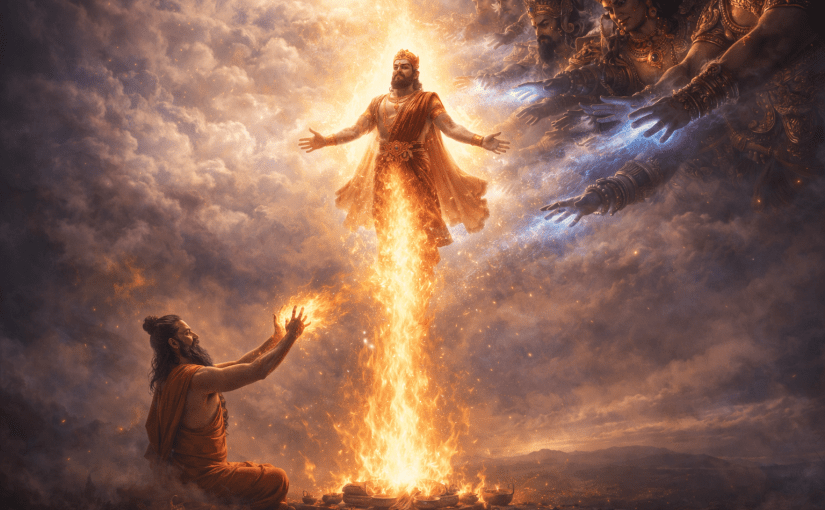
Chapter 22 – Superposition and Collapse: The Dance of Choice and Becoming

Creation is not a frozen script, but a living play of possibilities. At the quantum level, reality does not exist as fixed entities waiting to be discovered—it exists as superpositions, states of “may be,” “could be,” “shall be.” A particle before observation is not one thing or another; it is many things at once, carrying the fragrance of infinite futures. But when collapse happens—when an act of choice arises out of the silent field—one possibility is plucked from the garden of infinity and becomes the reality of this moment. Thus, superposition is the womb of creation, and collapse is its birth.

Imagine a child standing in front of a shelf of storybooks at night. Before choosing, every book is a possible story for the night — all the adventures, mysteries, and fantasies are equally open. It’s like a whole library of possible nights even though the child will read only one. But the moment the child picks a book, that story becomes the night’s reality, and all the other stories fade back into the shelf. This is exactly how superposition and collapse work: many possibilities exist at first, and one becomes real when the choice is made.

The sages of India intuited this mystery long before the equations of quantum mechanics. In the Upanishads, Brahman is described as “neither this nor that, yet also this and that”—a description that mirrors the quantum superposition. It is the realm where all attributes are held simultaneously, but none is bound. Collapse then is like the act of Ishvara Sankalpa—the divine will choosing to manifest a particular form from the unbounded potential of Brahman. Every event, every form, every particle we see is thus a frozen decision within this eternal game of becoming. That is why the Upanishads declare eko’ham bahu syām—“I am One, and I shall become many”—the divine will at the beginning of creation. Why not see this cosmic will as the very first collapse of pure potential into actuality, taking the form of fundamental fields and particles with specific properties such as form, charge, position, spin, and momentum?

Superposition: The Silent Ocean of Possibility

Imagine standing at the ocean early in the morning. The water is very calm, but that calmness is full of hidden possibilities—waves could rise in any direction at any moment. This is like superposition, where many outcomes exist together before anything is measured. In this “possibility state,” an electron is not spinning clockwise or counterclockwise—it is in a special quantum state that contains both possibilities at once, just like the calm sea contains all the potential waves before any one wave actually forms. Nothing is fixed yet; everything is only potential, waiting for one specific outcome to appear when observed.

In Sankhya, Prakriti before disturbance is completely calm — the three gunas are balanced, nothing has taken form, and nothing has begun. It is a state of pure potential. This is just like superposition in quantum physics, where all possibilities exist together but none is chosen yet. It’s called Prakriti in samyavastha or equilibrium. Prakriti waits for the presence of Purusha before anything moves or evolves. In the same way, a quantum state waits for measurement or interaction before one outcome becomes real. The moment Purusha’s attention falls on Prakriti is like the moment of collapse in quantum mechanics — the instant where potential becomes creation, and one definite reality appears. It’s called kshobha or disturbance in Prakriti. Why not call underlying fields as prakriti in samyavastha and particles born from them as kshobha in prakriti.

Prakriti is like sugar syrup. Within it, the sugar particle in it represents sattva; its dispersed presence throughout the syrup represents rajo guna through constant but unnoticeable movement; and its dissolution, where the particle no longer exists in solid form, represents tamo guna or destruction of particle form. Means in mool prakriti, all the three gunas remain in unchanging amount equally dispersed everywhere. It’s samyavastha. But when sugar particle is separated back from syrup through crystallization etc., then sattva guna varies at different locations as sugar particle has more concentrated sattva than rest of the sugar syrup. Similarly rajoguna also varies as sugar particles shows more concentrated motion than rest of the sugar solution on heating. With this tamoguna also varies for destruction or dissolution back of sugar particles contains more concentrated tamoguna or destruction than the uniform tamoguna in rest of the sugar syrup. If we replace the sugar particle with a quantum particle, the sugar syrup becomes the quantum field. The formation of a particle then expresses sattva as form, rajo guna as motion, and tamo guna as the particle’s eventual changing form, destruction or dissolution back into the field. It proves the same quantum fields were experienced by ancient sages with inner eyes which scientists are discovering as quantum fields through physical experiments. Brahma can be called as cosmic quantum field and soul as individualised quantum field as it has individual’s hidden impressions made from its countless lifetimes. Soul reborns again and again from this individualised quantum field. Liberation is like dissolving of even this field back into pure void space that’s nothing at all and is the background of grand quantum field aka prakriti. It’s only practically possible through nirvikalp samadhi, the top achievement of yoga.

There must exist a grand, all-encompassing quantum field from which every known quantum field arises. Science has not yet detected it, but logic strongly points toward its existence, because everything in nature moves toward unification. Just as diverse particles emerge from individual fields, all fields themselves must emerge from a deeper, singular foundation. In philosophical terms, this is the modern reflection of Prakriti—one source field from which all forms arise and into which they dissolve. Although string theory and few other scientific theories are speculating it.

Collapse: The Birth of Form

Collapse is not destruction; it is birth. When superposition resolves, a particular outcome is chosen and becomes the world. It is like the sculptor striking a block of marble: infinite shapes are hidden within, but one form emerges. Collapse is the act of manifestation, the narrowing of infinity into one thread of reality.

The Nyaya Darshana speaks of pramana, valid means of knowledge, where perception crystallizes the uncertain into the certain. Collapse is a cosmic pramana—it validates one outcome as the “real.” But this validation does not cancel the unseen others; they remain as shadows, as unseen branches in the cosmic tree, perhaps flowering in parallel universes.

Thus, every collapse is like an act of cosmic decision-making. The world is not predetermined; it is continuously deciding itself into being.

Choice as the Engine of Creation

Why is collapse so central to creation? Because collapse is the very engine of becoming. Without collapse, everything would remain an undifferentiated soup of potentials—silent, formless, directionless. Superposition is the clay, but collapse is the potter’s hand.

The Yoga Darshana explains creation as a process of sankalpa-shakti, the power of intention, arising from consciousness. The yogi is taught that by stilling the modifications of mind (chitta vritti nirodha), one returns to the ocean of possibility; but by focusing thought and intention, one collapses possibility into reality. In this sense, collapse is not only physical but also experiential. Each thought we entertain collapses infinite ideas into one lived reality.

In human life, collapse appears as choice. At every moment, we hover in superposition: Shall I act or refrain? Shall I love or withdraw? Shall I see the divine in the other, or reduce them to an object? Each decision collapses countless options into one stream of destiny. Thus, collapse is the bridge between freedom and form.

Quantum Collapse and Indian Metaphysics

In Vedanta, the play of Maya is described as veiling (avarana) and projection (vikṣepa). Superposition mirrors the veiling: the true state of things remains hidden, undefined, unmanifest. Superposition also veils the self luminous soul when it’s ready to collapse. Actually soul doesn’t collapse and can never collapse as it has nothing inside. It is perfect zero. It’s a perfect void. When soul of Brahma takes the form of prakriti, then it becomes full of all potentials. Although basic supreme soul remains fully void as such always. It means the soul of Brahma needs to become veiled to entertain the Collapse. Veiled means there is everything or every outcome in prakriti or bound soul in hidden or veiled or potential form without anything yet expressed through collapse. Collapse mirrors projection: a specific form is projected into consciousness of Brahma or human whatever level. What is hidden becomes revealed, what is possible becomes actual. The cycle repeats endlessly, each collapse weaving the fabric of the manifest.

The Bhagavad Gita proclaims: “I am the gambling of the gambler, the chance among things.” This chance, this sudden crystallization of one possibility among many, is none other than collapse. It shows that creation is not mechanical necessity alone—it is also play (lila), spontaneity, surprise. The universe evolves not by rigid design, but by the freedom of collapse.

Collapse as Sacred Fire

Consider collapse as Agni, the sacred fire. In the Vedic sacrifice, offerings are placed into fire, and fire transforms them into smoke and flame that rise to the heavens. In the same way, the infinite offerings of potential are cast into the fire of collapse. From that fire arises one reality, glowing with form and direction. Every collapse is thus a yajna, a cosmic sacrifice where possibilities are consumed to give birth to actuality.

This yajna continues ceaselessly: electrons choosing orbits, galaxies forming shapes, cells dividing, humans making decisions. All are flames of the same sacred fire.

The Pulse of Becoming

Superposition and collapse together form the pulse of becoming—the systole and diastole of the cosmic heart. Superposition is expansion into infinity, collapse is contraction into form. Together they beat, again and again, generating time, space, and history.

The Kashmir Shaiva philosophers described creation as the pulsation (spanda) of Shiva’s consciousness—an eternal throb between stillness and manifestation. Modern physics echoes this ancient intuition: reality is not a frozen block but a dynamic dance of probabilities collapsing into certainties.

Collapse and Evolution of Complexity

Each collapse does not occur in isolation; it feeds into the next. A particle’s collapse shapes its neighbor’s potential, like ripples overlapping in a pond. Over time, these ripples build into patterns, and patterns into structures. From hydrogen atoms to stars, from DNA to consciousness, the universe evolves because collapses accumulate into order.

In this sense, collapse is not merely local but evolutionary. The cosmos learns from each decision. Diversity emerges because collapses never follow a single path but branch into endless variations. Unity emerges because all collapses occur within the same underlying field. Creation is thus diversity in unity, and unity in diversity.

Collapse as the Mirror of the Self

Collapse is not just a physical event—it mirrors the movement of the Self. The Self is simply that which chooses, that which says, “I am this.” Means it ignores all of its hidden potentials and selects only a single outcome to identify with. In deep meditation, when thoughts fade, we rest in a state like superposition—pure being, without any identity. But the moment a thought appears, a collapse happens: the mind claims, “I am this body, this person, this story.” In this way, life becomes a continuous series of collapses happening on the still, silent ocean of superposition.

The Advaita Vedanta reminds us that behind all collapses, the Witness remains untouched—the pure consciousness that neither chooses nor becomes, but allows all choices and becomings to appear. To know that Witness is liberation, the transcendence of collapse itself. Probably it is this very same detachment and non-duality by whatever means, out of which quantum darshan can be a good one.

Quantum Collapse: The Engine of Creation

If we look at the grand picture, superposition provides the infinite palette, collapse paints the stroke. Together, they are the engine of creation. Without superposition, no possibility; without collapse, no actuality. Creation is thus not a single event but a continuous unfolding, driven by the rhythm of superposition and collapse.

This engine powers not only physics but life, mind, and spirit. Every breath is a collapse of air into lungs, every word a collapse of thought into sound, every act a collapse of freedom into destiny. The universe is not a machine, but a living story—authored moment by moment by the choices of collapse.

Copenhagen interpretation says the collapse is real and that no outcome is determined in advance—and many experiments support this. I also appreciate pilot-wave theory, where a particle is guided by a wave. It fits experimental results quite well. However, it claims that every outcome is already determined, which aligns with Indian philosophy that says everything is predetermined—even the movement of a leaf—and that humans are merely puppets.

If we think logically, when the probability distribution already tells us where a particle is most likely to be found, then perhaps the exact position is also predetermined; we simply do not know it yet.

Many-worlds theory is philosophically remarkable as well. In it, there is no collapse of superposition into a single outcome. Instead, every outcome manifests in parallel worlds. This resembles the human mind: one person may perceive a tree as tall, another as short; one may see it as more green, another as less green. A single object gives rise to multiple subjective outcomes. Many-worlds, in a sense, implies many minds—because the world is nowhere but within the mind.

Yet, among all interpretations, the Copenhagen interpretation—superposition and collapse—fits experimental observations most directly. That seems to be how nature operates everywhere. It is a kind of Darwinian quantum evolution: the peak of the amplitude is the most likely outcome, and nature consistently evolves toward it.

De Broglie was right: everything has a wave nature, whether electron, photon, atom, molecule, mountain, planet, or galaxy. Development occurs through survival of the fittest, and the “fittest” option is simply the option with the highest amplitude. This reveals a deep non-duality, where everything—physical or mental—operates through similar underlying patterns.

At the foundation of reality lies the pure quantum world, an impersonal field that performs the entire cosmic play without any capacity to feel. It creates, transforms, and dissolves everything effortlessly, yet it remains completely non-experiential, untouched by emotion or awareness. From this arises the quantum-human, a subtler layer where feeling and experience do appear, but with complete detachment and nondual clarity. The quantum-human experiences all sensations, thoughts, and perceptions generated by brain-wave dynamics, yet never mistakes them as “mine,” and therefore remains inwardly free. The mistake happens at the level of the macro-human soul, the ego-sense, which identifies with these brain-wave activities and assumes, “These thoughts are mine, these feelings are mine, this world is mine.” This misidentification creates duality, attachment, and ignorance. The quantum-human represents the middle path—a state in which a social human aka macro human being can still feel, relate, think, and live, but without falling into attachment and ignorance. Unlike the purely non-feeling quantum world, which no embodied person can emulate while living, the quantum-human offers a balanced model: fully feeling, fully aware, yet inwardly liberated. This is the practical ideal that Quantum Darshan points toward—living in society while maintaining the detachment and freedom that arise from understanding the deepest quantum game.

In nutshell, the main point of the story is that mystics discovered the ultimate truth and perfect peace by practicing seeing everything in the world as equal to themselves this way or that way that I also feel—meaning the inner working of everything is similar to that of a human being. Experience has already revealed this, and science will also reveal it fully one day. The division between living and non-living is superficial; at a deeper level, the functioning of all things is astonishingly similar. Call it the collapse of potential thoughts into specific thought or thoughts into a decision or something else—experience can never be denied simply because science has not yet fully explained it. Experience reigns higher than science. First comes experience; science only later affirms it so that even laypeople and non-believers can understand and believe it.

Conclusion

Superposition is the silence of infinite potential; collapse is the voice that speaks one possibility into being. Together, they form the essence of creation: freedom held in balance, then released into form. The Indian darshanas recognized this in their own tongues: as Purusha’s glance upon Prakriti, as the projection of Maya, as the pulse of spanda, as the divine will of Ishvara. Modern physics recognizes it as the quantum wave collapsing into measurement. Both are describing the same mystery: reality is not found—it is chosen, moment by moment.

Creation, then, is not behind us as a past event, but within us as an ongoing act. With every collapse, the universe is reborn.

Bhishma — Mahabharata’s Greatest Unsung Hero

The story of Bhishma abducting Amba, Ambika, and Ambalika is one of the most famous episodes in the Mahabharata. On the surface, it speaks of politics, duty, and human emotions. But when viewed through a yogic lens, it reveals subtle lessons about Kundalini energy and the journey of consciousness.

1. Bhishma: The Will That Guides Energy

Bhishma, with his unwavering determination, goes to bring the princesses to Hastinapur. In Kundalini terms, he represents the force of discipline and strong will that helps awaken and guide energy upward. Just as in yoga, Shakti cannot rise by itself—it requires direction, intention, and focused effort.

2. Vichitravirya: The Passive Consciousness

Vichitravirya, the young king, is passive and does not act on his own. He symbolizes receptive consciousness, the awareness that is ready to receive the awakened energy. The energy brought by Bhishma is meant to integrate with him, just as Kundalini rises to merge with higher awareness.

3. The Princesses: Different Types of Energy

  • Ambika and Ambalika represent energies that cooperate, integrate smoothly, and contribute to the continuation of life—just as balanced pranic channels support inner growth. Ida and Pingla matches them.
  • Amba, however, resists. She represents blocked or delayed energy, the kind that cannot merge immediately but requires purification, patience, and sometimes an entirely different pathway to awaken fully. Sushumna is having similar chracteristics.

4. The Abduction: Initiating the Energy Flow

Bhishma’s act of carrying the princesses away can be seen as a metaphor for initiating the upward movement of energy from lower to higher chakras. But force alone—whether physical, mental, or yogic—cannot guarantee complete integration. However it helps. But the inner energies must be ready to rise.

5. Rejection, Knot, and Transformation

Amba’s rejection by both Vichitravirya and Salva reflects a granthi—a knot of resistance inside the system. Blocked energy stores immense potential. It’s actually like meditation supporting object or dhyana alamban of Patanjali yoga to focus upon continuously to achieve samadhi or awakening. Over time, this energy transforms and goes up in a new, powerful form. Salva represents the lower chakras, and Vichitravirya represents the upper chakras of Bhishma. The energy of the Sushumna is stuck between them, reaching neither. Bhishma has given it upward motion, but not enough for it to reach the upper chakras as he is a celibate. Therefore, the energy returns to the lower chakras, but the petty worldly society now interprets her visiting the upper realms—even with the support of a celibate—as a sign that she has been defeated, seized, and loved by him. It is often seen in the layman-dominated society when an prior-known but now-turned intellectual is ignored by it and so he going to lonliness. Consequently, her past lover Salva rejects her. She has no way but to return to Bhishma and asks him to marry her, since only tantric force can elevate her to the top chakra, representing the Shiva-Parvati marriage or union. However, Bhishma, proud of his celibacy, rejects her offer, leaving her enraged. This celibacy is the result of spiritual sanskāras imparted by his father and family. The imprint of purity is so strong that he takes a solemn oath never to marry.
Amba eventually reincarnates as Shikhandi, whose presence becomes the cause of Bhishma’s fall. Symbolically, this represents how blocked energy eventually overcomes rigidity, merging at the right time, in the right form, only after purification.

Shikhandi confronting Bhishma symbolizes the moment when dynamic, transformed energy overpowers rigid, ego-driven will, allowing spiritual progress under the guidance of Arjuna (higher consciousness).

Yogi Bhishma — The Unsung Hero of Mahabharata

The story reflects a subtle truth about highly disciplined people. Like Bhishma, many celibates or individuals of strict discipline often reject potential partners, citing duty, career, culture, or moral codes—even when they have the strength or opportunity to accept them.

This rigid refusal creates a blocked emotional image in the heart chakra. The denied feminine energy becomes a subtle androgynous or eunuch-like mental imprint—male in its inability to act in a worldly sexual way, yet feminine in emotional tone. Over time, this blocked energy slowly transforms the disciplined mind, softening the rigid ego, turning the person more romantic or emotional, often leading them eventually into relationships and family life. However, this image remains like a eunuch Shikhandi for a long time and eventually dissolves after imparting realization. In this sense, it is also the “killing” of Bhishma by Shikhandi, because after the realization, a second birth is considered.

It means eventually, the once-stuck energy, purified through resistance and patience, rises to the brain, manifesting as guru-like image, wisdom, awakening, or divine consciousness.

The myth shows that rigid good will, when imposed on natural desire, stores great energy—but that energy eventually purifies, transforms, and expresses itself in a higher form.

Amba, Ambika, Ambalika as Yogic Channels

Amba can be understood as the Sushumna channel, while Ambika and Ambalika correspond to Ida and Pingala. Through forceful discipline, a yogi can manage Ida and Pingala—using asana, prāṇāyāma, and effort to push energy upward that can help to align sushumna as well but up to a limit.

But Sushumna is different:

  • Ida and Pingala can be controlled through practice.
  • Sushumna cannot be forced open.

For Sushumna to awaken, one must surrender, cultivate a balanced inner and outer life, heal buried impressions, and patiently wait.

Yogi Bhishma believed he could master Amba (Sushumna) by first controlling Ambika and Ambalika (Ida and Pingala), her two sisters.
He succeeded only partially—until he resolved his heart knot, transforming his inner image of Amba into image of guru, god etc. This shows that awakening requires inner transformation and the softening of rigidity—not just discipline. He started supporting the image of Amba in his mind later on, breaking his steadfast bow of celibacy, in a way leaning in front of destiny, and being tired of avoiding it, which signifies a confrontation with Shikhandi, the inner energy form of the outer Amba.

Ultimately, divine will must be accepted, and surrender becomes essential.

6. The Hidden Message

The Mahabharata teaches that:

  • Not all energies respond to force.
  • Purification, surrender, patience, and guidance are essential.
  • Blocked energy, when transformed, becomes a powerful force for realization.
  • The rigid ego must yield for true spiritual progress.

Conclusion

The Bhishma–Princesses episode is not only a story of kings and kingdoms—it mirrors the subtle dynamics of Kundalini within the human system. Bhishma represents willpower, Vichitravirya represents consciousness, and the three princesses symbolize energies waiting to awaken. Some integrate easily, some resist, and some transform through trials.

In the end, the tale teaches that effort and discipline alone are not enough. Awakening requires openness, surrender, inner healing, and divine timing.

Everyone often reflects upon their own mythological namesake, and perhaps the same has happened with me.
Recently, a new meaning revealed itself—one that seems to resonate strongly with the story of my own life.
That is why I expressed it without hesitation.
Perhaps this is the very influence of the name, and maybe this is its true meaning as well.

All of this is merely my personal experience and perspective.
The real truth is what the reader discovers within themselves.
If there is any error, it is mine; and if there is any essence, it is by the grace of the Divine.

chapter 21- Entanglement: The Hidden Thread of Unity

Imagine a universe where nothing is separate—not even for a moment. A universe where every particle, every star, and every human heart is silently connected through an invisible thread. This hidden thread is quantum entanglement, and it may be the most profound clue we have to understanding the unity of existence. What begins in physics soon expands into life, society, consciousness—and even spirituality.

If spin is the rhythm of creation, position is its stage, energy is its fuel, charge is its attraction and repulsion, and mass is its weight, then entanglement is the invisible thread that binds everything together.

Entanglement is one of the most mysterious qualities of quantum particles. It means that two or more particles, once connected, remain linked even if they fly apart across the universe. What happens to one immediately affects the other, as though an unseen string ties their destinies together.

To understand it in simple terms, imagine two lamps that were once lit from the same spark. No matter how far you take them—one on a mountain, another deep in a valley—their glow flickers in harmony. When one shifts, the other responds. This is how entanglement works. It defies distance and time, whispering that unity never truly breaks, even when diversity blooms everywhere.

Unity Beneath Diversity

Creation looks like diversity to our eyes: stars, rivers, animals, trees, and people. Everything seems separate. Yet entanglement suggests there is a deep oneness running beneath this seeming separation. Like a spider’s web, invisible yet holding all its strands, entanglement ensures that the cosmos is not a scattered puzzle but a woven tapestry.

Why not call entanglement an analogy to human society, where each member interacts with all the members to live and earn livelihood together? With this cooperation both manufacture various structures and machineries in a similar way. One insight emerges from here. Take an example: quantum particles make human eyes; humans make cameras. Both are similar, so the maker of both also proves similar. It also means both work in a cooperative society through similar 5 work senses, feel through 5 feeling senses, think with mind, decide with intellect, and have all bhavas, emotions, rasas, and arishadvargas. Simply, the qualities we see in humans are reflections of deeper cosmic principles already present at the fundamental level.

When the first quantum particles emerged, they did not float around in isolation. They carried within themselves silent connections with others. Because all are the children of single mother space. Each collapse of entangled particles did not just decide the fate of one—it shaped the destiny of both and probably even all to more or less extent, simultaneously, no matter how far apart they were. This synchronicity became the secret glue of creation.

Human’s married and family life can be understood through an analogy with quantum entanglement: just as one particle can be maximally entangled with only one partner and only partially with others, a husband is maximally entangled with his wife and indirectly with their children through her, while maintaining partial entanglements with society. Multipartite quantum entanglement fully resembles the family unit, where husband, wife, and children form a shared web of connections. If a person had a deep love affair before marriage, he became maximally entangled with that lover, and therefore cannot form maximal entanglement with his wife but only a partial one, exactly reflecting the monogamy and distribution rules of quantum entanglement. That is why purity is preferred for marriage, and society considers this a valid reason. If someone is accused of loving another partner, he or she is maligned and dishonoured. Similarly, In school and college life, students who get into romantic or sexual relationships with someone of the opposite sex tend to show less bonding with other classmates. This simply means that quantum particles behave very similarly to human beings in terms of family and social relationships, symbolically proving non-duality at all levels.

In Indian Darshana, this resonates with the idea of Advaita—the non-duality of existence. Just as the children of a mother are indirectly entangled with each other through their one shared mother, in the same way all quantum particles — or everything in existence — is entangled to some degree through the one shared mother: space itself. It is a reverse analogy, but it explains the idea clearly.

The Choosy Collapses of Entanglement

So how does entanglement guide creation? It does so through its choosy collapses.

When two entangled particles exist in superposition, each remains a cloud of possibilities until one collapses into a definite state, instantly shaping the state of the other. This is not merely a passive reaction but a creative choice of nature. In a deeper sense, all particles arise from the same shared space — the single ‘mother’ of creation — and therefore carry faint traces of connection with all others, just as children remain indirectly linked through their mother. Although modern physics shows that strong entanglement fades through decoherence, the underlying unity of space and quantum fields suggests a subtle background interconnectedness. Every collapse, every quantum decision, participates in shaping the unfolding cosmos, reflecting the profound non-duality behind the dance of forms.

This is also evident from the fact that every event in the body and even cosmos is connected to the past, future, and even processes occurring elsewhere in nature. For example, when strong stomach acid enters the mouth during vomiting, there is an immediate profuse flow of saliva to neutralize it; otherwise, the acid would dissolve the teeth. This hints at entanglement occurring even at the macroscopic level.

If two entangled particles must always be opposite in spin, when one chooses “up,” the other instantly becomes “down.” If one locks into a position, the other aligns correspondingly. It is similar to the case of two people arguing: when one becomes angry, the other calms down to maintain harmony. In the same way, married life works better when one partner embodies a more masculine energy and the other a more feminine energy. This coordination echoes everywhere in creation. It is as though nature whispers, “Even in difference, remain one.”

Through countless such coordinated and harmonical collapses, the universe maintains order — galaxies stay together instead of flying into chaos, atoms form stable molecules, and even human hearts feel subtle connections across distances. Entanglement is not just a physical phenomenon; it is the universe’s way of reminding us that, beneath everything, we are all connected.

Entanglement and Living Beings

Look at how life mirrors this principle. A mother feels the cry of her child even from miles away. Twins often sense each other’s moods without speaking. Friends think of calling each other at the same moment. Science may call this coincidence, but at its root lies the same mysterious entanglement that connects all existence.

Just as quantum particles collapse together, our lives, too, are woven in collapses of destiny. The choices of one being ripple through the web, shaping the path of another. Entanglement makes the cosmos less like a machine of cold parts and more like a living organism, breathing in unity.

In simple forest tribes or small rural communities, people often feel more emotionally connected, because their lives are quieter, slower, and less filled with distractions. In crowded metro societies, this emotional ‘coherence’ breaks down due to noise, stress, and constant mental clutter — very similar to how quantum entanglement disappears in particles when they interact too much with their environment. This is the social equivalent of decoherence. Yet even in big cities, a faint sense of connection still persists — between family members, close friends, or even strangers who suddenly understand each other without words. This lingering human coherence suggests that, just as some emotional entanglement survives in complex societies, a very tiny trace of quantum entanglement might also persist in complex and noisy natural objects. It would not be strong or useful like laboratory entanglement, but the fact that coherence never becomes zero hints at an underlying unity that never fully breaks.

Entanglement as the Harmony of Creation

Imagine a grand orchestra. Each instrument is unique, playing its own notes, yet all are tuned to a single rhythm, otherwise the music would be noise. Entanglement is that hidden rhythm. It ensures that even when the violin sings differently from the drum, both remain part of the same symphony.

Without entanglement, the world would splinter into lifeless fragments, like scattered beads without a thread. But because of it, the beads form a necklace—diverse in form, united in purpose.

Quantum Collapse: The Engine of Creation

At the heart of it all is quantum collapse. Creation is not a pre-written script. It is a live performance, each moment born afresh when a particle chooses one possibility out of many. Collapse is the great chooser, the silent decision-maker.

Entanglement adds depth to this act. One collapse does not happen alone—it carries others along, weaving a larger order. It is like dominoes falling in patterns, not randomly, but in carefully chosen designs that give rise to galaxies, stars, life, and consciousness.

Collapse is the engine that keeps creation moving, while entanglement ensures that the engine’s many parts remain in harmony. Together, they make sure the universe is not just a collection of accidents, but a living, breathing dance of unity and diversity.

Closing Thought

Entanglement teaches us that separation is only skin-deep. Beneath the surface, all existence remains connected. Every particle, every being, every star is part of a silent unity. When quantum particles collapse, they do not just create diversity—they reveal that this diversity never left its unity.

In this light, entanglement is not only a scientific puzzle but also a spiritual reminder: we are many, yet one; different, yet inseparably bound. Creation thrives on this truth, and collapse is the way it continuously paints the picture of unity within diversity.

Chapter 20: The Place of Creation

At the dawn of the universe, there was no here or there. The first particles were not settled in any fixed place. They existed as clouds of possibility, spread like mist across the vastness. To ask “where” they were was meaningless, because they were everywhere and nowhere at once.

This is the strange nature of quantum position. A particle before collapse is not a dot on a map but a haze of probabilities. Only when it interacts, only when it “decides,” does it appear at a particular spot. In that instant, a position is chosen, and the many vanish into the one.

The First Footsteps

Imagine a great empty field covered in soft dew. Countless birds hover above, each uncertain where to land. Suddenly, one descends on a blade of grass. Another chooses a twig. Another settles by the riverbank. Slowly, the field fills with definite presences.

In the same way, the first particles collapsed into positions. One appeared here, another there. What was once a uniform mist became a patterned arrangement. The seeds of galaxies were scattered across space like stars across the night sky.

It seems similar to bird instinct—when one bird settles somewhere, others also follow and occupy the surrounding spots, rather than choosing isolated places. In the same way, quantum particles may also seek different forms of “social security” such as protection, interaction, cooperation, division of labour, and many other collective behaviors. In this sense, they appear almost living, depending on how they express their liveliness through different modes. One thing is certain: they are not bound by the strict patterns that define life in the conventional biological sense. Perhaps the yogic principles of detachment and non-duality partially emerged by observing such natural phenomena, which were worshipped in Vedic culture.

Those choices — small, random, delicate — shaped everything that followed. A particle a little closer here made matter gather. A particle a little farther there left emptiness behind. Out of those uneven gatherings grew stars, planets, and the stage on which life would walk.

The Cosmic Mosaic

Think of making a mosaic. You have colored stones spread loosely in a basket. Where you place each stone decides the picture that emerges. A stone here may form the curve of a flower. A stone there may form the outline of a face. The picture is nothing but the sum of all placements.

Creation too is such a mosaic. Quantum particles, by collapsing into specific positions, drew the outlines of the universe. One placement led to density, another to emptiness, another to symmetry, another to asymmetry. Together, they painted the grand design of existence.

The Indian Darshana Parallel

In Indian thought, space is not a void but a living principle — Akasha. It is the first element, the womb in which all other elements arise. Yet Akasha is not filled until particles take their positions. Only then does space find its rhythm, its structure, its meaning.

Just as the choice of deśa (place) in yoga influences how smoothly the mind becomes quiet, the location of a quantum event determines where a particle finally appears, yet both operate on entirely different planes. In dhyāna, the mind returns to the original Ākāśa, the silent field of pure awareness, where no physical settling occurs; there is only dissolution into stillness. In contrast, the settling of a particle during quantum collapse is a material process within space-time, governed by physical conditions rather than consciousness. The analogy works only in a metaphorical sense: a supportive sacred space like temple helps the mind stabilise, just as certain dense regions of the cosmos allow matter to gather, while vast empty stretches remain like neutral spaces where nothing settles. This comparison highlights a resemblance in behaviour without confusing their foundations — one belongs to inner consciousness, the other to outer matter.

A temple is a concentrated field of pure consciousness, and therefore it naturally attracts the minds of meditators to merge with it. Similarly, a dense region of space is a concentrated field of particles, and it attracts the surrounding quantum waves to collapse into particles and join that cluster.

Chance or Play?

Science tells us that the particle “chooses” its place according to probability. Where the wave is stronger, the chance of collapse is greater. To the human mind, this looks like chance.

But Indian darshana reminds us: what seems random is also play — Lila. Each collapse is like a dancer choosing a step, not planned, not rigid, but part of a spontaneous unfolding. Out of those steps, the dance of the cosmos arises.

In cosmic psychology, quantum collapse can be seen as the mind of the universe choosing a definite experience from infinite possibilities. Each quantum quality—such as spin, charge, or position—unfolds on the same single probability wave, unaffected by the outcomes of the each others. The higher the amplitude of the probability wave, the stronger its pull on creation’s attention—like a thought or desire that repeats until it manifests. Collapse then is not random chaos, but a weighted selection, where the cosmos tends toward the possibilities most charged with energy, while still allowing even faint possibilities to occasionally become reality.

Layman’s Metaphor: Children in a Park

Picture a park where children are playing hide and seek. Before they run, you do not know where each will hide. Every bush, every tree, every bench is a possibility. But as the game begins, each child chooses a spot. One hides behind the slide, another under the tree, another by the fountain. Suddenly, the empty park is filled with presence, pattern, and life. The fun of the game comes from their choices. The universe too was like that park. Particles chose their hiding spots, and from those choices, the drama of galaxies and stars began.

If we look a little deeper, a child chooses the hiding spot that appears most strongly in his mind. This means his inner energy-wave rises higher toward the brain when he imagines that particular place. If he suddenly notices another, safer spot, the energy-wave remains the same, but the thought related to the previous choice sinks towards the muladhara chakra—a site of lower amplitude—while the new thought for the newer hiding place rises to the sahasrara chakra, a site of peak amplitude of the energy-wave. Because he has no time to analyse further, he quickly collapses into that choice.

The same play of rising and falling of every choice or expression on the amplitudes of the kundalini energy-wave operates in every living organism, much like in a quantum particle. Time also becomes a factor in determining the collapse, for if the time available is short, the best possible outcome that may be available later might not be selected.

A man who craves one motorcycle today may crave a different model tomorrow. When this happens, the thought of buying the earlier model sinks into the darkness of the Mūlādhāra, while the thought of buying the new model rises and shines in the brain. Yet exceptional circumstances—such as a low budget, an unwillingness to borrow money, or emotional or cultural factors—may still force him to buy the earlier, less-preferred model, because that thought is not fully in the zero-amplitude region of the Mūlādhāra. However, he will never buy a scooty if he naturally dislikes it, because the thought of buying it sits in the true zero-amplitude region of the Mūlādhāra, which corresponds to zero probability.

A similar situation can occur in quantum events, where the wave may collapse in a lower-amplitude region due to environmental interactions. Although the probability of this remains low, it never collapses into a zero-amplitude region, because the probability of finding a particle there is exactly zero.

It is like the spin character of a quantum particle with two outcomes: spin-up and spin-down. Suppose spin-up corresponds to the peak amplitude-height and spin-down to a mid-height of amplitude, while the “no-spin” or “both-spin” state corresponds to zero amplitude-height—something known to be impossible. Here, spin-up is like the new motorcycle model, spin-down is like the older model, and the scooty corresponds to the impossible “both-spin or no-spin” situation.

Similarly, a quantum state such as momentum can have many possible outcomes spread across the wave at various amplitude-heights: the highest amplitude level giving the highest probability, the lowest amplitude level giving the lowest probability, and intermediate level heights giving intermediate probabilities. The same dynamic operates in the human mind when many options are present.

A highly attractive motorcycle model may occupy one’s heart; another, slightly lower in preference, may focus energy on the navel chakra; a still lower option may settle around the Svādhiṣṭhāna chakra; and a problematic choice may rest in the Mūlādhāra. This means thoughts corresponding to each motorcycle model settle in a particular chakra after being analysed by the mind. The top model may focus energy on the Ājñā or Sahasrāra chakras. That is why there is a common Hindi saying for something deeply liked: “sīr chaṛhkar bolī hai”—it has risen to the head. It has the highest probability of being expressed or chosen. But it is also a famous saying that Hearth speaks more truth.

Dull localisations in the lower chakras are easy to ignore, but the shining leaps of energy in the higher chakras are hard to overlook. This is māyā—the illusion or attraction created by this shining and joyous thrill. If studied deeply, it may reveal profound psychological secrets about how humans behave and how they are propelled by the subconscious and by external environments.

Seeing this, the similarity between the living world and the quantum world appears astonishing and almost complete. The only major difference is that the quantum world is fully detached, non-dual, and completely unaffected and unbound — unlike the living world. If that is so, is it possible for human beings to share even a small portion of that freedom while still living? Perhaps nature worship and its personification in the Vedas were developed for this very purpose.

A yogi’s mind being like an innocent child is attuned to the cosmic mind because of his detached and nondual attitude. It functions like a quantum probability wave, naturally tending to choose the most uplifting and harmonious outcome for expression — just as a quantum wave has the highest probability of collapsing into a particle at the peak of its amplitude. This is because they have no bias toward any particular outcome. However, even if they must maintain a bias in order to run the world, it is not a real bias, because their attitude remains detached and nondual. That is why most of a yogi’s decisions appear wise and beneficial to all. However, there remains a negligible chance of a lower or less ideal decision, much like the faint probability of a quantum wave collapsing at a lower amplitude — but such instances are rare and cause little harm.

Position as the Seed of Diversity

Why is position so important? Because where something is decides what it can become. A seed in dry soil may wither. The same seed in fertile earth may grow into a tree.

So too with particles. A proton alone in emptiness is only a proton. A proton near an electron can become hydrogen. Many hydrogen atoms close together can become a star. Thus, the placement of each particle set the chain of possibilities that would follow. Similarly, a man digging alone, away from a group of people who are also digging, cannot complete a well on his own within a practical period of time.

One choice of position led to emptiness. Another led to clustering. From clustering came stars, from stars came elements, and from elements came us.

Humans also share the same tendency. They prefer to build homes and settle in already existing colonies or villages rather than in empty forests. As a result, these colonies grow increasingly populated, interactive and vibrant — just as stars cluster together, leaving the vast empty spaces of the cosmos untouched.

Quantum Collapse as the Engine of Creation

Here lies the heart of the mystery: creation is nothing but collapse. Before collapse, everything is a possibility. After collapse, something is real. Without collapse, the universe would remain a silent fog of probabilities, never stepping into form.

Collapse is the invisible engine that drives becoming. Each time a particle “decides” — to be here, to be there, to be this, not that — the world gains a new detail. Collapse is the moment when the unmanifest takes birth.

The rishis said, “From the unmanifest, the manifest arises.” Physics calls it collapse. Unmanifest means everything is there in superposition, not manifested in any outcome. Darshana calls it creation. Both point to the same truth: the world exists because probabilities bow down into realities.

In the same way, the soul decides where and in what form to express itself in a new birth, according to its hidden mental waves — the subconscious imprints. This corresponds to the peak of amplitude, meaning the peak of experience. The form with which this peak of experience aligns determines the soul’s next birth — some become human, others take form as animals, birds, and so on — together filling the Earth to enable the interactive and harmonious living of all creatures with one another and with nature.

Closing Reflection

So when you walk across the earth, remember: every grain of soil beneath your feet is there because a particle long ago chose that place. Every star shining in the sky is there because ancient collapses scattered matter into its seat.

Position is not a trivial thing. It is the silent artist, arranging particles like beads on a cosmic thread. Without those choices of “where,” there would be no “what,” no galaxies, no rivers, no bodies, no breath.

Closing Verse (Mantra-style)

From the cloud of maybes, a single point arises.
From the unseen spread, a place is chosen.
Position is the brushstroke of the cosmos,
Painting stars, weaving bodies, grounding life.
O choosy collapse, O silent hand —
You are the engine that made creation real.

When Darkness Turns Peaceful: The Quiet Maturity of Dhyāna

Today, I felt the Kundalini stationed at the navel chakra. I rose a little late, around 6 a.m., and practiced spinal breathing, my Guru-given poses and pranayama, along with some self-devised postures and a top-to-bottom chakra meditation—without holding the breath as daily routine. Soon, enough yogic pressure built up to launch dhyāna.

I sat in vajrāsana, keeping my eyes turned upward toward the eyebrow center, and even beyond—straight up toward the unlimited height of Ekārṇava. The breath gradually became regular and calm, though not completely suspended as on previous days.

The śūnya dhyāna was deep, with occasional flashes of my Guru Nārāyaṇa’s image—alive and radiant. Guru Tattva is not actually outside but within. When one turns inward, it naturally emerges from inside. It is the intermittently appearing image in the mind during dhyāna that keeps the mind from wandering—by focusing it upon itself until it finally dissolves into Brahman. In a way, it acts like a cargo vehicle of the mental world, carrying awareness directly toward Brahman.

That is why many religions give prime importance to the Guru. They design their lifestyles to encourage introversion and dhyāna, allowing a stable Guru-image to form within the mind itself. However, for this process to become truly effective, there must be a suitable person embodying divine qualities—only then can he or she become a true Guru. In the absence of such a living master, divine idols may serve as substitutes, though they cannot compare to a living Guru, who is like an animated idol of God, and therefore far more transformative.

The Guru principle is revered in every sect and religion, but it seems that Sikhism understands the essence of Guru Tattva most profoundly.

I felt that just as Kundalini energy nourishes the chakras within the body, it also nourishes the chakras beyond the body, extending infinitely into śūnya. The same Kundalini that maintains physical vitality also helps transcend the body, merging into the endless expanse of Ekārṇava śūnya.

Today, I gave priority to the nourishment of śūnya rather than to any specific chakra. Still, the intermediate chakras seemed to receive their share of energy naturally whenever it was directed upward toward Brahman. I could sense the energy supporting the area behind the navel chakra along the spine, while the other chakras felt calm and balanced—not blissfully inflamed like the navel center.

Yesterday, my energy had settled at the Anāhata chakra. It had descended gradually—from Sahasrāra downward—each day resting at the next lower chakra. A day earlier, I had also conserved Mūlādhāra energy, which perhaps rose swiftly to the navel. This rapid movement might be due to the role of descending energy; although all energies rise from Mūlādhāra, the descending current seems to return from Sahasrāra like the monsoon rains returning from the mountains. When the forward and returning monsoons (the western disturbance rains) meet over an area, they bring catastrophic rainfall. Similarly, when descending and ascending energies meet at a chakra, they cause its profound activation, often producing a mental upheaval that can be difficult to control at times although quantum darshan helps in it.

In any case, śūnya dhyāna was peaceful. Later, I tried focusing directly on the navel chakra to give it an extra boost. The breath then turned irregular, as if adjusting itself to channel energy into the navel center. When I shifted my focus back to the Ājñā chakra, the breath again became calm. After a few such cycles, I gently ended my dhyāna and stood up to begin my morning routine.

There comes a time in meditation when bliss fades, and only silent awareness remains. I am experiencing this now—no bliss, but a completely still and neutral space. I can’t even call it darkness, because darkness usually frightens or repels one; yet I feel the exact opposite. I find perfect peace there, a deep relief from the agitation of breathing. At first, this may seem like something is lost—but in truth, it marks the maturity of dhyāna.

Earlier, the mind sought experiences—light, warmth, or waves of joy. Darkness felt empty and unsettling. But when the storms of breath and thought finally rest, perception changes. The same darkness no longer threatens; it simply is. Nothing outside has changed—only the seer has.

This is the quiet flowering of awareness: peace without excitement, clarity without effort. Even without inner light or sensation, a subtle luminosity begins to shine—the light of knowing itself.

When this awareness deepens, life feels transparent and gentle. Speech, work, and movement unfold within the same still space that once appeared only in meditation. There is no need to hold awareness—it holds itself. I am still waiting for that stage to blossom within me.

In this simplicity lies the true radiance of dhyāna: not a blaze of visions, but a calm seeing that never leaves, even in the heart of darkness.

Quantum darshan; Chapter 19 – Parity: The Tilt of Creation

At the very start, the universe was almost perfectly balanced — like a mirror showing the same picture on both sides. It simply means, In the beginning, the universe was perfectly symmetric—there was no left-right distinction between object and image, no real-virtual difference between the two, and although charges, forces etc. were opposite, they were exactly equal, creating a state of complete balance. Every particle, every force, every tiny action had an equal and opposite twin. If the universe had stayed this way, nothing would have moved. Nothing would have changed. Nothing would have existed as we know it.

But the universe didn’t stay perfectly balanced. It tilted. Even a tiny tilt was enough to start everything moving and changing. This small imbalance is seen in two important ways in science:

  1. Parity asymmetry – Some forces in nature, like the weak nuclear force, do not treat left and right the same. Tiny differences here meant that the universe could have direction, that one side could behave differently from the other. The weak nuclear force is the only one that prefers one “handed” direction over the other, breaking the mirror symmetry of nature. This tiny one-sidedness preferred reactions that allowed matter to win slightly over antimatter after the Big Bang, making the very existence of stars, worlds, and life possible. Likewise inside the body, If prana flowed perfectly symmetrically in the Sushumna, meaning equal left and right, equal up and down, there would be no directional impulse—no manifestation of individual experience, no creation of worlds—just pure nonduality, just as perfect parity symmetry would prevent matter from winning over antimatter, leaving the universe empty. This imbalance in the magnitude of prana drives specific emotions and actions. When the upward-moving prana is dominant, a person becomes more spiritually oriented; when the downward prana is stronger, one is more physically inclined. Similarly, greater prana flow in the left channel (Ida Nadi) makes a person more feminine, while dominance in the right channel (Pingala Nadi) makes one more masculine. When prana becomes equal in all directions, the opposing currents neutralize each other, leading to breathlessness in Kevala Kumbhaka or Nirvikalpa Samadhi—a thoughtless pre-creative state, just like the stage preceding the beginning of creation.
  2. Matter-antimatter imbalance – At the beginning, matter and antimatter were almost equal. But there was a tiny excess of matter. This small difference is why stars, planets, and life exist at all. Without it, everything would have destroyed itself in a flash of energy. Likewise inside the body, at the very beginning, the potentials for stillness and manifestation were almost equal: the upward and downward currents in the Sushumna flowed symmetrically, just as matter and antimatter existed in nearly equal amounts. Then a tiny excess of upward flow appeared, creating just enough imbalance to spark individual experience—thoughts, sensations, and life—allowing consciousness to unfold into worlds, while a small excess of matter over antimatter allowed stars, planets, and life to exist. Without this slight tilt, everything would remain in perfect nonduality, like a universe where matter and antimatter annihilate each other completely, or a Sushumna where energy flows perfectly symmetrically, producing no manifestation at all.

Let us rewrite this in further detail. At the very beginning, the universe was almost perfectly balanced, like a mirror reflecting an object — left and right were opposite in appearance but equal and followed the same rules. Although they appear slightly unequal—differing only in direction—they remain identical in their underlying laws and reactions. In other words, both have been said equal with respect to rules obeyed, not appearance. This is called symmetry: even if something looks reversed, its behavior is still predictable and is equal to parent form. But if the universe had stayed perfectly symmetric meaning if particles and their mirror images were equal in number, nothing would have moved or changed. Everything would have cancelled out with its mirror image. Matter and antimatter would have destroyed each other, forces would have canceled out, and creation could not have begun. Treat antimatter as mirror image of matter. A tiny tilt — a small breaking of symmetry of number or force — changed everything. Weak forces began to treat left and right differently, a scientifically proven effect called parity violation, and some reactions slightly favored matter over antimatter — a phenomenon known as CP violation or charge-pairity violation. Matter and antimatter always have opposite charges. Matter is what makes up the universe — electrons, protons, and neutrons — while antimatter is their “mirror opposite,” like positrons and antiprotons. Normally, when matter and antimatter meet, they annihilate each other, producing energy. But in experimental particle decays, there is a slightly higher probability for matter to form than antimatter. Though these differences are extremely tiny, they pile up repeatedly in the early universe, eventually creating a small excess of matter that formed all the stars, planets, and life we see today. Even at the quantum level, particles exist in multiple possibilities, and one outcome becomes real when measured — this is called quantum collapse. Together, these scientifically proven effects explain how the universe tilted, giving direction to galaxies, allowing stars to burn, molecules to have “handedness,” and life to grow. Symmetry alone is stillness, like calm water; breaking symmetry is motion, like a river flowing. Creation began with this first tilt, the subtle imbalance that turned potential into reality, stillness into movement, and possibility into the living, evolving universe we see today. Yet at the deepest level, why nature has these rules — why left differs from right, or matter slightly outweighs antimatter — remains one of the greatest mysteries of existence. The same mystery extends to the body as well: why Ida differs from Pingala, or why the upward surge of energy outweighs the downward flow, remains one of the greatest mysteries of existence. Philosophically, it may be regarded as the growth-oriented wish of the Almighty Supreme.

If we dissect it further, in the universe, symmetry is subtle and sometimes broken. Parity (P) violation shows that nature is not perfectly left-right symmetric — the weak force “prefers” one handedness. Charge (C) violation reveals that swapping particles with their antiparticles (means replacing particles with their antiparticles or in other words charged particle made oppositely charged antiparticle) does not always produce identical behavior and weak nuclear force does not affect them equally. CP violation goes deeper: even after combining a mirror flip with a particle-antiparticle swap means after directional swap and trying to correct it with charge swap, a tiny asymmetry still remains. While P and C can be violated independently, Parity violation (P) was already known in the weak force — it treats left and right differently. When scientists combined parity violation with charge conjugation (C), which swaps particles with antiparticles, they expected the two violations to cancel out. But experiments showed that even this combined symmetry (CP) is slightly violated — meaning a small imbalance still remains. In other words, CP violation means that an imbalance — arising from the combined effects of charge violation and parity violation — still remains, although it is reduced after attempting to correct the parity violation through particle swapping. This tiny leftover asymmetry is crucial, as it helps explain why matter dominates over antimatter in the universe, showing that the cosmos itself carries an inherent, subtle bias at the most fundamental level. In yogic terms, If the asymmetry between the upward and downward prana is balanced by shifting the flow between Ida and Pingala, a subtle imbalance still remains — and this residual asymmetry gives rise to thoughts.

In yoga and the human body, symmetry too is subtle and often incomplete. The two sides of the body — ida and pingala, lunar and solar currents — represent the left-right (P) aspect of our internal energy field. Perfect balance between them creates stillness; imbalance generates movement and evolution. The charge (C) aspect parallels the polarity of emotion and intention — attraction and aversion, desire and renunciation — our human version of positive and negative charge. Yoga gradually harmonizes these forces, yet even after deep purification, a faint residue of imbalance often remains — the yogic equivalent of CP violation. This subtle leftover tendency — neither purely active nor passive, neither fully detached nor fully engaged — becomes the creative bias that sustains individual existence, just as cosmic CP violation sustains matter itself. Without that faint asymmetry, neither the universe nor the yogi would manifest as a living, evolving expression. Hence, the aim is not to erase all imbalance, but to realize its sacred role — the gentle imperfection that allows consciousness to experience itself as creation.

In another analogy, In the beginning, both the universe and a perfectly still mind were in flawless balance—no left or right, no real or virtual, just pure symmetry. Yet, tiny biases—like subtle impulses in meditation or CP violation in particles—created small differences. Normally, perfect balance would erase them, but a slight openness lets them persist, seeding growth: in the cosmos, it became stars and galaxies; in the mind, it becomes evolving awareness. From the subtlest imperfection, the greatest creations arise.

Think of a pot of water. If the pot is perfectly still, the water stays still. Tilt it just a little, and the water flows. That’s what happened with the universe — it leaned slightly, and the flow of galaxies, stars, and life began.

In Indian philosophy, this is like Shiva and Shakti. Shiva is stillness, perfect balance. Shakti is movement, the first tilt, the first action that starts creation. Without Shakti, the universe would remain frozen and silent.

Even at the tiniest level, in the world of quantum particles, things can exist in many possibilities at once. When a particle is measured or interacts with something, one possibility becomes real — this is called quantum collapse. By itself, quantum collapse doesn’t create the universe’s tilt, but it shows how possibilities become reality. The real tilt comes from nature’s small preferences — like the slight favoring of matter over antimatter.

In the human field of consciousness, countless thoughts, emotions, and intentions also exist in superposition — potential realities waiting to be chosen. The moment awareness focuses on one thought or emotion, that possibility collapses into experience — just like a quantum event manifesting from probability. Meditation trains this awareness to become a silent observer, reducing unnecessary collapses caused by mental restlessness. Yet, even in deep stillness, the mind retains its subtle bias — its own version of nature’s tilt — a gentle preference shaped by tendencies (vasanas) and latent impressions (samskaras). The subtle bias within consciousness sustains individuality, propelling life’s continuity from moment to moment. Yoga doesn’t erase this bias but purifies it until the remaining preference aligns with truth itself. Then, consciousness begins to choose effortlessly — not from ego, but as pure intelligence expressing harmony. What once was mental decision becomes spontaneous movement, free of tension or motive. Every action, word, or thought arises as if the universe itself is flowing through the individual. This is quantum darshan — the direct seeing where observer and observed merge, and infinite potentials collapse into form by the silent will of Truth. Life then unfolds naturally, every moment luminous, precise, and whole — not chosen by someone, but happening through the still radiance of awareness itself.

Because of these tiny tilts, the universe works the way it does:

  • Galaxies spin in certain directions. This is reflection of directional preference of quantum world.
  • Stars burn matter, not antimatter. This is like life shines with ascending energy in spine.
  • Life uses molecules with a preferred “hand” (left-handed or right-handed). Amino acids of proteins, the main building blocks of body have left handed twists.
  • Time moves forward, never backward. On paper or equation, it can move backward but in reality, time always moves forward.

Without these tiny imbalances, nothing would grow, nothing would change, nothing would exist. Symmetry is like calm, still water. Asymmetry is like a river flowing toward the sea. Symmetry is silence; asymmetry is life itself.

Everything we see — from the tiniest particle to the largest galaxy — began with a tiny tilt, the first small imbalance that made the universe start moving, growing, and creating.

Similarly, within the human being, perfect balance is pure stillness — samadhi, where all dualities dissolve into calm symmetry. Yet life as we know it arises from tiny tilts within that stillness — the pull of desire, the urge to breathe, the impulse to move, to love, to seek. Just as the cosmos began from a minute asymmetry, the human journey unfolds from the faint imbalance between rest and expression, awareness and activity, Shiva and Shakti. Too much symmetry and one dissolves into stillness; too much asymmetry and one is lost in turbulence. Yoga is the art of keeping this sacred tilt alive — not erasing it, but refining it until it flows in harmony with the universal rhythm. In that subtle dance between silence and movement, the yogi mirrors the cosmos: still at the center, yet ever-creating at the edge.

Awareness at the Anahata Chakra – Healing Through the Goddess Within

I began my yoga practice at 5 a.m. today. The air was still, mind silent, and body ready. After spinal breathing, I moved through guru-given yoga and my own selected set, including chakra meditation from top to bottom — without holding breath. These days I avoid breath-holding to prevent excess head pressure. Yet I’ve realized there’s no real need to fear it; the head has an incredible capacity to bear and balance the force of prana.

Once, during a dream-state gastric uprising, I experienced immense head pressure, momentary choking, and a transient rise in blood pressure — but the body adjusted beautifully. It reminded me that a well-practiced body knows how to balance itself. So, my preparatory yogic routine continued for about an hour and a half — enough to create the internal yogic pressure required for launching into dhyana.

I know this yogic pressure is temporary. It gradually dissolves into the luminosity of dhyana, just like gas slowly burning out from an LPG cylinder. And when that inner fuel finishes, the practitioner naturally returns from dhyana — first through strong internal contractions from lower to upper area of body backside as to facilitate the movement of energy in the three main spinal channels, followed by the gradual deepening of breath. When the breath returns to normal, the eyes open by themselves. The same happened today.

During dhyana, Vajrasana again gave an excellent starting response. Subtle breathing began automatically at the Ajna Chakra and continued for quite long. Yet all along, I felt a kind of sexually blissful senation at the Anahata Chakra. I was including this bliss within my Ajna-to-Muladhara meditation line, so both centers — Ajna and Anahata — were simultaneously satisfied. No other centres seemed power hungry. Later, I shifted my dhyana solely to Anahata. The awareness deepened there, but the main purpose of dhyana — the realization of Shunya (void) — was not completely fulfilled there. So, I again combined both Ajna and Anahata awareness together.

I recall a Kriya Yoga expert once said that “spinal meditation alone can’t grant liberation.” He emphasized that Ajna Chakra meditation includes the whole spinal system. Today, I understood his point deeply — indeed, every chakra of the backbone is reflected within Ajna. Yet, even knowing this, my sensational awareness remained localized at the rear Anahata Chakra, unwilling to move elsewhere, although breathing awareness was on agya chakra.

Yesterday my focus was at Vishuddhi Chakra, where I had a throat infection. That infection cleared today, but the infection and along with it the energy had descended to the chest. This shows how sensitively these inner sensations mirror physical conditions — a subtle diagnostic test and often a healing mechanism. Still, medicines nowadays help more directly, supporting this inner process. In ancient times, diagnosis and healing through awareness given the form of the Goddess held prime importance, as there were not so many worldly facilities available.

As I visualized the Goddess at the Anahata, the rising sexual bliss from the Muladhara seemed to empower Her presence. I could faintly see Her fighting demons — symbolic of microorganisms — within my chest. It felt as if the Anahata Chakra itself had become a Lingam, the real blissful lingam now manifesting only there.

After about thirty minutes, when my legs cramped, I slowly shifted to Sukhasana, minimizing body movement while keeping awareness rooted at Ajna to avoid breaking dhyana. I then sat for another hour, not breaking earlier feeling that Shakti was healing my heart center and its connected tissues.

Towards the end, a magnificent experience unfolded — a clear perception of Shunya, more radiant than yesterday. It felt as though I was seeing the infinite sky directly above, though my head was hardly tilted upward.

Reflections:
The heart center feels open today — calm, luminous, and healing. The Shakti there is gentle yet profound. Awareness no longer seems confined to a point but spread like the sky itself. Every breath now feels like a hymn in the temple of the heart. Moreover, I was quite busy intellectually yesterday, so it seems that heavy intellectual work facilitates dhyana; however, it can also take a toll on the body’s health.

परमात्मा तो पता नहीं पर,कण-कण रहता तू है जरूर

काफी दिनों से मौन था कविता-मन, आज फिर मन बोला — और कविता बन गई।
परमात्मा तो पता नहीं पर,
कण-कण रहता तू है जरूर।

मूलकणों ने सबकुछ देखा जो,
कुछ देख रहा है तू।
काम भी सारे करते हैं वो,
जो कुछ भी करता है तू।।
काम, क्रोध और लोभ, मोह,
मत्सर के जैसे सारे भाव।
सारे मूल कणों में रहते,
जैसे दिखलाता है तू।।
वो तो भवबंधन से दूर,
तुझको इसका क्यों सरूर।
परमात्मा तो पता नहीं पर,
कण-कण रहता तू है जरूर।।

मूल कणों का वंशज है तू,
वे ही ब्रह्मा-प्रजापति।
उनके बिना न जन्म हो तेरा,
न ही कोई कर्म-गति।।
वे ही तेरे कर्ता-धर्ता,
वे ही हैं पालनहारी।
वे ही हैं शरणागत-वत्सल,
रक्षक, स्वामी, और पति।।
अहंकार बिल्कुल न उनमें,
पर तुझको किसका गरूर।
परमात्मा तो पता नहीं पर,
कण-कण रहता तू है जरूर।।

सृष्टि के आदि में बनते,
परम पिता परमात्मा से।
परमात्मा तो दिख नहीं सकते।
वे ही निकटतम आत्मा से।।
बना के मूर्ति पूजो या फिर,
ऐसे ही चिंतन करो।
सबकुछ कर भी अछूते रहते,
तुम भी ऐसा जतन करो।।
झांका करो उन्हें भी नित पल,
रहो न दुनिया में मगरूर।।
परमात्मा तो पता नहीं पर,
कण-कण रहता तू है जरूर।।

योग से ऐसा चिंतन होता,
सुलभ किसी से छिपा नहीं।
कर्म ही है आधार योग का,
वाक्य कहां ये लिपा नहीं।।
क्वांटम दर्शन निर्मित कर लो,
अपने या जग हित खातिर।
चमत्कार देखो फिर कैसे,
हार के मन झुकता शातिर।।
मेरा दर्शन न सही पर,
अपना तो गढ़ लो हजूर।
परमात्मा तो पता नहीं पर,
कण-कण रहता तू है जरूर।।

डाक्टर हो या हो इंजिनीयर,
नियम समान ही रहते हैं।
अच्छे चिंतन बिना अधूरे,
काम हमेशा रहते हैं।।
कर्म से स्वर्ग तो मिल सकता है,
मुक्ति बिना न चिंतन के।।
यूनिवर्सटी शिक्षा दे सकती।
ज्ञान बिना न संतन के।।
उसके आगे सब समान हैं,
गडकरी हो या हो थरूर।
परमात्मा तो पता नहीं पर,
कण-कण रहता तू है जरूर।

🌸 मेरी नई कविता प्रकाशित 🌸

मुझे खुशी है कि मेरी कविता

“परमात्मा तो पता नहीं, पर कण-कण रहता तू है जरूर”

एक अंतर्राष्ट्रीय हिंदी साहित्यिक पत्रिका साहित्य कुञ्ज में प्रकाशित हुई है, जो मूलतः कनाडा से प्रकाशित होती है।

📖 इसे पढ़ें और अनुभव करें:

🔗 https://tinyurl.com/43vucmpp कविता पढ़ें

यदि आपको कविता पसंद आए, तो इसे शेयर करें और साहित्य प्रेमियों तक पहुँचाएँ।

🙏 आपका समर्थन मेरे लिए बहुत मायने रखता है। #कविता #साहित्यकुंन्ज #HindiPoetry #PublishedPoem #InternationalPublication

The Fiery Grace of the Goddess Within

A Morning of Dhyana and the Awakening of the Red Shakti

In spiritual practice, every dawn brings a new mystery. Sometimes the journey unfolds gently — like a soft sunrise — and sometimes it roars like a divine storm within. This morning’s sadhana revealed one such fierce and purifying play of Shakti — a meeting with the Red Goddess who dwells in the Vishuddhi Chakra, cleansing and transforming with fiery grace.

The Dawn of Practice

Today, I rose early at 4:30 a.m., drawn by the quiet pull of dawn. My sadhana began with spinal kriya breathing, followed by Guru-given light postures and pranayama. Then came chakra meditation — top to down — and finally, a few self-learned postures that felt natural in the moment.
By around 6 a.m., the body was prepared, the breath steady, and the awareness ready for dhyana.

Breath at the Ajna — The Seat of Silent Fire

I sat first in Vajrasana. The breath gradually calmed and anchored itself at the Ajna Chakra, mostly at its back side though still connected to the front. The sensation there was unique — a broad, dull, yet blissful inflammation, carrying a subtle sexual tone.

It felt as though that area alone was breathing, consuming the prana, while the rest of the body remained still and breathless. With each inward pulse, it seemed to feed on the breath, performing some mysterious, vital work known only to itself.

My face had turned slightly upward, and the neck tilted back just enough to make my inner gaze face infinite space above. Though the tilt wasn’t physically great, the awareness itself had turned upward in surrender to infinity.
The mind was silent. The dhyana deepened.

The Shift and the Hunger of Vishuddhi

After some time, I brought my head slightly down, eyes closed, gaze fixed in a gentle squint at the eyebrow centre. The meditative current continued unbroken. I occasionally scanned all chakras — each felt fresh and content — all except the Ajna, which alone still hungered for breath.

I let it feed as it wished until, after a while, awareness shifted to the throat region, where the oral and nasal passages meet the back wall. That area, too, began consuming breath, drawing pranic nourishment like a thirsty desert drinking rain.

Then the current descended into the Vishuddhi Chakra. There, the energy found the greatest hunger — something was out of order. The Shakti refused to move further; she had work to do there. She lingered — healing, transforming, purifying.

The Vision of the Red Goddess

As the process intensified, the sexual-type bliss grew stronger. Suddenly, a vivid image of the Goddess appeared within the throat region — fierce and radiant.
She wore red garments, her many hands adorned with red bangles, worn along most of the length of her forearms, clashing and ringing as she struck at tiny rascals — perhaps microorganisms — symbols of impurities. Her lion roared beside her, aiding her divine battle.

Her face was fearsome, glowing with red anger, lips painted crimson, thirsting to devour the darkness. Her long, dishevelled hair flew in all directions as she fought relentlessly. Her terrifying feminine roar in high pitch was heart shaking.

Then the sexual energy from the Muladhara rose to support her — surging upward, fueling her divine rage and purpose. The scene grew ever more intense — the Shakti rising, transforming, conquering.

When I visualized the same Goddess at the Muladhara, she rose in even greater ferocity, bursting upward through the spine. The body, caught in this inner battle, grew exhausted. Dhyana slowly came to its natural end.

A Symbolic Offering

As the awareness returned outward, I found myself instinctively walking to the chemist’s shop and buying Betadine gargle — as if to offer a worldly weapon to the Goddess, aiding her fight within me.
Perhaps she was cleansing not only the spiritual but also the physical battlefield.

Thus ended today’s dhyana — a fierce yet purifying encounter with the Red Goddess of the Throat, the living embodiment of transformation and sacred fire.
Each such meditation reveals that the Divine Feminine is not distant or abstract — she is alive within, tirelessly healing, balancing, and guiding the evolution of consciousness.

Kundalini Through the Mahabharata – Demystifying the Yoga of the Fifth Veda (Chapter 2)

The Mahabharata is often called the Fifth Veda — written for those unable to study the original Vedas. Veda means “supreme knowledge,” and the supreme knowledge can only be the knowledge of God. In this sense, Yoga too is the same supreme knowledge — the direct realization of the Divine.

So, in a deeper way, the Mahabharata is Yoga expressed in the form of stories. Through social, moral, and mythological narratives, it offers the essence of Yoga to the general public. It is like a sugar-coated tablet — one may taste only the sweetness of the story, yet unknowingly receive the medicine of spiritual wisdom. The reader enjoys the unfolding of events, but deep within, subtle seeds of Yoga are sown, silently preparing the mind for higher realization.

Those who read it with an open heart begin to feel its inner power. Even without knowing, they receive glimpses of Yoga. And gradually, they are propelled toward direct spiritual practice, drawn by the unseen force hidden within its verses.

Through this series, I am trying to demystify the Mahabharata step by step — revealing how behind every event, character, and dialogue lies the play of Yogic principles. I hope readers find this exploration not only interesting but also deeply beneficial for their inner journey.

Kundalini Through the Mahabharata – Demystifying the Yoga of the Fifth Veda (Chapter 2)

Continuing from Chapter 1 in the previous blog, we now progress to Chapter 2.

When Ganga Left and Desire Returned: The Silent Law of Separation

Shantanu had questioned Ganga to save Bhishma from flowing into the conscious ocean. In that moment, ego disturbed the divine energy flow. Ganga had already fulfilled her promise—to leave Shantanu if she were ever stopped from her sacred work. Seven luminous streams, symbolizing the seven chakras, had merged back into her waters; the eighth, Bhishma, she raised herself before returning him to his father. When she withdrew, the flow of Kundalini that once danced freely became a memory of bliss in Shantanu’s being—awareness without movement. Instead, it settled into stillness, carrying within it the silent ache of separation from the divine current.

The Loss of the Divine Flow

Shantanu’s grief was not ordinary. It was the ache of a yogi who once felt the current of Shakti and now feels her absence. The river of consciousness had retreated; prana stood still.
That stillness — though peaceful — carries a hidden danger: in stagnation, desire re-awakens.

Satyavati: The Call of Earthly Nature

From that emptiness rose Satyavati, the daughter of the fisherman, born of river fragrance and clay. She was not Ganga’s pure flow but its earthy echoMaya in tangible form. Fish or fishy means strong ill desire or craving.
Where Ganga rose upward, Satyavati pulled downward, reminding consciousness of its unfinished bond with matter.

When Shantanu longed for her, it was the spirit re-entering the field of duality. Her father’s condition — that only her son may inherit the throne — was not greed but the law of karma: every descent must create lineage, continuity, consequence.

Bhishma’s Terrible Vow

To preserve his father’s longing, Bhishma renounced his own.
That single act became the hinge of Yoga itself — energy choosing duty over desire.
Celibacy here is not denial but containment: the upward redirection of force that once sought union in body now seeks union in consciousness. Bhishma stands as the embodiment of Shantanu’s sexual energy, sublimated after Ganga withdrew. This energy rises upward, becoming holy and pure, giving rise to spiritual qualities such as penance, renunciation, and tolerance and many more.

Bhishma thus stands as retained Kundalini, energy stabilized in awareness. He governs the realm of dharma but never sits on the throne — just as awakened energy rules life silently but never claims ownership.

The Hidden Movement of Consciousness

Ganga’s withdrawal, Shantanu’s longing, Satyavati’s demand, and Bhishma’s vow — together form a single inner event:

  1. Union with the Divine (Ganga)
  2. Loss of Grace and the Return of Desire (Shantanu’s sorrow)
  3. Re-entry into Matter (Satyavati)
  4. Sublimation and Mastery (Bhishma)

Simply put, Bhishma represented the top chakra, while his seven brothers symbolized the lower chakras that were released from emotional bondage as the energy rose through the Sushumna in the form of Ganga. Bhishma himself was not released, because Mother Nature desired that he fulfill many moral and worldly duties in the public interest. Satyavati gave him a further push upward, helping to test and prove his worth. In truth, spirituality flourishes best when balanced with material life, for the latter continually guides the former along the right path. Moreover, the sublimation of energy from the physical to the spiritual plane is aided by materialism itself, since energy or Shakti is fundamentally material in nature.

Each seeker walks through these stages: awakening, loss, temptation, and vow. The river flows on, but its memory becomes the discipline that guides the rest of the journey.

Essence

When Kundalini withdraws, the seeker feels bereft. Yet that loss births Bhishma within — the steadfast awareness that guards the soul’s dharma even amid worldly storms.
Ganga’s absence is not abandonment; it is initiation into responsibility.

In practical life, Nature often grants brief moments of opportunity for spiritual upliftment amidst worldly chaos and duties. These moments invite one to take refuge in Ganga—symbolizing the upwardly sublimated energy of sexual union—which cleanses all the chakras. As the highest chakra begins its perfect purification, worldly temptations appear in the form of Satyavati. At this stage, man forgets to sublimate and raise the sexual energy; instead, he lets it flow downward, like a fishing stream.

The pure awareness established in the highest chakra, though unable to attain liberation, becomes a great worldly saint—like Bhishma. This is Nature’s way of maintaining the balance between worldly existence and supreme knowledge. Ultimately, Nature liberates Bhishma as well, once she is satisfied with his worldly service. After a period of worldly immersion, he again receives Ganga’s companionship and grows spiritually.

Again for some time, he indulges in outward sensual pleasures to test the strength and maturity of his Bhishma-awareness. This cycle continues until man, as Shantanu, becomes old and mature enough to receive Bhishma’s awareness permanently from Ganga, raising it further toward liberation through his yogic wisdom.

An interesting point here is that these mythological figures and stories are eternal, unlike a single human being bound by flesh and a limited lifespan. Bhishma still exists today as the awakened mind, continually nurtured by Ganga as Sushumna— now and forever.