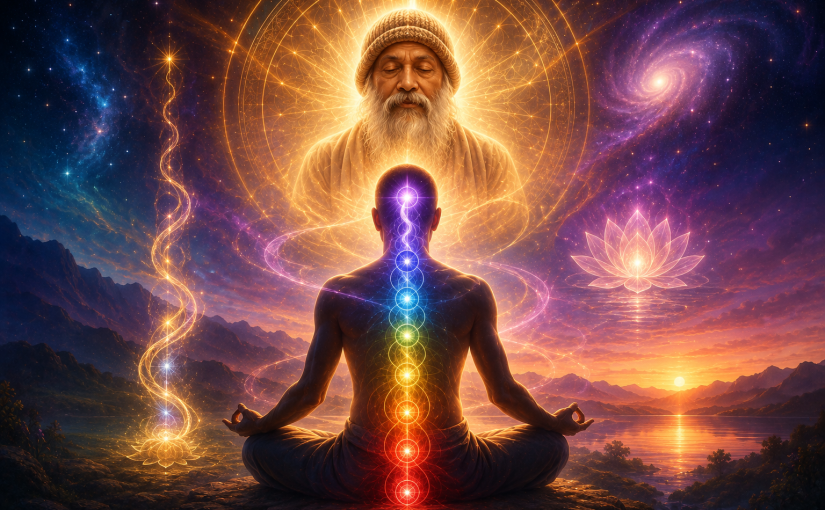
Quantum Duality and Nondual Consciousness: The Forgotten Balance Behind Humanity’s Survival

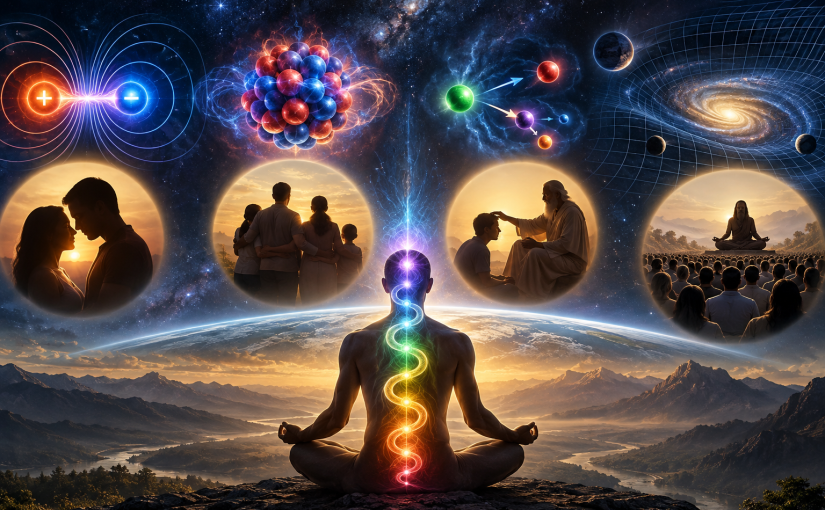
One of the deepest secrets of quantum science and its relationship with consciousness can be compressed into a single core insight: the entire cosmos, whether living or non-living, moves through a delicate balance of duality and non-duality. The dual nature of the world is not a mistake or a limitation—it is the very fingerprint of existence. Everything that appears, from atoms to minds, carries both a particle aspect and a wave aspect. This applies equally to unconscious matter and to conscious life.

In this vast design, wave nature functions like a control unit or a brain, while particle nature functions like the working unit or the body. The wave holds possibilities, coherence, and intelligence; the particle executes, interacts, and manifests. Both are required for creation to move forward. If there were only wave nature, nothing would ever be expressed into form. There would be infinite possibility but no world. If there were only particle nature, the cosmos would be chaotic, unregulated, and mechanically driven without inner order, just like a body without a nervous system.

Why Entanglement, Superposition, and Interference Matter

Modern quantum physics has already shown us how this balance operates. Without entanglement, there would be no cosmic regulation, because particles would have no deep relationship with one another. Without superposition, there would be no choice, because systems would be trapped in fixed states rather than holding multiple possibilities. Without interference, there would be no refinement, no pattern formation, and no subtlety of expression. These quantum features are not technical oddities; they are the very language of creativity in nature.

Likewise, in human life, without a non-dual wave-like dimension, the mind becomes trapped in rigid patterns. There is no flexibility, no creativity, no compassion. Without the dual, particle-like dimension, nothing practical could be achieved. Work would not happen, societies would not organize, and no structure could be built. Only when both are present together does meaningful life arise.

Human Mind as Quantum Balance

In the living human world, if there were only non-duality, no worldly evolution or growth would occur. People would remain in abstract peace but would not build, create, or transform the material world. On the other hand, if there were only duality, there would be constant stress, inefficiency, poor quality of work, conflict, and war. History shows that when societies become overly dualistic—focused only on competition, profit, and control—humanity moves toward collapse rather than progress.

Without mutual cooperation there is no regulation of societies. Without thinking beyond fixed parameters there are no discoveries or inventions. Without meaningful interaction there is no development of skill, culture, or wisdom. Duality in the mind works like the particle nature of matter, while non-duality works like its wave nature. Both must coexist for a balanced and humane civilization.

Emotions, Duality, and the Soul

Just as all interactions in the quantum world arise from particle nature, and interactions push systems to express their particle aspect even more, all emotions arise from the duality of the mind. Emotions intensify identification, separation, and attachment. The conscious entity that feels and witnesses interactions in the quantum world is traditionally called Brahman or the gods, and it remains unaffected by those interactions. The conscious entity that experiences emotions in the human mind is called the soul, and it is deeply affected by them.

The reason the gods or Brahman remain untouched is the wave nature of the quantum world itself. Wave nature neutralizes the disturbances created by interaction because it is the opposite of fixation. It holds everything without being trapped by anything. In the same way, a human being can develop a god-like mind by adopting a wave-like, non-dual attitude while moving through particle-like worldly interactions.

Why Ancient Nondual Traditions Were Essential

This is why non-dual traditions such as Sanātana Dharma, Buddhism, and Yoga arose at the very beginning of human civilization. They were not religious inventions; they were technologies of balance. They taught humanity how to remain rooted in wave-like awareness while functioning in a particle-like world. They preserved compassion, coherence, and inner freedom while allowing outer progress. They described quantum darśan in the form of an Upadeśa tradition flowing among the devatās and then from the devatās to human beings. Nārāyaṇa, or Parabrahman, gave this teaching of non-duality to Brahmā; Brahmā gave it to the Sun-god; the Sun gave it to the Prajāpatis; the Prajāpatis gave it to Manu; and from Manu it came to humanity through different sages.

Today, this non-dual dimension is being eroded. Modern civilization is increasingly driven only by particle logic—competition, consumption, and fragmentation. As non-duality disappears, compassion disappears with it. When compassion fades, selfishness rises. When selfishness rises, conflict and war become inevitable. The loss of non-duality is directly reflected in the loss of compassion, and the loss of compassion threatens the survival of the entire human race.

The forgotten truth is simple yet profound: just as the universe requires both waves and particles to exist, humanity requires both non-duality and duality to survive. When this balance is restored, both science and spirituality point to the same future—a coherent, compassionate, and creative civilization grounded in the deepest laws of reality.

Chapter 37: hasya rasa in quantum world

Hāsya (Joy / Laughter) — Quantum Analogy

In human experience, Hāsya is the emotion of lightness, delight, and spontaneous resonance.
It is not just amusement; it is the sudden release of tension, remembrance of unbound wave nature, the harmony of unexpected coherence, and the cosmic tickle of existence itself.

In quantum physics, Hāsya finds its parallel in spontaneous coherence, resonance, and the delightful unpredictability of energy interactions.

Balance Between Coherence and Interaction: The Hidden Engine of Organic Evolution

Highly noised, disturbed and decohered quantum particles, such as those in stone, are so rigidly fixed and lack coherent amusement that they appear to have ceased growing—though they may still be growing at the slowest possible rate.
On the other extreme, a highly coherent wave that is almost devoid of worldly chaotic interactions is so diffused and ungrounded that it seems to float endlessly in the sky, lacking the stability needed to become fixed or grounded—let alone to grow further in a worldly way.
The intermediate organic world, however, is both firmly grounded and highly interactive, while also maintaining deep coherence. Because of this balance, it grows and develops in extraordinary ways, leading to highly complex organic evolution—often surpassing even human levels of social coherence and interaction.

Likewise, some people are so rigidly fixed in worldly duties and chaotic interactions that they lack coherence and amusement within society—much like fixed stone. Such individuals seldom grow or develop their wider potential. In this sense, Quantum particles in a stone are like office babus bound to a rigid routine—going to the same office every day, following the same travel route, sitting on the same chair at the same table, handling the same papers. There is stability, but no growth, no development. That’s why they’re seldom smiling. Just as closedness and a non-coherent lifestyle bring about a non-smiling personality, a non-smiling nature can in turn create closedness.


Others are so amusing and internally coherent that they never attain fixation at all; they keep floating like a coherent wave that never collapses into actuality. How can physical growth occur when there is no physical fixation? Their minds may feel free—almost liberated—but this state, too, remains unbalanced.


A few rare individuals resemble organic molecules: fully coherent yet fully engaged with the world. Because of this balance, they grow completely—spiritually as well as worldly—at the same time. In this sense, Quantum particles in organic living matter—or within a living body—are like travel agents or hospitality employees: constantly working, interacting, coordinating, adapting, and growing together. Their dynamism, flexibility, communication and continuous exchange allow development and evolution to occur naturally. Just as openness gives birth to amusement, an amusing nature can in turn cultivate openness, coherence, and growth.

Analogy 1 — Quantum Superposition and Surprise

A particle exists in multiple states at once until observed — a superposition.
The moment we witness its outcome, there is a spontaneous “reveal” — often unexpected.
This is the quantum equivalent of laughter: the delight that arises when hidden potential resolves in an unforeseen, playful way.

Spiritual parallel: Joy arises when the mind lets go of expectation and witnesses the unpredictable dance of reality.

For example, a man with a long nose tends to remain in a kind of superposition, not fixed to his nosy position. When someone reminds him of his long nose, he immediately collapses into his natural nosy personality, and everyone around who notices this bursts into laughter. Fixing floaty personalities into definite ones produces amusement, happiness, and laughter in all, because only these collapsed outcomes are capable of interacting with others and growing worldliness, whereas superpositioned outcomes cannot. If he does not receive a collapsing shock, people laugh little or not at all. The stronger the feeling of collapse he experiences, the more people laugh. This simply means that laughter is a kind of quantum collapse.

In fact, people laugh at him not simply because he appears fixed or inferior, but because seeing him collapse into a particle-like state reinforces their own sense of a superior wave-like nature. This amusement arises deeply and indirectly from wave nature, not from the particle nature that is visible superficially and directly. Seeing an individual momentarily isolated or set apart strengthens the sense of togetherness and coherence within the spectator group. This underlying dynamic is the principle behind the amusement created by performing artists and comedians.

Analogy 2 — Bose–Einstein Condensate (Collective Harmony)

At ultra-cold temperatures, bosons collapse into a single coherent quantum state — moving as one entity.
This is group resonance, like laughter shared among a community — each particle retaining individuality, yet moving in unified delight.

Spiritual parallel: Hāsya arises when hearts synchronize — the joy of connection, shared resonance, and collective exuberance.

This is like people shedding the hotness of worldly interactions and responsibilities and becoming cool. As a result, they have much more time and energy to spend on amusement. People living in cold and snow-bound areas, without much technology, often spend their lives in a state of coherent amusement. A bust of laughter make everyone coherent and progressive and liberated feeling just like a resonant wave.

Seriousness vs Amusement: How Balanced Lightness Creates Academic, Social, and Inner Excellence

I used to be quite serious in childhood. This seriousness arose from continuous exposure to highly stressful worldly interactions and responsibilities far beyond what is natural for that age. I carried pressure early. I took great pain in studies, reading, and examinations, and I approached them with intensity rather than ease.
In senior secondary school, I noticed an interesting contrast. Some of my classmates were constantly smiling, amusing, joking, and playful, yet they were average or even low in academics. At the same time, there was a small group of exceptionally intelligent students who also laughed and joked, but in a more superficial way—their core remained firmly anchored in study. They seemed to benefit from both sides. Their primary focus stayed on academics, yet they allowed themselves short bursts of amusement.
I, however, chose seriousness. I was afraid that if I flowed into amusement, I might lose myself. That fear kept me disciplined and focused, and I did excel in studies—though not to the level of those rare “double strikers” who mastered both intensity and lightness. What amazed me later was realizing how playing the role of laughter, joking, and amusement—while keeping the mind serious about responsibilities—allowed them to excel far beyond others. These short bursts of amusement, often with half attention or even no mind at all, seemed to relieve stress born of particle like bound nature and bring inner and even outer wavy coherence. They helped align all other aspects of life smoothly.
In university, I still could not learn this art of pretending amusement. During senior secondary school, a few kind and emotionally mature classmates mainly sweeties subtly kept me included in their coherent wave—without forcing me to actively participate in amusement and without letting me fall into an inferiority complex. But in university, adolescence changed the dynamics. People became more self-centered. Amusement became transactional: give one unit, receive one unit—or less. Otherwise, the quieter or serious person was made to feel inferior.
By the grace of gurus and teachers, and especially as I was leaving university, I slowly learned this art in my early professional life. I learned how to allow lightness without losing depth. This learning helped me immensely—socially and professionally. It made my growth more balanced, more all-round, and allowed me to remain coherent across different groups, environments, and societies.

Later on, to enhance this effect, I even tried becoming somewhat funny-like—intentionally stimulating others to laugh and laughing myself in response. At times, I even laughed in solitude, which amazed some people. In reality, this laughter brought back the remembrance of my meditation image, and everyone knows this state is akin to nonduality. In this way, I used to laugh in order to remain nondual while living within duality. The whole cosmos is constantly laughing, because it is nondual even while appearing dual. Laughing is a balancing act as it brings particle nature and wave nature closer together,  allowing both to remain together—or neither of them to dominate. In this sense, duality and nonduality exist together. Nonduality can arise only in the presence of duality, because without duality there is nothing to which the word non can be applied. Ignoring particle-like bound nature through laughter itself means embracing wave-like liberated nature.

Analogy 3 — Quantum Fluctuations and Spontaneous Energy

Even in “empty space,” virtual particles pop in and out of existence — a subtle cosmic playfulness.
This is the universe giggling at itself — the quantum tickle of creation.
Hāsya in humans mirrors this: the unbidden delight at life’s small, miraculous, or absurd moments.

Spiritual insight: Laughter is the consciousness of play or Leela— spontaneous, irrepressible, and free from attachment. Through laughing, particle like fixed form is diluted and wave like liberated form is strengthened. It’s like a balancing action that prevents one to stubbornly bound to the collapsed form.

This is like a collapsive smile—small and light. There is a continuous virtual collapse of virtual waves into virtual particles. Or we may say this is the nondual giggle of the quantum world within its dual nature of wave and particle. This means the cosmos carries a continuous smiling face everywhere.

Analogy 4 — Constructive Interference (Amplified Joy)

When waves overlap in phase, amplitudes enhance — energy grows instead of cancelling.
Shared laughter amplifies joy, just as coherent quantum waves amplify intensity.

Spiritual parallel: Hāsya is resonance with the field of existence — when joy spreads, it multiplies effortlessly.

This is seen everywhere in human society as well. When one person smiles, others naturally begin to smile too. A single smiling face brings coherence to the behaviour and actions of everyone present around it. This enhances the wave nature. Many waves then interfere constructively, widening superposition and its outcomes. As a result, all involved progressively develop and grow through increased creativity and invention.
I myself am a real example of this. My life had become static due to a lack of smiling and joking. Then I opened the door to the treasure of smiles and humour, and I could not stop growing—even willfully. Later, after gaining enough in the world, I became serious and overly intellectual again, losing practicality. Life once more became slow-moving.
Now I am again trying to enter the era of the amusing waveform—not out of physical need, but for spiritual upliftment—because amusement is waveform even amidst particle form, and waveform is spiritual. Just as smiling enhances wave nature, wave nature also enhances smiling in return. It’s like a cascading chain reaction of cause and effect.

Wave–Particle Duality as Proof of Nonduality: A Vedantic View of Matter

The dual nature of matter indirectly implies the nondual nature of matter—this is a Vedantic fact. The dual nature of the world means it carries both bound particle nature and liberated wave nature together. When both exist together, it also means neither of them exists independently. Just as plus one and minus one together result in zero—neither plus nor minus—so too duality resolves into nonduality. This reveals an amazing link between science and spirituality.

Breathing Yet Not Breathing: Integrating Dhyāna in Daily Life Amid Chaos

A lived inquiry, written as it unfolded

When the body begins to ask for khecarī

I began to feel that khecarī mudrā was needed not as a yogic achievement but as a practical necessity. Without it, daily worldly chaos made entry into dhyāna difficult. With it, prāṇa rotated effortlessly, and breath retention no longer felt suffocating. It was not breath holding; it was breath resting.

Earlier, during a seven-day Śrīmad Bhāgavatam recitation at home, I entered deep dhyāna without khecarī. The spiritual environment itself carried continuity. That showed me something important: my system already knew dhyāna. What was missing in daily life was not knowledge, but sealing.

Many people gave advice. Some insisted a guru was mandatory. Some said other techniques must be learned first. None of that explained what my body was actually asking for.

The question was not ideological. It was physiological.

Khecarī as a seal, not a ladder

Khecarī revealed itself not as a tool for ascent, but as an internal valve. It reduced sensory leakage, redirected vagal tone, and completed a closed prāṇic circuit. Breath retention stopped being suppression and became circulation. Suffocation disappeared.

This clarified something crucial: khecarī was not something to be held. It was something that appeared at the threshold and dropped away once dhyāna stabilized. Treating it as permanent or as an achievement only invited effort and distortion.

Used correctly, khecarī was permission, not command.

I find rolling the tongue back and touching the soft palate beneficial for initiating dhyāna. It causes the lower jaw to drop, creating a wide gap between the upper and lower teeth, and increases the hollow space at the back of the mouth where swallowing occurs. After dhyāna stabilizes—usually after about 10–15 minutes—this tongue position feels unnecessary and the tongue naturally returns to its normal position. However, the lowered jaw, the gap between the teeth, and the increased hollowness at the back of the mouth continue to remain sustained. Probably, this is a form of body language that prevents energy from being directed toward talking, swallowing, or eating. As a result, the energy tends to be used for dhyāna. It is an amazing trick.

Why rules and warnings didn’t apply cleanly

Warnings about gurus and prerequisites exist for practices that force energy upward or chase power experiences. My experience was the opposite. Energy already moved to ajñā naturally. Khecarī stabilized rather than provoked. There was no chasing, only response.

Practices arise when the system is ready. They are not chosen by ideology. The body was not asking what was allowed. It was asking whether it could continue naturally.

The non-tongue internal seal

A crucial shift happened when the function of khecarī appeared without tongue positioning.

By resting attention gently in the inner throat hollow—behind the face, where swallowing ends—the jaw dropped naturally, the mouth widened inwardly, and breath lost importance. Retention appeared without decision. Dhyāna opened by itself.

This showed clearly: form is optional; function is essential.

When breath becomes “breathing yet not breathing”

At a certain point, something hidden began circulating. Breath was present, yet imperceptible. The body breathed, but I was not breathing. There was no suppression, no control, no danger. Only coherence.

This was not something to observe closely. The moment attention tried to watch it, it collapsed. The correct attitude was friendly ignorance. Letting it happen behind me, not in front of me.

I think this type of spontaneous breathing is called breathlessness because it doesn’t move awareness up and down like normal breathing, only supply oxygen to the body. Breath continues its subtle and deeper up-and-down movement, fully alive and functional, yet the mind no longer rides it as it does with gross and superficial breathing in ordinary life. What stops is not breath, but the mind’s dependence on breath for rhythm, movement, and direction. Movement remains, life flows on, but awareness stands still in itself—this is not suppression or breath stoppage, but the quiet freedom of the mind when it no longer needs breath as its vehicle. At times breathing can become so subtle almost looking like nonbreathing.

Why Watching the Breath Dissolves Thought Only at the Subtle Prāṇic Level

What is called looking at the breath dissolves thought does not refer to ordinary gross breathing, because in gross breathing the breath is heavy, mechanical, and tightly coupled with thought, so the mind rides it up and down and watching it only refines attention without producing thoughtlessness. Thought dissolves only when breathing has already shifted into a subtle, yogic, almost breathless movement of prāṇa, where movement continues but is no longer a physical pumping of air. In this subtle movement the mind no longer rides the breath, the coupling between respiration and thought breaks, and awareness can rest without being carried. When prāṇa moves freely up and down in this way, there is no deliberate focusing at all; awareness is naturally drawn because the movement itself is blissful. It is not attention in the ordinary sense but ānanda recognizing itself in motion.No effort is needed, because effort would disturb the state. Nothing is being suppressed. Thoughts fade away on their own because the sense of bliss is complete and leaves nothing unfinished for the mind to work on. The mind actually hovers in order to complete a task, and bliss is dependent on that completion. The main goal of the mind is to experience complete bliss; work is only an intermediary tool. When full bliss is felt directly, there is no need for any mediating tool. What remains is a natural, self-sustaining state of awareness that continues by itself, experiencing itself without thought.

Fasting, light meals, and hollowness

Light eating or fasting during the week-long Bhāgavatam produced the same effects as khecarī: reduced saliva and mucus, teeth no longer clenching as if ready to bite something, jaws no longer tense as if prepared to grab food, teeth and jaws not aimed at talking vulgarly like ordinary days but to listen and contemplate gods stories, and an increased sense of inner hollowness. The teeth and jaws were no longer oriented toward vulgar or ordinary speech, as on usual days, but instead toward listening to and contemplating the stories of God. Digestion became quiet, speech reflexes softened, and dhyāna came easily because energy, spared from other bodily functions, became available to it.

This was not asceticism. It was chemistry. Comfortably light—not empty—was the key, especially with GERD sensitivity.

The throat hollow and its limits

The throat hollow revealed itself as an amazing junction. But it did not work when prāṇa was highly disturbed. This was not failure; it was correct physiology. No doubt, techniques are invaluable in yoga, but they too have their own limits.

Subtle tools cannot override gross turbulence. Tricking body has its own limits. When disturbance was high, grounding had to come first: feeling body weight, letting breath be ordinary, allowing settling before any inward turn. However, sometimes direct entry into nirvikalp can also happen from high disturbance, this is just try and watch. There’s no fixed ruling, exception is at every step. The following rule is generalised or averaged.

This clarified a hierarchy:

  • High disturbance → grounding
  • Medium disturbance → throat hollow
  • Low disturbance → dhyāna without entry
  • No disturbance → nirvikalpa, no tools

Jaw drop and posterior awareness clarified

Jaw drop meant teeth not meeting, jaw unengaged, tongue unimportant. The tongue might touch the palate naturally or not—it didn’t matter. Jaw led; tongue followed.

Posterior awareness did not mean visualizing channels or tracing chakras. It meant awareness withdrawing from facial activity and resting behind expression. Facial activity like manipulating and maintaining facial expressions, expressing emotional impressions etc. draws lot of energy. Attention focusing on backside of throat in hollow shift the focus of energy from front to backside. This is backside where energy is conserved and transmitted to higher centres through back channel called sushumna without being wasted in front body focused bodily functions.

When described anatomically, it felt like a blissful, light pressure on the posterior surface of the head—not force, but density without effort. It’s like rear agya chakra activation. It acts like a valve in back channel. When it feels unpleasant pressure, valve is closed type. When it feels blissful mild pressure the valve is like open.

This posterior fullness spread gently, supported breath irrelevance, and felt safe and stable.

Why posterior awareness feels safer than forehead focus

Forehead focus engages control and vigilance. Posterior awareness supports integration and regulation. The front decides; the back stabilizes.

Posterior awareness does not ask what should happen. It allows nothing to need to happen.

Daily-life micro-adjustments

Integration showed itself through tiny permissions:

  • Jaw unengaged
  • Teeth slightly apart
  • Tongue irrelevant
  • Breath unmanaged checked

During stress spikes, grounding came first, then jaw softening, then posterior awareness returning quietly.

Dhyāna was no longer entered. It was allowed.

Emotional reactions transform quietly

Emotions still arose, but ownership dissolved. There was delay without effort, movement without hooking, and body-led regulation.

I was not handling emotion. I was outlasting it.

Reactions completed faster and left less trace. This was real integration.

Speech returns without breaking coherence

Silence and speech stopped opposing each other. Speech arose from silence instead of against it. Words slowed. Jaw moved without tension. Awareness stayed behind expression.

Silence remained even while speaking. This is all about integration of yoga in daily life.

The closing understanding

Nothing here was about gaining something new. Everything was about not disturbing what was already stable.

Progress was no longer depth, but recovery time. If one enters dhyana rapidly from chaotic worldliness then even dhyana of short duration may be better than prolonged continuous dhyana that is hard to launch again. Then chaos mattered less. Techniques fell away. Life and dhyāna stopped competing.

Nothing needs to be held. What is real stays.

This is not a conclusion. It is a way of living.

Why extreme khecarī stories still attract sincere practitioners

Later in the inquiry, an old memory surfaced from a book written by a Western practitioner who had lived in India and learned yoga deeply. He described cutting the lingual frenulum hair-thin each day with a surgical blade, applying antiseptic, and eventually achieving a tongue that could enter the throat tunnel perfectly, without visible wounds.

This account was not raised as a desire to imitate, but as a remembered narrative that still carried psychological weight. Such stories attract sincere seekers for specific reasons: they promise finality, convert mystery into mechanics, and appeal to sincerity through sacrifice. They suggest that one decisive physical act can complete the path.

But integration has no mechanical closure. It refines how life is lived, not how anatomy is altered.

Why such accounts are not guidance

Those historical accounts belong to a different era of medicine, psychology, and understanding of the nervous system. Cutting the frenulum, even gradually, is physical self-injury with real risks: bleeding, infection, nerve damage, scarring, loss of fine tongue control, and psychological fixation on technique.

More importantly, such actions are unnecessary when the functional effect of khecarī is already present. Neuro-energetic coherence cannot be stabilized by anatomical violence.

If the effect is present, the form has already served its purpose.

Why yogic language itself causes confusion

At the deepest level, the confusion was never about practice. It was about language.

Classical yogic texts were written without modern neuroscience or physiology. Yogis used metaphor and experiential shorthand. When they spoke of the tongue entering the throat, nectar dripping, prāṇa piercing, or breath stopping, they were describing felt states, not surgical instructions.

Over time, experiential language hardened into literal method. Metaphor was mistaken for mechanics.

The same misunderstanding applies across yoga:

  • “Breath stops” means breath loses centrality, not suppression.
  • “Prāṇa rises” means regulation shifts from survival circuits to integrative circuits.
  • “Ajñā opens” means vigilance and control relax, not pressure generation.

Reading yogic texts from lived experience

Western minds, trained to optimize and proceduralize, are especially vulnerable to literalizing yogic poetry. The unconscious question becomes: “What exactly do I do?”

But yoga was never about doing more. It was about interfering less.

A simple rule clarifies everything: if a description sounds violent, effortful, or irreversible, it is metaphor, not instruction. Real yogic transformations are gentle, reversible, sanity-preserving, and embodied.

Khecarī Mudrā, Physical Catalysts, and Awakening: Why Techniques Open the Door but Meditation Sustains Realization

Khecarī is not “nothing physical,” but neither is it a guaranteed path to awakening. Physical interventions—khecarī, sexual yoga, even circumcision—can act as catalysts by reorganizing the body–nervous system and opening access to peak nondual states, as lived experience shows. Yet awakening is not produced by anatomy; it is stabilized only through regular meditation and clarity. Khecarī is rarely reported as the cause of awakening because it works silently as a support, not as an insight, and when realization stabilizes it often becomes unnecessary or drops away. Sexual yoga gets reported more as it produces hype and peak of physical experience that’s charming for general public, not silent nirvikalp. Overuse or forcing of tongue—especially in people with GERD or airway sensitivity—can create side effects, as seen with sleep apnea, while simpler factors like feeding style and digestion may play a larger corrective role. The honest conclusion for the general public is proportion: physical techniques may open doors for some, carry real risks for others, and should be optional, gentle, time-limited, and always secondary to sustained meditation and bodily integration.

The final integration

What unfolded across all these conversations was not the acquisition of a new practice, but the removal of unnecessary interference.

Khecarī revealed itself as a seal, not a ladder. The throat hollow emerged as a junction, not a switch. Posterior awareness proved safer than frontal control. Breath became breathing yet not breathing. Emotions completed without residue. Speech returned without breaking silence. Extreme practices lost their attraction.

Progress revealed itself not as depth, but as reduced recovery time. Life and dhyāna stopped competing.

Yoga, seen clearly, was never a user manual. It was poetry pointing toward non-interference.

Anything that requires injury to sustain silence is not silence.

This is not a conclusion. It is integration.

When Buddhi Chooses Sleep: The Yogic Psychology of Gandhārī and Dhṛtarāṣṭra

A Moment in the Mahābhārata That Demands Deeper Seeing

In the Mahabharata, Gandhārī’s decision to cover her eyes for life so as to share the blindness of her husband Dhritarāṣṭra is often praised as the highest form of devotion. Yet when looked at quietly, without sentiment, this act does not remain simple. Something in it presses for a deeper reading. It feels less like sacrifice and more like a decisive inner posture—one that silently shapes destiny.

This is not a story about physical blindness alone. It is a story about consciousness, intelligence, and the subtle ways bondage continues even in the presence of love.

Jīva as Dhṛtarāṣṭra: Blindness Carried Forward

Dhṛtarāṣṭra represents the Jīva—the individual being shaped by past karma. His blindness is not accidental and not limited to the eyes. It symbolizes a long-standing incapacity to see clearly, to discriminate, to restrain desire and attachment. This blindness is carried forward from previous births as samskāra. In this birth, it simply expresses itself openly.

Nothing in the story suggests that this Jīva could not have been aided. Blindness here is not fate sealed forever; it is a condition awaiting either reinforcement or correction.

Gandhārī as New Buddhi in a Fresh Birth

Gandhārī represents Buddhi, the faculty of intelligence and discernment. She is not blind by nature. She enters this life with clear seeing, moral strength, and the capacity to guide. Before marriage, she stands close to what can be called samaṣṭi buddhi—intelligence that is still aligned with universal order rather than personal entanglement.

This is crucial: Buddhi arrives fresh in this birth. It is capable of seeing what the Jīva cannot.

The Warnings of Elders and Gurus

The elders and gurus advise Gandhārī clearly to keep her eyes open. This is not a social detail; it is symbolic. It represents śāstra, dharma, and higher wisdom reminding Buddhi of its responsibility. The message is simple: do not abandon discernment. Love does not require blindness. Partnership does not demand the sacrifice of intelligence.

At this moment, a real choice exists.

The Decisive Act: Buddhi Choosing Slumber

Gandhārī sees the blindness of the Jīva she is about to join. Instead of remaining awake and serving as a mirror, she chooses symmetry. She decides that if the Jīva cannot see, she too will not see. This is not ignorance and not compulsion. It is a conscious, emotionally motivated decision.

Here, Buddhi abandons its dharma of viveka. It chooses companionship over correction, harmony over awakening, loyalty over truth. Intelligence does not illuminate; it lies down beside blindness. It is like the Kundalinī snake coiled and Śakti sleeping in the Mūlādhāra chakra.

This is the silent turning point of the epic.

Why This Is Not Compassion in Yogic Psychology

In yoga, compassion never requires the dimming of intelligence. Buddhi exists to bring clarity to the Jīva, not to anesthetize it. When Buddhi voluntarily suspends its seeing, it does not become noble; it becomes dormant. By blindfolding herself, Gandhārī validates the Jīva’s blindness and removes the very friction that could have led to awakening.

This is love that prefers peace over truth—and therefore sustains bondage.

Why the Jīva Remains Unawakened

A Jīva does not awaken simply because Buddhi is present. Awakening happens only when Buddhi stays awake. In this pairing, Buddhi becomes a sedative rather than medicine. The Jīva remains blind not because help was absent, but because help chose not to function.

This is the deepest tragedy: intelligence was available, but it refused its role.

Later Power, Earlier Failure

Gandhārī later demonstrates immense tapas and spiritual power. Her curse after the war is devastating. Yet this power appears only after irreparable damage has occurred. If she had seen and acted early, things could have changed. Acting only at the end changed nothing. A blind Buddhi practicing yoga may acquire various powers and siddhis, but it does not attain awakening.

Blindness postpones responsibility. What is not corrected early returns later as destruction. Similarly, a blind Buddhi practicing yoga may acquire various powers and siddhis later in life, but it does not attain awakening.

A Pattern That Repeats Everywhere

This story is not confined to an ancient epic. It repeats wherever intelligence dims itself to preserve relationship, wherever clarity is sacrificed to avoid disturbance, wherever love fears awakening more than ignorance. In such moments, Buddhi chooses sleep, and Jīva continues as it is.

Awareness cannot be awakened by someone who refuses to see.

Final Understanding: How Bondage Continues Quietly

The Jīva was blind due to past karma.
The Buddhi was seeing in this birth.
But Buddhi chose sleep over sight, companionship over awakening.

Thus blindness continued—not by fate, not by ignorance, but by a conscious choice made in the name of love.

Liberation does not fail because light is absent.
It fails when intelligence willingly turns away from seeing.

Beyond Death and Liberation: Holding Consciousness Between Worlds

A Personal Reflection on Trishanku, Vishvamitra, Kundalini, and the Inner Guru

How Compassion, Ritual, and Inner Prayer Hold Consciousness Until Liberation Ripens

The Classical Story of Trishanku: The King Suspended Between Heaven and Earth

In the ancient tradition, King Trishanku of the Ikshvāku lineage desired to ascend to heaven in his physical body. When the royal priests refused to perform the rite, he approached the sage Viśvāmitra, whose tapas was unmatched. Through his austere power, Viśvāmitra attempted to send Trishanku to the celestial realms, provoking resistance from the gods. When the ascent was obstructed, Trishanku was left suspended between heaven and earth, neither accepted by the devas nor returned to the mortal world. Refusing to let him fall, Viśvāmitra established him in a unique state—neither fully liberated nor condemned—where he remained held by the force of the sage’s tapas.

Rethinking the Trishanku Story: Blessing, Not Punishment

I have often felt that the story of Vishvamitra and King Trishanku is misunderstood. Most readings stop at ego, rivalry, or defiance of the gods. But to me, it feels very different. It feels like a blessing, not a punishment. Vishvamitra did not abandon Trishanku halfway. He held him.

I feel Vishvamitra created an abode for Trishanku not out of anger, but out of compassion. However, it may be understood as a spiritual anger directed toward the devas for denying liberation to Trishanku. It was pure and positive—aimed at growth, and getting inspiration to do a great job, not rivalry. Trishanku was not ready for full liberation, yet he should not have fallen back. So Vishvamitra, through tapas, prayer, and sheer inner power, held him in between—high enough to be safe, steady enough to ripen. This suspension itself feels like grace. Liberation is not always immediate. Sometimes it is protection from regression.

Rituals for the Departed: Collective Tapas in Everyday Life

When I look at society today, I see the same intention expressed differently. People perform Bhagavatam kathas, shraddhas, yagyas, pindas, and tarpanas, prayers, rest in peace or RIP for their departed loved ones. These are not empty rituals. They are collective efforts to hold consciousness high enough so that it does not collapse back into unconscious karmic drift. Vishvamitra did this alone. Ordinary people do it together, repeatedly, across time.

Seen this way, Trishanku becomes an archetype. Not damned. Not liberated. But protected. Suspended with care.

When the Myth Became Personal: My Own Experience

This is not just philosophy for me. It touched my life directly.

Dream Visitations and the Call for Assistance

After the death of a close acquaintance, I experienced her presence repeatedly in dream visitations. These were not frightening. They were not dramatic. They felt like a seeking—an unspoken request for assistance in liberation. I did not try to command anything. I did not panic. I prayed.

Prayer, Kundalini, and the Meaning of Urging God

I prayed strongly. I urged kundalini for her peace, for her liberation, for forgiveness of acts that might be preventing liberation, for release from unresolved weight. For me, kundalini is representative of God—not as a personality, but as the deepest intelligence of integration. Urging kundalini is urging God. It is aligning intention with the highest coherence of consciousness. We may even call it a personified dhyāna-supporting chitra that often lingers during savikalpa dhyāna and, as it converges toward nirvikalpa dhyāna, enables a smooth and rapid transition.

I also urge liberation for all beings, twice daily, in my dhyana. I do this because liberation is not a limited resource. It is not like physical matter that gets exhausted by giving. It is like light. It can be wished for all, together, without loss. This understanding feels very clear to me.

Signs of Resolution: Clarity, Softening, and Residual Sadness

Over time, I noticed something important. The appearances in dreams became clearer. Calmer. More refined. Each interaction carried less confusion. There was a subtle sadness present—not fear, not agitation—but a gentle sorrow. It felt connected to not being perfectly cared for during illness and the dying phase. I did not try to fix this sadness. I simply allowed it. I know it will resolve one day on its own.

This clarity felt like confirmation—not in a grand mystical sense, but in a quiet, settling way. Something was integrating. Something was being completed.

Kundalini as Dhyana Chitra: The Inner Guru Clarified

I want to be clear about one thing. When I speak of kundalini here, I mean dhyana chitra. The inner meditative image. The inner guru. Not a voice. Not an external command. Not an authority that tells me what to do. It is orientation, not instruction. It does not demand action. It dissolves naturally in meditation.

Where Resolution Truly Happens

On careful observation, I see that nothing was resolved outside me. The resolution happened within. A tense relational field completed itself, which is why clarity increased and interactions became softer instead of more intense.

This reflects the true purpose of ancient rituals. They were meant as acts of love, not fear—support rather than rescue, holding rather than pulling. Their role was to stabilize awareness, reduce downward pull, and allow natural ripening to occur. It means these practices certainly work in this world, and they may also have effects beyond it, in the afterworld as well.

Yogic Understanding: Death as Pratyahara and Suspension

From a yogic perspective, death itself is forced pratyahara. The danger is regression into old samskaras. Holding practices—whether tapas, prayer, ritual, or remembrance—keep awareness above that collapse point or above throat chakra. Trishanku’s suspension mirrors this exactly.

Psychological Grounding: Grief, Holding, and Completion

From a psychological perspective, this is also healthy grief. Remembering without clinging. Caring without binding. Letting go without denial. Societies that abandon ritual often carry unresolved trauma because transitions are left unheld.

Responsibility Without Burden

One crucial truth remains central to me. I am not responsible for liberating anyone. I am responsible for not obstructing liberation with fear, guilt, or attachment. My prayers are permission, not intervention. Opening, not pushing.

Why Experiences Fade When Resolution Occurs

That is why these experiences naturally fade. Fewer visitations. Less emotional charge. More neutrality. Eventual quiet disappearance. Resolution softens. It does not escalate.

This is the role of the inner guru. Not to act. Not to control. But to allow completion to happen without force.

Returning to Trishanku: The Archetype of Compassionate Suspension

When I look back at Vishvamitra and Trishanku now, the story feels intimate, not mythic. One consciousness holding another until gravity loosens. One being refusing to let another fall, without pretending readiness that is not yet there.

Different methods. Same compassion.

Not a Conclusion, But a Resting Place

This blog is not a conclusion. It is a resting place. A suspension that does not need to hurry. Just as liberation itself does not hurry.

Nonduality on the Street: What Dogs Quietly Teach Us About Being Whole

Nonduality and Animal Behaviour: Understanding How Dogs Perceive Reality

Most conflicts between humans and animals do not arise because animals are violent or humans are weak. They arise because humans forget how animals perceive reality. Dogs, especially street dogs, do not respond to our words, beliefs, professions, or intentions in the way we imagine. They respond to state. They sense whether a being standing before them is internally divided or internally whole. This difference alone often decides whether a dog barks, chases, attacks, ignores, or quietly settles.

A dog does not encounter us as a psychological story. It encounters posture, breath, facial tension, rhythm of movement, and the invisible but very real coherence or incoherence of the nervous system. When a human lives in inner division—fear mixed with courage, friendliness mixed with suspicion, dominance mixed with anxiety—the body leaks signals. These signals create edges, and edges invite testing. Barking, circling, and chasing are not moral judgments; they are responses to fragmentation. When a human is internally unified, however, something entirely different is perceived. The body moves as one piece. The breath flows evenly. The face carries no agenda. To a dog, such a human does not appear as another competing individual. He appears as part of the environment.

Nonduality and the “Mountain Effect”: Why Coherence Dissolves Conflict

This is why the metaphor of “being one with the mountain” is not poetic exaggeration. When a person is inwardly undivided, the animal nervous system reads scale, not size. The human feels large, not because of muscle or dominance, but because there is no resistance to push against. Animals do not fight mountains, rivers, or weather. They adapt to them. In the same way, a coherent human presence often dissolves confrontation before it begins. The dog does not submit; it disengages. Dogs primarily challenge what they perceive as a threat to their territory. A nondual being makes the least claim on resources and shows minimal territorial behavior, which dogs instinctively respond to positively. In practical life, one must of course keep possessions in order to live, but inwardly one remains nondual—akin to being possessionless. A mountain may hold countless forms of natural wealth, yet inwardly it is almost possessionless. Actually, all healthy animals instinctively appreciate nonduality, because they are closest to it—though compulsively rather than by conscious choice.

How Dogs Read the Human Face and Body

Dogs are highly sensitive face readers, but not in the emotional sense humans assume. They read movement, contrast, breath, and eye tension. Wide eyes, exposed sclera, projecting chin, forward breath, and sudden motion activate reflexive circuits, especially in abnormal or stressed dogs. A relaxed, upright head with the chin slightly tucked—not collapsed—soft eyes that are neither staring nor fearful, and a neutral, peripheral gaze communicate something very specific: awareness without challenge. This posture is not submission; it is protection without aggression. Children, especially, must be taught this, because most bites occur when fear and excitement amplify facial signals.

Limits of Nonduality: Rabies, Extreme Stress, and Reflex Behaviour

It is important to understand that nonduality is not a magic shield. It works well with normal, socially regulated dogs, particularly when encounters are individual and calm. It does not reliably work with rabid dogs, severely injured animals, starving animals, or highly aroused packs. Rabies damages inhibition. In such cases, subtle presence gives way to raw reflex. Calm behaviour reduces reactions as long as perception is intact. When perception collapses as in rabies, severe pain or hunger, reaction runs on reflex. Sometimes instinctive actions—creating distance, increasing physical silhouette, using barriers—can pause an attack, as in the experience of lifting a large boulder overhead during a rabid assault.The dog probably sensed my body as being huge, with my face partially shielded by it. This is why the technique of increasing apparent body size—such as holding a stick or a bag wide in front with both hands or becoming tall lifting both hands up—sometimes works. However, these actions should be done softly and calmly, with a nondual attitude and without fear, in a defensive—not attacking—sense. One should never attack, because we can almost never overpower a beast. That pause may save seconds. But only medicine saves lives. Washing wounds thoroughly and seeking vaccination and immunoglobulin is not optional. There is no spiritual immunity to rabies, and pretending otherwise costs lives.

Essential Safety Education for Children Around Dogs

Children should also be clearly advised never to pelt stones or sticks at dogs, never to pass close to a sleeping dog, and never to stare continuously into a dog’s eyes, as this is read as a challenge. Children can easily underestimate the strength of small-looking dogs, so they should be made aware that even smaller dogs possess hidden, inherent strength and can cause serious injury. They should not rush or run suddenly, because dogs often interpret such movement as an act of theft or escape. Instead, one should calmly walk back in a slow, reverse motion without turning the back, keeping the dog in peripheral view. Even while increasing distance, it is safer to remain partially oriented toward the dog, gazing sideways rather than fully away, because dogs sometimes approach silently from behind and may bite without barking. Facing the dog inhibits this and often repels further approach. Most importantly, children should avoid displaying fear, as dogs read facial expressions in a very direct, gross manner. These behaviors should not be acted or pretended; they must be genuine, because dogs can easily sense the difference between performance and real inner state. nearby elder people should be called for help, never to walk alone in dog prone areas. If an attack occurs despite all precautions, becoming passive by curling the body inward and protecting the head and neck does not usually encourage further aggression. Most dogs attack in response to movement, noise, and interaction, not from an intent to continue harm indefinitely. When these signals suddenly disappear, the feedback loop sustaining the attack often collapses, leading the dog to disengage once arousal drops. This approach does not guarantee safety in every situation—especially in cases involving packs, rabies, or extreme predatory states—but it can significantly reduce the severity of injury by protecting vital areas. Passivity here is not surrender, but the withdrawal of signals that fuel aggression, buying critical time until the animal disengages or help arrives.

Personal Experiences of Nonduality and Aggressive Dogs

Once, while I was in a state of full nonduality arising from śarīra-vijñāna darśana, I approached the door of a stranger’s house. Suddenly, a dog jumped toward me with intense anger—barking fiercely, teeth fully exposed in a way that felt genuinely dangerous. I remained standing as I was, without reacting outwardly, and slowly called the owner in a calm voice. The dog stopped right near my feet and began wagging its tail. In a similar incident some years earlier, within three years of my dream-state awakening, a dog tethered by a chain at a house broke free and charged toward me with comparable aggression, yet again stopped near my feet in the same manner. I had gone there to treat that dog and had treated him earlier as well, so perhaps some remembrance existed. More recently, during a phase of what I call quantum-darśana nonduality, I encountered a stray dog at a shopkeeper’s house. It jumped toward me with an intensity of aggression that is difficult to describe fully. I raised my hands calmly and, with a gentle smile, spoke softly—playing lightly, saying that I meant no harm, asking it to calm down. The dog stopped near my feet, allowed me to touch its body affectionately, and then walked away peacefully, sniffing the grass with curiosity. I do not know whether the dogs were responding with amazement to a sensed state of nonduality, or whether nonduality itself prevented the bites. Perhaps both explanations are partially true.

Pack Dynamics: Why Groups Behave Differently

Pack dynamics reveal another layer of reality. A single dog reads a human. A pack reads itself. Once arousal crosses a threshold, individual awareness collapses into collective rhythm. Even calm dogs may act against their own earlier disposition. This is why packs often target crowds rather than solitary, coherent individuals. Chaos mirrors chaos. Coherence has nowhere to land in noise. Leadership in packs functions only while the pack remains socially regulated. A socially intelligent leader can anchor calm and prevent escalation—but only before ignition. Once panic spreads, hierarchy dissolves and physics replaces psychology. This is true for dogs and humans alike.

Street Dog Leadership and Shared Territory: A Real Example

A lived street example illustrates this more clearly than theory. A patwari—a revenue employee—used to attend early-morning yoga classes at a temple. A stray pup settled with him first, drawn by routine, calmness, and predictability. The dog was physically cared for by his family and became part of that household’s daily management. Much later, another person entered the same street. Normally, a street dog would respond to a late entrant with suspicion, barking, or chase. Instead, the dog responded with amazement and closeness, without anger or testing. This was not because of association alone. It was because the newcomer did not enter as an intruder but as coherence. There was no territorial counter-pressure, no dominance, no fear. The dog sensed no edge.

Over time, two bonds coexisted naturally. One bond was logistical—food, shelter, routine, survival. The other was orientational—calm presence, non-interference, inward settlement. Dogs are capable of this maturity. They can eat in one place and orient emotionally to another. They attach inwardly not to who gives the most, but to who disturbs them the least. That is why some attachments feel quiet and deep rather than clingy or possessive.

In a later incident, when a territorial dog beneath a car triggered an alarm and other dogs began assembling, the street dog positioned itself near the coherent human, growled without charging, and faced the others. It did not bark hysterically. It did not attack. It held space. That single act communicated affiliation, legitimacy, and controlled authority. The pack dispersed—not out of submission, but because the situation was re-evaluated and arousal dropped below ignition threshold. In pack situations, dog-to-dog signals override human presence. Calm human behavior matters because it allows such leadership to function rather than amplifying chaos. A similar neighbourhood experience happened to me when I was at the peak of nonduality. The dog used to look at me with a sense of closeness mixed with amazement.

What Dogs Ultimately Teach About Nonduality

All of this carries an important lesson for children and society. Animals are not enemies. They do not understand our words, arguments, or moral self-images. They understand whether we are at war inside or at peace. Teaching children not to scream, stare, run suddenly, or invade animal space is not fear-based education; it is intelligence-based education. Most bites are preventable when perception replaces panic.

Dogs do not practice nonduality consciously. They never left it. They live without inner conflict. Humans leave that ground through excessive thought and return to it through coherence. When humans return, animals respond naturally—not as disciples, but as mirrors. Life stops pushing back, and the mind stops splitting. In that sense, dogs encourage nonduality not by instruction, but by rewarding wholeness with peace.

Conclusion: Nonduality as Practical Wisdom

Nonduality, then, is not a belief system. It is a way of being that reduces friction with life itself—including animals. Wisdom lies in holding presence, science, safety, and compassion together. Presence prevents many conflicts. Medicine saves lives. Education saves society.

Animals do not understand what we say.
They understand whether we are whole.

Chapter 36: shringar rasa in quantum world

From Binding Impulses to the Aesthetic Intelligence of the Cosmos

After traversing the Ariṣaḍvarga—the six binding movements of consciousness—and examining Bhaya Bhāva as a derivative emotional contraction, the inquiry now enters a subtler and more luminous territory: the realm of Rasas. Unlike the Arishadvargas, which bind awareness into survival-oriented patterns, Rasas represent the aesthetic flowering of consciousness, where emotion transforms from compulsion into expression. With spiritual or nondual understanding, the same energetic emotions that once appeared turbulent and binding are transformed into Rasas. What was earlier experienced as pressure, craving, or fear becomes blissful aesthetic movement. It is like a stormy sea that, without losing its depth or power, settles into calm, rhythmic waves. The energy remains the same; only its expression changes. Just as rasa or literally meant Juice is the abstract essence or distilled taste of a fruit, rasa is also the abstract essence of an emotion—the pure, refined experience felt when emotion is freed from personal story and fully savoured by consciousness.

Rasas arise only when emotion is accompanied by awareness. While all living beings experience bhāvas such as fear, anger, or affection, these remain immediate and instinctive. Rasa appears when the same emotional energy is consciously witnessed, understood, and inwardly tasted like juice of fruit rather than blindly acted out. This capacity for reflective awareness is most fully developed in the human being, which is why Rasas find their clearest expression in human art, devotion, and inner life. From a deeper nondual perspective, Rasas are not created by humans but are universal aesthetic movements of consciousness itself, with the human mind–body serving as the primary instrument through which they are consciously experienced. This is so because the cosmos is composed of quantum entities whose behavior resists classical separation and fixed identity. Their relational and nonlocal nature reflects a nondual pattern at the most fundamental level of reality. In this sense, contemporary quantum understanding resonates with nondual insight, allowing us to speak meaningfully of a quantum darśana.

Duality pushes emotion into immediate outward action, blurring its taste and leaving it crude—like an unripe fruit. Nonduality, by preventing reactive or vulgar expression, preserves the emotion within, allowing it to be slowly and fully tasted, like fruit juice savoured till the soul is satisfied. That is why it is said: “ras se tript ho gae”—fulfilled by rasa itself.

Among all Rasas, Śṛṅgāra stands first—not merely as love or attraction, but as the primordial impulse toward union, resonance, and beauty. Seen through a quantum lens, Śṛṅgāra reveals itself not as a human sentiment alone, but as a fundamental principle woven into the fabric of the universe itself.

Śṛṅgāra is often misunderstood as a refined form of desire, but its nature is fundamentally different from Kāma. Just as quantum attraction and quantum coherence are distinct, Kāma and Śṛṅgāra also operate at different levels. Kāma moves through attraction and seeks fulfillment, while Śṛṅgāra arises from resonance and harmony. It is the movement through which consciousness recognizes itself in another beautified or decorated form and is naturally drawn toward balance, beauty, and union. This is why Śṛṅgāra expresses itself not only in intimacy, but also in poetry, devotion, music, and art. Through this rasa, existence delights in its own expression. Seen through a quantum perspective, the same movement appears as the universe’s natural tendency toward relational coherence rather than isolated and separate existence.

With Śṛṅgāra Rasa, one naturally appears attractive to others, yet remains content within one’s own existence. This attraction does not arise from lack or desire, but from inner harmony. In being at ease with oneself, one also becomes a source of joy for others, as the same resonance that brings inner happiness gently spreads outward, creating happiness and ease in those who come into contact with it.

Classical literature and lived experience repeatedly show that Rasa is a spiritual art rather than mere emotion. In Kālidāsa’s Śākuntalam, Śakuntalā’s beauty does not arise from desire or seduction; her very presence creates harmony, calming nature and uplifting those around her. In the devotional songs of Mīrābāī, love for Kṛṣṇa is intense yet free of possession, where longing itself is joyful and complete. The Rādhā–Kṛṣṇa tradition portrays attraction without lack or anxiety, a union in which both remain fulfilled within themselves while overflowing with joy for one another. Bharata’s Nāṭyaśāstra further clarifies that when Rasa is properly evoked, even the spectator tastes emotion without personal craving or bondage. The same truth is visible in everyday life, where a person who is inwardly at peace often appears naturally attractive, content in their own existence, and quietly capable of making others feel lighter and happier. In all these cases, raw emotion is refined into conscious expression, revealing Rasa as the art through which awakened consciousness radiates harmony and joy.

In quantum physics, particles do not exist as independent entities in the classical sense. Through quantum entanglement, two particles that have once interacted cease to be separate systems altogether. Their states become inseparably correlated, responding as a single whole regardless of spatial separation. This phenomenon mirrors the very heart of Śṛṅgāra: union beyond distance, connection beyond causality. Just as entangled particles echo one another’s state instantaneously, lovers in Śṛṅgāra experience a shared vibration of consciousness, where individuality softens without being annihilated.

Śṛṅgāra Rasa as Quantum Coherence: A Lived Experience of Nondual Attraction

I once experienced a form of soul-level entanglement that endured for a long period and eventually culminated in a brief yet powerful glimpse of awakening during a dream state. The experience was overwhelming in its intensity, yet inwardly perfect. In retrospect, it felt like a pure expression of Śṛṅgāra Rasa. We knew nothing of each other’s address, family background, or detailed personality, even never mutually talked directly, yet there existed a profound and inexplicable attraction that clearly denied physical union. It resembled quantum coherence rather than classical attraction.

Even those emotionally close to me seemed repelled by her image, as if her presence occupied my entire mental space. For years, she appeared as a constant inner image, almost like a sustained mental samādhi. Yet this was not an attachment that pulled me away from life. I did not abandon others or chase her physically. On the contrary, there existed a strange inner force that counteracted physical attraction. Whereas physical attachment to one person often leads to neglect of others, this experience made me more attentive, more caring, and more present with those around me.

In this sense, her Śṛṅgāra Rasa felt deeply empowering. Rather than binding me to her, it turned my awareness inward, revealing my own nature and sense of self. Had the interaction been driven by pure Kāma, the result would likely have been the opposite—narrowing of attention, possessiveness, and emotional contraction. Instead, this rasa expanded awareness.

In much of classical and even contemporary literature oriented around Rasa, such a presence often becomes the central figure. My experience followed a similar pattern, with a depth and subtlety difficult to convey fully. To describe all its layers would require a separate book altogether. What is shared here is only a brief indication of the profound and transformative effects that Śṛṅgāra Rasa, when lived as coherence rather than desire, can have on human consciousness.

Rasa as Living Sādhanā: How Presence Alone Transformed Emotion into Spiritual Expression

Not only feminine Śṛṅgāra Rasa, but all other Rasas—including those traditionally associated with masculine expression—were lived and experienced by me at their highest intensity, fully and practically, without consciously studying any scripture or watching cinema for guidance with her indirect company. Later exposure to literature and art only enriched and clarified these lived experiences. I grew up, however, in an environment where classical and spiritual reading was natural within the family, and it is possible that this subtle atmosphere played a silent role in shaping the inner terrain.

What is most striking is that, through her presence alone, all raw emotions within me were gradually transformed into their corresponding Rasas. Fear, anger, longing, intensity—each was cleansed of its material distortions and compulsive tendencies, revealing its inherent nondual spiritual luminosity. It was as if emotional energy was being washed and refined, uncovering its true aesthetic and conscious form. The process felt similar to a quantum particle returning to its natural wave-form when no longer forcibly observed or interacted or outwardly acted—freed from distortion, it reveals its true nature. A similar process may occur in bliss-producing cinema, books, drama, and literature. The artists or characters involved are not objects of personal attachment, and we usually know little about their private lives. Even scenes in films or books are not viewed or read with personal attachment, as they are only semi-real. In this sense, we do not forcibly observe or localize them. This non-interfering distance allows emotions to remain in their wave-like form, preserving them as pure Rasa. When emotions are excessively localized through possession, expectation, or personal involvement, they collapse into raw emotional states. Rasa, in contrast, represents the natural and original form of emotion, while raw emotion arises from false localization and compulsive identification. At that time, cinema industry was booming, may be it had indirect effect on me.

She did not teach through words, doctrines, or instruction. She taught by presence alone. Without preaching, without guidance, without intention, she functioned as a living catalyst. In that sense, she became my guru—not through authority or philosophy, but through silent transmission. The detailed unfolding of this life journey, and how she came to occupy this central yet non-possessive role, is explored fully in the book She Who Became My Guru. What is shared here is only a brief glimpse into how Rasas, when awakened through presence rather than practice, can become a complete spiritual path in themselves.

Śṛṅgāra Rasa or Aesthetic impulse of harmony or beautification instinct as Quantum Coherence

Beyond entanglement lies quantum coherence, a condition in which multiple particles share a unified wave phase, allowing their effects to amplify rather than interfere destructively. The logic of my experience aligns not only with a quantum analogy but also with classical Indian aesthetic theory, particularly the Nāṭyaśāstra siddhānta. In Rasa theory, Bharata makes it clear that Rasa arises only when emotion is freed from personal possession and private gain. Mere entanglement—whether emotional or relational—tends to produce mirroring and closure, where one partner reflects the state of the other but the field remains narrow and self-contained. Such bonding often leads to isolation rather than collective harmony. Quantum coherence, by contrast, offers a more fitting analogy for Śṛṅgāra Rasa: it allows constructive interference, expansion, and amplification across a wider field. In my experience, the relationship was not confined to a closed dyad; alongside a loose entanglement, there existed a powerful coherence that naturally extended into the social sphere. This explains why the experience did not diminish social bonds but instead invited unexpected and generous social support. Had it been only a private, possessive connection between two individuals, such collective resonance would not have occurred. Both Rasa siddhānta and lived experience suggest the same principle: where emotion remains localized, it binds; where it becomes coherent and depersonalized, it expands and becomes shareable.

Coherence is not force; it is harmony. It is the physics of beauty itself. In Śṛṅgāra, this same coherence appears as emotional and energetic resonance, where two beings enhance one another’s vitality, creativity, and joy. Love, in this sense, is coherence within the field of awareness—a state where inner rhythms align and life begins to sing.

My relationship with sweetie was not merely a form of emotional or psychological entanglement, but closer to what may be understood as quantum coherence. It was not that only the two of us were connected; rather, through that coherence, a wider field seemed to open. Both of us felt naturally connected with society at large, and even when we were physically separated, that sense of connection appeared to extend further—to the community, the nation, and in a subtler way, to the wider world itself. In this sense, even a reader encountering these words from a distant corner of the globe becomes part of that extended field of resonance. Perhaps through the brief glimpse of awakening that arose from this coherence, the experience touched something vast, hinting at a connection that feels boundless, even cosmic, without losing its grounding in lived human experience.

Śṛṅgāra Rasa Explained Through Quantum Physics: Love, Beauty, Polarity, and Nondual Unity

The universe itself is born from an aesthetic act. Modern physics describes creation as emerging through spontaneous symmetry breaking—a perfect balance giving rise to polarity, form, and differentiation. Śṛṅgāra celebrates this very movement. Polarity is not opposition but invitation. Male and female, Shiva and Shakti, positive and negative charges exist not to negate one another, but to participate in a dynamic embrace that generates form, beauty, and experience. Beauty, therefore, is not sameness, but balanced difference held within unity.

Even attraction at the most fundamental level unfolds poetically. Electromagnetic interaction occurs through the exchange of photons, quanta of light that mediate attraction and repulsion between charged particles. Every bond in the universe is, quite literally, carried by light. In Śṛṅgāra, light appears as the glance, the touch, the silent recognition between beings. What physics names photon exchange, mysticism recognizes as the subtle transmission of consciousness from one heart to another. Repulsion follows a similar pattern. Hatred between individuals is often sustained through the exchange of toxic elements such as abusive words, hostile behavior, harmful actions, and negative thoughts. Likewise, the loving bond between father and mother is frequently reinforced through the shared exchange of their children; when such exchange diminishes, the bond may weaken. Conversely, hostility between parents seeking divorce is often maintained through repeated exchanges of legal notices, lawyer bills, accusations, hostile communication, and adversarial thoughts. In this sense, relationships—whether loving or hostile—do not persist in isolation; they are continuously reinforced through what is exchanged between the parties, mirroring the way interactions in the physical universe are sustained through mediating forces.

Seen in this light, Śṛṅgāra Rasa represents the most refined and conscious form of exchange. Unlike relationships sustained by material transactions or emotional bargaining, Śṛṅgāra operates through subtle, non-compulsive circulation—of presence, warmth, recognition, and shared meaning. Just as quantum coherence does not rely on repeated forceful exchanges to maintain interaction, Śṛṅgāra does not depend on constant gifts, demands, or emotional negotiations. Its bond remains alive through resonance rather than transaction. Where ordinary attraction must be continuously fed to survive, Śṛṅgāra sustains itself through harmony, allowing connection to persist without exhaustion. In this sense, Śṛṅgāra Rasa is the aesthetic and spiritual culmination of relational exchange, where interaction becomes effortless, non-binding, and quietly self-sustaining.

Śṛṅgāra Rasa and Kundalinī Meditation: The Power of Resonant Love in Awakening Consciousness

Śṛṅgāra Rasa plays the most important role in forming and sustaining a meditative Kundalinī image. Neither she nor I ever demanded anything from each other, yet a deep resonance arose naturally between us. This resonance did not remain confined to two individuals; it extended into the collective social field and unfolded on its own, without effort or intention. It is often said that the one who helps us the most is remembered the longest. Yet in this case, she offered no direct physical or mental help. The help came indirectly, through a constructive resonance generated by Śṛṅgāra Rasa itself. This subtle support far exceeded all other forms of physical or spiritual assistance I had known.

Because of this, her image became firmly and continuously imprinted in the mind, almost as an unbroken remembrance. That very image functioned as a living meditative form—one that nourished Kundalinī energy and supported its rise and awakening. All other forms of help tend to be limited, temporary, and dependent on external sources. The help received through resonant love, however, is limitless, enduring, and independent, because it arises from within oneself through resonance rather than being received from another person. Attractive love may provide partial support and produce a weak or short-lived meditative image, but resonant love born of Śṛṅgāra Rasa operates in the opposite way.

When beauty and adornment are expressed in a refined and dignified manner, they cleanse and illuminate the face, allowing it to be deeply and positively imprinted on the mind. If expressed vulgarly, the same process can lead to repulsion or destructive resonance. Physical love and Śṛṅgāra Rasa may appear to use similar routes of beautification at the surface level, but they differ completely in their mental and energetic implementation. This distinction reveals the supreme importance of Śṛṅgāra Rasa in meditation, where resonance—not possession—becomes the true source of awakening.

Thus, Śṛṅgāra Rasa is not an extra emotion, but the natural way life connects with itself. Where the Ariṣaḍvargas bind the mind through compulsion and Bhaya contracts awareness through fear, Śṛṅgāra gently opens and expands it. In meditation, this opening appears as a living image that nourishes Kundalinī energy without force or effort. At a wider level, the same principle operates throughout the universe, where beauty, resonance, and harmony hold things together—whether as human relationships, quantum interactions, waves of energy, or stars in motion. In Śṛṅgāra Rasa, consciousness no longer struggles to secure itself; it rests in fullness and quietly celebrates its own being.

Chapter 35: bhaya emotion in quantum world

The six fundamental emotional movements—Kāma, Krodha, Lobha, Moha, Mada, and Mātsarya—are not isolated states but root currents of consciousness. From these arise countless secondary and tertiary emotions, just as a single tree gives rise to many branches. Bhaya (fear), for example, does not exist independently; it emerges as a derivative expression when these primary forces remain unresolved or imbalanced. In the same way, the vast complexity of human emotional life can be traced back to varied combinations and distortions of these six foundational movements.

Fear arises when consciousness contracts from infinity into the illusion of separateness — and the quantum world offers perfect parallels for this contraction.

Bhaya (Fear) — Quantum Analogy

In human beings, fear is the vibration of insecurity that comes when we sense loss of control, separation from the whole, or threat to identity.
In the quantum world, this is mirrored by systems that resist uncertainty, collapse potential, or shield themselves from exposure to the infinite wave of possibilities.

Analogy 1 — Wavefunction Collapse (Fear of Uncertainty)

In the quantum domain, every particle exists as a probability wave — open, free, infinite in potential.
But the moment an observer measures it, the wave collapses into a single fixed state.
This collapse is the quantum reflection of fear — the system’s surrender of infinite possibility for the comfort of certainty.

Spiritual parallel: When fear arises, consciousness contracts from the infinite flow (“I can be anything”) to a limited self-image (“I must protect this”).
Just as observation kills superposition, fear kills freedom.

I was a fearful child—not violently bullied in the extreme sense, yet targeted enough for vulnerability to settle into my nervous system early. My physical weakness, later diagnosed as ankylosing spondylitis, had not yet surfaced as disease, but its genetic seed was present from birth, quietly keeping the body fragile; and fragility is noticed quickly, because the weak are always easier targets. It may also be that bullying is faced by everyone, but weaker individuals tend to panic more. At times fear would rise intensely, yet that very fear became the force that turned me inward toward spirituality, almost as a reflexive counter-movement—when identity weakens, fear weakens, and spirituality dissolves identity at its root—so what appeared as a curse became a blessing in disguise. Whenever I was established in a spiritual mode, fear simply could not touch me; it returned only in the worldly mode where identity reasserts itself, and this oscillation also hampered my worldly growth, because a fearful person cannot expand outwardly with confidence. In later school life, something unexpectedly protective occurred: I came into gentle, indirect company with girls, and bullish boys instinctively kept their distance; girls, cows, and the diseased are all traditionally considered weak, yet their company carried a peculiar fearlessness, the same unthreatened state I felt while grazing cows—an innocence untouched by social dominance. University life reversed this balance again; adolescent vulnerability was left unprotected, ragging in those days carried a ghostly brutality now largely controlled, and my weakness surfaced once more, though by then I had already entered a post-realisation phase—an awakening that had occurred momentarily in a dream state but left deep, lingering aftereffects. Empowered by that awakening and its fearlessness, I resisted and confronted what I would otherwise have endured silently, sometimes at the cost of my own life; once I was beaten severely, stripped to the last shred of dignity, and left broken, saved only by grace, yet throughout the episode I felt no fear at all. For nearly three years after that surge of awakening, my mind remained strangely conditioned—fear arose only when others narrated the seriousness of those events; otherwise I felt myself held by an invisible, divine handle, as though life itself had taken responsibility, and when I observed others trapped in their localized identities, I would momentarily return from the infinite to the finite and smile inwardly at the childlike seriousness with which they carried their fears. After about four years, something decisive crystallized: guided by an instinct that felt both divine and exact, I initiated a personal freedom-fighting movement based on a tit-for-tat principle—not out of aggression, but out of balance—and this erased even the last residual traces of fear, fitting wings simultaneously to my worldly and spiritual growth, a movement that has continued in quiet continuity till today. These oscillations between infinity and localization, between wave and particle, have accompanied me throughout life, and perhaps they must—for total transcendence may liberate inwardly, but some degree of localization remains necessary for functioning within the world.

Analogy 2 — Quantum Tunneling Barrier (Fear of Crossing the Unknown)

Electrons sometimes face an energy barrier they can cross only by tunneling — a process that defies classical logic.
A fearful system “hesitates” at the threshold, staying trapped in its potential well rather than tunneling through to freedom.
Likewise, fear in humans prevents transcendence beyond familiar boundaries.

Spiritual parallel: Enlightenment requires quantum tunneling of awareness — the courage to pass through the barrier of ego into the infinite. Fear keeps one oscillating inside the well of the known.

Many people are unable to begin their livelihood or entrepreneurial journey simply because of fear—fear of obstacles, fear of failure, fear of loss—and as a result remain unemployed or under-engaged throughout life. Obstacles are not accidental; they are necessary filters that test capacity, discipline, and intelligence, and they reward efficiency—without such filters, society cannot grow qualitatively. These barriers are meant to be crossed intact, not destroyed, just as a wall defines a meaningful passage rather than being removed altogether. To a fearful person, however, such obstacles appear impossible, because he is afraid of harm and of losing his fixed, conditioned identity while confronting them. When that rigid identity dissolves—along with the fears tied to it—and one becomes inwardly free, like a wave containing multiple possibilities rather than a single forced path, intelligence itself reveals a way forward that avoids collision altogether. Success, then, lies not in being uni-optional but in becoming multi-optional. In quantum physics, a particle restricted to a single path must strike a barrier to proceed, but by retaining its wave nature—by remaining open to multiple possibilities—it finds a way through without direct penetration, appearing almost miraculous. Great business leaders resemble such quantum entities: they do not entangle themselves in every detail of their enterprise, nor do they confront every obstacle head-on; instead, they operate with flexibility and strategic distance, allowing systems to function smoothly while preserving clarity, momentum, and inner freedom.

Analogy 3 — Quantum Entropy and Instability (Fear of Dissolution)

Particles and systems constantly try to maintain stability against entropy and decay.
This “clinging to form” mirrors the fear of death — a resistance to dissolution into the larger field.
But in truth, entropy is not destruction; it is reintegration into the quantum field — just as death is reintegration into consciousness.

Spiritual parallel: The enlightened one sees entropy as liberation; the fearful one sees it as loss.

In essence, fear (bhaya) is not merely an emotion but a fundamental contraction of consciousness. Just as a quantum wave collapses into a fixed particle when forced to choose prematurely, fear compresses infinite inner potential into a narrow, hesitant identity. This contraction creates resistance—resistance to uncertainty, to entropy, and to the natural flow of life—making even passable obstacles appear insurmountable. Spiritually, fear arises from the illusion of separateness, where the self is perceived as fragile, isolated, and threatened by the unknown. In this contracted state, one hesitates before action, clings to safety, and avoids passage, much like a particle that fears entering a barrier. When fear dissolves, the self expands again into its wave-like nature—fluid, multi-optional, and inwardly secure—allowing movement without collision and action without anxiety. Thus, fear is best understood not as danger itself, but as the inward withdrawal from one’s own infinite capacity.

How Twice-Daily Dhyāna Ripens Naturally into Samādhi in a Busy Modern Life

In today’s hurried world, extended meditation for many hours or days is simply not practical for most people. Life is full of responsibilities, work, family, and unavoidable mental engagement. Because of this, the idea that only long retreats or extreme practices can lead to Samādhi often feels unrealistic. What I have gradually understood through my own experience is that one hour of Dhyāna twice a day, done daily and sincerely, is a powerful and sufficient alternative.

This understanding did not come from theory alone, but from observing how my body, breath, attention, and awareness actually behave over time.

Morning Dhyāna and the Role of Preparation

In the morning, I do not jump directly into sitting. Before one hour of Dhyāna, I spend about one hour in prerequisite practices—yoga āsanas, prāṇāyāma, and spinal breathing. The purpose of this is not to chase energy experiences or force breath retention. It is simply to remove resistance.

Normally, there is some natural resistance in the system for blissful awareness or prāṇa to flow freely from bottom to top. Daily life, posture, emotions, and habitual tension all contribute to this friction. When I do āsanas and breathing practices, there is a mild, structured effort that loosens this resistance. It is not violent forcing, but it does gently push the system out of inertia.

Once this movement happens, the system seems to learn the pathway. For some hours afterward, awareness flows more easily on its own. During Dhyāna, breath often becomes extremely subtle or even halts naturally, without any intentional breath holding. This makes breathless Dhyāna happen effortlessly.

However, I have also observed that this “habit” of easy flow does not last forever. After daily activities or after about 24 hours, resistance slowly returns. This is not failure or regression—it is simply natural entropy. That is why refreshing the system every morning with yoga and prāṇāyāma is helpful. Just like bathing or brushing teeth, it is daily hygiene for awareness.

Over time, as practice matures, dependence on preparation may reduce by itself, but there is no need to force that conclusion.

Empty Stomach vs Light Food

I also noticed something subtle but important. Sometimes, when I meditate after eating fruit or a light meal, Dhyāna does not deepen as much. Other times, surprisingly, a light meal actually matures Dhyāna.

The reason became clear: digestion pulls attention and energy downward. On days when awareness is already very sharp or over-concentrated in the head, a light meal helps redistribute energy and soften excess intensity. On other days, especially when clarity is needed, an empty stomach allows awareness to gather more cleanly.

So food is not an enemy or a rule—it is a fine adjustment knob. The important thing is that I still sit for the full one hour regardless of depth or outcome.

Fixed One-Hour Sitting: The Real Training

Sitting for one full hour whether Dhyāna matures or not turned out to be crucial. This habit trains something deeper than concentration—it trains non-dependence on experience.

Some days Dhyāna deepens quickly. Some days it feels flat, dull, or neutral. Still, I sit. This teaches the system to stay without bargaining, without checking results. That kind of staying is what allows deeper states to appear naturally later.

Not every sitting is meant to be deep. Some sittings are meant to remove the need for depth.

Evening Dhyāna Before Sleep

In the evening, I again sit for one hour just before bed. This sitting has a different role. It is not for sharp clarity or effortful depth. It is for dissolution.

If sleep comes during evening sitting, that is not failure. It means the nervous system feels safe enough to let go. Awareness hovers at the edge of sleep, effort drops, and many subtle shifts happen below memory. Sometimes Dhyāna matures quietly; sometimes sleep takes over. Both outcomes are correct.

Morning practice gathers.
Evening practice dissolves.

Together, they bracket the entire day so that nothing accumulates.

Chakra Contemplation Without Forcing Breath

In Dhyāna itself, I found that chakra contemplation from top to bottom works best for me. This is not intense visualization and not breath control. It is simple contemplation—allowing awareness to rest at each level.

Because there is no forced breath retention, respiration sometimes halts on its own. This happens not by intention but because attention becomes continuous and relaxed. Breathlessness appears as a by-product, not a goal. This spontaneous breath-hold is transient and accompanied with blissful constriction on contemplated chakr.

Over time, the sense of moving through individual chakras sometimes disappears. Instead, all chakras feel connected like a single vertical string, with awareness resting on the whole axis at once rather than on a single point. This is a sign of integration, not a new technique.

Inclusion of Ajñā Chakra

When Ajñā is gently included—eyes closed, gaze naturally upward without strain—along with awareness of the whole vertical axis, or any specific activated chakra, Dhyāna often becomes thoughtless, breathless, and quietly blissful. Ajñā here is not a peak or target, but a stabilizer. Agya chakra is the real site of these spiritual qualities.

Nothing is forced. There is no staring, no tightening, no effort to hold the state. That is why it feels safe and complete.

Throat (Neck) Area Prominence

Recently, I noticed that prāṇa sometimes seems to rest more around the neck or throat area, with a blissful and breathless quality. This is not something I try to create. It appears naturally as tension releases at that junction between head, chest, and breath.

The important thing is not to cling to this sensation or localize attention there. It should be included but not emphasized. Over-attention can subtly stall integration.

Why This Practice Can Ripen into Samādhi

Through all of this, one understanding became clear:
Samādhi does not come from chasing depth or extending duration. It comes from familiarity and non-preference.

By sitting twice daily:

  • whether deep or shallow
  • whether alert or sleepy
  • whether blissful or neutral

awareness slowly learns to rest without conditions.

Extended hours of meditation may force surrender, but daily repetition teaches surrender. Teaching lasts longer.

In a modern life, one hour in the morning (with preparation) and one hour in the evening (with surrender) is not a compromise. It is a realistic, intelligent, and complete path.

Final Understanding

  • Preparation removes resistance; it does not push prāṇa.
  • Breathlessness in Dhyāna is natural when effort drops.
  • States come and go; the habit of sitting remains.
  • Integration matters more than intensity.
  • Samādhi will not announce itself—it will be recognized later, quietly.

The most important thing I have learned is this:

Use effort where effort belongs, and stop effort where it must end.

From there, practice ripens on its own.

Why Kundalini and Saṁskāras Do Not Operate in Animals the Way They Do in Humans

Saṁskāras can be understood as symbolic markings impressed upon a human being through consciously designed spiritual ceremonies. These are not casual social events; they are grand, emotionally charged occasions in which relatives, friends, elders, and the wider community gather with a single individual as the focal point. The person receiving the saṁskāra becomes the center of collective attention, intention, and emotion. This focused convergence is not accidental—it is deliberately structured to imprint deep emotional and psychological tendencies that shape the individual for life.

Such ceremonies generate powerful emotions within the recipient because humans are uniquely responsive to meaning, symbolism, and shared attention. When hundreds of minds momentarily align around one person with reverence, expectation, and intention, the effect is far stronger than ordinary cooperation or social interaction. Worldly cooperation is usually task-oriented and fragmented; saṁskāras, by contrast, are designed exclusively for emotional and inner imprinting. One individual becomes the sole beneficiary of the collective emotional field, making the imprint unusually strong and persistent.

Metaphorically, this process resembles quantum entanglement—not as a literal physical mechanism, but as a structural analogy. In quantum systems, particles that interact within a coherent environment exhibit correlated behavior even after separation. Similarly, during a saṁskāra, many minds temporarily converge within a highly focused symbolic space. The emotions, values, and intentions do not merely add up linearly; they become coherent. Once imprinted, these emotional correlations persist long after the ceremony ends, influencing the individual’s inner responses independent of physical proximity. This comparison does not claim scientific equivalence; it simply highlights a parallel principle: intense interaction under conditions of focus, coherence, and meaning creates unusually stable imprints.

Across a human lifetime, there are traditionally sixteen saṁskāras, each corresponding to key transitions—birth, learning, maturity, responsibility, and death. Together, they refine emotional depth, psychological structure, and spiritual receptivity. These imprints form a subtle emotional architecture within which higher processes, including Kundalini awakening, can later unfold. Saṁskāras are not merely cultural customs; they are intentional emotional technologies.

Not every individual absorbs these imprints equally. Certain emotionally receptive people resonate more deeply than others. Their sensitivity allows emotions to adhere more strongly, creating bonds that often appear as love or devotion. This love is not merely relational or outward-facing; when it matures and turns inward, it becomes transformative. In yogic and tantric understanding, this inward-turning love can later express itself as Kundalini movement. What begins as emotional bonding gradually converts into inner energy. In this way, bhāva (emotion) evolves into bhakti (love or devotion), and bhakti further condenses into śakti (inner power).

This progression is logical within its own framework. Focused collective attention produces strong emotional imprinting; individual sensitivity determines depth of absorption; deep emotional imprinting gives rise to love; and inward-directed love becomes spiritual energy. Psychology explains the imprinting, neuroplasticity explains the durability, and spiritual traditions describe the energetic flowering.

Animals, however, do not participate in this process in the same way. They do not receive saṁskāras—not because life or awareness is absent in them, but because the necessary emotional and neurological infrastructure is undeveloped. Animals do have emotions, but these are largely immediate, survival-oriented, and unlayered. They lack the capacity to absorb, integrate, and symbolize the collective emotions of many minds simultaneously. Their brains are not designed to hold complex symbolic meaning, long-term emotional imprinting, or ritualized identity formation.

Moreover, animals are not placed at the center of intentional emotional convergence. No ceremony is designed to imprint values, identity, or transcendental orientation upon them. Without repeated, structured emotional imprinting across life stages, there is no stable inner architecture for love to refine itself inwardly and no latent reservoir from which Kundalini can later rise.

Thus, Kundalini and saṁskāras are not absent in animals due to inferiority, but due to difference in design. Human life is uniquely structured for emotional accumulation, symbolic meaning, and inward transformation. Saṁskāras provide the emotional soil, love becomes the living current, and Kundalini is the flowering that appears when conditions mature. Animals live in harmony with nature, but humans alone are given the tools to consciously transcend it.