Chapter 3: Her Entrance: Myra

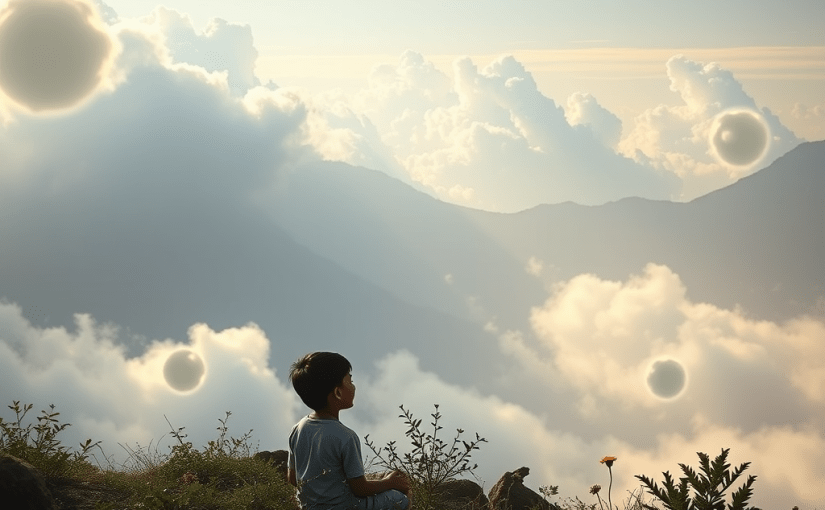
The pines stood still, like ancient witnesses, swaying gently in the cold morning breeze, as if whispering secrets only the mountains knew. Ishaan Sharma, with his satchel slung over one shoulder, walked silently towards the classroom, his shoes crunching faintly over fallen needles and pebbles. The calm rhythm of his new life in the cantonment-flavored school in Himachal Pradesh had begun to settle in like snow on a quiet ledge. It was peaceful—almost too peaceful. But somewhere in his heart, a strange anticipation pulsed. Something—or someone—was about to change everything.

The school, though civilian in name, bore the discipline of the army around it. A blend of civilian institutions nestled in an area that otherwise echoed with the boots of patrolling soldiers. Yet, even amidst such order, Ishaan had started finding his rhythm. The mess food had become more edible, the library more welcoming, and his bunked evenings beneath pine trees had started feeling like silent conversations with the cosmos. After the chaos of a city school he’d briefly tried—loud, impersonal, and utterly devoid of true learning—this haven amidst Himachal’s misted slopes felt like a calling answered.

That morning, he was early. His usual spot on the third bench near the window offered a perfect view of the hills beyond—hills that reminded him of his village, his parents, and the way the wind used to carry the scent of rain before it fell. He took a deep breath, as if drawing strength from that distant memory.

And then, like a quiet thunderclap in the midst of his silent sanctuary, **she walked in**.

Myra.

Her entrance wasn’t grand. There was no gust of wind, no celestial spotlight, no dramatic background music. Just a girl with curious eyes, hair tied in a lazy braid, and a smile that wasn’t trying to impress anyone. She walked into the room as if she belonged there—not in the arrogant way some do, but like a song finding its chorus.

She glanced around the room and, strangely, her eyes landed on Ishaan—as if drawn not by accident, but by some quiet gravity. He looked away instinctively, but the moment lingered, suspended like dew on a leaf just before it falls.

They didn’t speak that day.

The next day, she was back, this time seated two rows behind him. Ishaan, out of habit, listened more than he spoke. But Myra had a different rhythm altogether. During the short breaks between lectures, she would hum to herself or scribble in a notebook filled with doodles and notes. There was something oddly comforting in her presence, like the way certain dreams stay with you long after you’ve woken up.

Then came the announcement.

A regional quiz competition. The topic: Child Care and Family Planning.

That afternoon, Myra approached Ishaan as the class was dispersing.

“Hey… Ishaan, right?”

He turned. “Yes?”

“Would you have any good material to prepare for the quiz? I mean, I don’t want to go in blind.”

He paused, then nodded slowly. “Actually… I have a book. It’s from my uncle’s collection—he’s a medical practitioner. It covers family planning and child care quite thoroughly. Some diagrams too. I can bring it tomorrow.”

Her face lit up. “That would be perfect! Thanks!”

He gave it to her the next day, neatly wrapped in an old newspaper. Myra took it with a quiet smile, her fingers brushing against his. Something passed between them—silent, unformed.

The book was slightly clinical, rich with factual knowledge, diagrams, and medical insights. Ishaan had hesitated for a moment before deciding to hand it over. But since Myra had asked for it herself, a part of him felt unburdened—free from the guilt of handing a girl something so… straightforward. Perhaps even too straightforward.

She returned the book two or three days later. There was a lightness in her step, and yet, a shade of bashfulness touched her cheeks. She looked away while handing it back, but a faint happiness shimmered in her eyes.

“Very helpful,” she mumbled. “Thank you… and for being so… open.”

Ishaan simply nodded, heart quietly racing. A strange comfort had grown between them—born not of sweet nothings but of shared learning and silent honesty.

On the day of the quiz, rain clouds loomed like curious spectators. As they stood outside the assembly hall waiting for their turn, Myra turned to him and whispered, “Nervous?”

He shook his head. “No. With you, I’m calm.”

She laughed gently. “Good. Because I’m a nervous wreck. If I mess up, just smile at the judges. You have that mountain-boy innocence. It works.”

He smiled. “And if I mess up?”

She thought for a second. “Then I’ll cover up with my city-girl overconfidence. We’re balanced.”

The quiz was intense, yet their preparation showed. Ishaan’s factual clarity blended with Myra’s confident articulation. They handled complex questions on contraception methods, child nutrition, family welfare schemes, and infant care. A few spectator students later commented that Ishaan seemed emotionally stirred when Myra spoke—as if her voice awakened something deeper in him.

After that day, the invisible current between them deepened. They never talked directly and separately—only among classmates—but something had already begun taking root.

In shared glances, in accidental smiles, in the casual way Myra mentioned his name during group discussions, something beautiful stirred. Neither confessed, neither chased.

But the mountain breeze knew. So did the pines.

And perhaps, so did their souls.

She had unknowingly become his mirror, his muse, and perhaps even the flicker of something sacred. There was a mystic current beneath their connection, as though their souls had once circled each other in a different lifetime, now reunited in these hills.

And Ishaan, who once spoke only to mountains, had begun to speak with his heart.

What he didn’t know then was that Myra’s presence in his life wasn’t just to offer companionship or inspiration. She had come to awaken something far more profound. She would become the very spark that lit his path—not just through exams or classrooms, but through the winding, sacred journey of the self.

He didn’t know it yet.

But she would become his Guru.

And this—this was just the beginning.
Chapter 2: A School in the Arms of Discipline

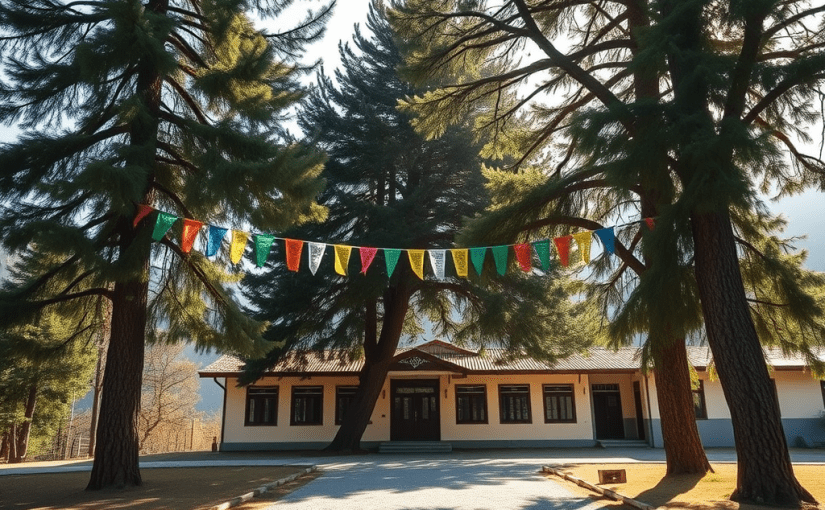
The scent of resinous pine hung softly in the air, like the memory of something sacred.

As Ishaan stepped down from the last rickety bus that had brought him up the winding roads from the comfort of home, a silence greeted him—one that wasn’t empty, but full. It was as if the mountains themselves were holding their breath. The sunlight filtered through tall deodars, dappling the gravel path like blessings from the sky. His city-worn shoes crunched over dry needles and hidden pebbles, but even that sound felt respectful here, hushed by nature’s quiet grandeur.

He paused. His gaze wandered to the fluttering prayer flags strung between two oaks—tired from the wind, but still dancing. Somewhere nearby, a bird sang just once, then flew off, its wings slicing the silence like a whisper.

This was not the city. Not even close.

Not the crowded school he had tried earlier in Chandigarh even though for a very brief period—a place full of vehicles, vending machines, and voices louder than thoughts. That city school had promised everything—facilities, computers, science labs, even a swimming pool—but the noise! The endless, soul-numbing hum of engines, gossip, mobile phones, and ambition. There, no one really studied. They competed. No one really listened. They just waited for their turn to speak. Ishaan’s heart, already too soft for that world, had shrunk into itself like a turtle under threat.

This, however, was different. That’s why the mountains, his inborn mates, were calling him back once again—away from the hustle of the city.

Here, amidst the thick woods of Himachal Pradesh, was a modest civilian school nestled within a cantonment area—a strange blend of order and calm. Though the buildings wore no army badge, the air carried discipline, a certain stillness of routines long practiced. The cantonment itself was mostly civilian now, with shops and households run by locals, but the army’s subtle influence hung in the backdrop like a prayer woven into the air—never loud, never pushy, just present.

Even the wind seemed to move with purpose.

He approached the school gate, where two children—perhaps from the senior classes—stood chatting softly, their uniforms neat and their postures straight. One of them looked at Ishaan and gave a small, sincere smile. Not the polished, indifferent half-smile of city kids, but something more human.

“Ishaan Sharma?” a voice called from the porch.

He turned. A teacher, tall and lean, with streaks of silver in his hair and eyes that had clearly seen more than textbooks, stepped down the stairs and offered a hand. “Welcome to Pine Crest School.”

Pine Crest.

Even the name carried dew.

As Ishaan walked beside him toward the main building, he noticed everything—the prayer flags near the flagpole, the scent of turmeric wafting from the kitchen, the rhythmic chirping of crickets from somewhere behind the library. No noise. No rush.

For the first time in many weeks, his heartbeat matched the rhythm of his steps

A Different Kind of Routine

The days that followed were unlike anything he had imagined. Here, students stood up when teachers entered not out of fear, but habit. The morning assembly wasn’t a chore—it was an invocation. Each student spoke something—a quote, a poem, a prayer—not to impress, but to share. And the teachers, though firm, seemed like mountain guides—always watching, but never pushing too hard.

The classrooms were modest—no smartboards, no plush seating—but what they had was attention. Focus. A kind of warmth that even broken desks couldn’t hide. Ishaan would often catch himself staring at the window during lectures, only to realise that the lessons were somehow seeping in even as he drifted. It was as though the very air here whispered equations and metaphors.

One day, during recess, a curious boy named Gagan plopped down next to him with a lunchbox full of pickled lingdu and chapatis.

“You’re the city guy?” he asked, mouth already full.

“I was,” Ishaan smiled. “Now I’m here.”

Gagan squinted like a monk considering a riddle. “You’ll stay. People like you always stay.”

“Why?”

“Because you look like you came searching for something.”

That line stayed with him longer than the taste of wild fern pickle.

The Silent Guru

The school had no formal guru. But in the silence between lectures, during the morning PT runs under foggy skies, or while sitting alone on the sun-warmed steps of the old temple behind the school, Ishaan found teachings more profound than words could ever deliver.

Once, during a class on moral science—a subject often laughed off elsewhere—the teacher, Mr. Dutt, placed a pebble on the table.

“What is this?” he asked.

“A stone,” someone replied.

“A weapon,” said another, giggling.

Mr. Dutt smiled. “Yes. But it is also a reminder. This came from a river nearby. Rolled, shaped, softened over decades. Like you. Life will toss you, polish you, bruise you—but if you allow it, it’ll shape you. Into what? That’s your choice.”

Something stirred in Ishaan’s heart.

He had thought transformation was loud, like lightning splitting the sky. But here, it arrived on little feet. Quiet. Patient.

That evening, he wrote in his journal—a habit he had picked up from the school’s curious emphasis on self-reflection:

> “I thought I needed a guru in saffron robes, speaking mantras. But maybe the pine trees are my gurus. Maybe the wind that wakes me up is. Maybe I am.”

Whispers in the Forest

There was a trail behind the hostel—a winding path that led to an abandoned British-era stone bungalow half-swallowed by moss. Rumor had it a saint once lived there. Some said it was haunted. Others said it was blessed. Naturally, the boys were forbidden to go.

Naturally, Ishaan went.

One misty Sunday morning, he followed the deer-trodden trail alone. With each step, the air thickened—not with fear, but with a kind of electric stillness. The kind you feel before a revelation. Or a memory.

The bungalow appeared like a forgotten temple, cradled in vines and secrets. He stepped inside. Dust motes floated like souls in sunlight. There were no ghosts, but in the silence, he heard something deeper.

His own breath.

His own heartbeat.

And then—nothing.

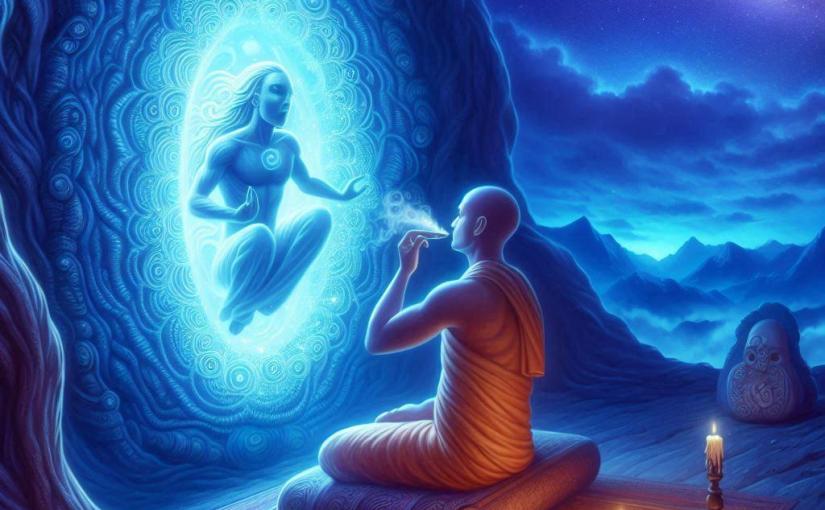
A strange emptiness bloomed inside, and for a fleeting second, he felt his “I” dissolve. No name, no class, no boy from the hills—just an awareness. Expansive. Eternal. Not frightening, but freeing. Like falling into the sky and finding it soft.

Then a bird chirped.

And the moment passed.

But it had happened. He couldn’t un-feel it.

The Awakening

Back at school, things seemed the same—but something inside had changed.

When he looked at classmates, he saw not competition, but stories. When teachers scolded him, he didn’t shrink—he listened. When the school’s peon, old Lalaji, limped across the corridor, Ishaan no longer ignored him. He offered a hand. And a smile.

“Something’s different about you,” Gagan remarked one evening.

“I think I’m just… beginning to notice things.”

Gagan nodded. “That’s how it starts. Before you know it, you start noticing yourself.”

Epilogue to a Beginning

Months passed.

Winter arrived with silence painted in snow. The mountains donned white robes like saints meditating in plain sight. The school felt warmer somehow. Perhaps because Ishaan had stopped looking for warmth outside.

He had come to escape the city. He had stayed because this place—this school wrapped in deodars, shadowed by army boots but sung into silence by birds—had taught him what no classroom ever could:

That discipline was not about rules, but rhythm.

That spirituality didn’t always wear beads—it sometimes wore sweaters and read geography.

And that the first guru… often waits quietly… until the student becomes silent enough to hear.

Introduction to the Series: She Who Became My Guru

Hi friends,

Love, in its deepest essence, is not merely a romantic emotion—it is a portal to transcendence. “She Who Became My Guru” is not just a story of teenage tenderness or cosmic coincidence; it is a soulful narrative of transformation, where divine love (prema) and spiritual awakening walk hand in hand through the corridors of everyday life.

This blog series is based on lived experience, contemplative memory, and mystical insight. It tells the story of an introverted student from a remote village whose life changes forever upon meeting a girl in a disciplined, army-controlled senior secondary school. What begins as a casual friendship for a quiz competition soon ripples into a deep undercurrent of emotional and spiritual evolution.

She was not a teacher. She was not a saint. Yet, her mere presence activated a current within the boy’s being that would slowly rise, oscillate, and eventually explode into a full Kundalini awakening. All without rituals, dogmas, or conscious pursuit—just the raw purity of presence, emotion, and silent grace.

Through dialogues, vivid scenes, mystical moments, and subtle humor, each chapter brings to life the boy’s inner journey. From the shy exchanges in a schoolroom to the surreal experiences on the Moon (yes, truly!), this story is both grounded in Indian mysticism and painted with the colors of futuristic imagination. Tantra, Samadhi, Puranic echoes, modern education, arranged marriage, sexual energy, and cosmic vision—all unfold as living characters in this spiritual adventure.

This is not just a novel. It is a window into what modern love can truly become when blessed with awareness. It is also a gentle challenge to outdated spiritual orthodoxy, proving that even the silent longing of a village boy can unlock the gates to Savikalpa Samadhi.

Why Read This Series?

  • To explore the mysteries of Kundalini and self-realization in a relatable, story-driven format.
  • To discover how spiritual experiences unfold in the most unexpected moments of modern life.
  • To reflect on the roles of feminine presence, ancestral wisdom, and inner control on the path of awakening.
  • To immerse yourself in a story that is simple yet profound, poetic yet real.

Each chapter is written in easy-to-understand language, deeply emotional, and filled with thought-provoking reflections—all embedded within a suspenseful, engaging narrative. The characters may be fictional in name, but their souls are rooted in real experiences—mine, and perhaps yours too.

So, dear reader, walk with me. One chapter at a time.

Let this journey begin.

Chapter 1: The Boy from the Quiet Hills

In the cradle of the lower Himalayas, where clouds brushed treetops like old friends and time slowed to the rhythm of rustling pine needles, there lived a boy named Ishaan. His village—silent, scattered, and serene—seemed etched more in spirit than in stone. It was a place where the morning mist carried the dreams of its people, and the twilight melted into tales told by flickering hearths.

Ishaan was a child of that hush. To the world, he was quiet—almost invisible—wandering through school corridors with the stillness of snowfall. Teachers marked his presence; classmates overlooked it. Yet, beneath that silence breathed a spirit wide awake.

At home, Ishaan transformed. He spoke with candor and a flicker in his eyes, revealing the poetry of a mind that saw beyond what was seen. His mother often said that his silences weren’t empty—they were full, like the sky before rain. To his siblings, he was a storyteller, a mimic, a thinker who asked why the stars trembled and where dreams went after waking. But in public, words betrayed him. They halted on his tongue, unsure, unready, often unspoken.

He had just passed his matric exams from the modest village school—a single-story building shaded by deodars and discipline. His marks, quietly earned and quietly celebrated, opened a new door. His father, a stern yet sensitive man of the soil, decided it was time Ishaan stepped out of the cradle. A senior secondary school awaited in the town across two rivers and one dusty highway—a place that promised better education and, perhaps unknowingly, solitude of a different kind.

As they packed his modest belongings—a steel trunk, a water flask, a photo of Lord Shiva, and the tight hugs of a home—something shifted. Ishaan was leaving not just geography behind, but the language of comfort and known patterns. His village was more than a place; it was a rhythm he had memorized. Now, it would become memory.

The morning of his departure, the hills stood still, as if listening. His mother’s silence was heavier than her tears. His younger brother clung to his kurta. His father said little—just a firm nod, a pat on the back, and a gaze that meant everything. Ishaan sat on the rickety bus, watching the pines retreat like waving elders.

That bus ride was the first chapter of an inward journey—one that wouldn’t just carry him to a school, but toward a self still forming, still hiding. He felt a strange loss—not of people or places—but of something nameless, a quiet certainty that used to live within him. The fields grew flatter, the air warmer, and the silence inside him louder.

There’s a peculiar loneliness in growing. Not the loneliness of absence, but of shedding. As the bus wound down the mountains, Ishaan felt he was not simply going somewhere—he was being unmade, so he could be made again.

That was the first lesson the hills taught him:
You don’t grow by adding; you grow by leaving.

And so began his life beyond the quiet hills. He didn’t yet know that the roads he took would soon bend into strange meetings, that the stillness in him would find an echo in someone unexpected—a presence that would awaken, guide, and undo him in ways no school ever could.

But that is for another time. For now, Ishaan sat in silence, a boy uprooted, gazing at a world he didn’t yet belong to, unaware that he was already on the path—not just to knowledge, but to a silent revolution within.

Kundalini Yoga vs Sanyas ~ An in-depth exploration

Best wishes to all friends for the Maha Kumbh fair at Prayagraj

Friends, this time I thought that whatever is in my mind, I should keep writing, of course it may not become a systematic post. It often happens with me that I sit down and start writing and that article itself becomes a systematic post.

This time many great personalities were seen as sanyasis in the great Kumbh Mela. For example, IIT Baba Ji or Gorakh Masani Ji and Mamta Kulkarni Ji. It is believed that most of the sanyasis got peace by leaving the world, got knowledge as well. But no one has shared the experience of getting self-realization or Kundalini awakening. So, has sanyas remained limited to peace and knowledge only? It can be thought that many people do not make it public. But this thing does not make sense. If they can share the miracle-filled siddhis and powers with everyone, then why not the experience of awakening. There is definitely a discrepancy somewhere. I am not expressing distrust in the tradition of sanyas. But it also has its own limitations.

Sanyasis inspire common householders to live a life of simplicity, meditation, charity and detachment. But this sect should also be reserved for deserving people only. It can also be contaminated by the entry of undeserving people into it. In olden times, the Guru used to give permission to his disciple to become a Sanyasi only after being assured of his disciple after taking a tough test, not just like that. However, today also twelve years are needed to spend serving Guru, yet screening doesn’t seem as rigorous as earlier. Although there being a tough exam to enter the Akhara, its quality cannot be doubted. Babas roaming around outside the Akharas and doing as they please create confusion about everyone. Our respected grandfather also once asked his Guru for permission to take initiation in Sanyas. But the Guru flatly refused saying that his household responsibilities were incomplete at that time. He accepted that advice. That is why he remained detached in household life. It is because of him that we are here today. If he had become a Sanyasi prematurely, then we would not have been what we are today, neither this blog would have been there, nor so many books and nor so much knowledge and science.

By taking Sanyas, the burden of the mind is reduced. This gives strength to do Sadhana. But due to lack of sufficient availability of power, that Sadhana often does not succeed on time. You know that power is associated with a woman, and her company is forbidden in sanyaas. Or else it takes countless years to get success due to lack of power. Many people cannot wait for this long period, and many pack up and leave. And many get deviated from sadhana and get into the habit of intoxicants like bhang etc. Time moves cyclically everywhere. Leaving the world for a short time may give peace, but soon that peace also starts feeling like a burden. That peace is relative, not absolute. Absolute is the ultimate peace which is found only when one attains complete samadhi. Even after removing the burden from the head, the head feels a little light for some time. But after some time, even an empty head starts feeling like a burden. And then one feels like lifting the burden. If awakening is found in that time of a little relative peace, then it is fine, otherwise it is a lost cause. This is because when that time of peace is over, he again takes up the burden of worldliness, forced by nature. Of course that worldliness is then limited to the monastery and the temple. But it is worldly. If I did not take the burden from there, I took it from here. If I took the golden pitcher off my head, I picked up a clay one. It is the same thing.

In this context, I am reminded of the story of King Shikhidhwaj from the Yoga Vasishtha Granth. He was a great scholar and the husband of Yogini Chudala. The king leaves the kingdom and goes to the forest, and starts living there like a householder. The queen tries to convince him a lot, but he was obsessed with renunciation. Morning and evening ritualistic practices, evening prayers, tarpan, sacrifices to Gods, yagnas, idol worship and being busy all day long for them. He spent many years living in the forest but he did not get the direct knowledge of awakening. His Yogini wife was watching his entire drama with her Yoga Vidya. Out of pity, she came to the forest and after listening to his tale of sorrow, started consoling him. She started telling her husband that when he had left the household, why did he start a new household in the forest. How will he get peace by taking off one burden and picking up another. In the relative peace that he got for a short time, he did not do real meditation but spent his accumulated energy in expanding the new household. Now when his mind is inclined towards Sadhana, he has no strength left due to the entanglements of the jungle household. If you miss the time, then it is lost. Then the king made his wife his Guru and did Yoga Sadhana under her guidance. Finally, he attained knowledge. Then when she started taking her back to the kingdom, the king started hesitating, fearing that he might fall into ignorance again. Then the queen explained to him that after attaining knowledge, there is no ignorance, no matter what kind of pleasures a person chooses. Yes, there is one condition that one has to remain detached. The queen’s desire of Romance pleasures and love-making also remained unfulfilled due to the king’s untimely departure to the forest. Then both of them returned to their kingdom with immense happiness, traveling in various planes in beautiful gardens, forests, groves etc. and doing various lovemaking. After enjoying the kingdom happily for countless years, both of them got liberated. This is the main and very beautiful story of this book, and shows that women were also not less than men in Yoga, but were better than them. It also highlights the importance of household dharma.

In the limited period of peace, only Tantra Yoga can bring awakening, but it is socially forbidden. Of course, the left-way people use sex, meat and alcohol for Kundalini Yoga Sadhana. But they stay hidden from society. These means are outside the Vedas. That is why they come under Left Tantra. It means that household life is better than Sannyas. Because there, even the left-way sadhana can be done secretly. For a householder, it is more important than a Sanyasi. Because by chance of time, he gets peace only for a very limited time.

In ancient times, a gentleman used to work in a government job. He lived a very struggle-filled life. Because there was a lot of pressure of work. But he did not let the flame of spirituality die in his mind and in his daily life. Due to time, he was transferred to a deserted and lonely Himalayan region for a limited time. This was bound to give him great relative peace. There, he came in contact with a yogi and did intense sadhana and attained awakening. From a common man, he became a great yogi. Then soon he was again transferred to a stressful area. However, he continued his sadhana somehow and little by little. Due to this, he got many disciples in due course of time. All of them started spreading the word of Grihastha Yoga. What I mean to say is that this happens with many people. Opportunities are rarely found again and again. But at least one opportunity is received by everyone in their life.

Some scientists also say that the more the difference between worldliness and renunciation, the more is the possibility of getting sudden awakening. In my opinion, even if a simple effort is made for awakening, then also that possibility increases manifold. If tantric power is also involved in it, then what can one say? If knowledge could be obtained only by leaving the world, then memoryless or drug addicts would be the most knowledgeable. They do not remember anything about the world, meaning they have completely left the world. But many other factors are also responsible for knowledge.

This means that nothing is left by leaving. The real leaving is to become detached. It means to remain detached or unattached from the world while living in it is to leave it. By this, both kinds of happiness are obtained together. The happiness of household life like love etc. and the happiness of renunciation etc. We can use the comforts and luxuries of life while living in the world. You can do it for attaining knowledge also. This is not possible in sanyaas. Of course, comforts and luxuries are bad because they make you fall in the trap of illusion. But they can also be useful in getting you out of illusion. The knife with which a dacoit can create terror, can also be used to cut vegetables. Here we are not comparing any system with another. Neither are we calling anyone good or bad. We are only telling that as far as our eyes can see. Of course, there is no doubt that there is much more beyond this.

Kundalini awakening as Deepawali and Lord Rama’s yogasadhana as mythological allegory of the epic Ramayana

Shubh Diwali!

Kundalini is Goddess Sita and soul is Lord Rama

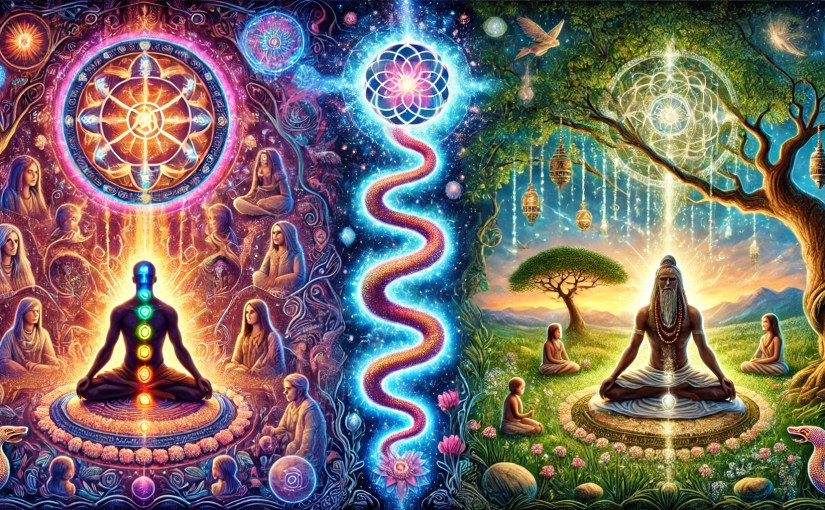
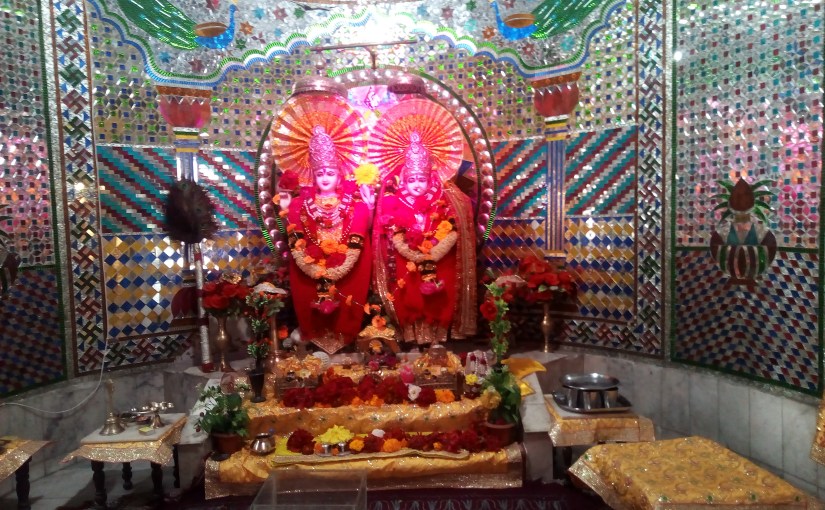
Sita is the Kundalini who enters from outside world in the form of a picture of the object through the light entering the eyes. In fact, the Kundalini energy of the body has gone out of the eye. It is also said in the scriptures that the whole personality of a man resides in his mind, which keeps wandering in the outside world by going out through the external senses. Everywhere outside is the kingdom of material defects or Doshas i.e. Ravana, a ten-headed demon. That kundalini power comes in his possession, and cannot escape from his clutches. The living soul i.e. Rama, who resides in the brain, looks helplessly at Sita Shakti wandering in that external world. This is what Jatayu’s brother Sampati ie. a big vulture has to see across the ocean with his sharp eyes and tell her well being to Rama. Then Rama engages in yoga, and associates a lot with the idol of the deity made in a temple, etc. or the guru living there, and pleases him with body, mind and wealth. By this, gradually the impression of the picture of his master deepens in his mind, and there comes a time when that mental picture becomes permanent. This is the start of samadhi or kundalini awakening. This is said as rescuing Sita from Ravana, the king of Lanka, and bring her to city of Ayodhya by crossing the bridge over the sea. The ray of light is that bridge, because through it the physical picture from outside entered the mind. The mind is Ayodhya, in which the soul of Rama resides. No one can fight with the mind, because it is beyond materialism. Very little is known about the mind of others. Everyone can fight with someone’s body, but not with the mind. Its second meaning is also that the mind should be put on the right path only after persuasion and not by coercion or scolding. Even through telepathy etc., it is just a guess. One can never know completely about another’s mind. First of all, the soul of Rama, wandering in the outside world that’s in Ravana’s Lanka, kept seeing his half part that’s Sita Mata from afar. Meaning he didn’t pay much attention to her. Even if he went out, he indulged himself half-heartedly. That is, he did not make enough efforts to bring back the kundalini power. Then, when Rama became very upset by her separation, then he jumped energetically out of his mind in to the outside world. This is what is depicted in the form of his battle with the demons. In fact, the real and lively life is like a war-level struggle and outward facing or extrovert life. It’s Karmyoga, the root and beginning of every meditation. Meaning that he came out of Ayodhya and entered Lanka through the bridge of eyesight. He started working hard in the world with his full heart and with full attention. Meaning that he started looking for Sita in Lanka. Then due to some satsang or good company, divine qualities started increasing in him. Meaning that the practice of Yama-Niyamas of Ashtanga Yoga of Patanjali started by him by itself. This satsang is in the form of friendship between Rama and the demon saint Vibhishana. Due to this, the soul Rama liked something very much, and he was constantly in contact with that one thing. Meaning that Rama’s eyes fell on his dearest Sita, and he began to be engrossed in her love. Meaning that in this metaphorical story, this principle of tantra has also been propounded that a woman that’s wife is the most helpful in yoga. The main purpose of the Puranas is spiritual and transcendental. The temporal purpose is secondary or inferior. But most people get the opposite. For example, they draw from this spiritual myth the same cosmic ethic that one should not cast an evil eye on a foreign woman like Ravana. Although this teaching is also correct, but they either do not understand or ignore the main and basic purpose of Kundalini Yoga hidden in it. Then the position or posture of the body of the soul Rama and the process of breathing itself began to adjust in such a way that maximum attention could be kept on the object of his favorite. Due to this, the development of Yogi Ram reached the asana and pranayama part of Ashtanga yoga. This means that Rama would sometimes stand for a long time to see Sita from afar and secretly, sometimes he would sit this or that way for a long time, sometimes he had to hold his breath for a long time, sometimes he had to breathe very slowly. This was so that the people entangled in the world, the demons of Lanka, would not come to know about this act of meditation or dhyana, so that they would not disturb his attention or meditation. What is actually a material object or a woman, that or she does not even know that someone is meditating on that or her. This is done very cleverly. If she finds out, she will shy away and will not be able to display her varied looks and emotions. Due to this meditation wouldn’t mature, Also, due to the creation of ego due to this, there will be further impairment in meditation. The same happens in the case of Guru as well. Similarly, what does a stone idol standing in the temple know that someone is meditating on it? Because Sita’s picture had occupied most of the space in Rama’s mind, so it had no desire to store unnecessary ambitions and unnecessary things. Due to this the fifth limb of Ashtanga Yoga, Aparigraha itself became manifest. Aparigraha means neither accumulation of unnecessary things nor wanting them. Then in this way, by prolonged practice of these initial five limbs of yoga, the image of that object or woman becomes fixed in the mind of the soul Rama. These are the dharana and dhyana or meditation, advanced limbs of ashtang yoga. You can call it as start of Samadhi or kundalini awakening. It means that Rama rescued Sita from Ravana of Lanka, and carried her through the same ray of light as bridge built on the ocean of atmosphere to the beach of eyes and then to Ayodhya in the form of mind or through Pushpak vimana that’s an classical aeroplane named Pushpak as written in Ramayana. Due to this the ten defects of his senses were destroyed. It is celebrated on the day of Dussehra festival as burning of effigy of Dashanan or ten-headed Ravana. The soul or Rama then practiced tantric yoga for twenty days to provide the final and emancipatory leap or escape velocity to kundalini for its awakening. During that time, he kept on taking picturesque and scenic journeys to reach home. Anyway, meditation along with remembrance of one’s permanent home gives more strength to Kundalini, because Kundalini is also associated with permanent house, as I mentioned in a previous article. Kundalini gets additional strength even from picturesque journeys, that’s why pilgrimage trips have been made. With that all-out effort, his Kundalini was awakened within a short span of twenty days. This is Ram’s reaching Ayodhya that’s the original place of Kundalini. This is the Kundalini awakening. The light of sattvikta that engulfs the mind after Kundalini awakening is depicted as the festival of lights, Deepawali. Because the effect of Kundalini awakening spreads the light of joy by spreading all around in the society, especially in the home, so this is the joint celebration of Happy Diwali festival by the people of Ayodhya.

Kundalini Yoga is the main motive of the soul getting birth inside a body

Friends, how can one’s complete personality be seen in darkness? I mean how can a living person be felt in the darkness of his soul. This can only happen if all the things said and thought by him, all his behavior and all his work done in his lifetime are recorded in that darkness. Everything should be recorded separately in that darkness. If the same darkness keeps increasing or decreasing by all, then that darkness will be considered inert. Just like different types of light in the form of different objects on gradually fading keep increasing the single and the same darkness of the night. By looking at the darkness, it is not known that which types of light in the form of different types of objects are contained in it. But while feeling the darkness of a person’s soul, we feel that different types of light in the form of different types of objects present in that person’s mind are contained there. However, still one undivided darkness is felt. This is surprising. Perhaps the same thing happens in black holes as well. There is only one undivided darkness in it, but if someone feels it through yoga etc. then perhaps all the substances swallowed by it can be felt in it, of course in subtle form. Science also says that information never gets destroyed. It is possible that in a black hole also, information of all separate substances is recorded or encoded in separate form. Then when a new universe or star is formed from that black hole, then that information again appears in the same gross form as earlier. However, science does not believe this. Therefore, consider it a thought experiment. Anyway, there are many areas, which are beyond the understanding of modern science. Spirituality is also one of them. That is why it is said that the soul is conscious. It means that it has everything that is in the mind of a living being in various forms. Of course, it is in gross form in the mind and in subtle form in the soul. But this is just a matter of saying and it is relative. While feeling the soul, we do not feel even the slightest difference between gross and subtle. We feel the entire living person as that dark soul. Even the soul itself feels that it is fully alive as before. Although it knows that now it has been freed from the bondage of the body, but it does not see any change in itself. It means the same old personality but in a new form such that it acquires additional qualities like comprehensiveness, immortality, of course not fully like God but in a relative form. It means that the soul itself is present in the form of what is called subtle body in the scriptures.

The subtle body of the scriptures is the soul itself. The subtle body has been described in detail only to embellish the words. The subtle body is said to consist of the soul, intellect, mind, ego, five sense organs, five organs of action and five breaths. It means that the soul can think, take decisions, feel its ego, can breathe, can listen, can speak, can smell, can feel the touch, can see, can work with hands, can walk with feet, can taste with tongue, can do the work of genitals and genitals. Then why does the soul take a body? Perhaps so that it can get waves. And also so that it can develop and reach God. It is said in the scriptures that the soul takes birth only to attain love. It is the same thing. Love is created from the waves of the mind. Why not say in simple words that the soul takes the body only for Kundalini Yoga, because only through Kundalini Yoga, love increases and by removing the impurities of the soul, the soul also develops.

So I am saying that the soul had talked to me. If it talked, it must have thought as well. If it thought, it must have taken a decision as well. If it talked to me, it must have seen me and listened to me as well. It must have felt itself or its ego, only then it would be able to talk. It means it had all the sense organs. Speech, that is, organ of speaking, is considered a sense of action. It means it also had sense of action. Along with that, it was telling me about a special activity going on at a faraway place which could have influenced me. It means it went there on its feet. It enquired about it and informed me about it. Feet are also sense of action. At the time of its physical state, that soul did not know anything about that activity. The body needs life and vital air to do so many things. Without air, even a leaf cannot move. It means the soul was doing the work of life without inhaling vital air or breathing. In other words or to explain, the sages have written that the subtle body i.e. the soul also has five vital breaths, which help in performing various tasks of the subtle body. The soul is the most important element in the subtle body as it is its base. All the other elements are dependent on the soul as they are based on it.

Kundalini Yoga reduces the potential difference as Rajo guna between Sattva Guna and Tamo Guna

Even if a person wants, he cannot stop the disturbance in his Gunas. The Prana Vayu keeps creating waves in the Gunas, just like the wind creates a storm in the ocean. However, the Yogis who have controlled the Prana Vayu through Pranayama etc., to a large extent, control the waves and so know well their real and basic level of the soul made of base level unchanging gunas. Take a person who has always seen a stormy sea, and has never seen a calm and still sea. He will think that the sea is always like this and that is its real form. Means in a way he will not have any knowledge of the calm soul form like the real and basic form of the sea without waves. If he ever sees a completely calm sea instead of regular stormy sea or say, the sea frozen due to cold in the polar region, then he will say that the sea has dried up or ended. Similarly, when people see a living person dead, they say that he is dead, but a person never dies. It’s worth mentioning here that it’s not the positive appraisal of negligence towards body like self harming instincts or suicide etc. The body always dies. Then one doesn’t know when one will get a new body, which one to get, with how much hardship it’ll be got, even after getting it one don’t know how long it will remain alive, who knows. Therefore one must take good care of the body. It only means that the soul of a person never dies, because the soul is the real form of a person. It is like a person who has always felt his form as the form of waves of his mind, i.e., with changing qualities. He does not know that this form of waves is not his basic form. He has never pacified his mind with yoga, meditation, etc. All the seas in a storm look the same, because the water is not visible properly in them. But when the storm calms down, then the water of some appears blue, while some appear green. The water of some is less, while some have more. Some have less sea vegetation like algae, while some have more. In some, there will be one type of sea creatures, while in some, there will be some other type. Similarly, people with frequent mental storms also look the same. As soon as we start focusing on any of their qualities, it changes at that very moment. This is why only by meeting the soul after death, we can get accurate and detailed information about its basic qualities.

There are as many oceans as there are living beings in the universe

This is a very interesting subject and by continuing to write, new puzzles keep getting solved. And if there is some experience along with it, then what can be said. Consider the rising wave to be happiness or Satva Guna and the wave falling below the normal surface of the ocean to be sorrow or Tamo Guna. This keeps happening in the mind throughout life. After death, the mind or soul becomes like the normal surface of the ocean. Neither the wave goes up nor down. Neither happiness nor sorrow. But this is not so, because if there are three gunas, then happiness and sorrow will always be there. This is the Trigunatita Parmatma in whom there is neither happiness nor sorrow, but there is only absolute bliss. Understand that both Satva Guna and Tamo Guna are present in the soul. However, both are in less quantity because there is no body to highly lift or drop them, that is, to create huge waves in them. This is the equilibrium state of the gunas. Meaning Satva Guna is also at its constant level and Tamo Guna is also at its fixed constant level. Someone will say that then how will the quantity of all the three gunas be different in all people. See, the one who has more Satva Guna at the time of death, will be fixed there after death, meaning it will remain more even later. It is like if the wave of the polar sea rises up when it freezes, then it will remain raised at the same level even after freezing, it will not change from there. However due to gravity it can’t be frozen at very high level. It is also true that at the time of death, the gunas often remain at the level as the sum average form of all its previous gunas and deeds. Meaning, there will be different amounts of darkness in the soul of all people. No matter how close two people are to each other, the amount of darkness in the souls of both cannot be the same. This is impossible. There will always be some difference. That is why there is never any deception in the matter of soul that the soul of so and so entered the body of so and so by mistake. Whatever happens in stories seems to be an educational metaphor. When a ghost etc. occupies someone’s body, it clearly tells that he is a ghost. That is why he is driven away by tantriks etc. If someone had the power to become a photocopy of someone’s soul, then the ghost would have also become so. Then no one would know and no one would even drive him out of the other’s body. But this does not happen. That is why it is said that the mental state at the time of death determines the future after death. That is why many people go to pilgrimage places like Kashi to die, many listen to spiritual texts like Gita etc. at the time of death. Here another problem opens up. Of course, after death the soul becomes changeless and unrest-free, peaceful and all-pervasive like God, but there is a huge difference between the two. The soul, though it seems like Nirgun, is bound by all three Gunas, but God is actually Nirgun i.e. beyond Gunas. That is why he is more than the soul and you can say that he is the form of the ultimate subtle, the ultimate all-pervasive, the ultimate changeless, the ultimate peaceful, and the ultimate Sachchidananda. This should be understood especially by those people who are under the illusion of considering God and the soul to be almost the same. Many worship buried dead bodies etc. Many think that after death their ticket to heaven is booked.

Kundalini Yoga assist in successfull sex

Another secret fact I tell you is that during sexual contact also this base level soul contact is most profound. This is because at times of sex one wants to be in full loneliness except only two sexual partners. This instinct is the origin of shying stance in sexual matters. No one wants to do sex in public as then it’s not sex but a dramma only. Even no one wants to talk about his real sexual experience leave away sexual drama that’s advertised heavily by cheaters. So said, what’s more loneliness than the basic soul form fully away from worldly chaos whether physical or mental. Although everything of base level soul is not visible like scenes on a TV, but its average subtle form is experienced. It’s like a special or unique darkness. Of course, that form may seem suffocating to us, because we are not used to it. But the free soul that has got accustomed to it will not feel so. Even sexual energy is so much high that it provides more than enough bliss in that short lived basal soul form contact. This way love also grows. It’s common observation that departed soul contact often occur in tantric mixed sexual environment. The reason is same that intense sexual energy of tantra provides enough energy to withstand that short lived suffocating soul contact. Simple sex don’t suffice much as there’s less mind control in it and also, it’s of shorter duration. Kundalini Yoga based tantra boosts the sexual experience because it further increases the level of loneliness with help of kundalini meditation that’s prerequisite for blissful and successful Sex. Kundalini meditation rules out every worldly chaos except a single mental kundalini image. It’s necessary because we can not keep mental energy on hold, and while doing so it’s suffocating and bliss also goes on hold. Then what a sex without bliss. But with kundalini image in mind, it becomes the source of profound bliss. It’s fully akin to complete loneliness as mental kundalini image is nothing physical but only a mental creation. That is why it is said that true love can happen with only one person at a time, not with two. Tantra also advocate going solely with single partner for long period of time. However it’s important and interesting to know one reprimanded by multiple partners severely only wishes to go in perfect solace only with single one. Perhaps sex is pleasurable because it attempts to reach the deepest depths of the soul, the top treasure of bliss. In fact sex science is much deep and vast than supposed as truly told by Osho Maharaj.

Soul and world is the gameplay of light and darkness

Kundalini Yoga is an integral part of Sex

I feel that what we consider as Satva Guna is becoming Tamo Guna in the background. It is like the shade is formed from sunlight. It means that whatever the soul has experienced from the beginning, all of it is present in it in the form of Tamo Guna i.e. darkness. Whatever it will continue to feel in the future, it will also keep getting recorded as darkness. It is like according to intensity and the nature of sunlight, the intensity and the nature of shade will be formed. As the type of leaves of the tree, the type of shade will be formed. That is, the shade in the form of Tamoguna will be formed according to the nature of the body, mind or brain. This means that the shade has all the information about the sunlight that forms it or the sunlight that has filtered through its leaves. Satvaguna is the pure form of the soul. It will remain by default. It cannot be erased. It is possible that it may be visible more or less according to the amount of Tamoguna. If Tamoguna is more, Satoguna will be less and if Tamoguna is less, Satoguna will be more. Rajoguna will also be in the form of the natural tendency of the soul under which it wants to go from Tamoguna to Satoguna. This means that if we do not feel the world, it will not be recorded in the soul as Tamoguna. But it is also not possible to stay away from the world. That way tamoguna will come later, first one may have to die of hunger. The middle path is of detachment. It means to experience worldly matters without attachment. Due to this, worldliness will continue and its shadow will also not be able to settle on the soul or it will settle less. This is easily possible through yoga. In the scriptures, it is said to adopt sattvik methods without attachment so that its sattvik sanskars keep on getting into the mind. It takes less effort to remove sattvik sanskars from the mind than rajasik and tamasik ones, which increases the possibility of liberation. If these are not put into the mind, then absurd sanskars will keep getting into the mind because the mind cannot remain empty. It is very difficult to remove them, which reduces the possibility of liberation to a great extent. But only this will not work. The soot of the impression of worldliness of countless past births which has settled on the soul will also have to be cleaned. That too will be done through Kundalini yoga, especially aggressive tantric Kundalini yoga. Due to this, Sattva Guna will increase in the soul and Tamo Guna and Rajo Guna will decrease. Rajo Guna will decrease because now the nominal Tamo Guna does not have enough potential to move towards Sattva Guna at a fast pace. This latent Rajoguna is also like the potential difference between two opposite poles of electricity. The greater the difference between their opposite charges, the more rapidly will be the flow of more electric current in the circuit connecting them. The Sattva Guna of the pure soul is supreme and definite. The amount of Tamoguna of the bound soul will determine whether the potential difference of Rajoguna between them will be less or more. See, the circuit between the two will be connected only when the soul gets a body. Then a lot of electric current will flow between them in the form of mental thoughts. It will keep increasing or decreasing according to the Tamoguna of the soul. That is why after drinking etc. in a party, people feel refreshed and get involved in their work with new zeal and enthusiasm even more than before. This is just an example. And it can also be harmful in matters of spirituality. Many people, after spending a long time in solitude, enter the world with new and increased energy. This is the power of the Tamoguna of loneliness.  As said above, Tamoguna decreases with Kundalini Yoga. This reduces the potential difference of Rajoguna between Satvaguna and Tamoguna. That is why the behavior of a Yogi is not impulsive or short-tempered or blindly progressive, but is patient, serious and systematic. Many times, Tantra Yogis can temporarily accept Tamoguna to achieve temporary impulsive behavior according to the demand of time and place. This Rajoguna remains in the form of latent potential difference in the soul without a body. Meaning, there is a force to go from darkness to light, but due to the absence of the electrical circuit of the body, the darkness is unable to reach the light. Meaning, Tamoguna cannot express as Satoguna.

Kundalini awakens from the Kunda and activates the vaikalpik Kalachakra as Sudarshan Chakra in which sharirvigyan darshan ek adhunik kundalini tantra book helps a lot

It is said that the word Kundalini is not in the scriptures. But the word Kund is there a lot in Shivpuran. In Sanskrit language, a masculine object shaped like an earring or ring is called Kundalin and a feminine object having such shape is called Kundalini. Perhaps the word Kundal is also derived from the word Kund. The relation between the two is clearly visible. The literal meaning of Kund is round pit, and Kundal means round ring. The only difference between the two is that the pit has a bottom surface, but the rings do not, otherwise both are the same. Just as word Harshil is made from Harsh, similarly Kundal can be made from Kund. Harsh means full of joy and Kundal means accompanied with pit. This is because kundal fits properly inside kund. Only any Sanskrit grammar scholar can check this guess of mine, if he is reading this article. Even if a kundal is not formed from the word kund, the snake gets molded into the shape of the coil and hides in the kund i.e. the pit. That is why it is said that the snake has made its kundali. It should not be surprising if the pit in which a snake coils itself and hides is called a kund. In the dark pit of Mooladhar, the widespread power of the mind shrinks and gets hidden in the form of a meditation picture. That is why that power is called Kundalini. It climbs up through all the chakras and spreads in the nadis of the back and brain shaped like a hooded snake. Vishnu installed Shivalinga in the pit. Since it is related to religious faith, not much can be said about it because some staunch Hindus start doubting the fact that the one who calls the stories of the Puranas mythical is a Hindu. Well, in their opinion they are also right, because these stories are not fabricated. Myths are also of two types, one apocryphal or useless type and one based on scientific truth or useful type. The myths of the Puranas are of a different type, meaning that although they may seem like myths, they are completely based on scientific truth. That is why we highlight their scientific truth so that they are not considered fabricated myths and their lost respect can be regained. However, with common worldly thinking, it can be understood that the above Shivalinga worship by Lord Vishnu is similar to the way some skilled Tantra yogis gave Shivdhyan-superimposed sexual power to Muladhar as generated from Yabyum Asana. It is only by Shiva’s meditation on the Linga that it becomes pure and becomes Shivlinga. The method of great and ideal yogis like Dev Vishnu may certainly be advanced and sattvik, but the aim of all is the same, and that is to awaken the Shakti.

Vishnu was trying to worship Shiva with a thousand lotus flowers, that is, he was trying to lift the Shivadhyanachitra from the perineum up to the Sahasrara Chakra through the spine. Shiva hid a flower with his Maya shakti, which means that Vishnu, being fascinated by Shiva’s illusive power, was not able to offer his ego to Shiva. Vishnu searched for that last flower everywhere on earth but could not find it, meaning ego is within, not outside. Even if the entire external creation is offered to Shiva, the offering will still remain incomplete, because the ego residing inside the brain has not been offered. Vishnu then offered his one eye i.e. by awakening the third eye i.e. Ajna Chakra, he brought its power down from the front channel to the Muladhar Chakra. Being completely satisfied with that, Shiva present there climbed up to the Sahasrara Chakra and became fully awakened, that is, being pleased, he presented himself in visual form to Vishnu. The web of ego resides in the form of intelligence, and the symbol of intelligence is the Agyachakra. Meaning, the power of the mind which was trapped in the web of intellectualistic worldliness, got freed and got attached to Shivdhyan Chitra i.e. Kundalini picture, due to which it woke up. Then Shiva gave him Sudarshan Chakra, meaning the Sahasrara Chakra formed after su darshan or good visualisation or Shivadarshan i.e. awakening, is Sudarshan Chakra. Killing evil and demons means eliminating bad thoughts. At many places it is also shown like a rod, which seems to symbolize the Sushumna Nadi.

Shri Krishna had lifted Govardhan Mountain on the Sudarshan Chakra itself, that is, through the awakened Sahasrara Chakra, the form of knowledge, he made the physical world so light, subtle and ethereal that it rose up and came in the middle of the void sky. With this, the cowherds men, i.e. the common worldly people under the influence of senses, were saved from the indiscriminate rain of sorrows, which was being caused by Indra in the form of ego. Cow is called the senses and the one who grazes the cow means an ignorant human being suffering from the influence of senses. This seems to be a similar case of Ravana lifting Mount Kailash on his arms. Sudarshan Chakra moving only at will and coming back on its own after striking and always rotating indicates that it is a divine chakra i.e. Sahasrara Chakra. Its spokes, axles etc. indicate seasons etc. Kalachakra is also compared to this among Buddhists. Even in Kalachakra, there are spokes etc. equal to Sudarshan Chakra which indicate the movement of time, seasons etc. Both contain thunder and electricity. This is the energy flowing in Sushumna and giving instant awakening. Like Sudarshan Chakra, Kalachakra is also associated with Vishnu, Krishna, Shiva etc. Both are described in the Vedas. However, Kalachakra is mainly used among Buddhists.

There are three types of Kalachakra, baahya or external, aantarik or internal and gupta or secret. External macro universe is included in external, internal is micro universe inside the body and secret is included in mysterious liberating sciences like yoga etc. I think that having complete knowledge of one leads to knowledge of all three. For an extroverted person, it is the sadhana of the external Kalachakra. internal for an introvert and Gupt Kalachakra is made for Sanyasin or renunciate type of person. Knowledge and liberation come from all three. Premyogi Vajra’s philosophy of physiological science or sharirvigyan darshan can be called a kind of internal Kalachakra, because it describes the universe inside the body. Kalachakra is a circle in which various deities, symbols and figures are displayed. In fact, there is a world with similar diverse forms in all the three time cycles aka kalchakras. By its sadhana it is natural that Sushumna, Sahasrara and Kundalini etc. get awakened, which then destroy the demons in the form of evil thoughts and nature. In this case also Kalachakra and Sudarshan Chakra are same. It can be said that the Kalachakra is available to a common man, whereas the Kalachakra available to an ideal man like Vishnu has been called Sudarshan Chakra. The common man destroys only his own ignorance whereas Vishnu and his incarnations like Ram, Krishna, Buddha etc. destroy the ignorance of countless devotees. That is why Sudarshan Chakra can be called a special Kalachakra.

In Vamana Purana also this chakra has been called Kalachakra. Its twelve spokes indicate the twelve months and six navels indicate the six seasons. It is also said that the mantra ‘Sahasrat Hum Phat’ is inscribed on its spokes. This sounds like a Buddhist mantra. The Sikhs also used the Chakra as a weapon, which could be used directly or by throwing. At many places it is also said that the center of Sudarshan Chakra is made of Vajra. Vajra is the same spinal cord through which Vajra Shakti passes to Sahasrara. This article will be completely understood after reading the next article because its original story described in Shivpuran will be written in it.

Even in Rigveda, Sudarshan Chakra has been called Kalachakra. Apart from the three Kalachakras, there is also a fourth alternative Kalachakra, in which the mind is not allowed to be affected by the movement of time. This is the chakra of enlightenment and spiritual knowledge. This is Advaita, this is Dvaitadvaita, meaning Advaita is living amidst duality. This is the concept of tantra philosophy called body science philosophy created by Premyogi Vajra. This is Vishnu’s evil destroying Sudarshan Chakra. These are the three previous Kaalchakras, which due to the blows of time are going to put the common man’s mind in duality, ignorance and sorrow and put him in the cycle of birth and death again and again. The benevolent Sudarshan Chakra, the fourth and last one is the alternative Kalachakra, which undoubtedly rotates at the speed of time, but by teaching man to live non-dually in it, gives him happiness, prosperity and liberation. Anyone can have the time cycle that can kill, but only a knowledgeable person like Vishnu can have the one to save. That is achieved when the Sahasrara Chakra is awakened. This time continues like a cycle and never stops. Birth is followed by death, death is followed by birth and then again death. Creation is followed by destruction, destruction is followed by creation and then again destruction. Seasons keep changing in cycles, happiness and sorrow keep coming and going in cycles. We cannot run away from this cycle. The cycle itself cuts the cycle. Varadayi that’s boon providing Sudarshan or Alternative Chakra is the only way to escape. Meaning, keep moving with the cycle but do not let it disturb your non-dual peace. This is the praise and worship of Sudarshan Chakra.

Sudarshan Chakra cut Shishupala’s throat, which means that due to Shishupala’s duplicitous behavior his power did not rise above Vishuddhi Chakra. Because a person speaks with the power of Vishuddhi Chakra of the throat, then the power rising up is stopped by the throat and ends in abusive language, which means the path of power near the throat is cut, which means the throat is cut. Shishupala was abusing Krishna a lot. Kundalini chakras are also called chakras because the level of power on them also keeps changing cyclically. Sometimes the power increases and reaches a peak, which is called awakening of the chakra, and then decreases and reaches a minimum. For example, sometimes the heart’s emotions are in full swing and sometimes it becomes emotionless. After some time, the heart again gets filled with emotions, which sometimes leads to creation of a good poem. This cycle continues. If the Chakra is awakened, it does not mean that it will remain awakened forever. Its power will keep increasing and decreasing. Don’t be afraid of this nor be affected by it. This is the vaikalpik Kalachakra, meaning the Buddhist thinking kalchakra i.e. through truthful imagination or philosophy, we have to eliminate the ill effects of Kalachakra and create positive effects from it. Similarly, Sahasrara Chakra is also sometimes at its peak power. At that time, this can give material prosperity and liberation to deserving person by giving knowledge or boon, and by cursing the sinful person, it can also put him in material loss and bondage. Then the Sahasrara Chakra also occurs at a lower Shakti level, at which time Shri Krishna used to behave like a common man. He behaved like an incarnational man only when the Sahasrara was in a state of extreme power, at which time the Sudarshan Chakra was shown rotating on his finger as an external and physical symbol of the Sahasrara Chakra. Common people cannot feel the subtle Sahasrara Chakra inside the mind or brain. Through awakened Sahasrara Chakra that’s Sudarshan Chakra there is divinity, prophecy and greatness.

Man is born in the external kalchakra and learns a lot by living in it for a long time. This is the time cycle or kalchakra of initial practice. Then, being troubled by the blows of sorrow arising from it, he starts imposing it on the internal kalchakra. Meaning, he starts giving solace to his mind that whatever is there in the vast universe is also there in his own small body. Meaning ‘Yatpinde tat brahmande’. To do this becomes very easy with the book titled “sharirvigyan darshan, ek adhunik Kundalini Tantra, ek yogi ki premkatha”. This gives him a feeling of non-duality due to which he feels some protection from the blows of time. This happens because despite the entire Kalachakra running inside the body, none of its components fall into the bondage of duality. After remaining stable in it for a long time, when he becomes pure enough, then his tendency automatically leans towards the secret time cycle or gupta kalchakra of Yoga Sadhana. While doing yoga and moving forward, he himself turns towards Tantric Kundalini Yoga. Through Tantra Yoga, his Kundalini is awakened in the Sahasrara Chakra, which means he becomes the possessor of the vaikalpik Kalachakra or Sudarshan Chakra. Yet whenever he keeps coming down from this supreme Kalachakra due to lack of energy in Sahasrara, he easily reaches there with a little push of tantric energy.

The infinitely wide external kalchakra becomes smaller and smaller. First it reaches the level of the internal kalchakra. Then it becomes more subtle and limited to seven Kundalini Chakras and becomes the Gupta Kalachakra. It’s called Gupta or secret because not everyone can feel it but only the Kundalini yogis. Then after awakening, it becomes subtle to the level of the point of sahasrar chakra and becomes an vaikalpik Kalachakra. The kalchakra continues from the beginning till the end, but earlier it was the one who puts you in the bondage of ignorance, in the end it becomes the giver of knowledge and liberation. This is a very effective and practical meditation which must be adopted. To put it in the simplest terms, it is like that in between the material worldly life, one should keep experiencing one’s body as well, the paths ahead open up on their own. Yoga is made only to develop its habit. While doing Yogasana, worldly thoughts keep coming due to the activity of Prana and along with this, attention is also focused on the special posture of the body and breath, which means the external Kalachakra keeps getting transformed into the internal Kalachakra.

Kundalini tantra is based on Shiva-linga

Friends, according to a story of Shivpuran, once some disciples asked the Purana narrator whether Shivlinga is worshiped everywhere because of being a linga or there is some other reason. On this, he narrates a story that in a great forest named Daruk,  devotees of Lord Shiva used to always meditate on Lord Shiva. Some time they had gone to the forest to collect Samidha. At the same time, Shiva came in the guise of a Tantrik Avadhoot to teach them and test them, who was making evil attempts while holding the Linga in his hand. The sages’ wives got very scared after seeing him. And others came there desperate and surprised. Some other women held each other’s hands and hugged each other. Some women became ecstatic with the friction of that embrace. At the same time Rishivars came and seeing that behavior became sad and distraught with anger. They started saying among themselves, who is this, who is this. When Tantrik Avadhoot did not say anything, they cursed him saying that he was behaving against the Vedas so his Linga should fall on the ground. So did happen. That Linga burnt all the objects in front like fire. Wherever it went, it would burn everything. It went to hell, went to heaven, went everywhere on earth, but did not settle anywhere. All the people became distraught, and those sages also became very sad. No god or sage found peace. The gods and sages who did not recognize Shiva took refuge in Brahma. Brahma scolded them a lot for unrecognising Shiva like illetrates though they being knowledgeables and scholars and said that if Goddess Parvati becomes Yonirupa then it will become stable. To please the Goddess, they were told the following method. An eight-petalled lotus should be made and a Kalash should be placed on top of it and water from the pilgrimage site containing Durva and Yavankurs should be filled in it. Then that Kumbh that’s holy handheld small pitcher should be invoked through Veda mantras. Then, after worshiping it in the Vedic manner, one should anoint the Shivalinga with the water from the Kalash while remembering Shiva and reciting Shatrudriya mantras. Then sprinkle the Linga with the same mantras, then it will become calm. Then after installing the arrow or Bana in the form of Girija yoni, the Linga should be placed on it and then it should be invoked. Then Shodashopachara pujan means God should be worshiped with sixteen types of ingredients, and then He should be praised. This will make the Linga stable and healthy, and all three abodes will become free from disorders and happy.

However, this story cannot be explained. This is a sensitive religious matter connected with the faith. This can be understood by one himself. Yes, it can definitely be said that every man wanders in search of his sexual partner at some time or the other. During that time, the picture of trance that is formed in his mind can definitely make him irritable and jealous. This is because samadhi requires additional energy, which can be obtained only with the help of a close companion. The octagonal lotus is a symbol of the Anahata Chakra, and love originates on it only. Placing a pot filled with water from the holy places on it means gathering and concentrating the meditative power on it. Different pilgrimages mean different chakras. Durva grass symbolizes fertility, growth and development. Yav Ankur means sprouted barley, which appears the symbol of Chaddi Kala or all-round development, because it contains all types of tonics, vitamins and minerals, that is why it is also called green blood. In common language, it seems to mean to sacrifice everything for the heart, i.e. for love. Yogis are also like this, who leave their families and engage in worshiping their deity and attain knowledge. Worshiping that Kalash means worshiping the deity image etc. associated with shakti on the heart. Due to which it becomes more enlightened i.e. happy, just as by serving a person that person becomes happy. Worshiping with Veda mantras means giving more sharpness to that picture and making it clear, pure and luminous. Beejmantra also does the same. That mental meditation picture can be of anyone, Guru, beloved, deity, seed mantra etc. The amplified shakti along with that worshiped picture is then descended from Anahata Chakra to Swadhisthana and Muladhar Chakra. This is the anointing of that divine Linga with the water of the Kalash. In Abhishek, the stream of sacred power in the form of water flows continuously. Prokshan is called sprinkling of water. To bring down the Shakti from the heart pot again and again through morning and evening sadhana is the divine prokshan. Shatrudriya Mantra has various secret Mantras etc., which release various invisible waves, which have invisible divine spiritual effect on the mind of man. Although natural banalinga is found in the Narmada river, yet it seems that the arrow has been described as the seat or peetha of the Linga. When I inquired from Bing AI, it replied that a consecrated arrow is buried in the ground, and Shivalinga is installed on top of it. Maybe it is right. Because at many places such Shivalingas are seen which do not have a peetha or base. When asked, the priests etc. there tell that this Shivalinga is dug deep in the ground. It is possible that the arrow inside the ground may be its peetha. By the way, the shape of the peetha also resembles an arrow. Then beyond that, in common man’s language, only tantric or divine sexual intercourse is considered. Well, everyone may have their own opinion. Due to this, all the three worlds i.e. the entire body becomes calm and healthy i.e. it becomes established in its pure self, because all the worlds are present in the body itself. This is often seen in the world, that is why spoiled or spoiling youth are married off by their families in a hurry. After that I have seen many improvements in them. But nothing improves in someones. I also blame their wives for this, yet males may appear more responsible for this too. That is why it is said that only Parvati as the peetha can hold the Shivalinga. That’s why Imparting spiritual values to women was considered more important than to men, because woman is the foundation of the entire family. I heard a grown man express his personal opinion that if men were not married, they would eat each other raw, because wives control men. He himself married another woman after the death of his first wife. What has been said is correct. A friend was also saying that Tantric sex does not seem like sex at all, it becomes some other very sacred spiritual act. I think only foolish, negative, unsuccessful and heretical people vent their anger by putting both in one category. In a book, Love Story of a Yogi, when the author was asked by a woman about the main reason for his recent Kundalini awakening, instead of marking out his experience to the questioner, he narrated his experience to everyone and said that while meditating on the Kundalini picture on the sensation of Vajrashikha, he got his awakening. He attained awakening by moving it in and out of its receptacle, but what he did was not sexual intercourse. On this, that Western or possibly American woman asking the question present on the online Kundalini group pinpoints him with loving surprise and little funny style and tells him that in their country it was called sexual intercourse, she don’t know which strange culture or land he belongs to. After reading that by all group members, everyone’s communication in that group on that topic had stopped, but diverted it to the usefulness of tantra accepting its utmost importance in awakening. Meaning, the author had expressed his feelings and indirectly answered the main question. This story also seems like the ankhing technique of Egypt.

It is clear that the false propaganda spread by heretics or hindu opponents has been refuted in this story. The sage was very far-sighted. He knew that this could happen in the future. This story also reflects a common incident happening in the society, not any divine transcendental type etc. Unmarried teenagers are like that. They keep making gender-oriented jokes with girls whenever they get a chance. One of them is also the real knower of Shiva type Tantra. But people consider everyone to be the same lewd and scoundrel. It is said that along with the grain the mite also gets ground. How do public know who is true and who is a liar? Therefore, along with others, they also insult Shaiva and curse him, which means they also look upon him with evil eyes. In fact, the Shaiva linga is not a normal Linga. Due to the influence of Shaiva Tantra, it actually becomes the favorite deity. In a way, due to the effect of Sadhana, that Shaiva person becomes Linga form. Wherever he goes, in a way, his favorite linga is going in his form. The displeasure of that presiding deity troubles everyone, i.e. burns them. This can also happen, because the whole world is in the wandering minds of the people, and by being in the company of that presiding deity in the form of Shivalinga, they are getting disillusioned with their wandering minds, this can be called the burning of the world. Only a Tantrayogini like Parvati can wear that Maheshwar Linga properly, so that the meditation picture of the presiding deity can also be meditated along with it. An ordinary woman will not be able to cooperate in meditation. This means that the presiding deity will be angry and will remain without awakening. Kundalini activity without awakening can also be harmful, as it can go out of control. Uncontrolled power will burn everyone. Awakening shows man the true and complete form of power. And that form, though most beautiful and powerful, is also extremely peaceful. This keeps the man calm, meaning he remains in control of his awakened awareness.

I found this story to be the one of most meaningful story of Shivpuran. One can write as much as one wants on this. The answer to the question raised by the sages in the beginning whether Shivalinga is worshiped only because it is a Linga or there is some other reason, has been given in a very civilized manner. This is similar to the answer given by the above author. Meaning, Shivlinga is not the ordinary worldly linga, as the wicked, foolish, lustful scoundrel, Entangled in the illusion of materialism, very work-oriented, anti-religious or sexy type of people understand or talk about. It is surprising when many Hindus also fall under their influence and provocation, and start thinking the same way. Everywhere on social media etc. they ban considering Shivalinga as a part of Shiva’s body, saying that it is only a sign or symbol of Shiva, or only a symbol of union of Shivashakti, or a cosmic union, not of any physical so and so. Well, at their place and in a spirituoscientific sense they are right too, because there is nothing like ordinary worldly object or organ in it. Learning from them, Bing AI also says the same. In this case, if the heretics fall very low, then those so-called Hindu protectors rise very high. No one lives in the middle of the practical world i.e. on the middle path. Extremism is prohibited everywhere. The middle path is the best. This can be understood with an example. There is only one gun. One civilized man kills a terrorist with it, while another madman kills the general public. What is the fault of the gun in this? Similarly, the Shivalinga controlled by Yogi Shiva kills the demon in the form of ignorance, while on the contrary, the ordinary one used by the common people kills the gods in the form of knowledge. Once I met a tantric person, who was a friend of my friend. He had taken initiation from Guru in the famous Kamakshi temple. He was telling that in front of him a Tantrik had used his mind controlling art aka Vashikaran Vidya on a common and unknown woman passing through a crowded road, due to which she was ready to follow him and do anything with him when he called her. However, he was just testing his knowledge, so he stopped the vashikaran, due to which the woman went back on her way. True Tantriks never do wrong things, if they do they go straight to hell. It means that there is a similar Vashikaran secret hidden in the above mythological story, because for the people of old times, awakening was the most important achievement, for which they used to make the most efforts. Nowadays, many other sciences and arts are prevalent, for which people struggle a lot. Yet those mythological teachings may still survive in Guru traditions, which, if supported by the Crown, can be discovered and preserved for posterity.

Kundalini as Lord Vamana pierces Shukracharya’s duality-form eyes

Friends, continuing the previous post, that sacrificial ego that’s king Bali let Vamana come under compulsion, and he also gets apprehension that he may not survive after Kundalini awakening. By the way, the glory has been sung in such a way that King Bali was the biggest donor, who donated three steps of land to Vamana despite knowing his future destruction. Every living being is the supreme donor like King Bali. Knowing that his ego will be destroyed by Kundalini Yoga, his boundless material world will be destroyed, still he does Kundalini Sadhana at some point or the other. When a man is engaged in good deeds like King Bali, then sometimes Lord Vishnu comes to him in the form of a meditation picture to do good to him. He can be a friend, lover, guru or deity in any form. Guru is also considered as the form of God. Anyway, for everyone, their lover is God. For example, suppose a woman enters a man’s life. Men have tens of businesses, and hundreds of relationships. Because of them, innumerable images are formed in his mind. So he takes that woman for granted, and thinks that a woman is nothing in front of his vast material world. He allows her to take up space in his mind, that is, he allows the first step associated with it in the form of her Bhava or existence or Sattva Guna, the second step in the form of her motion or Rajo Guna, and the third step in the form of Darkness or Tamo Guna to fall into his mind-like kingdom. But gradually his love for her grows, and with time she occupies more and more space in his mind. In the end, she spreads throughout his empire, and then awakens and destroys man’s ego as king Bali. The same happens in Kundalini Yoga. This means that there is no difference in essence between yoga and love. King Bali was also doing a great Yagya, which means he was doing a good deed. A man knows that he will become a crazy yogi or crazy lover by falling in the circle of meditation, yet he adopts it and moves forward. Through the awakening, kundalini captured the entire heaven with one step, that is, with Sattvagun. Heaven is dominated by goodness. Because all the three gunas become infinite at the time of Kundalini awakening, that is why it has been said that Kundalini or Vamana has completely permeated all the three worlds. The second step means that the Kundalini picture spread in the whole earth with Rajoguna, because the earth is Rajogunapradhan. With the third step in the form of Tamoguna, the ego and its associated thoughts of karma go into the dark subconscious of the Mooladhara. Since tamoguna is created by killing or destroying someone, it is created by destroying the ego and the mental creation it feeds on. The position of Lord Vishnu as the gatekeeper of Patal Lok or pit abode means that Dhyanachitra keeps on purifying those demons i.e. thoughts buried in the subconscious by letting them go up, i.e. to the brain or heaven, so that everyone becomes gods. At the same time, Vishnuswarupa Dhyanchitra is focused on the Swadhishthana and Muladhara chakras by Kundalini Yoga, so that the demonic emotions that are suppressed in them are exposed and become pure when they comes in contact with it, so that they do not bind the yogi, that is, demons are not able to trouble the deities, because all the deities reside in the body itself. Anyway, Swadhishthan Chakra is called emotional baggage.
Shukra Acharya, the rakshasguru who became Bali’s priest in the yagya, first explains a lot to Bali that he should not trust Vamana because he will snatch everything from him in three steps. But when Bali does not agree, then Shukracharya enters the hole of the conch shell being used to pour out water as a mark of strong will power to donate, but Vaman enters kusha that’s a special grass stick in it and breaks his eye? One more thing, because the conch shell is also on the back of the living being, and like the spinal cord gives it protection, it becomes even more confirmed that the sushumna nadi itself has been called the conch shell. In addition, the shape of the conch is similar to that of a hooded serpent or dragon, which is equated with the spinal cord and the Sushumna located in it. An experienced patriarch never wants to let his host get lost in the wilderness of spirituality, no matter how beneficial it for the host may be. He knows that if the host comes to know the truth, then it will not be easy to cheat him and extract money from him in the name of Yagya etc. rituals. Although rituals are right at their place and are an important ladder for awakening, but who cares about the ladder when the destination is reached. Shukracharya i.e. priest or Guru by pouring out Shukra i.e. semen to block the energy flow of Sushumna is depicted as entering the conch shell. Vaman’s opening it with the Kusha stick is the raising of the Shakti from the Muladhar with the help of the Kundalini Dhyanachitra. It is the line of sensation extending from Muladhara to Sahasrara which is in the spinal cord. It is a thin light streak felt like a broom stick or the stick of kusha grass. This is Sushumna activation or awakening. If the back, especially the spine, is massaged before sexual intercourse, then this sensation line is felt easily and with pleasure. Then the semen power easily rises up, making the sexual intercourse very blissful and spiritual. The pressure of the sexual organs also ends. Man often does this inspired by the greed for Kundalini bliss, that is why the myth says that Vamana did this. Due to this, Shukracharya’s eye bursting means due to the effect of Kundalini, the dual vision of semen power or Shukracharya is destroyed. Shukra means semen in Sanskrit. When the semen power will not flow towards the world full of duality but will flow towards the soul full of non duality, then it is natural that the duality filled vision of semen power will be destroyed. Bali or ego goes to Patala, means after Kundalini awakening man cannot express ego in the form of luminous world because he has experienced the most luminous Kundalini awakening. Therefore, being detached from the gross world, he becomes unmanifested in the form of his subtle body. Moreover, he finds himself too down in front of awakening. This down feeling is depicted as patal or submerged abode. It is like darkness. This is his hellish abode. However, due to the gradual purification of the subtle body, it continues to be purified. It is said as Lord Vishnu guards it as its gatekeeper.