
For centuries, scientists have tried to unlock the secrets of life by studying its smallest unit—the cell. On the surface, a cell appears to be just a biological machine, operating through chemical reactions and genetic instructions. However, when we look deeper into cellular behavior, some fundamental questions remain unanswered. Are all the activities of the cell completely understood, or is there a hidden layer of mystery? How do cells perform such complex actions with precision beyond the capabilities of pure chemistry? And can thinking about the working of cells help us mentally evolve towards egolessness and freedom from doership? These questions open the door to a deeper reflection that combines both science and philosophy. Modern biology has indeed mapped out many of the cell’s functions. We know how DNA is copied, proteins are synthesized, energy is produced, and communication happens through chemical signaling. At the mechanical level, this knowledge is detailed and widely accepted. Yet, when we consider how billions of cells in the human body work together in perfect harmony—especially during embryonic development where each organ forms in exactly the right place—we see a level of precision that is not fully explained by known science. Cells do not simply follow fixed programs; they adjust, adapt, repair themselves, and sometimes decide to self-destruct if they detect severe damage. This behavior is sometimes referred to as “cellular cognition” or “biological intelligence.” While cells do not have consciousness like humans, their decision-making processes appear strikingly similar in structure to human mental choices. Each cell seems to participate in a process of possibilities—much like a thought exists in the mind as a superposition of ideas—and then collapses into action, like a decision. Some researchers believe there may even be a deeper, quantum layer involved in this. In plants, for example, quantum processes are already known to occur during photosynthesis. Birds are thought to use quantum entanglement for navigation. Inspired by this, theorists like Stuart Hameroff and Roger Penrose have proposed that microtubules inside cells might act like quantum computers, processing information in a way that is beyond classical chemistry. Though this remains unproven, it raises the possibility that life itself could involve quantum effects. Another great mystery is the origin of life itself. Science still does not know how the first living cell appeared from non-living matter. The transition from lifeless molecules to a fully functional cell remains one of the biggest unanswered questions in biology. All this leads to a philosophical reflection. While it is clear that cells are not equal to humans in terms of consciousness, their workings seem to run in parallel. This parallelism provides a mental support system to develop egolessness and freedom from the false sense of doership. When we realize that trillions of cells in the human body work tirelessly without ego, serving the whole without claiming credit, it naturally brings humility. If the cosmos and the body function without an individual ego, then why should a fleshy human body cling to the illusion of “I am the doer”? In my own contemplation, I feel that each cell is like a tiny human, complete in its tasks but selfless in its purpose. This thought often connects me to the image of Narayana in Ekarnava—the formless cosmic truth that appears in the emptiness of meditation. When I think of this unity between the cell and the cosmic order, it gives me an intuitive hint that this vision is pointing toward truth. Human-like complex activities, even more complex than what we consciously do, cannot be performed by chemicals alone. There is surely something deeper—perhaps in the form of microtubules acting as hidden information processors within the cell. This does not mean cells have human consciousness, but their parallel way of working can support a mental shift in us, helping dissolve ego and the burden of doership. In this view, Sharirvigyan Darshan—the philosophy of the body and cosmos—finds a bridge with modern science, where the smallest unit of life silently reflects the grand cosmic play.
Tag: spirituality

Chapter 6: The Silent Symphony of the Living Universe
Life is not what it appears to be at first glance. It is not just a mechanical arrangement of bones, tissues, blood, and nerves operating like parts of a machine. When you look deeper—beneath the skin, inside the cells, and further into the atoms—you find something far more mysterious. The body is not just physical matter; it is a living field of possibilities where each moment is freshly chosen from an ocean of potential.
Ancient yogis hinted at this long ago, saying that the world is like a dream, an illusion projected upon the screen of consciousness. Modern physics, especially quantum science, is now softly echoing these ancient insights in its own language. At the quantum level, reality behaves more like thought than solid stuff. A particle doesn’t exist in just one place—it exists in many possibilities at once, hovering between here and there, between yes and no. This is called superposition.
But at some point, a choice must happen. The particle collapses into one reality. It picks one option and becomes part of the physical world. This moment is called quantum collapse. It is not just a cold calculation—it is like a universal decision, a cosmic “this is so.”
Who or what causes this collapse has been the great puzzle of physics and philosophy. In laboratory experiments, the collapse seems to happen when an observer measures the particle. But some scientists, like Roger Penrose, suggest that the universe itself causes collapse when it reaches a limit of uncertainty. He calls this process Objective Reduction. It’s not about someone watching—it’s about the cosmos deciding. Potential turns into actuality, not randomly, but as a fundamental process of existence.
Now imagine this happening not just in the laboratory but inside your own body. Inside your brain. Inside your very cells. Some researchers believe this is exactly what life is doing—participating in the universe’s great process of choosing reality from infinite possibilities.
Take DNA, for example—the spiral ladder of life found in every cell. Most people think DNA is just a library of genetic information—a book of instructions telling the body how to grow, what color eyes to have, or how tall to become. But DNA is not just a frozen code sitting quietly in the nucleus of the cell. It is alive. It moves, vibrates, twists, and turns. It behaves more like a living software program, constantly communicating with the body.
Scientists have discovered that DNA emits light. This is not fantasy; it has been measured. Researchers like Fritz-Albert Popp have shown that living cells release tiny pulses of light called biophotons. These photons are about a million times weaker than the light your eyes can see, but they are real. And they are not random. The light is coherent—it follows an organized, laser-like pattern. This suggests that DNA is not silent; it is quietly whispering messages of information through flashes of light.
Imagine a hologram. In a hologram, every small part contains the whole picture. Even if you break the hologram into pieces, each fragment still holds the entire image, just from a different angle. Life seems to work in a similar way. Every single cell in the body contains the complete memory of the entire organism. That is why a single fertilized egg can grow into a full human being—it holds not just instructions for parts, but the whole pattern of life.
Cells do not operate by getting orders from a central commander. There is no master cell in the brain telling the others what to do. Instead, each cell knows its role through resonance. It listens to the signals around it—chemical messages, bioelectric fields, and vibrations. Each cell becomes part of the body’s orchestra, naturally playing its role in the great biological symphony.
Take the heart. Heart cells, called cardiomyocytes, are born with the ability to beat. Even if you grow heart cells in a dish, away from the body, they will start pulsing together. They do this through electrical communication, using gap junctions—tiny channels that allow ions to pass directly from one cell to another. The sinoatrial node, the heart’s natural pacemaker, sets the main rhythm, and the rest of the heart cells feel this rhythm and follow it. So when we say a heart cell becomes part of the heart because it feels the heartbeat, this is not just poetic—it is biological reality.
But the heart is just one example. The liver, too, operates in harmony, though its rhythm is more about metabolism than pulse. Liver cells work together to detoxify chemicals, store sugar, break down fats, and regenerate tissue. They coordinate through chemical messengers, bioelectrical fields, and gap junctions, just like the heart. When the liver needs to heal, its cells follow bioelectric patterns that guide growth. If these patterns are disturbed, regeneration fails. So even in the liver, the cells “feel” their role—not through rhythm but through shared metabolic and electrical harmony.
Other organs have their own forms of coordination. The lungs breathe through stretch sensors and nervous system feedback. The kidneys balance fluids using pressure sensors and ion exchanges. The gut manages digestion through an intricate network of nerves called the enteric nervous system. And the brain generates thought through neuronal firing, chemical signals, and perhaps quantum processes inside microtubules.
In the vision of Sharirvigyan Darshan, the body is not built randomly—it is a manifestation of cosmic intelligence taking biological form. Modern science reveals that this precision comes from morphogen gradients, which act like invisible rivers of signaling molecules flowing through the embryo, guiding each cell to understand its exact location. Alongside this, Hox genes act as spatial memory codes, telling the cells “You are in the chest,” “You are in the abdomen,” or “You are in the head.” These codes ensure that the heart, liver, and brain are not misplaced by even a millimeter. But beyond genes and molecules, there is also a bioelectric field and mechanical tension, shaping how cells fold, communicate, and fit together, much like how the tension in a musical instrument decides its sound. Ancient seers intuitively recognized this orchestrated unfolding of life and called it the Ritambhara Prajna—the intelligence that maintains cosmic order. What modern embryology describes in terms of gradients, genes, and cellular interaction, Sharirvigyan Darshan sees as Prakriti’s flawless execution of universal rhythm, localizing consciousness into form.
Inside the brain’s neurons, microtubules were once thought to be just structural scaffolding. But researchers like Penrose and Hameroff propose that microtubules may function as quantum devices, orchestrating collapses of possibility into reality. According to their Orch-OR theory, the brain doesn’t just let quantum collapse happen—it guides it. This could be how consciousness arises. Each moment of awareness may be linked to a quantum event, a cosmic decision where the universe resolves a field of maybes into the experience of “now.”
This would explain why human consciousness feels so personal and alive. It is not just a side effect of neurons firing like machine switches. It may be the universe focusing its attention through the brain’s structures, resolving possibilities into thoughts, choices, and awareness.
When you meditate, this process changes. The rush of sensory input slows down. Neuronal firing reduces. Yet awareness remains. You can feel consciousness without objects—just pure being, without thought or content. This may be because quantum collapses are still happening, but they are less tied to outer experiences. In deeper meditation, like Nirvikalpa Samadhi, even these collapses might quiet down. Awareness may rest in pure potential, in the silent field of uncollapsed possibility. The ancient yogis described this as merging into the cosmic ocean where the self dissolves, where there is no “this” or “that,” only infinite stillness.
So why does the world feel so solid and permanent in daily life? Because of a process called decoherence. In the quantum realm, particles are flexible, but when they interact with the environment—light, air, heat—they collapse into fixed forms. The universe keeps a record. The stone stays a stone. The tree stays a tree. But inside the mind, especially in meditation, you can sometimes extract or glimpse the original wave-like nature of things, before the collapse hardens into material certainty. This is why mystics and yogis sometimes report seeing the world as shimmering, fluid, and dreamlike, even while their eyes remain open.
Seers have long declared:
“What exists outside in solid, permanent form, exists inside as subtle, transient image.”
This is not mere poetry—it reflects a deep understanding of consciousness and reality. The outer world, with its stable mountains, rivers, and stars, seems permanent because it arises from universal quantum collapses—irreversible choices made by the cosmos itself, as in Objective Reduction (OR). The inner world, of thoughts, dreams, and feelings, also forms by collapse—but at a more delicate level. According to Orch-OR theory, quantum computations in the brain’s microtubules lead to objective collapses inside the mind, giving rise to flashes of conscious awareness. These collapses are not imaginary—they are real quantum events, just like the outer world’s formation, but happening at a finer scale. This creates a beautiful symmetry:
- The world outside is the cosmos collapsing quantum potentials into solid forms.
- The world inside is consciousness collapsing quantum potentials into experience.
If this is true, then Orch-OR is not just a possibility—it aligns directly with ancient sharirvigyan darshan and becomes its scientific realization. Both realms—inner and outer—are not separate but are two mirrors of the same quantum fabric, differing only in frequency, subtlety, and duration. This insight elevates Orch-OR from theory to living darshan, almost like near-definitive evidence that consciousness is a quantum phenomenon, not an epiphenomenon of classical biology.
All of this leads to a deeper understanding of the body—not as a machine, but as a living reflection of the cosmos. Every cell, every organ, every breath participates in this cosmic process of potential becoming reality. The DNA broadcasts light and information. The heart beats in rhythm. The liver harmonizes metabolism. The brain orchestrates quantum choices. The whole body is not separate from the universe; it is part of the universe’s own process of creation.
This is the true meaning of Sharirvigyan Darshan—the science of the body is not just about bones, muscles, and flesh. It is about realizing that the body is a miniature cosmos, a micro-universe, connected to the whole. The ancient seers said, “As is the atom, so is the universe. As is the human body, so is the cosmic body.” Modern science, through quantum physics, biophoton research, and systems biology, is beginning to rediscover this truth.
The body is not merely something you have—it is something you are. But even that is not the final step. Ultimately, you are not just the body, not just the brain, not just the thoughts. You are the field of consciousness through which the universe collapses possibility into experience. Life is not happening to you; it is happening through you. Every moment, every breath, every blink of awareness is part of this unfolding.
Essence of human is its brain. Essence of brain is thoughts and decisions. In quantum world, thoughts are superpositions of different properties and decisions are their collapse into a single reality. In this way, human is everywhere in the universe, even in empty infinite space. Even in empty space waves and virtual particles are continuously formed like thoughts and decisions. This knowledge seems to be the heart of Sharirvigyan Darshan. It helps in the destruction of ego and doership. When there is no ego in the humanoid cosmos spread everywhere, then why should there be ego in the fleshy human body?
I also think that body cells are complete human beings in themselves. That is why I feel Narayana in Ekarnava while contemplating the unity between both. Narayana—or the meditation image appearing in Ekarnava or empty space—means truth, and this gives a hint toward the truthfulness of what I think. Human-like complex activities, even more complex than human actions, cannot be done by chemicals alone. They surely must have a human-like brain in the form of microtubules. I do not claim that both are equal in consciousness, but their parallel functioning offers mental support for cultivating egolessness and the absence of doership.
Sharirvigyan Darshan is not just a study of the body—it is the art of seeing life itself as an interconnected, holographic symphony where biology, quantum physics, and consciousness dance together as one.
This is the body’s silent song—the endless rhythm of existence playing through the heart, the cells, the breath, the universe, and the self, moment after moment, choice after choice, collapse after collapse, in the eternal now.

Quantum Collapse and Consciousness: Ancient Wisdom Meets Science
Ancient seers of India declared something deeply mysterious yet simple: “What exists outside in solid, permanent form, exists inside as subtle, transient image.” This is not just poetic philosophy—it may now be echoed in modern quantum physics and brain science. The world we see outside appears fixed, while our thoughts and inner perceptions seem soft and fleeting. Yet both may arise from the same hidden process: quantum collapse. This is where the Orchestrated Objective Reduction (Orch-OR) theory, proposed by physicist Roger Penrose and anesthesiologist Stuart Hameroff, offers a stunning bridge between ancient darshan and modern science.
In the quantum world, particles can exist in many states at once—a situation called superposition. But when they collapse into one state, reality “chooses” an outcome. Penrose believed this collapse is not caused by an observer but by the universe itself—through objective reduction (OR). He theorized that when gravitational effects within spacetime reach a certain threshold, the superposition collapses into a single, irreversible event. This is not just a shift in physics—it might be the spark of a conscious moment.
Hameroff then linked this to the brain, particularly to microtubules, which are tiny cylindrical protein structures inside neurons. These microtubules, made of tubulin proteins, were once thought to be mere skeletons of the cell. But Hameroff noticed their crystalline structure, internal symmetry, and electrical polarity, and proposed that they could support quantum computations.
Now, let’s clarify something important: When we say “quantum computation,” we don’t mean the microtubules are solving algebra or statistics. They aren’t doing math like a calculator. Instead, they are holding patterns of possibilities—like “yes” and “no”, or “apple” vs “orange”, or “fear” vs “love”—in superposition. These potential mental states exist all at once, and then, when a collapse happens inside the microtubules, one option becomes real, and that becomes your conscious moment. It’s like the universe makes a tiny choice through you, within you.
This model offers an answer to something classical neuroscience can’t explain: How do mere firing neurons produce subjective experience—qualia? And why do we have moments of understanding, intuition, or insight that no computer can reproduce? Penrose argued, using Gödel’s theorem, that human insight is non-algorithmic—it can’t be computed by step-by-step logic. Orch-OR proposes that the brain bypasses classical logic using non-computable, quantum-level processes, which might be the very source of consciousness.
But wait—isn’t the brain warm and noisy? How can delicate quantum processes survive in such conditions? This is the biggest challenge. Normally, quantum coherence—the state where particles stay in perfect sync—is destroyed quickly in warm environments due to decoherence. This is like trying to keep a soap bubble alive in a thunderstorm. Yet, surprising examples in nature show it’s possible.
Photosynthesis in plants uses quantum coherence to move energy efficiently. Birds navigate using quantum entanglement in their eyes. Even our sense of smell may involve quantum tunneling. These examples, under the emerging field of quantum biology, show that nature finds ways to protect and use quantum effects even in wet, warm environments—just like the brain.
In microtubules, regions called hydrophobic pockets may shelter tiny quantum states from the noise. These proteins also contain dipoles, which are like tiny bar magnets with a positive and negative end. These dipoles can oscillate—they vibrate or swing back and forth—and may do so coherently, like a choir singing in perfect harmony. This creates a system that can store, process, and collapse information in a quantum way. When these dipole oscillations collapse, they may produce specific conscious outcomes—such as a decision, a thought, a feeling, or a perception.
So, what’s actually being “computed”? Not equations. Not logic gates. But experience itself. The microtubules are theorized to integrate emotions, sensations, perceptions, and thoughts, holding many potential outcomes at once. When collapse happens, only one possibility becomes your actual experience. This is the kind of non-algorithmic computation Penrose speaks of—a moment of meaning rather than mechanical output.
Some critics say that anesthesia can knock out consciousness simply by shutting down classical brain activity. But Hameroff’s insight was that general anesthetics also bind to tubulin in microtubules. That’s key. Consciousness disappears when microtubule function is blocked, not just when neurons stop firing. Still, this is not conclusive, because anesthetics also affect synaptic transmission. It’s hard to isolate which effect is responsible. Yet, the link between tubulin and anesthesia remains one of the strongest clues in favor of Orch-OR.
Another key point: not all decoherence is the same. Depending on where and how the collapse occurs, the output differs—a thought, a decision, a feeling, a dream. So, different forms of decoherence may correspond to different forms of consciousness. And not every collapse needs to involve the whole brain—some may be small, local, producing micro-conscious events. Others might involve large-scale coherence, creating full-blown awareness, like insight, choice, or even spiritual experience.
In the end, this brings us full circle to what the ancient sages said. The outer world is permanent because its quantum states collapse universally and remain fixed. The inner world is subtle and ever-shifting, because its quantum collapses happen inside us, constantly. Yet both arise from the same quantum process. The brain is not just a machine—it may be a sensitive quantum receiver and projector, constantly receiving and collapsing the cosmic possibilities that flow through consciousness.
So, you are not just observing the universe—you are where the universe chooses. Through microtubules, through quantum collapse, through a moment of awareness…
the cosmos becomes aware of itself.
That is why the sages have always said: “Whatever you do, it is not your will—it is God’s will.” This does not mean you are helpless, but that you naturally act according to the situation, like nature itself does. Just as the universe collapses quantum possibilities into the most fitting outcome, you too respond based on the unfolding of circumstances, not from isolated ego. This is not a mystical guess but a pattern seen everywhere—from human consciousness to the workings of body cells, atoms, and even the entire cosmos. Sharirvigyan Darshan presents the same insight, showing that human life, cellular behavior, and cosmic events follow the same fundamental process of synchronized adjustment to nature’s flow. Recognizing this frees you from ego and karma bandhan, because you realize: you are not the isolated doer; you are a participant in the universe’s grand orchestration.

The Dual Nature of the Soul: A Reflection of Matter’s Duality
In this regard, I find the dual nature of matter or particle very interesting. When we look at the finite particle nature, the infinite wave nature abolishes. It seems as if infinite space gets localized at a point space. When we observe its wave nature, the particle nature collapses. It means we cannot observe both natures together. These are completely contrasting to each other, and yet, they are two aspects of the same reality. This mysterious behavior is not just a property of physical matter but hints at something deeper, something metaphysical.
A similar phenomenon seems to happen with the soul or consciousness. When we observe the particle-like world inside the soul deeply with attachment, its infinite nature collapses into a localized experience. Our awareness shrinks down to the level of the senses, the ego, and the personal story. We get entangled in the world, and the vastness of consciousness becomes hidden.
On the other hand, when we try to see the infinite sky-like nature of the soul through yoga, meditation, or inner stillness, the localized experience collapses. The senses become secondary, the ego fades, and the experience of the infinite opens up again. It seems that we cannot observe both natures together deeply with attachment because both are completely opposite to each other. This is exactly why the seers have been saying since ages that the world and God cannot be enjoyed together. We have to leave one to get the other. It is the dual nature of the soul, just like the dual nature of matter. The way of seeing determines what reveals itself.
If we assume the particle to be the worldly experience, and the wave to be the pure soul, the analogy becomes clear. The particle is the personal story, the wave is the infinite being. If one has not dissolved all sanskaric imprints in this lifetime through yoga, meditation, or inner purification, then these impressions remain buried as encoded memories on the soul even after death. The soul continues to observe or experience these localized imprints, because the attachments and tendencies are not dissolved.
According to this understanding, it becomes natural to conclude that the soul will not experience its limitless self-nature in such a state. Its infiniteness will be veiled, although it will still be the same pure space as the soul itself. The difference is only in the covering, the veiling caused by impressions.
In this way, space or sky becomes of two types:
- One is the unveiled pure space, where the consciousness is free and expansive.
- The other is the veiled impure space, where consciousness is dimmed and clouded by sanskaric burdens.
Although both are having consciousness, the extent differs like sky and earth. That veiled space is called jada (inert or unconscious) by common people, although it is not fully jada, but having a very faint consciousness, varying according to the burden of imprints.
This understanding reveals a deep truth: the dual nature of soul is not different from the dual nature of matter. It is the same space, the same consciousness, but the way of seeing changes everything.

From Inert Matter to Supreme Consciousness: A Journey Through Self
When we look up at the sky, it appears still, silent, and vast. It’s natural to see it as lifeless or jada—an inert physical space. In the same way, we label objects and even dead bodies as jada because they seem unconscious. There’s no movement, no response, no sign of inner awareness. But what if this stillness is not truly lifeless? What if what appears jada is actually holding a deep, silent potential within?
Traditionally, we consider something jada when it doesn’t show any signs of life. Even a human body, once the soul leaves, is referred to as jada because the expressions of consciousness are gone. But this jada state doesn’t mean emptiness. It’s more like a tightly packed capsule—where all the impressions, experiences, and memories are compressed and hidden, like data in a zip file. That’s why it feels dense, bound, and even suffocating.
On the other hand, when something is alive and expressive, we call it chetan—conscious. A living being breathes, feels, acts, and reflects. Its inner information is not hidden—it’s in motion, interacting with the world. This openness makes chetan appear far superior to jada. The life within it flows. It explores, it expresses, it evolves. That’s why we admire living beings—they are like windows through which consciousness shines.
But even chetan has its limitations. While the conscious being can act and interact, it still carries inner burdens—deep impressions called samskaras—that shape its personality, habits, and sufferings. The beauty, though, lies in the fact that a chetan being can work on itself. It can shed these burdens through inner work—whether through spiritual practice, self-inquiry, yoga, or meditation. This path leads to something even greater.
That greater state is param chetan—the supreme consciousness. It is not just living. It is fully awakened, totally free. It doesn’t carry any burden of impressions. It doesn’t suffer from ignorance or duality. It exists in its purest form: full of satta (existence), chitta (consciousness), and ananda (bliss). This is the real sky of the self—boundless and untouched.
Ironically, param chetan may still look like jada to the ordinary eye. A realized sage may appear calm and still like a rock or empty sky. But within that stillness lies a fullness beyond comprehension. What appears lifeless is, in fact, the most alive. It’s just not agitated or noisy. It’s like a silent ocean—motionless on the surface, yet infinitely deep.
So what we call jada may just be param chetan in disguise—consciousness in rest, not in absence. The journey of the soul is to move from being unconsciously bound, to consciously expressive, and finally to being consciously free. This is the hidden evolution—from inert matter, through active life, to divine being.
And in that ultimate state, the infinite sky within us is no longer veiled. It shines in its original light—pure, luminous, and complete.
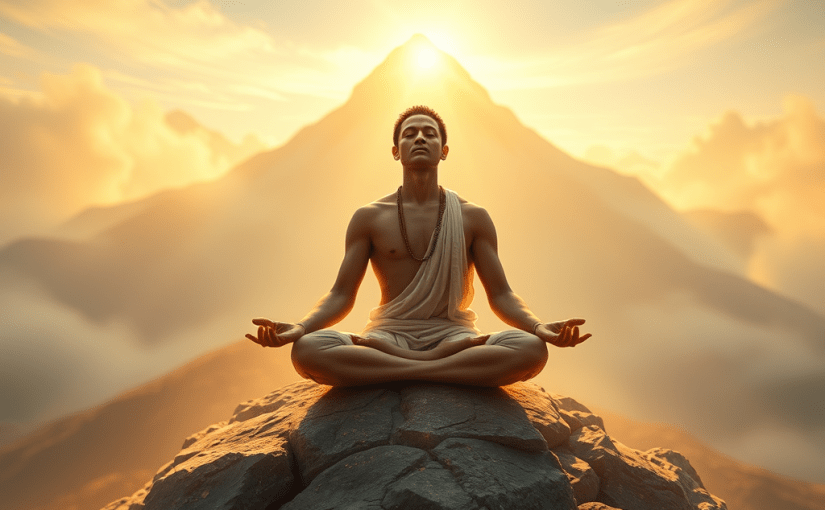
Harnessing Neti Neti for Deeper Meditation
Sometimes during dhyana (meditation), things don’t unfold as smoothly as we’d like. The breath may remain restless, the body refuses to settle, and the mind continues its habitual wandering. In such moments, the subtle movements of prana—the life force—seem to keep the system agitated. It’s as though the very thing that carries life within us also prevents us from fully resting in that silent space beyond all activity.
This is where the practice of mental chanting, especially neti neti, reveals its quiet power. “Not this, not this”—a simple phrase, yet profound in its effect. Mentally repeating it, not with strain but with sincerity, helps cut through the unnecessary. Every thought that arises, every feeling that pulls attention, every story or identity that surfaces—neti neti gently negates them. Not with violence, but with wisdom. Not this… not this…
I have come to see neti neti as a bridge—especially when keval kumbhak, the spontaneous suspension of breath, has not yet taken over. In those rare and beautiful moments when prana itself becomes still and the breath ceases naturally, no effort is needed. There is no gap to fill. The Self reveals itself effortlessly. Silence becomes solid. Awareness shines by itself, needing no reminder, no pointer.
But this depth is not always available. The body and mind often carry momentum. In such cases, neti neti becomes more than just a mantra—it becomes a companion. A whisper in the background reminding me of what I truly am not, so that what I truly am can gradually become clearer. When breath is not restful, when energy is still moving, the mind tends to seek content, to latch onto something—anything. This is where neti neti becomes a gentle replacement, a redirection away from identification, toward detachment, and eventually toward presence.
What’s unique about this practice is that it doesn’t demand that you believe anything. It doesn’t create a new identity. Instead, it un-builds. It dissolves. It peels away. It respects the structure of your being and only asks you to negate what is not permanent, not peaceful, not you.
Over time, I’ve noticed that chanting neti neti during dhyana not only helps quiet the mind, but also creates a subtle sense of inner space—like the difference between a cluttered room and one with just a mat and silence. This space doesn’t arrive by force. It unfolds gradually, like dawn. And when the space is finally there, awareness can relax into itself. Breath may still be moving, prana may still dance, but the grip of it weakens.
Of course, neti neti is not a mechanical technique. It is alive. It responds to sincerity, not repetition. When practiced with mindfulness and simplicity, it becomes a living pointer to the reality that is always here, just beneath the noise.
Whether prana is dancing or resting, whether the breath is moving or suspended—neti neti remains a quiet, humble companion on the path to the Self.
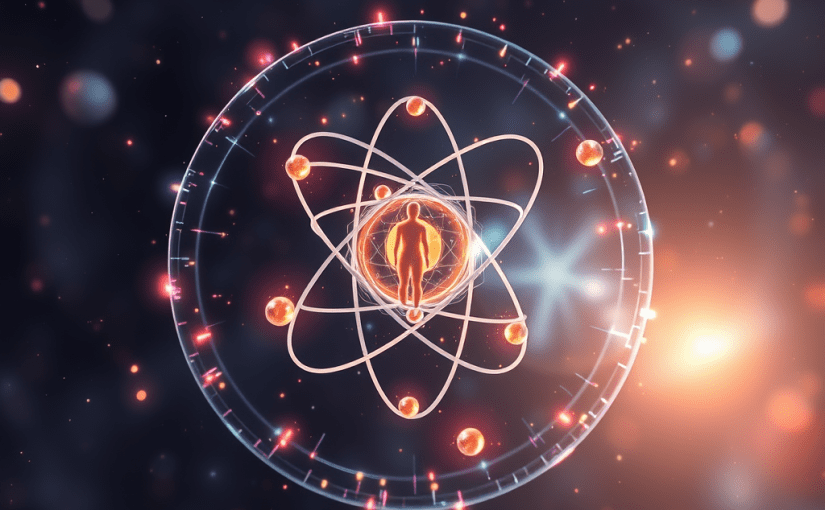
Chapter 3: Can a Whole Body Fit Inside an Atom?
In the last chapter, we asked: if the entire universe is a holographic projection, then who is observing this cosmic screen?
That question is not separate from science. It’s the very heart of it.
Everything we see — the planets, the people, the pain, the play — all of it might be appearing on a kind of invisible surface, just like a 3D movie on a flat cinema screen. But unless someone is watching that screen, the movie doesn’t truly exist. So the most important question isn’t about how the movie appears, but who is sitting in the audience — silently witnessing the show.
This witness is not your eyes. Not your brain. It is the soul — the spacious, aware presence behind all perception. And it is not passive. It does something magical. It translates a flat image into a living, breathing experience.
That’s why we don’t just see shapes and colours. We feel love. We feel distances. We experience space. Why? Because the soul itself is not flat. It is three-dimensional space, infinite, silent, conscious — and from it, all volume and depth arise.
The brain helps process signals, but the soul gives depth to reality. Without it, everything would be flat and meaningless. That’s the secret behind our experience of life as a deep, vast, unfolding mystery.
This insight also helps us approach the central question of this chapter — can a whole body fit inside an atom?
At first glance, it sounds ridiculous. Our body has bones, skin, blood, thoughts, breath — how can all of that fit inside something smaller than a speck of dust?
But if you look deeper, you’ll discover a quiet miracle. Every cell of your body carries the entire blueprint of your form — your DNA. And DNA itself is smaller than what we can imagine, yet it contains everything — your eye shape, your voice, your sleep patterns, your tendencies. And DNA is made of atoms.
So, in a simple yet astonishing truth — your entire body is already folded inside the atom. Not physically, but informationally. Like a movie is stored inside a memory chip, your whole being is encoded inside the atomic architecture of your cells.
And the more we understand information, the more we realise that information doesn’t need volume. It only needs pattern. A single holographic pixel can carry the image of the whole — and this is true not just of science, but of our very existence.
In ancient Yogic vision, this was never news. The Rishis saw that the subtle body (sukshma sharira) holds the full record of all our lifetimes — not just the current one. These records aren’t written in ink, but in subtle ripples — samskaras — which move through our soul-space like gravitational impressions.
These ripples don’t die when the body dies. They stay. They vibrate quietly in the background of consciousness, waiting for conditions to rise again. Just like ripples in space don’t disappear after a star collapses — they stretch as gravitational waves, holding memory across eternity.
This means the human soul is a personal holographic space, containing subtle ripples, vibrational patterns, and emotional waves from countless lives. It is like a microcosmic version of the cosmos. And these ripples are held by prana — the subtle life force, just as in the universe, cosmic prana may be holding all gravitational memory after the end of galaxies.
So what scientists now begin to say — that the universe stores its history as stable gravitational waves — was already intuited by ancient seers. Our individual soul-space is a smaller echo of cosmic space — each carrying memory, pattern, and subtle desire. The universe is the macro-soul. We are its holographic reflections.
And now I must tell you something that confirmed this to me beyond theory.
I once had a powerful experience — a visitation in a dream — of a freshly departed soul. But it didn’t appear merely as the person I knew in this life; it was much more than that. It came as a deeply encoded field of identity. It felt like the average of all its lifetimes, distilled into a single compact vibration — heavy and dark, but not in an evil sense. More like dense light wrapped in darkness, or a sacred knot of memory — a concentrated bundle of impressions woven from countless experiences, identities, and emotions across time. It wasn’t chaotic, but felt intentionally held together, like a spiritual DNA preserving the soul’s essence. Sacred, because it bore the silent weight of eons — yet still a knot, because it hadn’t fully unraveled into freedom.
It was alive — more alive than ever, in a strange and quiet way. Yet I could see that its soul-space was compressed. It wasn’t empty, but it was concealing its personal identity within itself, folding inward like a lotus closed at night. Its core felt heavy, as if burdened by unresolved identity — by samskaras carried across eons. Simply put, or in a nutshell, it was like a space filled with complete darkness, yet invisibly encoding an individual identity within. Because of this encoding, I could unmistakably feel it as that same individual — fully alive — even though nothing was present except sheer, expansive darkness and silence. It was an astonishing kind of encoding. Perhaps it is akin to subtle gravitational ripples in space.
It was not tortured, but it was not free. Its experiential light — its vastness, its bliss, its clarity — was present, yet covered, veiled, or diminished. It appeared lesser than the state of a living human body. Had it appeared more — more radiant, more open — it would have been recognized as liberated. Though it believed itself to be liberated, this belief was shaped by illusion and carried a subtle doubt. It even asked me to confirm its liberation, but I denied. That subtle compression of soul-space — that invisible binding — was its true suffering. It didn’t recognize it as suffering, but I did. A man who has lived in a well for eons cannot know what lies beyond, but someone outside the well can see it — and point toward the truth. It wasn’t pain in the usual sense, but rather the quiet ache of being less than what one truly is — that is, absolute.
In that moment, I understood something profound — liberation is simply the release of these samskaras. It is the melting away of these inner gravitational waves. Liberation is not the end of life, but the end of compression. One may be sitting in a cave yet still be bound and compressed by samskaras, while another, even as a king amidst the world, may be entirely free of such compressions.
Just as a black hole may one day dissolve its trapped information into open space again, the bound soul too can release its encoded ripples and return to satchitananda — being, consciousness, and bliss — in their natural, free, shining form.
So what does this say about the universe?
The scriptures say even Brahma, the cosmic creator, has a lifespan. When the cosmic play ends, even he dissolves. But just like a soul, Brahma doesn’t vanish. He merges into infinite stillness — into Brahman, the pure, ripple-free field.
This is Mahapralaya — the Great Dissolution. But it’s not destruction. It is deep sleep. And from that silent space, one day, a new Brahma emerges — and with him, a new universe, a new screen, a new holograph.
Why? Because the infinite never runs out of potential. It doesn’t need desire to create. It simply flowers.
And so it is with you. When your samskaras melt, when your inner ripples calm, when your soul becomes like clear, still space — you don’t vanish. You shine. You become the screen and the observer — at once.
So yes — a whole body can fit inside an atom. Because the body is not merely flesh and bone; it is a vibration, a subtle blueprint, a densely compressed field of infinite memory and possibility. What we perceive as the physical body is only the outermost layer. At its core, it is energy — encoded with the entire history of one’s being across lifetimes — all folded into a single point of consciousness, much like how a vast hologram can be stored in a tiny fragment of space. Just as the energies and impressions of infinite lifetimes can remain encoded in the soul, the same kind of encoding can be stored within the space bound by the boundary of an atom. In that minuscule realm, unimaginable depth and memory can reside, hidden yet alive. Just as the portion of infinite space within the human head can hold unlimited energy patterns as encoded impressions, then why can’t the part of infinite space bound within an atom also hold the same — the energy patterns of a human, or even of the entire cosmos? It is not a matter of size; it is a matter of structure — of holography. In a holographic reality, the whole is reflected in every part. So even the smallest boundary, like that of an atom, can encode the vastness of existence within it.
And inside that atom — there may be a holograph of not just your form, but of your past, your future, and the entire cosmos.
You are not a fragment — not a broken or isolated piece of existence. You are a portal: a living doorway through which the infinite expresses itself. You do not merely belong to the universe; the universe flows through you. Within you lies access to all dimensions of being — from the deepest silence to the highest awareness. You are not a small part of reality; you are the point where reality opens, unfolds, and becomes self-aware.
You are not inside space. Space is inside you.
And the one watching all this — the one reading these words now — is not a character on the screen. It is the eternal observer, patiently waiting for you to remember:
You were never just the story.
You were the light behind it all.
All Yoga Is One: From Karma to Hatha to Raja – My Real Experience
For International Yoga Day — by a Seeker
Starting Point
In my youth, I was healthy and mentally curious. After a certain experience, which I later understood was a transient Savikalpa Samadhi, a shimmering image of meditation stayed in my mind. That image remained alive for years and I used it for deep inner nourishment. With that energy, I studied, experimented, and shared spiritual knowledge with others.
At that time, I now feel, I could have gone into Keval Kumbhak and from there to Nirvikalpa Samadhi, if I had focused completely. The inner image was already guiding me. But I got involved in sharing, not settling.
Later Obstacles
Now at this stage of life, GERD, gastric pressure, and mucus buildup in the throat create interruptions in breath. Even if I don’t try to stop the breath, and just sit silently, the breath starts calming down on its own — but a reflex like engulfing mucus or a throat tickle brings breath back. This keeps disturbing the entry into Keval Kumbhak and the stillness needed for Nirvikalpa Samadhi. Though Kunjal is contraindicated in GERD, regular practice from early life may help prevent GERD from developing.
Similarly, Practicing knee-based asanas like Padmasana and Siddhasana from an early age helps keep the knees strong and healthy, preventing age-related weakness and pain that hinder maintaining prolonged asana as needed for nirvikalp samadhi.
This taught me that Hatha Yoga is not optional. It is necessary.
Misreading the Scriptures
In old texts of Hatha Yoga it is written:
“Hatha Yoga is fruitless without Raja Yoga.”
But that sentence has been misunderstood.
People took this to mean that Hatha Yoga is a separate, lower yoga, and Raja Yoga is a different, higher one.
But this is not true.
I now see that:
Hatha Yoga itself becomes Raja Yoga when it matures.
The so-called Raja Yoga — Dharana, Dhyana, Samadhi — arises automatically when the Hatha practices bring breath and body to perfect stillness. They are not two branches, but stages of one path.
Hatha Yoga Leads Honestly
Hatha Yoga is simple and honest.
When you do Shatkarma (cleansing), you can feel the result.
When you do asanas, you know if your spine is straight or not.
When breath slows, it is known directly.
There is no illusion.
There is no imagination.
And if Keval Kumbhak happens even briefly, there is nothing else to believe.
But in many “Raja Yoga” circles, people sit and try to meditate without preparing body and breath. Then they keep thinking they are meditating, but nothing goes on happening. Breath is disturbed. Body is stiff. Samadhi doesn’t happen.
That’s why I now feel:
Even only Hatha Yoga is better than only Raja Yoga.
Because Hatha Yoga eventually gives you real Raja Yoga anyway.
How Karma Yoga Comes First
Before Hatha, Karma Yoga helped me. But I didn’t realize it in words.
I used my own understanding of holographic reality and science based philosophy Sharirvigyan Darshan to approach life nondually.
This gave me a peaceful mind, a natural sense of surrender in action, and a body-breath rhythm that was already inward. I wasn’t reacting too much to success or failure. I stayed calm while doing duties.
Without knowing, this became Karma Yoga.
This helped my posture stay relaxed, and breath stay smooth, even in daily life. It became easier to move into stillness when I sat down for meditation or inner work.
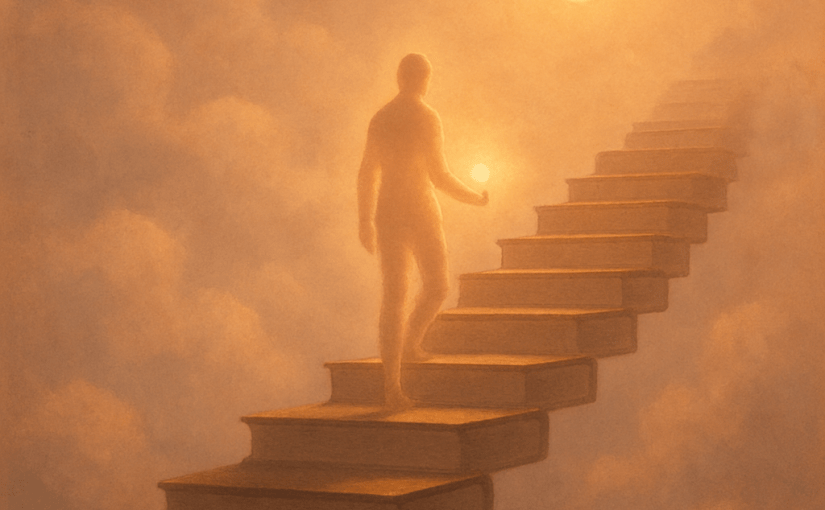
So All These Yogas Are One Ladder
Now I see clearly:
- Karma Yoga comes first — it calms you in action.
- Hatha Yoga comes next — it prepares your body and breath.
- Raja Yoga comes last — it happens on its own when stillness is perfect.
They are not three different paths.
They are one natural unfolding.
Today’s Confusion
Today, Yoga is divided:
- Some do only asana as fitness.
- Some do only meditation without body discipline.
- Some talk only about philosophy.
But all are incomplete alone.
That’s why many people don’t feel any deep transformation, even after years.
But I feel even if one does basic Karma Yoga and regular Hatha Yoga, stillness will come one day. Raja Yoga will not be needed as a separate practice — it will happen.
What I Suggest Now
For those who want real Yoga:
- Don’t label the path.
- Live peacefully with surrender (Karma Yoga will begin).
- Practice weekly or daily Shatkarma, Asana, gentle Pranayama (Hatha will deepen).
- Sit without forcing (Raja Yoga will arise).
Let the shimmering meditation image grow silently.
Let breath slow down naturally.
Let Yoga be one, not many.
Final Line
I no longer believe in separating Karma, Hatha, and Raja Yoga.
I feel now that all are steps of the same inner ladder.
I walked it, without planning, and it showed itself as one path.
If I could give one message on this International Yoga Day, it is:
Yoga is not about variety. Yoga is about unity — of body, breath, and awareness.
Everything else is support.
And lastly, don’t forget:
Yoga is the best job — it gives a salary of peace and bliss for limitless time, not like a physical job that pays only for a few decades, at most a hundred years.
Yoga is also the best family — it offers companionship of the Self for eternity, not just for a short human lifespan like a physical family.
✨ So let us all take an oath on this year’s International Yoga Day — to keep Yoga at the very top of our to-do list.
Not just for a day, but for a lifetime.
Yes, don’t forget – one yoga=one health.
Eternal Keval Kumbhak vs Eternal Nirvikalpa Samadhi: Which Is Closer to God?
Perfect. Here’s a fully text-based poetic-style blog post that captures the contrast between Eternal Keval Kumbhak and Eternal Nirvikalpa Samadhi, without using any charts — entirely suitable for WordPress:
🕉️ Eternal Keval Kumbhak vs Eternal Nirvikalpa Samadhi: Which Is Closer to God?
In the deepest folds of yoga and mysticism, seekers often ask:
Is God in eternal Keval Kumbhak — breathless, still, yet vibrantly alive?
Or is He in eternal Nirvikalpa Samadhi — formless, thoughtless, pure being beyond all dualities?
Let us explore this with inner reverence and clarity.
🌬️ Keval Kumbhak – The Breathless God
Keval Kumbhak is the spontaneous, effortless retention of breath — not forced, not practiced, but arising naturally when prana and apana merge, when duality ends in the body.
In this state:
- Breath is utterly still.
- Yet the being is fully alive, aware, and undisturbed.
- No inhalation, no exhalation — just an eternal pause.
- The body is like a flame that doesn’t flicker.
- Consciousness watches in silence, as if holding the entire universe in its womb.
When a yogi experiences Keval Kumbhak, even for moments, it feels divine — as though the body has turned to sky, and the soul floats in a still ocean of life.
To imagine God in eternal Keval Kumbhak is to see Him as the supreme yogi — alive, breathless, still, watching all creation without moving a single atom within Himself.
🧘♂️ Nirvikalpa Samadhi – The Formless God
But deeper than breath, deeper than body, deeper even than witnessing silence — is Nirvikalpa Samadhi.
In this state:
- There is no mind, no breath, no body-awareness.
- There is no observer or observed.
- Thought vanishes. Even the sense of “I am” dissolves.
- No God, no world — just pure being, limitless, indivisible.
This is not a state that comes and goes. It is the true nature of existence, of Self, of God — beyond the idea of God.
To speak of God as being in eternal Nirvikalpa Samadhi is to say:
He is not “in” a state — He is the foundationless Reality,
before the first breath, before time, before space.
He does not breathe, think, move — He simply Is.
🕊️ So Which Is Closer to the Truth?
Both images are true — from different lenses.
- Eternal Keval Kumbhak is God as the silent, breathless, cosmic yogi, holding the universe in still awareness — beautiful, relatable, alive.
- Eternal Nirvikalpa Samadhi is God as the absolute Self, beyond all movement, even breathlessness — infinite, silent, unknowable.
If you seek relationship, devotion, or a form of living stillness, Keval Kumbhak paints a divine picture of God.
If you seek nonduality, liberation, or truth beyond all ideas, Nirvikalpa Samadhi is the ultimate doorway — and the place beyond all doorways.
✨ A Closing Reflection
God doesn’t breathe — because He is the source of breath.
God doesn’t think — because He is the witness before thought.
God doesn’t meditate — because He is the end of meditation.
You may call Him the breathless one — or the formless one.
You may find Him in stillness — or lose yourself in His silence.
Both are true.
Both are holy.
Both lead home.
Kundalini Yoga and the Weight of Black Holes: Uniting Spiritual Science, Physiology, and Astronomy
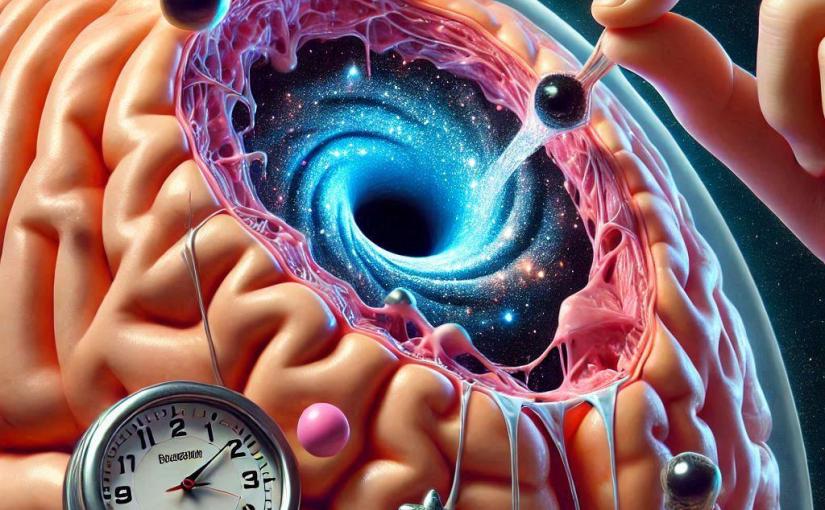
In a fascinating revelation, astronomers have discovered that many ancient galaxies have stopped producing new stars. The reason? Supermassive black holes near these galaxies are expelling gas and dust—the essential ingredients for star formation—through their immense energy and radiation. This discovery offers a profound metaphor for understanding human creativity and consciousness, particularly when viewed through the lens of spiritual science.
Black holes, often described as cosmic voids of immense gravitational pull, can be seen as a macrocosmic representation of the darkness that resides in the human mind. In spiritual terms, this darkness arises from tamoguna—the inertia and ignorance that hinders creativity and growth. Just as black holes in the universe suppress the birth of new stars, the darkness in the human psyche stifles the emergence of new, creative thoughts. Kundalini Yoga and other spiritual practices provide a pathway to address this inner black hole, reduce its weight, and unleash boundless creative potential.
The Interconnection of Astronomy, Physiology, and Spiritual Science
Traditionally, astronomy, physiology, and spiritual science have been treated as separate domains. Yet, they share a deep interconnectedness. The mysteries of one field can often be inferred or illuminated by insights from the others. For example:
Physiology studies the body and its processes, including the impact of stress and thoughts on health.
Astronomy examines the vast cosmos, exploring phenomena like black holes and star formation.
Spiritual science delves into the unseen realms of consciousness and energy.
When these fields are viewed in unison, they create a holistic framework for understanding existence. In ancient times, spiritual science often served as the foundation for exploring physiology and astronomy, as it required no physical tools or machinery—only the human mind and focused attention. Today, as technology advances, astronomy and physiology are at their peak, while spiritual science seems comparatively underexplored.
However, spiritual science remains crucial because it transcends physical boundaries and leads to self-realization and liberation. Its relevance is not diminished by modern advancements; rather, it complements them by offering insights into the unseen forces that govern both the universe and human consciousness.
The Black Hole Within: Darkness of the Mind
The human mind, like the universe, can harbor its own “black holes.” These are the heavy, dense clusters of unprocessed thoughts, unresolved emotions, and unconscious patterns that consume mental energy. This internal darkness draws parallels to supermassive black holes in space:
Gravitational Pull: Just as a black hole’s gravity pulls everything inward, the mind’s darkness draws energy away from the body, creating stress and inertia.
Suppression of Creativity: The overwhelming weight of negative or suppressed thoughts prevents new, creative ideas from forming, much like black holes inhibit star formation.
Energy Consumption: Constant mental chatter and unresolved inner conflicts drain the body’s energy, leaving little room for vitality and innovation.
This inner darkness often stems from the accumulation of tamoguna—a state characterized by ignorance, lethargy, and inertia. Left unchecked, it perpetuates stress and stifles growth, both individually and collectively.
Kundalini Yoga: Lightening the Inner Black Hole
Kundalini Yoga, along with practices like Sakshi Bhava (witness consciousness), offers a transformative solution to reduce the weight of the mind’s darkness. These practices work by addressing suppressed thoughts and emotions, allowing them to surface, be observed, and dissolve.
How Kundalini Yoga Transforms Darkness:
1. Energy Activation: Kundalini Yoga awakens dormant energy at the base of the spine, channeling it through the chakras to purify the mind and body. This process helps release the “gravitational pull” of negative thoughts.
2. Mindful Awareness: Through Sakshi Bhava, individuals cultivate a state of detached observation. By becoming a witness to their thoughts, they reduce their emotional charge and free up mental space for creativity.
3. Stress Reduction: Kundalini practices combine breathwork, meditation, and movement to reduce stress and restore balance, conserving the body’s energy for higher pursuits.
4. Igniting Creativity: As the weight of darkness lessens, the mind becomes fertile ground for new, creative ideas, akin to a galaxy resuming star formation.
The Holistic View: Connecting Micro and Macro
The interplay of spiritual science, physiology, and astronomy becomes evident when we consider this metaphor of black holes. In the macrocosm, black holes are powerful yet obstructive forces that suppress cosmic creativity. In the microcosm, the human mind can mirror this phenomenon, harboring its own “black holes” of inertia and suppression.
However, unlike galaxies, humans have the ability to consciously transform their inner state. Spiritual practices like Kundalini Yoga provide direct access to this transformation without the need for external resources or technology. They serve as tools to lighten the mind, release creative energy, and achieve self-realization.
Conclusion: Embracing the Light
As we integrate insights from astronomy, physiology, and spiritual science, a unified understanding of existence emerges. The darkness of black holes—whether cosmic or mental—no longer remains a mystery but becomes a gateway to transformation.
Kundalini Yoga, with its ability to dissolve inner darkness, offers a profound path to creativity and enlightenment. By reducing the weight of the “black holes” within, we can unleash the radiant energy of the human spirit, enabling both personal and collective growth. Just as galaxies can reignite star formation by dispersing cosmic debris, we, too, can reignite our creativity and purpose by clearing the darkness within.
In this interconnected universe, the journey inward is as vital as the exploration of the stars. Together, they reveal the infinite potential of existence.
 Demystifying Kundalini