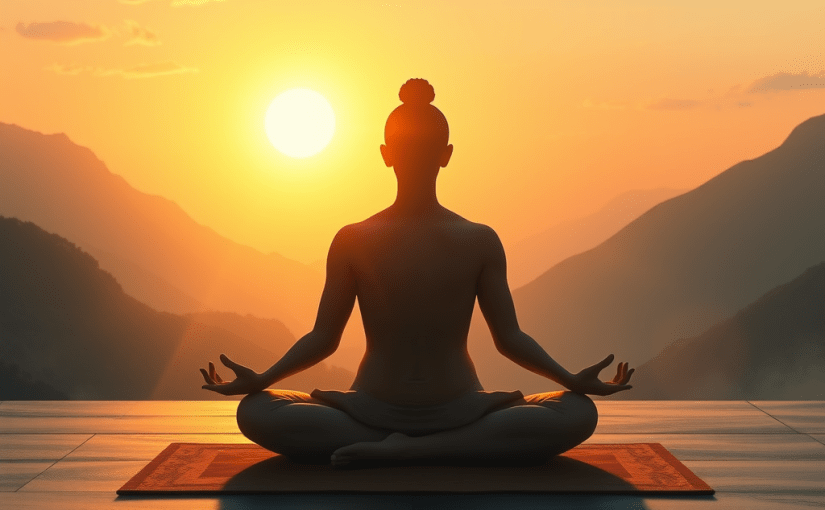
Harnessing Inner Silence: A Yogic Approach to Stress

I often feel that the best way to understand the working of the mind is to compare it with something everyone has seen in daily life—a television set. A TV screen looks simple: you switch it on, and pictures appear, but behind those pictures is a dance of invisible electromagnetic signals. Science tells us that these signals are nothing but waves of energy, and the TV has the ability to catch them and convert them into clear images. In the same way, our mind also catches signals. These signals are not coming from a satellite or broadcasting tower but from inside us—from our own emotions, thoughts, desires, and karmic tendencies. When these mental electromagnetic waves strike the inner screen of our awareness, pictures of experience appear. It could be joy, anger, worry, love, or fear, but the process is similar. Consciousness plays the role of the TV screen, and the mind keeps throwing waves of energy onto it.

The more emotionally charged we are, the stronger these waves become. A small irritation in the mind produces a faint image, but a burning anger or deep desire produces a very sharp and lasting picture. Just as a powerful broadcast fills the whole TV screen with brightness and color, a strong mental wave engraves itself on our inner screen with force. These impressions do not go away easily; they leave behind stains that we call samskaras or karmic seeds. Over time, the mind keeps collecting these charges, like a capacitor storing electricity. If the charge remains unprocessed, the same patterns keep repeating—old memories replay, reactions arise automatically, and inner conflicts become stronger. The result is a restless, noisy screen where one hardly sees clearly.

Yet, there is a miracle hidden in this very mechanism. Through yogic insight and practice, these waves can be stilled and transformed. Instead of becoming deeply emotional, amplifying the waves, and then either burying them in the subconscious or scattering them outward through speech and restless action, the energy of thought can be quietly conserved through sharirvigyan darshan contemplation. It no longer surges as an uncontrolled wave on the surface, nor does it sink irretrievably into the subconscious; rather, it settles as a silent charge a little deeper within. Energy at this depth remains accessible—ready to be uncovered and transformed through yoga—whereas energy buried too deeply by strong, uncontrolled, and painful emotions becomes difficult to reach or work with in ordinary life. This is like electricity stored in a battery—not being wasted in a running fan or bulb, nor going too too deep to be retrieved, but waiting silently, full of potential. In my own practice of Sharirvigyan Darshan-based Karma Yoga, I witnessed this transformation. Normally, thoughts rise and immediately push us into speaking, moving, or reacting. But when I practiced awareness-in-action, I did not allow them to flare out. I did not suppress them either; I simply let them reduce into a silent potential. This potential felt like an electric field—not noisy or oscillating, but alive and calm. When it accumulated sufficiently, it produced a strange kind of pressure in the mind—calm, blissful, yet sometimes accompanied by occasional headaches that could even last for a long time. At times, this excess silent energy would suddenly release itself, giving me a glimpse of samadhi or awakening, whatever one may call it. What made it remarkable was that it did not happen through withdrawal from the world but right in the midst of karma, simply by shifting my attitude toward action through Sharirvigyan Darshan. That made it even more precious for me, because it happened without leaving ordinary life behind.

The challenge is that this potential charge cannot remain suspended forever; life keeps pulling us back. If it is not consciously dissolved through sitting meditation, dhyana, tantra, or self-inquiry, it reactivates into waves as soon as ignorance-filled worldly activity begins without the guidance of Sharirvigyan Darshan. Yet one cannot keep contemplating Sharirvigyan Darshan endlessly, because with prolonged practice the mental pressure can grow uncontrollable, forcing one to abandon it. To be safeguarded from this, the excess pressure needs to be discharged through sitting yoga—primarily through tantra yoga—by channeling all the stored charge into a single meditation image. This awakens the image swiftly and can grant a glimpse of self-realization.

In savikalpa dhyana, the energy smoothens into deep absorption through a meditation image, while in nirvikalpa dhyana, it merges even more directly—through keval kumbhak—into pure awareness. Without such conscious dissolution, the stored charge eventually finds unconscious routes of discharge, appearing as impatience, ego, or restlessness. If this is true over the long term—after decades of Sharirvigyan Darshan-based Karma Yoga—it is equally true in the short term, during a single sitting of energy work. That is why I found it important to sit silently after daily practice, without rushing back into activity. An hour or two of stillness after yoga allowed the inner field to settle and release naturally in silence, rather than spilling into unconscious reactions. Otherwise, failing to channel the stored energy is like collecting rainwater carefully only to let it leak away through a broken vessel, or seep so deep underground that it becomes irretrievable.

The difference between yogic charge and ordinary worldly charge is subtle but crucial. Worldly charge is like stuffing garbage into a cupboard—on the surface, things may look organized, but inside, toxins are building up. These repressed charges eventually cause psychological confusion or even physical illness. Yogic charge, on the other hand, is like distilling water until it becomes pure and transparent. In fact, it is not fresh charge but the resurfacing and purification of buried charge. It doesn’t add a new burden; it slowly releases what is already there, refining it into silence.

Charge generated through Sharirvigyan Darshan-based Karma Yoga works in a similar way. Although it does create fresh charge, it first purifies it through non-dual awareness and detachment. Unlike impure worldly charge, which seeps deep into the subconscious, karmayogic pure charge remains on the surface and can be easily channeled. It also never feels heavy like ordinary worldly charge.

When I practiced with bodily awareness in a calm environment, I saw this clearly. My emotions would rise, but instead of identifying with them, I stayed aware. Outwardly, I was as active and expressive as before, yet inwardly there was silence—as if the waves had transformed into pure charge. No one could have guessed that I was containing so much energy within. It was entirely mental; physically, I was fully engaged in worldly life. That inner quietude was powerful, luminous, and gave me an intuitive understanding that no book could ever teach.

Even brief moments of such inner silence left a permanent mark, like a cascading effect that continued to unfold long after the sitting meditation or a Karma Yoga–based dynamic meditation, both in their own way equally. Silence grows upon silence, each pause deepening into the next, because it is both blissful and strangely addictive in its purity. Once, for about ten seconds, all the inner waves dissolved into the field of pure awareness. In that moment, there was no difference between the waves and the ocean, no division of experiencer and experienced — everything was non-dual. That short glimpse proved more valuable to me than years of ordinary experience, for it carried a weight and certainty that no external proof could provide. It revealed that even a fleeting contact with silence plants a seed that begins to grow of its own accord, quietly shaping the inner landscape. It also clarified that the real purpose of sadhana is not to chase after visions, energies, or sensations, but to refine one’s accumulated charge into a state of quiet potential that naturally opens into samadhi. Over time, as the brain becomes accustomed to holding this subtle current, the potential no longer feels heavy or overwhelming but grows fluid and light. This refinement allows life to be lived with a freedom and clarity untouched by restlessness, as if silence itself has become the ground upon which every experience moves.

This helped me understand viveka and vairagya in a practical way. Viveka is simply the ability to discern which impressions are beneficial and which are harmful, because in silence the mind becomes transparent and a better judge. The Sāṅkhya-based puruṣa–prakṛti viveka is this same practical viveka: the world with attachment (prakṛti) is denied, while the world without attachment (puruṣa) is accepted. Vairagya is not about running away from life, but about engaging without clinging — since the inner charge is no longer restless, it does not grasp at anything for relief.

Slowly, I began to see that the yogic path is not mechanical at all. It is not about forcing bliss or controlling every thought, but about a deep sensitivity to how one’s inner charge is forming and expressing. When the mind is charged in the yogic way, even a small stimulus is enough to enter dhyāna. This happened to me: I was deeply charged with my meditation image, and when my kin spoke about it, that small stimulus instantly awakened me into self-realization. Just as a charged particle produces a wave instantly with a slight movement, a charged mind can sink into meditation with minimal effort. In contrast, an uncharged mind must struggle first to build that energy before it can focus. Conversely, if the mind is charged in a worldly way, even a small stimulus can push it into blind worldliness.

I also noticed that the same applies in worldly life. An officer who has been given charge of an office can act immediately, while a stranger in the same chair will spend weeks just figuring things out. In the same way, a stretched canvas can take paint beautifully, while a loose canvas must first be stretched. A charged brain is quick to respond with thoughts, while an uncharged brain — like that of a nirvikalpa yogi absorbed in silence — takes much longer to respond. To the outside world, that silence may appear dull or even boring, but within it is blissful. The paradox is striking: first one builds the charge to attain self-realization and nirvikalpa samadhi, and then one lets go of all charge in renunciation. Yet even after self-realization and nirvikalpa samadhi, karmayogis continue to cultivate yogic charge in moderation, using it as needed to remain engaged in worldly life without drifting away from it entirely.

For me, the most important realization was that stress itself is a form of charge. The difference is only in its quality. Worldly stress is heavy and destructive, while yogic stress—or yogic charge—is light and releasing. Both are stretches in the fabric of inner space, but one binds and the other frees. My personal journey showed me that the same mind that suffers under chaotic charge can also shine when that charge is refined into stillness. What matters is not to let the waves scatter outward or bury them in deeper layers but to reduce them gently into potential. That potential becomes the gateway to silence, to freedom, and ultimately to samadhi.

Journey of Nada, Keval Kumbhak, and Deep Dhyana

I noticed that during deep meditation, when I enter keval kumbhak — spontaneous breath suspension — even ordinary external sounds like people talking, mantras, or conch blowing affect my meditation profoundly. The stillness of the mind in keval kumbhak makes these external sounds feel amplified, not terribly but blissfully and calming down breath to enter deeper dhyana, almost like they are resonating inside me. Within these sounds, mind dissolves and these sounds even dissolve into nirvikalpa quickly. At first, I wondered if this was the same as Nada, the inner sound described in Nada Yoga.

After reflecting, I realized there’s a subtle difference. Nada is internal, independent of the outside world, and arises naturally from the flow of prana and consciousness. What I was experiencing with external sounds was similar in effect, but not true nada. The external sounds were acting as triggers or anchors, deepening dhyana, but they are not generated from within.

Interestingly, I once had a glimpse of true internal sound — an extraordinary OM-like vibration that was blissful, deep, and sober, like so called voice of God. That experience felt completely different: it was independent of external stimuli, and I could feel consciousness itself vibrating in resonance. That is what Nada truly is, and it shows the mind is capable of perceiving the subtle inner universe.

Many practitioners wonder if keval kumbhak alone, with its associated void, is enough for final liberation. I found that the void from keval kumbhak is indeed sufficient. The stillness, non-dual awareness, and temporary dissolution of the sense of “I” create a direct doorway to nirvikalp samadhi. Nada is helpful, as it deepens and stabilizes meditation, but it is not essential for liberation.

I also noticed that in my practice, my strong meditation image of Dada Guru already acts as a powerful anchor. The image generates concentration, subtle energy, and devotion, which naturally lead to deep absorption. In this case, keval kumbhak arises spontaneously, the mind enters void, and bliss is already accessible. Nada may appear, but the image alone is sufficient to stabilize meditation.

Here’s how I conceptualize the stages of my meditation experience:

  1. Meditation Image as Anchor:
    My Dada Guru image keeps the mind absorbed and generates subtle energy. External sounds or nada are optional at this stage.
  2. Keval Kumbhak:
    Spontaneous breath suspension creates extreme mental stillness. The void arises naturally, and subtle mental vibrations may appear.
  3. Void:
    The mind experiences non-dual awareness. Mental fluctuations stop, bliss arises, and the mind is ready for advanced stages.
  4. Nada:
    Internal sound may arise spontaneously, guiding deeper absorption. It enhances meditation but is not mandatory for liberation.
  5. Integration:
    Meditation image, void, keval kumbhak, and nada work in harmony. The mind achieves stable absorption, preparing for continuous nirvikalp samadhi.

Practical Insights from My Experience:

  • External sounds can deepen meditation, but true Nada is internal and independent.
  • Keval kumbhak is a powerful catalyst, but Nada does not require it to arise.
  • A strong meditation image can serve as a complete anchor, making external Nada, even internal nada optional.
  • Liberation ultimately depends on stable void and absorption, not phenomena like sound.

Daily Practice Direction:

  • Let your meditation image anchor your mind effortlessly.
  • Allow keval kumbhak to arise spontaneously; do not force it. However, in yoga, both views about keval kumbhak are valid. Patanjali-type Raja-yoga teachings emphasize that kumbhak should arise naturally as the mind becomes still, while Haṭha Yoga texts say that by learning uniting prāṇa and apāna through practice, one can also enter it willfully. In practice, a middle way works best: slight, gentle regulation of breath helps balance prāṇa and apāna, after which kumbhak may either happen spontaneously or be entered at will. Forcing is harmful, but skillful tweaks to breath, as hinted in the old texts, can make keval kumbhak accessible immediately.
  • Observe any inner sound that appears, without grasping or expectation.
  • Bliss and absorption will deepen naturally; Nada will appear when awareness is refined.

Through this journey, I learned that meditation is a play of subtle energies, awareness, and devotion. External triggers help, inner phenomena inspire, but ultimately, it is the mind’s stillness and refined awareness that open the doors to the ultimate experience — nirvikalp samadhi.

Living Samadhi in All Seasons of the Day

I have come to realize that Samadhi is not something to be locked inside a meditation room or reserved only for those rare moments when the world is quiet. For me, it has become a rhythm — like breathing in and out — flowing through the morning, afternoon, evening, and even into the busiest parts of the day. It’s not just about the cushion; it’s about carrying that awareness like a fragrance that lingers wherever I go.

My mornings begin with yoga, the body stretching and opening like the petals of a flower at dawn. The energy starts to hum in the spine, and before it dissipates, I let it settle in meditation for a full hour. This is not a forced concentration, but more like stepping into a quiet lake and letting the ripples fade on their own. The body is still, the mind settles, and the space between thoughts becomes more vivid than the thoughts themselves. I can feel the energy in the Ajna Chakra — steady, blissful — and this alone is enough to keep the mind detached from the usual noise of the day. Morning energy work creates a potential that lasts throughout the day, making it easier to enter deep dhyana during later meditation sittings, and sometimes even bringing brief, samadhi-like naps at intervals throughout the day.

Afternoons are different. Just after lunch, I sit in Vajrasana for about 30 minutes. This is a calmer, grounding period — digestion for both the body and the soul. Vajrasana itself is steadying, and I find that meditating right after a meal in this posture helps the body stay relaxed while the mind quietly tunes itself. It’s not as intense as morning practice, but it carries a deep, homely stillness, almost like a midday nap for the inner being — except you stay fully awake. I feel the downward spinal breath is more prominent during eating dhyana due to the downward movement of life force aiding digestion. However in early morning when belly is empty, the upward movement of breath seems more prominent.

Evenings are my favorite. About three hours after dinner, just before sleep, I give myself another hour. Here, there is no need to prepare the mind — the day has already done its work of tiring the body and mind. I simply sit, and the awareness slips into its place like a familiar old friend returning home. Often, this is the deepest session of the day because the body has nothing left to demand, and the mind knows there’s no more work to be done. The transition into sleep from this state feels like slipping from the banks of a quiet river into the open sea. When you fall asleep directly, the mind may stay restless, leading to light sleep and vivid dreams, which prevents full mental rest. But if you first slip into dhyana and then let sleep come naturally, the mind is already calm and inwardly settled. This allows sleep to be deeper, more blissful, refreshing, and satisfying.

But it doesn’t end with these sitting periods. My way of Karma Yoga — through Sharirvigyan Darshan — has become the thread that keeps it all stitched together. While working, I remain aware of the body as if it were an atom: the brain as the nucleus, the electrons as shifting personalities, thoughts as orbiting patterns that I don’t need to catch or control. The body works, the mind thinks, but I stand a little apart, like the witness. In this way, the practice is not interrupted by activity; it is activity that becomes part of the practice.

There is a sweetness in this rhythm. Morning freshness, afternoon grounding, evening melting into stillness — and in between, the flowing stream of Karma Yoga. Each session is like cleaning a window so that the view stays clear. Over time, I have learned that Samadhi is not only found in long stretches of sitting but also in these shorter, daily touchpoints that keep the awareness polished and alive. When combined, they become a continuous current, humming quietly beneath the surface of everything I do.

It is important to understand that while dhyana or samadhi itself is not dependent on the mind, the mind is still required to prepare the ground for it. In the early stages, mental focus and clarity are essential to enter the state. This is why being fresh, alert, and well-rested allows dhyana to establish more quickly and with greater depth. Once true samadhi is reached, it becomes self-sustaining — the mind in that state neither tires nor drifts into drowsiness or sleep over time. By contrast, if one attempts meditation in a dull or drowsy condition, the practice is likely to slide into yoganidra or ordinary sleep rather than samadhi.

Public demonstrations such as being buried underground for days cannot be equated with samadhi. These feats are often the result of advanced pranayama skills such as keval kumbhak (effortless breath retention) or other survival-oriented techniques. While impressive, they do not necessarily reflect inner absorption, and the ego investment in performing such displays can become a subtle obstacle to genuine spiritual advancement. True samadhi, as described in the yogic tradition, is free of exhibition and rooted in inner stillness.

Harnessing Neti Neti for Deeper Meditation

Sometimes during dhyana (meditation), things don’t unfold as smoothly as we’d like. The breath may remain restless, the body refuses to settle, and the mind continues its habitual wandering. In such moments, the subtle movements of prana—the life force—seem to keep the system agitated. It’s as though the very thing that carries life within us also prevents us from fully resting in that silent space beyond all activity.

This is where the practice of mental chanting, especially neti neti, reveals its quiet power. “Not this, not this”—a simple phrase, yet profound in its effect. Mentally repeating it, not with strain but with sincerity, helps cut through the unnecessary. Every thought that arises, every feeling that pulls attention, every story or identity that surfaces—neti neti gently negates them. Not with violence, but with wisdom. Not this… not this…

I have come to see neti neti as a bridge—especially when keval kumbhak, the spontaneous suspension of breath, has not yet taken over. In those rare and beautiful moments when prana itself becomes still and the breath ceases naturally, no effort is needed. There is no gap to fill. The Self reveals itself effortlessly. Silence becomes solid. Awareness shines by itself, needing no reminder, no pointer.

But this depth is not always available. The body and mind often carry momentum. In such cases, neti neti becomes more than just a mantra—it becomes a companion. A whisper in the background reminding me of what I truly am not, so that what I truly am can gradually become clearer. When breath is not restful, when energy is still moving, the mind tends to seek content, to latch onto something—anything. This is where neti neti becomes a gentle replacement, a redirection away from identification, toward detachment, and eventually toward presence.

What’s unique about this practice is that it doesn’t demand that you believe anything. It doesn’t create a new identity. Instead, it un-builds. It dissolves. It peels away. It respects the structure of your being and only asks you to negate what is not permanent, not peaceful, not you.

Over time, I’ve noticed that chanting neti neti during dhyana not only helps quiet the mind, but also creates a subtle sense of inner space—like the difference between a cluttered room and one with just a mat and silence. This space doesn’t arrive by force. It unfolds gradually, like dawn. And when the space is finally there, awareness can relax into itself. Breath may still be moving, prana may still dance, but the grip of it weakens.

Of course, neti neti is not a mechanical technique. It is alive. It responds to sincerity, not repetition. When practiced with mindfulness and simplicity, it becomes a living pointer to the reality that is always here, just beneath the noise.

Whether prana is dancing or resting, whether the breath is moving or suspended—neti neti remains a quiet, humble companion on the path to the Self.

Calm Your Mind with Water: A Simple Meditation Technique

Sometimes, ancient wisdom meets inner intuition, and something powerful yet simple emerges. That’s exactly what I experienced with a small but deeply calming practice I stumbled upon—holding a sip of water in the mouth while meditating. Over time, I noticed that this little act had a profound ability to pull my rising energy down, especially during moments when I felt heavy pressure in the head, stuck in thoughts, or uncomfortable upper body energy that wouldn’t settle.

The idea is extremely simple. Sit calmly with a glass of clean, room-temperature water beside you. Take a small sip—not a mouthful, just enough to comfortably rest in your mouth. Then, gently close your eyes and simply meditate on the presence of water inside your mouth. No breath control, no visualization, no technique—just awareness of the water. Let the breath be fully natural and free.

After a while, you may notice something amazing. Without any force, the body starts responding. Soft, involuntary pulses begin around the lower abdomen. It feels like a gentle version of Kapalbhati Pranayama, but it happens naturally. It’s not a forced kriya, just a downward pull, like the body wants to balance itself. The overcharged head space begins to lighten, the throat relaxes, and you can actually feel energy shifting down toward the navel and below.

One of the best parts is that you don’t have to hold the same sip of water for ten minutes. That would be uncomfortable. Just when the sip feels enough, either swallow or spit it out and take another fresh sip. Keep the cycle going for 5 to 15 minutes, depending on what feels good. It’s totally body-led and effortless. There’s no stress on the mind, no pressure on the stomach, and no disturbance to the breath. The water seems to anchor the mind and body together.

For someone like me, who has experienced occasional GERD or acid-related discomfort, this method came as a relief. Unlike deep breathing techniques or aggressive kriyas, this is safe, cool, and calming. There’s no strain on the diaphragm, no holding of breath, and no reflux triggered. The coolness of the water balances the heat inside, and the grounded awareness pulls prana down from the chest and head. It’s also useful for spiritual practitioners who often experience excess energy in the head after meditation or pranayama. It gently rebalances without any intense effort.

This simple water-holding meditation can be used before sleep, after meals (with a 1–2 hour gap), or anytime when you feel too much mental chatter, pressure in the forehead, or a rising kind of energy that needs settling. But best time is empty stomach immidiately after morning yoga when brain pressure is high, then it lowers excess energy very effectively. It’s safe, soothing, and so intuitive that you might wonder why this hasn’t been talked about more.

A word of caution—use only clean drinking water. Don’t overdo it or hold water too long if you feel uncomfortable. Avoid doing this with a sore throat or if you’re feeling cold. But generally, it’s a harmless, soothing practice that works like a charm when done with quiet awareness.

What began as a random experiment became one of the most grounding techniques in my personal toolkit. It’s not from a book, nor taught in any formal yoga class, but it’s one of the most peaceful meditative hacks I’ve found. Water, attention, and a little bit of stillness — that’s all it takes to reconnect with the body and feel balanced again.

Jal Neti vs Sutra Neti: Which is Right for You?

Many people who start yogic cleansing often ask: is Jal Neti enough, or does Sutra Neti have some special benefit? I used to wonder the same. After practicing both and learning from yogic texts and real experiences, here’s what I’ve found, explained in the most down-to-earth way possible.

Jal Neti, the more common method, is done using a Neti pot filled with lukewarm saline water. You tilt your head and pour the water in one nostril, letting it flow out from the other. This cleans out the dust, mucus, and pollution from your nose and sinuses. It’s gentle, easy, and great for everyday use. Especially if you suffer from colds, allergies, or live in a polluted area, Jal Neti can make a big difference. For most people, Jal Neti is fully enough.

Sutra Neti, on the other hand, is more advanced. It involves inserting a thin rubber catheter or medicated thread into one nostril and pulling it out from the mouth. It sounds scary at first, but with proper training, it can deeply clean the nasal passages and sinuses, especially when Jal Neti doesn’t work fully. It’s helpful in chronic sinusitis, nasal blocks, or when you’re into deeper yogic practices. But Sutra Neti is not a daily thing and should only be learned under expert guidance.

So, to put it simply: If you’re doing Neti for regular nasal cleaning or breathing ease, Jal Neti is enough. Sutra Neti is like a specialist tool — only needed when the problem is deeper or if you’re pursuing intense yogic paths.

Tips to Avoid Complications in Both Jal and Sutra Neti

Now, both these practices are powerful, but you must be careful. Here are some simple safety tips that you should never ignore.

For Jal Neti, always use lukewarm sterile water — boiled and cooled. Mix it with non-iodized salt, about half a teaspoon per glass. Lean forward, tilt your head sideways, and let the water flow gently from one nostril to the other. Keep your mouth open and breathe only through your mouth during the process.

The most important step after Neti is drying your nose. If water remains inside, it can lead to infection or a headache. So after Neti, gently blow your nose and do about 30 to 50 rounds of Kapalabhati (fast breathing). It may seem like a small thing, but this step alone saves you from many issues.

For Sutra Neti, never try it on your own the first time. It must be learned from a skilled teacher. The catheter should be smooth and lubricated with edible oil or ghee. Insert slowly, gently pull it through the mouth, and move it back and forth carefully. Don’t do it if you have a nose injury, cold, or recent nasal surgery.

Whether it’s Jal or Sutra Neti, always clean your equipment well and never share it with anyone.

What If You Do Suction Instead of Neti Pot?

Now here’s an interesting thing. Some people (like I did earlier) don’t use a Neti pot but instead suck water from their hand or fist into one nostril and let it flow out from the other or mouth. This method, while practiced by some, is not the safest. It’s often called suction Neti or active Neti.

Though it works for some, it has more risks. It can pull water into your ear tubes (Eustachian tubes), causing ear pain or infections. The suction may irritate your nose lining and cause burning. You must be extremely gentle if using this method. But the safest and most beginner-friendly way is always the gravity-based Neti pot.

What If Ear Infection Happens?

Let’s say you feel pain or pressure in the ear after Neti. Don’t panic — it can happen if water gets into the middle ear due to improper posture or drying.

First, stop Neti practice immediately. Keep your head upright and avoid lying down right away. You can apply a warm compress behind the ear, do gentle jaw movements, or try steam inhalation to relieve pressure. Don’t poke anything into the ear.

If the pain doesn’t go away in a day or two, or if you notice fever or fluid discharge, visit a doctor (preferably an ENT). They might prescribe mild antibiotics, painkillers, or decongestants.

To prevent this in future, always dry your nose properly after Neti and never do it forcefully. Also, avoid it when you have a cold or nasal congestion.

Can I Use Iodized Salt in Jal Neti?

No. Never use iodized table salt in Jal Neti. It can burn, irritate, or inflame your nasal lining. Iodine and anti-caking agents in it are not good for your nose. Instead, use non-iodized rock salt (sendha namak) or pure sea salt. These are natural and gentle.

If you accidentally use iodized salt once or twice, it might just sting a bit. But for regular practice, switch to the correct salt.

Rock Salt vs. Black Salt — Can Both Be Used?

This is another common doubt. Rock salt (sendha namak) is perfect for Jal Neti. It’s clean, unprocessed, and non-iodized. It’s what is traditionally recommended.

Black salt (kala namak) is completely wrong for Neti. It has sulfur, smells like eggs, and can seriously irritate the nose. It’s used in food or for digestion, not nasal cleansing. So always check the label — use only pure rock salt or Neti salt.


So that’s everything you should know — not just about Jal vs. Sutra Neti, but about real-life practice, safety tips, mistakes to avoid, and what to do if something goes wrong.

Jal Neti is a gift from yoga. Done correctly, it clears the mind, purifies the breath, and protects against pollution and sinus troubles. Just practice it with care, patience, and proper knowledge.

All Yoga Is One: From Karma to Hatha to Raja – My Real Experience

For International Yoga Day — by a Seeker


Starting Point

In my youth, I was healthy and mentally curious. After a certain experience, which I later understood was a transient Savikalpa Samadhi, a shimmering image of meditation stayed in my mind. That image remained alive for years and I used it for deep inner nourishment. With that energy, I studied, experimented, and shared spiritual knowledge with others.

At that time, I now feel, I could have gone into Keval Kumbhak and from there to Nirvikalpa Samadhi, if I had focused completely. The inner image was already guiding me. But I got involved in sharing, not settling.


Later Obstacles

Now at this stage of life, GERD, gastric pressure, and mucus buildup in the throat create interruptions in breath. Even if I don’t try to stop the breath, and just sit silently, the breath starts calming down on its own — but a reflex like engulfing mucus or a throat tickle brings breath back. This keeps disturbing the entry into Keval Kumbhak and the stillness needed for Nirvikalpa Samadhi. Though Kunjal is contraindicated in GERD, regular practice from early life may help prevent GERD from developing.

Similarly, Practicing knee-based asanas like Padmasana and Siddhasana from an early age helps keep the knees strong and healthy, preventing age-related weakness and pain that hinder maintaining prolonged asana as needed for nirvikalp samadhi.

This taught me that Hatha Yoga is not optional. It is necessary.


Misreading the Scriptures

In old texts of Hatha Yoga it is written:

“Hatha Yoga is fruitless without Raja Yoga.”

But that sentence has been misunderstood.

People took this to mean that Hatha Yoga is a separate, lower yoga, and Raja Yoga is a different, higher one.

But this is not true.

I now see that:

Hatha Yoga itself becomes Raja Yoga when it matures.

The so-called Raja Yoga — Dharana, Dhyana, Samadhi — arises automatically when the Hatha practices bring breath and body to perfect stillness. They are not two branches, but stages of one path.


Hatha Yoga Leads Honestly

Hatha Yoga is simple and honest.

When you do Shatkarma (cleansing), you can feel the result.
When you do asanas, you know if your spine is straight or not.
When breath slows, it is known directly.

There is no illusion.
There is no imagination.
And if Keval Kumbhak happens even briefly, there is nothing else to believe.

But in many “Raja Yoga” circles, people sit and try to meditate without preparing body and breath. Then they keep thinking they are meditating, but nothing goes on happening. Breath is disturbed. Body is stiff. Samadhi doesn’t happen.

That’s why I now feel:

Even only Hatha Yoga is better than only Raja Yoga.
Because Hatha Yoga eventually gives you real Raja Yoga anyway.


How Karma Yoga Comes First

Before Hatha, Karma Yoga helped me. But I didn’t realize it in words.

I used my own understanding of holographic reality and science based philosophy Sharirvigyan Darshan to approach life nondually.
This gave me a peaceful mind, a natural sense of surrender in action, and a body-breath rhythm that was already inward. I wasn’t reacting too much to success or failure. I stayed calm while doing duties.

Without knowing, this became Karma Yoga.

This helped my posture stay relaxed, and breath stay smooth, even in daily life. It became easier to move into stillness when I sat down for meditation or inner work.


So All These Yogas Are One Ladder

Now I see clearly:

  • Karma Yoga comes first — it calms you in action.
  • Hatha Yoga comes next — it prepares your body and breath.
  • Raja Yoga comes last — it happens on its own when stillness is perfect.

They are not three different paths.
They are one natural unfolding.


Today’s Confusion

Today, Yoga is divided:

  • Some do only asana as fitness.
  • Some do only meditation without body discipline.
  • Some talk only about philosophy.
    But all are incomplete alone.

That’s why many people don’t feel any deep transformation, even after years.

But I feel even if one does basic Karma Yoga and regular Hatha Yoga, stillness will come one day. Raja Yoga will not be needed as a separate practice — it will happen.


What I Suggest Now

For those who want real Yoga:

  • Don’t label the path.
  • Live peacefully with surrender (Karma Yoga will begin).
  • Practice weekly or daily Shatkarma, Asana, gentle Pranayama (Hatha will deepen).
  • Sit without forcing (Raja Yoga will arise).

Let the shimmering meditation image grow silently.
Let breath slow down naturally.

Let Yoga be one, not many.


Final Line

I no longer believe in separating Karma, Hatha, and Raja Yoga.
I feel now that all are steps of the same inner ladder.
I walked it, without planning, and it showed itself as one path.

If I could give one message on this International Yoga Day, it is:

Yoga is not about variety. Yoga is about unity — of body, breath, and awareness.

Everything else is support.


And lastly, don’t forget:
Yoga is the best job — it gives a salary of peace and bliss for limitless time, not like a physical job that pays only for a few decades, at most a hundred years.

Yoga is also the best family — it offers companionship of the Self for eternity, not just for a short human lifespan like a physical family.

✨ So let us all take an oath on this year’s International Yoga Day — to keep Yoga at the very top of our to-do list.
Not just for a day, but for a lifetime.

Yes, don’t forget – one yoga=one health.