Friends,
I felt myself sufficiently transformed while writing this chapter. It dissolved a few deep doubts, like those related to Sankhya Vivek Khyati. Initially, I used to think it was something special, but now it feels like nothing other than Nirvikalpa Samadhi in yoga, with only the difference in words differentiating the two philosophies. Similarly, the subtle science behind the union of Purush and Prakriti, and the ignorance found in that, became clearer. I gained a new dimension regarding the witnessing. I got amazing similarity between cosmos and human body. Let us walk together again to see what unfolds ahead.
Just as a quiet lake might mirror the sky with such clarity that one forgets the water is even there, so too the cosmic field, in its truest form, is a smooth, undisturbed presence—pure, serene, and boundless. The seventh chapter previously unfolded the concept of energy and wave-fields within and beyond the human body, culminating in the realization that what appears material is, in truth, a vibrant play of non-material patterns—fields and waves interwoven through space. Now, seamlessly extending from that exploration, this chapter descends deeper—into the hidden movements of those fields, into the invisible architecture of space, and toward the sublime recognition of a field so pure, so untouched by ripple, that it stands apart: the field of pure awareness.
Begin with a single stationary charge, a fundamental entity in physics. It sits silently, yet not inert. Around it radiates an electric field—a subtle tension in space, like a barely stretched fabric. This field is localized, forming around the charge like an invisible cocoon. But disturb this silence, let the charge move—and something changes. Now it does not just sit; it dances. It begins to generate ripples in its surrounding field. Accelerate it, and those ripples deepen, becoming self-sustaining waves—electromagnetic waves, to be precise. These waves are not static imprints but dynamic travelers, pulsing outward at the speed of light, weaving through the vastness of space.
Yet, a curious condition arises here. For a charge to keep producing such waves, it must accelerate—not just move at constant speed, but continuously shift its direction or speed. Similarly, a human brain activity or learning should not be at a constant pace but should be increasing in speed day by day to spread in the world like a wave. But how could one do that without chasing the particle or brain activity endlessly? The solution is profoundly elegant: oscillation. Instead of pursuing a charge endlessly in space, let it swing rhythmically in place—forward and back, like a pendulum of light. And lo, this rhythmic movement becomes the source of continuously emitted electromagnetic waves. In a wire carrying alternating current, electrons do not travel far; they merely oscillate locally, producing ripples that propagate far and wide. But whether in wire or in space, it is this dance—this play of acceleration—that gives rise to light. The same happens in brain to. It keeps on changing subject and direction of activity rapidly instead of chasing a single subject endlessly with increasing speed that can make him mad instead of wavy. Rapdly changing gunas between satoguna, rajoguna and tamoguna also produce oscillating brain. That is why rapidly changing person is often seen successful in worldly matters.
And now arises a philosophical beauty. That which seems so material—light, heat, visibility—is not an object but a disturbance, a ripple in an invisible field. And this ripple has its twin nature: it is both electric and magnetic, each feeding the other in perfect rhythm, a cosmic choreography of mutual arising. What begins as a local ripple in the electric field gives birth to a magnetic field, which in turn regenerates the electric one, and so on, endlessly, as the wave moves. It is like Ida and Pingla nadis in the body that runs alternating with help of each other like a dancing girl, and creating central sushumna wave like em wave propagating to produce spark in consciousness. Why not call electric field ida and magnetic field pingla, and wave propagating ahead sushumna. When ida pulses strong, only then it produces pingla pulsing and vice versa alternatingly pushing ahead the sushumna pulse in between till pulsation is strong, otherwise subtle pulsation of ida or pingla like separate electric or magnetic field goes on happening always without producing perceptible sushumna pulse as em wave. Duality-full worldly working with nondual attitude produces this strong pulsation. Duality provides strong oscillation of charged brain, while nondual attitude keeps mind away from attachment to any special worldly act that can fix charged brain on single matter thus hindering its rapid and continuous oscillation. It is amazing. We keep admiring non-duality always, but duality is also not any lesser participant in spiritual evolution.
But this brings another subtle question to the surface. Are these fields already present in space, waiting to be disturbed, or are they created anew each time a charge dances? The scientific understanding leans toward the former. Space is not empty; it is already a field, a vast and subtle playground, waiting to carry any ripple with ease. The field is there even before the wave arises—smooth, serene, and unmanifest. It is only when something moves—a charge, a particle, a disturbance—that the latent potential becomes kinetic, that the ripple emerges. Similarly, ida and pingla are always there. It is the movement of meditational charged brain that determines the extent of energy transmission in these.
This is precisely why alternating current in household wires does not flood the surroundings with radiation despite its oscillating nature. The wavelength of powerline current (50 or 60 Hz) is enormous—thousands of kilometers long—while the wire, even if spanning cities, remains minuscule in comparison. As a result, the radiated waves do not build up coherently. They cancel and collapse in themselves, barely escaping into space. Only when a structure—like an antenna—is crafted in harmony with the wavelength does radiation become organized and efficient.
And now the stars begin to whisper their secrets. Without human intelligence, without deliberate design, natural celestial bodies become perfect antennas. A pulsar spins with mathematical precision, its magnetic fields aligned just so. Charged particles trapped in its magnetic grip accelerate fiercely, spiraling and spinning—emitting powerful beams of electromagnetic radiation, sweeping the cosmos like lighthouse beams. Even the sun, seemingly chaotic, hides organized thermonuclear rhythms beneath its surface. The intense heat at its core generates photons—packets of electromagnetic energy—which, after a long diffusion through solar layers, emerge as sunlight. This light, this familiar warmth touching the skin on Earth, is the ultimate evidence that the universe knows how to organize waves without needing wires, circuits, or blueprints.
But step back now from particles and stars, from wires and waves, and return to the deeper insight that began this journey—the field. All of these waves, fields, and ripples are disturbances on something. A wave cannot exist without a medium, even if that medium is intangible. In classical terms, the electromagnetic field is that medium—a subtle tension that exists throughout space. But if this field itself has ripples, then is it truly smooth? No. It is already filled with potential disturbances, like a pond ruffled by breezes. A truly smooth field must be beyond even these—beyond motion, beyond polarity, beyond opposites.
This brings forth the concept of the cosmic field of pure awareness. Unlike the electromagnetic field, which carries ripples of energy, pure awareness is undisturbed, motionless, timeless. It is not made of charge or mass. It does not require oscillation to propagate. It simply is. And yet, everything else arises from it—not as an effect arises from a cause, but as a dance arises on a stage. The stage remains unmoved by the drama played upon it. In this sense, the electromagnetic field is a playground, and its waves are the players, but pure awareness is the ground beneath the playground itself. Then why not call this vast, supreme playground Shiva, and the playground that fits within it Shakti? This is the eternal union — yet there is the Leela, the divine play of Shakti dancing and then merging once again into Shiva. This process of expansion and recession repeats endlessly. That is why the male and female enjoy the play of separation and union — to dance and to merge repeatedly. This repeated separation and union is the very essence of love.
If one looks inward, tracing perception back through sensation, energy, and thought, one reaches a similar realization. The mind moves like an oscillating charge, like up and down moods, like up and down breath movements, producing thoughts like em waves. Emotions ripple like magnetic feedback loops. The body radiates energy like a living antenna. But what receives it all? What watches the movement without moving? That is pure awareness. It is the witness field—ever present, never disturbed, beyond vibration.
What is astonishing is how closely the outer physics reflects the inner spiritual path. A charge must be accelerated to emit energy, just as the motivated sou-space must be stirred to produce thoughts and actions. Just as interaction of particle with others produce charge on it, the motivation and inspiration got by soul-space from others create a type of tension or strech on it. Yet, beyond all physical patterns lies stillness—not dormancy, but fullness. In the same way, the ultimate state of being is not a storm of experience but a quiet presence—a state where the field is known not by what it does but by what it is.
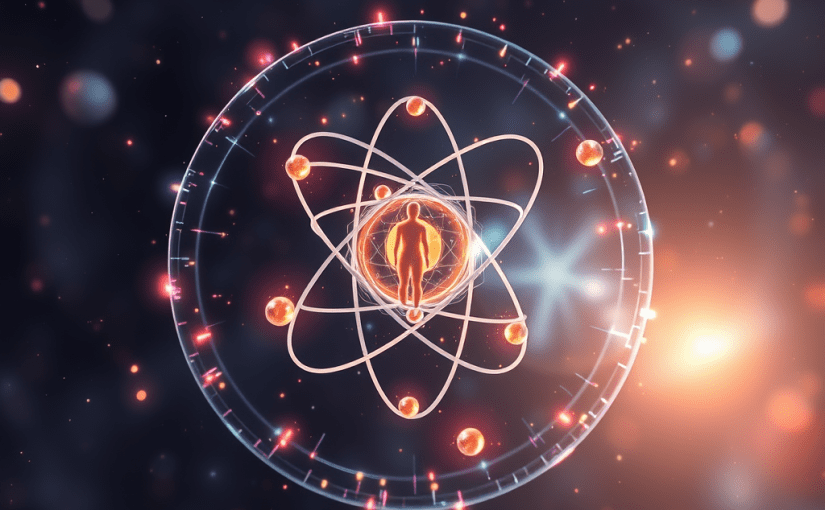
And so, as the earlier chapters explored how the body itself behaves like an energy field, like a dynamic hologram of atomic dance, this chapter brings an even deeper recognition—that all these dances, all these waves, point toward something more profound. They are signs of a deeper field, one not of energy, but of being.
Every ripple in the electromagnetic field, every ray of light, every whisper of electricity, is a visible expression of an invisible truth. That truth is that space is not empty. It is filled with potential, with presence, with the ability to express form without being form itself. And beyond even that potential is a state where no wave arises, where no charge is present, where awareness rests in itself—whole, pure, and unmoving.
This is why the body can feel energy not just in the brain but along the spine, in the chakras, in the very cellular presence of being. These are not hallucinations but inner ripples in a subtle field—a field that mirrors the outer electromagnetic field but is rooted in consciousness. Just as light arises from the dance of electrons, so too inner light of mind arises from the subtle awakening of awareness within through dancing moods and thoughts to and fro.
There is wonder in this symmetry. The same laws that govern stars and antennas apply to the self. The same ripples that leave a distant star and travel light-years to reach the Earth are echoed by the ripples of thought crossing the inner space of a mind. But both ultimately point toward the silent field—the pure field that is never disturbed, never touched, and yet allows all experience to arise.
And so the journey continues—from charge to wave, from wire to light, from body to awareness. The path winds through the outer cosmos and the inner self, always returning to the same mysterious truth: that reality is not made of things but of fields, and the final field—the field behind all fields—is pure awareness. It is the cosmic mother-field, upon which all players play, unaware sometimes that they are all made of the same eternal silence.
Many people look confused when the talk of witnessing arises. Many think the ever changing mind is the witness. But in fact, only that which is changeless can watch changing things. How can something that itself keeps changing witness or remember another changing entity? Suppose A is watching object 1. Now, if A suddenly becomes B, how can B remember the experience of watching 1—unless there is something unchanging in A that continued into B? This shows that the real witness is not the changing body or mind, but a stable, unchanging awareness. Another perspective is that everything in the world is not truly created new, but simply a rearrangement of the same underlying substance into different shapes and forms. In this view, the only real “stuff” that exists is pure awareness. The only witness possible is also this very same. Other everything that do not have even their own existence, how can they become witness. Whether see at cosmic level or at body level, the rule does not change. At both places, witness is only that same single one. It is not made from anything else—it is the source, the base, and the material of all appearances. True existence belongs only to this so called dark, silent field of unchanging, pure awareness. The luminous world also called Prakriti—what we see, feel, and think—is made up of waves, fields or charges constantly shifting and passing. How can something that is always changing be said to truly exist? And if it has no independent existence, how can it hold real knowledge and bliss? These three—existence, knowledge, and bliss—always living together, appear in the luminous, changing world because of illusion. In truth, their source lies in the silent, unshaken, dark field—the foundational sky also called Purusha—upon which all waves play like fleeting ripples. And Sankhya philosophy rightly says to separate purusha from prakriti. A mixture of both is world-originating though being a nightmare for liberation seekers. Unconscious Prakriti becomes like conscious with company of conscious purusha. But when it perishes as it being perishable by default, it becomes unconscious, because how can one remain conscious if it is even not existing. Perished can not be conscious. Due to this, purusha also start considering itself unconscious or perished or dead because it was snugly attached to prakriti. And the prakriti perishes every moment, so the purusha feels itself unconscious every moment. However, full perish is at the time of death of the body. The world is based on a lie. We purushas give existence to everything or prakriti in the world, but in reality, nothing truly exists. We share the real existence of our own souls with everything, and in return, we forget even our own existence and become non-existent—just like the worldly things we associate with. It is truly said: beware of bad company. But don’t worry. Through regular practice of Yoga, Keval Kumbhak, and Nirvikalp Samadhi, the soul gradually remembers this existence of its own pure awareness. This path is both worldly and practical—because denying the world is neither wise nor truly possible. Keeping detached and non-dual attitude with help of suitable philosophies like sharirvigyan darshan during worldly indulgment seems the only middle path for a business minded and worldly progressive person to be saved from the bite of this prakriti-serpent.
One day, I got a good example of the middle path. In the evening, I had spent around 15 minutes in Padmasana. As I sat, my breathing gradually slowed down. Just then, my tiffin arrived, and my mind rushed toward thoughts of food and hunger. Somehow, I tried to continue and spent another 15 minutes attempting to regain Dhyana, but eventually, I stood up and had my dinner. Due to the calming effect of meditation, my appetite had reduced significantly, so I ate only half the usual portion. At the same time, I regretted my foolishness for breaking the state of Dhyana. After dinner, I sat in Vajrasana, and suddenly, my breath almost came to a complete standstill—for 20 minutes. Then I shifted to Sukhasana for about 30 minutes, and even with surrounding noise or slight body movements, the breath remained still and subtle, barely regaining any motion. At that moment, I remembered Buddha—how, when he had been meditating with an empty belly, his Dhyana was not reaching completion. But on the day a devotee lady offered him a bowl of dessert, and he accepted and ate it, he attained perfect Samadhi and Nirvana.
Purusha is attracted by the shimmer of Prakriti just as an insect is attracted towards the candle flame and both get perished. Prakriti is cheater. It first enjoys everything with company of purusha. Once it perishes, purush can not be saved then because both are snuggly joined to each other. That is why it is called thagini, dakini, pishachini, maya, sofia etc. in scriptures. That is why sankhya thought of school advises to separate purusha from prakriti and rest in purusha in peace. However, it is only possible with yoga that emerged from sankhya due to this very same reason. This all has been detailed only to evoke interest in yoga, otherwise blank philosophy can never reveal the truth. The state of nirvikalp samadhi is the state of this isolated pure purusha.
True liberation is not achieved by bypassing form, but by passing through it with full awareness. Only after Purusha consciously experiences the complete union with Prakriti — as in Savikalpa Samadhi — can it effortlessly transcend into Nirvikalpa Samadhi. This is why the Sanatana path, with its emphasis on idol worship, mantra, and gradual inner refinement, is not only spiritual but deeply scientific. It honors the natural journey from the manifest to the unmanifest — from form to formless.
In the cosmic state too, the same process as soul development unfolds—when the expanding world reaches its outer limit, it begins to dissolve back into the same pure mother field from which it had originally emerged.
Up to the stage of Nirvikalp Dhyana, there still remains a subtle potential for the world to arise. You can call it a weak electromagnetic field, from which the electromagnetic wave—appearing as the world—can emerge. In this deep meditative absorption, the seed of manifestation—the quiet power to perceive or imagine a world—still exists in a dormant state. But when one goes deeper and enters Nirvikalp Samadhi, even this potential is transcended. It is the stage where even the faintest tremors of the electromagnetic field vanish. In that state, there is no observer, no imagined world, and no seed of creation. That is why it is called Nirbeej or seedless samadhi. Only pure awareness remains—formless, actionless, and beyond the cycle of appearance and disappearance. From here, there is no automatic return to world-experience unless awareness itself chooses to veil itself again. The potential to form the world in pure existence is not physical—unlike the vibrations seen in earlier stages—but is entirely immaterial and experiential, existing only as pure presence, nothing else. As per another view, even in deep meditative states such as Nirvikalp Dhyana, one may experience a subtle sense of potentiality—a precondition for experience—but this may not be physical in the sense of measurable waves or energy fields. Unlike earlier states where internal experience may correlate with neural activity, subtle vibrations, or sensory imagery, this deep state transcends such phenomena. The ‘potential’ here refers to the pure capacity for awareness to manifest experience—not through energy or vibration, but through the sheer presence of consciousness itself. From a neuroscience or physics standpoint, this cannot be described as an electromagnetic field or wave. Rather, it’s better viewed as a subjective, non-material awareness—an experiential space in which forms might later arise. Any attempt to link this directly to electromagnetic fields would be metaphorical unless supported by measurable brain states or field interactions.
The term charge carries meaning beyond just particle physics—it implies a type of stress, potential, or readiness to act, much like when we say someone has been ‘given charge’ of a position. It doesn’t inherently mean a physical entity, but a dynamic condition. In this way, just as a particle becomes charged, the brain too can become charged. This creates a kind of tension or polarization within self-awareness—like a stretching or subtle stress in the fabric of inner space. This tension is experienced as the electric field. These are the finest tremors of potential—subtle fluctuations that, with a slight stimulus, are ready to unfold as electromagnetic waves, as thoughts or sensations. Without charge, there is no field, no ripple, no wave—only a clean, smooth, unperturbed state of space externally, or pure awareness internally. Charge is the seed of all movement, all experience. What we call work stress seems to be the same kind of stretch or tension in the inner sky of awareness.
Just like an officer taking charge of an office is quick to respond in office work, but a layman will take much more time to adapt to the environment first and then work through interaction with different people—similarly, a charged particle, having its surrounding space already stressed as an electric field produced by itself, is much quicker to produce an EM wave with the slightest motion, while an uncharged particle will have to create charge in itself first through interaction with other particles. In the mental sector, a charged brain, having inner space stressed as so-called darkness or ignorance produced by itself, is quick enough to produce working thoughts with the slightest energy stimulus, while an uncharged brain of a samadhistha yogi will take much more time, first developing charge inside it through people’s interactions, inspirations, and motivations. Just as small length of antenna helps oscillating charged particles to produce effective em wave, similarly, focused meditation, rather than widespread and haphazard thinking, helps in the origination of long-lasting and effective thought waves. That is why, after samadhi, there is clarity in thoughts.
If we recall the psychological essence of this whole lengthy chapter in a single paragraph, it becomes the following.
Departed soul-space, although smooth and without ripples, is stressed. We can liken it to the faintest of electric fields. It is very faintly charged. It is a localized space, although always connected to the infinite supreme space. Yet, the soul feels itself restricted locally. No doubt, space is space—there is literally no difference between local and non-local space. Both are smooth and without ripples. There’s no actual boundary between both possible. But soul-space is charged. The ego, desires, attachments, and dual lifestyle of the previous birth acted like a charged particle and made the soul-space charged and localized, virtually isolating it—through illusion—from the vast, endless, and uncharged space of the supreme soul. It has the potential to develop similar ripples of ego, desire, karma, and thoughts as were present in its previous lifetime. Hence, it takes rebirth—unlike the liberated soul, which is uncharged and feels fully one with the supreme soul. This proves that every thought and action of ours goes on being recorded in the form of the soul’s charge. This charge is what the scriptures refer to as ignorance (agyana), the veiling of the soul, bondage of soul, karma bandhana etc. and so on. This is literal bondage—like an animal gathered from open fields and tied to a peg, the infinitely existing soul is similarly localized. This description is not only literal, but based on my own experience of encountering a departed soul in a dream visitation, as described in detail at many places. The brain or soul space also becomes charged after yoga. This is because gross thoughts become reduced to mere potential or charge. That’s why it is advised to discharge it through nirvikalpa dhyana by sitting calmly at the end for an hour or two. This leads to nirvikalp samadhi or merging with supreme soul as with this even hidden potential or charge of soul space gets smoothed out. Otherwise, it will be discharged through worldly activities during the day. This worldly discharge further increases hidden charge of the soul space through new karmas and thoughts. However, this discharge—especially when helped by sharirvigyan darshan dhyana—will be centered in detachment and non-duality, as the process of charging through yoga was done with the same mental attitude. So built up charges and subsequent discharges will be less gruesome. This is opposite to the ordinary worldly charging of the brain, which is associated with attachment, desire for results, ego, and duality. Therefore, the same negative qualities remain during discharge too, which keeps increasing the soul’s bondage more and more. A similar miracle occurs through Sharirvigyan Darshan-based Karma Yoga. With it, mental EM waves produced during worldly activities are subdued to a mere charged potential. Given the right opportunity, this potential can even smooth out into a glimpse of samadhi, as happened to me. It’s a heartfelt experience—not just a literal or intellectual exercise. In a non-yogic lifestyle, charge is produced forcefully, compressing prior mental garbage and hiding it in a corner of the soul-space. This later manifests as various psychological and physiological complications, including the progressive bondage of the soul. But yogic charging is of a releasing nature. It doesn’t hide prior mental garbage or create new charge from scratch. Rather, it reduces existing mental impressions to the level of subtle potential. In this way, mental cleansing also happens. With this approach, we find readymade charge and don’t have to struggle to produce it afresh. Moreover, the charge naturally aligns with our personality and environment. We can even screen these charges—eliminating the harmful ones and nurturing the beneficial—thus allowing continuous soul development in a streamlined way. This process is deeply rooted in self-experience. In contrast, creating fresh charge is risky, and the guidance of a quality guru becomes essential. It’s well known that no one can read another’s mind; it’s wiser to mold our own charge according to our situation. It may take a little more time, but it is well-proven and deeply experienced already. In a nutshell, If the charge, potential or electric field gained through yoga by being reduced from em waves of gross thoughts isn’t smoothed out, it again redevelops into mental EM waves of thoughts through worldly activities, which then need to be subdued once more—first by reducing them back to potential state to head towards the nirvikalp state of pure awareness. It’s not hard to believe that mental EM waves produce pictures of experience on the screen of soul-space, especially when science has already shown that EM waves can produce images on a TV screen.
This insight is not just for physicists or mystics. It is a truth open to anyone willing to look closely—at the stars, at light, at thought, or at breath. For behind it all, there is a field not of matter, not of energy, but of presence. And that presence is who one truly is—not the ripple, not the player, but the ground upon which the game is played.







 Demystifying Kundalini