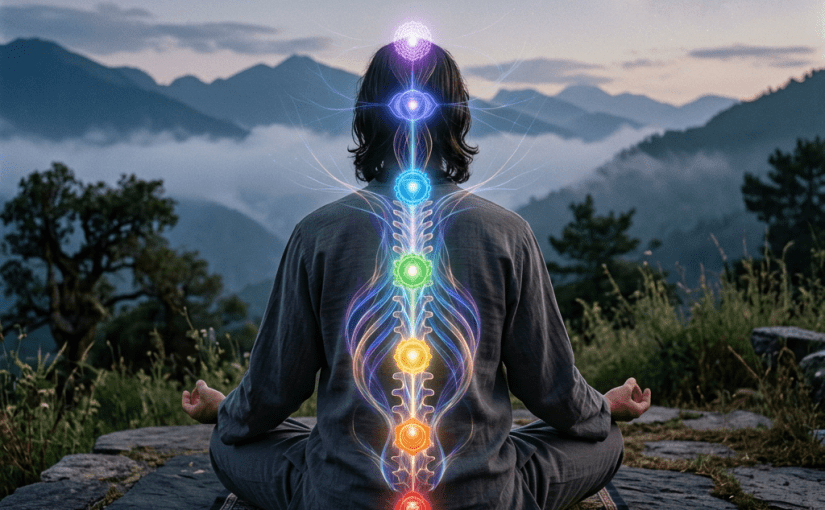
How Worship of Different Gods Can Purify Different Emotions and Prepare the Mind for Nondual Meditation and Kundalini Yoga

Happy Krishna Janmashtami Festival to All

Different Gods as Different Doors of Emotional Surrender

I have been looking at worship of gods and goddesses in a somewhat different way. I do not see all idols only as objects to whom one offers flowers, prayers and devotion. I also see them as different symbolic forms through which different kinds of emotions can be surrendered. The human shape, face and familiar stories of a deity make this easier for the mind. An emotion is otherwise invisible and difficult to hand over to something abstract, but when I stand before a recognizable divine form, I can consciously place a particular class of emotions, memories and experiences before that form. The idol therefore becomes a practical meeting point between my personal emotional life and a larger spiritual symbol.

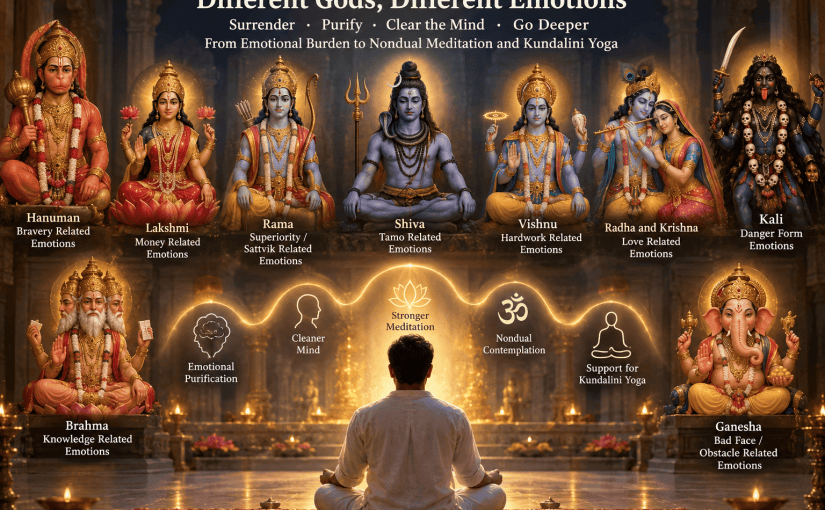
My experience with Hanuman made this especially clear to me. I stood in front of Hanuman and surrendered all kinds of emotions and incidents connected with bravery. I did not surrender only the idea of courage. I surrendered the emotional burden associated with being brave, the memories of situations in which bravery had been expressed, and the feelings that had gathered around those experiences. After doing this I felt quite relieved and disburdened. This was important because it showed me that surrender does not necessarily mean destroying a quality. I was not trying to lose courage or become weak. I was trying to release my attachment to carrying all the psychological material connected with courage.

This idea then became broader. Hanuman can be one form for one class of emotional material, but other gods and goddesses can serve as suitable forms for other classes. In this way, worship need not be psychologically identical every time. The particular deity gives the mind a particular symbolic direction.

Lakshmi, Rama, Shiva and Vishnu as Different Emotional Purifiers

For me, Lakshmi can become a focus for purification of money-related emotions. Money carries many kinds of psychological material: greed, fear, insecurity, pride, attraction, competition, status-consciousness and anxiety about losing what one has. Instead of allowing all these feelings to remain mixed together inside the mind, I can bring them before Lakshmi and surrender them. The purpose is not to reject money or prosperity. It is to reduce the emotional burden and attachment surrounding them so that money can remain a practical part of life without becoming an excessive psychological identity.

Rama can similarly become a focus for emotions connected with superiority, righteousness and even sattvik identity. This is important because not every difficult emotion is obviously negative. A person can become proud of being good, pure, disciplined, spiritual or morally superior. Even sattvik qualities can therefore become material for ego. By surrendering these emotions before Rama, I can retain the quality of righteousness without carrying the feeling that I am superior because of it.

Shiva, in my framework, can become a focus for tamasic emotions and heavier inner tendencies. This includes dullness, darkness, destructive impulses, heaviness and other forms of emotional material that may be difficult to approach directly. Instead of constantly fighting such tendencies mentally, I can place them before Shiva as a symbolic act of surrender and purification.

Vishnu can represent another kind of emotional burden, especially that connected with hard work, preservation, responsibility and the effort required to continue one’s worldly duties. Work itself is not the problem, just as courage itself is not the problem. The burden may come from attachment to achievement, pressure, exhaustion, pride in one’s effort or the feeling that everything depends personally on me. Surrendering this material can allow work to continue while reducing the psychological weight carried with it.

Radha and Krishna, Kali, Brahma and Ganesha

Radha and Krishna can serve as a focus for love-related emotions. Love can be beautiful, but it can also become attachment, longing, possessiveness, jealousy, fear of separation, emotional dependence and repeated mental involvement with another person. By bringing these emotions before Radha and Krishna, the aim can be to purify the emotional intensity without rejecting love itself. Love may remain, but the clinging around love can become lighter.

Kali provides a particularly powerful symbolic form for emotions connected with danger, fear, threat and intense vulnerability. When the mind carries danger-related emotions, it can remain prepared for something bad even when no immediate danger exists. Bringing such emotions before Kali can create a strong symbolic act in which fear and the feeling of threat are consciously surrendered. The terrifying form itself can make this surrender psychologically meaningful because it does not require fear to be hidden or softened before approaching the symbol.

Brahma can become a focus for knowledge-related emotions. Knowledge is valuable, yet knowledge can also create pride, intellectual superiority, attachment to being right, the need to display understanding and an identity built around knowing. Surrendering knowledge-related emotions before Brahma does not mean rejecting knowledge. It means trying to separate knowledge from the ego that can grow around knowledge.

Ganesha can become useful for another category of emotions, including feelings connected with one’s appearance, obstacles, embarrassment, unfavorable self-image or the sense that one’s face or body has something wrong with it. A form that itself differs from ordinary human appearance can become a particularly meaningful symbol here. Instead of remaining ashamed of an appearance-related feeling or repeatedly fighting it, I can bring it into the presence of Ganesha and surrender the emotional burden attached to it.

There can naturally be many more such associations. The list does not have to end with the major deities. Different forms, stories and qualities can provide different symbolic containers for different emotional burdens. What matters is the relationship between the deity and the emotional material being surrendered.

Worship as Emotional Purification Rather Than Mere Ritual

In this understanding, idol worship becomes a practical method of emotional purification. Different gods do not necessarily have to be understood as mechanically removing different emotions from the mind. Rather, the traditional qualities and forms associated with them help the mind organize and surrender different kinds of psychological material. One form may naturally draw courage-related emotions, another wealth-related emotions, another love, another fear, another knowledge, another ego connected with virtue, another heaviness and so on.

The physical idol itself is only the outer support. The deeper process happens in the mind. I stand before the form, recognize what I have been carrying, consciously offer it, and allow myself not to hold it so tightly. The emotional burden may then become weaker. Repeated practice can make this process more familiar. The emotions do not necessarily vanish permanently, and there is no requirement that the mind become emotionless. What changes is the amount of unnecessary attachment, repetition and identification surrounding them.

This is why I find the word purification useful. A purified mind does not mean a blank mind or a mind incapable of strong feeling. It means a mind in which emotions can arise without every emotion becoming another object of possession, struggle or identity. Courage can remain courage without becoming a burden. Knowledge can remain knowledge without becoming superiority. Love can remain love without becoming excessive attachment. Money can remain useful without becoming the center of psychological security. Hard work can continue without carrying endless pressure. Spirituality itself can remain without creating the feeling of being better than others.

From Emotional Clearing to Nondual Contemplation

Once emotional burdens have been eased, I can see how the mind may become more suitable for meditation. A mind constantly occupied by unresolved memories, fears, pride, attachment, achievement and personal stories has less attention available for subtle contemplation. When some of this material is surrendered, the mind can feel quieter and less crowded.

This gives a natural place to the nondual practices that I follow, including what I call sharirvig darshan and quantum darshan. These forms of contemplation require a different quality of attention from ordinary emotional thinking. The less the mind is pulled around by personal emotional material, the easier it may become to stay with a subtle idea, observation or contemplative image. In this sense, devotional worship and nondual meditation do not have to be competing paths. Worship can prepare the emotional ground on which deeper contemplation becomes easier.

The idol also has another role here. The physical form provides a stable image for the mind. By repeatedly looking at the face, posture and overall form of the deity, the image may gradually become established inwardly. With concentration, the physical idol is no longer the only place in which the form exists for the practitioner. The image can become increasingly available in meditation. Emotional surrender may make this easier because a less burdened mind is less easily distracted.

Thus there can be a practical progression: emotion is recognized, emotion is surrendered, emotional burden becomes lighter, the mind becomes cleaner, attention becomes steadier, the meditation image becomes stronger, and deeper contemplation becomes possible.

How This May Support Kundalini Yoga

I therefore see worship of gods and goddesses as potentially supportive of Kundalini yoga. I do not mean that worship automatically raises Kundalini or that a particular idol mechanically produces a particular energetic effect. The connection is more practical and experiential. Kundalini-oriented meditation requires sustained attention, inner stability and the ability to remain with subtle bodily and mental experiences. Emotional turbulence can make this difficult. Emotional purification may therefore help prepare the mind for the practice.

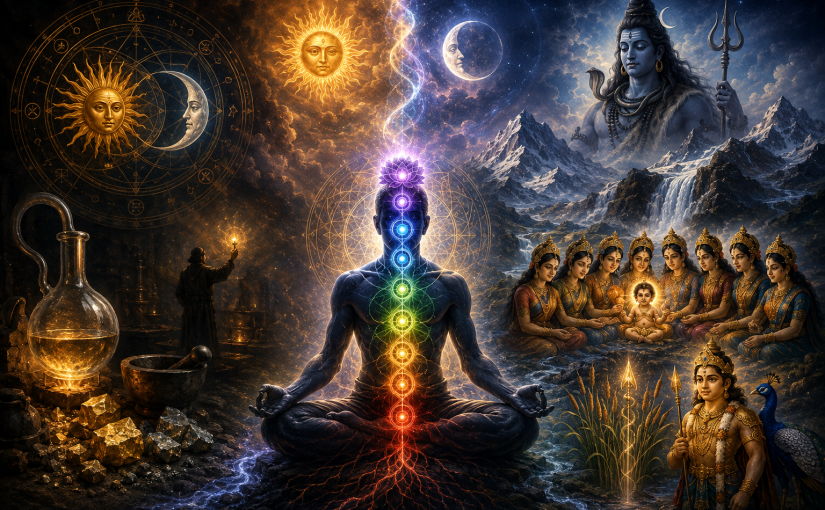
When different emotional burdens are consciously surrendered through different divine forms, the mind may become less entangled in its own history. This does not mean abandoning ordinary life. In fact, the qualities represented by the deities can remain fully available. Hanuman can represent courage, Vishnu work and preservation, Lakshmi prosperity, Rama righteous conduct, Shiva the transformation of heavy tendencies, Radha and Krishna love, Kali confrontation with danger, Brahma knowledge and Ganesha the overcoming of obstacles and difficult self-image. The goal is not to get rid of these qualities but to reduce the emotional ownership and burden associated with them.

This also connects with ego. A positive quality can become a source of bondage when it turns into identity. “I am brave,” “I am knowledgeable,” “I am spiritual,” “I am righteous,” “I am successful,” or “I am the one who works hardest” can all become heavy identities. Surrender allows the quality to remain while softening the claim of ownership around it. The person can still be brave when bravery is needed, work when work is needed, love when love is present and use knowledge when knowledge is useful, without constantly carrying the psychological demand to prove that identity.

The Spiritual Symbol and the Quantum Idea

I also connect this understanding with the physical nature of idols. An idol is made of matter, just as the human body and the rest of the physical world are made of matter. From a philosophical point of view, this can be contemplated as part of a common physical reality. I sometimes use the language of quantum particles to think about this deeper commonality. The human form of the deity then becomes a practical appearance through which consciousness relates to something that, in a deeper philosophical view, is not fundamentally separate from the rest of existence.

At the same time, I find it important to distinguish my contemplative interpretation from a scientific claim. It is reasonable to say that physical idols consist of ordinary matter and ultimately of physical constituents described by physics. It is not an established scientific fact that particular gods or specific emotions are literally particular quantum particles. The quantum language can therefore be kept as a philosophical or meditative way of understanding unity and interconnectedness rather than presented as proof of a specific religious interpretation.

This distinction does not reduce the value of the experience. The practical effect can still be meaningful. A symbol can change the way the mind relates to an emotion without requiring a scientific theory to validate every aspect of the symbol. The relief I experienced before Hanuman is a direct example. I surrendered my bravery-related emotions and incidents and felt lighter afterward. That experience itself is the foundation of my understanding.

However, as per Quantum Darshan every emotion resides in quantum particle. It is other thing they are not aware of them, leave alone attachement to these. That is why ancient saying god resides in every particle. They even not knowing quantum science knew its spiritual essence it seems. So it is like technique to become detached with all emotions by surrendering them to quantum particles. Different outer forms like different masks applied to them.

All emotions are basically in nature and we have only learnt these from there. Idol worship is like returning that all emotional burden back to nature that have been obtained from it.

Many Divine Forms, One Movement Toward Inner Freedom

Seen as a whole, my understanding of god worship is therefore not about choosing one deity as the only correct emotional purifier. Different forms can provide different doors into the same larger process. Lakshmi can help me examine money-related attachment. Rama can help me soften superiority and even pride in sattvik qualities. Shiva can help me surrender heavy and tamasic tendencies. Vishnu can receive the burdens attached to work and responsibility. Radha and Krishna can receive love-related attachment. Kali can receive fear and danger-related emotions. Brahma can receive knowledge-related pride. Ganesha can receive emotions connected with obstacles and unfavorable self-image. Hanuman can receive bravery-related experiences and the burden of identifying too strongly with courage. Many other deity forms can naturally occupy similar roles according to their qualities and according to the particular emotional material of the practitioner.

The deeper movement is the same: what has been psychologically carried as “mine” can be consciously surrendered. When this is repeated, the mind may become cleaner and less burdened. A cleaner mind may contemplate nonduality more easily. A steadier mind may develop meditation imagery more strongly. Deeper meditation may then provide a better foundation for Kundalini-oriented practice.

For me, this makes idol worship far more than an external religious activity. It can become a practical psychology of surrender. The idol gives a face to the abstract, the deity gives a symbolic direction to the emotion, surrender reduces the burden of personal ownership, and the resulting lightness can prepare the mind for deeper contemplation. I do not have to destroy my emotions, nor do I have to destroy the qualities associated with them. I can allow courage, love, knowledge, work, prosperity, righteousness and strength to remain while surrendering the unnecessary psychological weight around them.

My experience before Hanuman gave me the clearest starting point for this understanding. I stood before the image, gave away the emotions and incidents connected with bravery, and felt relief and disburdenment. From there I began to see a larger possibility: perhaps every divine form can become a doorway for surrendering a different emotional burden. Through many such doors, the mind can gradually become lighter. And when the mind becomes lighter, it may become more capable of the stillness, imagery, nondual contemplation and subtle awareness through which my meditation and Kundalini practice can continue to deepen.

Why Is Kundalini Called Mystical? When Awakening Happens Without Trying

The Continuous Meditation Image and the Movement of Prana

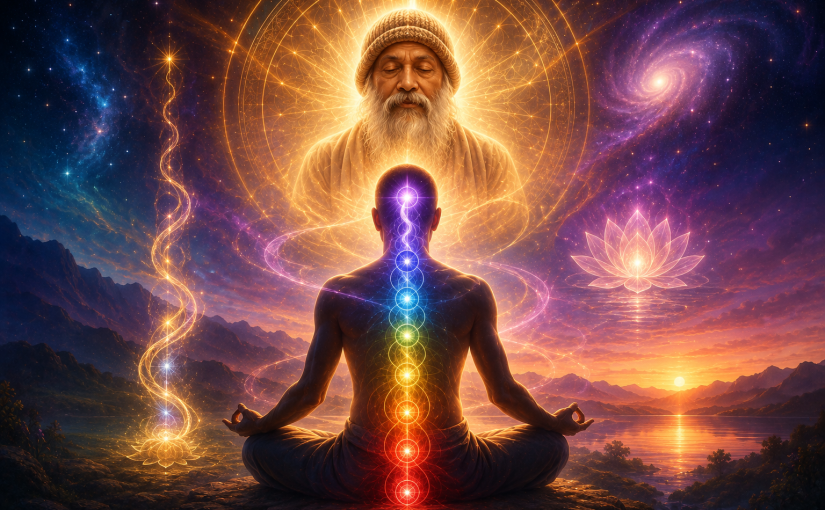
My meditation experience has led me to look at the relationship between prana, kundalini, breathing, nondual contemplation and the inner meditation image in a different way. The most striking feature is the continuous and uniformly shining quality of the meditation image. It does not remain like an ordinary thought or a weak mental picture. At times it becomes so stable, bright and lively that it seems almost like a physical object seen with open eyes. This raises a basic question: what keeps such an inner image continuously alive?

One possible explanation, within the traditional yogic understanding of prana, is that the major support is not ordinary breathing but an upward movement of prana from the muladhara toward the brain. Breathing may still play a role, but it appears to become secondary when sushumna is active. In ordinary functioning, breathing participates in the distribution and movement of prana throughout the body. Exhalation, in particular, seems to be associated in my experience with a downward movement. When this downward movement becomes stronger, the meditation image can become somewhat dimmer, as though some of the energy supporting the image has moved away from the brain.

But when sushumna becomes active and prana is experienced as continuously rising through the spine, the situation seems different. Kundalini energy appears to provide prana to the whole body according to need while its movement is upward through the central pathway, energizing the different chakras and their corresponding functions. It therefore does not seem necessary for this same energy to be repeatedly pushed downward in the way ordinary pranic distribution appears to occur with ordinary breathing. The kundalini energy rising up is giving proportionately equal nourishment to all chakras and their corresponding organs so energy do not need to be moved down frequently from the brain. This may explain why breathing naturally becomes slower or may even pause during deep activation of sushumna.

The experience becomes especially interesting when ordinary breathing cannot slow down. During physical work, stress or other conditions requiring increased respiration, breathing may remain active and its downward effect may still be present. Yet if sushumna is strongly activated and prana is continuously flowing upward, the meditation image may not become significantly dimmer. The downward movement associated with breathing is then apparently unable to overcome the continuous upward supply. The image can remain present, more or less continuously, because it is constantly being supported by the upward current.

From this perspective, a continuously present meditation image could become an experiential indication of an increasingly stable meditative state. If the upward movement through sushumna is sufficiently established, the image may remain continuously present in varying degrees of brightness, approaching what can traditionally be called savikalpa samadhi. This is not meant to establish scientifically that prana literally moves in this way, but to describe the relationship as it is experienced within the yogic framework.

Nondual Contemplation and the Felt Energy Vacuum in the Brain

Another part of the experience has become equally important. Nondual contemplation produces a particular peacefulness and calmness. It is not simply the intellectual acceptance of a philosophical idea. When contemplation becomes deep, ordinary mental activity seems to become quieter, and there is a distinct feeling of spaciousness or even an energy vacuum in the brain.

This felt vacuum may have an important role in the upward movement of kundalini. When ordinary mental activity becomes quiet, there seems to be less energy occupied by scattered thoughts, emotional reactions and ordinary subject-object thinking. The quietness may therefore allow, or in the traditional interpretation even draw, more kundalini energy upward from the base toward the brain.

This seems to explain why a meditation image can become particularly lively during nondual contemplation of sharirvigyan darshan, quantum darshan or another nondual vision. Nondual contemplation first produces the quiet and peaceful condition. That quietness seems to create a receptive space in the brain, after which the upward energetic movement becomes stronger and the established meditation image becomes more vivid.

The process can therefore be understood as a cycle: nondual contemplation produces stillness; stillness allows stronger upward movement; the upward movement makes the inner image brighter and more alive; the bright image stabilizes attention; and stabilized attention further deepens the stillness. The process reinforces itself rather than depending upon deliberate mental effort at every moment.

The term “energy vacuum” is useful for describing the experience, but it should not be mistaken for an established physiological mechanism. What can be directly reported is the felt peacefulness, quietness, spaciousness and associated energetic movement. Whether that experience is ultimately explained through prana, kundalini, neurological activity, attention, interoception, conditioning or a combination of these remains an open question.

Why Does Only One Meditation Image Become So Luminous?

This raises a more difficult question. If nondual contemplation and the upward movement of kundalini increase the energy available in the brain, why does only one preassigned meditation image become continuously bright and lively? Why do other thoughts not become equally vivid?

A possible answer is that the meditation image has become a specially established pathway through long and regular practice. Ordinary thoughts are temporary and associative. One thought produces another, and the mind constantly moves from one subject to another. A deliberately practiced meditation image is different. It is singular, predetermined, repeatedly brought back into awareness and strengthened through thousands of acts of concentration.

Thus, when the mind becomes quiet and more energetic, the established meditation image may be the easiest form through which that intensified activity can express itself. The energy may not literally be restricted to one image; rather, that image may have become the most strongly conditioned and stable representation available.

In this sense, prana may provide the power while meditation provides the channel. Repeated practice may have created a pathway of least resistance. This can explain why a random thought such as what to eat later does not suddenly acquire the same luminosity as the chosen meditation image. The random thought has no comparable stability, repetition or intentional reinforcement.

There is also an important difference in the quality of perception. Ordinary imagination is usually dim, unstable, fragmentary and dependent upon deliberate effort. The meditation image I experience can become continuous, uniformly bright and perceptually alive. It can approach the quality of seeing an object through open physical eyes. This is not simply a matter of imagining the object more clearly. It represents a change from deliberate visualization toward a more spontaneous and self-sustaining inner perception. However at times other images also can intensify like lively physical object but I do not give attention to those and in a way do not like them so energy from them again shifts to meditation image.

The strongest explanation may therefore involve both energy and conditioning. The upward energetic state supplies intensity, while long practice supplies the established form. The image becomes the point where the two meet.

Kundalini and the Long Association with the Meditation Image

There may be an even deeper reason for this special relationship. Kundalini may have become associated with the meditation image itself through the united contemplation of both over a long period of daily practice. The image was not practiced in isolation. It was repeatedly encountered in a meditative state involving concentration, inwardness, nondual contemplation and the experience of an upward kundalini movement through the spine.

If these elements have been repeatedly experienced together, they may eventually become strongly linked. Then, when the image first appears during nondual contemplation, even if only weakly, its appearance may itself become a trigger for the familiar upward movement of kundalini. The image becomes brighter; the upward movement becomes stronger; the stronger movement makes the image more stable; and the stable image draws attention still more completely.

The resulting process can be represented simply as image, upward current, brighter image, stronger concentration, stronger upward current, and still brighter image. The important point is that the image may no longer be merely an object of thought. It may have become a doorway into the entire meditative configuration developed through repeated practice.

This also explains why the experience can be directly felt as a continuity from the base to the image. The movement is not experienced merely as an abstract belief in kundalini. There can be a bodily sense beginning at the muladhara, moving upward through the spinal region and reaching toward the brain or the inner image. From the standpoint of phenomenology, this is a spatially organized experience: the energetic movement seems to have a beginning, a pathway and a point of expression.

It is still important to distinguish direct experience from interpretation. The direct experience is the sensation of an upward movement associated with the meditation image. Calling that movement kundalini, or saying that prana literally travels through a physical channel along the spine, is a traditional interpretation of the experience rather than something established by modern physiology. Keeping this distinction makes the account stronger rather than weaker.

When I enter a familiar place or meet people already associated with my meditation or meditation image, the experience may begin quite distinctly. More often it is better with loving environment that helps get peaceful rest with spine erect and relaxed breath. At first, kundalini seems to rise clearly, felt as a blissful sensation moving upward along the spine—sometimes as one continuous movement and sometimes in stages, almost as if it were passing from one chakra to another. After some time, however, the upward movement may become unnoticeable. An hour or so later, I may no longer consciously feel any movement along the spine, yet the meditation image remains vividly luminous in the brain, accompanied by a deep sense of bliss and peace. Means the kundalini energy prepared the stage for sometime for expression of meditation image there.

The bliss associated with the initial upward surge can resemble sexual pleasure, but it feels different in quality—more refined, diffuse, and inward, as though the familiar sexual sensation has been transformed into a subtler and more pervasive form of bliss. I can describe this as a subjective resemblance to sexual pleasure without claiming that the experience is literally sexual or that a specific physiological process of sexual energy moving upward has been established. But contraction and shrinkage of lower organs with feel of their relief from stress and burden by pushing something up proves this thing experientially.

The Role of the Third Eye and Ajna Chakra

The experience then suggests another component: the role traditionally attributed to the third eye or Ajna chakra. The meditation image does not merely become brighter somewhere vaguely inside the mind. It becomes exceptionally clear and immediate in the region associated in yogic traditions with Ajna.

From this perspective, savikalpa samadhi can be understood as the united contribution of several factors rather than as the result of one factor alone. The regularly practiced meditation image provides the established object. Nondual contemplation produces peacefulness, quietness and a reduction of ordinary mental activity. Kundalini or the upward movement of prana supplies the increasing energetic intensity. Ajna, or the third-eye center in the traditional model, provides the focal center through which the inner object becomes exceptionally clear.

This combination can explain why the image of Dadaguru can become so vivid. It is not merely a picture that has been remembered. It has been practiced repeatedly and associated with the deepest meditative conditions. When nondual contemplation quiets the mind and the upward movement becomes strong, the image can appear almost independently of deliberate effort. At its most developed, it can become continuous, uniformly luminous, stable and lively, with an immediacy approaching physical seeing with open eyes. Even can awaken providing self-realization glimpse in exceptionally favourable environment and heightened energy.

This is where the distinction between ordinary visualization and savikalpa samadhi becomes important. Ordinary visualization still requires the meditator to construct and maintain an image. In the experience being described here, however, the image increasingly seems to maintain itself. Attention no longer has to continuously manufacture it. It becomes a stable inner object around which the mind becomes unified.
This is, in a sense, the special quality of kundalini—the blissful and deeply absorbing state can be achieved deliberately through Tantra, but it can also happen spontaneously. The ordinary meditator may struggle for years, even for a lifetime, simply to maintain a meditation image steadily, let alone reach awakening. What kundalini seems to do spontaneously is therefore not something that can be reproduced so easily by other methods, even when those methods are practiced deliberately and for a very long time.
The difference is important. With ordinary meditation, there can be a continuous struggle to hold the image, bring the wandering mind back, and prevent the visualization from fading. In the experience associated with kundalini, the process can appear to reverse itself: instead of the practitioner constantly maintaining the image, the image seems to become self-sustaining. It shines by itself, attention gathers around it, and the mind enters a state of bliss, peace, and increasing unity without the same continuous effort.
This may be one reason the idea of kundalini appears so extensively in the spiritual literature of the world. Sometimes it is described directly, but much more often it may be expressed indirectly through symbolic stories, verses, sacred figures, ritual practices, images of ascent, inner transformation, divine union, death and rebirth, or the awakening of a hidden power. The language changes from tradition to tradition, and these accounts should not automatically be treated as literal descriptions of the same physiological process. Yet the remarkable persistence of such imagery suggests that human beings have repeatedly tried to describe experiences in which something deeper than deliberate mental effort seems to take over the process of transformation. That is why kundalini is so often termed mystical. But what exactly is mystical about it? If kundalini is understood as a process in which much of the work of awakening can happen spontaneously, without the meditator deliberately producing each stage, then the term seems especially appropriate.

Mystical does not necessarily mean something that has no scientific or physiological basis. It can simply point to something extraordinary that seems to unfold by itself, beyond the ordinary capacity of deliberate effort. A meditator may spend years struggling to maintain concentration, stabilize an inner image, deepen absorption, or transform consciousness. Yet in an experience attributed to kundalini, some of these processes can appear to happen spontaneously, sometimes with remarkable speed and intensity.

What could seem more extraordinary than awakening itself occurring in this way? The remarkable feature is not that kundalini must be a supernatural force, nor that its effects cannot ultimately have physiological or psychological explanations. The mystery lies in the phenomenology: something that normally appears to require enormous effort seems to organize and propel itself from within.

In that sense, kundalini can be called mystical without making an anti-scientific claim. Its mystery is not necessarily that it violates physiology, but that it can produce such profound changes in consciousness with such apparent spontaneity. The experience can feel as though the practitioner is no longer doing the awakening; rather, awakening itself has begun to do the work.

As told above, the term savikalpa remains appropriate within this framework precisely because there is still a particular object. The experience is not completely objectless. There is still the meditation image of Dadaguru, but ordinary mental fluctuation has become greatly reduced and the object has acquired extraordinary clarity and stability.

At the same time, the presence of a bright inner image alone should not automatically be equated with savikalpa samadhi in the classical sense. Traditionally, savikalpa samadhi refers to a deeper transformation in the relationship between awareness, mental activity, and the meditation object.

One can have a bright image of one’s puppy or buffalo or even a beautiful flower or a stone, but how can we call that meditation simply because the image is bright and vivid? There are other qualities of meditation as well, such as nonduality, detachment, bliss, humility, true and selfless love, and the rise of kundalini. These qualities make a meditation image much more spiritually significant. A person who develops such qualities can therefore be considered a better fit for a spiritually oriented meditation image, particularly one associated with a guru, God, or another sacred figure. A Guru, having achieved these qualities through deliberate effort, inspires his followers to cultivate the same qualities in their own lives. Thus, he makes the meditation image further intensify itself in the mind by encouraging the follower to sustain these qualities in daily life. As these qualities are sustained, they further intensify the image, which in turn inspires the follower to embody them even more deeply. This cycle continues, and the image gradually becomes established in the mind, remaining uninterrupted—somewhat like savikalpa samadhi.

Animals or inanimate objects may possess many of these qualities naturally, but they do not possess emotions and cognition in the same way as human beings. In animals, these qualities appear to be largely instinctive or naturally given, whereas in human beings they can be consciously chosen, cultivated, and developed. This gives them greater weight in the context of spiritual practice, because the human being can deliberately direct these qualities toward meditation and awakening. However, as per Patanjali medittion of whatever favourite object can produce samadhi but I think that may take more time than meditation of any spiritual subject. No doubt animals have many spiritual type qualities that is why each god is shown with an animal, so meditation of guru or god with animal seems having synergistic effect. This seems the meaning of god and animal shown together. I also felt this. I largely remain with animals and inside nature during my heightened initial spiritual growth and both awakenings. That’s why most of awakened beings are animal and nature lovers, atleast living in harmonious company with these. Also, animal and nature lovers tend to be more spiritual than others. This is because nonduality is inherent nature of animals and nature. What they do just instinctively to survive, not with any willful dual agenda.

Therefore, the strongest and most accurate statement is that a continuous, luminous image may be an experiential feature associated with a state that resembles or develops toward savikalpa samadhi, rather than by itself proving that the classical state has been attained. The image becomes much more significant when it appears together with the other qualities of meditation—bliss, detachment, nonduality, selfless love, inner stillness, and the spontaneous rise of kundalini.

A Possible Unified Model

Taken together, the experience suggests a unified process. Long practice establishes a particular meditation image as the strongest and easiest inner pathway. Nondual contemplation quiets ordinary thought and creates a profound peacefulness and felt spaciousness in the brain. This quietness appears to make the brain receptive to a stronger upward movement of kundalini from the muladhara through the spine. As that movement reaches the region of the brain and Ajna, the established meditation image becomes increasingly bright, stable and perceptually immediate.

Once the image appears, it may itself reinforce the upward movement because the image has been repeatedly associated with that energetic condition. The process therefore becomes self-reinforcing. A small appearance of the image can initiate a larger upward response; the upward response makes the image brighter; the brighter image holds attention more firmly; and the firmer attention deepens nondual stillness. Breathing may still influence the state, particularly through exhalation and its apparent downward effect, but when sushumna is strongly active, the continuous upward process may become dominant enough that ordinary breathing cannot extinguish the image.

The whole experience can therefore be understood as the convergence of nondual contemplation, kundalini, the practiced meditation image and the Ajna or third-eye focus. None of these elements needs to be considered independently. The meditation image supplies the established form, nonduality provides mental stillness, the upward kundalini experience provides energetic intensity and bliss, and Ajna provides the traditional focal center through which the inner perception becomes exceptionally clear.

The deepest feature of the experience is therefore not simply that an image can be seen in meditation. It is that a particular image, practiced over a long period, can become so deeply associated with stillness and upward energetic movement that it begins to appear with a continuity, uniform brightness and vividness normally associated with direct physical perception. From the yogic perspective, this can be understood as the meeting of prana, kundalini, sushumna and Ajna with a well-established meditation object. From a psychological and neuroscientific perspective, some of the same experience could be approached through learned attention, conditioning, imagery, interoception and changes in ordinary mental activity.

The experience itself, however, remains the starting point. The interpretation can continue to develop without diminishing what was directly observed: the quiet produced by nondual contemplation, the felt movement from the base through the spine, the reduced dependence on ordinary breathing, and above all the transformation of the practiced image of Dadaguru from an ordinary mental representation into a continuous, uniformly shining and unusually lively inner presence.

Third Eye Opening and Awakening: How Breath, Prana and Inner Seeing May Be Connected

The Experience That Led to the Question of the Third Eye

My understanding of the third eye did not begin with the idea of a mystical organ somewhere inside the head. It emerged from observing something much simpler: the difference between sensory experience and purely mental experience, and the remarkable change that can occur when the breath spontaneously pauses. This observation also connects with the larger exploration of sex, breath suspension, kundalini and samadhi, but the present question is much more specific. It concerns what happens to the brightness and continuity of experience when sensory input is present or absent, and why certain states are traditionally associated with the third eye or ajna chakra.

One of the first things I noticed was that there can be a remarkably uniform brightness in ordinary sensory experience even while the breath is running normally. If I look at beautiful scenery, for example, the visual experience remains continuously bright. The breath is moving in and out, yet the scenery does not seem to become darker with every outbreath. The sensory system is continuously receiving information from the external scene, and this continued sensory input appears to keep the corresponding mental formation uniformly alive and bright. The mental image is therefore constantly supplemented by perception itself.

But when the breath spontaneously pauses while looking at beautiful scenery, the experience can become much stronger. The scenery may suddenly feel extraordinarily vivid, stable and blissful. I have referred to this as “breathholding beauty.” The point is not that physically holding the breath creates beauty, but that when the breath naturally pauses, the already beautiful sensory experience can become unusually intense and experiential. The temporary absence of ordinary respiratory movement seems to allow the experience to become more continuous and concentrated.

This observation becomes even more interesting when there is no external sensory object.

Why Pure Thought Reveals the Effect More Clearly

During purely mental thought, when there is no sensory involvement, the darkening effect associated with outbreath becomes more obvious. A thought or mental image has no external sensory stream continuously supplying it with information. There is nothing like the visual scene before the eyes that keeps refreshing the mental formation. The thought therefore has to sustain itself internally, and fluctuations associated with respiration can become more noticeable.

In this sense, sensory experience may conceal something that becomes obvious in purely mental experience. When looking at a scene, the senses continually supplement the mental image. During a thought without sensory involvement, that supplementation is absent. The changing respiratory rhythm can therefore appear more directly related to the changing brightness or stability of the mental formation.

This should be understood as a phenomenological observation rather than an established physiological law. I am describing how the experience appears and the model that arises from it, not claiming that science has established that every exhalation literally darkens a thought. The distinction between experience and its proposed mechanism is important.

Spontaneous Breath Suspension and Uniformly Bright Thought

During energetic ascent, when the breath pauses spontaneously, something different can happen. A mental formation that would ordinarily fluctuate can remain uniformly bright. It can acquire a continuity similar to that of sensory experience, or even to directly seeing something with the eyes open.

This is significant because there may be no external sensory input providing the image. Yet the mental image can remain vivid, stable and continuously present. In the experience, it is as though prana is now doing what sensory input ordinarily does: sustaining the mental formation and keeping it continuously bright.

This gives a possible experiential explanation for why such states can feel like seeing rather than merely thinking. An ordinary thought is something I can know, imagine or construct mentally, but an intensely bright inner formation can have a different quality. It can feel directly experienced, almost as though something is actually being seen. The eyes can remain closed, and yet the experience can have a perceptual intensity comparable to seeing with open eyes.

This is the point at which the traditional idea of the third eye becomes especially interesting.

The Third Eye as Inner Seeing

The third eye does not necessarily have to mean another physical eye or an additional anatomical sensory organ. From this perspective, it can describe the emergence of a mode of inner perception in which prana sustains a mental formation with a continuity and brightness that ordinarily come through sensory input.

Normally, the physical eyes see an external object because sensory information is continuously reaching the brain and contributing to the perceptual experience. In the state I am describing, an internally generated mental image can acquire a similar continuity without depending upon an external sensory object. The experience can therefore resemble direct perception even though the physical eyes remain closed.

This also gives a deeper meaning to the word “awakening.” When a person wakes from ordinary sleep, the physical eyes open and the external world becomes visible. There is a transition from an inward, dreamlike or unconscious condition to a state in which the world is directly perceived. In a somewhat analogous sense, the third eye can be understood as an inner awakening: the physical eyes remain closed, but an internal world becomes directly and intensely perceptible.

The mechanism or process through which this inner “waking up” is experienced can therefore be called the opening or functioning of the third eye. The third eye is not necessarily a separate organ; it is the name given to the capacity for this intensified inner seeing.

Why Ajna Is Called the Third-Eye Chakra

At ajna, there can still be something that resembles an object of perception. There is inner brightness, inner seeing of medtation image, and an experience that can feel almost like direct perception through the senses. This is why ajna is specifically described as the location of the third eye.

The important feature is not merely brightness. Brightness alone would not explain the expression “eye.” The defining feature is the experiential quality of seeing. Something appears before awareness in a way that can resemble an object of perception. It may be an image, a form, a scene or another mental formation, but it is experienced with a directness that goes beyond ordinary intellectual thought.

This experience is also not necessarily mystical. In a broader sense, everyone may have the third eye open to some extent at different times. Human beings constantly experience mental images, thoughts and inner representations without having corresponding physical objects immediately before the senses. Every mental thought therefore has something of the nature of a third eye: it creates an internally experienced object or representation.

The difference is one of degree and intensity. The more a person is intellectually self-contained and inwardly engaged without unnecessary dependence on sensory and worldly stimulation, the more developed this capacity for inner seeing may be. A person who can remain inwardly occupied does not need constant external sensory stimulation to maintain mental activity. In this broad sense, the third eye is not an extraordinary possession belonging only to mystics. It is a capacity already present in ordinary consciousness.

From Ordinary Thought to a Fully Open Third Eye

Every mental thought can therefore be regarded as a very simple form of third-eye functioning. When I think about something that is not physically present, there can still be an internal representation of it. I may see a place in my mind, remember a person’s face, imagine an object or construct an entire scene without looking at anything externally.

Ordinary thought, however, usually does not have the same intensity as external sensory perception. I know that I am imagining it. Its brightness, stability and immediacy are generally weaker than the direct perception of an object before the physical senses.

The third eye can therefore be understood as a continuum rather than an all-or-nothing event. At one end there is ordinary mental imagery and thought. At a stronger level, inner imagery becomes increasingly vivid and independent of sensory support. At the highest level of this particular function, an inner thought or image can become as strong, stable and directly experiential as external sensory perception. In that sense, the third eye is fully open when inner seeing reaches the intensity of actual sensory seeing.

This also explains why third-eye experiences do not have to be dramatic visions. The essential characteristic is the quality of perception. A mental formation may become exceptionally clear without necessarily producing a supernatural event. What changes is the degree to which the inner formation is experienced as something directly seen.

My Experiences of Awakening and the Third Eye

My own experiences make the distinction between third-eye functioning and complete awakening particularly important. I experienced this inner seeing during both of my awakening experiences that were accompanied by self-realisation, and I experienced it for a third time during the temple imagery described earlier. But the third experience was different because the awakening was incomplete, or perhaps more accurately, it was a simple awakening without full self-realisation.

This suggests that the third eye may be closely synonymous with awakening, but the two cannot be treated as completely identical. The third-eye function can occur without complete awakening or self-realisation. There can be inner seeing, extraordinary brightness and a feeling of having awakened internally without the complete transformation associated with self-realisation. However it looks true that the way to full awakening is through third eye. It is like saying that door to awakening of meditation image is lively meditation image itself. When through prolonged and constant meditation it crosses certain threshhold of liveliness it becomes full awakening.

In my experience, the awakenings accompanied by self-realisation occurred at the level of sahasrara. The simple awakening associated mainly with the temple imagery was experienced around ajna, or did not fully express itself in sahasrara. This distinction helps explain why ajna and sahasrara can both be associated with extraordinary inner brightness while still representing different levels or qualities of experience. So third eye opening seems synonym to savikalpa samadhi.

Ajna, Sahasrara and the Difference Between Seeing and Realisation

At ajna, there can still be something resembling an object of perception. There is a seer and something that appears to be seen. The inner experience can be remarkably vivid, but it retains the character of seeing. This is precisely why ajna is associated with the third eye.

At sahasrara, however, the experience can move beyond inner perception. There can be full awakening together with self-realisation and complete nonduality. The issue is no longer simply whether a mental formation is bright enough to resemble sensory perception. The deeper transformation is that the distinction between the observer and the observed can itself disappear.

Therefore, sahasrara should not simply be understood as an even brighter version of ajna. Ajna represents the emergence or intensification of inner seeing; sahasrara, in the experience of full awakening, represents going beyond the separation between seer and seen. There can still be extraordinary brightness, but brightness is no longer the essential point. Self-realisation and nonduality become the defining features.

This also explains why I experienced third-eye-like inner perception during experiences that differed in their degree of awakening. The inner seeing could appear without complete self-realisation. The third eye, therefore, seems to be closely related to awakening because awakening makes inner perception exceptionally direct, but full awakening with self-realisation is something further.

Awakening as an Inner Opening of the Eyes

The word “awakening” itself now becomes particularly suggestive. When a person wakes from sleep, the physical eyes open and the external world becomes visible. The act of waking therefore naturally becomes associated with seeing. In the inner experience, something similar may happen while the physical eyes remain closed.

The difference is that instead of waking into the external sensory world, consciousness seems to wake into an internal world. The mental formations that previously existed only as thoughts or images can become directly perceptible, intensely bright and stable. It is as though the inner eye has opened while the physical eyes have remained closed.

This may be why the language of the third eye and awakening fits the experience so naturally. The physical eye sees objects after waking into the external world; the third eye sees the mental world after an inward awakening. The comparison is not intended to establish that a literal hidden eye exists. It describes the similarity in the experiential quality of becoming awake and seeing.

Thus, the internal mechanism or process that provides this experience of “waking up” can be called the third eye. It is the transition from ordinary mental representation toward direct inner perception.

The Continuum From Thought to Third Eye to Self-Realisation

The whole observation can therefore be seen as a continuum. Ordinary thought already contains a rudimentary form of inner seeing because a mental formation can be experienced without a corresponding external object. Sensory perception is normally stronger because continuous sensory input keeps the mental representation uniformly alive. Pure thought reveals respiratory fluctuations more clearly because there is no sensory supplementation. During spontaneous breath suspension while its work taken up by kundalini, an internally generated formation can become uniformly bright and stable. When this inner brightness becomes strong enough to resemble direct sensory perception, the experience can be described as a fully open third eye.

At ajna, this inner seeing can become particularly prominent, which explains its traditional association with the third eye. It can occur without full mystical awakening and may exist in lesser degrees in ordinary people. In my own experience, however, it became especially clear during awakening experiences. The temple imagery represented a simpler or incomplete awakening mainly associated with ajna, while the experiences accompanied by self-realisation reached sahasrara.

At sahasrara, the process goes beyond seeing. Full awakening with self-realisation and nonduality is not merely the perfecting of mental brightness. It is a change in the relationship between consciousness, the observer and the perceived world.

The third eye, then, may be understood not as a mysterious physical organ but as a name for the awakening of inner perception. Its ordinary form may already exist in every thought and mental image. Its stronger form appears when inner formations become independent of continuous sensory support and acquire exceptional brightness and stability. Its fullest perceptual expression resembles direct sensory seeing with the physical eyes closed. And when awakening proceeds beyond perception into self-realisation and complete nonduality, the experience reaches a different dimension associated, in this framework, with sahasrara.

This makes the traditional expression “opening of the third eye” less mysterious. It can be understood as an awakening of the capacity to see inwardly, first in ordinary mental forms, then with increasing brightness and directness, and finally with an intensity that can resemble external perception itself. The remarkable point is that the physical eyes need not open for this inner seeing to begin. In fact, the paradox is precisely that one can feel as though one has awakened and begun to see while the physical eyes remain closed. However both eyes are not fully equal. Outside is outside, and inside is inside. Therefore, difference is jenuine, still many things are in common.

Kundalini Awakening, Sexual Energy and Samadhi: How Sexual Release May Lead to Thoughtless Awareness

The Peak of Orgasm and the Possibility of a Samadhi-Like State

The question that led this exploration was simple but profound: what is the scientific basis of the samadhi-like feeling that can arise at the peak of orgasm and immediately after sexual release? My experience suggests that the answer may lie in what happens to the whole body-mind system at the height of sexual excitation. During sexual activity, the body becomes intensely activated, and at release there is an abrupt transition. I began to consider whether the enormous excitation accumulated during the sexual act could support a short period of breathlessness or respiratory suspension after release. In the language of yoga, I understand this accumulated intensity as prana. I am not claiming that prana has been physically measured as a stored substance or that it literally substitutes for oxygen. I am describing what the experience feels like and exploring its possible meaning. The important point is that the body can remain intensely awake even when ordinary breathing becomes temporarily very quiet or appears to stop.

Sexual Energy, Breath and the Upward Movement of Prana

At sexual release, the pranic flow is experienced as a voluminous, unidirectional movement from muladhara toward sahasrara. Ordinary breathing, in my understanding, creates an oscillation of prana, moving it up and down with inhalation and exhalation. Such oscillation does not seem suited to the state produced at the peak of release, where the movement is experienced as one powerful upward surge. Therefore, breathing seems to pause until the entire wave of sensual joy or pranic intensity has passed upward through the central axis. This is why the temporary suspension of breath becomes significant in the experience. The essential phenomenon is not simply breathlessness. It is the combination of respiratory stillness with complete wakefulness while the rising energy seems to move toward sahasrara. Probably, the rising Prana keep wakefulness maintained in absence of breathing. It means not only breath or oxygen but prana is also needed for life. Prana can compensate for breath to some extent. I do not mean that science has established that prana physically travels through the spine in this way. The traditional yogic model provides the language with which I understand the experience, while physiology can investigate its observable correlates.

Why Sexual Experience Can Resemble Concentrative Meditation

This led me to another possibility. Sexual activity may contain an involuntary form of concentration. During intense sexual excitation, attention becomes increasingly absorbed in a narrow field of bodily sensation and pleasure. Competing thoughts can diminish, ordinary self-monitoring can weaken, judgement weaken, nonduality arises, and the whole organism becomes organized around one highly intense process. Meditation usually approaches absorption from the quiet side: stillness leads to concentration and concentration can lead to absorption. Sexual excitation approaches it from the opposite direction: intense excitation progressively concentrates consciousness until release is followed by stillness. Thus the common factor may not be sexuality itself but concentration. In this sense, sexual orgasm may sometimes function as a naturally occurring, physiologically driven concentration process. This does not prove that orgasm is samadhi, but it raises the possibility that different routes can converge on similar features of consciousness.

Ordinary Sexual Energy and the Meditatively Prepared System

I then considered what might happen when the person is already practicing meditation. In ordinary life, sexual energy may be experienced as dispersing into different parts of the body and through different side channels. But if someone has been meditating regularly with awareness stabilized at ajna and sahasrara, the entire system may already have a strong attentional orientation toward the upper axis. In the traditional model, daily yogasana also prepares the body-mind for meditation. It steadies the body, reduces restlessness, develops bodily awareness and makes sustained attention easier. It also propels prana upward to top chakras through spinal axis. Yogic tradition further understands asana as helping keep the pranic channels or nadis open and reducing obstruction to prana. Therefore, when a powerful sexual release occurs in a meditatively trained person, the experience may be very different from that of an ordinarily active person. The same or a broadly comparable energetic surge may be expressed differently because the receiving system has changed. The energy may be experienced as moving more directly toward sahasrara, while the breath becomes extremely subtle or temporarily suspended. Breathing stops more than ordinary person as now prana is to be lifted to the top. I would not claim scientifically that breathing physically interferes with prana or that daily asana has been proven to open literal energy channels. These are parts of the yogic explanatory and experiential framework. The more cautious scientific question is whether training attention and regulating the body changes how an intense sexual or autonomic event is experienced. This is experiential science. If we keep searching physical science in it, much of availale time for genuine experience to be got is reduced.

Savikalpa and Nirvikalpa-Like Expression of the Same Surge

An important distinction emerged from my own experiences. I do not think the same amount of energy necessarily produces the same state of consciousness in every person. The energetic surge may be similar, perhaps with some difference in intensity, while the body-mind system expressing it can be very different. Earlier in life, I was ordinarily peaceful and calm but my mind was active and strongly oriented toward nonduality. I was not trying to stop thoughts through meditation at the particular time of the experience. When the powerful ascending experience occurred, I experienced a glimpse of self-realization together with what I call savikalpa samadhi. At its peak there were what appeared to be thoughts, but on closer examination they did not feel like ordinary thoughts. They were more like waves appearing within a background of self-awareness. They did not fade and return in the ordinary way. They remained constantly and uniformly bright along with the background of self-awareness. Although pure background self-awareness as in nirvikalp samadhi is indescribable, it also felt bright with waves. Everything uniformly bright and nondual. This is why I describe the experience as thoughts without thoughts.

It may also be that sudden release and gush of upward energy as mainly in younghood produces high energy awakening linked to savikalp samadhi and slow, steady and stable flow of energy as in maturity produce more of nirvikalp samadhi.

Breath Suspension and the Brightness of Mental Waves

There was another striking feature. Ordinarily, I experience the in-breath as brightening a thought and the out-breath as dimming it. In that sense, ordinary mental content seems to oscillate with breathing. During the peak experience, however, the breath paused. The normal cycle of brightening and dimming therefore seemed to pause as well. The mental waves did not disappear, but remained uniformly bright for the whole experience, which lasted around ten seconds. The mind had not become empty. Rather, its ordinary thought process had changed into something more like luminous waves in self-awareness. This is why I distinguish this from simple thoughtlessness. The awareness remained awake, but what ordinarily appeared as thought no longer behaved like ordinary thought. It was as though thoughts remained without the usual process of thinking them and as if thoughts and thought-experincer both had become one.

Why the Same Energy May Produce Different States at Different Stages of Life

This led to a further hypothesis. Producing or sustaining these highly differentiated, luminous waves in awareness seems, from my experience, to require tremendous energy. I say this from direct experience, not from any measurement of metabolic or pranic energy. Others may not experience the process in the same way. The important point is that the subjective intensity of energy and the way the body-mind expresses it need not be identical for everyone. In younger and more active life, the mind may have enough cognitive momentum to express an intense ascending event through vivid nondual thoughts, insights or imagery. The result can therefore be savikalpa-like. Later, with maturation, prolonged meditation and a naturally quieter mind, there may be much less mental activity available to produce those waves. Increased workload and exhaustion may also reduce the amount of cognitive activity, although exhaustion alone should not be confused with samadhi because ordinary exhaustion produces dullness or sleepiness rather than necessarily heightened awareness.

Thus the model is not simply that more energy produces nirvikalpa and less energy produces savikalpa. It is that a similar rising gush of energy can encounter a different body-mind system and therefore be expressed differently. Earlier, strong energy met a peaceful but active nondual mind and produced luminous waves within self-awareness. Later, strong energy met a quieter mind with fewer thoughts and possibly reduced cognitive reserve, and the same kind of ascending event tended to produce more nirvikalpa-like states. The difference may therefore lie not only in the magnitude of the energy but in the condition of the system receiving and expressing it. What could be the way of expressing of that upsurging prana energy other than thoughtlessness with wakefulness if it can neither form thought waves due to system-exhaustion nor ordinary thoughts due to paused breath? It may also be that energy gush is reduced in intensity by body itself if system is not capable of tolerating it as body is intelligent. So with this reduced gush only nirvikalpa can be experienced not high energy savikalpa with self realisation.

A Spontaneous Energy Experience in Half Sleep

Another experience helped clarify this distinction. On one occasion, in a half-awake and half-asleep state, I felt a rising, shining and blissful streak of energy moving through the spine. I had deliberately preparing the mind through meditation, yogasana, breathing techniques or sexual activity but with little pause or hesitation on those days. During its ascent, I suspect there may also have been a temporary pause in breathing lasting roughly ten to fifteen seconds. The temple imagery that was present in the mind remained continuously bright like directly seeing with open eyes during this period. Yet the experience did not produce the same direct recognition of background self-awareness that I had experienced during the earlier fully awake event.

This suggested to me that the intensity of the energetic sensation itself is not necessarily the measure of the depth of the consciousness that accompanies it. The half-sleep experience had a much more conspicuous luminous energetic streak, whereas in the earlier daytime experience, when self-realization was glimpsed, the actual movement of energy through the spine was almost unnoticed. In other words, the energy can be highly perceptible without producing the deepest transformation of awareness, while a subtler energetic movement can accompany a much greater recognition of self-awareness.

The Metaphor of Friction, Heat and Light

I have used the word friction to describe the possibility that when the rising energy encounters resistance, its movement becomes more perceptible as brightness, heat or a streak-like sensation. By friction I primarily mean a metaphor, although whether something corresponding to it may actually exist remains unknown. May be just like electrons passing through heating coil colliding with its particles due to obstructed path produce heat and light, same may be true in spine too atleast psychologically. I do not claim that there is a scientifically established physical friction inside the spine producing the experienced light. There may be physiological processes involving interoception, autonomic activity, sensory integration or altered brain processing that contribute to such sensations. But the traditional language of blocked or unobstructed prana provides another way of describing the same experience. In one case, the movement may be felt as a dramatic streak because the process is perceptually prominent; in another, the movement may be almost unnoticed while its effect on consciousness is profound. Therefore, a spectacular energetic sensation should not automatically be taken as a higher state.

From Savikalpa-Like Experience Toward Nirvikalpa-Like Absorption

The earlier experience was important precisely because the mind was not trying to become thoughtless. I was living with a peaceful, calm and active nondual orientation, and in that condition the peak experience gave me a glimpse of self-realization along with the intense energetic event. The luminous waves that remained in awareness showed me, experientially, a distinction between awareness and what appears within awareness. However it was not coceptual or visible much, may be it produced its effect on succeeding lifestyle, behaviour and attitude silently. Afterward, it became easier to settle into thoughtlessness. In this sense, the initial savikalpa-like glimpse may have been necessary for me however it may not be necessary for all. I needed the peak of worldliness itself to recognize what I experienced as kundalini awakening together with a glimpse of self-realization. Once that distinction had been directly felt, stillness became easier to recognize and enter.

Later, when thoughts were naturally fewer and the mind had matured through continued practice, the ascending energy and accompanying breath suspension tended to produce more nirvikalpa-like states. The ordinary thought-producing mechanism was already quieter. With suspended breathing there was no familiar respiratory oscillation to brighten and dim mental content so no ordinary thoughts as those are nothing else but mixture of bright and dark spots, and there was not the same amount of cognitive activity available to create the earlier luminous waves. Therefore, the system seemed to have fewer ways of expressing the ascending intensity through differentiated thought. What remained was thoughtlessness together with full wakefulness.

A Possible Understanding of Tantra

This entire sequence makes me wonder whether something like this may help explain why Tantra arose. If ordinary sexual energy is experienced as dispersed through the body, while a meditatively prepared system can gather and direct the experience toward a single upper axis, sexual release becomes more than ordinary pleasure. The enormous concentration already present in sexual excitation may become a vehicle for attention and absorption. Tantra may therefore be understood, at least as one hypothesis, as an attempt not to suppress sexual energy but to use its extraordinary intensity as a means of transforming consciousness. Meditation prepares the receiving system; sexual excitation supplies an unusually powerful concentration-producing event; release creates a sudden transition toward stillness; and the resulting state may differ according to how prepared and quiet the mind already is.

What Science Can and Cannot Yet Say

The scientific investigation should not begin by assuming that prana, nadis, ajna, sahasrara and sushumna are established anatomical structures. They belong to a traditional yogic map and to the language through which these experiences are interpreted. At the same time, science does not have to dismiss the experiences simply because their traditional explanation has not been established. The experiences themselves can be investigated through respiration, autonomic activity, cardiovascular changes, brain activity, interoception, attention, imagery, self-processing and subjective reports.

The central phenomenon I am interested in is therefore not simply orgasm, breathlessness or an unusual light in the spine. It is the possibility that an intense ascending experience can temporarily alter respiratory rhythm and ordinary thought while preserving or even intensifying wakeful self-awareness. In one state, the remaining cognitive activity may appear as luminous waves within self-awareness, producing a savikalpa-like experience. In another, when the mind has become sufficiently quiet, the same or a comparable energetic event may be expressed primarily as thoughtlessness with full wakefulness, producing a nirvikalpa-like experience.

This leaves an open scientific question rather than a finished conclusion: perhaps different routes—meditation, sexual excitation and spontaneous internal experiences—can produce different physiological pathways that nevertheless converge on some common organization of consciousness. My own experiences suggest that the crucial variable may not be the amount of energy alone, but the condition of the body-mind system through which that energy is expressed. The spectacular rising streak, the breath pause, the luminous thought-waves, the recognition of self-awareness and the later thoughtless absorption may be related phenomena, but they are not necessarily the same phenomenon. Understanding how they interact may provide a more precise bridge between the ancient language of kundalini and samadhi and the modern scientific study of altered states of consciousness.

Sex, Samadhi and Sharirvigyan Darshan: From Orgasmic Silence to Nirvikalpa Samadhi

Why Osho’s Observation About Sex and Samadhi Feels Experientially True

Osho’s statement that sex can give a glimpse of samadhi begins to look much more meaningful when it is examined as an experience rather than as an idea. At the peak of sexual climax, there can be a brief interruption of ordinary thinking. The mind, which is usually filled with thoughts, images, expectations, memories and self-consciousness, can suddenly become completely quiet. For a moment, there may be no ordinary mental activity at all. In that limited sense, the experience can resemble a glimpse of samadhi. It does not necessarily mean that orgasm itself is samadhi, but it can reveal something important: when ordinary thought stops, consciousness can have a very different quality.

This distinction becomes especially important when comparing the experience with the different forms of samadhi described in yoga. There is a kind of high-energy awakening in which sexual or tantric energy becomes intense, consciousness expands, self-realisation appears, and there is a powerful sense of awakening or transcendence. Such an experience can resemble what I call savikalpa samadhi. At its peak, there may be a glimpse of energetic awakening, as I experienced. There is still something happening that can be experienced. There is still a subtle quality of consciousness, a sense of witnessing, bliss, expansion, energy or self-awareness. The mind may be extraordinarily quiet, but there is still some content to the experience.

What I am discussing here, however, is something different. I am referring to nirvikalpa samadhi, understood as the void in which even the ordinary structure of experience disappears. This is far more difficult to recognise. It is not simply a state in which there are few thoughts. Having few thoughts by itself can just as easily be a sign of dullness or mental inactivity. Nor is it merely extraordinary pleasure, bliss, energy, extreme wakefulness, extreme mental activity, trance, or even a sense of witnessing. It points toward a state in which the usual distinction between experiencer and experience is no longer available in the ordinary way. There is a complete absence of thought, yet it is not a state of mental blankness or inactivity. On the contrary, there is an unmistakable fullness of wakefulness—as though the mind is completely alive and fully active, yet without thought. There is no particular thing being experienced, no separate experiencer standing apart from it, and nothing to grasp or describe. It is simply this.

The difficulty is that we normally recognise consciousness through its contents. Here, the contents are absent, but consciousness is not. It is fully awake without being occupied by anything.

Why Nirvikalpa Samadhi Is So Difficult to Recognise

Nirvikalpa samadhi has a paradoxical quality that makes it especially difficult to describe. In one sense, it can resemble sleep because there is no ordinary memory of what happened during the interval. Yet it is not the same as unconscious sleep. In sleep, we ordinarily say that we were unconscious and later woke up. In deep samadhi, the question becomes much more subtle because the mental machinery that ordinarily produces experience, observation and memory may itself have become inactive.

This creates an extraordinary paradox. There may be no experience available afterward that can be described in the ordinary sense, and yet the person may know that something fundamentally different happened. There may be no ordinary content to remember, yet there may be a profound recognition of the transition and of the difference between that state and ordinary unconsciousness. It is therefore not quite accurate simply to say, “I experienced nothing.” A more careful description would be that there was no experiencable object there in the ordinary sense, yet the state did not feel equivalent to ordinary sleep.

This is also why nirvikalpa samadhi can be difficult to recognise the first time. Someone who has never gone deeply into meditation may experience a brief absence of thought and assume that they have fallen asleep, become exhausted, fainted, or simply lost a part of the experience. I had a similar thought when I first experienced keval kumbhak. I initially assumed that I had become tired and simply gone blank, but I soon realised that it was something entirely different.

Someone who has already experienced deep meditation has a useful inner reference point. They can compare the new experience with what they have already known in meditation and recognise the difference more easily.

That is why a person with genuine experience of deep samadhi may be better able to recognise a samadhi-like glimpse during another extreme state of consciousness. Someone like Osho, who spoke from a background of deep meditation, could potentially distinguish between ordinary pleasure, excitement, blankness, unconsciousness and a genuine cessation of mental activity. He could point toward something that most people otherwise struggle even to imagine.

The Difference Between the Orgasmic Glimpse and Nirvikalpa Samadhi

The most accurate way to understand the sexual experience is therefore not to say that orgasm is nirvikalpa samadhi. Rather, the sexual climax may sometimes provide a brief glimpse of the cessation of ordinary mental activity. It can show, in a form that is immediately accessible to human experience, what happens when thought suddenly stops.

There is an important difference between the event itself and what follows. The sexual climax can be very brief, whereas meditative samadhi may continue for a prolonged period. The climax may therefore act more like a doorway or a glimpse, while meditation allows the deeper state to be entered and observed more fully. In this view, the most interesting evidence is not merely the thoughtless moment at orgasm but what happens immediately afterward.

In my experience, the sequence matters enormously. If the body and mind are brought into a calm, wakeful state and the sexual peak is followed immediately by sitting quietly in meditation, the subsequent meditation can become remarkably effortless. One does not have to struggle to establish concentration in the usual way. Instead, the mind can settle almost immediately, and the person may enter a deep meditative state for a long period. Kevala kumbhaka, or a naturally breathless state, can arise without deliberate forcing. Meditation may remain deep for an hour or even two hours.

This is very different from simply becoming sleepy after sex. If one becomes exhausted, lies down and falls asleep, there is no opportunity to investigate the transition. The entire process has moved into ordinary unconsciousness. The possibility of observing whether the orgasmic glimpse can open into a deeper meditative absorption is simply lost.

Wakefulness, Calmness and the Quality of Sexual Experience

This makes the quality of the sexual experience extremely important. It is not simply a question of stronger stimulation or greater excitement. In fact, excessive excitement may interfere with the very phenomenon being investigated. When the sexual act becomes overly intense, agitated or forceful, attention can become scattered and the body can become exhausted. After discharge, the person may quickly become sleepy and fall into ordinary unconsciousness.

The experience seems more interesting when it takes place in full wakefulness and alertness, rather than late at night when the body is already tired and the mind is naturally approaching sleep. A calm and relaxed sexual experience may preserve a much clearer quality of awareness. There may be no need to force anything. The act can feel gentle, quiet and almost automatic, as though the body itself is carrying out its own natural process.

This is an important distinction between intensity and clarity. A more powerful experience is not necessarily a more useful one for investigating consciousness. What matters is whether awareness remains awake while effort, psychological interference and unnecessary excitement decrease. The ideal described here is not an act dominated by force or shock, but something calm enough that it almost seems as though “the body is doing itself.”

That quality is especially important if the intention is to observe what happens immediately after climax. If one remains awake, quiet and physically settled, the moment can become an object of careful inner observation. If one becomes drowsy and falls asleep, there is no such observation. The opportunity has passed.

The Importance of Sitting Immediately in Meditation

There is therefore a very practical point in this whole observation. If the aim is to investigate whether the brief thoughtless state at climax can lead naturally into deeper meditation, one needs to remain still afterward. Sitting calmly in a stable posture such as padmasana gives the body an appropriate environment in which to settle.

The sequence is then very different from simply returning to ordinary life. Sexual climax may be followed by a brief cessation of thought. If, at that precise time, one gets up, starts working, begins talking or becomes occupied with external activity, the mind soon becomes active again. The same thing happens if one simply goes to sleep. In either case, the meditative possibility is interrupted.

By contrast, sitting immediately in meditation allows the transient opening to be explored instead of being wasted. The sequence becomes sexual climax, brief thoughtless or void-like glimpse, immediate stillness, effortless settling, natural kevala kumbhaka or breathlessness, and prolonged meditation. The sexual experience may be only the beginning of the transition, while the subsequent meditation provides the real opportunity to investigate what has happened.

This also explains why the condition of wakefulness is so important. One needs enough alertness to recognise the transition and remain still without disturbing it. The body may have completed its physiological activity, but the mind has not yet returned fully to its ordinary pattern. That narrow interval may be especially interesting for someone who already knows deep meditation.

How Prior Meditation Changes Recognition

This brings me back to the most important distinction. Someone who has never experienced deep samadhi may not know what to look for. But someone who has already entered prolonged meditative absorption can compare the quality of one state with another.

This does not mean that every orgasmic climax is samadhi, nor that every moment of blankness is nirvikalpa. It means that prior meditation provides a phenomenological reference. The person has already experienced what deep absorption feels like, has already encountered kevala kumbhaka, has already seen how ordinary thought can disappear, and has already become familiar with the difference between deep meditation, sleep, excitement and unconsciousness.

Therefore, if a brief state during orgasm appears strangely familiar and is followed immediately by effortless deep meditation, the person is in a better position to notice the relationship. The strongest part of the observation is arguably not the claim that climax itself is nirvikalpa, but that the climax may create a brief opening followed by a state in which meditation suddenly becomes effortless.

Sharirvigyan Darshan Makes the Philosophy Practical

This is where Sharirvigyan Darshan becomes especially lively. The philosophy does not have to remain a system of abstract ideas. It can become a way of observing the body directly.

When two bodies meet sexually, instead of thinking only in terms of two personalities, two desires or two psychological identities, one can observe the meeting of two living bodily systems. There are sensations, breath, rhythm, muscular movements, nervous responses and countless cellular processes taking place continuously. The body is performing its own functions without needing the conceptual mind to supervise every detail.

During sex, the body is naturally fully activated, with all its systems and cells intensely engaged in the process. Yet the cells themselves are mindless. Their intense activity is not accompanied by excitement, anxiety, resistance, or psychological disturbance. Their mindlessness can therefore be understood not as unconsciousness or ignorance, but as a kind of inherent calmness—a “calm-mindedness” in which there is no separate mind to become disturbed. If they had a mind with attachment, as a living being does, they would also have an unconscious mind. But they never had such a mind; so from where could ignorance arise? Ignorance is only an after-effect of attachment. Since there was never attachment in the first place, there is no ignorance either. Their mindlessness is therefore not ignorance or unconsciousness; it is simply the absence of a mind that could become attached and disturbed. Observing this can help the human mind remain calm even while the body is intensely activated.

If the body’s cells can be intensely active without any mental disturbance, then why should the observing mind necessarily become disturbed merely because the body is highly activated? The activity of the body and its cells can continue fully while the observing mind remains calm. This is where Sharirvigyan Darshan becomes practical rather than theoretical: it allows one to see intense bodily activity without adding unnecessary mental excitement to it.

The idea of the karmayogi cell becomes especially relevant here. A cell does not think, “I am performing an action for myself.” It simply performs its function. It works without the egoic story that usually surrounds human action. Applying this way of seeing to the larger body can create a similar attitude: allow the body to function rather than constantly trying to impose an idea of what it should do.

The result is not indifference but observation. There can still be intense bodily experience, but the mental attitude becomes cooler and more spacious. The sexual event is no longer viewed merely as a pursuit of pleasure. It becomes an opportunity to observe the body, the mind, the cessation of thought and the transition from activity into stillness.

From Sexual Experience to Meditative Investigation

Seen in this way, the entire subject becomes less about sex itself and more about the nature of consciousness. Sexual climax happens to provide an unusually sharp and accessible moment in which ordinary thought can suddenly disappear. Meditation provides the environment in which that disappearance can be investigated more deeply.

The essential sequence is therefore not simply sex followed by pleasure. It is wakeful awareness, calmness, minimal force, natural bodily action, a brief cessation of ordinary thought, immediate stillness, and meditation. The more excited and exhausted the body becomes, the more difficult it may be to observe the transition clearly. The calmer and more alert the person remains, the more interesting the observation becomes.

This also gives a more careful interpretation of Osho’s teaching. He may have been pointing out that an ordinary human experience already contains a tiny hint of a profound truth. At climax, there can be a moment in which the mind stops its usual commentary. That moment can serve as an experiential clue. A person who has not meditated may simply enjoy it and forget it. A meditator may recognise that something significant has happened. A person deeply familiar with samadhi may be able to compare that moment with states already known through meditation.

The deepest insight, however, is not to confuse the glimpse with the destination. A sexual climax with calm, peaceful, and spontaneous sexual release may offer a temporary interruption of thought. Savikalpa samadhi may involve profound absorption in which some subtle awareness or content remains. Nirvikalpa samadhi, as understood here, points toward an even more radical void in which the ordinary structure of experiencer and experience disappears. The sexual moment may therefore provide a doorway, while prolonged meditation reveals what happens beyond that doorway.

A Living Experiment in Consciousness

What began as a statement about Osho and sex therefore becomes a much broader investigation of consciousness. Sex can sometimes reveal a sudden cessation of ordinary thought. Deep meditation can reveal that stillness more deliberately. Prior experience of samadhi can provide the reference necessary to distinguish it from sleep or simple exhaustion. Remaining awake and sitting in meditation immediately afterward can reveal whether the temporary opening naturally facilitates deeper absorption.

For me, this is where Sharirvigyan Darshan becomes remarkably alive. It takes philosophy out of books and places it inside direct observation of the living body. The body is not treated as an obstacle to spiritual experience but as a field in which consciousness, energy, sensation, breath and action can be observed without unnecessary interference.

The most intriguing possibility is therefore not that sex itself is samadhi, but that certain qualities of sexual experience may expose a doorway that meditation can explore more deeply. When excitement becomes calm, force becomes effortless action, thought becomes silent and the body seems to perform itself, an unusual threshold may appear. If one remains awake rather than becoming unconscious, sits quietly rather than returning immediately to activity, and allows meditation to continue without force, that threshold may become the beginning of a much deeper investigation.

Perhaps this is why the connection between sex and samadhi can be meaningful without reducing samadhi to sex. The sexual experience may provide a glimpse. Meditation provides continuity. Prior experience provides recognition. And Sharirvigyan Darshan provides a practical way of observing the entire process with coolness, wakefulness and minimal interference. What begins as an ordinary bodily event can then become a living experiment in the mystery of thoughtlessness, awareness, void and samadhi.

Kundalini, Tantra and Alchemy: The Hidden Parallel Between the Emerald Tablet and the Birth of Kartikeya

The Common Pattern of Alchemy, Tantra and Kundalini

A striking correspondence appears when the symbolism of the Emerald Tablet, tantric ideas of kundalini, and the traditional narratives of Kartikeya’s birth are examined together. This does not mean that the Emerald Tablet is literally a tantric text, that Kartikeya’s story was deliberately written as a chakra diagram, or that the two traditions necessarily influenced one another. Their histories are distinct. The important observation is structural: each can be read as describing a concentrated generative potential that is produced through complementary principles, carried by an intermediary force, progressively nourished or refined, and ultimately transformed into a higher or perfected state.

The Emerald Tablet is a short Hermetic text rather than a complete description of the whole alchemical process. Its central teaching begins with a unified principle, the “One Thing,” from which multiplicity arises. It describes the Sun as Father and the Moon as Mother, followed by the statement that the wind carries the generated principle in its womb and that the Earth nourishes it. The text then speaks of separating the subtle from the gross, ascending from earth toward heaven and bringing the powers of above and below together. Later alchemical traditions developed such imagery into the Magnum Opus, the great work of purification, separation, transformation and reunion, culminating symbolically in perfected matter, the Philosopher’s Stone and the transmutation of base metal into gold.

The phrase concerning the wind is especially important. The wind is not presented merely as something that transports an object; it carries the principle “in its womb.” The imagery therefore combines movement with containment and gestation. In a comparative yogic reading, this is reminiscent of prāṇa or vāyu: not simply physical air, but the vital movement associated with breath and subtle activity. The parallel should not be turned into the claim that the author of the Emerald Tablet was describing Indian prāṇāyāma. The historical evidence does not establish that. The meaningful comparison is functional: an already generated potential requires a medium through which it can be carried, developed and transformed. Similarly, earth symbolizes the Muladhara Chakra because it provides the constant foundation and nourishment necessary for its growth and ascent. Earth, or grounding, is also symbolically associated with the Muladhara in Tantra. This does not mean that the earth described in the Emerald Tablet refers specifically to the Muladhara Chakra; rather, the symbolic parallel between the two is clear.

The Tantric Parallel

Tantric and yogic traditions provide a different vocabulary for a similar transformational pattern. Kundalini is traditionally described as a latent power that can be awakened and directed through the subtle body, particularly through Suṣumṇā, the central channel. The chakra systems vary between traditions, and the familiar seven-chakra model is not universal across all historical yoga, but the later widely known model presents successive centers from the base of the subtle axis toward the crown. Within this framework, the process is not simply transportation from one point to another. Each stage can be understood as a transformation of the original potential.

This is why the correspondence becomes more precise when the chakras are regarded as stages of refinement rather than as seven physical containers. The generative potential associated symbolically with the lower center is progressively transformed as it passes through successive levels. Prāṇa provides the mediating movement, while Suṣumṇā represents the central route of ascent. The culmination is associated with the highest state of consciousness, traditionally symbolized by Sahasrāra. This should not be confused with a claim that chakras or Suṣumṇā are physical anatomical structures. They belong to a traditional subtle-body model and can be studied scientifically as a phenomenological and contemplative system without being presented as established anatomy.

The role of breathing must likewise be stated precisely. Yogic breathing practices regulate breath and prāṇic activity, but kundalini awakening is not traditionally reduced to mechanically pushing an energy upward by respiration alone. Different traditions combine breath regulation with concentration, meditation, purification, bodily locks and other practices. Thus the useful analogy with the Emerald Tablet is not “air physically carries semen through seven organs,” but rather that a concentrated potential is mediated and transformed through a regulated vital process.

The Birth of Kartikeya

The Kartikeya birth narratives provide a striking mythological parallel. There is no single uniform version: the Rāmāyaṇa, Mahābhārata and Purāṇic traditions arrange the roles of Śiva, Agni, Gaṅgā, the Kṛttikās, Svāhā and the reeds differently. Yet several versions share the central idea that an extraordinary generative power associated with Śiva cannot proceed through ordinary reproduction. It must be transferred, contained, carried and developed through several intermediary stages before Kartikeya is born.

The seven Kṛttikās are traditionally maternal figures who nourish Kartikeya and are associated with the Pleiades. The identification of these seven mothers with the seven chakras is not an explicit statement of the ancient myth and should therefore be treated as an esoteric interpretation, not a historical fact. Nevertheless, the symbolic correspondence is unusually coherent. If the seven Kṛttikās are interpreted as seven successive centers or stages, their nursing represents the nourishment and maturation of an already generated potential. The original essence is not merely transported unchanged; it is developed through successive levels until it can manifest in a new form.

This gives the Kṛttikās a particularly interesting symbolic relation to the chakras. The chakras, in this interpretation, are not merely passages. They are stages of gestation and refinement. What begins as a concentrated generative potential at the lower level is progressively transformed into increasingly subtle expression. The “nursing” of the seven mothers therefore becomes a mythic image of progressive development.

Himalaya, Gaṅgā and Suṣumṇā

The later stages of the Kartikeya narrative can also be read through a yogic symbolic framework. The Himalaya may be interpreted as an image of the great spinal axis, the mountain being the archetypal vertical structure of Indian sacred geography. Gaṅgā, which carries the developing essence in relevant versions of the story, can then be compared symbolically with Suṣumṇā, the central current of the subtle body. The comparison is not that the myth literally defines Gaṅgā as Suṣumṇā; it is that both function within their respective symbolic systems as a central route through which something transformative is carried.

The reeds at the final stage can similarly be read as an image of the place of culmination, corresponding symbolically to the highest region of the subtle ascent and, in a later tantric vocabulary, to Sahasrāra. Again, the reeds do not historically have to mean Sahasrāra for the comparison to be meaningful. The sequence itself is what matters: origin, transmission, sevenfold nourishment, central passage, culmination and birth.

Kartikeya’s birth can consequently be interpreted as the birth of an awakened principle. The significance is not ordinary biological reproduction but transformation: a powerful potential that begins in an unmanifest or unstable state passes through containment, nourishment and refinement until it emerges as a qualitatively different being. This is closely analogous to the alchemical movement from crude matter toward gold.

The Meaning of the Generative Essence

The sexual terminology in these traditions should therefore be understood primarily as symbolic language for concentrated generative potential. Where Kartikeya traditions speak of Śiva’s semen or reproductive essence, it is unnecessary—and scientifically unjustified—to claim that physical semen literally travels upward through the spine and becomes kundalini. The stronger interpretation is that reproductive substance represents concentrated creative potential: something capable of generating new life and therefore an effective symbol for energy that is retained, transformed and redirected toward another form of manifestation.

The same principle helps clarify the Father and Mother of the Emerald Tablet. They need not signify ordinary biological parents. They can represent complementary principles, such as active and receptive, conscious and transformative, or solar and lunar aspects. Their conjunction generates the potential; the wind carries it; the Earth nourishes it; and the process of separation (from worldly lust) and refinement (with help of meditation image constantly in mind) brings it toward perfection.

Thus the central subject is not sexual activity but generation, retention, mediation, refinement and rebirth.

The Alchemical and Yogic Meaning of Transmutation

This also explains why the alchemical transformation of base metal into gold is such a powerful parallel. Taken literally, historical alchemy sought material transformation and the Philosopher’s Stone. Taken symbolically, the same language describes the movement from the crude to the perfected, the impure to the purified, and the divided to the unified. Gold becomes an image of completion and incorruptibility.

In the tantric interpretation, the corresponding transformation is from an unawakened or conditioned human state into awakened consciousness. In the Kartikeya myth, an extraordinary generative power passes through a process of transmission and nourishment before becoming Kartikeya. In alchemy, the raw material becomes gold. The outward symbols differ, but the underlying narrative is similar: potential is not merely released; it is transformed.

This distinction is important. Kundalini should not simply be equated with semen, the Philosopher’s Stone should not simply be equated with Sahasrāra, and Kartikeya should not simply be equated with awakened consciousness, and Kritika not to be equated with an anatomically located chakra. The deeper correspondence is between processes rather than objects.

The Most Precise Comparative Model

The three systems can therefore be placed beside one another in a single sequence. In the Emerald Tablet, the One expresses itself through complementary Father and Mother principles; a generative essence arises; the wind carries it in its womb; the Earth nourishes it; the subtle is separated from the gross; ascent and descent bring higher and lower powers together; and perfection is achieved. In the tantric model, latent potential is awakened; prāṇa mediates its movement; successive chakras refine it; Suṣumṇā provides the central route; and the culmination is awakening. In the Kartikeya narratives, Śiva’s extraordinary generative power is transferred, contained, nourished through the Kṛttikās in relevant versions, associated with the mountain and Gaṅgā, and finally manifested as Kartikeya.

The common structure can therefore be expressed without forcing one tradition into another: unity or concentrated potential → complementary principles → generation → carrying medium → nourishment and progressive refinement → central ascent or transformation → culmination → emergence of a perfected state.

This is stronger than the simple assertion that “alchemy is Tantra” because it does not depend on proving an uncertain historical connection. It identifies a functional similarity in the way different traditions represent transformation.

A Scientific Boundary

A scientifically responsible interpretation must also distinguish experience from physical mechanism. Modern research can investigate breathing, meditation, attention, autonomic regulation, sensory changes, altered states of consciousness and the subjective experiences practitioners associate with kundalini. It cannot presently establish chakras as physical organs, Suṣumṇā as an anatomical channel, or the literal conversion of semen into an independently measurable substance called kundalini. The traditional subtle-body system is therefore best treated as a religious, contemplative and phenomenological model unless specific claims acquire independent empirical evidence.

That limitation does not make the model meaningless. A disciplined spiritual tradition can contain repeatable practices, defined procedures, recognizable stages and recurring experiences without being identical to modern physical science. What may legitimately be called experiential knowledge is knowledge obtained through structured practice and observation of experience. Whether such knowledge qualifies as “science” in the strict modern sense is a separate question requiring reproducibility, operational definitions and independent measurement.

The Full Meaning of the Parallel

The most compelling insight is therefore not that an ancient alchemist secretly knew the chakra system or that an Indian myth secretly describes modern physiology. It is that three very different symbolic traditions repeatedly use the same broad image of transformation. Something primordial or generative is concentrated; complementary principles participate in its formation; a medium carries it; successive stages nourish and refine it; the transformed potential moves toward a higher condition; and something new is born.

In the Emerald Tablet, the result is expressed through alchemical perfection and gold. In Tantra, it is expressed through the awakening and ascent of kundalini toward higher consciousness. In the Kartikeya narrative, it appears as the extraordinary birth of a divine being after a prolonged process of transmission, nourishment and maturation. The correspondence is therefore best understood neither as proof of identity nor as a coincidence to be dismissed, but as a meaningful comparative pattern: what is latent can be retained, carried, refined and transformed until it emerges as a higher state of being.

That is the deepest point at which the alchemical, tantric and Kartikeya narratives meet. Their languages differ, their histories differ, and their literal claims must remain distinct, but their central transformational imagination is remarkably close: the crude becoming refined, the latent becoming manifest, the divided becoming integrated, and the ordinary becoming awakened.

A Hidden Link Between Yogic Cleansing, the Nervous System, and Deep Dhyāna: Could Ancient Yogis Have Discovered an Unexplained Neurophysiological Mechanism?

For long I have observed that deep meditation, or dhyāna, does not always arise merely through mental effort. It often appears that the body itself participates in preparing the mind for meditation. This repeatedly raised a question in my mind: does the nervous system have a much greater role in establishing dhyāna than we usually recognize? After numerous personal experiences, I have begun wondering whether certain physical sensations, particularly those originating in the throat and upper airway, may help establish the internal conditions necessary for effortless meditation. I do not present this as a scientific conclusion, but as a sincere observation that deserves careful scientific investigation.

Most discussions of meditation describe dhyāna as a purely psychological or spiritual process. Classical yoga emphasizes concentration, purification of the mind, and the gradual awakening of higher consciousness. Modern neuroscience explains meditation through changes in brain activity, attention networks, autonomic balance, and large-scale neural synchronization. It seems entirely possible that both descriptions are observing different aspects of the same phenomenon.

During my own practice, I gradually noticed that certain physical sensations seemed to make entering meditation significantly easier. This was not an isolated experience occurring once or twice. The same pattern repeated itself many times over months and years. Whenever a particular subtle sensation appeared in the throat, meditation frequently became effortless, deeper, and more stable.

Initially I wondered whether dhyāna itself actually deepens with physical sensations. The answer may not be as simple as saying that sensations cause meditation. Ordinary bodily sensations usually distract the mind. However, certain subtle sensations repeatedly appeared to coincide with the effortless establishment of meditation. This suggested that the nervous system itself might be participating in creating the conditions necessary for dhyāna. At the same time, this effect appears to become evident only when one actually sits for meditation after appropriate yogic practices. Without engaging in dhyāna, the benefit seems largely limited to a state of mental calmness and relaxation rather than progressing into deeper meditative absorption.

This led to a further thought. Perhaps certain groups of nerves, when stimulated appropriately, help prepare the nervous system for meditation. Instead of considering meditation solely as a mental event, it may be useful to view it as a neurophysiological state involving the brain, autonomic nervous system, sensory pathways, and consciousness simultaneously.

One particularly interesting observation did not occur only once but repeatedly over many occasions. During periods of mild acid reflux, a subtle scratchy sensation frequently developed in my throat. Although acid reflux itself is certainly undesirable and should never be considered a meditation aid, I repeatedly noticed that this particular throat sensation often made it easier to enter dhyana when I subsequently sat for meditation. Because the observation occurred consistently rather than as an isolated event, it became increasingly difficult to dismiss it as mere coincidence.
Looking back, I also recall that my first prolonged experience of kevala kumbhaka, approximately one and a half years ago, arose unexpectedly while I was sitting at a bus waiting shelter during an active phase of GERD. At that time, a similar throat sensation was present. However, this occurred against the background of an established daily practice of yogasanas, praṇayama, and meditation. This suggests that the throat sensation alone may not be sufficient to produce deeper meditative states. Rather, it may help facilitate the transition into dhyāna only when the nervous system has already been conditioned through sustained yogic practice. In individuals who have not undergone such long-term preparation, similar sensory stimulation may simply produce a calmer, more relaxed state of mind without progressing into deeper meditative absorption. This remains a personal observation and a hypothesis that merits systematic scientific investigation rather than a definitive conclusion.

However, this was not the only experience.

Over time I recognized that very similar throat sensations repeatedly occurred during traditional yogic cleansing practices such as dhauti, kunjal, and sutra neti. Each time these practices produced a mild scratchy or stimulated feeling in the throat or upper airway, meditation became noticeably easier and deeper. This repeated consistency immediately distinguished these observations from a single accidental experience.

The similarity between these different situations became increasingly difficult to ignore. Although the causes differed, the resulting throat sensation appeared remarkably similar, and the meditative response also seemed remarkably similar. Such repeated observations naturally raise important questions about possible underlying physiological mechanisms. It is conceivable that sleepless devotional vigils (jāgran), involving overnight singing and musical worship, may in some individuals produce mild gastritis and throat irritation. It is possible that these physiological changes contribute to a calmer mental state that may facilitate meditation (dhyāna). However, this remains a hypothesis rather than an established scientific fact. It is possible that the traditional advice to cultivate the habit of sleeping less was given for the same reason.

Modern neuroscience provides several possible directions for understanding these observations. The throat, pharynx, upper esophagus, and nasal passages contain rich sensory innervation through the vagus nerve, glossopharyngeal nerve, trigeminal nerve, and related autonomic pathways. Stimulation of these sensory pathways sends continuous information to brainstem nuclei, which in turn communicate with regions involved in autonomic regulation, attention, awareness, emotional balance, and sensory integration.

This does not mean that stimulation of a single nerve directly produces dhyāna. Present scientific evidence does not support such a conclusion. Rather, it suggests the possibility that activation of particular sensory and autonomic pathways may help establish a physiological state that supports meditation more readily. Dhyāna itself most likely emerges through coordinated activity involving multiple neural systems rather than one isolated structure.

These observations also invite a fresh interpretation of classical yogic teachings. Ancient yogic texts consistently describe practices such as dhauti, vaman dhauti, and sutra neti as methods for improving the flow of prāṇa and preparing the practitioner for higher stages of yoga. The traditional explanation uses concepts such as prāṇa, nāḍīs, purification, and energetic balance.

It is possible that these traditional descriptions accurately captured reproducible experiential effects while expressing them through the philosophical language available at that time. Ancient practitioners may have carefully documented what these practices consistently produced in experience without possessing the anatomical or physiological knowledge required to explain the underlying biological mechanisms. Their explanation of improved prāṇic flow may therefore represent the experiential side of a deeper physiological process that modern science is only beginning to explore.

This possibility should be approached with humility. It would be incorrect to state that prāṇa simply means nerve impulses or that prāṇic flow is identical to neural activity. Classical yoga and neuroscience describe reality using different conceptual frameworks. Nevertheless, there may be meaningful points of correspondence between the experiential language of yoga and the physiological language of neuroscience.

From an integrative perspective, one may cautiously hypothesize that yogic cleansing practices improve the physiological conditions supporting meditation by stimulating sensory nerve origins and autonomic neural pathways within the throat and upper respiratory tract. Traditional yoga describes the resulting experience as improved prāṇic flow. Modern neuroscience may eventually describe portions of the same process in terms of neural modulation, autonomic regulation, sensory integration, and altered brain states. These explanations need not compete; they may complement one another.

What makes this idea particularly interesting is not one isolated observation but repeated consistency. Across different situations—including yogic cleansing practices and occasionally other mild throat sensations—the transition into meditation repeatedly appeared easier and deeper. Such reproducibility makes the observation worthy of systematic investigation rather than casual dismissal.

Future scientific research could examine whether controlled stimulation of specific sensory pathways in the throat or upper airway influences the ease with which experienced meditators enter stable meditative states. Researchers could simultaneously study autonomic activity, vagal regulation, functional brain imaging, electroencephalography, respiratory patterns, and subjective depth of meditation. Such interdisciplinary studies could build meaningful bridges between neuroscience, physiology, contemplative science, yoga, and philosophy.

This possibility is not presented as proof of a new scientific discovery. It is offered as a careful observation arising from repeated personal experience, combined with an attempt to understand it using both traditional yogic knowledge and modern neurophysiology. Sometimes scientific progress begins precisely in this manner—with a simple, repeatedly observed phenomenon that initially appears too ordinary to deserve attention.

Perhaps ancient yogis discovered an important experiential principle long ago but understandably described it using the philosophical language available in their era. Modern science now possesses sophisticated tools capable of investigating mechanisms that were previously beyond observation. Whether these repeated experiences ultimately reveal a new understanding of meditation remains unknown. Nevertheless, they raise an intriguing question worthy of serious attention from neuroscientists, physiologists, meditation researchers, philosophers of consciousness, yoga scholars, and sincere practitioners throughout the world. If future research confirms even part of this hypothesis, it may deepen our understanding of how the nervous system participates in preparing the human mind for one of its highest states—dhyāna.

Shavid Contemplation, Deep Meditation and the Gradual Purification of the Mind: A New Perspective from Sharirvigyan Darshan

The Hidden Importance of the Transitional State After Deep Meditation

One of the most valuable observations that emerged during my long journey with Sharirvigyan Darshan did not concern the deepest state of meditation itself but the silent period immediately following it. Repeated experience showed that after remaining in a Nirvikalpa-type state of meditation for nearly an hour, it was not beneficial to end the practice abruptly. Instead, I found that simply allowing natural breathing to resume without consciously regulating it while remaining quietly seated created a unique transitional state. During this period, the body could be relaxed, and even the sitting posture could be changed gently to remove physical discomfort, yet the underlying meditative awareness remained remarkably undisturbed. Yes, eyes must be closed otherwise senses become active to produce ignorance. This observation gradually revealed that the conclusion of meditation may be as important as meditation itself.

Thoughts Dissolve Naturally in Unified Awareness

Within this transitional state, memories, impressions, emotions, and old thought patterns began to arise spontaneously. They did not appear in the ordinary manner experienced during daily life. Instead of standing apart as separate mental objects confronting the observer, they seemed to emerge from the very field of awareness established during deep meditation. They possessed an extraordinary intimacy with consciousness itself and appeared almost inseparable from the witnessing awareness. Because this sense of separation had diminished, these thoughts dissolved naturally without struggle, suppression, or deliberate effort. Their emotional intensity steadily faded, leaving behind an unmistakable feeling of bliss, clarity, lightness, and inner peace. This silent dissolution appeared to be one of the most significant processes occurring after meditation rather than during meditation alone.

What Happens When the Transition Is Interrupted

A striking contrast became apparent whenever this natural transition was disturbed. If I stood up immediately after meditation or entered ordinary activities without allowing this quiet interval to unfold, the entire phenomenon disappeared. Later, when similar thoughts appeared while walking, exercising, or working, they behaved very differently. They emerged as separate psychological entities confronting the observer instead of arising from the same unified awareness. Consequently, rather than dissolving, they often reinforced their own impressions. The mind remained comparatively heavier, and the latent tendencies associated with these thoughts appeared to continue existing with greater strength. This repeated observation suggested that the silent transitional phase possesses a unique transformative value that cannot easily be recreated during ordinary daily activity. This may also explain why practicing brief periods of dynamic non-dual contemplation throughout the day using Shavid Contemplation or Quantum Darshan appears to be beneficial. Even during ordinary activities, these short intervals repeatedly shift attention from exclusive outward sensory engagement toward unified awareness. As a result, the influence of the external senses appears to diminish temporarily, breathing often becomes naturally slower and quieter, and the mind begins returning toward a more integrated state. With the reduction of sensory fragmentation, spiritual ignorance—as understood within Sharirvigyan Darshan—appears to lessen. This transition is frequently accompanied by the spontaneous appearance of an inner meditative image or subtle radiance, suggesting that consciousness is once again moving toward its original undivided condition. Thoughts again seems appearing similar to true and pure self, not separate. this produces bliss and peace.

Witnessing Depends Upon the Physiological State of Consciousness

These experiences gradually led me to an important conclusion. Witnessing is not merely a psychological technique that can be applied with equal effectiveness at every moment of the day. Genuine witnessing appears to depend upon a particular physiological condition of the living body. Deep yogic practice seems to establish an integrated field of consciousness in which the organism functions as a unified whole. Within this integrated condition, thoughts lose much of their apparent separateness and become capable of spontaneous assimilation into awareness. Outside this physiological integration, witnessing often remains conceptual. The distinction between observer and observed continues to exist, allowing mental activity to strengthen itself rather than dissolve. This insight forms an important foundation of Sharirvigyan Darshan, where consciousness is understood not merely as an abstract philosophical idea but as something directly influenced by the living body’s integrated physiological condition.

Shavid Contemplation and the Gradual Purification of the Mind

A remarkably similar phenomenon became evident during Shavid contemplation. Thoughts, bodily sensations, emotions, memories, and psychological impressions appeared less distinct from the witnessing awareness and merged naturally into it. As this process unfolded, the luminosity of consciousness became increasingly apparent. However, this luminosity is not comparable to the light of a candle or any ordinary physical illumination. It is an experiential luminosity—a direct expression of consciousness itself, characterized by bliss, presence, and pure existence. It is not perceived merely as visual light but as a living awareness in which existence, consciousness, and bliss appear inseparably united. Frequently, this state was accompanied by the spontaneous appearance of an inner meditative image or subtle radiance, serving as a clear indication that the mind was returning toward its original undivided condition. Over months and years of continued practice, it became increasingly obvious that this silent dissolution was not an isolated meditative event but an ongoing process of inner purification. The accumulated burden of impressions gradually became lighter. Emotional conditioning, repetitive thought patterns, and habitual reactions slowly weakened without any conscious effort to suppress them. The mind naturally became quieter, clearer, more peaceful, and increasingly stable.

Why Higher Yogic States Arise Naturally

These observations also helped explain why authentic progress in yoga often appears gradual rather than sudden. Higher yogic states do not emerge merely through the repeated performance of techniques. They become increasingly accessible as the accumulated mental impressions are progressively purified. Shavid contemplation appears to facilitate this purification by allowing impressions to be assimilated into unified awareness instead of continually reinforcing themselves through psychological separation. Looking back upon my own journey, I found that my progress through different stages of yoga closely paralleled this gradual clearing of the mind. As the accumulated burden of impressions diminished, meditation deepened naturally, and states that once seemed difficult began to arise almost effortlessly. Rather than chasing extraordinary spiritual experiences directly, the practitioner discovers that higher states begin to unfold spontaneously as the mind becomes sufficiently purified.

The Body Continues the Work of Meditation

Within Sharirvigyan Darshan, this observation carries an important implication. The transformative power of meditation may not reside exclusively in the period of complete absorption itself. Equally significant is the silent interval immediately afterward when natural breathing resumes while the physiological unity established during deep meditation continues to remain present. During this transitional phase, previously accumulated mental impressions appear to be gently integrated into the unified field of consciousness instead of remaining isolated psychological structures. In this way, the body’s own conscious physiology appears to continue the work of meditation even after formal meditation has seemingly ended. This understanding also explains why profound inner purification cannot ordinarily be reproduced through intellectual self-observation alone. The dissolution of impressions depends not merely upon attention but upon the physiological state from which attention itself arises. When the living body enters profound integration through sustained yogic practice, witnessing naturally becomes transformative. When such integration is absent, witnessing often remains only a mental exercise.

Sharirvigyan Darshan as a Living Physiological Philosophy

These observations further suggest that Shavid contemplation represents far more than a simple technique of observation. It appears to be a continuous physiological and contemplative process through which the living body and mind gradually regain their original harmony. As this harmony deepens, higher yogic states cease to be extraordinary achievements and instead become the natural expression of a purified, integrated, and increasingly luminous consciousness. In Sharirvigyan Darshan, therefore, the body is not merely an instrument used by consciousness. It is the very medium through which consciousness assimilates, purifies, and ultimately liberates its own accumulated impressions.

The Role of the Senses in Spiritual Ignorance

These experiences also offered a possible explanation for one of the oldest teachings found in yoga and non-dual philosophy. It may be that the external senses, by constantly directing attention toward a world of apparently separate objects, reinforce the habitual division between the observer and the observed. As this division grows stronger, consciousness becomes increasingly identified with sensory experience, conceptual thought, and psychological conditioning. In this sense, the traditional statement that the senses obscure wisdom can be understood not merely as a moral teaching but as a physiological and experiential principle. The senses themselves do not create ignorance. Rather, continuous outward engagement prevents the integrated state of consciousness in which mental impressions naturally dissolve and direct knowledge of unity becomes possible. However, the very same senses, when used judiciously within the framework of non-dual contemplation, gradually become instruments of liberation rather than bondage. Instead of continuously reinforcing fragmentation, they begin supporting the purification of the mind by repeatedly directing awareness toward the underlying unity of existence. Thus, the senses themselves are not inherently obstacles; their influence depends upon the attitude and mode of consciousness with which they are employed. In this sense, they may be compared to a bidirectional river. Flowing in one direction, they carry the mind outward into attachment, fragmentation, and spiritual ignorance. Flowing in the opposite direction through non-dual awareness, they gradually elevate consciousness toward inner purification, wisdom, and liberation. Whether they become the cause of bondage or the means of liberation ultimately depends upon the orientation of awareness itself.

Sharirvigyan Darshan and Quantum Darshan on Non-Dual Awareness

Within Sharirvigyan Darshan (shavid) and Quantum Darshan, spiritual ignorance may therefore be understood primarily as the consequence of persistent fragmentation of consciousness produced through excessive outward sensory engagement. Liberation does not require rejecting the senses or withdrawing permanently from the external world. Instead, it requires transcending exclusive dependence upon them through the cultivation of integrated awareness. When consciousness becomes sufficiently unified through sustained yogic practice, sensory experience no longer dominates one’s identity. The senses continue performing their natural functions, but the deeper unity of consciousness remains continuously present. Wisdom then arises not from intellectual belief or philosophical speculation but from direct experiential realization of the underlying non-dual nature of existence. In this understanding, Shavid contemplation becomes not merely a contemplative practice but a living process through which the body, mind, and consciousness gradually recover their original unity, allowing higher yogic realization to emerge naturally through progressive purification rather than forceful effort.

A New Yogic Hypothesis on Dhyana: Does Long-Term Yoga Gradually Build the Capacity to Sustain Prana? A 10-Year Personal Observation

Why Does Dhyana Become Effortless After Years of Yoga?

For nearly ten years, I have practised yogasanas, pranayama and meditation almost daily. Like many beginners, I initially struggled to enter dhyana. Simply sitting quietly did not naturally produce meditation. Sometimes there were thoughts, sometimes restlessness and sometimes only sleep. Over the years, however, I began noticing a remarkably consistent pattern that gradually changed my understanding of meditation.

I repeatedly observed that effortless dhyana was usually preceded by a gentle, pleasant feeling of fullness in the head. It was not an ordinary headache or painful pressure. Rather, it felt stable, comfortable and blissful. Whenever this fullness reached a certain level, merely sitting with light awareness of the breath became sufficient for meditation to arise almost automatically. It felt less like I was practising meditation and more like meditation itself was beginning.

I do not present this as scientific proof but as a long-term yogic observation based on repeated personal experience.

Yoga Appears to Prepare the Ground for Meditation

Recently, after several days of travel, I could not perform my usual yoga because of lack of time. My body became slightly less flexible, the internal flow experienced during practice seemed somewhat obstructed and meditation no longer settled naturally. When I resumed yogasanas and pranayama, even though I performed them quickly before leaving for office, the pleasant fullness returned and dhyana began almost unwillingly near the end of practice. I had to deliberately stop after about twenty to thirty minutes only because I was getting late for office. Otherwise it appeared capable of continuing much longer.

This experience strengthened an observation I had already made many times. Yoga itself does not seem to create meditation directly. Rather, it appears to prepare the internal conditions in which meditation naturally arises.

The Role of Head Fullness

Initially I called this experience head pressure, but later I realised that “fullness” described it more accurately because the feeling was pleasant rather than painful. Gradually another possibility occurred to me. Perhaps what I experience as head fullness is actually concentrated prana. From the traditional yogic perspective this interpretation seems reasonable. Science cannot presently measure prana directly, but yoga has always emphasised disciplined experience as an important means of understanding consciousness.

One important observation is that meditation does not require maximum fullness. There appears to be a threshold. Below that threshold, meditation struggles to settle. Once it is reached, dhyana begins effortlessly. Beyond that, increasing the sensation further does not appear necessary.

Mental Work Produces It More Than Physical Work

Another surprising observation concerns daily work. Physical work rarely produces this state, whereas prolonged intellectual work often does. Thinking, planning and sustained mental effort increase the feeling of fullness in the head far more than physical labour. Although physical work also produces it however it should be with baseline nonduality so that head fullness can develop.

However, this happens only if morning yoga has already prepared the body. In that case, intellectual work often pushes the system beyond the threshold where meditation naturally begins. Merely sitting quietly with gentle attention to the breath produces brief thoughtlessness, witnessing and calm.

Without morning yoga, the same intellectual work usually produces only tiredness or sleep rather than meditation. This suggests that mental work alone is insufficient. Yoga appears to create the necessary preparation.

Worldly Stress and the Natural Tendency Towards Meditation

I also observed that demanding worldly work sometimes creates a similar tendency. After yoga, sustained mental activity often reaches a point where I no longer feel capable of continuing intense intellectual work. Instead, there is a natural inward movement. The mind wants to become silent. Meditation seems to relieve this accumulated burden. Unfortunately, many times office work and social responsibilities rarely provide enough quiet time, so the resulting meditation remains shallow and short-lived. Only brief witnessing and reduction of thoughts occur before duties interrupt the process.

A New Working Hypothesis

These observations gradually led me to a new hypothesis. Perhaps one of the deeper purposes of long-term yoga is to gradually develop the body’s ability to comfortably sustain increasingly refined pranic activity in the head. Early in practice, even a comparatively small amount of this activity may feel intense. Years of yogasanas and pranayama appear to increase the comfortable capacity to sustain it. Once this capacity and the level of pranic concentration reach a certain threshold, dhyana begins almost spontaneously.

This may also explain why beginners struggle with meditation. The difficulty may not lie only in controlling thoughts. The necessary internal preparation may simply require years of regular practice.

Patanjali, the Bhagavad Gita and Long-Term Practice

This understanding also gives new meaning to the repeated emphasis on abhyasa in the classical yoga tradition. Patanjali teaches that the fluctuations of the mind are restrained through persistent practice and dispassion. Likewise, in the Bhagavad Gita, Krishna acknowledges that the mind is difficult to control but teaches that it becomes manageable through practice and detachment. Various yogic traditions also associate steadiness of mind with regulation of prana.

My proposal is not that these scriptures explicitly describe “prana accumulation in the head.” Rather, my own experiences seem to resonate with their emphasis on long-term disciplined practice as the foundation of meditation.

An Invitation for Further Observation

Everything described here arises from approximately ten years of regular yoga practice. It is neither a scientific claim nor an attempt to establish a universal law. It is a working yogic hypothesis based upon repeated experience.

The central question is simple: Could long-term yoga gradually increase the comfortable capacity to sustain what practitioners experience as concentrated prana in the head, allowing effortless dhyana to arise naturally once a certain threshold is reached?

I cannot answer this question for everyone. I can only say that this pattern has repeated itself consistently throughout my own journey. If other sincere practitioners begin carefully observing what actually happens before effortless meditation arises, they may confirm, modify or reject this hypothesis through their own direct experience. Yoga has always advanced through sincere practice, careful observation and inner verification. Perhaps this question deserves deeper attention from practitioners, philosophers, neuroscientists and consciousness researchers alike.

The Hidden Link Between Mindfulness, Sexual Energy, Nonduality, and Spiritual Awakening: My Personal Self-Realization Experience

Mindfulness as an Alternative to Meditation Images

Over the years I have reflected deeply on the difference between mindfulness-based awakening and awakening through a meditation image. My own experiences suggest that mindfulness can serve as a direct path to self-realization, especially for people who do not feel comfortable with symbolic meditation, deity forms, visualization practices, or any mental image that appears strange or culturally unfamiliar.

A method that gradually became clear to me begins with a brief contemplation of Sharirvigyan Darshan or what I sometimes call Quantum Darshan. The contemplation itself need not be long. It only has to shift the mind away from ordinary worldly identification and toward a deeper understanding of reality. After a short period of contemplation, a subtle accumulation of energy may begin. Ordinarily, this accumulated energy gets attached to thoughts, desires, memories, fantasies, worries, ambitions, or even spiritual goals. In many meditation traditions, it may also become linked to a meditation image, mantra, deity, chakra symbol, or another chosen object.

My experience suggests another possibility. Instead of allowing the energy to become attached to a meditation image, one may simply remain mindful of whatever is occurring in the present moment. Attention stays open and receptive. The energy that would otherwise become concentrated around a mental object instead strengthens mindfulness itself. In this way, awareness becomes increasingly stable without dependence upon any symbolic focus.

Mindfulness tries to recreate awakening glimpse

What I experienced during my awakening glimpses was that all mental and external forms appeared equal to one another. There was perfect nonduality. It felt like the highest level of mindfulness. This suggests that just as an awakening glimpse creates mindfulness, cultivating mindfulness can also lead to awakening. When, through constant mindfulness practice, nonduality reaches a certain threshold, it reveals its unified underlying existence in the form of an awakening glimpse.

How My First Awakening Was Different

Looking back, my first awakening appears very different from my later experiences. At that time there was no deliberate spiritual ambition. I was not seeking enlightenment, awakening, samadhi, liberation, or any special spiritual achievement. There was no conscious attempt to attain a higher state. What happened seemed to emerge naturally from the way my attention functioned.

At that stage of life, egolessness did not arise directly through Sharirvigyan Darshan or Quantum Darshan. Instead, it appears to have developed through deep engagement with science, combined with the influence of spiritual company and spiritually inclined thinking. Scientific inquiry gradually weakened rigid assumptions about reality. Spiritual association softened the boundaries of personal identity. Together they created conditions in which a glimpse of something deeper became possible.

Most importantly, I did not intentionally cultivate devotion toward a single meditation image. I did not select one inner form and treat it as a beloved object that deserved exclusive attention. Rather, my attention remained distributed across the entire field of experience.

The Power of Equal Attention to All Sensations

One insight that seems central to my experience is that mindfulness has the ability to accommodate all sensations and feelings simultaneously. Thoughts, emotions, bodily sensations, attractions, fears, pleasures, discomforts, desires, and perceptions can all be held within awareness together.

This creates an important shift. Normally the mind spends enormous energy judging experiences. It labels some experiences good and others bad. It pursues some and avoids others. It compares, analyzes, evaluates, condemns, and desires. Such activity consumes attention and fragments awareness.

When mindfulness becomes sufficiently strong, there is little time or energy left for judgment. The available energy is devoted to accommodating the entire field of experience. Awareness remains with all sensations equally. Instead of separating experiences into categories, mindfulness simply observes them.

As this process deepens, the apparent differences between experiences begin to lose their dominance. Pleasure and pain remain different in content, but they appear increasingly similar in nature. Attraction and aversion remain different in expression, but they are both recognized as sensations arising within awareness. Thoughts and emotions remain distinct phenomena, yet both reveal themselves as temporary appearances.

When all experiences are viewed without judgment, a remarkable possibility emerges. One begins to sense that the background underlying all experiences may be the same. If every sensation appears within awareness and every feeling is known by awareness, then perhaps awareness itself is the common foundation.

From Non-Judgment to Nonduality

This recognition naturally points toward nonduality. Nonduality does not initially appear as a philosophical doctrine. Instead, it emerges as a direct observation.

When awareness remains open to everything equally, the divisions created by preference gradually weaken. Experiences continue to arise, yet the observer becomes less occupied with deciding which experiences deserve attention and which do not. Because all experiences are welcomed into the same field of mindfulness, they begin to reveal a shared nature.

The realization may arise that all sensations are simply different expressions of one underlying reality. Different forms continue to exist, but they are recognized as movements occurring within the same background. This insight does not require intellectual analysis. It emerges naturally through observation.

At an appropriate moment, the common background itself may become evident. Many traditions describe this background as pure awareness, witnessing consciousness, Buddha nature, Atman, or simply consciousness itself. Regardless of terminology, the experience involves recognition of that which remains present while all sensations come and go.

Sexual Energy, Mindfulness, and Awakening

Another aspect of my experience concerns the role of sexual attraction. Many spiritual systems regard sexual energy either as a distraction or as something that must be redirected toward a chosen spiritual object. My experience was somewhat different.

The energy generated by attraction did not become dispersed through endless fantasy or emotional indulgence. At the same time, it was not deliberately redirected into a meditation image. Instead, that energy appeared to strengthen mindfulness itself.

Because attention remained broad and inclusive, the energy associated with attraction became available to awareness rather than to mental fixation. It contributed to the intensity and stability of observation. Rather than feeding imagination, it nourished presence.

This may have been one of the important factors behind my first awakening glimpse. The available energy was not fragmented among numerous mental activities. Nor was it concentrated exclusively upon a symbolic object. It remained within awareness itself.

The Dream-State Awakening Glimpse

Ultimately, this process culminated in what I can best describe as a dream-state awakening glimpse during adolescence. It was not the result of a carefully designed spiritual program. It was not the product of systematic concentration upon a chosen image. It emerged through a combination of scientific inquiry, spiritual influence, accumulated energy, inclusive mindfulness, and the gradual weakening of egoic identification.

The experience carried a sense of self-realization. Awareness seemed to recognize itself directly. The glimpse was brief, yet it left a lasting impression. Looking back, it appears that the pathway involved broad mindfulness rather than exclusive concentration.

The sequence, as I understand it today, may be described as follows: contemplation weakens ordinary identification, energy begins to accumulate, mindfulness receives that energy, judgment decreases, all sensations are accommodated equally, differences lose their dominance, the common background becomes apparent, and awareness recognizes itself.

My Second Awakening and the Role of Meditation Images

My later awakening experience appears to have followed a somewhat different route. In that case, self-realization occurred through a meditation image. The energy that accumulated became connected with a chosen spiritual focus. Concentration deepened through that object, and awakening unfolded through the resulting absorption.

At the same time, Sharirvigyan Darshan played a major role in the development of egolessness during this later phase. Whereas scientific inquiry and spiritual company seemed especially influential before the first awakening glimpse, Sharirvigyan Darshan contributed more directly to ego dissolution during the second awakening process.

Afterward, my perspective gradually shifted toward Quantum Darshan, though elements of Sharirvigyan Darshan remained present. With increasing age and maturity, however, extremely energetic states became less suitable. Stability, balance, and integration gained greater importance than the pursuit of intense energetic experiences.

Chakra Dynamics During Mindfulness

Another observation concerns the movement of energy through the chakra system. During mindfulness, energy does not necessarily remain fixed in one center. Different feelings appear to gather energy within different chakras. Other feelings seem to move that energy elsewhere. As experiences arise and pass, the energetic emphasis changes accordingly.

Mindfulness allows these shifts to be observed without interference. Rather than forcing energy toward a predetermined destination, awareness witnesses its natural movement. In this way, energy circulates through the system according to the changing landscape of experience.

A Personal Understanding of Direct Self-Realization

Today, my understanding is that both object-based meditation and objectless mindfulness can lead toward awakening. One path gathers energy around a chosen image and proceeds through concentration and absorption. The other path allows mindfulness itself to become the recipient of accumulated energy. Through equal attention to all sensations, judgment weakens, nonduality becomes evident, and awareness may eventually recognize its own nature.

My first awakening seems closest to the second path. My second awakening appears closer to the first. In this, meditation image became so strong and crossed a threshhold level beyond which it starts revealing background pure awareness. Both contributed to my understanding, yet the mindfulness-based glimpse remains especially significant because it emerged without deliberate pursuit of a spiritual goal. It arose naturally through observation, inclusiveness, scientific inquiry, spiritual influence, and the simple willingness to remain present with all experience.

For me, this remains one of the clearest demonstrations that self-realization can emerge not only through devotion to a meditation object but also through open mindfulness that embraces every sensation equally and reveals the single awareness in which all experiences arise.