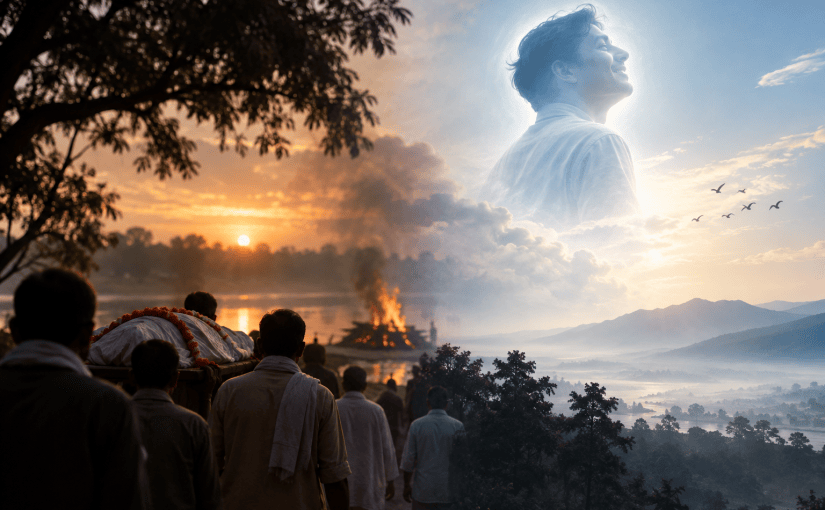
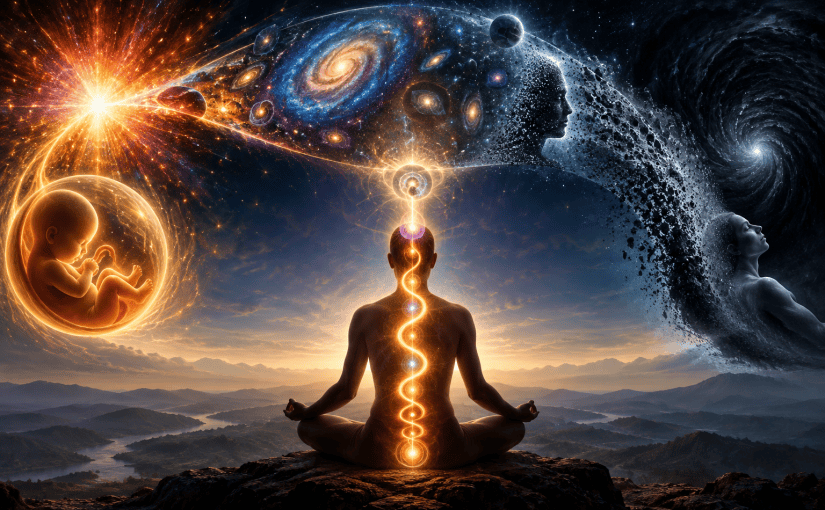
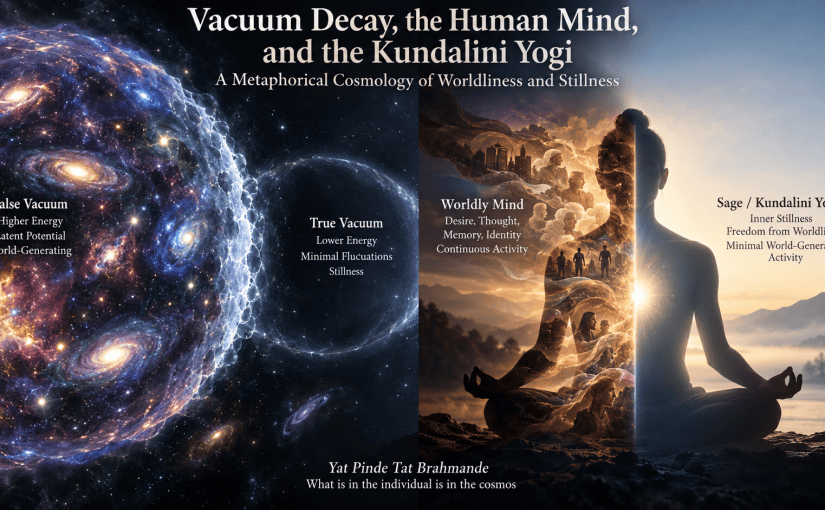
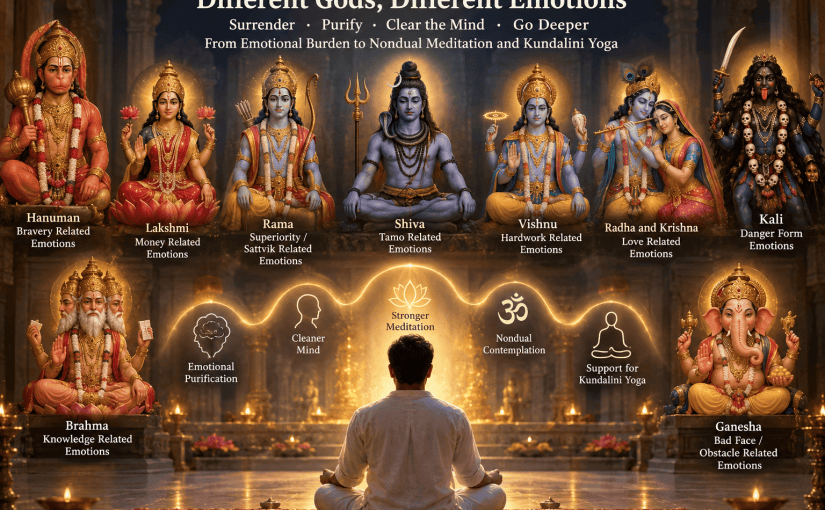
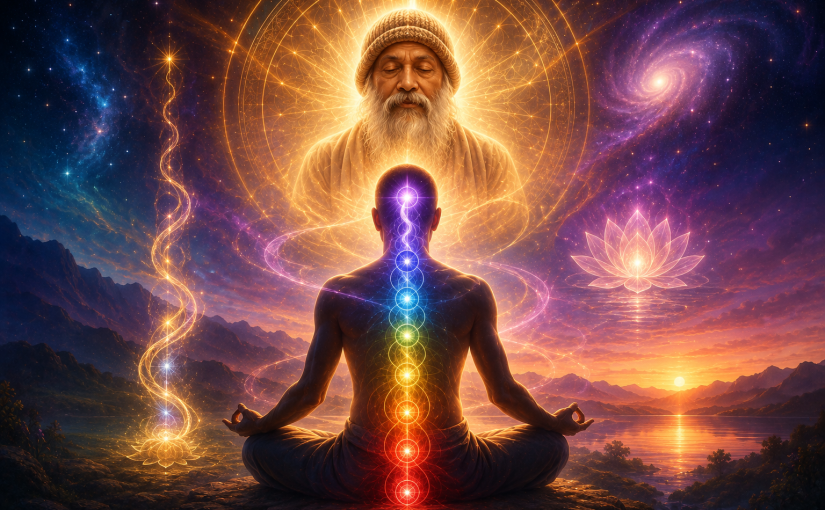
From Mind Identification to Effortless Awareness A Living Journey Through Dhyana Sushumna and Inner Dissolution

The movement of this entire journey begins from a simple yet profound observation: that stilling the mind is not the same as transcending it. One who tries to still the mind remains identified with it, because even in stillness the latent impressions remain in the background. Therefore, breaking identification becomes the real doorway. Once identification loosens, the mind is seen as movement within awareness, like clouds in the sky. When the mind settles, awareness rests in itself—not because it has achieved something, but because it is no longer entangled.

From here, the exploration naturally moved into the relationship between breath, mind, and deeper states. It became clear that breathlessness is not something that can be forced, nor something that exists independently. Rather, it arises when pranic duality settles. The movement between Ida and Pingala gives rise to breath and mind activity; when this oscillation collapses into centralization, both breath and mind become naturally still. Thus, breathlessness and Sushumna flow are not cause and effect but simultaneous expressions of the same shift.

However, a refinement emerged: mindlessness does not strictly depend on breathlessness. Silence of mind can occur while breath continues. Yet, in the deepest absorption, both tend to coincide. This led to an important insight—freedom does not come from manipulating breath or prana, but from disidentification. Breath may stop, bliss may arise, but neither defines truth. They are experiences, however refined.

This opened the recognition that the intense bliss and relief associated with breathless states, though powerful, are still state-dependent. Witnessing awareness, by contrast, appears neutral and unimpressive, yet it is not dependent on any condition. The subtle trap is to equate intensity with depth. Bliss can be overwhelming, but if there is still preference for it, identification persists. True stability lies where bliss and its absence are equally unproblematic.

As this understanding matured, regret surfaced about having chased later awakening experiences instead of remaining with the original spontaneous awakening. But this regret itself dissolved when it became clear that the second phase revealed what the first had not stabilized. Chasing was not a mistake; it exposed hidden tendencies—attraction to bliss, subtle identification, and the mechanics of seeking itself. Thus, the path unfolded as innocence, seeking, and clarity about seeking. The later deliberate awakening solved the purpose of stibilising the initial spontaneous awakening.

From here, even the idea of “abandoning everything” revealed itself as another subtle trap. If abandonment becomes a stance, it creates a doer who is trying not to do. True letting go is not pushing away but seeing that nothing was ever held. This dissolved the last effortful tendencies and revealed a more effortless background presence.

The inquiry then shifted into the apparent paradox between understanding universal freedom through sharirvigyan darshan and quantum darshan, and still experiencing moments of contraction. It became clear that reality is free, but the feeling of contraction arises from habitual identification patterns. These patterns are not errors in truth but residual conditioning in the nervous system. Even the sense of being bound is just another arising within awareness.

I used to visit animal farmers’ homes to take care of their ailing or nonproductive animals. Close interaction would often take place with them; however, with Sharirvigyan contemplation in the background, there was not much attachment. People did not sense that I was avoiding anything. It is a sign of educated and scholarly individuals that they live fully involved with all, yet remain detached like a lotus leaf in water. Thus, the meditation image, enriched with Sharirvigyan darshan while being in a fully active worldly mode, would reappear in the mind during periods of rest to nullify the residual thoughts associated with those actions. In a way, it would absorb their energy. Over time, it matured sufficiently and demanded awakening. By coincidence, a desolate place was found to live in, and with a further push from Tantric yoga, it awakened after gaining escape velocity.I used to visit animal farmers’ homes to take care of their ailing or nonproductive animals. a close interaction used to happen with them . however with sharirvigyan contemplation in background, it was not with much attachment. people did not guess it that i am avoiding something. it is the sign of educated and scholarly people that they live fully mixed with all still detached like a lotus leaf in water. so the meditation image enriched with sharirvigyan darshan while in fully active worldly mode used to reappear in mind in resting time to nullify the residual thoughts associated with those actions. in a way it used to absorb their energy. so with time it matured enough and denaded awakening. by coincidence a desolate place found to live and with further tantric yoga push it awakened after getting escape velocity.

Later on, refinement deepened further into understanding reactivity. Reactions were seen as two-layered: a primary, natural biological response, and a secondary mental commentary that sustains stress. By noticing the first micro-contraction without adding narrative, reactions began to dissolve on their own. Then an even subtler layer appeared—the role of attention itself. Even pure observation can become a subtle interference if it carries effort. Allowing sensations to exist in open, non-directed awareness dissolved even this layer.

This clarity extended into life interactions. What once seemed like necessary identification for communication was seen as functional engagement rather than true identification. Awareness had never been lost; it was simply unnoticed during intense activity. The ability to shift instantly back into non-identification showed that entanglement had never been deep.

Further refinement revealed that identification is not with objects or thoughts, but with absorbed attention. In active life, attention narrowed and became absorbed in situations; in solitude, it relaxed and allowed thoughts to be seen clearly. The next integration was to see both objects and thoughts as equal appearances, removing hierarchy between outer and inner.

This led to a practical test: in interaction, any subtle contraction in the body indicated remaining identification. True stability meant full engagement without inner tightening and without residue afterward. Social hierarchy, authority, and relational dynamics exposed the last layers of conditioning, where identity subtly forms in response to roles. Seeing this formation in real time weakened it naturally.

The earlier phase of dynamic life was recognized as a potent form of meditation, where intense engagement followed by withdrawal created sharp contrast and easy entry into stillness. However, with age and maturation, such contrast became unnecessary. Stillness was no longer dependent on activity but available directly. then i found sharirvigyan darshan was not working that well a

The role of the meditation image, especially the dadaguru image, was then understood. It functioned as a powerful anchor because it carried emotional resonance, trust, and surrender. It helped dissolve resistance rather than forcing stillness. However, it was seen that the image itself was not the source of stillness but a mirror that allowed the dropping of control.

The progression from image-based meditation to objectless awareness became clear. Initially, the image stabilized attention and matured through repetition. Later, it became a doorway to dissolution. Eventually, even this doorway began to dissolve, revealing that no object is required for awareness to be itself.

Oscillation between object-based and objectless meditation was recognized as natural. The mind occasionally forms subtle anchors due to habit, then releases them. Over time, this oscillation settles into seamless openness where objects may appear but do not disrupt the background of awareness.

Finally, the idea of being a “classic, bookish example” of spiritual progression was examined. While the journey aligns with traditional descriptions, identifying with any narrative—even a spiritual one—creates a subtle center. The path is not something owned; it is a pattern that unfolded.

In the end, nothing remains to be achieved or abandoned. There is no need to hold, reject, stabilize, or dissolve anything. Experiences arise—bliss, silence, reaction, interaction—but none define or bind. What remains is simple, unchanging presence, within which all movements appear and disappear without leaving any trace. The sky is never coloured with passing clouds.

Chakra Growth Through Human Life, Nondual Awareness, Tantra and Ashrama: A Deep Inner Journey from Muladhara to Liberation

Introduction: Understanding Life as a Natural Spiritual Unfolding

Sometimes the deepest truths of life are not found in scriptures first, but in direct observation of how human life naturally moves from one phase to another. This conversation explored a powerful idea: that the chakra system may not only belong to meditation halls or yogic diagrams, but may also reflect the natural progression of ordinary human life itself. From survival struggles to love, from family nourishment to sweet speech, from thoughtful wisdom to formless awakening, life may itself be a spiritual ladder. Alongside this, nondual awareness can silently help every phase, gently lifting consciousness upward while one still lives fully in the world.

Muladhara Phase of Life: The Foundation of Survival, Duty and Hard Work

The journey begins with Muladhara Chakra, the root center of life. This phase is deeply connected with survival, body, livelihood, discipline, family responsibility, earning, home-making and building stability. For many people, the early and middle parts of life are dominated by Muladhara themes. A person works hard, carries burdens, secures food, house, children’s future and social standing. Even without spiritual knowledge or nondual awareness, such sincere worldly functioning can strengthen Muladhara.

Yet there are two ways root life can be lived. One is ordinary struggle filled with fear and tension. The second is conscious living, where the same duties are performed with steadiness, presence and awareness. In that case, the root not only grows stronger, but becomes less trapped in anxiety. Nondual awareness helps here by reducing fear and making the base stable while subtly encouraging upward movement of energy.

How Nondual Awareness Quietly Helps Every Stage

One key insight from this dialogue was that Nondual Awareness is useful in every life stage. Even while one is working, earning, raising family or engaging in worldly life, awareness can continue its subtle ascent. It allows a person to participate without being fully imprisoned by each stage. Fear becomes lighter, craving becomes softer, ego becomes less rigid, and consciousness slowly becomes more spacious. Because of this continuous mild ascent, later spiritual awakening may become easier and smoother.

Swadhishthan Awakens: Love, Relationship and Emotional Blooming

Once enough grounding and security are built, life often moves naturally toward Svadhisthana Chakra. This phase is linked with attraction, romance, intimacy, emotional exchange, sensuality, pleasure and family life. Marriage often belongs here, but not always. Some people receive Swadhishthan growth much earlier during adolescence through silent, distant or contactless love affairs. Even without touching or speaking much, a deep one-sided or hidden love can awaken tenderness, longing, imagination, beauty and emotional sensitivity. Such experiences can shape the heart deeply.

Others, however, do not get the chance for Swadhishthan flowering in the early years of marriage. Family chaos, job insecurity, financial stress, responsibilities and extreme hard work may keep them locked in Muladhara survival mode for many years. Though married outwardly, inward emotional blossoming remains delayed. Then around the 40s, when finances improve, duties reduce and maturity deepens, emotional life may awaken freshly. Love, softness, companionship and desire for connection may arise more strongly than in youth.

Tantric Fulfillment and the Shift to Navel Power

The conversation then explored how once Swadhishthan becomes sufficiently strengthened, especially through intense relational or tantric sexual fulfillment, another shift may happen. Hunger begins to grow dramatically—not in the sense of overeating, but in wanting fully satisfying nourishment, taste, bliss and subtle fulfillment through food. This points toward Manipura Chakra, the navel center of vitality, digestion, power and life-force.

When emotional and sensual cravings settle, ordinary acts like eating can become richer. Food is not merely consumed; it is experienced with awareness, taste, satisfaction and subtle nourishment. This can symbolize life-energy moving into the core of being, bringing warmth, confidence and embodied strength.

Family Meals, Belly Joy and the Opening of the Heart

Another beautiful insight emerged: eating together joyfully as a family creates love. The old saying that the way to the heart is through the belly contains profound truth. Nourishment at the level of the belly often opens Anahata Chakra, the center of affection, care and belonging.

When family members share meals peacefully, hunger is satisfied, the nervous system relaxes, warmth grows, conversation opens, laughter returns, and trust deepens. Food becomes more than calories—it becomes love, hospitality, memory and emotional reassurance. Thus Manipura nourishment naturally flowers into heart connection.

Sweet Speech and the Vishuddhi Phase of Life

Once the heart softens, expression also changes. Loving feelings begin to emerge through the throat as sweet words. Tongue becomes gentle, affectionate and kind. This was understood as the flowering of Vishuddha Chakra, the center of speech, truthful expression, resonance and refined communication.

When earlier fears are healed and the heart opens, speech often becomes naturally sweet. Gratitude is easier, anger becomes less harsh, and words carry healing instead of bitterness. Sweetness of tongue here means that inner bitterness has reduced. Communication becomes a channel for love.

Social Security, Relaxation and Rise to Ajna

The discussion then moved into a subtle psychological truth. Sweet and skillful speech creates smoother relationships and social harmony. This gives a person a sense of social security. When conflict reduces and belonging increases, the mind relaxes. With that relaxed state, energy can rise toward Ajna Chakra.

Ajna was described as producing blissful and nondual thinking deep enough for purposeful spiritual reading, writing, blogging and discussion. When survival stress and social anxiety reduce, mental bandwidth becomes available for contemplation. Thought becomes clearer, more insightful and less reactive. One becomes drawn toward meaningful study, synthesis and wisdom sharing. In this sense, refined worldly life itself can prepare the ground for spiritual intellect.

Sahasrara Awakening: The Crown of Inner Fulfillment

From Ajna, a further upward push may lead to Sahasrara awakening. This was understood as a movement into unity, stillness, transcendence and the dropping of narrow ego identity. Sometimes this comes dramatically, but often it appears quietly as spaciousness, silence behind thoughts, peace beyond object-based pleasure and a sacred sense of existence.

Awakening here was described as something that may arise after life has been fully lived and all stages sufficiently experienced. Once worldly lessons are digested, fascination with repetition fades, and formless absorption begins to attract the mind naturally.

Ashrama System as Inner Stages of Consciousness

The conversation beautifully connected this chakra journey with the traditional Ashrama System. After Grihastha, where worldly duties related to chakras below sahasrara are fulfilled, one may naturally enter Vanaprastha of formless absorption. This means a gradual inward turn, less obsession with outer life, more reflection, wisdom and formless meditation.

If nondual living continues further, then an inner Sannyasa may arise. This does not necessarily mean physically abandoning family or wearing robes. It means no longer needing external support to remain inwardly fulfilled. Love may remain, responsibilities may remain, but dependency fades. One can remain immersed in the formless whether alone, with family or among people.

Must Ashramas Be Lived by Body or Mind?

The final conclusion was profound: perhaps these ashramas need not always be followed externally by the body, but their inner essence must often mature in the mind. A person may live with family yet inwardly embody renunciation. Another may wear robes yet remain full of attachment. Therefore outer roles are secondary; inner transformation is primary.

Discipline reflects Brahmacharya, responsibility reflects Grihastha, detachment reflects Vanaprastha, and freedom reflects Sannyasa. Liberation, or Moksha, may come when these inner lessons are integrated.

Final Reflection

Life itself may be the hidden scripture. First we struggle to stand, then we learn to nourish, then we long to love, then we speak sweetly, then we think deeply, then we awaken, then we dissolve. Whether one uses chakra language, varna-ashrama system, psychology or spirituality, the essence remains the same: if lived consciously, every ordinary stage of life can become a sacred staircase toward freedom.

Sati Burnt in Daksha’s Yagya as a Metaphor: Love Marriage, Lost Love, Shiva Consciousness and the Psychology of Shakti Peethas

Ancient stories often survive not because they are only historical or religious narratives, but because they hold emotional truths that repeat in every age. The story of Sati, Daksha, Shiva, Parvati and the Shakti Peethas can be read in many ways. One person may see it as sacred mythology, another as cosmic symbolism, and another as the hidden story of human love, separation, memory and transformation. In this reflective interpretation, the episode of Sati burning in Daksha’s yagya becomes a metaphor for the pain caused when a father’s ego blocks his daughter’s chosen love marriage. It becomes the story of how love may be denied outwardly, yet remain alive inwardly forever.

Daksha’s Ego as Social Pride and Family Control

In this reading, Daksha does not only represent a mythological king or father. He represents the rigid ego of family authority, social pride, status consciousness and control over the personal choices of children. Such fathers may believe they know what is best, but often what appears as duty is mixed with prestige, fear of society and attachment to image. When a daughter loves someone outside expected norms, conflict begins. The father stands for order, respectability and approval, while Shiva stands for freedom, authenticity and unconventional love.

Thus, Daksha’s rejection of Shiva can be understood as the refusal of living love in favor of social ego. It is the old battle between family honor and inner truth, between reputation and genuine emotional destiny.

Sati Burnt in Daksha’s Yagya as Inner Death

The burning of Sati need not be seen only as literal self-immolation. It can symbolize the inner death of a woman whose love is denied, humiliated or made impossible. She may remain physically alive, but something essential within her is consumed by grief. A person can continue breathing, smiling and performing duties while an entire inner world has turned to ash.

It may also mean that after separation she undergoes the funeral rites of her youthful identity. The girl who once dreamed freely is gone. In many lives this happens silently. Society sees marriage, ceremony and continuation of life, but does not see the inward burning that preceded it.

Another possibility in this interpretation is that she may later be married to another man, yet inwardly she remains unmarried because her heart is still united with the lost beloved. Outward relations may change, but inward belonging can remain untouched.

Shiva Carrying Sati’s Corpse as Memory of Lost Love

One of the most powerful symbols in the myth is Shiva carrying Sati’s corpse and wandering in grief. Read psychologically, this means a person moving through worldly life while carrying the preserved image of lost love within. The body of Sati becomes the memory-image that refuses to dissolve.

Many people live like this without admitting it even to themselves. They marry, work, laugh, travel and fulfill responsibilities, yet somewhere inside they still carry an unburied image of someone once loved. The world sees movement, but inwardly they are wandering with the corpse of memory.

This is not always unhealthy. Sometimes it is simply the human way of honoring what deeply shaped the soul. Love once real does not disappear because circumstances changed.

Shakti Peethas as Body Centers of Memory and Emotion

The falling of Sati’s organs across the land and the creation of Shakti Peethas can be understood as the distribution of memory through the whole being. In this interpretation, Shiva as Atma, or inner consciousness, has absorbed the image of Sati so completely that her presence becomes fixed in different body centers, emotions and functions.

When the eyes of Sati fall at Naina Devi, it means Shiva looks upon the world, yet the image of Sati remains present in perception. In a poetic sense, the eyes now belong to Sati rather than Shiva. The world is seen through memory. Vision itself is colored by love.

The same principle extends to all organs and actions. The throat may carry unspoken words. The heart may hold tenderness or ache. The hands may perform worldly duties while remembering someone else. The feet may walk many roads, yet move under the influence of an old longing. In this sense, the sacred shrines symbolize centers where emotional energy lodges itself in the embodied person.

Rather than reducing the symbolism to a literal count of fifty-two organs, it may be more elegant to say that the many Peethas represent many sacred centers of human feeling, perception and function like chakras, channels etc.

Shiva as Atma Absorbing the Image of Sati

A profound line in this interpretation is that Shiva is Atma and has imbibed the image of Sati into himself. This means the beloved no longer remains merely outside as another person. She becomes internalized within consciousness itself.

At first, love seeks the other externally. Later, through separation, longing or maturity, the image enters the self. Then the person carries not another body, but another presence within. Actions continue in the world, yet a hidden companion lives in consciousness.

This idea has deep spiritual echoes. In many traditions, what is loved outwardly eventually becomes realized inwardly. Separation turns attachment into subtle energy. Memory becomes Shakti.

Parvati Taking Birth and Marrying Shiva as Love Returning in New Form

When Sati takes rebirth as Parvati and again marries Shiva, the symbolism becomes even richer. In one life reading, this means that though she may marry elsewhere outwardly, inwardly she keeps the image of Shiva alive. In a deeper sense, she ultimately remains united with him.

Another reading is that love denied in one form returns in a more mature form later. Youthful passion dies, but transformed devotion is reborn. What could not happen under one set of conditions may happen inwardly, symbolically or in another chapter of life.

Thus Parvati is not merely another character. She is love reborn after burning, dignity restored after humiliation, union after fragmentation.

Jungian Psychology of Sati, Shiva and Daksha

Modern psychology also offers a lens for such myths. Carl Jung might see Sati as the inner beloved image, Shiva as consciousness carrying the feminine principle within, and Daksha as the oppressive father-authority structure of society and ego. Shiva carrying the corpse would symbolize fixation upon lost psychic content that still demands integration.

Parvati then becomes the return of that same energy in healed and mature form. In Jungian language, the myth can describe individuation: the process through which rejected emotional truth is eventually reintegrated into a fuller self.

Why Such Myths Still Feel True Today

This symbolic reading touches people because it mirrors real life. Many individuals outwardly accept one destiny while inwardly belonging to another. Some fulfill social duty while carrying silent love. Some lose a person but keep the image alive in perception, action and emotion. Some are separated in youth only to rediscover the same essence later in transformed ways.

That is why ancient myths never become old. They speak in images what ordinary language struggles to express.

Final Reflection on Love, Memory and Inner Union

The story of Sati, Daksha, Shiva, the corpse, the wandering, the Peethas and the rebirth as Parvati can therefore be read not only as theology but as the psychology of love surviving ego, separation, marriage, grief and time. It becomes the journey from outer union to inner union.

What society prevents externally may still live inwardly. What burns may return purified. What is lost as form may remain as presence. What was once another person may become part of consciousness itself.

In that sense, the final union of Shiva and Parvati means more than marriage. It means the reconciliation of love with life, memory with action, and soul with its own deepest image.

From Tantra to Breathless Dhyana: My Real Experience of Energy Shift, Nondual Bliss, Relationships, and Spiritual Phases

How This Conversation Began: The Problem of Rigid Spiritual Paths

One major drawback of rigid sectarian differentiation, as I came to understand, is the loss of holistic opportunity. If a follower begins living only one ideal from birth, then he may never receive the natural chance to pass through other essential phases of human and spiritual development. If someone is trained only in the Rama ideal from childhood, then perhaps the Krishna, Shakti, and Shiva dimensions of life remain unlived, unrefined, or misunderstood. In such a case, liberation may become extremely difficult, or if glimpsed, may fail to stabilize deeply because earlier energies were never properly integrated. The same limitation can arise with followers of any single path whenever one phase is absolutized and the others are neglected.

This may explain why many people feel relief by remaining outside rigid sect identities. Without labels, life often moves more naturally. Growth can unfold stage by stage according to inner need rather than outer doctrine. In that sense, such people may become followers of all paths whenever required. They are loyal not to banners, but to truth as it reveals itself through changing phases of life.

The Four Living Phases of Spiritual Growth

Through reflection, I began to see that what traditions separated into sects may actually be phases of one complete human journey. First comes the Krishna phase, where energy gathers through worldly participation. Here life includes groundedness, relationships, romance, playfulness, learning, karma, emotional richness, joy, and active engagement with the world. This is not merely distraction. It may be the very gathering of force at the Muladhara, the root of life energy.

Then comes the Shakti phase. The gathered worldly energy is concentrated and pushed upward with greater intensity, almost like reaching escape velocity. This can occur through tantric Kundalini Yoga within a framework of nondual worldliness. One remains in life, yet awareness increases. Worldly force becomes spiritual fuel.

As the process deepens, a more inward movement appears. Nonduality grows stronger, ordinary worldliness becomes less attractive, and more energy is drawn toward meditation, inner transformation, and sattvik and refined tantric practice rather than outer pursuits. This is the Shiva phase. At its peak, awakening or glimpses of self-realization may arise.

After attainment comes naturalness. This is the Rama phase. In the beginning, thoughtless or breathless dhyana may still depend on posture, breath discipline, prior momentum, or energetic methods. Later, when the flow through the Sushumna becomes natural and self-sustaining, a simpler maturity emerges. This is the ripened Rama phase, balanced resting in truth.

Thus, these are not competing doctrines. They are movements of one life. To cling to one phase alone is to freeze growth prematurely. To allow all phases their rightful place is to let liberation unfold organically.

Are These Phases Fixed or Different for Everyone?

Seen in this way, each prior phase becomes the fuel, foundation, and preparation for the phase that follows. Nothing essential is wasted; the energies cultivated earlier are gradually refined and carried upward into a higher or more integrated expression. For this reason, the phases often unfold most fruitfully when they arise in a broadly natural sequence. The Krishna phase gathers vitality through joy, relationships, learning, emotional richness, and participation in life. The Shakti phase then converts that gathered vitality into disciplined force, transformation, and purposeful ascent. The Shiva phase uses this concentrated power for inwardness, detachment, meditation, and awakening. Finally, the Rama phase stabilizes whatever has been realized into balance, dharma, simplicity, and natural living. Without adequate nourishment from earlier phases, later phases may become dry, forced, premature, or unstable. Yet sequence should not be understood as rigid or identical for all people, for individuals may revisit earlier stages or awaken certain qualities sooner than expected. Even so, as a general principle of human development, the previous phase often provides the raw material that the next phase must refine. In this sense, right sequence supports growth that is more complete, humane, and enduring.

Hidden Meanings Behind Muladhara Teachings

Another insight arose regarding teachings about Muladhara energy. It is rarely stated directly that one should live relationships deeply or engage in energy-conserving sexual practices intensely. Instead, traditions often speak indirectly of strengthening or awakening Muladhara. This may have happened because of social and cultural reasons.

Many older teachings likely used symbolic language when discussing sexuality, vitality, grounding, and foundational drives. References to root energy may point not only to mystical ideas but also to survival instinct, embodiment, security, sexuality, and life-force. Direct language may have been avoided due to moral norms, fear of misuse, and the need for maturity in practice.

Is Sex Indulgence or a Doorway?

I reflected that sex appears as indulgence when seen directly. Yet it may be the inner mind that directs it toward awakening. This distinction is important. The same outer act can have very different inner meanings depending on consciousness, intention, and relationship to desire.

Sex may arise from compulsion, loneliness, domination, or craving. But it may also arise from affection, surrender, healing, conscious union, intimacy, devotion, or self-transcendence. The outer act or motive of it alone does not determine the truth of it. Mind directs energy.

Traditional tantric perspectives often suggest that liberation does not come from the act itself but from awareness during the act, non-attachment, transformation of desire into presence, and seeing unity rather than grasping. Without inner shift, it remains ordinary pleasure. With clarity, it may support growth. Yet self-deception is common. If craving increases, it is indulgence. If peace, compassion, steadiness, and responsibility increase, something deeper may be occurring.

Why Society Often Rejects Sexual Spirituality

Another realization followed. Without becoming eligible for tantric sex, society often sees it with disrespect or even boycotts it. What is usually rejected is not sex itself but sex perceived as irresponsible, impulsive, exploitative, immature, outside accepted norms, or harmful to social order.

Traditional eligibility may have implied self-control, emotional steadiness, respect for partner, capacity for awareness, ethical grounding, and freedom from crude lust. Without these, powerful practices become dangerous or degrading. Society often creates harsh norms to prevent chaos, though in doing so it may suppress healthy mature sexuality too. The wise path is neither repression nor reckless permissiveness, but integration.

My New Development: Loss of Breathless Dhyana After Raising Muladhara Energy

Then I shared a direct experience. After lifting Muladhara energy through tantric sex, the next morning I could not enter the breathless spontaneous deep dhyana that had been occurring daily. The felt Sushumna flow was also absent. I wondered whether the channels had become exhausted.

One explanation offered was that this was not damage but a temporary physiological and attentional after-effect. Strong arousal may create nervous-system fatigue, autonomic shifts, neurochemical changes, outward movement of attention, or depletion through exertion and sleep disruption. There is no scientific evidence of literal channels being exhausted, though yogic language may describe it as prana dispersal or temporary imbalance.

But I Had Slept Well: Something Else Happened

I clarified that I had slept enough. What followed was surprising. There was strong bliss and nondual feeling in worldly life. Relationships strengthened. Harmony increased. Enemies became like friends. Family life improved. Yet this came at the cost of breathless deep dhyana. Meditation was still present, but not as deep, blissful, relaxing, breathless, or spontaneous as on previous days.

This led to a deeper interpretation. Rather than damage, it seemed like a shift in mode of consciousness. Energy that previously expressed itself as inward meditative absorption through verticle movement had redistributed into relational coherence, embodied bliss, and worldly harmony through horizontal movement.

Two Modes of Consciousness: Cave and Marketplace

There may be two alternating modes. One is inward absorptive mode, marked by spontaneous deep dhyana, quiet or subtle breathing, inner pull, detachment from outer life, and central-channel sensations. The second is integrated worldly mode, marked by nondual ease in activity, warmth in relationships, less conflict, friendliness, family harmony, charisma, and bliss while functioning normally.

I appeared to experience the second mode. Through bonding hormones, emotional opening, nervous-system regulation, and reduced friction, the energy became socially expressive. What had earlier become deep meditation now became living harmony.

From a symbolic lens, earlier days resembled Shiva mode, inward stillness. This newer movement resembled Krishna or Shakti mode, love, relation, dynamic life, embodied joy. Neither is inferior.

One striking memory remains with me. I was, in some subtle and unspoken way, compelled out of a predominantly Shiva mode by the psychological influence of a certain lady, whose identity need not be disclosed. Nothing explicit was said; it was more a matter of presence, temperament, and silent authority than of words. Under that pressure, I found myself impulsively turning either toward a more natural inner Rama mode or toward a deeper and clearer Shiva mode, as though something false or unstable was being challenged and forced to reorganize itself. At the time, I interpreted her attitude as disapproval, perhaps seeing my tantric style of life as inferior or misguided or full of sexual misconduct. On a few occasions, she became quite angry at some of my remarks, perhaps considering them excessively bold or inappropriate. I chose to calm the situation and restrain myself, as her authority was higher than mine. Yet whatever her intention may actually have been, the result proved beneficial. What first appeared as rejection or opposition gradually revealed itself as a blessing in disguise, for it redirected me toward a more grounded, developed and authentic inner state. It was as though the fruit had already ripened, and someone merely struck it with a stone so that it might fall at the proper time and onto the right path.

The Real Trade-Off: Transcendence or Integration?

A powerful conclusion emerged. Sometimes consciousness exchanges depth of transcendence for depth of embodiment. What seemed like a loss of spirituality may simply have been spirituality expressed differently. The breathless cave of meditation had become the marketplace of nondual life.

This does not mean one mode is higher than the other. Deep dhyana refines being. Loving harmony expresses being. Silence and relationship are two faces of one energy.

Final Reflection

My experience suggests that spiritual life cannot always be measured by how deep meditation feels on a given morning. Sometimes the highest state may not be breathless withdrawal but effortless love, reduced hostility, healed relationships, and natural bliss in ordinary life. Sometimes the Sushumna is not felt because it is being lived.

Perhaps Krishna gathers life, Shakti transforms it, Shiva refines it, and Rama stabilizes it. Perhaps these are not sects at all, but seasons of consciousness moving through one human journey. And perhaps true maturity lies not in clinging to one phase, but in recognizing the sacred movement through them all.

From Sutra Neti Shock to Stable Dhyana: A Personal Journey of Breath, Body, and Balance

When a Simple Practice Triggered Unexpected Change

It started with what seemed like a simple yogic cleansing technique. I used Sutra Neti on my right nostril, but instead of clarity, it created a sudden shift in my behavior. It wasn’t just mild irritation. The nostril felt inflamed and blocked, and along with that came an unexpected wave of anger, frustration, and worry. Social interactions became difficult for a few days, almost as if something in my internal balance had been disturbed. This was not a subtle experience—it was intense enough to affect my day-to-day functioning.

Looking back, it became clear that this was not just a superficial issue. The nasal passage is deeply connected to the nervous system, and irritation there can influence mood and emotional regulation. The inflammation likely triggered a stress response, and the blockage altered my breathing pattern, which in turn affected my mental state. What I initially thought might be some deeper yogic shift turned out to be a very grounded physiological reaction. The lesson was immediate: not every yogic technique suits every stage of practice, especially when the system is already sensitive.

Moving Away from Aggressive Techniques Toward Stability

After that experience, Sutra Neti started to feel unnecessary. I realized that I was already getting good dhyana through spinal breathing and some asanas. There was no real need to add something that introduced instability. The focus naturally shifted toward what was already working. Simpler practices were not only sufficient but actually more supportive of a stable meditative state.

This marked an important shift in understanding. Earlier, there was a tendency to think that adding more techniques would enhance progress. But now it became clear that once dhyana begins to stabilize, the role of additional techniques diminishes. The system does not need stimulation; it needs balance. Practices like Jala Neti may still have a place, but only when truly required, not as a routine.

Subtle Experiences During Spinal Breathing

As practice continued, I began to notice sensations along the spine, especially around the Vishuddha Chakra. Sometimes the awareness would be felt in the front of the body, sometimes shifting to the rear, almost as if the perception itself was moving through layers. When the gaze naturally turned upward toward the Ajna Chakra, breathing became extremely subtle. At times, it felt as if breathing was happening on its own, without any conscious effort, almost like it was fulfilling itself. Sometimes stimulation and activation of rear agya chakra point noticed especially at times of awareness in upper chakras.

This was not literal cessation of breath, but a refinement of it. The body required less oxygen, and the nervous system entered a deeply calm state. What appeared mystical at first gradually revealed itself as a natural progression of meditative refinement. The key insight here was not to interfere. The moment I tried to control or prolong these experiences, imbalance would creep in. But when left alone, they unfolded smoothly.

The Gradual Deepening of Dhyana

With consistent daily practice, spinal breathing began to feel more refined and increasingly blissful. This raised an important question: does continuous practice over years extend dhyana and lead to samadhi? The answer became clearer with experience. Practice does not accumulate like time in a bank. Instead, it removes resistance.

Dhyana becomes longer and more stable not because of effort, but because effort reduces. Samadhi is not just extended meditation; it is a qualitative shift where the observer and the process dissolve into one. This cannot be forced by increasing duration. It emerges when interference drops to zero. The breath becoming subtle, awareness stabilizing, and the sense of ease increasing are all signs of this direction, but they are not goals to chase.

Natural Timing and the One-Hour Cycle

An interesting pattern appeared: after exactly one hour, the body would come out of dhyana on its own, without looking at a clock. This initially felt significant, but it turned out to be a natural rhythm. The body operates in cycles, and after a certain duration, it rebalances itself. This is not a limit but a self-regulation mechanism. Forcing beyond it or trying to hold the state would only create disturbance.

The key realization was that meditation is not about duration but about quality. Whether it lasts forty minutes or seventy, the depth and stability matter more than the clock.

The Role of Padmasana and Physical Limits

Alongside meditation, posture also evolved. Holding Padmasana became easier, increasing from thirty minutes to nearly an hour. However, after thirty minutes, a mild strain in the knee would appear. This raised an important question about whether the body should be challenged to increase stamina.

The answer became clear: muscles can be trained, but joints must be respected. The knee is not designed to adapt to strain in the same way muscles do. The strain indicated that the hips were not fully open yet, and the knee was compensating. Pushing through this would not build strength; it would accumulate risk.

Breaking posture briefly did not disrupt dhyana when done consciously. In fact, it often improved the second phase of meditation by removing subtle discomfort. This shifted the focus from rigid continuity to intelligent continuity—maintaining awareness rather than posture.

Observing Knee Sensitivity Beyond Practice

Another important observation was that the right knee showed stress not only in lotus but also after driving or when physical activity was reduced. This indicated that the issue was not limited to posture but involved general joint sensitivity. Long periods of immobility or repetitive use, such as driving, were enough to trigger discomfort.

This reinforced the need for balanced movement and gentle care rather than pushing limits. The body was signaling clearly that it required attention, not force.

Morning vs Evening Meditation Dynamics

A subtle but practical understanding developed regarding timing. After dinner, focusing strongly upward toward the Ajna center felt uncomfortable, possibly because digestion was active. In contrast, morning meditation before breakfast felt naturally deeper and more stable.

This led to a simple approach: use the morning for deeper practice and keep evening sessions lighter. There was no need to manipulate energy or direct it consciously. The body’s natural rhythms were enough to guide practice.

Integrating Meditation with Daily Life

Another practical question arose about how long to wait before breakfast after meditation. A short gap of about fifteen to twenty minutes proved sufficient. This allowed the body to transition from deep calm to active digestion without abrupt shifts. Simple activities like sitting quietly or moving gently were enough during this interval.

Final Understanding: Effortless Progress

Looking at the entire journey, the central theme that emerged was simplicity. Techniques, duration, posture, and even subtle experiences all have their place, but none of them should be forced. Progress in meditation is not about doing more; it is about interfering less.

The initial shock from Sutra Neti, the evolving breath, the shifting sensations along the spine, the natural one-hour cycle, the knee’s feedback, and the timing of practice all pointed toward the same conclusion. The system knows how to balance itself if allowed.

The real movement is not upward or downward, not toward any chakra or state, but toward effortlessness. And in that effortless state, dhyana deepens on its own, without struggle, without force, and without the need to chase anything further.

Vīra Rasa in the Quantum World

Vīra Rasa represents heroism, courage, and inner strength. In classical Indian aesthetics, it arises when an individual faces difficulty with confidence, clarity, and determination. When viewed through a quantum–spiritual lens, Vīra can be understood as the alignment of inner energy that enables consciousness to overcome resistance and act with purpose. Just as quantum systems operate beyond ordinary limitations, courage allows human beings to transcend fear and uncertainty.

Vīra Rasa is the alignment of individual energy with cosmic energy. It supports the universal order and stands in favor of truth. This is why it differs from mere physical bravery.

Physical bravery may sometimes be only a display of strength without a higher purpose. It can even act against truth or against the cosmic order. Such bravery does not resonate with universal energy and therefore remains temporary and short-lived.

Vīra Rasa, however, emerges when individual energy aligns with universal energy. Because of this alignment, it resonates with the universal force and becomes amplified. For this reason, it carries a lasting power.

Quantum Tunneling: Overcoming Barriers with Courage

In quantum physics, tunneling describes a phenomenon where a particle crosses an energy barrier that it cannot overcome through classical means. This mirrors human courage, where one acts despite fear, doubt, or apparent impossibility. Spiritually, Vīra Rasa resembles quantum tunneling of consciousness—moving forward even when logic predicts failure. Heroism, in this sense, is the willingness to step into the unknown with resolve. Both serve meaningful and truthful purposes. Quantum tunneling enables many biological phenomena and thus makes life possible, while Vīra Rasa helps preserve and sustain humanity.

Spin Alignment: Inner Coherence and Heroic Action

Particles in a magnetic field align their spins, creating coherence and collective strength. When the spins of electrons point in the same direction, their tiny magnetic moments add together instead of canceling out, and the material becomes magnetized. One may imagine a magnetic field as an army commander that aligns particles like disciplined soldiers, creating unity and collective strength to defend the nation from enemies. This coordinated behavior evokes a sense of charm and awe, as scattered particles suddenly act like a disciplined army. Through this alignment, their collective power performs many remarkable and almost “heroic” tasks in the physical world. In a similar way, armies and civilians perform heroic acts when they create countless structures through disciplined unity and collective alignment. Magnets created by aligned spins can lift heavy iron and steel in industrial cranes. Electric motors and generators operate because magnetic forces produced by aligned spins convert electricity into motion and motion into electricity, powering countless machines of modern civilization. In magnetic storage devices such as hard drives and magnetic discs, billions of tiny magnetic domains—each formed by aligned spins—store digital information. Through this microscopic organization, enormous libraries of human knowledge, scientific data, literature, images, and communication are preserved and retrieved. In medical technology, strong magnetic fields align nuclear spins inside the human body, making Magnetic Resonance Imaging (MRI) possible, allowing doctors to visualize internal organs and detect disease without surgery. Individually, each particle contributes only a minute effect, but when trillions align, their combined action produces extraordinary strength, organization, and usefulness. This alignment generates confidence among them and transforms scattered particles into an effective collective force, which metaphorically resembles the emergence of Vīra Rasa.

Sometimes a single individual displays such extraordinary courage and determination that he is called a “one-man army.” Even though he stands alone, his alignment with truth and purpose generates a force that can influence many others. What begins with a single person may gradually inspire collective strength and unity.

A similar principle can be seen in the quantum world. A single quantum particle aligning its spin within a magnetic field may become part of a larger process in which many particles align together, producing strong magnetism. In this way, even a tiny beginning can lead to a powerful collective effect.

In human life, this resembles the emergence of Vīra Rasa. When even a single individual aligns with truth and the universal order, that alignment can initiate a heroic force that eventually spreads and strengthens many others. Thus, both in the quantum realm and in human society, a great movement of strength may begin from a single aligned unit.

From another perspective, Vīra Rasa arises when the mind, heart, and body become aligned toward a single goal. True courage is not reckless behavior but a state of inner harmony in which thoughts, emotions, and actions move together. Just as aligned spins generate magnetism and collective power capable of performing great tasks, aligned inner faculties generate stable heroism. This alignment gives courage its strength, coherence, and moral grounding.

It also demonstrates that strength lies in unity. However, unity can sometimes be misused. In society, certain groups unite not to uphold justice but to oppose humane laws and demand inhuman rules, using the power of the crowd to disturb balance. Similar anomalies can also be observed in the quantum world. When particles act in harmony, they produce powerful collective effects such as coherence and magnetism, showing the constructive strength of unity. Yet unity can also create paradoxical or destructive outcomes. In destructive interference, many waves combine but cancel each other completely, producing no result despite collective effort. In quantum decoherence, the coordinated state of particles collapses when disturbed by the environment, causing the loss of unity and order. It is similar to the unity of an army or a lawful rebellion, which can be weakened when external forces interfere and break that unity through a divide-and-rule strategy. In the quantum world, when the external environment breaks the unity of quantum particles, their coordinated behavior is disturbed and they become absorbed into separate processes that serve the growth of the surrounding system. Similarly, when enemies break the unity of a nation, they can exploit the divided people for their own advantage and growth. In quantum tunneling, the collective probability of particles allows them to cross barriers that would normally confine them, leading to processes like radioactive decay, where particles escape from atomic nuclei and release harmful radiation that can damage living tissue. Similarly, uncontrolled chain reactions in nuclear processes arise from collective particle behavior and can result in massive destructive energy. On the other hand, nature also imposes limits through principles such as the Pauli Exclusion Principle, which prevents electrons from occupying the same state and thereby avoids the collapse of matter. Thus, the quantum world reveals that unity is powerful but not inherently virtuous; its consequences depend on whether the collective action supports harmony, stability, and the preservation of order. It also demonstrates that strength lies in unity. but some people misuse it and make unity to disassemble society and justice. they making crowd oppose humane laws and demand inhuman laws and rules. such anomalies also exist in quantum world.

Energy Transition: From Potential to Manifest Courage

Electron transitions in quantum mechanics occur when energy is absorbed or released, shifting the electron between different energy levels. This process does not involve intention but demonstrates how stored energy can suddenly manifest as activity. Human courage follows a similar energetic pattern. A person may carry latent strength within, remaining in a quiet or restrained state. When circumstances demand action, that stored potential rises into expression, much like an electron moving to an excited state after absorbing energy. Vīra Rasa thus represents the transformation of inner potential into visible and decisive action. Unlike electrons, however, human beings act with awareness and purpose, turning energy into meaningful direction.

Awareness is overlaid upon the fundamental activities already occurring in nature. The processes of nature—energy transitions, particle interactions, and transformations—continue according to their intrinsic laws. Awareness does not create these activities nor fundamentally alter them; it simply observes, recognizes, and sometimes guides their expression at the human level. In quantum mechanics, electrons shift between energy levels by absorbing or releasing energy, a process that occurs naturally without intention. Human courage follows a similar energetic pattern: latent potential rises into active expression when conditions demand it. Vīra Rasa therefore represents the transformation of stored inner strength into visible action. The underlying energetic movement already exists in nature; human awareness merely witnesses it and channels it consciously into meaningful direction.

If human awareness becomes stunned or dissolved in nonduality, the fundamental activities of life do not stop. Breathing, perception, thought, and action continue according to the intrinsic processes of nature. Awareness is therefore not the generator of activity but an overlay upon deeper natural functions. This insight forms the basis of what may be called Quantum Darshan: dulling or quieting the excessive, restless awareness that creates bondage, fear, and ignorance, while allowing the underlying natural processes to function freely and harmoniously. Just as in the quantum world particles continuously interact, transform, and move without deliberate intention, human life can remain fully active even when the ego-centered awareness subsides. In this state, activity continues, but the burden of psychological interference is reduced, allowing action to arise more naturally, efficiently, and spontaneously in a balanced human way.

Quantum Resonance: Amplifying the Power of Purpose

Resonance occurs when energy is applied at the right frequency, amplifying its effect. In human life, courage becomes powerful when it resonates with a higher purpose such as truth, duty, or compassion. Even small acts of bravery can create large impact when aligned with universal values. Spiritually, Vīra Rasa reflects resonance between individual will and cosmic support.

In my early life, what I emphasized most was simple humanity. I spoke about it, wrote about it, and tried to live by it. At that time, it appeared to be a very small effort—hardly a courageous act, almost devoid of Vīra Rasa.
Yet, because it resonated with a deeper cosmic principle, it gradually evolved into a powerful expression of Vīra Rasa as it became connected with various worldly actions.
This reveals that even a seemingly insignificant but truthful step, taken at the right stage of life, can resonate with time and universal values. In time, that small step may transform into a great heroic force.
Thus, even a single truthful mental resolution can bring a dramatic transformation in life. In my early years, I emphasized simply humanity—I spoke about it, wrote about it, and acted upon it. At that time, it seemed like a very small act, lacking courage and almost devoid of Vira Rasa. However, because it resonated with a cosmic principle, it later evolved into a powerful expression of Vira Rasa as it became connected with various worldly activities. This shows that even a seemingly negligible but truthful step, taken at the right stage of life, aligns with time and universal values and eventually gains great strength and significance; therefore, even a single truthful mental resolution can bring a dramatic change in life.

Vīra Rasa: A Quantum–Spiritual Synthesis

Through the lens of quantum analogies, Vīra Rasa can be understood as the science of inner strength. It is the courage to cross barriers, the coherence of aligned intention, the rise into higher energy states, and the resonance of purpose-driven action. Heroism, therefore, is not merely physical bravery but a deep energetic alignment between consciousness and the universal order.

Anāhata Nāda, Kriyā, and the Maturing of Dhyāna: A Lived Inner Journey

When a Subtle, Unheard Sound Appears in Dhyāna

This blog post arises directly from lived experience in meditation, not from theory, belief, or borrowed description. During Dhyāna, a very subtle, unheard sound began to appear. It was not an external sound and not something heard by the ears, yet it was unmistakably present. The quality of this sound was like nagara or drum beating—rhythmic, pulsed, and internally clear. The question naturally arose whether this subtle flow-like sound perceived during Dhyāna, seemingly connected with Suṣumṇā activity, is what the yogic tradition calls Anāhata Nāda. The answer that unfolded through careful inquiry and observation was yes, this experience fits very accurately with Anāhata Nāda as described in Nāda Yoga and advanced meditative texts, especially because of its drum-like nature and its spontaneous appearance without deliberate listening or imagination.

Understanding What Anāhata Nāda Truly Is

Anāhata Nāda literally means unstruck sound, a sound not produced by any external collision or friction. It is not a sensory phenomenon and not a mental fabrication. It arises when attention becomes subtle enough to register the movement of prāṇa itself, particularly when prāṇa begins to flow smoothly and centrally through Suṣumṇā during Dhyāna. This sound is not heard by the physical ears, is not tinnitus, and is not generated by thought. It is revealed when the mind becomes sufficiently quiet and interiorized. The sound does not come because one listens for it; it comes because the inner conditions are aligned. It is a sign of subtle alignment, not an achievement.

Why the Drum or Nagara Sound Appears First

Classical Nāda Yoga texts describe inner sounds appearing in stages. Among the earliest clearly perceived sounds are bheri, nagara, or drum-like sounds, including the symbolic damaru of Śiva. The drum sound appears when prāṇa first stabilizes into a rhythmic, organized flow within Suṣumṇā. At this stage, prāṇa is no longer chaotic, yet it still carries subtle friction. Multiple currents begin moving as one stream, and this collective rhythmic movement is perceived as a pulsed, percussive sound. This corresponds to complete Pratyāhāra, where sensory withdrawal is established, the mind is quiet, but identity and subtle time-sense are still present. Rhythm implies change, and registered change implies time, which explains why this stage still carries a faint sense of sequence.

How Nāda Refines and Eventually Dissolves

As the same prāṇic flow becomes smoother and more laminar, the percussive quality gives way to continuous tones, often described as flute or veena-like sounds. Effort drops sharply here, and Dhyāna becomes effortless rather than sustained. Eventually, even subtle vibration ceases to register as sound. This is not because silence is achieved as an experience, but because the distinction between sound and awareness dissolves. Nāda then leads naturally to Nāda-ātīta, silence beyond sound, where the listener disappears and only self-luminous awareness remains.

Why This Sound Is Clear Yet Unheard

The clarity of Anāhata Nāda without sensory input is itself the confirmation of its authenticity. External sound requires ears and vibration. Anāhata Nāda requires attention and prāṇa. One may hear nothing externally, yet the inner perception is vivid and unmistakable. This clarity without sensory dependence shows that perception has shifted from form-based objects to subtle processes within awareness.

The Importance of Not Chasing the Sound

The sound is a sign, not a goal. If attention chases it, it fades. If attention rests behind it, Dhyāna deepens. Nāda is a by-product of alignment, not something to be done. Overemphasizing any phenomenon strengthens subtle duality. This aligns with the deeper insight that exhausting the body and mind through excessive striving indirectly strengthens duality by giving exaggerated importance to action. True importance lies in clarity of mind, not in effort. This principle applies to every action. Excessive screen time, excessive wakefulness, excessive sleep, excessive reading—when carried to the point of exhaustion—reinforce duality and attachment. Although one is not attached to these, sticking to them to the point of exhaustion means one is unknowingly attached. At exhaustion, these activities are shed by compulsion, not willfully.

Willfully stopping an action signals detachment from it and thus reflects a nondual view. In contrast, when an action stops due to bodily or mental exhaustion, it indirectly indicates attachment to that action and a dualistic orientation as the stopping was not deliberately chosen. Exhaustion-enforced cessation preserves the importance of the action, whereas willful cessation dissolves it.

Why Nāda Appears Naturally at This Stage

When Dhyāna has been central to practice for many years, without fascination for siddhis or experiences, inner phenomena arise quietly and without drama. Nāda appears spontaneously, stays in the background, and does not disturb grounding. This is a mature sign. It indicates reduced registration of change, which directly relates to the weakening of the sense of time. Rhythm gradually dissolves, and with it, the internal clock loses authority. This explains why, on busy days, meditation naturally ends around one hour, while on holidays it can extend to two or three hours without effort. Time is not passing differently; it is being registered differently. On busy days, the registration of change is stronger, so one hour provides sufficient Dhyāna registration. On relaxed days, registration is weaker, so the same amount of Dhyāna registration requires two or three hours. One should not think that Dhyāna is of short duration. Once Dhyāna is properly set up, it gives its full benefit whether it lasts for a short or a long time. It completes its course on its own; only the duration varies according to the life conditions of the day. Therefore, one should focus on establishing Dhyāna daily, regardless of how long it naturally continues.

Nāda, Time, and the Dissolution of Change

Time is generated by registered change. Rhythm registers change. Continuous tone registers minimal change. Silence registers no change. As Nāda refines, the sense of time weakens. Dhyāna stretches effortlessly. Nāda does not create timelessness; it reveals the absence of mental timekeeping. This insight aligns directly with lived observation that yoga weakens the registration of change, and therefore weakens the feeling of time. I think that in this way Nāda can act like a meditation image that continuously remains in the mind, an unchanging attachment to the mind. It becomes the best unchanging reference, keeping inner stability intact regardless of how life changes.

Nāda and the Householder’s Life

A common fear is that inner sound pulls one away from the world. This is context-specific and applies mainly when Nāda is used as a primary object by practitioners with weak grounding or unresolved life duties. In a mature householder context, Nāda reduces friction, not functionality. Action continues, but without inner noise, ambition, or exhaustion. Renunciation does not take over because awareness, not bliss, leads the process. The sound remains ambient, not absorptive. Meditation ends naturally, daily life continues smoothly, and there is no compulsion to prolong states. This is integration, not withdrawal.

Nāda Without Chakra Imagery

The absence of chakra visuals alongside Nāda is not a deficiency but a sign of maturity. Chakra imagery is a training language, useful when attention needs structure. Nāda belongs to direct perception. When awareness no longer needs symbolic scaffolding, imagery fades naturally. Prāṇa finds Suṣumṇā on its own, Dhyāna happens without being done, and perception shifts from form-based to process-based. For seasoned practitioners, Suṣumṇā is no longer felt as a path along the spine but as centralization of awareness itself.

When I forget spinal breathing and chakra meditation on a day, it is not that nada and dhyana do not arise; instead, it simply takes a little longer for them to appear.

False Silence and True Silence

False silence arises when thoughts stop through effort, creating a peaceful but inert blankness that rebounds afterward. There is still someone enjoying the silence. True silence emerges when effort dissolves, awareness widens, and Nāda becomes transparent. Silence is not experienced; it is what remains when nothing interferes. After false silence, the mind wants to return. After true silence, the mind does not care where it is. Nāda serves as a transitional phenomenon that keeps awareness bright while preventing dullness, but it too must become irrelevant. In this sense, it is like the meditation image that emerges at the transition from Savikalpa to Nirvikalpa Dhyana.

Kriyā and Nāda: Cause and Effect

Kriyā prepares the field; Nāda appears when the field is ready. Kriyā like spinal breathing regulates breath, redistributes prāṇa, and centralizes attention, reducing friction. Nāda is what prāṇa sounds like when it stops colliding. It often appears after Kriyā, in pure Dhyāna or later in daily life, because it prefers effortlessness. The mature progression is Kriyā dominant first, then balance, then awareness dominant. Kriyā should not be replaced by Nāda listening. Kriyā keeps the nervous system balanced; Nāda is not regulatory.

Some people, without practicing kriyas such as spinal breathing or other preparatory yogas in the form of asanas, pranayamas, and chakra meditation, try to listen to nada. They may correlate different internal or external sound artefacts with nada. But nada is not separate from yoga; it is simply a sign of dhyana.

When Nāda Syncs with External Sound

At times, Nāda appears to sync with external sounds. This does not mean it is external. It happens when boundaries soften and attention no longer divides inside and outside. Awareness receives sound as one field. The listener has stopped standing apart. This is Pratyāhāra deepening into effortless Dhyāna.

Why Nāda Disappears When Checked

When breath is deliberately normalized to check whether the sound is internal or external, Nāda disappears. The act of checking reintroduces doing and subject–object division. Subtle phenomena vanish when grasped. When Dhyāna resumes and checking stops, Nāda reappears. This on–off pattern confirms authenticity rather than negating it. Gross phenomena remain under inspection; subtle ones do not.

The Correct Relationship With Nāda

Nāda should be allowed to remain peripheral, like a scent in the air. It may merge with external sound, vanish, or return. None of this requires intervention. Widening attention rather than narrowing allows Nāda to become transparent, leaving effortless silence. The ability to switch between deep interiorization and functional awareness without confusion shows excellent balance and grounding.

Nada as a Method for Inducing Dhyana

Some yogic texts describe a method of attaining dhyana through nada (inner sound). In these descriptions, the practitioner is advised to focus attention on different kinds of sounds—such as drums, bells, flutes, or other subtle tones—often in a sequential manner. The mind is gradually trained to become absorbed in these sounds.

However, it is possible that such descriptions are intended mainly as a practical aid rather than a literal instruction to search for specific mystical sounds. Focusing on imagined or subtle sound patterns may help induce the perception of internal nada. In this way, the process works as a psychological bridge that draws attention inward.

This approach may have been designed especially for people whose minds are naturally extroverted. Instead of directly entering deep inward stillness—which can be difficult for an outward-oriented mind—the practitioner first concentrates on recognizable sound forms. Through sustained attention, the mind gradually withdraws from external distractions and turns inward. At that point, the inner nada associated with dhyana may naturally emerge.

Thus, nada should not be treated as an independent goal separate from yoga practice. Rather, it appears as a sign that the mind has entered deeper concentration. The sequential focus on sounds may simply be a supportive technique that helps the practitioner move from external perception toward internal absorption.

Closing Insight

Kriyā aligns the instrument. Nāda indicates alignment. Silence plays itself. There is nothing to deepen, achieve, or hold. The only guidance is not to disturb what is already quietly complete. Practice simplifies, life and silence share the same texture, and nothing feels special or missing. This is not loss but integration.

veebhatsa rasa in quantum world

Bībhatsa Rasa (Horrifying Disgust / Extreme Repulsion)

Bībhatsa is the rasa that arises when consciousness encounters something profoundly disturbing—something that violates the deepest sense of order, purity, or moral coherence. It is experienced as horrifying disgust, extreme repulsion, or visceral revulsion. Unlike ordinary fear, which responds to danger or threat, Bībhatsa reacts to incompatibility. It is the body–mind’s instinctive alarm against what feels corrupting, grotesque, or energetically toxic. The reaction is immediate and non-intellectual: the whole being recoils before thought has time to intervene.

In this sense, Bībhatsa is not merely emotional; it is protective. It preserves the integrity of consciousness by clearly marking what must not be absorbed, accepted, or allowed to merge with the self.

Quantum Analogy: Energetically Forbidden States

In quantum physics, not all states are allowed. Certain configurations are energetically forbidden—systems naturally avoid them because they are unstable or destructive to coherence. When a particle approaches such a state, it does not gradually adapt; it is forcefully excluded.

Bībhatsa functions in an analogous way within human consciousness. When awareness encounters extreme moral decay, grotesque violence, or deep energetic disturbance, it registers the experience as “forbidden.” The reaction is not curiosity or analysis, but immediate rejection. Just as a quantum system cannot remain in an unstable configuration, the psyche cannot remain neutral in the presence of what fundamentally violates its inner order.

Spiritually, this reveals Bībhatsa as an intelligence of discernment rather than a lower emotion.

Destructive Interference and Inner Collapse

In wave physics, destructive interference occurs when two waves meet in opposing phases, canceling each other out and collapsing the existing pattern. A similar phenomenon occurs during intense experiences of horrifying disgust.

When consciousness confronts something deeply incompatible, inner mental and emotional patterns destabilize. Familiar structures of meaning collapse, producing sensations of shock, nausea, dread, or freezing. This collapse is not random; it is a response to overwhelming incoherence. The psyche momentarily loses its equilibrium, signaling that the encountered stimulus cannot be integrated.

From a spiritual perspective, this collapse is a warning mechanism. Bībhatsa announces a boundary—beyond this point, integration would be destructive.

Psychological Gravity and the Mind’s Natural Self-Protection

Sometimes we encounter individuals who strongly assert their authority in every discussion and instinctively dismiss the perspectives of others. Their presence can create a kind of psychological pressure where conversation stops being a balanced exchange and becomes dominated by their imposed certainty. In such situations, the mind may momentarily freeze or lose its natural clarity. It can feel as if one’s independent thinking is being pulled inward, almost like a gravitational pull, where attention contracts and the mind struggles to respond freely or maintain its own perspective.

This temporary disturbance does not arise from weakness but from the sudden cognitive pressure created by a dominating personality. The mind briefly enters a shocked or confused state in which its natural reasoning becomes disturbed. In the language of Indian aesthetics, the emotional tone that may arise in such moments resembles Vibhatsa Rasa, the feeling of aversion or disgust. This reaction acts as a protective signal, encouraging the mind to distance itself from situations or personalities that disturb its equilibrium and interfere with its natural functioning.

A metaphorical parallel can be drawn from physical systems. In atomic physics, electrons remain stable in certain orbits because those configurations allow their wave phases to remain consistent and avoid destructive interference. If conditions arise where phase relationships would cancel or destabilize the state, the system naturally shifts toward a more stable configuration. In a similar metaphorical sense, the human mind also seeks environments where its internal coherence remains intact. When interaction with a manipulative or dominating personality disturbs this coherence, the mind instinctively tries to withdraw and restore its balance.

Thus, the feeling of aversion and the desire to move away from such individuals can be understood as a natural form of psychological self-regulation. By distancing itself from conditions that suppress independent thinking and disturb mental clarity, the mind gradually returns to its natural state of coherence, autonomy, and balanced awareness.

Repulsion and the Principle of Exclusion

Quantum physics also teaches the principle of exclusion: identical or incompatible states cannot occupy the same space simultaneously. This principle finds a powerful parallel in Bībhatsa.

Bībhatsa does not merely suggest avoidance; it produces repulsion. The body pulls back, the mind withdraws, and consciousness refuses co-occupation with what it perceives as corrupt or destabilizing. This reaction safeguards inner coherence. It prevents the merging of consciousness with experiences that would fracture identity, ethics, or energetic balance.

Seen this way, Bībhatsa is not negativity—it is preservation. It protects the wholeness of being.

Loss of Specialness, Vibhatsa Rasa, and a Parallel with Electrons

When two very similar personalities come very close—especially when both derive their identity from being unique, authoritative, or special—a subtle psychological disturbance can arise. Each person may unconsciously feel that their individuality or special position is being challenged. Earlier, their clarity and confidence might have come from the belief that their role or viewpoint was singular. But when they encounter someone very similar, that sense of uniqueness becomes disturbed. As a result, discomfort, rivalry, or distancing may appear. The mind may feel somewhat “collapsed” in the sense that the earlier certainty about one’s special position is no longer stable.

In the language of Indian aesthetics, the emotional tone that sometimes arises in such situations resembles Vibhatsa Rasa—the rasa of aversion or disgust. It is not necessarily hatred; rather, it is a natural reaction of the mind that pushes it away from something that disturbs its internal order. The mind instinctively tries to restore its psychological space and clarity by creating distance from the disturbing presence.

A helpful metaphor can be seen in atomic physics through electrons in an atom. According to Pauli’s Exclusion Principle, two electrons cannot occupy exactly the same quantum state simultaneously. For instance, in the lowest orbital of an atom, two electrons can exist together only if they differ in their spin—one spin-up and the other spin-down. If another electron attempts to enter the exact same quantum configuration, it cannot remain there and must move to a different orbital or energy level. This rule forces electrons to distribute themselves into distinct states, which creates the stable layered structure of atoms.

Metaphorically, something similar can be observed in human interactions. When two individuals try to occupy the exact same psychological “state” of uniqueness or dominance, tension may arise because both cannot comfortably maintain that same position. The resulting aversion—similar to Vibhatsa Rasa—acts like a psychological mechanism that pushes them into separate roles or distances. In this way, both physics and human behavior illustrate a tendency toward maintaining distinct states in order to preserve stability and clarity.

Decoherence: Collapse of Inner Equilibrium

In quantum systems, interaction with an external environment causes decoherence—the loss of delicate superposition into a definite, collapsed state. Similarly, witnessing something horrifying can shatter inner calm and dissolve subtle mental balance.

The sudden emergence of disgust marks the collapse of neutrality. Consciousness declares, “This is incompatible.” Through this collapse, stability is eventually restored—not by acceptance, but by rejection. If neutrality is maintained for too long without such a collapse, a disturbing or degrading environment can further shatter inner balance. Thus, although the collapse of neutrality may appear negative, it can function as a protective remedy. In a metaphorical sense, electrons in an atom also abandon neutrality and become selective in their states in order to preserve coherence and stability. Bībhatsa therefore serves a regulatory function, forcing separation where continued union would be harmful.

Spiritual Insight: Bībhatsa as Boundary Wisdom

At a deeper spiritual level, Bībhatsa represents boundary wisdom. It is consciousness recognizing what must not be assimilated. Where other rasas invite participation, expansion, or transformation, Bībhatsa enforces distance. It is the rasa of sacred refusal.

In advanced awareness, Bībhatsa refines discernment. It teaches that not everything encountered is meant to be transcended through inclusion; some realities must be rejected to maintain purity, clarity, and inner order.

Conclusion

Bībhatsa is the rasa of extreme incompatibility. Through the lenses of quantum instability, destructive interference, exclusion, and decoherence, it reveals itself as an intelligent, protective force within consciousness. It signals danger not merely to survival, but to coherence itself. In doing so, Bībhatsa preserves the integrity of the self—emotionally, morally, energetically, and spiritually.

Book Catalogue and the Quiet Role of Hobbies in Stabilizing the Mind

A person without any hobby or creative outlet often becomes mentally restless or disturbed over time. This is something many people observe in everyday life. When the mind has nothing meaningful to engage with, it begins to turn its energy inward in an unhealthy way. Thoughts multiply, worries grow, and small issues start appearing larger than they actually are. Because of this, almost every culture has encouraged some form of hobby, art, reflection, or creative engagement as a natural part of life.

The reason behind this is quite simple. The human mind continuously produces thoughts, ideas, emotions, and mental energy. That energy needs a channel through which it can move outward constructively. If no such channel exists, the energy keeps circulating inside the mind. Over time this internal circulation may appear as overthinking, worry, irritation, unnecessary arguments, or mental fatigue. A hobby functions almost like a release valve for this pressure. When the mind becomes engaged in a meaningful activity, its energy flows outward in a balanced way.

Another reason hobbies are helpful is that an idle mind tends to amplify problems. When someone has nothing engaging to do apart from routine duties, the mind often begins replaying past events repeatedly. It may imagine future difficulties that do not even exist yet. It may compare life constantly with others and create unnecessary dissatisfaction. This process happens quietly and slowly, but over time it can disturb mental balance. A hobby gives the mind something constructive to focus on, preventing this endless cycle of mental replay.

Hobbies also create what might be called micro-joys in everyday life. These are small moments of satisfaction that occur regularly through simple activities. Gardening, reading, writing, music, photography, yoga, meditation, sports, crafts, or learning new subjects can all produce these small but meaningful experiences. Each of these activities gives the mind a sense of participation and quiet accomplishment. Even when the activity itself is simple, the psychological effect can be surprisingly positive.

Another important aspect is identity. Many people build their entire identity only around work responsibilities and family duties. While these roles are important, they can make life feel narrow if nothing else exists alongside them. A hobby adds another dimension to life. It is something done not because of obligation but because of genuine interest. This additional dimension often brings balance and freshness into daily living.

Psychologists sometimes describe the mental state produced by hobbies as a flow state. In this state the mind becomes fully absorbed in the activity being performed. Time passes quickly, stress hormones decrease, creativity increases, and the mind becomes calm. Many people unknowingly experience this state while painting, writing, playing music, reading deeply, gardening, or engaging in sports. Even simple activities can generate this state when attention becomes fully present.

From a broader perspective, intellectual and spiritual exploration can also function as hobbies of this type. Reading philosophical works, studying mythology, exploring yoga psychology, or reflecting on consciousness allows the mind to engage deeply without agitation. In such cases the activity becomes both a hobby and a form of contemplation.

Writing and reading spiritual or philosophical reflections naturally fall into this category. They allow the mind to explore ideas about life, consciousness, and existence. At the same time they give mental energy a constructive direction. Over time, such reflections sometimes grow into longer writings or books.

Many of the writings listed below emerged from exactly such reflective exploration. Some of them discuss Kundalini and yogic psychology. Others examine mythology, philosophy, or the meeting point between spirituality and science. A few books address practical matters such as self-publishing and building websites. None of them were originally planned as part of a large catalogue. They appeared gradually over time as different ideas and reflections developed.

For readers who encounter one of these writings and wish to explore further, the following catalogue brings many of them together in one place.

Books That Emerged from These Reflections

1.           A New Age Kundalini Tantra: Autobiography of a Love-Yogi

“The best and excellent. A must-read for everyone.” — Review for the original Hindi edition

2.           The Moon Vet: Consciousness, Cosmic Civilizations & Life Beyond Earth

3.           Kundalini Science: A Spiritual Psychology – Book 5

4.           Dancing Serpent: The Play of Inner Energies

5.           Love Story of a Yogi — From Love to Samadhi: Author Expanded Edition: A First-Hand Kundalini Awakening and Self-Realisation Experience Through the Lens of Patanjali

6.           UNLOCKING THE PURANAS : Purana Riddles and the Hidden Meanings of Ancient Myths; Expanded Author’s Edition

7.           Tantra: The Ultimate Knowledge

8.           Kundalini Demystified: What Premyogi Vajra Says

9.           Organic Planet: Autobiography of an Eco-Loving Yogi

10.         Comic Mythology: Awakening the Spirit with Beards

11.         Kundalini Science: A Spiritual Psychology – Book 2

12.         Sex to Kundalini Awakening, self realisation and enlightenment: Psychological Analysis of the Unsolved Mysteries of Mystical Sexual Tantra — Revised and Expanded Author’s Edition

13.         She Who Became My Guru

14.         Mythological Body: A New-Age Physiology Philosophy

“The best and excellent. A must-read for everyone.” — Review for the original Hindi edition

15.         My Kundalini Website on E-Reader

16.         The Art of Self-Publishing and Website Creation

17.         Bhishma Pitamaha: The Unsung Mahāyogī

18.         Kundalini Science: A Spiritual Psychology – Book 4

19.         Vipassana & Kundalini: Harmonizing Inner Awakening

20.         Kundalini Science: A Spiritual Psychology – Book 3

21.         KUNDALINI SCIENCE: The Spiritual Psychology Beyond Kundalini: The Journey to Nirvikalpa: Kundalini Science Series Volume VI

22.         Sanātana Dharma: A Lived Experience

23.         Sankhya Sansar: Revised and Ex-panded Edition: The Threefold Path to Awakening: An Experiential Journey Through Sankhya, Yoga and Vedanta

24.         The Conscious Universe Within : Quantum Science and Space Science in Yoga : Where Science Ends, There Yoga Begins

25.         Quantum Darshan: Consciousness, Body & the Quantum Universe – based on Sharirvigyan Darshan

26.         Blackhole Doing Yoga: A Cosmic Allegory

27.         The Dance of Unity : Kundalini, Cosciousness, and the Non-Dual Self : Expanded Author’s Edition-2026            

28.         KUNDALINI SCIENCE: The Spiritual Psychology of Kundalini Awakening: Expanded Author Edition: Kundalini Science Series Volume 1

29.         Krishna Living: Play, Love, Yoga, and the Evolution of Consciousness- Sanatana Dharma – Lived Experience (Series) Volume II

30.         Walking along the Bank: Reflections After Kundalini- After the Six-Volume Kundalini Science Series

31.         The Awareness Animals Trust: A Veterinarian’s Journey into Animal Behaviour, Awareness, and Shariravigyan Darshan

32.         Functional Restlessness: How Restless Energy Becomes a Path to Awakening

33.         Shakti Living: Power, Devotion, Courage, and the Feminine Evolution of Consciousness: Sanatana Dharma – Lived Experience (series) Volume III

34.         Shiva Living: The Shiva Awakening and the Path of Tantra Within: Sanatana Dharma – Lived Experience (series) Volume IV

35.         SANATANA DHARMA: A LIVED EXPERIENCE — Volume V; RAMA LIVING — The Rama Awakening and the Path of Rest Within

Series:                                          

1.           Kundalini Science – A Spiritual Psychology (Books 1–6)

2.           Sanatana Dharma – Lived Experience (Books 1-3)

Boxed Sets:                                 

1.           KUNDALINI ESSENTIALS- Experiences & Insights (Books 1-4)

2.           TANTRA & SACRED ENERGY-  From Love and Sexuality to Awakening (Books 1-3)

3.           KUNDALINI SCIENCE: A Spiritual Psychology: Complete Six-Book Series

Readers can find the books on Amazon by searching the author’s name there or on search engines.

All titles are also available in audiobook format.

Readers can find these books on Amazon by searching the author’s name or through general search engines. All titles are also available in audiobook format.

In the end, whether through hobbies, creative activities, philosophical reflection, or spiritual inquiry, the mind naturally seeks a constructive anchor. When that anchor is present, mental energy finds direction and balance. The catalogue above is simply a collection of such reflections that grew over time from curiosity about consciousness, life, and the inner dimensions of human experience.

Perception of Time: An Illusion — How Yoga, Environment, and Awareness Dissolve Time Even While in Motion

Introduction: Question That Sparked the Inquiry

A reader once asked me a simple but profound question on the theme of demystifying kundalini: if time is an illusion, then what really happens when we travel? When we sit in an aircraft and fly from one city or country to another, are we actually going anywhere? Or is the mind creating the perception of movement and time, giving us the feeling that we have reached somewhere? And if movement itself is illusory, how does one experience timelessness even while the body is in motion? This question opened a deep inquiry, not theoretical, but rooted in lived experience, observation, yoga, and long years of inner life.

Time Is Not Experienced Directly, Only Change Is

Time is never experienced directly. What we experience is change. The mind observes change, compares it with a previous state, stores that comparison as memory, and from this process the feeling of time is generated. Without comparison and memory, time does not arise as a felt reality. When we sit inside an aircraft, from an external reference frame the body is moving across space. But from the standpoint of immediate awareness, one is simply sitting. He does not see any change in his position. Even when looking outside, no scene appears to be changing, unlike when sitting in a car or a train.

When I drive a car, I become timeless. I do not notice the hours or even days spent on the journey. But when I sit as a passenger, even two hours start feeling like a whole day. During driving, my mind does not register changes, nor are there continuously changing thoughts, so the sense of time disappears. Although roads change, scenes change, and even thoughts change, the mind does not register them deeply because it requires sufficient space for driving attention. When this is accompanied by a non-dual sense, timelessness increases further, along with a sense of bliss.

As a passenger, however, I experience whorls of fleeting and constantly changing thoughts. To reduce this, I started reading something while traveling. Reading calmed down vulgar and restless thoughts, and as a result, the sense of time was reduced to some extent. Sensations arise, thoughts arise, sounds are heard, the body breathes. The sense that “I am going somewhere” is not a direct experience but a mental construction created by clocks, schedules, destinations, expectations, and memory. If these mental reference points are temporarily removed, movement continues, but time collapses.

Motion Does Not Create Time, Mental Registration Does

Movement by itself does not create time. Time is created when change is registered deeply and held. Change is continuous everywhere, but felt time arises only when change is noticed, compared, and stored. This is the crucial mechanism. Yoga does not stop change, and meditation does not freeze the world. What yoga changes is how change is processed. In a yogic life, experiences are lived fully but are not clung to. Meditation dissolves impressions before they can consolidate into dense memory. Change may be noticed lightly or may be deregistered quickly before it turns into the psychological substance we later call time. This is why days can feel full while living them, yet years can feel astonishingly short when remembered.

Before formally sitting for yoga, this state of unchanging Tao occurred in me even during periods of intense worldliness, with the help of Sharirvigyan Darshan. Through this, I became non-dual in experience. Non-duality is essentially synonymous with non-changing.

During those fifteen years as well, I experienced timelessness. Time did not dominate my life even then, because awareness remained established in something that did not move, even though worldly activities continued on the surface.

Jet Lag and the Body’s Relationship With Time

This understanding becomes clearer when we look at jet lag. Jet lag is not caused by distance but by crossing time zones. When one travels fast across multiple time zones, clock time jumps abruptly, but the body does not jump. The body lives by rhythm, not by abstraction. Circadian cycles, digestion, hormone release, sleep and wakefulness all follow gradual solar cues. Jet lag is the desynchronization between symbolic clock time and biological rhythm. The body must realign itself, and that realignment is felt as fatigue, confusion, or discomfort. In this sense, jet lag can be understood as the body reconciling continuity after the mind has leapt ahead through space using technology.

Why Delhi to Goa Felt Effortless

This is why flying from Delhi to Goa did not produce any jet lag for me. Hunger came naturally, sleep came on time, and I felt rested on arrival. There was no disturbance because no time zones were crossed. Clock time, sunlight rhythm, and body rhythm remained aligned. This experience shows something important: the body does not care about distance, it cares about rhythm. Whether one moves ten kilometers or two thousand kilometers is irrelevant to the body if rhythm is preserved. From the awareness perspective, movement happened, but time did not fracture. Experience remained continuous.

Ten Years That Felt Like Ten Days

While living a full yogic life for nearly ten years, those years passed like ten days. This is not poetic exaggeration. It is a direct consequence of how time is stored. Time exists only as memory, not as lived presence. When life is restless, conflicted, or driven by unresolved desire, memory becomes dense, and time feels long. When life is lived in presence, with minimal psychological friction, memory accumulation is light. In yogic living, days are lived, not counted. Experiences complete themselves in the moment. When one looks back later, there are very few mental bookmarks. The mind therefore concludes that little time has passed. This does not mean life was empty. It means life was complete enough not to leave residue. Time feels long only when something is unfinished.

Registration of Change Is the Real Clock

This leads to the central insight: time is not produced by change itself, but by the depth of registration of change. Yoga weakens unnecessary registration. Meditation clears impressions before they harden. Experiences are either lightly registered or unregistered quickly. Before they can thicken into psychological time, they dissolve. This is why suffering stretches time. Suffering creates strong registration through resistance, repetition, and unresolved emotion. One painful year can feel longer than ten peaceful ones. Yoga does not erase memory. It prevents excess accumulation.

The Role of Unfamiliar Locations and Reduced Social Obligation

Another important observation from my experience was that I was living in an unfamiliar location, with far fewer social obligations. This played a major role. Social obligation is one of the strongest amplifiers of time. Social life requires constant identity maintenance, comparison, anticipation, and retrospection. Each interaction creates micro-registrations that multiply memory density. When social obligation is reduced, the mind has less to track, rehearse, and store. Events naturally cluster into broader chunks. Instead of daily registration, experiences register weekly or even more broadly. This is not because nothing happens, but because nothing demands psychological bookkeeping. Solitude or low-demand environments allow experience to complete itself immediately.

Spiritual Environment and Subconscious Orientation

Timelessness during those ten years was also supported by the spiritual environment itself. Temples, kathas, Sanatan rhythms, and sacred symbols were ever-present. This environment did not force belief or practice. It gently oriented the subconscious inward. Certain ideas were already settled deeply, such as the notion that the Ganga purifies or that the cow is sacred. Because these ideas were settled, they did not require daily mental debate. They rested quietly in the background, freeing attention. When inwardness is socially normal, the nervous system relaxes into yoga without effort.

Adolescence, Childhood, and the Earliest Experience of Time and Duality


This timelessness that I describe was also experienced by me for about three years during adolescence. However, before that, in early childhood, I felt time as extremely delayed, perhaps the slowest and heaviest in my entire lifetime. That phase occurred largely due to the company I kept, especially with Mohan, a stormy and restless child. That environment intensified duality and made even short periods feel unbearably long.
Yet, paradoxically, that phase also helped non-duality to be learned indirectly. Through contrast, awareness began to recognize what it was not. However, even a small bout of duality—such as anger, dispute, or loss of non-dual self-awareness—even if it lasts for only a few moments, makes one feel as if one is passing through ages. Time stretches instantly.
Such moments do not end with the moment itself. They strain relationships for a long time afterward, thereby increasing duality further, just as a small spark increases a fire ahead. One disturbance creates conditions for many more. Because of this, one needs to be always cautious, not merely in action, but in inner alignment.

During my university time, I felt that five years were spent like five lifetimes. This happened because the environment there was completely filled with duality, especially around me. I do not know whether those people were around me so that I could learn from them, or whether they were meant to make me learn their style of living, but later it felt like both happened.

I was affected by their dual lifestyle, and perhaps they were also affected by my non-dual style, especially later in their lives when their jumping energy calmed down. Although I was recently awakened at that time, what can a single awakening do if the environment does not support it and instead opposes it? I was happier remaining alone in non-duality, but one cannot remain alone in a crowd for long.

Even before awakening, because of my family background rooted in non-duality, I already felt timelessness. This shows that a non-dual environment is more important than awakening itself. Awakening only gives confirmation that nonduality is the final truth.

Symbols as Functional Yogic Tools, Not Superstition

In yogic understanding, symbols are not literal or superstitious. They are functional. The Ganga represents flow, purification, continuity, and subconsciously aligns attention toward the central channel, the sushumna. The cow represents sensory nourishment without aggression. Preserving the cow symbolically means protecting the senses from being scattered outward. Worship of natural objects is not about external objects themselves. It is about regulating inner systems. Each symbol corresponds to subtle functions within the body and nervous system. Every form of energy and matter is connected to one or another chakra. Therefore, worshipping the presiding deity of that form is essentially worshipping the corresponding chakra, or practicing chakra meditation in a symbolic way. symbols are not main aim but the subtle yogic principles represented by them.

It is not that worshipping nature or preserving any special animal is the main aim of the scriptures. The main aim is the subtle yogic truth. Symbols may change, but the truth does not.

Why Gross Worldliness Cannot Hold Subtle Insight

People deeply immersed in gross worldliness often cannot understand subtle yogic states. Even if they momentarily glimpse them, they cannot retain them. This is not because they are incapable, but because their memory systems are busy preserving visible, measurable, socially reinforced objects. Gross things advertise themselves repeatedly and therefore remain remembered. Subtle states are self-erasing. Without an environment, rhythm, and symbolic support, subtle awareness is quickly overwritten. This is why traditional yoga relies so heavily on environment, routine, and symbolism, not merely on technique.

Timelessness Is Not Escape, It Is Alignment

Timelessness did not arise because I escaped the world. It arose because the world I was in did not constantly pull attention outward. When the senses are protected, when symbols remind without demanding, when identity work is minimal, change still happens, but it is not registered as time. Yoga does not slow time or speed it up. It reduces the mind’s need to measure it. Awareness remains unchanged whether the body is sitting still or crossing continents. Movement continues. Time dissolves.

Conclusion: Living Yoga, Not Practicing It

This entire inquiry leads to one conclusion. Time is manufactured through memory. When memory lightens, time thins. When awareness is complete, time disappears. Yoga lived as a way of life, supported by environment, rhythm, and inward orientation, naturally dissolves time without effort. This is not an altered state. It is the ground of experience. Whether the body is in motion or rest becomes irrelevant. That is yoga lived, not practiced.

Ultimately, this converges to the ultimate base of non-duality. Change is what affects consciousness and the body. Change itself is duality. First, consciousness is affected, and with it the body, as both are deeply connected. A change in time zone is an extreme change in the environment, leading to extreme duality and, consequently, more pronounced effects on the body.

If non-duality is maintained, these changes may become less severe. In fact, change itself may even become beneficial by producing stronger non-duality, because the former becomes the basis for the emergence of the latter when approached with the correct mindset.

What a change in time zone produces body-change through a sudden alteration of position, an even greater degree of it is produced with dual mindset while living in the same location. We do not notice it because it is gradual and sustained, even though it is low-grade. Yet it affects the body and consciousness much more than occasional changes of location.

Thus, non-duality appears to be the most fundamental antidote to the poisoning of body and mind caused by continuous change, especially in modern life.

One more experiential insight emerges from this. Working too strenuously, to the point of exhausting the body and mind, strengthens duality indirectly and unknowingly. This happens because it gives the inner message that one’s work is more important or special. Importance should exist in the mind, but it should not be given excessive weight, as that produces duality.

Today, many people exhaust themselves in electronic screens, mobile phones, and constant stimulation. They may speak about non-duality, but their lifestyle itself is deeply dual. In the same way, doing too little is also duality, because it gives insufficient weight to responsibility and importance and makes one attached to easy goingness.

Excess and lack, both are harmful and dual. Only the middle path is non-dual. Working moderately, in balance, becomes a door to non-duality.