Chapter 28: krodha or anger in quantum world as second basic emotion

Krodha, in its profoundest sense, is not merely an emotional eruption but a cosmic principle of resistance. Just as Kāma expresses itself as the drive toward union, Krodha emerges as the force that confronts, opposes, and fractures anything that obstructs the cosmic flow. In the language of physics, this duality is mirrored in the fundamental interactions that hold the universe together—attraction and repulsion. If Kāma corresponds to the gravitational and electromagnetic pull that binds particles, stars, and even living beings, then Krodha can be seen as the repulsive quantum force that prevents collapse, preserves identity, and destroys what blocks equilibrium. At the subatomic level, this resistance manifests in the Pauli Exclusion Principle, nuclear repulsion, and opposing spin states that forbid particles from occupying the same quantum space. Without such repulsive dynamics, matter would merge into a featureless mass and the cosmos would have no structure. Thus, Krodha is not a negative force; it is the fierce protector of balance, the destroyer of excess, and the guardian that upholds individuality within the universal play.

1. Electron–Electron Repulsion (Pauli Exclusion Principle)

In quantum physics, no two electrons can occupy the same quantum state or crowd too closely together. This resistance is not accidental but a fundamental expression of nature’s law known as the Pauli Exclusion Principle, which manifests as a fierce repulsive force preserving individuality at the subatomic level. In human psychology, anger often arises in the same manner—not as blind aggression, but as a boundary-restoring impulse that protects one’s identity, personal space, or energetic integrity. Just as electrons repel to prevent collapse of matter into a formless mass, anger emerges to prevent the collapse of the self into submissiveness, exploitation, or erasure. Thus, Kāma and Krodha play complementary roles: Kāma seeks to unite what is separate, while Krodha separates what must remain distinct. Love without boundaries dissolves into chaos, while anger without the memory of love becomes destructive. When understood together, they form a balanced polarity that sustains both cosmic order and psychological wholeness.

2. Matter–Antimatter Annihilation

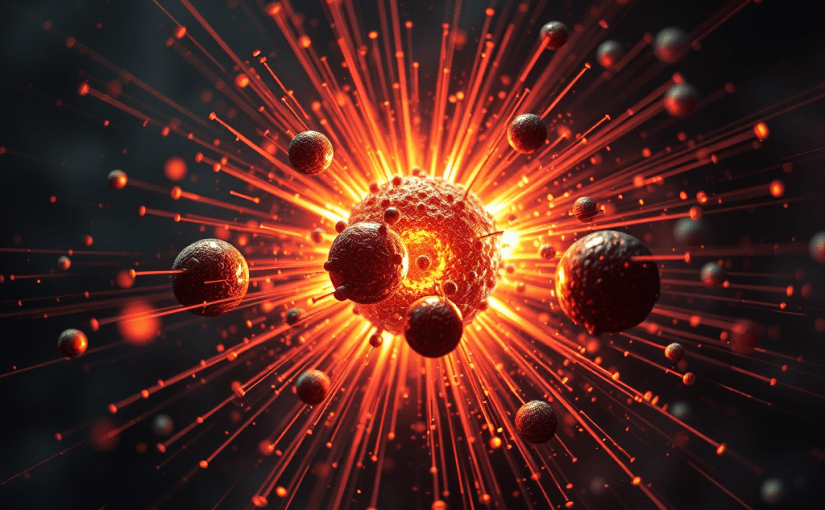
In the quantum realm, when matter encounters its perfect opposite—antimatter—they do not merge, negotiate, or coexist. Instead, they annihilate one another in an instant, releasing a burst of pure energy in the form of gamma radiation. This dramatic event echoes a subtle inner phenomenon within human consciousness. When opposing forces within us—such as ego and truth, desire and reality, or illusion and clarity—collide without harmony, the result is often an explosive surge of emotion, most commonly anger. Yet this anger is not merely destructive; it is a radiant conversion of contradiction into awareness, just as annihilation transforms dense particles into light. At its deepest core, anger becomes the soul’s rage for truth, a force that burns away falsehood, hypocrisy, and self-deception. What seems violent on the surface is, in essence, an alchemical process: a transformation of emotional density into pure insight, much like matter turning into luminous energy.

When elders suddenly prohibit youngers from their actions they become angry as there wrong action collide with the right action. They think elders as source of anger and get annoyed with them. But when they are tactfully guided towards right action, still little anger is produced in them but it’s gradual, controllable and its energy well transformed into right action. In former case they are scolded and prohibited from doing, not guiding them to right action. So their freed energy don’t get channelised but becomes source of anger.

3. Quantum Fluctuation Instability

In the quantum vacuum, energy is never quiet. Even in what appears to be empty space, virtual particles constantly flash into existence and disappear again, creating a ceaseless turbulence. These fluctuations are normal, but when they grow too intense, they disrupt the stability of entire systems. This same principle operates in the human mind. When the manas, the subtle mental field, is stirred by unmet desires or unresolved needs, its energy begins to oscillate restlessly. If this inner fluctuation becomes excessive, it breaks through as irritation or anger. In essence, anger is the restless vibration of energy trying to restore balance, much like unstable quantum fluctuations seeking equilibrium. In yogic terms, such anger can be understood as Kundalini striking against obstructions in the nāḍīs, attempting to clear pathways for a smoother flow of consciousness.

Just as physics describes virtual particles as momentary fluctuations of a quantum field—not real objects popping in and out of existence—anger too is not a real entity inside the mind. It is simply a temporary disturbance in the mental field, a spike of energy created when desire, fear, or resistance disrupt inner equilibrium. Quantum fields ripple when pushed from balance, and the mind-field does exactly the same: a small fluctuation passes unnoticed, but a strong one rises as irritation and, if amplified, appears as anger. In both cases the “thing” is illusion; only a transient pattern exists. The moment the field regains stability, virtual particles disappear back into silence, and anger also dissolves into clarity—revealing that neither ever had solid, independent existence.

Quantum fluctuations and human anger share the same dual nature: both can create or destroy depending on their intensity. In physics, gentle quantum fluctuations seeded the early universe with tiny density variations that later grew into galaxies—creation born from subtle disturbance. But when fluctuations become too strong, they destabilize fields, trigger phase transitions, and can tear apart atomic bonds, as seen in high-energy collisions or during cosmic inflation—destruction born from excess disturbance. The mind behaves the same way. Mild anger can be constructive; it breaks stagnation, energizes action, and helps correct injustice, just as small fluctuations help the universe reorganize into higher order. But intense, uncontrolled anger overwhelms the mental field, breaking relationships, clouding judgment, and damaging the body—just as large fluctuations can collapse stability in quantum systems. In both worlds, small ripples generate growth, while violent waves shatter equilibrium.

A quantum field trapped in a false vacuum and Kundalini caught in obstructed nāḍīs are reflections of the same cosmic principle: energy becomes dangerous only when denied its path. In physics, a field resting in an unstable valley looks calm on the surface, yet holds immense tension beneath; one strong fluctuation is enough to push it out, releasing a burst of energy powerful enough to reshape spacetime itself—as happened in the early universe, or as could occur in a hypothetical false vacuum decay. In the inner universe of the human being, Kundalini behaves no differently. When nāḍīs are open, the rising energy becomes insight, strength, and awakening. But when obstructions hold it down, the same force strikes repeatedly against the blocks, erupting as anger, frustration, or emotional upheaval. The danger never lies in the energy, whether cosmic or human; it lies in the confinement. When the pathway is clear, the energy transforms creation; when blocked, it becomes destruction. Thus, both cosmos and consciousness whisper the same truth: unobstructed flow is harmony, trapped energy is turmoil.

If the early universe had remained trapped or blocked forever in a false vacuum (vaccume with high potential energy like a water filled dam at a height), creation would never have unfolded. A false vacuum carries immense energy, yet its confinement blocks its transition to true vaccume (vaccume with lowest potential energy) needed for matter, atoms, and galaxies to arise, leaving the cosmos as an endlessly inflating but forever empty expanse—a reality suppressed before it can even begin. When the false vacuum transitions to a true vacuum, its excess potential energy is converted into the kinetic energy of quantum fields. This additional motion strengthens the fluctuations within the fields, and these amplified vibrations manifest as quantum particles. The same principle appears within the human being: when life-energy rises and meets a permanent obstruction in the nāḍīs, the resulting anger is not merely a burst of emotion but a sign of trapped potential that cannot evolve. If the blockage never clears, the energy remains frozen, unable to rise into clarity, creativity, or growth. Thus, whether in the vast universe or the inner world, trapped energy does not destroy through violence but through suppression—by preventing higher states of reality from ever emerging. in contrast, if nadis are open, the life energy rushes up and distributed to entire body in low energy form as basic energy form. The excess energy released then becomes available for transformative thoughts and experiences that support growth. But if this surge of high energy remains permanently blocked in the inner channels, it merely expands the time-space of life without forming new ‘particles’ of experience. When such energy cannot express or transform, it often appears outwardly as anger.

I am writing from my own practical experience. There was a time when I used to be angry almost all the time, frustrated with everything and everyone, living in a constant off-mood filled with suppressed anger. In truth, it was not people who troubled me—my energy itself was suppressed, blocked like a dam. I was always in a fighting mode, not for attack but for defence as I had tolerated sudden attacks, and not like a classic wrestler, but like a puncher or knocker, and though I actually fought only two or three times, the aggression had become my inner habit. Because of this constant inner tension, my health began to suffer, and even the so-called “energy boosters” I used only harmed me in the long run. Then, by God’s grace, I met a tantric-type person—fully functional in worldly life yet inwardly deep—who taught me an intuitive, indirect tantric method of channeling energy upward through the backbone. It was more of a mental tantra than a physical one, yet with time it naturally benefited the body as well. When the obstruction in my Kundalini flow dissolved, my anger disappeared instantly. I could laugh, love, and feel intimacy again. That once-trapped energy transformed me, opening beautiful states of awakening and setting me on a path of continuous writing and book creation that still flows today.

Why hide anything from sincere readers? In truth, I simply surrendered to that long-suppressed romantic image — even went clean-shaven like a laughing Buddha in front of it. Lol. It laughed, I laughed, the world laughed, and eventually even life itself laughed. That very surrender opened the back channels on its own. I did no formal practice. The once-suppressed love awakened in the mind with the support of Mūlādhāra energy, rewiring and refreshing my brain enough to bring a complete transformation—rising happiness, renewed clarity, and a successful worldly life. In time, as life and inner maturity ripened, that same love-energy in the form of love-image naturally redirected itself toward the guru-image, deepening through yoga and tantric sādhanā and culminating in awakening.

True and False Vacuum of the Mind: A Scientific Analogy of Dhyāna and Cosmic Quantum States

In deep Dhyāna, two types of mental states are experienced. Both appear like a thoughtless vacuum. During the preparatory phase, the mind first passes through a dull, thick, unstable, and darker vacuum that can be called the individualised false vacuum. Its excess energy is dissipated in the form of fleeting thoughts, which are effortlessly witnessed due to slow and regulated observation of the breath. Because of this witnessing, these thoughts gradually dissolve, and the mind enters a peaceful, thin, blissful, lighter, and low-energy vacuum that appears stable. This can be called the individualised true vacuum. It is possible that this true vacuum draws energy from deeper subconscious layers as the power of Dhyāna penetrates the mind over time.

After about an hour, this calm state again shifts into a heavy, agitated, and high-energy vacuum. This state feels unstable, and a desire to stop Dhyāna naturally arises. However, if one continues sitting, the mind releases its excess energy again through fleeting thoughts, just as the cosmic false vacuum transforms into the cosmic true vacuum by releasing energy in the form of quantum particles through agitated quantum fields. By allowing this process to continue without interference, the mind once again settles into the individualised true vacuum. This cycle of alternating states—false vacuum and true vacuum—can continue repeatedly, as long as one remains in Dhyāna.

I personally observed this during a seven-day Bhāgavatam Katha Śravaṇam. The daily Katha lasted for three hours, and I remained in Dhyāna throughout, witnessing these cycles, each phase lasting slightly less or more than an hour. Such a spiritual environment made it easier to sit effortlessly. In daily life, however, this atmosphere is not present, so after completing one full round in Dhyāna, I usually end the practice when the false vacuum returns due to lack of time and supportive surroundings.

Interestingly, ending Dhyāna while still in the false vacuum allows its excess energy to dissipate into non-dual worldly activities, which makes the next Dhyāna session begin with a faster transition to the true vacuum. If one maintains a non-dual attitude throughout the day, the arising thoughts in the false vacuum are naturally witnessed and dissolved, gradually bringing the mind back to the true vacuum.

However, if a person engages in worldly activities with duality and attachment, or without proper witnessing of fleeting thoughts, one remains stuck in the energetic false vacuum for a long time. In such a case, no spiritual growth occurs, and the energy remains stagnated at a high potential. Although the release of this stored energy into worldly pursuits can temporarily create a brief sense of peace, satisfaction, and fulfilment, the human mind soon fills this space again with physical and mental clutter, returning to the habitual false vacuum. Therefore, the true vacuum must be sustained for a longer duration through spiritual behaviour, otherwise the false vacuum becomes the default state of life.

Upon finishing the task, or during the next sitting, when the practitioner again begins Dhyāna, the light mental vacuum automatically returns for the first hour. This implies that the extra energy contained in the heavy mental vacuum was dissipated through worldly action when done in karmyoga style with the help of nondual darshan like sharirvigyan darshan or quantum darshan. This process resembles cosmic creation, where the false vacuum decays into the true vacuum, and the excess energy is used to produce the universe. The true vacuum is closer to God, the ultimate state of absolute stability. Thus, one may say that creation occurs through inspiration from God. Just as the energy of the mental false vacuum produces dualistic worldly actions, the energy of the cosmic false vacuum decays to create diverse quantum particles by breaking the symmetry of quantum fields and forces.

These vacuums are actually quantum fields. They are never still and always remain in motion. Their lowest state of fluctuation is called the true vacuum, while a higher fluctuation state is called the false vacuum. This implies that the mind is also a quantum field—an inner or individualized quantum field—which never comes to rest, just as it has long been known in philosophy that manas is chanchal (restless).

A time comes in a yogi’s life when even this true vacuum appears to dissolve into a fully motionless mind-field. This is the experience of the Self in its completeness, known as mature Nirvikalpa Samādhi. This experience suggests that there may also be a stage in cosmic devolution when even the last traces of quantum fields disappear. In this sense, the quantum fields dissolve into a baseless, infinite space—also referred to as God.

The same has been described in the Vedas by ancient seers, especially within Vedānta philosophy. Vedānta states that creation emerges again in the same—but reverse—order during cosmic evolution. First Prakṛti or Māyā arises within Paramātman, and from it the universe unfolds in an orderly manner. However, the Sāṅkhya school offers a more “modern” or so called scientific approach by proposing that Prakṛti, or the grand quantum field, is eternal like Puruṣa (Paramātman) and does not dissolve into it. Thus, Sāṅkhya recognizes two primordial eternal realities, while Vedānta accepts only Brahman as the sole eternal principle. However, the Vedānta explanation feels more authentic to me, because it mirrors the inner cosmos just as perfectly as the outer cosmos.

The ancient seers did not observe cosmic events through telescopes, they did not build particle accelerators, nor did they fill papers and books with mathematical formulas. They observed within themselves, and through that inner exploration, they inferred the laws governing the external cosmos.

4. Electrical Discharge (Lightning Analogy)

Lightning is born from imbalance. As electric charge builds up in storm clouds, the difference between cloud and ground becomes too great to contain, and the sky releases its tension in a sudden, blazing discharge that restores equilibrium. The same pattern unfolds within the human psyche. When emotional charge—frustration, desire, insecurity, or pressure—accumulates without release or grounding, it seeks a way out. If not guided, it discharges as anger, sharp words, or destructive behavior, just as lightning strikes indiscriminately. The spiritual lesson is simple: unreleased energy leads to tension, and accumulated tension eventually explodes. But when a person learns to ground awareness, to hold the charge with clarity instead of reaction, the same energy can be transformed rather than discharged blindly. The yogi, therefore, does not waste the bolt outward; he channels it upward, turning raw emotional electricity into illumination.

Once, in a moment of anger toward someone close, I experimented with grounding this emotional charge instead of letting it explode outward. As soon as I drew the rising energy downward, it felt as though the fire in my head dropped into the chest, and the mind instantly became still—like a tense cloud suddenly releasing rain. Yet something remarkable happened: from the chest, the energy flowed into both arms, filling them with an unexpected surge of strength. The impulse to attack vanished, but the vitality remained, as if the body had been prepared for action without aggression. Had there been danger, that same force might have served as powerful self-defense, but since the mind was already calm, it simply settled into the muscles as pure potential. This experience revealed that anger is not merely destructive; when grounded, it transforms into usable strength. The energy does not disappear—it becomes power without violence, readiness without rage.

5. Entropy Increase and Chaotic Reordering

In quantum thermodynamics, every system naturally moves toward greater entropy—toward disorder—and when its balance is disturbed, chaos erupts not as a failure but as a route to a new equilibrium. Disorder becomes the catalyst for reorganization. The same principle operates within human emotion. Anger may appear destructive, yet it often shatters rigid patterns of stagnation, revealing truths we have ignored, confronting boundaries we have tolerated, or dismantling situations we have silently endured. In that sense, Krodha becomes not merely a breakdown but a breakthrough, a force that burns away what has become stale, false, or suffocating. Philosophically, this is Shiva’s Tāṇḍava at work within the psyche—fierce, transformative, purifying. It is the universal law of creative destruction, through which new harmony arises only after the old has been consumed by the fire of change.

For example, when an electron rests quietly in its ground state, it is in a low-entropy, perfectly ordered condition. The moment a photon strikes it, this order is shattered—the electron absorbs the energy, jumps to an excited state, and enters a phase of instability and unpredictability. This brief chaotic state is entropy rising, just as anger breaks the rigid calmness of the mind and throws the inner system into disorder. But the chaos does not last; the electron soon releases the extra energy as a photon and settles into a new stable level. Although order returns, it is never the same as before—the system has emitted energy, interacted with its surroundings, and permanently increased the universe’s entropy. This is the quantum picture of creative destruction: old order breaking, chaos rising, and a new equilibrium emerging, exactly like Krodha functioning as Shiva’s tandava within the psyche. In this sense, entropy is not merely the spread of disorder; it is the universe’s own method of development. What appears as chaos is often a necessary breaking of rigid patterns so that creation can continue in a new form. Just as Krodha functions in the psyche—disrupting the old order so a deeper harmony can arise—entropy, too, serves as the silent architect of evolution, transformation, and renewal.

We often see people living in the same comfortable nest for years. After a while, they become stagnant and even feel it themselves. A desire to rise above that ground level arises—this is kāma. But when someone interferes with their upward movement, anger is produced within them. This anger is like an excited energy state: powerful, but impossible to sustain for long. Eventually, they compromise and settle at a middle level—slightly above their previous base state, yet below the unstable, excited level of krodha. This krodha is beneficial for their transformative development, provided it remains controlled and within human boundaries. Just as an electron does not harm its environment while undergoing its own ‘krodha-like’ excitation, but instead contributes to new formations and growth, a person must use anger constructively. Those who get carried away by the emotion and lose control may take harmful missteps—something that can be avoided through contemplation rooted in the quantum darśana.

In truth, anger often arrives like a friend to support one’s upward movement, but many people misunderstand it—especially when its intensity feels uncomfortable. They see it as an enemy that has come to ruin their life, instead of recognising it as a force that needs tactful handling and redirection for growth. When they resist or suppress it, the pressure only builds instead of reducing. Just as a gun’s barrel is damaged if the muzzle is blocked and the trigger is pressed, suppressed anger can harm the body and mind. What it really needs is redirection—transforming it into love, friendship, courage, or firm positive determination. Anger is a powerful form of energy that can accomplish great things when used wisely, but can cause harm when left uncontrolled. Inside a heater’s element, electrons collide with atoms and push their electrons into excited states. The atoms do not resist this agitation; instead, they safely bring their electrons back down to the ground state of calmness by releasing the excess energy as photons, illuminating the world. In the same way, the excess energy of krodha should light up one’s life with clarity and strength thus lighting the entire world, not create the darkness of inhumanity.

Deeper Understanding

Within the cosmic cycle of forces, three currents continuously sustain existence. Kāma, the impulse to create and unite, corresponds to Brahma, the generator of forms and relationships. Krodha, the force that breaks, resists, and destroys what obstructs harmony, reflects the fierce energy of Rudra, who dissolves what has outlived its purpose. Between them flows Śama, the quiet balance of peace and preservation, expressed as Vishnu, who maintains order and nurtures continuity.

Seen in this light, anger is not an impurity to be suppressed but a sacred movement of Rudra that rises only when dharma—or natural order—is disrupted. It is the impulse of the cosmos to correct imbalance. In quantum language, this same principle governs fields and forces: when energy accumulates unevenly, nature releases it to restore equilibrium. Thus, anger is not merely human emotion—it is a corrective discharge of imbalance, a divine mechanism through which harmony is renewed.

Kundalini Through the Mahabharata – Demystifying the Yoga of the Fifth Veda (Chapter 2)

The Mahabharata is often called the Fifth Veda — written for those unable to study the original Vedas. Veda means “supreme knowledge,” and the supreme knowledge can only be the knowledge of God. In this sense, Yoga too is the same supreme knowledge — the direct realization of the Divine.

So, in a deeper way, the Mahabharata is Yoga expressed in the form of stories. Through social, moral, and mythological narratives, it offers the essence of Yoga to the general public. It is like a sugar-coated tablet — one may taste only the sweetness of the story, yet unknowingly receive the medicine of spiritual wisdom. The reader enjoys the unfolding of events, but deep within, subtle seeds of Yoga are sown, silently preparing the mind for higher realization.

Those who read it with an open heart begin to feel its inner power. Even without knowing, they receive glimpses of Yoga. And gradually, they are propelled toward direct spiritual practice, drawn by the unseen force hidden within its verses.

Through this series, I am trying to demystify the Mahabharata step by step — revealing how behind every event, character, and dialogue lies the play of Yogic principles. I hope readers find this exploration not only interesting but also deeply beneficial for their inner journey.

Kundalini Through the Mahabharata – Demystifying the Yoga of the Fifth Veda (Chapter 2)

Continuing from Chapter 1 in the previous blog, we now progress to Chapter 2.

When Ganga Left and Desire Returned: The Silent Law of Separation

Shantanu had questioned Ganga to save Bhishma from flowing into the conscious ocean. In that moment, ego disturbed the divine energy flow. Ganga had already fulfilled her promise—to leave Shantanu if she were ever stopped from her sacred work. Seven luminous streams, symbolizing the seven chakras, had merged back into her waters; the eighth, Bhishma, she raised herself before returning him to his father. When she withdrew, the flow of Kundalini that once danced freely became a memory of bliss in Shantanu’s being—awareness without movement. Instead, it settled into stillness, carrying within it the silent ache of separation from the divine current.

The Loss of the Divine Flow

Shantanu’s grief was not ordinary. It was the ache of a yogi who once felt the current of Shakti and now feels her absence. The river of consciousness had retreated; prana stood still.
That stillness — though peaceful — carries a hidden danger: in stagnation, desire re-awakens.

Satyavati: The Call of Earthly Nature

From that emptiness rose Satyavati, the daughter of the fisherman, born of river fragrance and clay. She was not Ganga’s pure flow but its earthy echoMaya in tangible form. Fish or fishy means strong ill desire or craving.
Where Ganga rose upward, Satyavati pulled downward, reminding consciousness of its unfinished bond with matter.

When Shantanu longed for her, it was the spirit re-entering the field of duality. Her father’s condition — that only her son may inherit the throne — was not greed but the law of karma: every descent must create lineage, continuity, consequence.

Bhishma’s Terrible Vow

To preserve his father’s longing, Bhishma renounced his own.
That single act became the hinge of Yoga itself — energy choosing duty over desire.
Celibacy here is not denial but containment: the upward redirection of force that once sought union in body now seeks union in consciousness. Bhishma stands as the embodiment of Shantanu’s sexual energy, sublimated after Ganga withdrew. This energy rises upward, becoming holy and pure, giving rise to spiritual qualities such as penance, renunciation, and tolerance and many more.

Bhishma thus stands as retained Kundalini, energy stabilized in awareness. He governs the realm of dharma but never sits on the throne — just as awakened energy rules life silently but never claims ownership.

The Hidden Movement of Consciousness

Ganga’s withdrawal, Shantanu’s longing, Satyavati’s demand, and Bhishma’s vow — together form a single inner event:

  1. Union with the Divine (Ganga)
  2. Loss of Grace and the Return of Desire (Shantanu’s sorrow)
  3. Re-entry into Matter (Satyavati)
  4. Sublimation and Mastery (Bhishma)

Simply put, Bhishma represented the top chakra, while his seven brothers symbolized the lower chakras that were released from emotional bondage as the energy rose through the Sushumna in the form of Ganga. Bhishma himself was not released, because Mother Nature desired that he fulfill many moral and worldly duties in the public interest. Satyavati gave him a further push upward, helping to test and prove his worth. In truth, spirituality flourishes best when balanced with material life, for the latter continually guides the former along the right path. Moreover, the sublimation of energy from the physical to the spiritual plane is aided by materialism itself, since energy or Shakti is fundamentally material in nature.

Each seeker walks through these stages: awakening, loss, temptation, and vow. The river flows on, but its memory becomes the discipline that guides the rest of the journey.

Essence

When Kundalini withdraws, the seeker feels bereft. Yet that loss births Bhishma within — the steadfast awareness that guards the soul’s dharma even amid worldly storms.
Ganga’s absence is not abandonment; it is initiation into responsibility.

In practical life, Nature often grants brief moments of opportunity for spiritual upliftment amidst worldly chaos and duties. These moments invite one to take refuge in Ganga—symbolizing the upwardly sublimated energy of sexual union—which cleanses all the chakras. As the highest chakra begins its perfect purification, worldly temptations appear in the form of Satyavati. At this stage, man forgets to sublimate and raise the sexual energy; instead, he lets it flow downward, like a fishing stream.

The pure awareness established in the highest chakra, though unable to attain liberation, becomes a great worldly saint—like Bhishma. This is Nature’s way of maintaining the balance between worldly existence and supreme knowledge. Ultimately, Nature liberates Bhishma as well, once she is satisfied with his worldly service. After a period of worldly immersion, he again receives Ganga’s companionship and grows spiritually.

Again for some time, he indulges in outward sensual pleasures to test the strength and maturity of his Bhishma-awareness. This cycle continues until man, as Shantanu, becomes old and mature enough to receive Bhishma’s awareness permanently from Ganga, raising it further toward liberation through his yogic wisdom.

An interesting point here is that these mythological figures and stories are eternal, unlike a single human being bound by flesh and a limited lifespan. Bhishma still exists today as the awakened mind, continually nurtured by Ganga as Sushumna— now and forever.

Kundalini and the Eight Vasus: The Secret Descent of Divine Energies

When one reads the Mahabharata through the eyes of Yoga, every myth becomes a mirror of inner evolution.
The story of Ganga and her eight sons—the Vasus—appears as an ancient drama of curse and compassion. Yet within it flows the hidden current of Kundalini Shakti, moving between heaven and earth, spirit and matter.

The eight Vasus were radiant beings of light, guardians of nature’s elemental powers. But once, out of a moment’s desire, they stole the celestial cow Nandini from Rishi Vashishtha’s ashram. The cow was not a mere creature—it was Maya, the wish-fulfilling field of creation itself. By desiring her, the divine energies turned toward possession, and thus, the fall began.

Vashishtha’s curse was not punishment—it was the law of descent. When pure pranic forces seek pleasure rather than purpose, they must enter the limitation of birth. The eight Vasus, once infinite, were destined to experience the density of form.

Ganga, the river of consciousness, took mercy. She agreed to bring them into the world and return them swiftly to her waters.
As she gave birth, each of the first seven sons was immersed back into her flow—symbolizing the seven levels of energy that dissolve into the Source when purified by surrender. These seven represent the seven chakras, released one by one as consciousness ascends beyond them.

But the eighth—Prabhasa, the chief offender—had to remain. He was born as Bhishma, the son who could not be freed. He became the embodied energy, the Kundalini retained—not dissolved, but disciplined. Bhishma’s legendary vow of celibacy mirrors the highest yogic restraint, where desire is transformed into awareness, and energy no longer flows outward but stands still in eternal witnessing.

Thus, in the language of Yoga:

  • The eight Vasus are the eight pranic currents that animate creation.
  • The theft of Nandini is consciousness seeking fulfillment in the external.
  • The curse is embodiment—karma’s necessity.
  • Ganga’s flow is the river of purification, where energies return to their origin.
  • Bhishma is the enlightened awareness that remains in the world but not of it—the realized yogi who lives amidst dharma yet stays untouched.

Kundalini, too, descends and ascends through these very layers. Seven streams rise and merge back into the ocean of spirit; the eighth, the witnessing consciousness, abides on earth as the dharmic flame.

When one reads this story not as history but as inner scripture, Bhishma’s silence on the bed of arrows becomes the silence of the awakened mind—pierced by the arrows of karma yet unmoved by pain, waiting only for the auspicious hour to return to the Eternal Ganga.

Narayana, Ekarnava, and the Inner Cosmic Symbolism of Meditation

Every day, in the depth of meditation, we witness Narayana emerging from Ekarnava—the cosmic sea of consciousness. Ekarnava is not an ordinary ocean; it is the primordial, wave-less expanse, the silent substratum from which all existence arises. It is the state of Nirvikalpa Dhyana, where the mind dissolves and only pure awareness remains. In this inner vision, Narayana appears not as a distant deity but as a sattvik, luminous, and loving presence—beautiful, peaceful, and radiating all divine qualities. His emergence is not from turbulence but from absolute stillness. He symbolizes the liberating force within meditation, an image of cosmic order and divine peace that gently calms the mind.

In this vast ocean of consciousness, Narayana performs a sacred task—he destroys the demons that produce evil ripples in the cosmic sea. These demons are not literal beings but represent chaotic thoughts, restless emotions, and egoic patterns that disturb the stillness of the inner ocean. When the mind is scattered, the cosmic Ekarnava becomes agitated, like a lake troubled by wind. Narayana, in the form of a meditation image, absorbs and dissolves these disturbances, restoring silence and harmony. The practice of meditation thus becomes a cosmic act, where the inner Narayana neutralizes the mental asuras—the vrittis that bind consciousness in cycles of suffering.

The journey into the Ekarnava, or cosmic ocean of formless consciousness, happens through Narayana. The meditator first focuses on the divine form—the saguna aspect—and gradually dissolves even that, entering the wave-less ocean beyond all images. Yet, Narayana himself is like a liberating wave—unlike the binding waves of mental turbulence, he is a gateway wave that carries the meditator into formlessness. On returning from this Nirvikalpa Samadhi, when the mind resumes its worldly functions, Narayana is the first to greet the seeker, symbolizing the return to dharma, compassion, and peace in daily life.

This same cosmic pattern explains why Rama and Krishna are considered avatars of Narayana. They were not avatars only in the theological sense but because their presence naturally became meditation images for millions. Their beauty, serenity, compassionate nature, practicality, spirituality and complete alignment with divine law made them easy objects of dhyana for the masses. People spontaneously visualized them, meditated upon them, and aligned their minds to divine consciousness through their forms. This is why they are called avataras of Narayana—they descended not just to perform earthly tasks but to anchor human minds in sattva and meditative absorption.

In deeper yogic symbolism, Narayana reclining on Sheshanaga in Ekarnava represents the human subtle body. The Sheshanaga (cosmic serpent) symbolizes the spine and the nervous system, with the raised hood representing the Sahasrara (crown chakra). When prana flows through the Sushumna Nadi, the central spinal channel, the breath becomes calm, and the mind enters deep meditation. Only then does Narayana appear in inner vision—resting peacefully on the serpent of the awakened kundalini. The serpent’s hood rising above Narayana is not just mythological ornamentation; it represents the pranic energy feeding the Sahasrara, allowing the mind to expand into cosmic awareness.

This ancient imagery is not mere mythology; it is psychological and yogic science hidden in symbols. When the breath becomes subtle and still, when prana ascends the spine, the mind becomes an ocean without waves—the Ekarnava of consciousness. Narayana is both the gateway and the guardian of this ocean. He destroys the demons of distraction, dissolves into the formless state, and welcomes the seeker back with peace and love when the meditative journey is complete. In this way, the images of Rama, Krishna, and Narayana reclining on Sheshanaga are not distant cosmic tales but direct representations of human spiritual anatomy and meditative experience.

Kundalini awakening as Deepawali and Lord Rama’s yogasadhana as mythological allegory of the epic Ramayana

Shubh Diwali!

Kundalini is Goddess Sita and soul is Lord Rama

Sita is the Kundalini who enters from outside world in the form of a picture of the object through the light entering the eyes. In fact, the Kundalini energy of the body has gone out of the eye. It is also said in the scriptures that the whole personality of a man resides in his mind, which keeps wandering in the outside world by going out through the external senses. Everywhere outside is the kingdom of material defects or Doshas i.e. Ravana, a ten-headed demon. That kundalini power comes in his possession, and cannot escape from his clutches. The living soul i.e. Rama, who resides in the brain, looks helplessly at Sita Shakti wandering in that external world. This is what Jatayu’s brother Sampati ie. a big vulture has to see across the ocean with his sharp eyes and tell her well being to Rama. Then Rama engages in yoga, and associates a lot with the idol of the deity made in a temple, etc. or the guru living there, and pleases him with body, mind and wealth. By this, gradually the impression of the picture of his master deepens in his mind, and there comes a time when that mental picture becomes permanent. This is the start of samadhi or kundalini awakening. This is said as rescuing Sita from Ravana, the king of Lanka, and bring her to city of Ayodhya by crossing the bridge over the sea. The ray of light is that bridge, because through it the physical picture from outside entered the mind. The mind is Ayodhya, in which the soul of Rama resides. No one can fight with the mind, because it is beyond materialism. Very little is known about the mind of others. Everyone can fight with someone’s body, but not with the mind. Its second meaning is also that the mind should be put on the right path only after persuasion and not by coercion or scolding. Even through telepathy etc., it is just a guess. One can never know completely about another’s mind. First of all, the soul of Rama, wandering in the outside world that’s in Ravana’s Lanka, kept seeing his half part that’s Sita Mata from afar. Meaning he didn’t pay much attention to her. Even if he went out, he indulged himself half-heartedly. That is, he did not make enough efforts to bring back the kundalini power. Then, when Rama became very upset by her separation, then he jumped energetically out of his mind in to the outside world. This is what is depicted in the form of his battle with the demons. In fact, the real and lively life is like a war-level struggle and outward facing or extrovert life. It’s Karmyoga, the root and beginning of every meditation. Meaning that he came out of Ayodhya and entered Lanka through the bridge of eyesight. He started working hard in the world with his full heart and with full attention. Meaning that he started looking for Sita in Lanka. Then due to some satsang or good company, divine qualities started increasing in him. Meaning that the practice of Yama-Niyamas of Ashtanga Yoga of Patanjali started by him by itself. This satsang is in the form of friendship between Rama and the demon saint Vibhishana. Due to this, the soul Rama liked something very much, and he was constantly in contact with that one thing. Meaning that Rama’s eyes fell on his dearest Sita, and he began to be engrossed in her love. Meaning that in this metaphorical story, this principle of tantra has also been propounded that a woman that’s wife is the most helpful in yoga. The main purpose of the Puranas is spiritual and transcendental. The temporal purpose is secondary or inferior. But most people get the opposite. For example, they draw from this spiritual myth the same cosmic ethic that one should not cast an evil eye on a foreign woman like Ravana. Although this teaching is also correct, but they either do not understand or ignore the main and basic purpose of Kundalini Yoga hidden in it. Then the position or posture of the body of the soul Rama and the process of breathing itself began to adjust in such a way that maximum attention could be kept on the object of his favorite. Due to this, the development of Yogi Ram reached the asana and pranayama part of Ashtanga yoga. This means that Rama would sometimes stand for a long time to see Sita from afar and secretly, sometimes he would sit this or that way for a long time, sometimes he had to hold his breath for a long time, sometimes he had to breathe very slowly. This was so that the people entangled in the world, the demons of Lanka, would not come to know about this act of meditation or dhyana, so that they would not disturb his attention or meditation. What is actually a material object or a woman, that or she does not even know that someone is meditating on that or her. This is done very cleverly. If she finds out, she will shy away and will not be able to display her varied looks and emotions. Due to this meditation wouldn’t mature, Also, due to the creation of ego due to this, there will be further impairment in meditation. The same happens in the case of Guru as well. Similarly, what does a stone idol standing in the temple know that someone is meditating on it? Because Sita’s picture had occupied most of the space in Rama’s mind, so it had no desire to store unnecessary ambitions and unnecessary things. Due to this the fifth limb of Ashtanga Yoga, Aparigraha itself became manifest. Aparigraha means neither accumulation of unnecessary things nor wanting them. Then in this way, by prolonged practice of these initial five limbs of yoga, the image of that object or woman becomes fixed in the mind of the soul Rama. These are the dharana and dhyana or meditation, advanced limbs of ashtang yoga. You can call it as start of Samadhi or kundalini awakening. It means that Rama rescued Sita from Ravana of Lanka, and carried her through the same ray of light as bridge built on the ocean of atmosphere to the beach of eyes and then to Ayodhya in the form of mind or through Pushpak vimana that’s an classical aeroplane named Pushpak as written in Ramayana. Due to this the ten defects of his senses were destroyed. It is celebrated on the day of Dussehra festival as burning of effigy of Dashanan or ten-headed Ravana. The soul or Rama then practiced tantric yoga for twenty days to provide the final and emancipatory leap or escape velocity to kundalini for its awakening. During that time, he kept on taking picturesque and scenic journeys to reach home. Anyway, meditation along with remembrance of one’s permanent home gives more strength to Kundalini, because Kundalini is also associated with permanent house, as I mentioned in a previous article. Kundalini gets additional strength even from picturesque journeys, that’s why pilgrimage trips have been made. With that all-out effort, his Kundalini was awakened within a short span of twenty days. This is Ram’s reaching Ayodhya that’s the original place of Kundalini. This is the Kundalini awakening. The light of sattvikta that engulfs the mind after Kundalini awakening is depicted as the festival of lights, Deepawali. Because the effect of Kundalini awakening spreads the light of joy by spreading all around in the society, especially in the home, so this is the joint celebration of Happy Diwali festival by the people of Ayodhya.

Kundalini yoga versus nuclear world war

kundalini energy neutralizes the poison drunk by Neelkanth Shiva Mahadeva

Friends, I recently went to a local fair. There I began to look at the dragon train. As soon as I saw its open-toothed mouth, the energy inside me seemed like getting up from Muladhara and revolving around. Though it was mild, it was blissful, almost the same as one feels at the sight of the Shivalingam. The modes of outward expression keep on changing according to prevailing local culture, but the basic thing remains the same. About the same thing, I was telling in the previous post that how the Kundalini energy comes down from the brain and goes to the warrior organs due to anger etc. Due to this, the memory and emotions in the brain become impaired. Emotions consume a lot of energy. That’s why man often falls ill after strong feelings or emotional trauma. You must have heard that such a man fell ill or passed away after losing a dear acquaintance. Philosophy of physiology controls uncontrolled emotions. It should also come as no surprise from the above psychological analysis that by meditating on a dragon or by imposing it on one’s body, the Kundalini energy begins to manifest at various chakras. Perhaps the Wrathful deities of Buddhists also helps Kundalini by the same principle. In fact, this same Kundalini science is hidden behind the ethics that is taught in various religious scriptures. Speak the truth, don’t steal, don’t get angry, talk sweet, be happy and smiling, don’t get attached etc. words seem unscientific to us, but the reason behind them is to save precious energy and make it available to Kundalini, so that she can awaken as soon as possible. Some people saw these ethical words related to health science only, ignoring the spiritual science that’s along with it. When the energy of violent creatures like dragons, lions etc. comes down from the brain, then it first comes on the jaw and neck. That is why with the dreaded and roaring face along with the acrobatic movements of the jaw and neck, they fall on the prey. Then some of the extra energy also goes to the front legs, due to which they hold the prey tightly. When the heart gets tired from these activities, then the extra energy also gets down to the heart. After that the energy reaches the belly, which increases appetite. This makes these even more violent, because from there the energy starts coming back up through the back channel to top and again drops little down to the jaws. When, even after so much effort, the prey starts running away breaking the control, the energy reaches the legs and chases the hunter after it. After a while that energy goes back to the brain, so the hunter gets tired and sits down. Then it doesn’t distort its face to take its energy down because it realizes that it’s not going to be of any use. It gets so much tired that it doesn’t even have the energy to drop energy from brain down. Energy is also needed to drop energy down. That is why at that time it seems calm, compassionate, non-violent and full of virtues like a cow, its memory and good emotions return, because at that time its mind is full of energy. It is a different matter that the energy that has descended from the brain is felt by the animal in the form of darkness, not as a Kundalini picture, because being a lower living entity, it has less brain, and it is not a Kundalini yogi either. In fact, the poison that Shiva had consumed and trapped it in the throat was the energy expressed in the form of the evil spirits of the mind. These evils enter inside the body from bad scenes and words through eyes and ears. When that negative energy of brain reaches the Vishuddhi Chakra, it gets transformed in to positive kundalini energy that remains trapped there for a long time. This is because of the position and texture of the neck. The neck is like the joint of the head and the trunk, which is the most mobile. Just as water or soil present in water pipe gets stuck on the flexible and soft joints located at places in it, in the same way energy remains trapped in the neck. That’s why he neither spewed nor swallowed that transformed poison, it remained trapped in the throat, that is why Shiva is called Neelkanth means blue throated. That is why it is said that one who has perfected the Vishuddhi Chakra, he has perfected many things. In fact, if the Kundalini energy is dropped on any chakra below the neck, then it suddenly turns around again and reaches the brain, and increases the pressure of stress there. However Kundalini energy stays longer at heart chakra, but it tries to return back to brain immediately from naval chakra and chakras below through abdominal contraction. Although it’s than positive kundalini energy, but chances of its converting back to evil thoughts are still there in the brain. Also, the energy can go to warrior organs to make chaos in the society. Shiva can be forced to perform dreadful tandava dance with that energy reaching arms and legs if swallowed. That is why it is kept on the Vishuddhi chakra of the neck. Meaning that if Lord Shiva drinks the poison of stress down from the throat, then it will be sucked from his stomach, and it will reach the brain back after mixing with the blood. Poison or bad feelings reaching the brain means death in the form of darkness of ignorance or evils of mind. Presumably the Kundalini energy reaches the stomach with food, and from there it reaches the brain. Shiva cannot even spew the poison,  because if he spews it outside, it can destroy the living beings. If the maladies of man’s mind come out in the form of abuse, anger, and the evil eye, they will naturally do harm to other people and animals. Due to this, mutual enmity and violence etc. will spread in the society. That’s why people say that such a man got very angry but he drank it. Actually anger is not drunk, it is kept stuck in the throat, by drinking, it will reach the mind again. However, with drinking too with subsequent reabsorption to brain, there is maximum probability of its being transformed to kundalini energy for long time with little extra thoughtful effort. That is why you must have heard many people saying being upset, I have come till my throat or that my breath or life is entangled in my throat. In fact, the weaker section people say this more, because they can neither swallow nor spit out trouble, for fear of being persecuted in return by the people. In fact, one like them is happiest, like the innocent Shankar, because of keeping trouble stuck in his throat. They do not get upset actually, due to proper management of the problem. They are seen as upset by others, because they do not know how to manage the problem. To many people, blue-throated Shiva may seem poor, but those people are poor themselves as they do not understand him. Shiva does not wear poison around his neck out of fear, but out of compassion for all living beings like his own son. Lord Shiva creates the whole creation and takes care of its entire work. So it is natural that his mind would also be filled with stress and depression. That tension does not come out on the world in the form of anger, that is why he keeps the poison of stress around his neck. Because the color of blood is also red-blue, which is a sign of energy, that is why his throat turns blue. He behaves like a great yogi.

Samudra manthan or earth exploitation produce poison in the form of mental defects that is digested or destroyed by great men like Shiva

It is said that the Halahal poison came out during the churning of the ocean. There were many other wonderful things obtained through it. Samudra or ocean means world i.e. earth, churning or manthan means tapping or milking. You are already seeing the majestic things, such as automobiles, computers, airplanes, nuclear reactors etc., countless machines. The same great churning is going on even today. Countless leaders, heads of state, global organizations, scientists and technicians are like ocean churning gods and demons. The entire world is devided in to two parts, one part made of so called demons or dictators, and the second part made of so called gods or Democratic people. No one has the courage to drink the poison that arises in the form of defects of the mind like anger, jealousy, ego etc. That is why the whole world is standing on the verge of nuclear war today. Everyone is waiting that Shiva will come in the form of a great man and drink this poison and save the world from destruction.

Gym exercise is better alongwith yoga

In today’s timeMany news are being heard that such and such artist or celebrity died due to heart attack while doing gym exercise. I think they are already going through a stressful life. This puts a lot of burden on their heart already. Then heavy exercise in a stuffy place like a closed room increases that burden, which leads to a sudden heart attack. First of all, stress should be reduced by yoga. Only after that physical exercise should be done, if needed and whatever is tolerable. Through yoga, energy starts circulating in the nadis. With the help of mutual contact of tongue and palate, it easily descends from the brain to the throat or other lower chakra, especially when there is a feeling in the mind of the philosophy of physiology. Philosophy of physiology reveals the mental kundalini picture, and with it the kundalini energy is taken with it by the attention of the palate-tongue mutual touch, that picture does not increase the pressure of the brain and shines on any favorable chakra through the front channel. Due to this, the Kundalini energy is not wasted in unnecessary conversations instead it strengthens the Vishuddhi Chakra too.

Vishuddhi Chakra as a sink or absorber of brain energy

While bathing in cold water, when the pressure in the brain increases due to the rising energy from below or starts causing a headache, then the energy coming from below starts condensing on the Vishuddhi chakra with the light of kundalini and contraction there. It seems that the lower body is the lower plate of the flour mill, the brain is the upper plate and the Vishuddhi Chakra is the small space in the middle on which the grain is being milled. Or the energy can directly climb to vishuddhi chakra without being noticed in the brain. The one who got the opportunity of bathing in the Ganges every day, was considered the most fortunate, virtuous and great. The proverb “Panchasnani Mahagyani” meaning “five times bathers being the most knowledgeable” also shows the importance of cold water bath. It is not easy to bathe in the icy cold water of the Ganges for five consecutive auspicious days of coldest January month at different shores in holy Haridwar city. There should be a lot of yoga power in a man. But it is definite that the one who has done this, there is a lot of possibility of his Kundalini becoming active. That is why it is said that the one who takes such a bath has nothing rare in the world and the hereafter, not even liberation. Those who take bath with cold water and live in cold places, for the vishuddhi chakra potentiating reason, seem very energetic and expert in conversation. It should be kept in mind that the practice of cold water bath should also be increased gradually like other yoga practices, so that there is no harm to health. One should not take bath on a day when he does not feel like it. Yoga is the name of practice and ease. There is no sudden and forced manner yoga. If there is a lot of fatigue on some day, then better yoga should be practiced slowly and comfortably than not. By this man learns to become a Sahaja Yogi or auto yogi. If one day feels weakness or does not feel liking, then other religious activities can be abandoned on that day, not the basic hatha yoga practice, because yoga is the basic foundation of life being connected with breath or prana, whereas other activities are add on i.e. are extra. What happens is that the feelings and thoughts arising in the mind during the conversation get imprisoned on the Vishuddhi Chakra because at that time the Vishuddhi Chakra is active. When the Vishuddhi chakra is activated again by yoga etc., then those buried thoughts and feelings come out and get destroyed, due to which one feels peace, and the person is refreshed for further new action. It’s just like rotating an empty audio cassette in an audio recorder records sound on it. When that loaded cassette is rotated again in the same way, that muffled sound comes out in the form of a song that we all hear. The same happens on all the chakras. This seems to me to be the huge chakra mystery that appears psychologically resolved with this, which was also being talked about in an old post.

Shree word as a Mahamantra (difference between contemplation and assumption or dhyana versus dharna)

In the hustle and bustle of life, if you cannot pronounce the word sharirvigyan Darshan in your mind, then chant Shree Vigyan or Shiv Vigyan or shavid or only Shree, Kundalini will become active with joy and peace. There is a lot of power in the word Shree, similarly there is a Shree Yantra. Perhaps this power comes from the philosophy of Physiology, because the word Shri seems to be a word derived from the body or sharir in Sanskrit or it’s its abbreviated form. The word Shree seems to me to be the greatest mantra, because it is easy to utter and creates such a unique pressure on body systems, which activates the Kundalini. Probably that is why before addressing someone by name, one puts Shri with it. Also, in start of many holy occasions and activities, shree word is pronounced. Similarly, Shiva is also a word similar to shareer or body, corpse or shava too. That is why a powerless Shiva is also called a shava. In a state of preoccupation or powerlessness, even the mere remembrance of the word “sh” is sufficient to maintain the impression that’s Dharna. In a state of preoccupation or powerlessness, even the mere remembrance of the word “sh” is sufficient to maintain the impression. In the emotional state of mind, remembering it gives special benefit. There is a lot of power in the letter “S” mainly “sh” made of it. That is why the word Shanti meaning peace is formed from the letter Sh. The remembrance of the word ‘Sha’ gives peace and peace is also provided by Kundalini. With the word Sha, Kundalini starts working on the chakras below the brain, mainly the heart chakra. It also gives peace along with pleasure, and also by lightening the burden of the mind, by which the warlike vices of the mind like lust, anger, etc. also get pacified. Similarly, the word shakti is formed from the letter sh, which is synonymous with kundalini. This is the science of Sanskrit language. You must have felt an atmosphere of peace all around after the Sanskrit Mantra Swastivachan. It is sung in a collective form, in which the entire creation is wished well. Why not get the benefit of knowledge even after having it? Because we do not keep the concept (or Dharna in Sanskrit) of knowledge. I am not talking about meditating. Can’t even meditate during busy life. You can make assumptions. There is a difference between perception and attention. Meditation means thinking about it continuously. This consumes energy. Dharana means having faith or belief in it or inclination of thinking towards that. It does not consume energy. When the appropriate time is found sometime in life, the dharana immediately turns into meditation or dhyana and leads to samadhi with little yogic practice. The stronger the dharana and the longer it lasts, the stronger and quicker the meditation will be set. Patanjali has also told in his sutras to attain the level of meditation or dhyana through dharana. Exactly the same happened with me. I used to hold a belief on the Advaita philosophy called ‘Sharir Vigyan Darshan’ but could not meditate due to lack of time and energy. That perception on their availability turned into meditation and ==== you know the rest of the journey (what happens). The concept of Advaita is indirectly the concept of Kundalini, because Advaita and Kundalini try to live together. Meditation, in a direct form, means intentional meditation on Kundalini, in which Kundalini awakening is achieved.

Transformation does not make man forget the old things, but adopts them with a positive attitude

Yoga itself does not do any transformation. This happens indirectly. By taking out the waste of the mind through yoga, the mind becomes empty and refreshed. With this the mind accepts new things. Even in new things, he accepts only good things and habits, because through yoga the virtue of goodness increases, which attracts only good things. Many people would think that after transformation from yoga, a person changes so much that his old friends and acquaintances get separated from him, old memories are erased in his mind, he becomes lonely and so on. But actually that is not the case at all. He has everything in him, but he doesn’t feel the cravings or tingling for them that precedes the transformation. For them there are no vices in his mind, such as lust, anger, greed, attachment and jealousy. This means that even old enemies start seeming to him as friends. If such a transformation happens with everyone, then fights with the worldly beings will end. If this kind of transformation happens to all the countries or heads of state, then wars etc. will be limited to stories.

kundalini shakti is dragon

Friends, in the previous post I was talking about bathing yoga means the Kundalini benefits of cold water bath and Ganga bath. Cold water bath is a complete yoga in itself. In this, Moola Bandha, Jalandhara Bandha and Uddiyana Bandha, the three main bandhas of yoga, are engaged together. However, nowadays the pollution in the Ganges has also increased a lot, and people did not have enough yogic power to withstand the cold water much. I had a middle-aged relative who went with his family to take a bath in the Ganges, and took a long holy dip in the Ganges with the names of each of his relatives. On his return home, he developed a lung infection, which cost him his life. There may have been other reasons too. Nothing can be said for sure without scientific investigation, but it is necessary to say that the water in which so many people are bathing together, and in which unburned or half-burnt dead bodies are thrown, along with the waste water of human settlements and industries, if ingested, it may contain germs that cause infection. Earlier it was not like this or it used to be less, and along with yoga power etc., the immunity of the people was strengthened.

I was also talking about the test of awakening. I’m going to go into some philosophical depth in this paragraph. If readers find it boring they can go ahead if they want. The test of awakening will have the advantage that the awakened person can be made entitled to as many amenities as possible. After awakening, even when the rich facilities will not be able to fascinate him, then only he will recognize the real value of awakening. How will he come to know the importance of awakening by retiring from the world? For him, the importance of those worldly pleasures will remain, whose longing and contemplation he will keep in his mind. A man will understand the importance of sugar only if he eats sweets immediately after eating sugar and he will not feel sweetness in it. If he does not eat sweets immediately after eating sugar, then he will continue to sing praises of sweets, and will consider sugar to be useless. That’s why I believe that immediately after awakening, there should be a flood of worldly comforts in the life of a man, so that he can feel their futility from the heart and then can make other people feel through discourses etc. That is why in the old times, the kings used to return to their kingdom after attaining enlightenment in the forest, and used to spend their future life happily with all the amenities as before, they did not stay hidden in the forest. Perhaps by realizing this truth from the heart, man reaches the pinnacle of self-development, not just by listening. Probably this was also the philosophy of Osho Maharaj. I too, like him, at times run completely contrary to the orthodox beliefs made up, now whether someone calls me a revolutionary or a Satyagrahi. The more appropriate term seems to be ‘free thinker’, because free thought is not imposed on anyone nor is crowd gathered for it, people choose themselves when they like it. It is democratic and peaceful, just the opposite of revolution. Osho Maharaj has explained this difference very well, on which he also has a book. Of course, one who has ever eaten confectionery before, then after eating sugar, by remembering the taste of confectionery, he can guess that the sweetness of sugar is more than confectionery, but the full knowledge of the dullness of confectionery will be known by eating it after eating sugar. Similarly, after awakening, a person can imagine that awakening is greater than all material pleasures, but the direct experience of the dullness of material pleasures will be by drowning himself in the comforts immediately after awakening. Just as if there it is impossible to get sugar again, then a person can eat sweets and remember sugar’s sweetness, and there is no other option, similarly a man can take help of worldly enjoyments to remember his awakening, and there is no other option. So where did this sannyas come from like a flower in the sky? I think sannyas is for one who has become settled in paravairagya means super detachment, that is, after awakening, having enjoyed all the comforts to the fullest, has experienced their dullness, and has become completely detached from them. He has not even the desire for awakening remaining, because like the comforts, awakening is also worldly, and both keep reminding each other. But a lot of caution is needed here, because having even a little sense of importance towards the world can make him a spiritually corrupt person, meaning he can simultaneously be deprived of both worldly and transcendental benefits. Therefore, the best and safest method is Karma Yoga of the householder’s ashram, in which there is no danger in any condition. By taking sannyas in simple dispassion immediately after awakening, he can operate from the old memories of pleasures, but it does not work like direct pleasures, and the yogi’s intellect for pleasures remains.

Far from the comforts, it is said here by many that the man, especially the awakened person, does not need food, only thin air is enough for him. How will this go? The physical truth has to be understood. Actually obesity is not caused by overeating, but by unbalanced diet. All the essential elements are needed in proper quantity for the proper functioning of the body’s metabolism. Due to any deficiency, the metabolism gets disturbed, due to which the food in the body is not able to burn properly, and accumulates and produces obesity. The body is the hearth. The faster it burns, the brighter the life. For many people, Hinduism today means some outward show. It has been understood to be limited to a special and almost virtually unscientific (because the science behind it is not understood) way of eating and living. For some people only those are Hindus who do not use meat and liquor, while for some only those are Hindus who keep distance from sexual intercourse. For some, Hinduism relates to escapism. Similarly, many people have a belief that the more a man non-violent, like a cow, the more Hindutva he has. Yoga and awakening are unnoticed as if going away to take oil. Even most people do not understand the meaning of Kundalini. They consider it as the Kundali means horoscope letter of astrology. Although it is also true that only escapism and decency can save the world, because due to the hyperactivity of humans, this earth is on the verge of destruction. This kind of outward show is in every religion, but because in Hinduism it is over generous and tolerant, so it becomes a weakness, giving other religions unnecessary dominance. If you remain missing from your shop, others will come and sit in it. However, it is worth noting here that the famous yogi Gopi Krishna has written in his book that after awakening, he needed so much energy that he could not survive without some non-vegetarian food. It may also be that different types of people have different types of needs. I was reading a friend’s post on Facebook, who was writing that the habit of blaming one’s own religion, defaming it and leaving it easily or being converted or becoming secular on petty things is the habit of Hindus only and not people of other religions. People of other religions do not blame their own religion at any cost but blame its misunderstanding and mismanagement. That is why many people even say that Hinduism is more threatened by the people of their own religion than the people of other religions. By the way, the goal of this website is not to discuss religion, it was a matter of incident. It has to be accepted that due to the great virtue of the generosity and tolerance of Hinduism, today most scientific research is being done on this religion. Sometimes it becomes difficult to speak or write Dil Ki Baat, which can lead to misunderstandings. Sticking one’s qualities to it permanently also creates misunderstandings. What happens is that the properties keep changing. It may be that a particular quality is more visible in someone or it comes and goes more often than other qualities. The same I have said about some of the above mentioned qualities of Hinduism that they are more visible sometimes, not always. Time calculation is also necessary, to clarify the situation. It may also happen that certain qualities are adopted by only some people of religion and not by others. Therefore, along with religion, it is also necessary to keep an eye on its constituents. Somewhere one particular quality may be more dominant with a religion, while another particular quality in another place. All the virtues are present in all religions, sometimes some are more visible, sometimes others. But the quality which is more visible than the average, is permanently attached to that religion, and with that quality the identity of that religion is attached, which creates religious animosity. That is why it is said that fight evil, not religion; Fight evil, not evil doer. The conditions may apply. If someone looks at me when I’m little bit angry for my jenuine rights, and spreads a permanent impression about me that I am an angry person, then I will feel bad. In today’s world, all religions seem to me to be unbalanced, that is, in an average way. Some religions have more Satoguna, some have Rajoguna, and some have Tamoguna. Some are going north like leftist, some going south like right wing activist, none in the middle. I am telling this from the average point of view, or as different religious leaders express their religion to the world, in fact there are great people in all religions. If all the religions start living together friendly, then this average imbalance will also end, and perfect balance will be established in the whole world. Yoga is balance.

Take for example the dragons of China. It is said that the believer of dragons is a Chinese. But we all adore dragons. It is not associated with any particular country. While bathing in cold water, when the head-mounted kundalini is lowered from the front, there is a rapid warm breath, especially with a jolt outward, as if a dragon is spewing fire. Warm breathing is a common term in love affairs. Mouth opens wide like a dragon or lion, all teeth are visible on the outside, nose and cheeks are pulled upwards, causing eyes to become slightly clenched, body shape also becomes like dragon’s, stomach inwardly Constricted, and the chest expanding and contracting with breath. The movement of the body also feels like a dragon. The dragon is shown to be flying because the Kundalini also reaches any corner of the universe in a moment. The body is the universe itself, the mini-universe. To kill man by dragon means to destroy man’s ego by Kundalini Shakti and take it under its control. What is shown in films, especially in animation films, is how man conquered and tamed dragons, took many tasks from it, sat on it, traveled by air, and took revenge on his enemies, etc., it only shows to achieve various worldly accomplishments with kundalini. Whether there is Kundalini Shakti behind the power of the dreaded animals, it is a matter of psychological research. Perhaps this is the psychological reason behind the face which becomes distorted and scary during anger. Actually the heat generated by the contraction of muscles comes out in the form of hot breath. Now you will say how to bring down the Kundalini from the brain. There is no rocket science in this. Let the brain loose like a child or a dumb deaf, just the Kundalini will come down with a jerky deep out breath and an inward contraction of the abdomen. Although quickly climbs up again. It takes practice to keep the Kundalini down continuously.

The assessment of a man’s face determines his personality

The assessment of a man’s face determines his personality. It’s just a matter of common sense. Arms and legs need strength to compete physically. The total power of the body is limited and determined. It cannot be increased immediately. That’s why the only way left is to give them the power of another part of the body. You cannot reduce the activity of any part too much, because all the organs are connected to each other. You can make a noticeable or decisive lack of power in the brain itself, because it has accumulated a lot of excess energy in the form of extravagant thoughts and feelings. That’s why faces get distorted during anger and fighting, because energy is coming down from it. Even before starting a fight, men do abusive or frivolous debate, so that thoughts and feelings and the thinking power of the mind are obstructed and due to the distorted face, that power comes down to the arms etc. That is why it is seen that even the slightest smile saves miraculously from serious quarrels. Due to this, the power starts returning to the brain, due to which the power of thinking increases and the battle is averted due to lack of power to the warrior organs. That’s why everyone wants to be friends with a smiling and calm person, even if someone smiles in a lie, and everyone runs away from the jealous and tense person.

Kundalini helped by good company and sanskara or culture or rite or sacrament

Friends, I was talking about sacraments or sanskara in the previous post. The more a person delivers the message of good promise or good deed or good conduct to people, the stronger his sanskar becomes on the mind. For this sanskar building, people write blogs, write articles, promote, organize paid or free camps, organize small and big functions, etc. The more crowd he gets, the more successful he is considered. These activities sometimes cost a lot, sometimes they are done cheaply. Many times it would have been done free of cost by the grace of elders and guru people. In this case, I narrate the incident that happened to me related to awakening. In college time, I got a chance to write an article in a magazine by the grace of the teachers. I wrote two or three articles and gave it away, which fortunately got printed on one page. Those articles were related to general physiological philosophy, humanity, religion, love, patriotism, karma yoga, tantra and poetry. I got a new identity from that. It instilled such a deep impression on my mind that I became very active and started making quadruple progress day and night. I feel that after many years of material development, when that seed of sanskar became a tree full of seeds, only then I got a second glimpse of awakening, due to which the creation of the philosophy of body science was completed in the form of a book, many others too. Many books were written, and Kundalini blog writing was also successful to a great extent. Meaning that first I have lived a lot of books in my practical life, later I have brought that life in the form of books and blogs. Not that I was born, and sat down to write. It is an imitation. Real writing is that in which one sees his life coming down on paper. At that time my sexual hormone levels were very high, as is the case with everyone at that age. But I feel that it was too much in me and spiritually special because of the first glimpse of awakening and activated Kundalini thereby. Perhaps this is the reason why the good sanskar has become so firmly established, which seemed desperate to be associated with me throughout my life. I also feel that after the first glimpse of awakening, my old conflict-like childhood had suddenly collapsed in my mind. It cleared my mind like a child, like a new blackboard without writing. Like a child, my transformation was going on, due to which my mind became very receptive like him. That’s why that auspicious ritual created such a positive and everlasting activity in my mind that it later showed me another glimpse of awakening. That is why it is said that children should be given good values. This makes it clear why a cultured teacher who instills good values in children has been given so much importance in the society. First of all, the first teacher is the mother. The effect of the sacraments given by her is the most stable in mind. That is why it is said, ‘ramante tatra devatah, narayasyatra pujyante, means gods live there, where women are revered. Shivaji Maharaj had started receiving rituals from mother Jijabai right from birth (say that from the womb itself), due to which he could protect Sanatan Dharma from the invading Mughals. The effect of samskaras remains on the mind for many births. I had heard and read a thing long ago. An 80 year old woman from Russia started school. When asked how that study would be useful to her, she replied that it would be useful in her next life. Means she was studying for the next birth. She may not have said this by study, but on the basis of her experience and inference etc., because I feel the theoretical dominance of reincarnation is there in Hindu religion only. A healthy society is built from a healthy mind. Healthy mind is made of healthy habits. Healthy habits are formed by a healthy education system. There is a proverb in Hindi, the mouth of a thorn is sharp from the beginning. This means that the personality of any person is known in his childhood itself. That’s why this proverb also shows the importance of rituals.

The above example also implies that it is not necessary that one should rely only on large and expensive ceremonies for the formation of samskaras. However, there remain the best practices in the society with these. The Sanskrit mantras that are uttered every morning also form the sacraments. The power of those mantras is that they create sanskars by having a deep effect on the subconscious mind. Kundalini power is also derived from Sanskrit mantras because while singing them, the breath becomes long, deep, slow and regular. They are in sync with the breath. Some part of the mantra is sung with a long deep breath going in, and some part with a long deep breath going out. In most of the cases, it is sung only with the exhaled breath. Only the attention is paid to the deep breath going in. By concentrating on the breath, more Kundalini-Advaita benefits are obtained. This makes the ritual stronger. Detached meditation on breath and mantra-words would lead to the emergence of non-duality and witnessing. Speaking Chalisa etc. also provide benefits from this psychological principle. By the way, everyone gets some benefit by singing a song. This is the spiritual psychology of singing. When I used to go to my maternal grandmother’s house in my childhood, my maternal grandfather used to call me and my two almost age maternal uncles again and again and reminded me of many such early morning mantras, which I still remember. Vedic Sanskrit creating a universal generosity that depicts real secularism, I will tell you that in this mantra. Saha navavatu sah nau bhunaktou sah viryam karavavahai, Tejasvinavadhitamstu ma vidvishavahai. It means protect us together, means we all protect each other, we all eat together means no one goes hungry or everyone gets employment, we all use force together means we all help each other. The knowledge acquired by us should be full of light of practicality, that means not just bookish, we should not hate each other. This is a very powerful mantra, and if not more then at least it must be recited every morning. When spoken by singing, it sounds more attractive and effective. In this the word ‘Ma’ is particularly influential. Although its meaning is ‘no’, but it also creates the effect of maan i.e. mother on the mind. Due to this the mind becomes naive and receptive like a child. Therefore, while singing, the word Ma should be given elongation and gravity. The famous Indian slogan, ‘Sabka Saath, Sabka Vikas, Sabka Vishwas’ is also this mantra in simple words. There is no doubt that this is an attempt to inculcate good values in the people of the country, which will surely bear fruit in time. Amazing psychology is hidden in Sanskrit mantras. If these are studied deeply, many mystical powers can be found. Being a Vedic mantra, its Sanskrit grammar and meaning is not very clear. Vedic mantras are like this. There is suspense in them. This is so that, of course, it is not understood in the gross, but with its special pronunciation and word formation, it leaves a deep subtle impression on the mind, which is far more powerful than the gross understanding. There is a lot of power in suspense too. Due to this man makes the horse of thoughts run fast, and can easily achieve many destinations. That’s why movies full of suspense are very popular. The above mentioned articles written by me were also full of suspense, that is why many people got so much power from them as I believe. I got it, but I think there are many others too who read it. Those were having double meaning. Two meanings emerged from them, both material and spiritual, civilized and uncivilized, religious and irreligious, sarcastic and serious, critical and analytical. Sometimes vulgarity was seen in them and sometimes tantric psychology. Such was the tinge of the philosophy of physiology with them that all of these contradictory expressions were also visible in them, and together nothing was visible. Everything seemed like a silent sky. That’s why they appeared to me liked by all kinds of people. Also, there was some virtual thrill in them. I feel that the stories of Puranas are very effective because they are full of suspense and thrill. Why did the movie Bahubali become so popular? There was suspense in it from the beginning, which ended at the end of the second part of the film. Thrill was also very much in it and of a virtual or mythological kind. Similarly, there is another mantra, ‘Karagre vasate lakshmi—-‘ etc. It appears pauranik mantra so having clear grammar. Opposed to it, Vedic mantras are like speaking in tongue, that’s why very powerful. It is said after waking up in the morning and looking at the palm. This reminds physiological philosophy, because it creates the experience of the whole universe in the hand, that is, in the body. Many people blame others for their rude conduct. But in reality the fault lies in the lack of good values in them. It is a different matter that the whole society is responsible to some extent for the lack of good values. For not inculcating good values, sometimes the blame is placed on the parents, sometimes on the teachers and sometimes on the family members, friends, relatives etc. and other close acquaintances. However, man himself is also responsible for his sanskars. It is the sanskars of a man’s past lives that decide what kind of sanskars he will receive. That’s why you must have seen that sometimes a person born in a very bad family also becomes a great Mahatma. Actually he does not get attracted towards bad sanskars in his present life because of good sanskars of previous birth, but he runs towards good sanskars, even if they are outside the family. similarly, a man in a well behaved family can go corrupt. There is a lot of meaning in this small saying, ‘Where there are the seeds of acacia sown, how from there one gets mangoes’.

Importance of Sanskars for Kundalini

Material achievements can be achieved even in a short period of time. But it takes a very long time to attain Kundalini. In most of the cases, even a whole life falls short and it takes many births. Who knows the address of the next birth, where to go, how to go. Therefore, efforts should be made that Kundalini be attained in this one human life. This can be possible only through rituals. If one starts giving him Kundalini rites from birth itself, and this process is continued throughout the life, then only this seems possible to happen. This also happened in the ancient Indian Hindu tradition. This is not a false boast. There used to be a temple at every step. Spiritual festivals and fairs used to take place. Spirituality was associated with every activity. People had faith in astrology. Vedic rituals dominated all around. Varnashrama Dharma ie. scientific division of society existed in its best form. Sixteen sacraments were performed for each person. All this was for Kundalini only. All this is Kundalini science, spiritual psychology. When elders used to impart sanskars, then the impression of their personality became deep on the mind of the children. With this, the child grew up to live two lives together, both his own and that of his ancestor. For example, suppose a person gives Kundalini rites to his grandson. By this a good feeling should be created in the grandson’s mind towards his grandfather. Due to this unknowingly, the grandson starts getting the benefit of the life experiences of the grandfather. Meaning that the grandfather is living second life as a grandson without dying, that is, the age of the grandfather has doubled, and the grandson gets twice the age of the grandfather along with his age. With this, the age of the grandson will be considered as three times, that is, 300 years. Now understand that the grandson has done Kundalini yoga continuously for 300 years. With so much time of meditation, it is very possible that he may get Kundalini awakening. The grandson’s real life is only one hundred years old, but he is getting the benefit of three hundred years due to the rituals. This is the reason why confusion arises in the matter of time counting as described in Hindu scriptures. Somebody’s age is said to be 300, some 500 or some thousands of years. Similarly, some do penance for hundreds of years and some for thousands of years. Actually it is not the actual age or time, but it is the benefit of such age or time being received due to the rituals. In the above example, similarly the grandfather lives two ages together, one for himself and one for his grandson. Even if he dies of old age, he still gets the benefit of both the ages of the previous birth in the next life, because of the sanskars. Sharing life with each other is possible only through sacraments or good company. In Hindu spirituality, the Guru tradition is also meant to increase the sanskaras. If one’s guru tradition is going on from 10 gurus, then the sacramental age of the present guru will be considered as 1000 years. Meaning he will get the benefit of 1000 years long Kundalini Yogasadhana automatically. This will happen because every guru has been giving his whole life to his disciple i.e. future guru in the form of sacraments, so that the sanskars keep on increasing. Similarly, if one’s lineage has been going on for 10 generations, then the sacramental age of the person of his present generation will be considered as 1000 years. The more emotional and loving relationship there is with each other, the more will be the benefit of the sacraments. If a family has been living a spiritual way of life continuously for ten generations, then the member of its present tenth generation will be understood to have been living a spiritual way of life continuously for a thousand years, without dying. This means that the more ancient the way of life or tradition, the more is the force of the sacraments in it. In this sense, the Hindu or Vedic tradition is the most powerful, because it is the oldest. If I am decoding Shiva purana then it may mean that I’m getting the sanskara of its author sage little or more through lineage. Sanskars are hidden in the tradition, so we should not allow the tradition to become extinct. Even if it is to be molded according to the age, then its original form should not be tampered with. The famous Chinese philosopher Confucius says that bring newness in such a way that oldness also survives. A man cut by tradition becomes directionless like a kite cut from a string. However, today we find all ancient traditions strange like the above Vedic tradition or way of life. This is because today they have become distorted, not in their original form. Today it has become a pretense or a sham. Today they do not have power. Today we have become very idealistic, due to which we have forgotten our original culture. It is as if the story goes in the Shiva Purana that Lord Vishnu created Buddhist-Jain type monks with shaved heads in order to misguide the Tripurasars named godly demons. They started preaching their illusory religion by preaching pseudo non-violence etc., things against Shivling, Vedas, Yagyas and animal sacrifices given in them. Due to this, the women became sluts. Due to which everyone became powerless. Those monks used to tie a cloth like mask on the mouth, and walked very slowly, so that no ant etc. creature could be harmed. By leaving Shivling worship, everyone turned away from the tantra. Knowing them to be powerless, the gods, knowing a good chance, got those Tripurasars killed by Shiva. Then those Mundi or shaved people went to Lord Narayan and said that your work is done, now you tell where we should go. Narayan instructed them to go to the desert and said that in Kali Yuga or black age, come out and spread in the world. In today’s Kali Yuga, this seems to be true. I will reveal this story in the next post.

The above points prove that Kundalini without sacraments is rare. There is no need to associate the word auspiciousness with sanskars, because it itself means auspicious sanskars. Special words can be added to describe special rites, such as physical rites, rites of cleanliness, etc. Since Kundalini is got through spiritual rites, therefore, in this Kundalini-related website, the meaning of sanskar will be understood as spiritual rites, which is a type of auspicious rites. Bad or inauspicious has to be associated with word  ‘bad’. It can be understood that Kundalini Yoga or other spiritual activities cannot be done easily by the child, but the sanskar can be instilled in him. No one will even know when this seed of sanskar will become a great tree in due course of time. Sanskar is formed by company or good company. Company itself means good company. That is why good company has great glory in spirituality. With the slightest company, countless people, even other living beings, have crossed the ocean of the universe. The scriptures are full of such examples. For example, a crow used to eat prasad or food offering offered at the temple. Due to the influence of company or sanskar, he became a monk in the next birth and became liberated. Any living being or man became spiritually liberated by staying in the company of a monk’s hut, etc. In Vrindavan garden of Lord Krishna, even the flowers and plants got salvation through the company of Lord Krishna. All this is a miracle of sanskar or company. Everything happens itself without doing anything. Like the sacrament, the meaning of company is also understood here to be auspicious or spiritual company. Basically there is no difference between good company and sanskar.

Kundalini Shakti is the vehicle, Sanskara or culture is the driver that guides it~’The Kashmir Files’ movie with its Psychological Analysis 

Friends, this week I saw the movie ‘The Kashmir Files’ on the big screen. This is the first film I have seen which is fully based on true events. Most of such films should be made, so that along with entertainment, social upliftment can also happen. Everyone should see this film. Religious fundamentalism and jihadi brutality have been depicted alive in this film. Together, I even went to a lake for meditation. By the way, I went to remove the daily stress and fatigue caused by worldliness, meditation happened on its own. I sat and lay for a long time on the rocky grass with various body postures and gazed at the lake. I continued to pay attention to the movement of the body, mainly the chest and abdomen, as happening by the attention on in-and-out breaths. Thoughts were coming and going. Various emotions were rising, and dissolving. I was gazing at them as a witness, because my attention was divided on the breath, and also on the wonderful natural scenery around. White birds were flying over the lake. From time to time they would take a slight dip on the surface of the water, and would fly away with their beaks holding something. They were probably small fish. At times with the big fish, the bird was unbalanced and also showed acrobatics. Once a fish fell down from a bird’s beak. He followed it swiftly, again caught it in the water and brought it up and flew away. Scholars have rightly said that Jivo Jeevasya Bhojanam, means living being is the food of living being. A little black bird was sitting on a nearby tree chirping in a sweet tongue, turning around to look here and there and also looking at me, as if making listen something to welcome me, a stranger. I saw my Kundalini as a close and beloved friend in it. I wondered how even such small creatures are so hopeful and positive about life and nature. They too go on their journey of life fearlessly. I began to feel the slight splash sound of the water of the lake hitting the shore as inside me, inside my soul. Let us little remember glimpse of the soul. Nowadays there are a lot of such natural places, where people throng. But such uninhabited though beautiful natural places are rarely found. When many distant people see such places for the first time, they get emotional. Many want to stay there for several consecutive days, day and night by putting up tents to enjoy the fullest of peace. However, I became calm, relaxed and healthy in no time, giving up the idea of making an appointment with the doctor. Well I was talking about the movie ‘The Kashmir Files’. One of the scenes that I found most emotional is that of Anupam Kher as Pushkar, feeling the snow chill of Kashmir in the heat of Delhi. He is telling the truth to his grandson that how his community was being killed and driven away by the jihadi mob while shouting freedom slogans, so he should not be misled by such people’s slogans today. He gets tired of explaining to him as he is old, which makes him tremble. Shaking, turning his eyes around and up, he says in a very soulful voice in the Kashmiri language that it seems that it has snowed in Baramulla, snow has fallen in Anantnag, etc. names of some other high hills too. Then his grandson stabilizes him by hugging him with love and sympathy. I love this way of expressing deep feelings. Kashmiri language is very beautiful, lovely and soulful language anyway. Reviews, discussions and articles about this film will be found everywhere in detail online, because nowadays it is dominated everywhere worldwide. I will throw light on the basic psychological principle associated with it. Like every time, we would like to clarify in this post that we are neither against any religion, nor in favor of any. We are real secular. We seek truth and humanity, wherever it may be found. The one who follows the truth may feel some difficulty in the beginning, but in the end victory is his companion. We explore the psychological element hidden in the core of religion in the form of Kundalini. A major element associated with this is the sanskara or culture or sacrament.

Sixteen Sanskars of Hindu Philosophy

Friends, we would prefer to speak Hindu philosophy instead of Hindu religion, because it seems to me to be a spiritual psychology. Philosophy also seems to me to be a psychology or a science. Its sixteen rites or sanskaras begin as soon as a person is born, and continue till his death. Death is also a sacrament, a funeral. Some spiritual activities are performed at the time of each sacrament. They are made in such a way that they leave maximum effect on the subconscious mind. This leads to the imposition of sanskars on the subconscious mind, like planting a seed in a field. Just as a seed germinates from under the ground and becomes a plant with time, similarly the spiritual rite as Kundalini emerges from the depths of the subconscious mind and emerges in the form of Kundalini activation and Kundalini awakening. Actually sanskar is formed in the form of Kundalini only. Kundalini is the seed, which is injected into the subconscious mind through the ritual ceremony. In this way, good humane teachings also get injected with the kundalini as these become tagged with it. Thus mixture of kundalini and human teachings is the sanskara actually. Kundalini is the carrier and human teachings are the carried. With time, both grows together and make possible existence of kundalini awakening and humanly society together possible. These sanskar ceremonies are performed in a person’s such life stage, when he is extremely sensitive, and the seeds of sanskar sit easily and firmly in his subconscious mind. For example marriage ceremony. I think this is the greatest sacrament, because a man is most sensitive at the time of his marriage. Similarly, the birth-sanskar is also very effective, because at the time of his birth a man was like buried in the depths of darkness. He has come into the light first time, so he is extremely sensitive. The Upanayana ceremony is performed during a man’s adolescence, when he is undergoing transformation due to his sexual hormones. That’s why this stage of man is also very sensitive. Sanskar ceremony is mostly to be done in that state of man, when there is more influence of sexual energy in him, because it gives power to Kundalini. At the time of birth, the sexual energy of the parents is taken support of. Even a small sacrament in the form of ‘desire for awakening’ can eventually lead to Kundalini awakening, because like a seed the sanskar grows with time. This is represented in the Gita by this verse, “Svalpamapysya dharmasya tryate mahato bhayat”, that is, even a little ritual of this religion protects against great fear. The rituals of Kundalini Yoga have been called here as ‘a little ritual of this religion’.

Kundalini acts as a carrier of rites

At the time of the sacrament ceremony, the atmosphere of non-dualism is created through various spiritual processes. With the power of Advaita, Kundalini starts getting stronger in the mind. With the muladhara-residing power of that Kundalini, the mind becomes very sensitive and receptive. In such a situation, whatever education is given, it is well settled in the mind, and even gets lodged in the subconscious mind. The mind is also filled with joy with Kundalini. So whenever a man continues to rejoice, then Kundalini also keeps coming to his mind, and also the teachings associated with it in olden times. In this way those teachings keep getting stronger. Anand and Kundalini live together. Both get their power from the base chakra. It is the nature of the living being to run towards happiness.

Along with shakti or power, good manners are also important

The culture as driver does the work of giving direction to the power as vehicle. In Hinduism, the virtues of tolerance, generosity, non-violence etc. are due to this reason, because in this these qualities are instilled in the mind in the form of sacraments. The religion in which people are taught from birth and even taught every day that their religion is the only religion, their god is the only god, no matter how many evil deeds they do, they will go to heaven, and people of other religions no matter how many good deeds they do, they will always go to hell, and for not accepting their religion, people of other religions should be killed brutally as soon as they get a chance, what else can be expected from them. They misuse Kundalini Shakti, because the inhuman sanskars in their mind keep pushing them on the wrong path with the help of that kundalini  power. Better than this, no rites should be inculcated in the mind, that is, no religion should be considered except human religion. When humans are made, then obviously humanity itself will flourish. Then the human values themselves will start growing in the mind. Buddha says, if you stop planting thorns, flowers will grow on their own. Kundalini Shakti always leads to goodness. But if by force, and even after lakhs of resistance of Kundalini, evils are repeatedly injected inside, then how long will she be able to keep up with it. Friends, a colorful forest full of various herbs grows around the fragrant marigold flower, while poisonous herb like lantana destroys every plant growing all around, and in the end it also gets destroyed. I was reading in Shiv Purana that one who is a devotee of Shiva, his every sin is forgiven. This means that such fanatical religions have emerged from Shivtantra itself. Tantra has many similarities with these. They can also be called extremist tantra. I remember a college time incident related to this. A lone Kashmiri Muslim in the entire hostel. The whole atmosphere seemed to be spoiled by that. Whoever came to mind, beating him. Blind well for flesh and eggs. Wine and slut misused often. Swords were hidden in the room. Expert in making petrol bombs. Once, in front of everyone, he secretly drew a sword from his almirah and put on my neck. I laughed looking at him because I thought he was joking. He too started laughing at the mockery of the fool. Then he put away the sword. An eyewitness friend of mine later told me that I shouldn’t have laughed, as it was a serious mater. I never understood what it meant. Yes, I used to rejoice during that time under the full influence of awakening and Kundalini. This shows how great enemies such religious fanatics are there of real spirituality. Just imagine that when a single Muslim among hundreds of Hindus can create so much disdain, what crime would they not have committed on the minority Kashmiri Hindus by being a majority in Kashmir. It was about the same time. This is the difference between rituals. The power is the same, but the sanskars are different. That is why it is very important to have good values along with power. This is what is shown in ‘The Kashmir Files Film’. This film is constantly setting new records.

Kundalini is the breath, the breath is Kundalini

Friends, the thing that has been written in the previous blog articles that the sage wives who bathed in cold water in cold weather i.e. the six chakras received semen power, it seems to me like the baptism ceremony of Christians. In baptism too, cold water is spilled on the naked body. This opens the chakras, and the circulation of energy improves. At the same time, having a naked body creates a childlike feeling of non-attachment and non-dualism in the mind. This also helps in the transmission of Shakti and the manifestation of Kundalini. I feel like my baptism while bathing every day. This proves that the same principle works behind Yoga and Baptism. Together, it has been written that six sage wives i.e. 6 chakras receiving the virya tej from Agni, who became a pigeon, can also be the remaining six chakras except for the Swadhishthana chakra. That is because the Swadhisthana Chakra itself is a part of that pigeon-turned-Agnidev. In Sahasrar, Advaita Bhava arises from Kundalini. Moon is a symbol of Advaita, because in it both light and darkness are present in equal form. That is why the sun is shown setting and the moon rising. During the same nondual state, Kundalini descends to the Agya chakra and then to the heart chakra. Many yogis consider the heart chakra to be the real chakra. Their experience is that the path towards enlightenment and liberation goes through the heart and not through the brain. I feel like this too many times. The spiritual liberation that is said through love is only through the heart, because love resides in the heart. In any emotional state of mind, Kundalini resides in the heart. It also protects against emotional shock and probably the resulting heart attack in adverse circumstances. That is why it is said to love animals. Animals can recognise kundalini at heart chakra very well. The heart is the controller of the animal, not the brain. It is also because they cannot speak. Therefore, the medium of expression of their mental thoughts is the emotional heart. Take a vow of silence someday and see. Your Kundalini will remain in the heart throughout the day. There is immense glory of silence. The effect of the heart in the cow is superior to that of all the animals, that is why the cow is given great importance in Hinduism. That is why nowadays the practice of living with a cow in the name of cowmmunication has increased. This normalizes the increased blood pressure, and relieves stress. Actually this is done by setting up camp on Anahata Chakra by the Kundalini Shakti. Therefore, Kundalini yoga should always be done. In bad times, Kundalini protects from all physical and mental harm. Many people have a similar experience of Kundalini descending immediately after a glimpse of Kundalini awakening. In this way Kundalini spreads to all the chakras. It is written in such a way that the moon told Shiva that the Krittikas took Kartikeya with them. The Shakh i.e. Ida nadi and Vishakh i.e. Pingala nadi are said to be giving power to Kartikeya i.e. Kundalini Purush, that is also according to my own experience. I feel my Kundalini getting strengthened by Ida and Pingala, just like Sushumna, provided both the nadis remain together or close to each other. When these two are not balanced, then the Kundalini does not go to the Sahasrara, and it remains less on the other chakras, although it may be felt anywhere inside or outside the body. Therefore, it is rarely able to move around in the microcosmic orbit loop. Although her power increases, but she remains sluggish and disorganized, due to which man also remains the same. Perhaps that is why it is said that the technique of Kundalini Yoga Sadhana should be correct, without the technique one should not meditate everywhere. The Kundalini must continue to revolve in the microcosmic orbit loop. It is also widely spread in the spiritual society that Kundalini should not go to Ida and Pingala. Probably this thing has been said for experienced and expert Kundalini Yogi. In fact, it is very difficult for Kundalini to enter directly into Sushumna without these lateral channels in common worldliness. This means, wherever the attention on Kundalini should be focused, it should be applied. After wandering in Ida and Pingala, she always goes to Sushumna. That is why the method of meditation is not shown anywhere in temples and spiritual activities. Only meditation is given importance through idols etc. We have given the analogy of Mount Kraunch to Ajnachakra. The real Kraunch mountain is in Uttarakhand. There is a temple of Lord Kartikeya there. It is said that about 80% of the peaks of the Himalayas are clearly visible from there. There is a dense forest, and natural beauty is scattered all around. Actually there is no difference between the body and the universe. The material creations which are in this body are the same outside as well and nothing else. It is a different matter that their size is small in the body, while it is large in the wider world. Although size is relative, not absolute or real. This theory has been proved by examining the test of science in the book ‘Physiology philosophy or sharirvigyan darshan’. I think first the Puranas were created, then the allegorical and mythological places depicted in them were shown in the external gross world. One of its objectives can be to promote religiosity and spirituality, while the other objective can also be to promote commercial and religious tourism. There are countless examples of such names. Sushumna Nadi is said to be ganga river in Puranas metaphorically, but in folk it is shown as a real river originating from Uttarakhand. The meaning of being liberated by bathing in the Ganges is that when the Kundalini energy flowing in the Sushumna nadi is received by the soul living in Sahasrar, then it becomes pure by washing away its sins, which leads to liberation. But the common people took it as an ordinary physical river. People lined up to take a bath in it. Although little indirect benefits are obtained from spiritual symbols, but they cannot give direct and conspicuous benefits like the benefit obtained by bathing in the Sushumna Nadi. Just as the Sushumna travels in the middle of the body, the Ganges river also flows through the middle of the Indian landmass. Just as the Sushumna connects the whole body with the brain, the Ganges river connects the entire Indian landmass with the Himalayas. That is why the Himalayas are called the head of the country. The Sahasrar or Kailash is present in the Himalaya. The Sahasrar form of Kailash is also present in the head.

To testify about Kartikeya before Shiva by the deities is to experience the movements of the body by the soul


To observe your body carefully is to convene a meeting of the deities by Shiva. I have unintentionally described such a gathering in my book sharirvigyan Darshan. I think I used to have a deep knowledge of Shiva Purana in my previous life. In this birth I had never read Shiva Purana, then how did it match my book exactly, although the book Physiology Philosophy is considered modern and scientific . Or, taking pity on the wandering human civilization, it should be the command or inspiration of Shiva that the knowledge given by him now seen endangered should be revived. It may also be that the culture of my family has been imposed on me since my childhood, because I remember that my grandfather loved Shivpuran very much, and used to read it specially. Coming to metaphoric story, then it is for the soul to come to know about the reality that is as if the deities have to make Shiva aware of the situation. It is theft of not to bring that radiance of semen into the experience of the soul in the form of Kundalini Purush. Since the semen doesn’t leave the body, the suspicion of its theft goes only towards the deities, who are situated in the body, regulating the whole body. The burning sensation produced by the semen is the curse given by deities to the semen thief. Due to the flush of blood circulation, the organs get life or prana. With the same prana, the respective chakras of those organs become active, due to which the Kundalini also starts shining there. For example, at the time of sexual arousal, the vajra expansion occurs due to the filling of blood in it. Let me state here that the upward creeping of the kundalini-snake is due to the contraction of the vajra after its expansion. Along with this, the Sushumna Nadi of the snake’s shape extending from Sahasrar to Muladhara is meditated upon. The vajra is the tail of that serpent, the pelvic girdle is wide of the serpent, it stands up through the center of the back, its innumerable hoods are spread in the brain, and the serpent ends in the central hood pointing to the agya chakra. After the expansion of the vajra, due to its contraction generated by this meditation, it seems that the snake crawled upwards to reach the sahasrar and with it the Kundalini Purush also starts shining in the sahasrar. If you pay attention to the tail of the serpent that it is touching the agya chakra by climbing up from the front, that means the tail of the serpent is touching its head and making it like a circular ring, then this crawling feeling is more. Then it descends through the front channel from agya chakra. In this way a loop is formed, on which the energy starts revolving continuously with gushing and orgasmic bliss feel. This lasts for few moments then body becomes somewhat tired due to continued spasmodic type muscular contractions. This contraction-like event mostly happens in almost a single, long and unbroken breath. Perhaps that is why the yogi is made to practice pranayama to hold the breath for a long time. Body regains the power to do it properly again after hours of favorable activities or rest. The engorgement of vajra with blood increases the expression of Kundalini on the Swadhisthana chakra and the Muladhara chakra. The same blood is called milk in the metaphor, because milk is made from blood only. Milk is nothing but a kind of filtered blood. It is also called milk because the tantric kundalini goes the most from the mooladhara to the heart chakra. It occurs at the thorax, where the source of milk is also there as the breast. Even in the Ankhing technique of Egypt, the Kundalini travels from the genital to the rear heart chakra. It is then taken from the back to the top through the ankhing loop and rolled over the head and brought back down from the front to the front heart chakra. Probably this technique has scared Kritika. The repeated revolution of Kundalini in the Ankhing Loop means Kartikeya’s assurance to Kritikas and coming to meet her again and again. As soon as the energy is passed through the back to the brain through the back above the muladhara, the Vajra is compressed again to its normal position, and With this the Kundalini also goes up. Then the chakra on which that life force goes, the blood or milk also goes there, following which the Kundalini man also moves. However, on those chakras we do not experience any fluid-borne expansion like the wang expansion, because those areas are located deep and firmly in the body. Sometimes the opposite happens. If the Kundalini Purush is meditated on a chakra, then the power itself rushes there. That is why Kartikeya is called Shanmukhi or six mouthed because it receives nourishment from the prana i.e. milk on the six chakras. Because the blood comes under the control of the water deity, it is said that the water god told that the krittikas breastfeed the newborn child. The authors of the Puranas of the Puranic era were wonderful spiritual scientists. The shivaganas who go to collect Kartikeya from krittikas are tantric actions which pull the kundalini from the chakras towards sahasrar. Those activities can be of simple hatha yoga as contraction-relaxation type or even a vicious type of Panchamakari kriyas, that is why the kritikas are shown to be afraid of them. It is natural that along with the Kundalini, blood circulation also starts going away from there, so they wither and turn yellow, that is, they start getting scared. The repeated return of Kundalini to the chakras from Kundalini yoga is the assurance of Kartikeya to return to his mother again and again. Due to this, they start to swell with new blood circulation, that is, their fear ends.Many people say that their Kundalini is stuck on some chakra, and does not move even if it is run. In fact, when there is no Kundalini, how will it move? Often a weak Kundalini also gets stuck in one place, like a weak man. No one can stop the mighty Kundalini from moving. Kundalini gets extra power from Tantric Panchamkars. Let me tell you the easiest way to express Kundalini. Take deep, slow breaths and keep your attention on it. Let the thoughts of here and there keep coming and going on their own. Do not welcome them, nor disrespect them. Immediately the Kundalini Purush will start being felt on some chakra. Then start moving it as you wish. Let me tell you another but mild way to express the Kundalini Purusha. Look at any bare areas of your body, such as your hands, with the focus of physiology philosophy that’s sharirvigyan darshan. Kundalini will manifest. Kundalini Purush and Kundalini Shakti live together. The mental meditation picture or Kundalini picture is the Kundalini Purush. This is also Shiva. It stays with power or shakti always. Shiva is manifested in full form i.e. in his original form by the flood of Shakti. This is Kundalini awakening. In fact, yogic breathing starts in the above way that’s while meditating sharirvigyan darshan along with looking at hand’s skin. That is how the Kundalini picture is expressed with it. It’s the whole wonder of the breath. Breath is yoga, yoga is breath. When we are attached to a thought, our breath stops. When we start breathing again naturally, attachment disappears and turns into non-attachment. With this, disturbing thought also calms down comfortably. With this, all mental defects like lust, anger etc. also get pacified, because they are the product of distorted thoughts. If attention is paid to the breath, then detachment from the power of Kundalini increases even more.

The yub-yum technique is an important cornerstone of the sexual Tantra

The technique of Yab-Yum is also hidden in the mystical metaphor in the same Kartikeya-Katha. Because it is said in the story that the genital made in the form of pigeon accepts the semen and provide that to the chakras made in the form of sage wives. In them a womb is formed from it, which starts developing into the Kundalini Purush. The same is done in Yab-Yum. In the joint position of yab-yum, this semen light is transferred very rapidly. In this, the male-female pair concentrates on all their paired chakras together. Due to this, the energy of the two Mooladharas falls on all the chakras one by. Due to this, Kundalini Purush appears rapidly there, which starts growing faster and faster. This is a very effective technique of tantra. After applying this technique, it seems that the pressure of the Mooladhara and Swadhishthana chakras and related organs has reduced completely and immediately. In fact, after reach of the semen-tej to chakras from there, Kundalini man becomes prominent there. This is to conceive by sage wives. After a long practice, the sushumna nadi opens up completely. Then that effulgence situated on the chakras immediately rises up through the sushumna and fills the Sahasrara. This is Kundalini awakening or in a lighter way prana rising. This is what the sage’s wives have to offer semen tej along with the womb to the river Ganges. The reed grass that has grown on the banks of the Ganges is to be provided with it, and a child is born on it. This metaphor has been described in detail in some of the previous articles. The main point to be noted here is that Shivling is also a symbol of Yab-Yum. For this reason, worshiping Shivalingam also gives the same benefits as Yab-Yum. What’s more, hatha yoga asanas are also designed to distribute this seminal energy throughout the body, it seems. It is from such direct experience that there is a belief in western countries that yogasanas increase sexual power.

It is clearly written in Shiv Purana that only Karthikeya i.e. Kundalini Purush, born from the semen of Shiva, can kill Tarakasur i.e. spiritual ignorance and get rid of it, nothing else. From this, why not assume that sexual yoga is the basic and main technique for self-awareness, the rest are allied activities. If a select number of people are awakened, it is due to unintentional entry of this sexual energy into the mind. It happens so slowly that they don’t even realize it. So they attribute the awakening to their colorful activities and picturesque beliefs. This is because at the time of their awakening they are associated with those kinds of activities or beliefs. This also gives rise to mutual disputes. Like the blind, some hold the tail of an elephant and tell it to be a real elephant, while some tell the trunk of an elephant as an entire one. No one knows the real elephant. It may also happen that the sexual power of Muladhara can be achieved by one’s specific beliefs or actions, but the man does not express the sexual part of it because of shame. We do not oppose other techniques. But the surprising thing is that the main technique and principle has been made auxiliary or secondary, and the auxiliary techniques are becoming the main. When milk becomes milk and water becomes water, then it is natural that many people will have a clear and scientific awakening, not only a few ones incidentally. Often people are immersed in external rhetoric and metaphors, the real thing is not known. I do not even understand them, and without understanding these mysteries, these appear as stories of some celestial planet. I keep looking on Facebook. Many names of goddesses like Dakini, Kali etc. have been associated with this basic principle. All the sects have given their own names. The basic thing is the same. There is no such thing that people do not know the basic scientific principle of awakening. It is clearly written in the Yoga scriptures that Kundalini resides in Muladhara. Then why run here and there? Why not find the power in the base itself. In fact, it was not considered in a practical form, but as an ornament or a metaphor. The disadvantage of making metaphors was that people did not know what was metaphorical and what was real. Those who understood this, they started taking the help of all other tricks except sexual intercourse to awaken the power of Muladhara. Perhaps this happened due to social hesitation and shame. Women tend to be more ignorant and hesitant about this, whereas in the olden days only women used to be successful tantragurus. On the one hand we believe that Kundalini resides in the Mooladhara and nowhere else, and on the other hand we are denying that intercourse, which is the most direct and powerful action to awaken the power of the Muladhara. It was a strange contradiction. Probably, lack of power or energy was also the reason for this. Due to the society becoming excessively idealistic and non-violent, there was a lack of strength in the body. Lack of potency leads to decreased interest in intercourse. Consumption of eggs can be a reasonable alternative. Egg can be considered a vegetarian food, because it does not contain any violence. Like milk, it is just a byproduct of an animal. It contains all the nutrients in balanced quantity. Egg also increases sexual arousal, so its intake should be right according to the tantra. In today’s developed and scientific era, this sexual hesitation should have reduced. Thanks to science, there is no fear of unwanted pregnancy nowadays. Of course, condoms cannot be used with tantric intercourse, because due to tantric activities, the vajra is continuously compressed and expanded, due to which it can get trapped inside. Without it, there may be an increased risk of transmission of sexually transmitted diseases, such as AIDS. But such a situation does not come because the sexual tantra is accomplished only with one single spouse, that is, the wife. In Tantra, it is forbidden to make other’s daughters and wives as sexual partners. In order to awaken sexual desire, indirect contact or laughter goes on in a civilized manner. Yet there are many contraceptive methods. Hormone pills. However, they have to be taken daily for a long time, which can lead to side effects. Even if there is an accidental ejaculation in the vagina during an unsafe cycle during tantric practice, there are other hormonal drugs to prevent pregnancy, such as Vikalp-72, which does not cause pregnancy if taken within 72 hours after ejaculation. If for some reason it cannot be taken, or in very rare cases, it fails, then there are other hormonal medicines called abortion pills, which, if taken sooner after the missed period, the better the result. There are user friendly minikits available which can detect pregnancy within 2-3 days from the day of missed period. By the way, all these are not needed if sexual intercourse is done during the initial practice of sexual tantra only during safe time. This time is the first seven days and the last 7 days of the menstrual cycle, including the first day of menstruation. In these days, even after ejaculation, pregnancy does not occur, because the egg is not available to the sperms during these days. This time frame is for those in which the cycle period is 28 days, and remains the same and unchanged each time. If the period length is more or less than this, then the safe period is increased or reduced accordingly. If this time is not equal, it can be deceiving. Although no contraceptive method is 100% safe, but all methods combined provide almost 100% protection. Sometimes the preejaculates also have few spermatozoa. But they are often insufficient for pregnancy. Well, mild methods are enough. Complicated methods like copper tee, tubectomy, vasectomy, spaying etc. are mostly not needed. I was reading in an old blog post in which a tantra practitioner was saying that nowadays population and unemployment is high, so sexual tantra can cause problems. Therefore, if you practice the sexual tantra, then do it carefully, and assume that if an unwanted pregnancy happens, then it is good to accept it happily. But in today’s present era all these things have become obsolete. The womb is also formed from the same type of intense sexual energy, which gives awakening. The sluggish and lazy sex cannot lead to pregnancy, neither can awakening be achieved from it. That is why Goddess Parvati was astonished that a pregnancy had to be made from the powerful semen produced by the powerful intercourse of Lord Shiva, that semen could not fail. But where did she get pregnant? Later it is learned that it appeared in the form of awakening in the womb of Sahasrara. From this it is natural that in the olden days people had to abstain from intercourse tantra, because it has full possibility of pregnancy, and due to lack of physical science there was lack of physical contraceptive techniques and knowledge at that time. Such informative things are good only in writing and reading, they are felt with hesitation and shame while speaking and listening. For this reason, in today’s chatting era, it is seen that sometimes even a goddess-like and virtuous woman, from whom speaking and hearing such things cannot be imagined, she does so much obscene chatting on her mobile phone, that the magic of writing begins to be believed even by those who have been a strong opponent of writing.